Want more images or videos?
Request additional images or videos from the seller
1 of 9
Yvonne Jacquette"From World Trade Center: Mixed Heights", Yvonne Jacquette, New York City Scene1997-1998
1997-1998
$18,000List Price
About the Item
- Creator:Yvonne Jacquette (1934, American)
- Creation Year:1997-1998
- Dimensions:Height: 36 in (91.44 cm)Width: 28 in (71.12 cm)
- More Editions Sizes:Unique workPrice: $18,000
- Medium:
- Movement Style:
- Period:
- Condition:
- Gallery Location:New York, NY
- Reference Number:1stDibs: LU1841214453082
About the Seller
5.0
Platinum Seller
Premium sellers with a 4.7+ rating and 24-hour response times
Established in 2022
1stDibs seller since 2022
133 sales on 1stDibs
Authenticity Guarantee
In the unlikely event there’s an issue with an item’s authenticity, contact us within 1 year for a full refund. DetailsMoney-Back Guarantee
If your item is not as described, is damaged in transit, or does not arrive, contact us within 7 days for a full refund. Details24-Hour Cancellation
You have a 24-hour grace period in which to reconsider your purchase, with no questions asked.Vetted Professional Sellers
Our world-class sellers must adhere to strict standards for service and quality, maintaining the integrity of our listings.Price-Match Guarantee
If you find that a seller listed the same item for a lower price elsewhere, we’ll match it.Trusted Global Delivery
Our best-in-class carrier network provides specialized shipping options worldwide, including custom delivery.You May Also Like
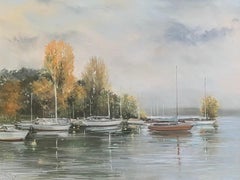
“Creux de Genthod” by Guy Pittet - Pastel on Paper - 65x50 cm
Located in Geneva, CH
**Artwork sold WITHOUT frame**
Guy Pittet (1929–2010) was a Swiss painter and watercolorist celebrated for his evocative depictions of urban and natural scenes, particularly those c...
Category
1980s Modern Landscape Paintings
Materials
Paper, Pastel
$600
H 25.6 in W 19.69 in D 0.79 in
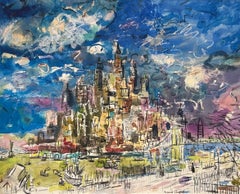
A Dynamic Mid-Century Modern Manhattan Scene, New York City by Francis Chapin
By Francis Chapin
Located in Chicago, IL
A Large, Dynamic 1950s Mid-Century Modern Watercolor of Lower Manhattan, New York City by Noted Chicago Artist, Francis Chapin (Am. 1899-1965). The image is watercolor, pastel and c...
Category
Mid-20th Century American Modern Landscape Paintings
Materials
Watercolor, Archival Paper, Charcoal, Pastel
$1,600
H 24 in W 29 in D 0.13 in
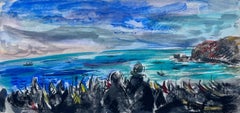
A Colorful, Panoramic Mid-Century Modern View of Nazaré, Portugal by Rudolph Pen
Located in Chicago, IL
A Colorful, Panoramic Mid-Century Modern View of the famed fishing village (and renowned surfing locale) of Nazaré, Portugal by Rudolph Pen. Painted in the 1960s, this vivid waterco...
Category
Mid-20th Century American Modern Landscape Drawings and Watercolors
Materials
Paper, Charcoal, Pastel, Watercolor
$750
H 12.5 in W 25.5 in D 0.13 in
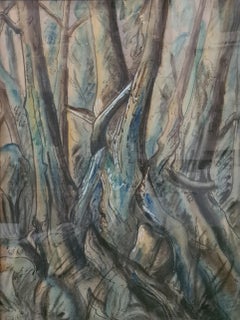
Mid-Century Modernist Watercolour On Paper, Trees At Buckfast Abbey
Located in Cotignac, FR
Early 1960s work on paper of a group of trees at Buckfast Abbey in Devon, England, by Alban Atkins. Signed bottom left, titled and dated to the reverse. There is also a collection or accession number to the backboard.
Atkins has captured the sculptural nature of the tree trunks as they have grown in the landscape giving the work a feeling of living, writhing things as well as an abstract feel in the composition.
Atkins was one of the group of important artists chosen and commissioned by Sir Kenneth Clark...
Category
1960s Modern Landscape Paintings
Materials
Paper, Pastel, Ink, Watercolor
$625
H 30.75 in W 23.25 in D 1.5 in
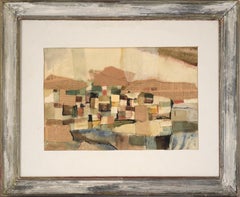
Patchwork Abstracted Landscape
Located in Soquel, CA
Abstracted landscape by an unknown artist (20th Century). The landscape is made up of patches of color, reminiscent of viewing agricultural land f...
Category
Mid-20th Century Modern Landscape Paintings
Materials
Paper, Pastel, Ink, Watercolor, Newsprint, Tissue Paper
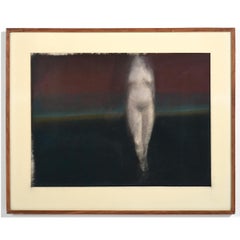
Thom O
Connor Pastel on Paper "The Model #5"
By Thom O
Connor
Located in Detroit, MI
"The Model #5" is a pastel on paper showing a nude female figure emerging from what appears to be an evening darkening mist where a distant landscape is suggested or perhaps she is e...
Category
Late 20th Century American Modern Figurative Paintings
Materials
Pastel, Paper
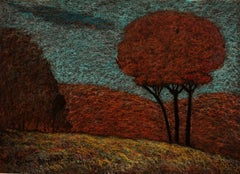
"Autumn"
By Gershon Benjamin
Located in Lambertville, NJ
Jim’s of Lambertville is proud to offer this artwork by:
Gershon Benjamin (1899-1985)
An American Modernist of portraits, landscapes, still lives, and the urban scene, Gershon Benj...
Category
1970s American Modern Landscape Paintings
Materials
Paper, Pastel
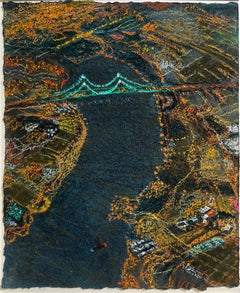
Metropolitan Fantasy - City at Night with Pulsing Lights
By Yvonne Jacquette
Located in Miami, FL
Yvonne Jacquette uses pastel on a heavy rag paper to depict an ariel city scene at night with pulsing lights. There is a heavy texture to the paper and the surface is rich and vibra...
Category
1990s American Modern Landscape Paintings
Materials
Pastel, Rag Paper
$18,000
H 17.5 in W 14.25 in
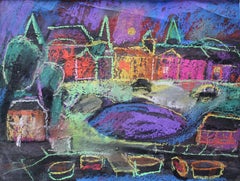
Travel notes Paper, pastel, 19x25 cm
Located in Riga, LV
Travel notes
Paper, pastel, 19x25 cm
The focal point of the artwork is a colorful cityscape, reflecting the artist's impressions and experiences of a particular place during their...
Category
Early 2000s Modern More Art
Materials
Paper, Pastel
$461 Sale Price
20% Off
H 7.49 in W 9.85 in D 0.4 in
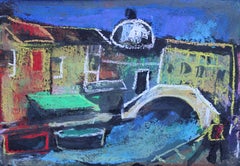
Travel notes 2007. Paper, pastel, 19x23 cm
Located in Riga, LV
Travel notes
2007. Paper, pastel, 19x23 cm
The focal point of the artwork is a colorful cityscape, reflecting the artist's impressions and experiences of a particular place during ...
Category
Early 2000s Modern More Art
Materials
Paper, Pastel
$461 Sale Price
20% Off
H 7.49 in W 9.06 in D 0.4 in
More From This Seller
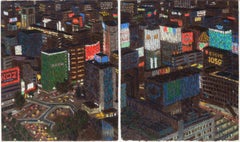
View All"Tokyo Diptych" Yvonne Jacquette, Japanese Urban Cityscape Nocturnal Aerial
By Yvonne Jacquette
Located in New York, NY
Yvonne Jacquette (American, b. 1935)
Tokyo Diptych, 1985
Pastel on paper
Overall 17 1/4 x 28 1/2 inches
Signed lower center
Provenance:
Carey Ellis Company, Houston, Texas
Brooke Alexander, New York
Collection of an American Corporation
Exhibited:
New York, Brooke Alexander, Yvonne Jacquette: Tokyo Nightviews, April 5 - May 3, 1986, n.p., illustrated; this exhibition later traveled to Brunswick, Maine, Bowdoin College Museum of Art, Yvonne Jacquette: Tokyo Nightviews, June 27 - August 24, 1986.
Yvonne Jacquette has a preference for high places, a circling plane, a penthouse window, an aerie from which to watch the world. Her work has often depicted the city and man-made landscape from the vantage of angels. It is a privileged perspective, long loved by photographers, who were perhaps the first to recognize the geometric grandeur of the city below. That grandeur structures Jacquette's images but is not its full content. Her work attempts to resolve the visual and emotional pardoxes of the modern metropolis. Only from the tower is there the possibility of order and context. And unlaced beauty.
Jacquette first visited Japan in 1982. Nighttime Tokyo, its cars and crowds and canyons of loud Vegas neon, made a vivid and bewildering impression on her. The neon signs, pulsing, scaling the walls of high rises, fascinated the artist, "like Times Square spread over miles." Her fascination was equal parts marvel, confusion, and curiosity—the sparks of art. She returned to Tokyo in May of 1985, choosing hotel rooms with expansive vistas. From these views Jacquette excerpted images for a series of pastel night scenes. The basic forms and colors of each drawing were blocked in during night sessions by the window. She worked in the dark, selecting colors by flashlight. In daylight, she sharpened the geometry and corrected ambiguous passages. She refined the drawings further in the studio until the images read clearly. Photographic correctness was not important. The finished drawings are complete statements, not simply preparatory sketches for paintings. They have the authority of expert witness. In clear, discreet jots of pastel they record the performance of seeing, each touch of color attesting to a moment's close scrutiny.
Yvonne Jacquette was born on December 15, 1934 in Pittsburgh, Pennsylvania and grew up in Stamford, Connecticut. She attended the Rhode Island School of Design, Providence from 1952 to 1955, when she moved to New York City. Her late husband was photographer Rudy Burckhardt, and the couple were part of a circle of artist friends that included Fairfield Porter, Alex Katz, Red Grooms, and Mimi Gross. She continues to live and work in New York City, as well as in Searsmont, Maine.
A flight to San Diego in 1969 sparked Jacquette’s interest in aerial views, after which she began flying in commercial airliners to study cloud formations and weather patterns. She soon started sketching and painting the landscape as seen from above, beginning a process that has developed into a defining element of her art. Her first nocturnal painting...
Category
1980s American Modern Landscape Drawings and Watercolors
Materials
Paper, Pastel
"Searsport Harbor Night I" Yvonne Jacquette, Harbor Scene, Urban Landscape
By Yvonne Jacquette
Located in New York, NY
Yvonne Jacquette
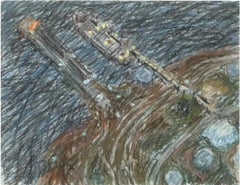
Searsport Harbor Night I, 1982
Pastel on paper
8 1/4 x 11 inches
Yvonne Jacquette was born on December 15, 1934 in Pittsburgh, Pennsylvania and grew up in Stamford...
Category
1980s Modern Landscape Paintings
Materials
Paper, Pastel
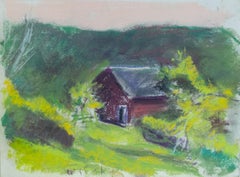
"Summer Studio" Wolf Kahn, Vermont Landscape, Abstract Impressionist, Pastels
By Wolf Kahn
Located in New York, NY
Wolf Kahn
Summer Studio, 2012
Signed lower center
Pastel on paper
9 x 11 1/2 inches
An important member of the second generation New York School, Wolf ...
Category
2010s Abstract Impressionist Landscape Paintings
Materials
Paper, Pastel
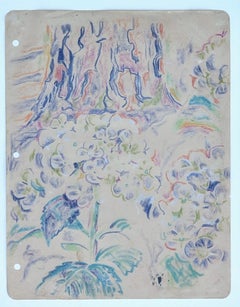
"Hydrangeas, " Walter Inglis Anderson, Mississippi Southern Illustrator, Flowers
Located in New York, NY
Walter Anderson ( American, 1903 - 1965)
Hydrangeas, circa 1950
Mixed media on paper
11 x 8 1/2 inches
Provenance:
Luise Ross Gallery, New York
Private Collection, New Jersey
Acquired from the estate of the above, 2021
Walter Anderson firmly believed that quality art was an important part of life and should be made available to everyone. As he said, "There should be simple, good decorations, to be sold at prices to rival the five-and-ten." Noticing that only poor quality art was available in stores and little was available for children, he resolved to make art which could be reproduced easily and sell inexpensively — linoleum block prints. This technique enabled him to provide affordable, quality art.
The technique of linoleum block printing is a simple concept; however, it requires much skill and talent to actually produce memorable art. Anderson purchased surplus "battleship linoleum," thicker than ordinary linoleum with a burlap backing for better support, to create his blocks. During the mid-1940s, he created almost 300 linocuts working in the attic of the sea-side plantation house, Oldfields, his wife's family home in Gautier. Masses of linoleum chips accumulated at the foot of the attic stairs as he often worked night and day. He began with sketching out a design directly on the linoleum. Once he had carved the image into the surface, he used the back of faded, surplus stock wallpaper that a friend sent him, laying long strips on top of the inked linoleum. A roller made of sewer pipe filled with sand served as his press. When the print was completed, he often colored it by hand with bold strokes and vivid colors. The prints were sold at Shearwater Pottery, the family business, for a mere dollar a foot.
But "what about a well-designed fairy tale for a child's room?" he asked himself. Since there was a lack of affordable art for children, much of his work with linoleum blocks focused on subjects for children. He depicted fables and fairy tales ranging from Arabian Nights, to Germany and the Grimm Brothers' Rapunzel, to the French story of The White Cat, to the Greek tales such as Europa and the Bull, and to tales from China, India, and other cultures. Anderson also created "mini" books featuring the alphabet and Robinson Cat. The blocks are not only alive with the story being depicted, but they are also filled with designs taken from Best-Maugard's Method for Creative Design. Swirls, half-circles and zig-zag lines fill every available space on the linoleum block making them come alive and capture their audience.
But fairy tales, children's verses and the "mini" books, consisting of about 90 blocks, were not the sole subject of Anderson's linoleum block prints. In total, he created approximately 300 linoleum blocks with subjects ranging from coastal flora and fauna, coastal animals, and sports and other coastal activities. Anderson even created linoleum blocks to be used to print tablecloths and clothing, some worn by his own children. Color and subjects of the linoleum block prints were not the only things that got them noticed.
In 1945 when Anderson was creating these prints, the standard size of linoleum block prints was only 12 by 18 inches. These small dimensions were due to the common size of the paper available and the restrictions made by national competitions. Since Anderson used wallpaper...
Category
Mid-20th Century American Modern Landscape Paintings
Materials
Paper, Crayon
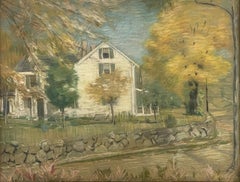
"New England Autumn" Philip Leslie Hale, American Impressionist Landscape House
By Philip Leslie Hale
Located in New York, NY
Philip Leslie Hale
New England Autumn, 1910
Pastel on canvas
25 x 30 inches
Provenance:
Estate of the artist
Sotheby's New York, American Paintings, Drawings and Sculpture, May 24, 1990, Lot 125
R. Anne McCarthy
Rose Art Museum, Waltham, Massachusetts (gift from the above)
Private Collection, Massachusetts
Exhibited:
Philadelphia, The Pennsylvania Academy of the Fine Arts, Tenth Annual Philadelphia Watercolor Exhibition, November 10 - December 15, 1912, no. 13.
Painter, teacher and writer, Philip Leslie Hale is recognized for his decorative paintings of the female figure and for his interior scenes with figures as well as for his progressive approach to painting. However, his career went through several phases that included sporting scenes, figural studies of women including nudes, portraits, and allegorical works reflecting the overwhelming forces of nature.
Of the Boston painters of his time, he seemed the most fully committed to Impressionism, and his technique suggests the influence of French impressionist Edgar Degas. In most of his paintings, the landscape was more important than the figure.
He was a prolific writer in local newspapers and periodicals about the contemporary art scene, discussing the work of his Boston colleagues. He also wrote numerous books on art and art history including a study of Vermeer that was published in 1913. Among his writings are 1892 newspaper columns for Arcadia Magazine titled "Letters from Paris", art criticism for the Boston Herald from 1905 to 1909; and art criticism for the Boston Evening Transcript. He argued for the Boston School of Art as led by Edmund Tarbell whose style was based on Impressionism with elements of Realism, especially figure painting.
Hale was born in Boston in 1865, the son Reverend Edward Hale, a Boston clergyman and a relative of Nathan Hale. He studied with Ellen Day Hale, his sister, and Edmund Tarbell at the Boston Museum School, with J. Alden Weir at the Art Students League in New York City, and then went to Paris for further studies at the Academie Julian and the Ecole des Beaux-Arts. He remained in France for fifteen years, returning to America about 1895. During that time, from 1888, he spent summers at Giverny, France with his good friend, artist, Theodore Butler, and became well acquainted with Claude Monet. Traveling throughout Europe, Hale visited the major museums, and copied the works of Ingres, Vermeer, Watteau and Michelangelo.
Hale married Lilian Westcott Hale...
Category
1910s American Impressionist Landscape Paintings
Materials
Canvas, Pastel
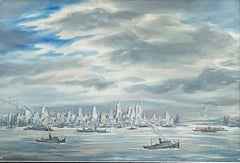
"New York City Skyline View from the East River, " Lionel Reiss, Jewish Artist
By Lionel Reiss
Located in New York, NY
Lionel S. Reiss (1894 - 1988)
New York City Skyline View from the East River
Watercolor on paper
13 x 19 inches
Signed lower left
In describing his own style, Lionel Reiss wrote, “By nature, inclination, and training, I have long since recognized the fact that...I belong to the category of those who can only gladly affirm the reality of the world I live in.” Reiss’s subject matter was wide-ranging, including gritty New York scenes, landscapes of bucolic Bucks County, Pennsylvania, and seascapes around Gloucester, Massachusetts. However, it was as a painter of Jewish life—both in Israel and in Europe before World War II—that Reiss excelled. I.B. Singer, the Nobel Prize winner for Literature, noted that Reiss was “essentially an artist of the nineteenth century, and because of this he had the power and the courage to tell visually the story of a people.”
Although Reiss was born in Jaroslaw, Poland, his family immigrated to the United States in 1898 when he was four years old. Reiss's family settled on New York City’s Lower East Side and he lived in the city for most of his life. Reiss attended the Art Students League and then worked as a commercial artist for newspapers and publishers. As art director for Metro-Goldwyn-Mayer, he supposedly created the studio’s famous lion logo.
After World War I, Reiss became fascinated with Jewish life in the ‘Old World.’ In 1921 he left his advertising work and spent the next ten years traveling in Europe, the Middle East, and North Africa. Like noted Jewish photographers Alter Kacyzne and Roman Vishniac, Reiss depicted Jewish life in Poland prior to World War II. He later wrote, “My trip encompassed three main objectives: to make ethnic studies of Jewish types wherever I traveled; to paint and draw Jewish life, as I saw it and felt it, in all aspects; and to round out my work in Israel.”
In Europe, Reiss recorded quotidian scenes in a variety of media and different settings such as Paris, Amsterdam, the Venice ghetto, the Jewish cemetery in Prague, and an array of shops, synagogues, streets, and marketplaces in the Jewish quarters of Warsaw, Lodz, Krakow, Lublin, Vilna, Ternopil, and Kovno. He paid great attention to details of dress, hair, and facial features, and his work became noted for its descriptive quality.
A selection of Reiss’s portraits appeared in 1938 in his book My Models Were Jews. In this book, published on the eve of the Holocaust, Reiss argued that there was “no such thing as a ‘Jewish race’.” Instead, he claimed that the Jewish people were a cultural group with a great deal of diversity within and between Jewish communities around the world. Franz Boas...
Category
1940s American Modern Landscape Drawings and Watercolors
Materials
Paper, Watercolor
$2,800 Sale Price
20% Off
Still Thinking About These?
All Recently ViewedMore Ways To Browse
Street Dance
Empire State Building Vintage
Alex Katz Red
Rudy Burckhardt
Mimi Gross Grooms
Flower Pond
French Sailboats Art
Geese Painting
Medaille D Argent
Mediterranean Village
Monets Garden Painting
Notre Dame Impressionist
Oil Paintings 1966
Pacific Coast Art
Painting Of Meadows
Portugal Landscapes
Realism Cityscape
Texas Longhorn