Items Similar to An intriguing Lucretia by the Follower of the Master of Female Half Lengths
Want more images or videos?
Request additional images or videos from the seller
1 of 20
Follower of the Master of the Female Half LengthsAn intriguing Lucretia by the Follower of the Master of Female Half LengthsMid 16th century
Mid 16th century
$80,734.05
£59,949.56
€67,500
CA$110,916.48
A$120,588.58
CHF 63,936.20
MX$1,445,551.29
NOK 812,596.31
SEK 744,448.70
DKK 514,566.56
About the Item
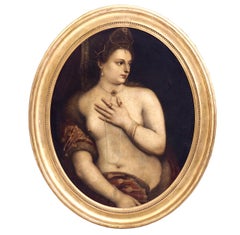
This painting depicting the suicide of Lucretia intrigues us with its strangeness. Although inspired by the artworks of the Master of Female Half-Lengths, it differs from them in its great sensuality and violent lighting. It is certainly the work of a different painter, also Flemish but probably later. The quality of the underlying drawing and the numerous pentimenti visible in the infrared reflectography indicate that this is indeed an original work by an anonymous painter, whom we propose to designate as the Follower of the Master of Female Half-Lengths.
1. Description of the painting
This painting depicts the tragic moment when Lucretia, the wife of Lucius Tarquinius Collatinus (Tarquin Collatin), commits suicide in front of her father and husband to clear her honor after being raped by her husband's cousin (Sextus Tarquin, the youngest son of the King of Rome, Tarquin the Proud).
The young woman's fixed gaze and half-closed eyes evoke both her determination and the numbness that is beginning to overwhelm her as the dagger, already deeply embedded in her solar plexus, is pursuing its deadly path. The few drops of blood visible under her arm foreshadow the hemorrhage that is about to kill her. This hemorrhage is perhaps also metaphorically foreshadowed by the folds of the scarlet cape lined with fur that she has just taken off.
The details of her adornments are finely represented: a gauze veil encircles her hair, a supple gold chain adorns her chest and hugs the contours of her breasts, emphasizing them; a second chain closer to her neck holds an oval pendant adorned with pearls.
The infrared reflectography we had carried out (10th and 11th picture of the gallery) reveals an underlying drawing of great firmness, which establishes most of the anatomical elements with great precision (the drawing of the phalanges is a good example - 12th picture of the gallery) but also shows numerous pentimenti, mainly in the positioning of the chest and the two gold chains.
2. An original artist: the Follower of the Master of Female Half-Lengths
The theme of Lucretia was one that was dealt with extensively by the Master of Female Half-Lengths, as can be seen in the two paintings reproduced in the gallery. The first one (12th picture in the gallery) was sold at Christie's on September 15, 2020 (lot 14), while the second one (13th picture in the gallery) appeared at Duran on June 25, 2020, before being acquired by the De Jonckheere gallery.
The Master of Female Half-Figures is an anonymous artist who was named by the art historian Max Jacob Friedländer after a painting in the Harrach collection in Schloss Rohrau, Austria, which depicts three young women singing and playing musical instruments in an interior . The paintings traditionally attributed to this master, one of the most successful and popular Flemish artists of the second quarter of the 16th century, are now considered to be the product of a workshop active in Antwerp (or Mechelen), specializing in half-length portraits of elegantly dressed young women who are depicted reading, writing, or playing music in intimate domestic settings. These paintings, generally small, were painted in a courtly style like that of Bruges painters such as Adriaen Isenbrandt (c. 1485-1551) and Ambrosius Benson (late 15th century-before 1550).
While the influence of the Master of Female Half-Length is notable, our painting is characterized by an aggressive eroticization of Lucretia's body and a dramatization of the lighting. As demonstrated by infrared reflectography of the work, this panel has been painted by an original artist with great drawing ability, whom we propose to designate as the Follower of the Master of Female Half Lengths.
Significantly larger than the two Lucretia reproduced above, our painting stands out for Lucretia's much rounder breasts and the highly geometric aspect of the overall composition, which is treated in ovals and curves (note the chain holding the pendant, which is placed in line with the hair under the gauze).
We are also struck when looking at this painting by the presence of the shadow cast on the left of Lucretia and by the shadow lines on the left and at the top of the painting. These shadows evoke a harsh, almost cinematic lighting, while creating an effect of depth. Although this same technique is found in several paintings by the Master of Female Half Lengths or his circle, the lighting here is much harsher and the delineation of the cast shadow is abrupt. We illustrate this difference with two works featured in the RKD database: a Virgin and Child attributed to the Master (14th picture in the gallery) and a Saint Mary Magdalene Writing (15th picture in the gallery).
It is interesting to note that the pompom on the cushion on which Saint Mary Magdalene is seated is very similar to the one that appears in the lower right corner of our Lucretia.
3. Framing
Our painting had been thinned (before the stamp was affixed and therefore probably in the first third of the 19th century) and fixed to a wooden backing which was removed to allow the panel to regain its natural curvature. The joints between the different planks that make up the panel were reinforced where necessary with small wooden pegs, as can be seen in the 8th picture in the gallery. We chose to frame this painting with a 17th-century Italian frame made of painted and gilded wood, reminiscent of Flemish frames from the same period.
- Creator:Follower of the Master of the Female Half Lengths (Flemish)
- Creation Year:Mid 16th century
- Dimensions:Height: 30.5 in (77.47 cm)Width: 25.25 in (64.14 cm)
- Medium:
- Movement Style:
- Period:
- Condition:Oil on oak panel Dimensions: 243/8 x 187/8 in (62 x 48 cm) – Framed: 30 ½ x 25 ¼ in (77.5 x 64 cm) Black lacquered and gilded wooden frame – 17th-century Italy Provenance: stamp with intertwined initials JMC on the back (unidentified).
- Gallery Location:PARIS, FR
- Reference Number:1stDibs: LU1568217298652
About the Seller
5.0
Vetted Professional Seller
Every seller passes strict standards for authenticity and reliability
Established in 2020
1stDibs seller since 2021
11 sales on 1stDibs
Typical response time: 1 hour
- ShippingRetrieving quote...Shipping from: PARIS, France
- Return Policy
More From This Seller
View AllDiana and Actaeon, a Mannerist painting after Joseph Heintz the Elder
Located in PARIS, FR
This painting seduced us with its rich colors. Depicting Diana and her companions surprised by Actaeon, it was inspired by an engraving by Aegidius Sadeler II after a painting by Jos...
Category
17th Century Old Masters Nude Paintings
Materials
Oil, Wood Panel
Allegory of Chastity, a drawing attributed to G. Porta with great provenance
Located in PARIS, FR
This magnificent drawing from the Venetian Renaissance intrigues us in many ways. It depicts an allegorical composition whose meaning partly escapes us: a veiled figure seated on a stone bench (which we have identified as Chastity), seems to be turning away from a woman's bust beside her, below which are two rabbits, a traditional allegory of fertility, but also sometimes of lust.
This drawing, executed on blue paper, undoubtedly belongs to the Venetian Renaissance. The inscriptions on the back of the old mounting board indicate the various attributions considered by its last owner, the British painter and art historian Sir Lawrence Gowing. We have retained the attribution to Giuseppe Porta proposed by art historian John Arthur Gere as the most relevant.
We were incredibly fortunate to find a hexagonal frame of a very similar format for this drawing, the upper corners of which were formerly cut (irregularly). This 17th-century Dutch frame comes from an aristocratic collection in Lombardy, and creates a kind of fascinating chase around this Venetian drawing...
Category
16th Century Figurative Drawings and Watercolors
Materials
Chalk
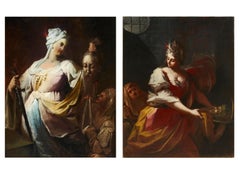
Judith and Salome, a pair of oil paintings on canvas by Francesco Conti
Located in PARIS, FR
This widely referenced pair of paintings is one of Francesco Conti’s most successful productions. Francesco Conti is one of the finest painters of 18th-century Florence. In the shimmering colors typical of his best work, he represents two opposite characters from the Bible: the virtuous Judith, whose courage saves her people by cutting off the head of the invader Holofernes, and the depraved Salome, who under the influence of her mother becomes responsible for the beheading of the prophet John the Baptist.
The artist's talent lies in his ability to treat these two macabre subjects with a light touch, presenting us with two attractive women who seem to twirl with glee amidst the severed heads...
1. Francesco Conti, the “Florentine Tiepolo”
Francesco Conti is a major painter of the Florentine school of the 18th century; he can even probably be considered, along with Giovanni Domenico Ferretti (1692-1768), as one of the two main painters of the second quarter of the Florentine 18th century.
Born in Florence in 1682, Francesco Conti began his apprenticeship in the workshop of Simone Pignoni (1611 - 1698), a disciple of Francesco Furini; he was also influenced by the Venetian Sebastiano Ricci. A protégé of Marquis Riccardi, he accompanied him to Rome between 1699 and 1705, where he frequented Carlo Maratta's studio. He settled permanently in Florence in 1705.
Painted exclusively on canvas, the majority of his work consists of religious subjects, altarpieces or private devotional works. It is likely that Conti himself was a devout churchgoer, as evidenced by his affiliation, in the third decade of the eighteenth century, to the Society of the Disciples of Saint-John-the-Baptist, and his entry, at the end of his life, into the fraternity of the Venerable Society of the Holy Trinity.
In Florence, Conti worked for the Grand Duchy's major patrons, including the last Medici - in particular Giangastone and Annamaria Luisa, Electress Palatine - and confirmed his role as a reference painter under the Lorraine Regency, as master of the Public Drawing School, which was closely linked to the institute responsible for the manufacture of semi-precious stone mosaics, then located in the Uffizi complex.
Matteo Marangoni, an art critic of the early 20th century, praised his "brushwork full of elegance and true spirit of the 18th century", pointing out that Conti was "probably one of the best colorists" of the Florentine school of his time. These two characteristics led the art historian Paolo dal Poggetto to nickname him the "Florentine Tiepolo".
2. Judith and Salome, two biblical characters opposing each other
These two paintings form a pair presenting two biblical episodes, which have in common the depiction of a "heroine" carrying the severed head of a man.
While the Salome episode might at first appear to be an echo of the Old Testament story of Judith, each character is the exact opposite of the other. Judith, whose story is told in the Book of Judith, is a beautiful young widow from Bethulia who, accompanied by her maid, went into the camp of the invading Assyrians and won the confidence of Holofernes, the general commanding the enemy army. Invited to a great feast on the fourth evening, she took advantage of Holofernes' drunkenness to cut off his head. “She went up to the bedpost near Holofernes’ head, and took down his sword that hung there. She came close to his bed, took hold of the hair of his head, and said, “Give me strength today, O Lord God of Israel!” Then she struck his neck twice with all her might, and cut off his head. Next she rolled his body off the bed and pulled down the canopy from the posts. Soon afterward she went out and gave Holofernes’ head to her maid, who placed it in her food bag...
Category
1710s Old Masters Figurative Drawings and Watercolors
Materials
Canvas, Oil
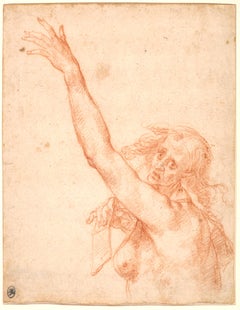
Study of a Fate at mid-body, a red chalk attributed to Giovanni da San Giovanni
Located in PARIS, FR
This spectacular red chalk drawing depicts an elderly woman, her eyes bulging, her hand stretched out towards the sky. This disturbing character, who seems close to dementia, and the elongation of her arm with its Mannerist overtones, plunge us into the Florentine artistic milieu of the first half of the 17th century. The proximity of this drawing to some characters in the fresco in the Pitti Palace representing The Muses, Poets and Philosophers chased from Parnassus, the last masterpiece of Giovanni da San Giovanni, leads us to propose an attribution to this artist and a dating of around 1635-1636.
1. Giovanni da San Giovanni, the painter of contradiction
We take here the title of the monography dedicated to the artist by Anna Banti in 1977, which remains the reference book for this artist. The son of a notary, Giovanni Mannozzi, known as Giovanni da San Giovanni, abandoned his studies to go to Florence at the age of sixteen, where he entered the studio of Matteo Rosselli (1578 - 1650) around 1609 and enrolled in the Academy of Drawing Arts in 1612. Around 1615 he produced his first known works, mainly frescoes for the city's tabernacles. He became famous in Florence for his originality, combining an obsessive application to the study of drawing and the reading of poetry and history with a disheveled appearance. Between 1619 and 1620 he decorated the facade of the Antella Palace in Piazza Santa Croce, a decoration that still partly survives today.
The death of Cosimo II in 1621 put an end to the Florentine building activity and Giovanni da San Giovanni left for Rome to find other sponsors with the painter Francesco Furini...
Category
17th Century Old Masters Nude Drawings and Watercolors
Materials
Chalk
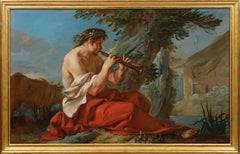
Mercury and Io, a rediscovered painting by Jean-Baptiste Marie Pierre (ca. 1740)
Located in PARIS, FR
We would like to thank Mr. Nicolas Lesur for confirming the autograph nature of the entire composition after a direct examination of the painting on November 27, 2024.
This painting...
Category
1740s Old Masters Figurative Paintings
Materials
Canvas, Oil
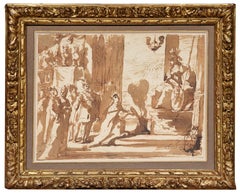
Allegory of the Treaty of Angoulême, a drawing attributed to Donato Mascagni
Located in PARIS, FR
We would like to thank Mrs. Ursula Verena Fischer Pace for suggesting the attribution to Donato Arsenio Mascagni.
We were immediately seduced by the rich tonalities of this allegory...
Category
1620s Old Masters Figurative Drawings and Watercolors
Materials
Ink
You May Also Like
17th Century By Gramatica Cryptoportrait of a lady as The Veronica Oil on Canvas
Located in Milano, Lombardia
Antiveduto Gramatica (1569 – 1626)
Title: Cryptoportrait of a lady as The Veronica
Medium: Oil on canvas
Dimensions: without frame 100 x 74.5 cm - with frame 123.5 x 103.5 cm
Ancien...
Category
17th Century Old Masters Figurative Paintings
Materials
Canvas, Oil
Aristotle Phyllis Spranger 16/17th Century Paint Oil on canvas Old master
Located in Riva del Garda, IT
Bartholomäus Spranger (Antwerp, 1546 – Prague, 1611) workshop
Aristotle and Phyllis
Oil on canvas 64 x 54 cm In frame 79 x 72 cm
The curious subject of this painting, quite...
Category
16th Century Old Masters Paintings
Materials
Oil
$9,702 Sale Price
20% Off
Late 16th Century by Jacopo da Empoli Temperance Oil on canvas
Located in Milano, Lombardia
Jacopo da Empoli (Florence, Italy, 1551 – 1640)
Title: Temperance
Medium: Oil on canvas
Dimensions: without frame 101.5 x 75.7 cm – with frame 140 x 115.3 x 10.50 cm
Expertise by Al...
Category
16th Century Old Masters Figurative Paintings
Materials
Canvas, Oil
$79,801 Sale Price
20% Off
Terwesten Woman Allegory Art Paint Oil on canvas 17/18th Century Old master
Located in Riva del Garda, IT
Mattheus Terwesten (The Hague, 1670 - 1757)
Portrait of a young woman with palette and brushes, as Allegory of the art of Painting
Oil on canvas
160 x 91 cm. - In frame 178 x 107 cm...
Category
17th Century Old Masters Paintings
Materials
Oil
$11,817 Sale Price
20% Off
Fantastic Old Master Painting of Woman, Probably Italian, 1680-1710
Located in Aalsgaarde, DK
Fantastic old master painting of nude woman with pearls, probably Italian, circa 1680 - 1710.
Measures: H. 90 W. 74 cm
H. 35.4 W. 29.1 in.
Category
Antique Late 17th Century Italian Paintings
Venus Paolo Fiammingo Paint Oil on canvas Old master 16th Century Italian Art
Located in Riva del Garda, IT
Pauwels Franck, known as Paolo Fiammingo
(Antwerp, 1540 - Venice, 1596)
Venus lying in a landscape
Oil on canvas 116 x 150 cm.
In antique frame 136 x 170 cm.
The work is accompanied by a critical card by Dr. Federica Spadotto
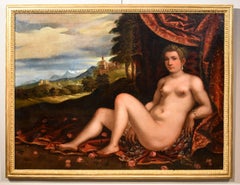
The splendid painting proposed sees portrayed, bare and stretched out on a red brocade cloth in gold sprinkled with roses, a refined and sensual Venus, in a composition with a profound symbolic value, and arriving at the perfect representation of the Renaissance woman who, like Venus, becomes an allegory love, eros, beauty and fertility.
The canvas is part of the prestigious Venetian artistic and cultural environment of the second half of the sixteenth century, whose distinctive distinctive trait can be traced back to its cosmopolitan vocation. This characteristic, as Dr. Spadotto noted in her in-depth study, belongs to the same physiology of the Venetian capital, that is, being a distinctly commercial city located in a strategic point with respect to trade. Representing one of the liveliest ports in the Mediterranean also meant witnessing the continuous passage not only of goods, but of men, ideas, suggestions from distant countries, which influenced not only the taste of their people, but above all art.
This happened thanks to the circulation of prints, as well as pictorial specimens, to which are added the stays of great foreign artists and, above all, the permanence in the capital of a non-negligible number of Dutch, Flemish and German masters.
An emblematic case in this regard comes from Pauwels Franck (Antwerp, 1540 - Venice, 1596), better known as Paolo Fiammingo, who established himself in his native city at a young age - in 1561 a figure enrolled in the Guild of San Luca - and arrived in Venice in 1573. .
He resided in Venice from 1584 until his death, although the stylistic and formal references of some of his works have led critics to believe that in previous years he had undertaken a journey to central Italy, or to Florence and Rome, where he would have metabolized the lively cultural debate that permeated these cities and which, on the other hand, seemed completely absent in Venice.
Here Paolo will be fascinated by the sense of color and by the atmospheric component fixed on the canvas by Jacopo Tintoretto (Venice 1518 - 1594), of which he becomes a collaborator, to undergo, around 1590, the suggestion of Paolo Caliari...
Category
16th Century Old Masters Paintings
Materials
Oil
$30,475 Sale Price
30% Off