Want more images or videos?
Request additional images or videos from the seller
1 of 10
Léon François ComerreLa Baigneuse - 19th Century Oil, Nude Figure by River Landscape by Leon Comerrec. 1890
c. 1890
Price:$7,442
$9,505.99List Price
About the Item
- Creator:Léon François Comerre (1850 - 1916, French)
- Creation Year:c. 1890
- Dimensions:Height: 27 in (68.58 cm)Width: 21 in (53.34 cm)
- Medium:
- Movement Style:
- Period:
- Condition:Very good condition.
- Gallery Location:Marlow, GB
- Reference Number:Seller: LFA05511stDibs: LU41533817822
About the Seller
5.0
Vetted Professional Seller
Every seller passes strict standards for authenticity and reliability
Established in 2001
1stDibs seller since 2016
713 sales on 1stDibs
Typical response time: 5 hours
Authenticity Guarantee
In the unlikely event there’s an issue with an item’s authenticity, contact us within 1 year for a full refund. DetailsMoney-Back Guarantee
If your item is not as described, is damaged in transit, or does not arrive, contact us within 7 days for a full refund. Details24-Hour Cancellation
You have a 24-hour grace period in which to reconsider your purchase, with no questions asked.Vetted Professional Sellers
Our world-class sellers must adhere to strict standards for service and quality, maintaining the integrity of our listings.Price-Match Guarantee
If you find that a seller listed the same item for a lower price elsewhere, we’ll match it.Trusted Global Delivery
Our best-in-class carrier network provides specialized shipping options worldwide, including custom delivery.You May Also Like
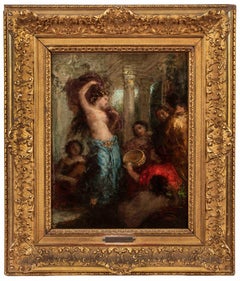
Orientale
By Henri Fantin-Latour
Located in New York, NY
Signed, lower right: Fantin
Provenance:
Gustave Tempelaere (1840–1904), Paris; possibly by descent to his son:
Julien Tempelaere (1876–1961) and with F. & J. Tempelaere, Paris, prob...
Category
1890s Romantic Figurative Paintings
Materials
Canvas, Paper, Oil
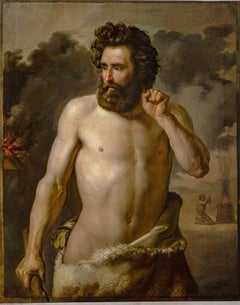
Religious figurative painting male nude 19th century Italian Romanticism
Located in Florence, IT
The painting (oil on canvas 120 x 96 cm, with gilded and carved wooden frame 140 x 116 cm) is signed and dated at lower right in italics "G. Giordanello 1846"
Little is known about ...
Category
1840s Romantic Figurative Paintings
Materials
Canvas, Oil
$41,529
H 55.12 in W 45.67 in
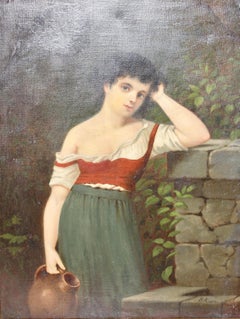
Painting, 19th century, oil on canvas, "Young woman at the well"
Located in Berlin, DE
Painting, 19th century, oil on canvas, "Young woman at the well"
Signed, B. Kern.
Dimensions with frame 61cm x 75cm
Category
19th Century Romantic Figurative Paintings
Materials
Canvas, Oil
$2,610 Sale Price
21% Off
Free Shipping
H 23.63 in W 18.12 in
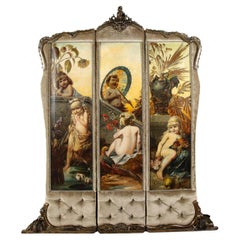
Palatial and Opulent Belle Epoque Giltwood
Oil on Canvas Three-Panel Screen
Located in Queens, NY
A Palatial and Opulent Belle epoque giltwood
oil on canvas three-panel screen, circa 1890.
"Allegory of Youth"
Comprising of three exquisite hand-painted triptych oil on canvas panels of cherubs and putti amongst a peacock, all by Ferdinand Wagner II (German, 1847-1927).
Each panel depicting different playful and joyous scenes of putti and cherubs.
All three-in-one panels within individually carved giltwood and upholstered frames. One panel signed at the lower left: Ferd.Wagner.
A truly magnificent and one of a kind piece, perfect for any room in the home.
Overall: 101" high 85" wide x 5" deep
Very good condition. Ready to place.
Ferdinand Wagner II (German, 1847-1927) was the son of Passau Ferdinand Wagner Senior, a teacher at a vocational art school who began training him professionally at a young age. After traveling to Italy in 1867-1868, he continued with his art studies at The Munich Academy of Arts led by Peter Von Cornelius and Julius Schnorr Von Carolsfeld. Wagner II was influenced by the Munich School of master painters and by his art teacher, Karl von Piloty, who had been teaching at the Munich Art Academy since 1856. Piloty’s approach to historical paintings was influenced by the French art academic Paul Delaroche and by the fine artworks by Rubens and the Venetians.
After his return to Germany he was commissioned to decorate the former the Tenormayer Wine Tavern in Munich, subsequently he received numerous other commissions as a decorator. Ferdinand Wagner II wall paintings and ceiling frescos...
Category
19th Century Romantic Figurative Paintings
Materials
Oil
$86,800
H 101 in W 85 in D 5 in
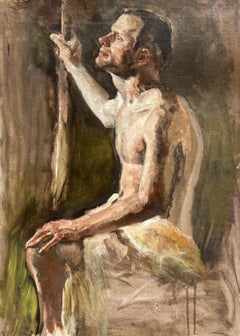
Dreamer (Mid-Century Impressionist European Nude Man Portrait Painting)
Located in New Orleans, LA
A beautiful painting I acquired when I was buying things from Russia and Ukraine maybe 7 or 8 years ago. It's painted on very heavy cardboard, as I'd say the majority from the Soviet...
Category
Mid-20th Century Romantic Figurative Paintings
Materials
Oil
$1,200 Sale Price
20% Off
H 35.5 in W 25.5 in
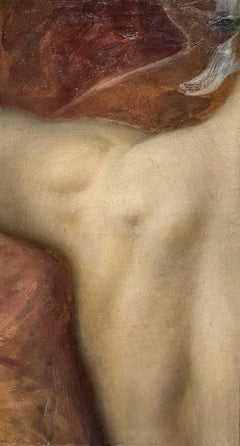
J J A Lecomte du Nouÿ (1842-1923) A shoulder and back study, oil painting
By Jean-Jules-Antoine Lecomte du Nouÿ
Located in Paris, FR
Jean-Jules-Antoine Lecomte du Nouÿ (1842-1923)
A shoulder and back study, oil study
oil on canvas
34 x 19.5 cm
In good condition, a few small inpaintings visible under UV lights
Stamp of the Estate sale in Toulouse on the stretcher
In a modern frame : 40 x 25 cm
Provenance :
Estate of the artist and family of the artist by descent
Estate sale in Toulouse 22 June 1999
This very interesting oil study was part of a set kept by the artist. He had studied fragments of anatomy both to use them as models in large compositions but probably also because he represented so many fragments.
It is clear that this fragment of anatomy has a power of suggestion and serves as a relay to the imagination of the viewer, who is led to imagine the rest of the body taken as a model. We can speak of metonymy in painting and it is clear that the artist had this in mind when he kept such studies with him.
Jean-Jules-Antoine Lecomte du Nouÿ was born on 10 June 1842 in Paris.
Originally of a Piedmontese origin, his family had been settled in France since the fourteenth century and by the time of his birth had reached the status of nobility
He was an Orientalist French painter and sculptor.
He was strongly influenced by the works and teachings of Charles Gleyre and Jean-Léon Gérôme. Lecomte du Nouÿ found inspiration for his art through extensive travels to Greece, Turkey, Egypt, Romania and Italy.
The thematic content of Lecomte du Nouÿ's work was mainly figural, but also spanned over a vast range of imagery throughout his career, including classical, historical and religious.
Lecomte du Nouÿ is known for remaining faithful to his detailed, realistic style throughout the extent of his career, despite the onset of the Impressionist, Fauvist and Constructivist artistic movements during his lifetime. His work is said to have contributed significantly to the establishment of an iconic repertoire representing the Orient in the nineteenth century.A Parisian street was named after him in 1932.
Lecomte du Nouÿ showed a strong attachment to visual art from a young age and was reported to have painted portraits of his father and uncle by the age of 6.
In 1861, at 19 years of age, the artistic talents of young Jean-Jules-Antoine Lecomte du Nouÿ prompted him to become a pupil at the atelier of Swiss artist, Charles Gleyre. Under Gleyre's guidance Jean-Jules-Antoine learned the significance of individualistic style and gained the foundations of creative visual presentation.
Later, Lecomte du Nouy further perfected his knowledge of the artistic form under the mentorship of Jean-Léon Gérôme, who was a renowned painter of the Academicism movement. It was at this time that Jean-Jules-Antoine learned the precision required to depict "la belle nature" —a style of illustration that aims to create the most beautiful representations of the natural form. This later became one of the main techniques employed in Lecomte du Nouÿ's signature artwork.
In 1865, Du Nouÿ accompanied fellow artist, Félix Auguste Clément...
Category
1890s Romantic Nude Paintings
Materials
Oil
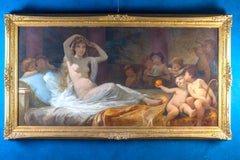
Venus with Putti Oil on Canvas with Gilt-wood Frame
Located in Rome, IT
French 19' century painting oil on canvas . Young Venus nude figure surrounded by delicious playing putti .
Finely carved and gilt-wood frame of the same period .
Measurements w...
Category
Mid-19th Century Romantic Nude Paintings
Materials
Oil
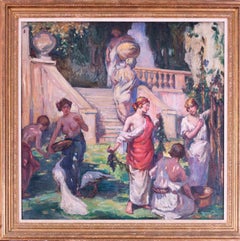
British, early 20th Century oil painting of ladies in a garden
By Sir Frank Brangwyn
Located in Petworth, West Sussex
Attr Frank Brangwyn (British, 1867 – 1956)
An Allegory of Summer
Oil on canvas
32.1/4 x 32 in. (82 x 81.5 cm.)
This richly worked canvas, An Allegory of Summer, depicts elegant figur...
Category
20th Century Impressionist Figurative Paintings
Materials
Canvas, Oil
Woman in Bloom - Figurative Nude Study Oil on Canvas
By Patricia Gren Hayes
Located in Soquel, CA
Woman in Bloom - Figurative Nude Study Oil on Canvas
A nude woman, seemingly pregnant, sits reclined in a chair with her hands at the base of her belly holding a flower. This striki...
Category
Mid-20th Century American Modern Figurative Paintings
Materials
Canvas, Oil
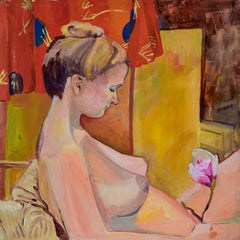
$2,650
H 29 in W 29 in D 0.75 in
Male Nude Figurative Composition - Original Oil Painting on Canvas
Located in Soquel, CA
In this delicate and expressive oil painting, a nude male stands with his backside to the viewer. Notably, the model looks over his left shoulder as his left hand grips the back of h...
Category
Mid-20th Century Impressionist Figurative Paintings
Materials
Canvas, Oil
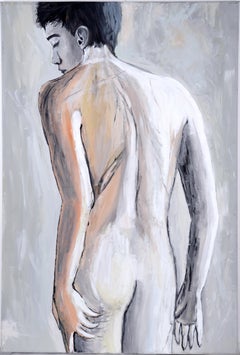
$450
H 36 in W 24 in D 0.75 in
More From This Seller
View AllNu avec des fleurs - Post-Impressionist Oil, Nude
Flowers - Georges D
Espagnat
By Georges d
Espagnat
Located in Marlow, Buckinghamshire
Signed nude oil on original canvas circa 1910 by French post impressionist painter Georges D'espagnat. The work depict a nude woman seated on a stall turned away from the artist. Paintings hang on the wall and there's a vase filled with pink and red flowers on the wooden mantlepiece beside her.
Signature:
Signed upper left
Dimensions:
Framed: 30"x26"
Unframed: 22"x18"
Provenance:
Private French collection.
Exhibition stamp verso
From the beginning of his career, it was a constant concern of Georges d'Espagnet to assert his originality. His studies at the École des Arts Décoratifs, Paris, did not last very long, for he wanted immediate independence and decided to follow courses in the private academies of Montparnasse. In about 1900, he became acquainted with Maurice Denis, Bonnard and Vuillard, and his collaboration with Denis led to a renewal of religious art in France.
In 1903, d'Espagnet was one of the founders of the Salon d'Automne, and was appointed professor in charge of studios at the École des Beaux-Arts, Paris, in 1934. He illustrated a number of books: Rémy de Gourmont's Evil Prayers ( Oraisons mauvaises) (1896), The Saints of Paradise ( Les Saintes du paradis) (1898), Simone (1907), Sistine ( Sixtine) (1922); Alphonse Daudet's The Immortal ( L'Immortel) (1930); André Gide's The Pastoral Symphony ( La Symphonie pastorale); Francis Jammes' Clearings in the Sky ( Chairières dans le ciel) (1948).
D'Espagnet belongs to the group of artists who made the Courrier Français so successful. The drawings of his which are published in it are strongly expressive and some bear comparison with the designs of the great Renaissance masters. He also contributed to L'Image. He often placed cheerful nudes in a landscape, reminding us that, though he moved away from the Fauves, he retained their freedom of colour and arabesque. He painted many portraits, including those of Albert André, André Barbier...
Category
1910s Post-Impressionist Nude Paintings
Materials
Canvas, Oil
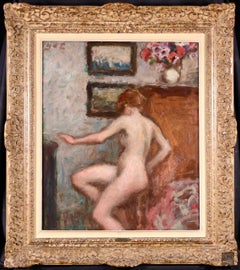
Le Coucher - Post Impressionist Nude in Interior Oil Painting by Pierre de Belay
By Pierre de Belay
Located in Marlow, Buckinghamshire
Signed and dated nude figure in interior oil on canvas by French post impressionist painter Pierre De Belay. This work depicts a painting of Pierre De Belay's wife - Helene. Here she...
Category
1940s Post-Impressionist Nude Paintings
Materials
Oil, Canvas
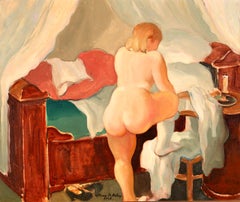
La Baigneuse - Academic Nude Figure in Landscape Oil by Paul Emile Chabas
By Paul Emile Chabas
Located in Marlow, Buckinghamshire
Signed oil on canvas nude figure in landscape circa 1910 by French academic painter Paul Emile Chabas. The piece depicts a nude woman bathing under a tree in a lake. The sky above th...
Category
1910s Academic Nude Paintings
Materials
Canvas, Oil
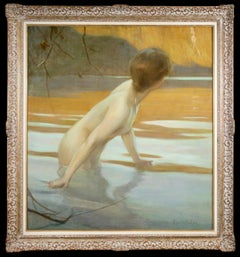
Nu Allonge - Post Impressionist Nude Oil Painting by Paul Elie Gernez
Located in Marlow, Buckinghamshire
Signed and dated nude oil on panel by French post impressionist painter Paul Elie Gernez. The work depicts a brunette nude relaxing on a fur rug, her ...
Category
Early 20th Century Post-Impressionist Nude Paintings
Materials
Panel, Oil
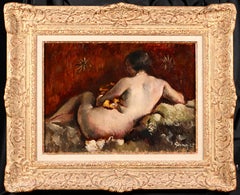
Reverie - Neo-Impressionist Nude Figurative Oil Painting by Georges Lemmen
By Georges Lemmen
Located in Marlow, Buckinghamshire
Signed and titled oil on board nude circa 1905 by Belgian neo-impressionist painter Georges Lemmen. The work titled 'Reverie' depicts a red-haired lady who is kneeling down and resting her head on her arm.
Signature:
Signed lower right and titled on original artist's label verso
Dimensions:
Framed: 16"x19"
Unframed: 10"x13"
Provenance:
Original artists label verso for Georges Lemmen at 96 Avenue Coghen , Brussels
Private collection - Brussels
Georges Lemmen was the son of an architect and studied under Amédée Bourson at the academy in St Joost-ten-Node. He was invited in 1889 to join the Group of Twenty ( Cercle des XX) which had been launched in 1884 by Oscar Maus and had in the interim emerged as an influential force in Belgian artistic circles, not least by bringing to public and critical attention the work of such artists as Georges Seurat and Paul Signac. The Cercle des XX would be reborn in 1894 as La Libre Esthétique.
In the early days of the Cercle des XX, Lemmen espoused a pointilliste technique. His earlier painting was clearly influenced by the Neo-Impressionists; over time, however, his style became more subtle and nuanced - recalling, perhaps, that of his compatriot Van Rysselberghe, another Cercle des XX member. With the group's rebirth as the Libre Esthétique, Lemmen's work became more intimiste in character, most notably in his portraits, nudes and still-lifes, where the influence of Bonnard and Vuillard is unmistakable, as is that of Renoir, particularly after Lemmen's travels in the Midi in 1911. From this point onwards, he would go on to make a major contribution to the renewal of the graphic and decorative arts in terms of his input to the new 'free' aesthetic and to Art Nouveau. Although his draughtsmanship retained its essential purity and elegance of line, his painting became more fleshy, imprecise and sensual, his compositions governed less by technical considerations than by the urgent need to express his emotions.
Between 1889 and 1893, Lemmen exhibited at the Salon des Indépendants in Paris, aligning himself with the Neo-Impressionists. In 1893, Henry van de Velde invited him to participate in the Pour l'Art association that had been created in Antwerp. He travelled to the south of France in 1911. By this juncture, he had already exhibited solo on two occasions (in 1906 and 1908) at the Galerie Druet in Paris. A further solo exhibition in 1913, his first in Brussels, cemented Lemmen's reputation.
Museum and Gallery Holdings:
Bremen (Kunsthalle): Standing Nude Combing her Hair
Brussels (Mus. royaux des Beaux-Arts de Belgique): Children's Room (watercolour); Reading; Couture; Young Girl by the Sea...
Category
Early 1900s Impressionist Nude Paintings
Materials
Oil, Board
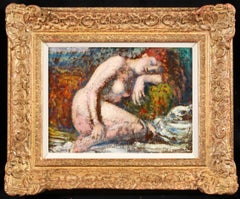
La Toilette - Post-Impressionist Nude Oil Painting by Georges D
Espagnat
By Georges d
Espagnat
Located in Marlow, Buckinghamshire
Signed oil on original canvas nude circa 1914 by French post impressionist painter Georges D'espagnat. The work depict a nude woman standing beside a wash basin in a boudoir.
Signature:
Signed lower right
Dimensions:
Framed: 45"x34"
Unframed: 37"x26"
Provenance:
Private collection - Netherlands
From the beginning of his career, it was a constant concern of Georges d'Espagnet to assert his originality. His studies at the École des Arts Décoratifs, Paris, did not last very long, for he wanted immediate independence and decided to follow courses in the private academies of Montparnasse. In about 1900, he became acquainted with Maurice Denis, Bonnard and Vuillard, and his collaboration with Denis led to a renewal of religious art in France.
In 1903, d'Espagnet was one of the founders of the Salon d'Automne, and was appointed professor in charge of studios at the École des Beaux-Arts, Paris, in 1934. He illustrated a number of books: Rémy de Gourmont's Evil Prayers ( Oraisons mauvaises) (1896), The Saints of Paradise ( Les Saintes du paradis) (1898), Simone (1907), Sistine ( Sixtine) (1922); Alphonse Daudet's The Immortal ( L'Immortel) (1930); André Gide's The Pastoral Symphony ( La Symphonie pastorale); Francis Jammes' Clearings in the Sky ( Chairières dans le ciel) (1948).
D'Espagnet belongs to the group of artists who made the Courrier Français so successful. The drawings of his which are published in it are strongly expressive and some bear comparison with the designs of the great Renaissance masters. He also contributed to L'Image. He often placed cheerful nudes in a landscape, reminding us that, though he moved away from the Fauves, he retained their freedom of colour and arabesque. He painted many portraits, including those of Albert André, André Barbier, Victor Boucher, Déodat de Séverac, Albert Marque, André Marty and Albert Roussel. He also painted mural decorations, including a wall for the Palais de la Découverte (1937), the ceiling of the Victor Hugo Room in the Palais du Luxembourg (1939), a decorative panel for the Palais de Justice, Toulouse (1941) and interior decorations for private houses. His landscapes are Impressionist in inspiration, and work for a certain sobriety, an intimacy, both in their composition - one, two or three sketched figures and large open spaces - and in the choice of colours and treatment with the special hazy brushstroke that marks his style.
D'Espagnet took part in a number of annual Parisian exhibitions, including the Salon des Indépendants, the Salon de la Société Nationale des Beaux-Arts, the Salon d'Automne (from 1903 to 1949, except in special circumstances), the Salon de la Libre Ésthétique, Brussels (1899, 1901), the Berlin Secessionists (1940). He also exhibited at the first Salon de la Société de la Gravure sur Bois. Among other exhibitions were 1912, A Century of French Art ( Centenaire de l'art français), St Petersburg; 1916, Kunstverein, Winterthur; 1918, 1926, Galerie M. Bertheim, Paris; 1930, Contemporary French Art...
Category
1910s Post-Impressionist Nude Paintings
Materials
Canvas, Oil
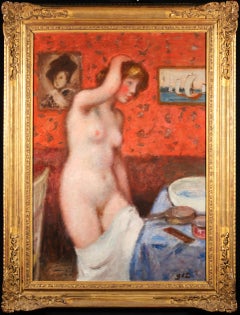
Still Thinking About These?
All Recently ViewedMore Ways To Browse
La Baigneuse
Terracotta Cat
Dance Of Death
Leon Comerre
Leon Francois Comerre
Robert Louis Raymond Duflos
The Sirens Dance
Female Nude Bondage
Gerald Leake
Girl On Bicycle
Makart Painting
Norman Rockwell Nude
Nude Asian Female Painting
Nude Mermaid Painting
Oil Painting Julian Ritter
Reclining Nude 1920S
Robert Phillip Nude Painting
Sierk Schroder