Items Similar to La Baigneuse - Academic Nude Figure in Landscape Oil by Paul Emile Chabas

Want more images or videos?
Request additional images or videos from the seller
1 of 14
Paul Emile ChabasLa Baigneuse - Academic Nude Figure in Landscape Oil by Paul Emile Chabasc.1910
c.1910
$22,678.89
£16,615
€19,546.94
CA$31,579.22
A$33,935.20
CHF 18,208.20
MX$399,735.86
NOK 228,947.94
SEK 209,142.46
DKK 146,086.07
About the Item
Signed oil on canvas nude figure in landscape circa 1910 by French academic painter Paul Emile Chabas. The piece depicts a nude woman bathing under a tree in a lake. The sky above the hills in the distance is a golden colour which is reflecting in the water below.
Signature:
Signed lower right
Dimensions:
Framed: 49"x45.5"
Unframed: 42"38.5"
Provenance:
Private collection - France
Chabas was a pupil of William Bouguereau and of Tony Robert-Fleury. He painted female nudes in the most traditional of the academic styles; he belonged to that element of the old Salon des Artistes Français unable to acknowledge the new creativity emerging from the beginning of the 19th century onwards. He was also a society portrait artist. In 1899, he received the national prize of the Salon and a gold medal in 1900. He was a member of the Comité des Artistes Français. He received the medal of honour in 1912, became a member of the Institut in 1921, and a commander in the Légion d'Honneur.
Solo Exhibitions:
1983, Paul Chabas 1869-1937: Une Peinture Sensuelle, Les Reflets du Temps, Paris
Museum and Gallery Holdings:
Montauban (Mus. Ingres): Portrait of Henry Lapauze (before 1923, oil on canvas)
Mulhouse: The Bath
Nantes (MBA): Happy Frolics; Portrait of Rogatien Lévêque; Portrait of Mme Puybaraud; Portrait of General Buat; Portrait of Mme Merlant
Paris (Louvre): Waves on the Rocks (tempera on paper)
Paris (Mus. d'Orsay): Portrait of the Artist's Wife (oil on canvas); Dusk (c. 1905, oil on canvas)
Tourcoing: Table Corner
Versailles (Mus. Nat. du Château et des Trianons): collection of portraits
- Creator:Paul Emile Chabas (1869 - 1937, French)
- Creation Year:c.1910
- Dimensions:Height: 49 in (124.46 cm)Width: 45.5 in (115.57 cm)
- Medium:
- Movement Style:
- Period:
- Condition:Very good condition for age.
- Gallery Location:Marlow, GB
- Reference Number:Seller: LFA04371stDibs: LU415317309132
About the Seller
5.0
Vetted Professional Seller
Every seller passes strict standards for authenticity and reliability
Established in 2001
1stDibs seller since 2016
713 sales on 1stDibs
Typical response time: 3 hours
- ShippingRetrieving quote...Shipping from: Marlow, United Kingdom
- Return Policy
More From This Seller
View AllLes Baigneuses - Neo-Impressionist Nudes in Landscape Oil by Georges Lemmen
By Georges Lemmen
Located in Marlow, Buckinghamshire
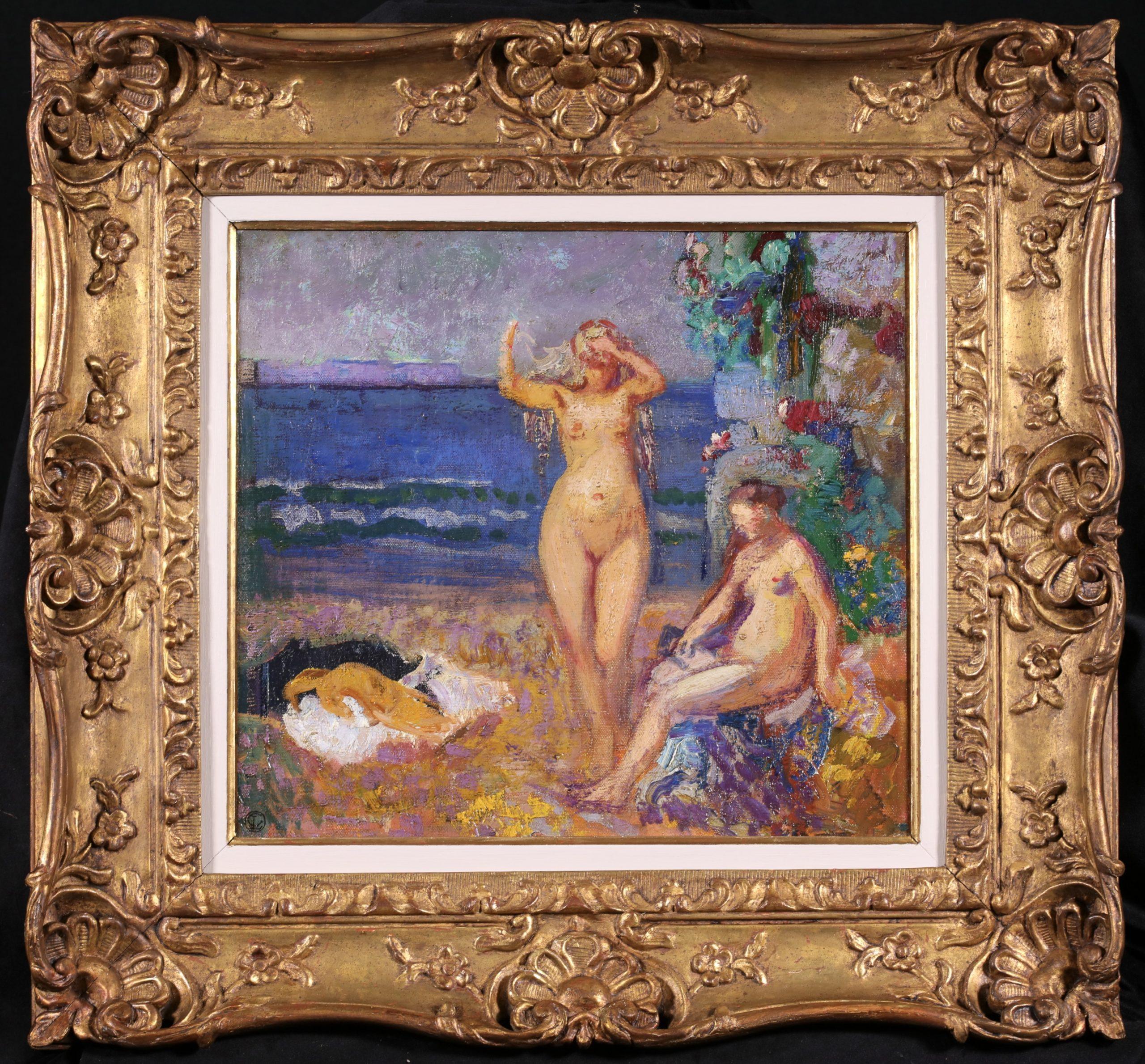
Signed oil on canvas nudes in landscape circa 1910 by Belgian neo-impressionist painter Georges Lemmen. The work depicts nude bathers on a sunny beach beside the sea.
Signature:
Signed lower left with the cachet of painter
Dimensions:
Framed: 23.5"x24.5"
Unframed: 14.5"x15.5"
Provenance:
Olivier Bertrand (expert on the painter) has confirmed the authenticity of this work
Georges Lemmen was the son of an architect and studied under Amédée Bourson at the academy in St Joost-ten-Node. He was invited in 1889 to join the Group of Twenty ( Cercle des XX) which had been launched in 1884 by Oscar Maus and had in the interim emerged as an influential force in Belgian artistic circles, not least by bringing to public and critical attention the work of such artists as Georges Seurat and Paul Signac. The Cercle des XX would be reborn in 1894 as La Libre Esthétique.
In the early days of the Cercle des XX, Lemmen espoused a pointilliste technique. His earlier painting was clearly influenced by the Neo-Impressionists; over time, however, his style became more subtle and nuanced - recalling, perhaps, that of his compatriot Van Rysselberghe, another Cercle des XX member. With the group's rebirth as the Libre Esthétique, Lemmen's work became more intimiste in character, most notably in his portraits, nudes and still-lifes, where the influence of Bonnard and Vuillard is unmistakable, as is that of Renoir, particularly after Lemmen's travels in the Midi in 1911. From this point onwards, he would go on to make a major contribution to the renewal of the graphic and decorative arts in terms of his input to the new 'free' aesthetic and to Art Nouveau. Although his draughtsmanship retained its essential purity and elegance of line, his painting became more fleshy, imprecise and sensual, his compositions governed less by technical considerations than by the urgent need to express his emotions.
Between 1889 and 1893, Lemmen exhibited at the Salon des Indépendants in Paris, aligning himself with the Neo-Impressionists. In 1893, Henry van de Velde invited him to participate in the Pour l'Art association that had been created in Antwerp. He travelled to the south of France in 1911. By this juncture, he had already exhibited solo on two occasions (in 1906 and 1908) at the Galerie Druet in Paris. A further solo exhibition in 1913, his first in Brussels, cemented Lemmen's reputation.
Museum and Gallery Holdings:
Bremen (Kunsthalle): Standing Nude Combing her Hair
Brussels (Mus. royaux des Beaux-Arts de Belgique): Children's Room (watercolour); Reading; Couture; Young Girl by the Sea...
Category
1910s Impressionist Nude Paintings
Materials
Oil, Canvas
Nu Allonge - Post Impressionist Nude Oil Painting by Paul Elie Gernez
Located in Marlow, Buckinghamshire
Signed and dated nude oil on panel by French post impressionist painter Paul Elie Gernez. The work depicts a brunette nude relaxing on a fur rug, her ...
Category
Early 20th Century Post-Impressionist Nude Paintings
Materials
Panel, Oil
Les Baigneuses - Post Impressionist Figures in Landscape Oil by Pierre Montezin
By Pierre Eugène Montezin
Located in Marlow, Buckinghamshire
Signed oil on canvas figures in riverscape circa 1910 by sought after French impressionist painter Pierre Eugene Montezin. The work depicts bathers in a river on a sunny summer's day...
Category
1910s Impressionist Figurative Paintings
Materials
Canvas, Oil

Baigneuses - Post Impressionist Nudes in Landscape Oil by Georges Pissarro
By Georges Henri Manzana Pissarro
Located in Marlow, Buckinghamshire
Signed and dated oil on board nudes in landscape by French post-impressionist painter Georges Manzana Pissarro. The work depicts nude bathers at a lake, sunbathing and paddling in th...
Category
1930s Post-Impressionist Nude Paintings
Materials
Oil, Board
La Toilette - Post-Impressionist Nude Oil Painting by Georges D
Espagnat
By Georges d
Espagnat
Located in Marlow, Buckinghamshire
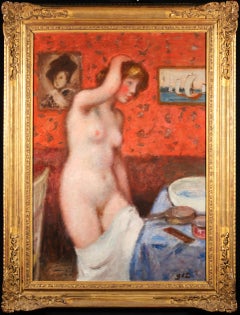
Signed oil on original canvas nude circa 1914 by French post impressionist painter Georges D'espagnat. The work depict a nude woman standing beside a wash basin in a boudoir.
Signature:
Signed lower right
Dimensions:
Framed: 45"x34"
Unframed: 37"x26"
Provenance:
Private collection - Netherlands
From the beginning of his career, it was a constant concern of Georges d'Espagnet to assert his originality. His studies at the École des Arts Décoratifs, Paris, did not last very long, for he wanted immediate independence and decided to follow courses in the private academies of Montparnasse. In about 1900, he became acquainted with Maurice Denis, Bonnard and Vuillard, and his collaboration with Denis led to a renewal of religious art in France.
In 1903, d'Espagnet was one of the founders of the Salon d'Automne, and was appointed professor in charge of studios at the École des Beaux-Arts, Paris, in 1934. He illustrated a number of books: Rémy de Gourmont's Evil Prayers ( Oraisons mauvaises) (1896), The Saints of Paradise ( Les Saintes du paradis) (1898), Simone (1907), Sistine ( Sixtine) (1922); Alphonse Daudet's The Immortal ( L'Immortel) (1930); André Gide's The Pastoral Symphony ( La Symphonie pastorale); Francis Jammes' Clearings in the Sky ( Chairières dans le ciel) (1948).
D'Espagnet belongs to the group of artists who made the Courrier Français so successful. The drawings of his which are published in it are strongly expressive and some bear comparison with the designs of the great Renaissance masters. He also contributed to L'Image. He often placed cheerful nudes in a landscape, reminding us that, though he moved away from the Fauves, he retained their freedom of colour and arabesque. He painted many portraits, including those of Albert André, André Barbier, Victor Boucher, Déodat de Séverac, Albert Marque, André Marty and Albert Roussel. He also painted mural decorations, including a wall for the Palais de la Découverte (1937), the ceiling of the Victor Hugo Room in the Palais du Luxembourg (1939), a decorative panel for the Palais de Justice, Toulouse (1941) and interior decorations for private houses. His landscapes are Impressionist in inspiration, and work for a certain sobriety, an intimacy, both in their composition - one, two or three sketched figures and large open spaces - and in the choice of colours and treatment with the special hazy brushstroke that marks his style.
D'Espagnet took part in a number of annual Parisian exhibitions, including the Salon des Indépendants, the Salon de la Société Nationale des Beaux-Arts, the Salon d'Automne (from 1903 to 1949, except in special circumstances), the Salon de la Libre Ésthétique, Brussels (1899, 1901), the Berlin Secessionists (1940). He also exhibited at the first Salon de la Société de la Gravure sur Bois. Among other exhibitions were 1912, A Century of French Art ( Centenaire de l'art français), St Petersburg; 1916, Kunstverein, Winterthur; 1918, 1926, Galerie M. Bertheim, Paris; 1930, Contemporary French Art...
Category
1910s Post-Impressionist Nude Paintings
Materials
Canvas, Oil
Nu avec des fleurs - Post-Impressionist Oil, Nude
Flowers - Georges D
Espagnat
By Georges d
Espagnat
Located in Marlow, Buckinghamshire
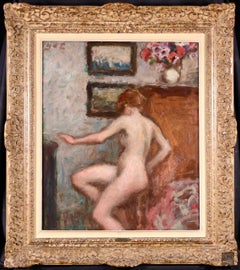
Signed nude oil on original canvas circa 1910 by French post impressionist painter Georges D'espagnat. The work depict a nude woman seated on a stall turned away from the artist. Paintings hang on the wall and there's a vase filled with pink and red flowers on the wooden mantlepiece beside her.
Signature:
Signed upper left
Dimensions:
Framed: 30"x26"
Unframed: 22"x18"
Provenance:
Private French collection.
Exhibition stamp verso
From the beginning of his career, it was a constant concern of Georges d'Espagnet to assert his originality. His studies at the École des Arts Décoratifs, Paris, did not last very long, for he wanted immediate independence and decided to follow courses in the private academies of Montparnasse. In about 1900, he became acquainted with Maurice Denis, Bonnard and Vuillard, and his collaboration with Denis led to a renewal of religious art in France.
In 1903, d'Espagnet was one of the founders of the Salon d'Automne, and was appointed professor in charge of studios at the École des Beaux-Arts, Paris, in 1934. He illustrated a number of books: Rémy de Gourmont's Evil Prayers ( Oraisons mauvaises) (1896), The Saints of Paradise ( Les Saintes du paradis) (1898), Simone (1907), Sistine ( Sixtine) (1922); Alphonse Daudet's The Immortal ( L'Immortel) (1930); André Gide's The Pastoral Symphony ( La Symphonie pastorale); Francis Jammes' Clearings in the Sky ( Chairières dans le ciel) (1948).
D'Espagnet belongs to the group of artists who made the Courrier Français so successful. The drawings of his which are published in it are strongly expressive and some bear comparison with the designs of the great Renaissance masters. He also contributed to L'Image. He often placed cheerful nudes in a landscape, reminding us that, though he moved away from the Fauves, he retained their freedom of colour and arabesque. He painted many portraits, including those of Albert André, André Barbier...
Category
1910s Post-Impressionist Nude Paintings
Materials
Canvas, Oil
You May Also Like
La Source - Nude in Landscape - French Impressionist art Victorian oil painting
By Jean-Jacques Henner
Located in Hagley, England
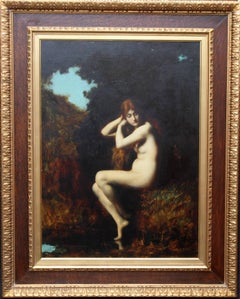
This superb French 19th century oil painting, La Source, location previously unknown according to the Jean Jacques Henner Catalogue Raisonee, is a fantastic art historical re-discovery. It is by noted artist Jean Jacques Henner, a French painter, Henner was noted for his use of sfumato and chiaroscuro in painting nudes, religious subjects, and portraits. La Source, or Spring, is a magnificent, very large French Romantic oil painting depicting a subject for which Henner became famous. Painted in 1881 it was exhibited at the Paris Salon that year. The sitter is Dorothy Tenant (1855-1926) or Dolly, an English art pupil of Henner’s and also his model. (See her biography below). La Source is a painting of a beautiful young woman, Dolly, unclothed, with long auburn hair sat on the edge of a pool in a landscape. Her serene face and body are almost glowing against the darker landscape, all enhanced by the sfumato and chiaroscuro technique. Beyond is a patch of startling blue sky, reflected in the pool at her feet. The rough brush work in the flora and fauna around her, a precursor to French Impressionism, contrasts with the smoothness of her skin. A really stunning painting with excellent provenance. This painting is in the Henner Musee National catalogue raisonne by Isabelle de Lannoy, noted as location unknown and exhibited at the Salon in 1881. Also noted in the catalogue raisonne are two studies for La Source identifying the sitter as Dolly Tennant. One of the images is also shown on the front cover.
Signed lower right.
Provenance. Exhibited Paris Salon 1881 entitled La Source.
Catalogue Raisonne, for National Museum of Jean Jacques Henner, France, p174. La Source, Salon 1881, location unknown. Plus study of Dolly Tennant for La Source and another study for La Source. .
The New York Market for French Art in the Gilded Age, 1867-1893 by Dr Leanne Zalewski, published by Bloomsbury Visual Arts, 2022, page 39, La Source image 3.3.
Formerly in the collection of Mary Jane Morgan (see below).
Aitken Dott - The Scottish Gallery ref R9101.
Sotheby sale 30th Dec 1985.
Thomas Agnews and Sons.
Condition. Oil on canvas, image size 35 inches by 27 inches and in good condition. Has been relined and had restoration during its life time.
Housed in a fine frame, 45 inches by 37 inches, in good condition.
Jean-Jacques Henner (15 March 1829 – 23 July 1905) was a French painter, noted for his use of painting nudes, religious subjects, and portraits. Henner was born at Bernwiller (Alsace). He began his studies in art as a pupil of Michel Martin Drolling and François-Édouard Picot. In 1848, he entered the École des Beaux Arts in Paris, and took the Prix de Rome with a painting of Adam and Eve finding the Body of Abel in 1858. In Rome, he was guided by Flandrin, and painted four pictures for the gallery at Colmar among other works. He first exhibited Bather Asleep at the Salon in 1863 and subsequently contributed Chaste Susanna (1865), now in the Musée d'Orsay. Other noted works include: Byblis turned into a Spring (1867); The Magdalene (1878); Portrait of M. Hayem (1878); Christ Entombed (1879); Saint Jerome (1881); Herodias (1887); A Study (1891); Christ in His Shroud and a Portrait of Carolus-Duran (1896); a Portrait of Mlle Fouquier (1897); and The Dream (1900).The Levite of the Tribe of Ephraim (1898) was awarded a first-class medal. Among other professional distinctions, Henner also took a Grand Prix for painting at the Paris Exposition Universelle of 1900. He was made Chevalier of the Legion of Honour in 1873, Officer in 1878, and Commander in 1889. In 1889, he succeeded Cabanel in the Institut de France. Henner's most widely known work is his 1885 portrait of Saint Fabiola. Although the original is now lost, it was copied by artists around the world for devotional purposes. Artist Francis Alÿs has collected over 500 copies of the portrait in a variety of media. The collection, known as the "Fabiola Project," is on exhibit at the Byzantine Fresco Chapel of the Menil Collection in Houston from May 21, 2016 - May 13, 2018. Henner had numerous pupils; among them were the American painter Mathilde Mueden Leisenring and the Romanian artist Dimitrie Serafim. From 1874 to 1889, organized with Carolus-Duran, what he called "the studio of the ladies" for women were not allowed entry to the École des Beaux-Arts. Some also served as his models. One of these was Dorothy Tennant who later married Henry Morton Stanley. Henner died at age 76 in Paris.
SITTER BIOGRAPHY
Dorothy Tennant (22 March 1855 – 5 October 1926) was an English painter of the Victorian era neoclassicism. She was married to the explorer Henry Morton Stanley. Tennant was born in Russell...
Category
19th Century Impressionist Nude Paintings
Materials
Oil
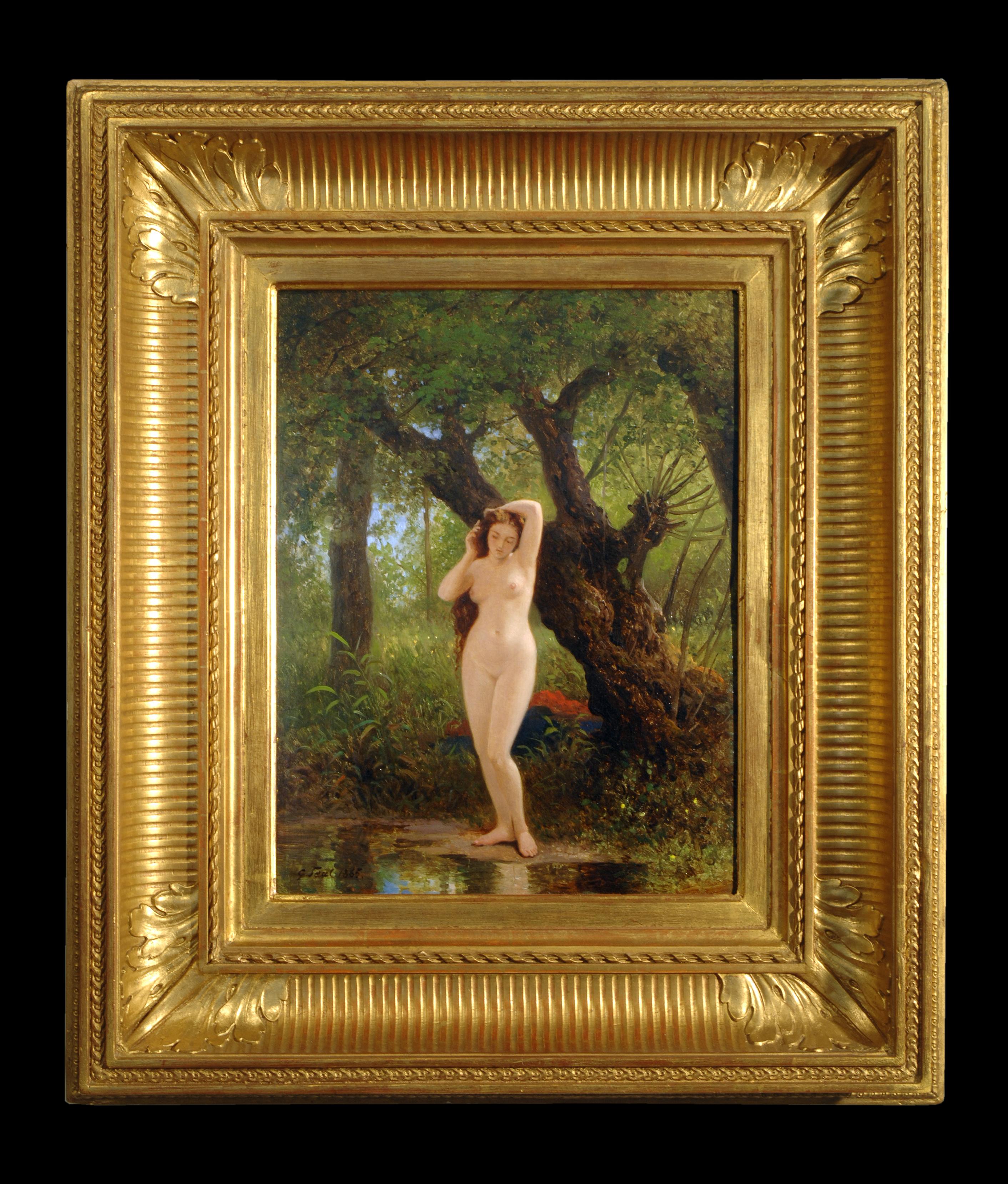
Green Landscape with Dreamlike Nude Figure at waters edge
Before Bathing
By Georg Eduard Otto Saal
Located in Shrewsbury, Shropshire
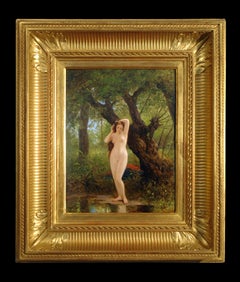
A German painter from Baden, he was a student of J W Schirmer in Dusseldorf and Baden Court.
Oil on Panel
Signed and Dated 1865
Provenance: Private Collection, Austria
Category
17th Century Impressionist Figurative Paintings
Materials
Oil, Panel
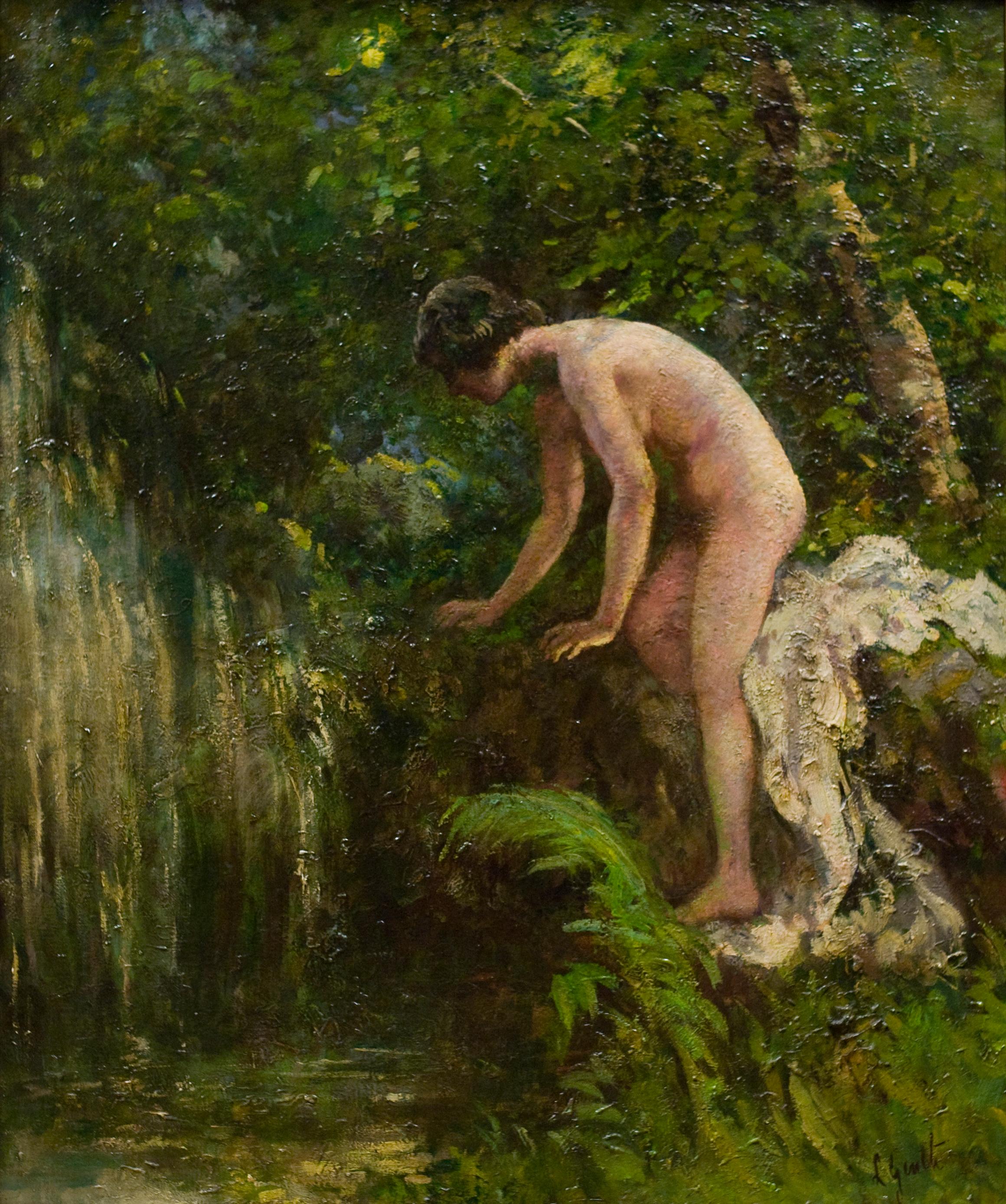
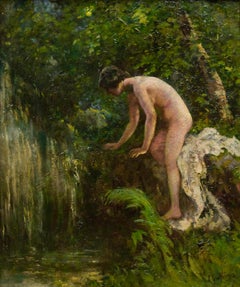
Nude by a Waterfall
Located in Mc Lean, VA
Signed lower right
Lillian Genth was an important American figurative painter. She studied in the U.S. and in Paris, under James McNeil Whistler. Genth ...
Category
Early 20th Century American Impressionist Figurative Paintings
Materials
Canvas, Oil
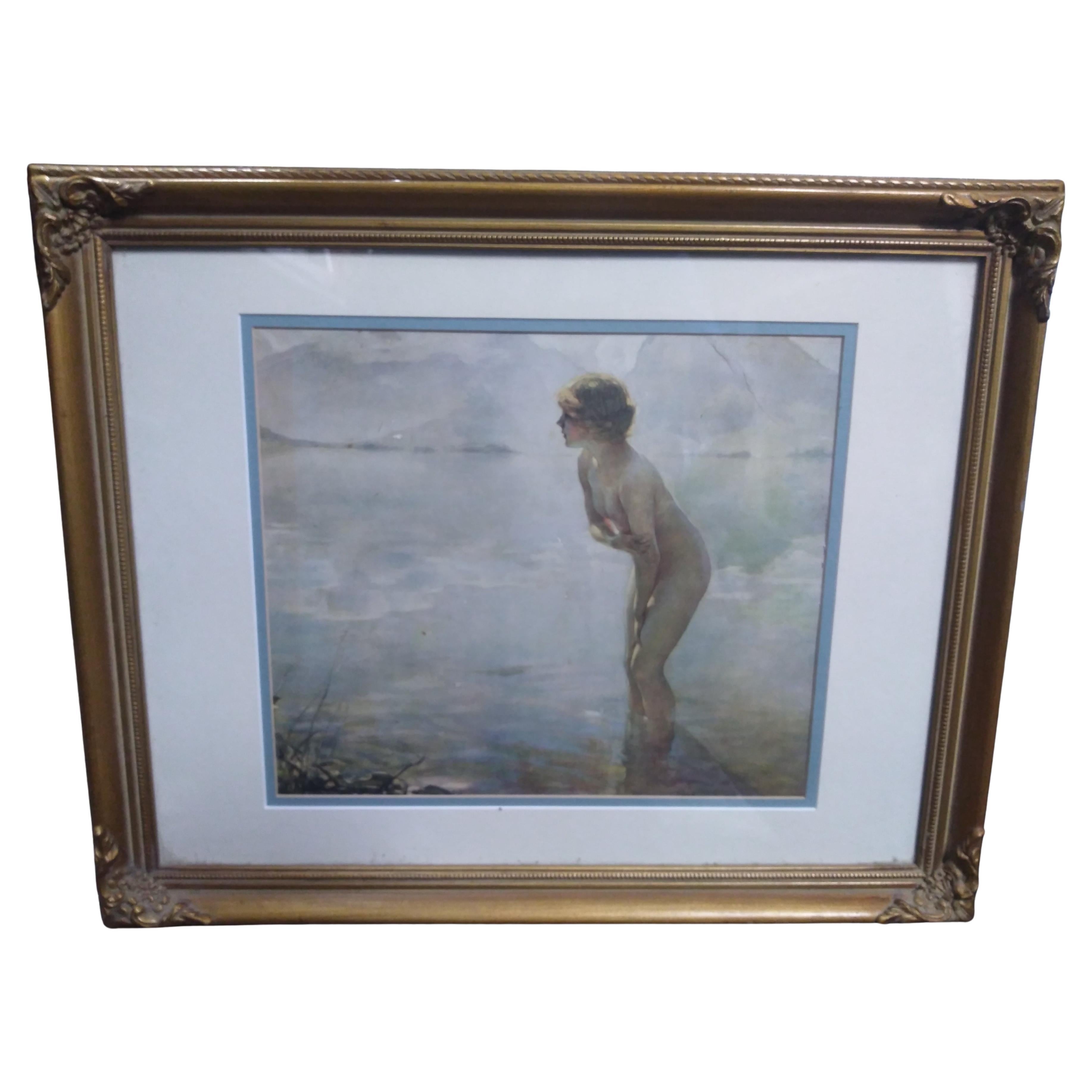
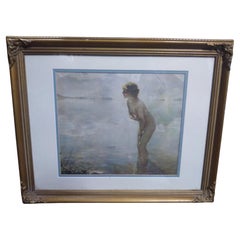
New York Graphics Society Print by Paul Emile Chabas "September Morning"
Located in Pasadena, TX
Paul Chabas was a 19th century French art
( 1869-1937 ). This is a print by the New York Graphics Society for of one of his works.
It's titled "September Morning". The print comes w...
Category
20th Century American Prints
Materials
Paper
$280 Sale Price
20% Off
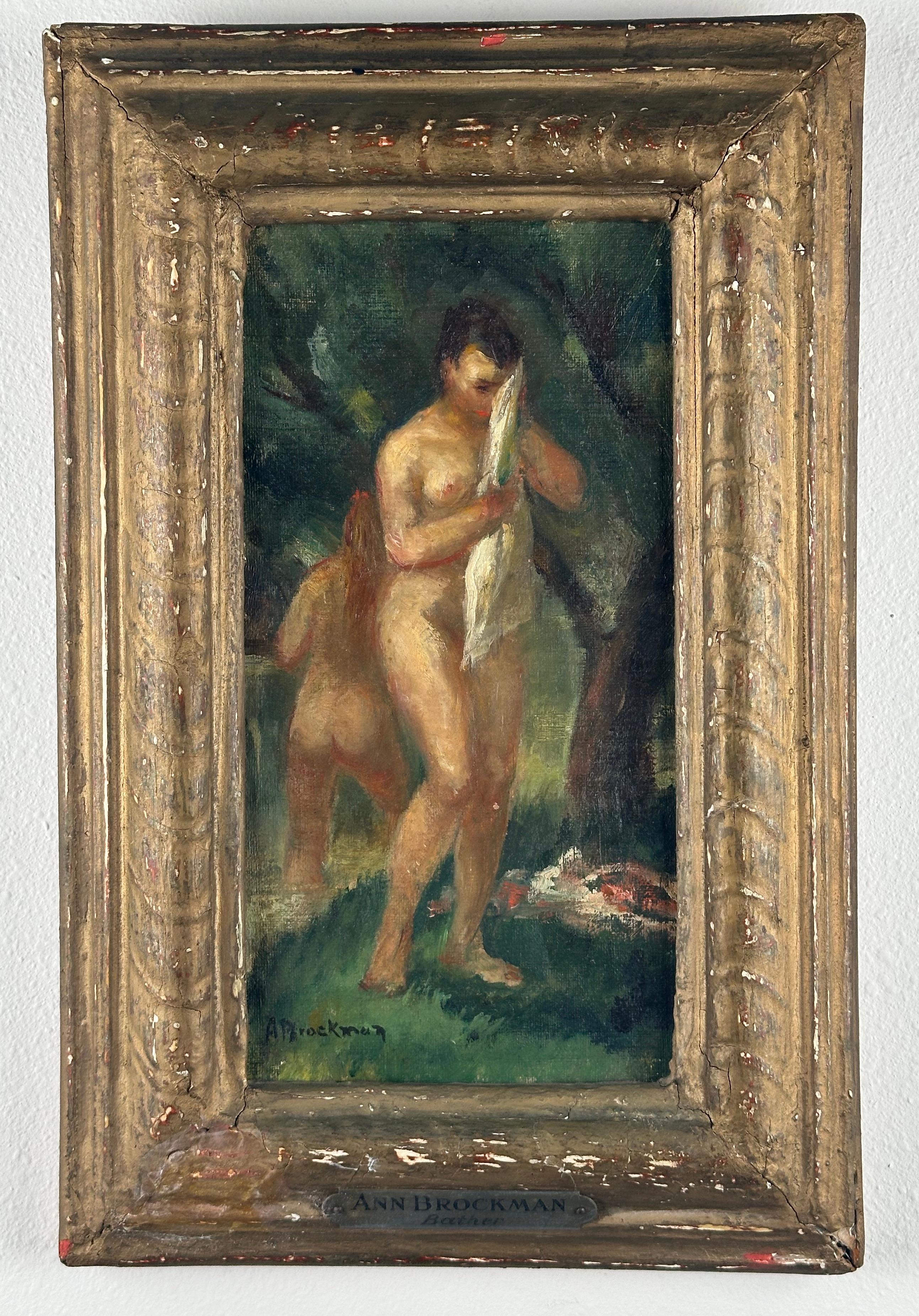
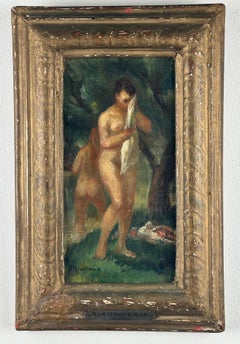
Female Bather (Nude Women)
Located in Wilton Manors, FL
Ann Brockman (1895–1943) was an American artist who achieved success as a figurative painter following a successful career as an illustrator. Born in California, she spent her childhood in the American Far West and, upon marrying the artist William C. McNulty, relocated to Manhattan at the age of 18 in 1914. She took classes at the Art Students League where her teachers included two realist artists of the Ashcan School, George Luks and John Sloan. Her career as an illustrator began in 1919 with cover art for four issues of a fiction monthly called Live Stories. She continued providing cover art and illustrations for popular magazines and books until 1930 when she transitioned from illustrator to professional artist. From that year until her death in 1943, she took part regularly in group and solo exhibitions, receiving a growing amount of critical recognition and praise. In 1939 she told an interviewer that making money as an illustrator was so easy that it "almost spoiled [her] chances of ever being an artist."[1] In reviewing a solo exhibition of her work in 1939, the artist and critic A.Z Kruse wrote: "She paints and composes with a thorough understanding of form and without the slightest hesitancy about anatomical structure. Add to this a magnificent sense of proportion, and impeccable feeling for color and an unmistakable knowledge of what it takes to balance the elements of good pictorial composition and you have a typical Ann Brockman canvas."[2]
Early life and training
Brockman was born in Northern California in 1895 and spent much of her youth in nearby Oregon, Washington, and Utah.[1][3] She met the artist William C. McNulty in Seattle where he was employed as an editorial cartoonist. They married in March 1914 and promptly moved to Manhattan where he worked as a freelance illustrator.[4][5] At the time of their marriage, Brockman was 18 years old.[6] Over the next few years, her career generally followed that path that her husband had previously taken. His art training had been at the Art Students League beginning in 1908; she began her training there after moving to New York in 1914.[1] After an early career as an editorial cartoonist, he freelanced as a magazine and book illustrator beginning in 1914; she began her career as a magazine and book illustrator in 1919.[7] He embarked on a teaching career in the early 1930s and not long after, she began giving art instruction.[8][9] While they both adhered to the realist tradition in art, their usual subjects were different. His prominently depicted urban cityscapes in the social realist whereas hers generally focused on rural landscapes. He was best known for his etchings and she for her oils and watercolors.[8][10]
Brockman returned to the Art Students League in 1926 to take individual instruction for a month at a time from George Luks and John Sloan.[1] Despite their help, one critic said McNulty's "sympathetic encouragement and guidance" was more important to her development as a professional artist.[11]
Career in art
In the course of her career as illustrator, Brockman would sometimes paint portraits of celebrities before drawing them, as for example in 1923 when she painted the French actress Andrée Lafayette who had traveled to New York to play title role in a film called Trilby.[12] She would also sometimes accept commissions to make portrait paintings and in 1929 painted two Scottish terriers on one such commission.[13] During this time, she also produced landscapes. In 1924 she displayed a New England village street scene painting in the Second Annual Exhibition of Paintings, Watercolors, and Drawings in the J. Wanamaker Gallery of Modern Decorative Art.[14] Available sources show no further exhibitions until in 1930 a critic for the Boston Globe described one of her portraits as "well done" in a review of a Rockport Art Association exhibition held that summer.[15]
Between 1931 and her death in 1943, Brockman participated in over thirty group exhibitions and five solos.[note 1] Her paintings appeared in shows of the artists' associations to which she belonged, including the Rockport Art Association, Salons of America, Society of Independent Artists, and National Association of Women Painters and Sculptors.[17][19]Between 1932 and 1935, her paintings appeared frequently in New York's Macbeth Gallery.[20][23][25][27] She won an award for a painting she showed at the Art Institute of Chicago in 1940.[41] In 1942, the Whitney Museum bought one of the paintings she showed in its Biennial of that year.[10] Critical praise for her work steadily increased during the decade that ended with her untimely death in 1943. In 1932, her painting called "The Camera Man" was called "a clever piece of illustration."[21] Three years later, a painting called "Small Town" gave a critic "the impression of freshness, honesty, and skill".[29] In 1938, a critic described her "Folly Cove" as "masterful" and said "Pigeon Hill Picnic" was "sustained by excellence of execution".[48] At that time, Howard Devree of the New York Times saw "evidence of gathering powers" in her work and wrote "she imparts a dramatic feeling to landscape. She even manages this time to do trees touched by Autumn tints without calendar effect, which is no small praise."[51] Three years later, a Times critic reported Brockman had "set herself a new high" in the watercolors she presented,[52] and another critic said the gallery where she was showing had not "for some time" shown "so outstanding a solo exhibitor as Ann Brockman."[2] Shortly before her death, a critic for Art News maintained that she was "one of America's most talented women painters".[46]
After she had died, a critic said Brockman's paintings "displayed real power", adding that she was "highly rated among the nation's professional artists" and was known to give "aid and encouragement, always with a smile," both artists and to her students.[10] in reviewing the memorial exhibition at the Kraushaar Galleries held in 1945, reviewers wrote about the strength and vibrancy of her personality, the quality of her painting ("every bit as good, possibly better than people had thought"),[53] called her "one of the best of our twentieth century women painters", and credited "her sense of the vividness of life" as a contributor to "the unusual breadth that is so characteristic of her work.[11] One noted that her work was "widely recognized throughout the country" and could be found in the collections of prominent museums, including the Metropolitan Museum of Art, the Whitney Museum of American Art, and the Art Institute of Chicago.[54] Writing in the Times, Devree wrote, "even those who had followed the steady growth of this artist for more than a decade, each successive show being at once an evidence of new achievement and an augury of still better work to come, may well be surprised at the combined impact of the selected paintings in the present showing,"[55] and writing in the Brooklyn Daily Eagle, A.Z Kruse said she had made "extraorginary accomplishments", painted with "inordinate distinction" showing a "lyrical majesty," and possessed "a keen esthetic sense which did not deviate from truth."[54]
Artistic style
(1) Ann Brockman, undated drawing, black chalk on paper, 18 x 22 inches
(2) Ann Brockman, High School Picnic, about 1935, oil on canvas, 34 1/4 x 44 1/4 inches
(3) Ann Brockman, untitled landscape, about 1943, watercolor and pencil on paper, 15 1/4 x 22 1/2 inches
(4) Ann Brockman, North Coast, undated watercolor, 21 1/2 x 30 inches
(5) Ann Brockman, On the Beach, 1942, watercolor on paper, 16 1/2 x 20 inches
(6) Ann Brockman, Lot's Wife, 1942, oil on canvas, 46 x 35 inches
(7) Ann Brockman, New York Harbor, 1934, watercolor on paper, 13 1/2 x 19 1/4 inches
(8) Ann Brockman, Youth, 1942, oil on board, 13 1/2 x 11 1/2 inches
Brockman was a figurative painter whose main subjects were rural landscapes and small-town and coastal scenes. She worked in oils and watercolors, becoming better known for the latter late in her career. Most of her paintings were relatively small. Although she made figure pieces infrequently, the nudes and circus and Biblical scenes she painted were seen to be among her best works. In 1938, Howard Devree wrote: "Her gray-day marines and coast scenes are familiar to gallery goers and are favorites with her fellow artists. Her figure pieces have attained a sculptural quality without losing warmth or taking on stiffness. One spirited circus incident of equestriennes about to enter the big tent compares not unfavorably with many of the similar pictures by a long line of painters who have been fascinated by the theme. She imparts a dramatic feeling to landscape. She even manages this time to do trees touched by Autumn tints without calendar effect, which is no small praise."[51] Similarly, a critic for Art Digest wrote that year: "Fluently and virilely painted, [her] canvases suggest a close affinity between nature and humans. The artist takes her subjects out in the open where they may picnic or bathe with space and air about them. A fast tempo is felt in the compositions of restless horses and nimble entertainers busily alert for the coming performance. Miss Brockman is also interested in portraying frightened groups of people, hurrying to safety or standing half-clad in the lowering storm light."[56]
Her palette ranged from vivid colors in bright sunlight to somber ones in the overcast skies of stormy weather. Of the former, one critic spoke of the rich colors and "sun-drenched rocks" of her coastal scenes and another of her "summery landscapes of coves and picnics."[11][50] Of the latter, Howard Devree said she "painted so many moody Maine coast vignettes of lowering skies and uneasy seas that artists have been heard to refer to an effect as 'an Ann Brockman day'".[57]
Brockman's handling of Biblical subjects can be seen in the oil called "Lot's Wife", shown above, Image No. 6. Her watercolor called "On the Beach" and her oil portrait called "Youth" may both indicate the "sculptural quality" that Devree said was typical of her figure pieces (Image No. 8, above).
An example of Brockman's bright palette in a typical summer theme is the oil painting called "High School Picnic" shown above, Image No. 2. Next to it is a painting, an untitled landscape of about 1943 whose medium, watercolor on paper, shows off the sunny palette she often used (Image No. 3).
Among the darkest of her works was an untitled 1942 drawing she made in black chalk (shown above, Image No. 1). In a book called Drawings by American Artists (1947), the artist and art editor Norman Kent noted that this study influenced her painting through its use of "forms" that were "elastic" and suggested "color". He said its "massing of dark and light" created "a definite mood" that was "impressionistic" and had "the strength of a man's work".[58] Brockman's undated watercolor called "North Coast" (shown above, Image No. 4) is an example of the paintings to which Kent referred.
Illustrator
(9) Ann Brockman, cover, March 12, 1917, Every Week magazine
(10) Illustration of an article, "The Taking of a Salient" by Henry Russell...
Category
1930s American Impressionist Nude Paintings
Materials
Oil
$1,200 Sale Price
20% Off
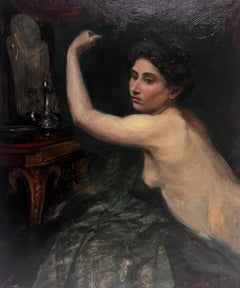
19th Century French Symbolist Oil Painting Sketch of Artists Nude Model Posing
Located in Cirencester, Gloucestershire
The Artists Model
French School, late 19th century
oil on canvas, unframed
canvas: 20 x 17.5 inches
provenance: private collection, France
condition: very good and sound condition
Category
Late 19th Century Symbolist Portrait Paintings
Materials
Oil, Canvas
$1,528 Sale Price
20% Off