Items Similar to A replica of the JB Greuze
s last self-portrait, by his daughter Anne-Geneviève
Want more images or videos?
Request additional images or videos from the seller
1 of 12
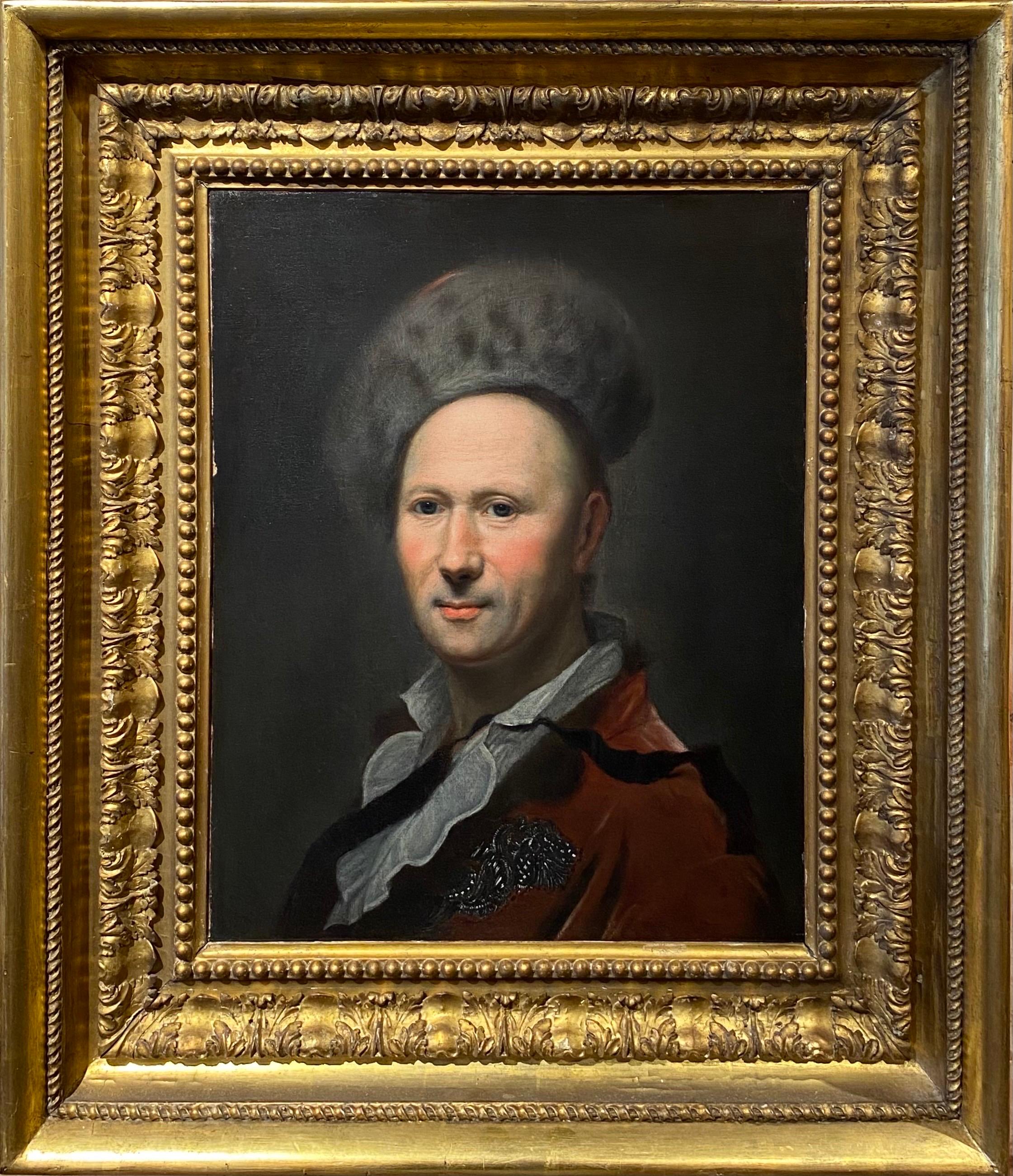
Anne-Geneviève GreuzeA replica of the JB Greuze
s last self-portrait, by his daughter Anne-Geneviève1805
1805
$16,083.80
£11,949.14
€13,500
CA$22,300.91
A$23,982.76
CHF 12,823.63
MX$289,225.30
NOK 162,163.57
SEK 147,751.89
DKK 102,892.42
About the Item
While the Petit-Palais is hosting the first exhibition dedicated to the artist in Paris in over a century, this replica of the last painting by Jean-Baptiste Greuze, executed by his daughter Anne-Geneviève alongside her father as he was living his last moments, presents us with a poignant image of the great artist, depicted with panache despite the disillusions of his life.
1. Jean-Baptiste Greuze, a painter who was adored in his time, long despised, and who is now being rediscovered
Jean-Baptiste Greuze was the sixth child of a roofer from Tournus and retained a certain rusticity in his behaviour from his provincial childhood, beyond his taste for describing picturesque scenes of the countryside. He initially started training with a little-known painter from Lyon, Charles Grandon, before his genius was recognised in Paris where he became a full-time student of the Académie (of Painting) in 1755. He exhibited his work for the first time at the Salon during the summer of 1755, before leaving on a trip to Italy in the company of Louis Gougenot, abbot of Chezal-Benoît.
Upon his return to Paris, Greuze became a prolific painter, participating widely in the Salons held between 1759 and 1765, to which he sent no less than 63 paintings: numerous genre scenes (The Marriage Contract, The Beloved Mother), but also portraits of his family circle, of courtiers and art lovers, or of his colleagues.
The Academy closed the doors of the Salons to him in 1767 for not having produced his reception piece within six months of his reception, as was the tradition. He worked actively on this painting (Emperor Severus rebukes Caracalla, his Son, for trying to assassinate him ) until the summer of 1769, tackling a historical subject inspired by the Roman History for the first time. Once this was completed, he was then fully admitted to the Academy, but as a genre painter, and not as an historical painter, which had been one of the greatest humiliations of his life.
Greuze then refused any participation in events organised by the Academy or its successor, the Academy of Fine Arts until 1800. Abandoning history painting, he gave a new twist to genre scenes, bringing them closer to history painting, as in this pair of canvases which constitutes some of his masterpieces: The Paternal Curse: The Ungrateful Son and The Paternal Curse: The Punished Son .
Married in 1759 to Anne-Gabrielle Babuti, the daughter of a Parisian bookseller, his marriage was unhappy and his wife probably frequently unfaithful. The institution of divorce enabled him to record their separation in 1793, keeping his two daughters Anna-Geneviève, born in April 1762, and Louise-Gabrielle, born in May 1764, with him. Little is known about his daughter Anna except that she was herself a painter and lived with her father until his death. It is likely that most of the paintings she produced up to that date were attributed to her father, whose technique she largely shared, making it extremely difficult to establish an autonomous corpus of her paintings.
Greuze died in his studio in the Louvre (rue des Orties) on March 21, 1805. Anne-Geneviève became a drawing teacher and earned a modest living ; she fell out with her sister, who died in 1812. Anne-Geneviève survived her until 1842, living in her house on rue du Cherche-Midi.
The attention paid to the expressivity of his characters and the emotional charge they convey enabled Jean-Baptiste Greuze to enjoy immense popularity with the eighteenth-century public, and they still constitute Greuze's true modernity. As the artist said, "I dipped my brush in my heart". Greuze was also an exceptional draughtsman and a portraitist of immense talent and exceptional longevity who painted both the Dauphin (the son of Louis XV and father to Louis XVI) and the young Napoleon Bonaparte.
2. Greuze's last self-portrait
Greuze was very much influenced by Dutch paintings during all his life. While the source of his inspiration for genre scenes can be found in Gerard Dou and in the painters of Leiden, Rembrandt's influence was certainly decisive in the creation of his many self-portraits.
It was not until 1800 that Greuze resumed his participation in the Salons. This self-portrait is one of six paintings sent , in the beginning of his eightieth year, to the Salon held during the summer of 1804. This is the last Salon in which he participated, 49 years after his first Salon in 1755. This portrait, now in the Musée des Beaux-Arts in Marseilles (6th photo in the gallery), was painted shortly before the Salon of 1804. It is therefore a true farewell by Greuze both to his public and to the art of painting, since it is also one of his last paintings.
"Greuze was medium in size, he had a strong character, a very large forehead, deep-set lively eyes, a spiritual temperament. His approach announced frankness and genius, it was even difficult not to say "here is Greuze" without almost seeing him. "This description made by C.L. Lecarpentier in Notice about Greuze read in the session of the Société libre d'Emulation in Rouen (1805) gives us a description of the painter which reinforces the powerful impression produced by this painting.
In this last self-portrait Greuze reuses the composition of a portrait he had painted some fifty years earlier and which is now in the Musée de Tournus. He points to himself from the end of his pencil holder and this gesture, full of optimism in the earlier, youthful painting, can now be read as an affirmation, despite the weight of the years, of his continuing capability as a painter.
As underlined by Edgar Munhall in the Catalogue of the Greuze Exhibitions organised in 1976, this gesture full of self-confidence, which contrasts with the restless and fragile expression of the gaze, evokes the words of Jean-Jacques Rousseau to whom he has often been compared: "I want to show my fellow men a man in all the truth of nature; and this man will be me". Comparing it to Rembrandt's self-portraits, Arsène Houssaye wrote: "One will be surprised at the vigour of an eighty-year-old painter; it is as frank and true as a Rembrandt portrait; it is less proud and less beautiful, but there is that tender feeling that animates all of Greuze's portraits".
A vertical plane (presumably the canvas he is about to paint) appears on the right side of the painting and was not present in his portrait as a young man. This surface, placed perpendicular to the junction between the hand and the mechanical pencil, creates a feeling of confinement. It could evoke the inexorable march of time, the approaching end of his life. This twilight vision is reinforced by the choice of a dark chromatic range: a monochrome of brown, grey and wine lees, on which the whiteness of the hair and the delicacy of the complexion stand out.
There are two other versions of this portrait in public collections: one in the Hermitage Museum in St. Petersburg (Russia) (7th photo in the gallery), the other (much less faithful) in the Phoenix Art Museum (Arizona - United States of America) (last phto in the gallery).
Our painting seems to have been painted by his daughter very soon after the one presented at the 1804 Salon, since the inscription at its back indicates that it was given in 1805, probably just after the painter's death, by his daughter Anna Greuze to the Countess de La Tour. The Catalogue Raisonné indicates that Greuze had painted a portrait of the Marquis de La Tour around 1780 (catalogue 1205). Although it is not possible to establish with certainty a link between this model and the recipient of this gift, we can assume that she was a close friend of the painter.
It is very difficult to know to what extent Greuze may have been involved in the realisation of this painting during its execution by his daughter. Based upon the inscription on the frame, it is most probable however that Greuze was still alive when it has been painted. In any case, the technique appears to be very skilful: a very thin pictorial layer, today deeply rooted in the original canvas, and painted without apparent repentance.
3. Framing
This painting has been framed with a Louis XVI period carved and gilded wooden frame.
Main bibliographical references :
Camille Mauclair - Jean-Baptiste Greuze (followed by the Catalogue Raisonné de l'Œuvre peint et dessiné by J. Martin and C. Masson) Paris 1906
Edgar Munhall - Jean-Baptiste Greuze 1725-1805 (catalogue of the 1977 exhibition organised successively at the Wadsworth Atheneum in Hartford, the California Palace of the Legion of Honor in San Francisco and the Musée des Beaux-Arts in Dijon)
Edited by Annick Lemoine, Yuriko Jackall, and Mickaël Szanto, Greuze, L’enfance en lumière, catalog of the 2025 exhibition at the Petit Palais.
- Creator:Anne-Geneviève Greuze (1762 - 1842, French)
- Creation Year:1805
- Dimensions:Height: 26.38 in (67.01 cm)Width: 22.88 in (58.12 cm)
- Medium:
- Movement Style:
- Period:
- Condition:21 ¼” x 18 ¼” (54 x 46.5) – Framed : 26 3/8” x 22 7/8”(67 x 58 cm) Signed and dated on the back on the frame: "made and given to Mme Comtesse de La Tour by Anna Greuze 1805". Louis XVI period carved and gilded wooden frame.
- Gallery Location:PARIS, FR
- Reference Number:1stDibs: LU1568217018852
About the Seller
5.0
Vetted Professional Seller
Every seller passes strict standards for authenticity and reliability
Established in 2020
1stDibs seller since 2021
11 sales on 1stDibs
Typical response time: <1 hour
- ShippingRetrieving quote...Shipping from: PARIS, France
- Return Policy
More From This Seller
View AllPortrait of Monsieur Aubert, a ceremonial portrait by Nicolas de Largillière
By Nicolas de Largillière
Located in PARIS, FR
Provenance :
Arnold S. Kirkeby (1901-1962)
Donated by Arnold S. Kirkeby to the Los Angeles County Museum of Art in 1955, where it remained until its sale at Sotheby's, New York on January 10, 1991, lot 82.
Christie's, London, July 7, 2010, lot 186, where it was purchased after the sale by the executors of the will of the late Edmund de Rothschild (1916-2009) for display at Exbury House
The Trustees of Exbury House
Literature :
R. Brown, Bulletin of the Art Division, Los Angeles County Museum, VIII, 1957, pp.8-9, no. 4;
S. Schaefer and P. Husco, European Paintings and Sculpture in the Los Angeles County Museum of Art (Los Angeles, 1987), p. 53 (illustrated and dated c. 1735)
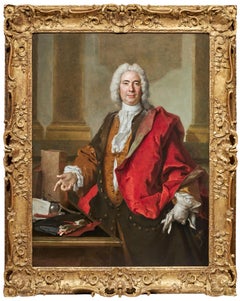
This sumptuous ceremonial portrait, executed around 1725-1730, depicts Monsieur Aubert, the French General Comptroller of Bridges and Roadways, as we learn from a letter on the desk beside our model. The virtuoso treatment of the fabrics, the authoritative yet confident pose, the vigorous treatment of the two hands, are representative of Largillière's talent, here at the peak of his art as portraitist.
The portrait also has a rather extraordinary provenance: donated by Arnold S. Kirkeby, an American hotel magnate and real estate developer, it was exhibited during almost forty years in the collections of the Los Angeles County Museum, before being acquired in 2010 by the executors of Edmund de Rothschild's will to adorn his former home Exbury House (Hampshire), where it remained until its sale in 2022.
1. Nicolas de Largillière, a great European portraitist
Nicolas de Largillière (or Largillierre), one of Europe's premier painters of portraits, history paintings, and still lifes during the late seventeenth century and the first four decades of the eighteenth, was born in Paris in 1656. He was the son of a hatmaker and merchant who moved with his family to Antwerp in 1659. As a boy of nine, he traveled for the first time to London in the company of an associate of his father. After returning to Antwerp more than a year later, his artistic gifts were recognized and his father apprenticed him to Antoni Goubau (1616-1698), a painter genre scenes and landscapes. Something of a prodigy, he was admitted to the painters' Guild of Saint Luke when he was only seventeen. In 1675 he made a second trip to London, where he was employed at Windsor Castle and worked as a restorer under the direction of Italian painter and decorator Antonio Verrio (c. 1639-1707), who brought him to the attention of King Charles II (r. 1660-1685).
At this time Largillière painted several still life paintings in the manner of the Dutch and Flemish masters. Thereafter he practiced this branch of painting with consummate skill, a talent that allowed him to make brilliant use of flowers, fruit, and animals in some of his most ambitious portraits and contemporary history pictures.
In 1679 Largillière settled in Paris, where he specialized in baroque portraiture in the grand manner of Peter Paul Rubens (1577-1640), Anthony van Dyck (1599-1641), and Peter Lely (1618-1680). The Flemish battle painter Adam Frans van der Meulen (1631 or 1632-1690) introduced him to Charles Le Brun (1619-1690) who, as First Painter to King Louis XIV (r. 1643-1715) and director of the Académie royale de peinture et de sculpture, was the predominant figure in France's official art establishment. Upon his acceptance as a candidate for admission to the Académie, he agreed to execute as his diploma picture a large portrait of Le Brun (completed 1686, Paris, Musée du Louvre, eight photo in the gallery) seated in his studio surrounded by the accoutrements of his art and an oil study for the ceiling of Galerie des Glaces at Versailles.
In 1686, Largillière made a final trip to England, where he painted portraits of the newly crowned king, James II (r. 1685-1688) (Greenwich, National Maritime Museum) and his consort Mary of Modena...
Category
1720s Old Masters Portrait Paintings
Materials
Oil
Mercury and Io, a rediscovered painting by Jean-Baptiste Marie Pierre (ca. 1740)
Located in PARIS, FR
We would like to thank Mr. Nicolas Lesur for confirming the autograph nature of the entire composition after a direct examination of the painting on November 27, 2024.
This painting...
Category
1740s Old Masters Figurative Paintings
Materials
Canvas, Oil
Two royal portraits (the Duc d
Angoulême and the Duc de Berry) by H.P. Danloux
Located in PARIS, FR
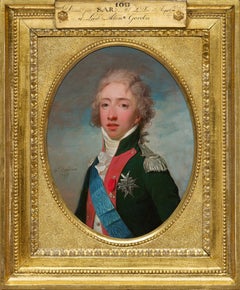
These two royal portraits are a major historical testimony to the stay of the Comte d'Artois (the future Charles X) and his family in Edinburgh in 1796-1797. Given by the sitters to Lord Adam Gordon, the Governor of Edinburgh, and kept by family descent to this day, these two portraits provide us with a vivid and spontaneous image of the Duc d’Angoulême and his brother the Duc de Berry. Danloux, who had emigrated to London a few years before, demonstrate his full assimilation of the art of British portrait painters in the brilliant execution of these portraits.
1. Henri-Pierre Danloux, a portraitist in the revolutionary turmoil
Born in Paris in 1753, Henri-Pierre Danloux was first a pupil of the painter Nicolas-Bernard Lépicié (1735 - 1784) and then, in 1773, of Joseph-Marie Vien (1716 - 1809), whom he followed to Rome when, at the end of 1775, Vien became Director of the Académie de France. In Rome he became friends with the painter Jacques-Louis David (1748 - 1825).
Returning to France around 1782, he settled in Lyon for a few years before returning to Paris in 1785. One of his first portraits was commissioned by the Baroness d'Etigny, the widow of the former Intendant of the Provinces of Gascony, Bearn and Navarre Antoine Mégret d'Etigny (1719 – 1767). He then became close to his two sons, Mégret de Sérilly and Mégret d'Etigny, who in turn became his patrons. In 1787, this close relationship with the d'Etigny family was further strengthened by his marriage to Antoinette de Saint-Redan, a relative of Madame d'Etigny. After his marriage, he left for Rome and did not return to France until 1789. It was during the winter of 1790-1791 that he painted one of his masterpieces, the portrait of Baron de Besenval. Set in a twilight atmosphere, this portrait of an aristocrat who knows that his death is imminent symbolizes the disappearance of an erudite and refined society which would be swept away by the French Revolution.
The Jacobin excesses led Danloux to emigrate to England in 1792; many members of his family-in-law who remained in France were guillotined on 10 May 1794. Danloux enjoyed great success as a portrait painter in England before returning to France in 1801.
During his stay in England, Danloux was deeply under the influence of English portraitists: his colors became warmer (as shown by the portrait of the Duc d'Angoulême that we are presenting), and his execution broader.
2. Description of the two portraits and biographical details of the sitters
The Duc d'Angoulême (1775-1844) was the eldest son of the Comte d'Artois, the younger brother of King Louis XVI (the future King Charles X), and his wife Marie-Thérèse of Savoie. He is shown here, in the freshness of his youth, wearing the uniform of colonel-general of the "Angoulême-Dragons" regiment.
He is wearing the blue cordon of the Order of the Holy Spirit, which was awarded to him in 1787, and two decorations: the Cross of Saint-Louis and the Maltese Cross, as he was also Grand Prior of the Order of Malta.
Born on 16 August 1775 in Versailles, Louis-Antoine d'Artois followed his parents into emigration on 16 July 1789. In 1792, he joined the émigrés’ army led by the Prince de Condé. After his stay in Edinburgh (which will be further discussed), he went to the court of the future King Louis XVIII, who was in exile at the time, and in 1799 married his first cousin Marie-Thérèse Charlotte of France, the daughter of Louis XVI and the sole survivor of the royal family. The couple had no descendants. He became Dauphin of France in 1824, upon the accession to the throne of his father but played only a minor political role, preferring his military position as Grand Admiral. Enlisted in Spain on the side of Ferdinand VII, he returned home crowned with glory after his victory at Trocadero in 1823.
He reigned for a very short time at the abdication of Charles X in 1830, before relinquishing his rights in favor of his nephew Henri d'Artois, the Duc de Bordeaux. He then followed his father into exile and died on 3 June 1844 in Gorizia (now in Italy).
His younger brother, the Duc de Berry, is shown in the uniform of the noble cavalry of the émigrés’ Army. He is wearing the blue cordon of the Order of the Holy Spirit, awarded to him in May 1789, and the Cross of Saint-Louis (partly hidden by his blue cordon).
Born on 24 January 1778 in Versailles, Charles-Ferdinand d'Artois also followed his parents into emigration and joined the émigrés’ army in 1792. After his stay in Edinburgh, he remained in Great Britain, where he had an affair with Amy Brown...
Category
1790s Old Masters Portrait Paintings
Materials
Canvas, Oil, Wood Panel
Portrait of Julien Prieur the bailiff of the Marquis d
Armentières as a Hunter
By Jean-Baptiste Oudry
Located in PARIS, FR
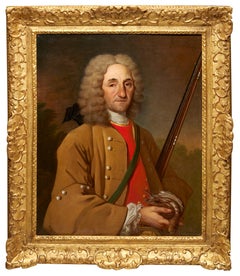
This portrait depicts us the trusted confidant of the Conflans d'Armentières family. More precisely, Julien Prieur was the fiscal procurator of the Marquisate of Armentières, playing...
Category
1730s Old Masters Portrait Paintings
Materials
Canvas, Oil
Portrait of an Ottoman Dignitary, a drawing by Giuseppe Nogari (ca. 1760)
Located in PARIS, FR
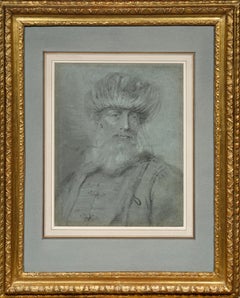
We would like to thank Mrs. Bozena Anna Kowalczyk for confirming the attribution of this drawing to Giuseppe Nogari in a study (available in Italian) from which we have taken our ins...
Category
1760s Old Masters Portrait Drawings and Watercolors
Materials
Chalk, Laid Paper
Three drawings by François Boucher in a mounting by Jean-Baptiste Glomy
By François Boucher
Located in PARIS, FR
We would like to thank Juliette Parmentier-Courreau of the Custodia Foundation for her welcome and support during the consultation of Glomy’s Journal des Ouvrages.
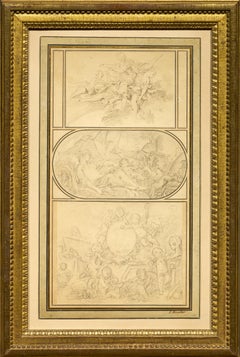
This spectacularly large "feuille de desseins ajustés" commissioned by François Boucher from Jean-Baptiste Glomy is emblematic of the painter's art and mastery of rocaille. It is also fully representative of the taste of this period in the field of decorative arts. The largest of these three drawings, placed at the bottom of the composition, is particularly interesting: dating from around 1756, it constitutes a modello (apparently unpublished) for the frontispiece of the "Catalogue des tableaux de Monsieur de Julienne"), preserved in the Morgan Library in New York.
1. François Boucher, the master of French rocaille
The extraordinary career of Francois Boucher was unmatched by his contemporaries in versatility, consistency and output. For many, particularly the writers and collectors who led the revival of interest in the French rococo during the last century, his sensuous beauties and plump cupids represent the French eighteenth century at its most typical. His facility with the brush, even when betraying the occasional superficiality of his art, enabled him to master every aspect of painting – history and mythology, portraiture, landscape, ordinary life and, as part of larger compositions, even still life. He had been trained as an engraver, and the skills of a draftsman, which he imbued in the studio of Jean-Francois Cars (1661 – 1738), stood him in good stead throughout his career; his delightful drawings are one of the most sought-after aspects of his oeuvre.
As a student of Francois Lemoyne (1688 - 1737), he mastered the art of composition. The four years he spent in Italy, from 1727-1731, educated him in the works of the masters, classics and history, that his modest upbringing had denied him.
On his return to Paris in 1734, he gained full membership of the Royal Academy of Painting and Sculpture with his splendid Rinaldo and Armida (Paris, Musée du Louvre). Although, throughout his career, he occasionally painted subjects taken from the Bible, and would always have considered himself first as a history painter, his own repertoire of heroines, seductresses, flirtatious peasant girls and erotic beauties was better suited to a lighter, more decorative subject matter. His mastery of technique and composition enabled him to move from large scale tapestry...
Category
1750s Old Masters Figurative Drawings and Watercolors
Materials
Chalk, Ink
You May Also Like
French School 18th century, Portrait of a gentleman, oil
Located in Paris, FR
French School 18th Century
Portrait of a gentleman holding his hat
Oil on paper transferred on wood panel
34 x 27 cm
Not signed which is normal for this type of artwork
In a beautifu...
Category
1760s Old Masters Portrait Paintings
Materials
Oil
Self Portrait of Artist - French 18th century art Old Master oil painting
Located in Hagley, England
This simply superb French Old Master self portrait oil painting is attributed to portrait artist Alexis Grimou. Painted circa 1720 it is a bust length standing portrait of the artist...
Category
1720s Old Masters Portrait Paintings
Materials
Oil
$13,180 Sale Price
20% Off
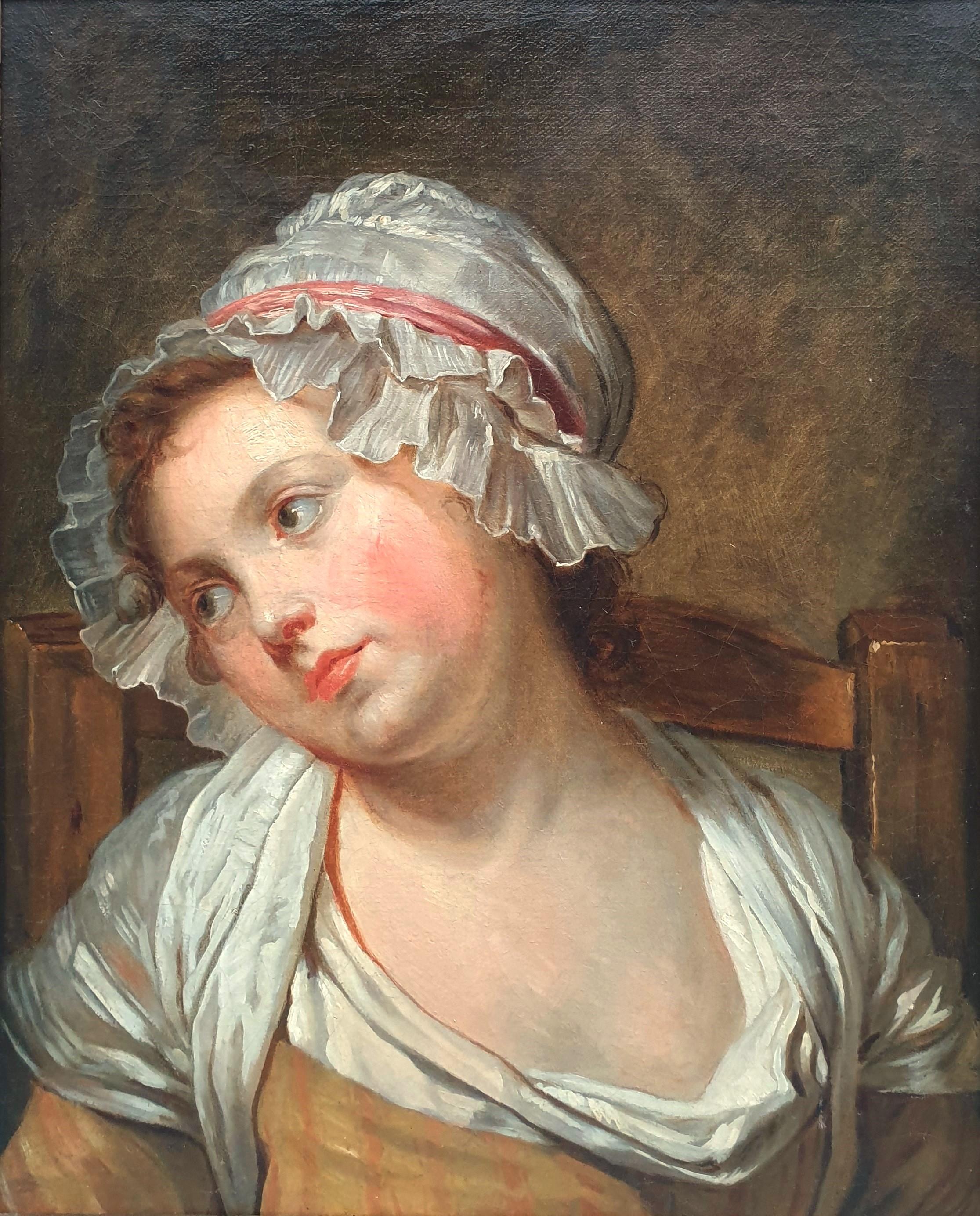
18th century french painting GREUZE Portrait of a young girl Oil on canvas
By Jean-Baptiste Greuze
Located in PARIS, FR
French school of the 18th century or the beginning of the 19th century After Jean-Baptiste GREUZE Tournus, 1725 – Paris, 1805 Oil on mounted canvas 46 x 38 cm (63.5 x 55 cm with the ...
Category
Early 19th Century French School Portrait Paintings
Materials
Oil
$2,412 Sale Price
55% Off
Portrait of Conrad Friedrich Hurlebusch, Early 18th Century Oil Painting
By Dominicus van der Smissen
Located in London, GB
Dominicus van der Smissen
Early 18th Century
Portrait of Conrad Friedrich Hurlebusch
Oil on canvas
Image size: 20½ x 16¼ inches
Period gilt frame
This is a portrait of Conrad Friedrich Hurlebusch, composer, Kapellmeister and organist, whom Van der Smissen most probably portrayed during his stay in Hamburg, Brunswick or Amsterdam. The identification is based on the reproduction of the portrait which was engraved by Pieter Anthony Wakkerdak (1740- 1774).
Van der Smissen has reduced the face of the sitters to an egg-shaped oval in three-quarter view, applying diminution to one half of the figure’s torso, which is farther away from the viewer. This partial side view, with the head turned to look at the viewer over the shoulder, creates spatial depth and brings the figure to life by avoiding the stiffness of a frontal depiction.
Because the artist chose to highlight the figure from above, a distinct shadow is cast under the tip of the nose, in the shape of a triangle. This is an often recurring and almost ‘signature’-like feature in Van der Smissen’s oeuvre.
Hurlebusch's garments are of a very high quality and serve to reflect the sitter’s wealth, status and elegance. During this period, gentlemen often shaved their heads in order to facilitate the wearing of a wig, which wouldbe worn with a suit. Here Hurlebusch has been depicted in a luxurious turban-like cap lined with lynx fur, a highly fashionable and expensive material at the time.
Over his shirt, he wears a velvet fur-lined gown adorned with decorative clasps fashioned from silver braid. The elegant informality of his appearance can be seen in his unbuttoned shirt and the unfastened black ribbon hanging from his button hole, which has been artfully arranged into a fluttering drape by the portraitist.
The Sitter
Hurlebusch was born in Brunswick, Germany. He received the first instructions in his field from his father Heinrich Lorenz Hurlebusch, who was also a musician. As an organ virtuoso, he toured Europe, visiting Vienna, Munich and Italy.
From 1723 to 1725 he was Kapellmeister in Stockholm; later he became Kapellmeister in Bayreuth and Brunswick, and lived in Hamburg from 1727 to 1742, where he had contact with fellow composers Johann Mattheson and Georg Philipp Telemann. He made his living composing, performing and teaching.
In 1735 and 1736, he is believed to have visited Johann Sebastian Bach in Leipzig, who promoted Hurlebusch’s compositions as the local seller...
Category
Early 18th Century Old Masters Portrait Paintings
Materials
Canvas, Oil
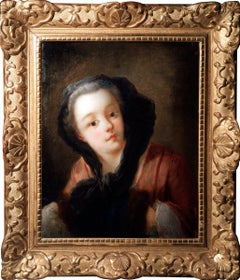
Jeune Femme Au Manchon Charles André Van Loo 1705/1765 (entourage)
Located in GOUVIEUX, FR
Titre :
Portrait de jeune femme à la coiffe noire
Artiste :
Entourage de Charles-André Van Loo (1705–1765)
École :
Française, XVIIIe siècle
Technique :
Huile sur panneau
Dimensio...
Category
Mid-18th Century French School Portrait Paintings
Materials
Oil
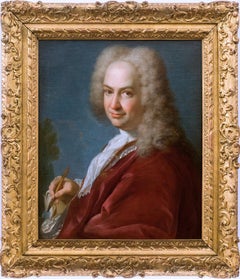
Presumed artist self-portrait
Located in BELEYMAS, FR
Louis-Gabriel BLANCHET
(Versailles, 1701 – Rome, 1772)
Presumed self-portrait of the artist
Oil on canvas
H. 73 cm; W. 60 cm
Circa 1730
Originally presented in a Restoration period frame with a "Mignard" cartouche, this beautiful painting initially appeared to us as a work from northern Italy. However, it exuded a rather French form of refinement, suggesting that its artist may have assimilated a dual influence from both sides of the Alps.
We thank our colleague and friend Philippe Mendès for spontaneously and judiciously "bringing out" the name of Louis-Gabriel Blanchet, a Romanized French portraitist, whose spirit and stylistic characteristics we clearly recognize here.
Blanchet's "French" years, before his final departure for Rome in 1728, following his winning of the second Grand Prix for painting after Subleyras in 1727, are extremely poorly documented. His father, Gabriel, was valet to Blouin, himself Louis XIV's first valet at the time. According to Thierry Lefrançois, Blanchet was one of the few students of Nicolas Bertin (1667-1736), whose studio he is said to have joined in the early 1720s. At a baptism on March 24, 1724, where he was godfather, he is mentioned as a painter in the picture store of the Duke of Antin, the director of buildings between 1708 and 1736. At this time, he was probably already married to Jeanne Quément, with whom he had a daughter also named Jeanne, who would marry Nicolas Aviet, the son of a valet in the queen's wardrobe, in Versailles in 1738.
When Blanchet arrived in Rome in October 1728, he was accompanied by Subleyras, Trémolières, and Slodtz. He enjoyed the goodwill of Vleughels, the director of the Académie de France, which had been based at the Palazzo Mancini since 1725, even though the latter was not always kind to our resident. From 1732, he was under the protection of the Duke of Saint-Aignan when he took up his post as ambassador to Rome. Along with Slodtz and Subleyras, they formed a trio of friends, joined by Joseph Vernet shortly after his arrival in Rome in 1734. Slodtz and Blanchet, on the occasion of Subleyras's marriage in 1739, were there to attest that their friend was not bound by any marital commitment, and Blanchet was a witness at Vernet's wedding in 1745.
It is most likely from these early years in Rome that our portrait of the artist dates, the expression and turn of his face irresistibly reminiscent of a self-portrait. The still relatively youthful features may correspond to Blanchet's thirty-something years, and the fluffy wig was still fashionable at this time.
The painting fits well with the depiction of a young painter wanting to display both the beginnings of success and a certain simplicity or restraint. A slight smile expresses a form of assurance in this man with a gentle, sincere gaze and a face radiating a keen sense of wit. We find here the air of intimacy present in almost all of Blanchet's portraits, even those from the 1750s and 1760s, as well as an almost complicity with the viewer. The spirit of the painting is quite close to that of the presumed portrait of Bouchardon (painted around 1730) and the portrait of Pannini, painted in 1736, but it possesses a more natural quality, notably thanks to the absence of decorum. Our work exhibits the characteristics of Blanchet's paintings: elegance, luminosity (especially in the whites), vibrant and refined colors (here, the harmony of the garnet of the garment and the slate blue of the background, whose uniformity is tempered by a very sketched landscape and a grove of greenery), light complexions, rather rosy cheekbones, often full lips, and rather tight framing.
According to the Academy's rules, Blanchet's stay should have ended in the spring of 1732, but, for reasons unknown, he remained in the Eternal City until his death, as did his friend Subleyras, with whom he shared accommodation until the late 1730s. The latter regularly called upon him to collaborate on his paintings, such as The Meal at Simon's. Through Saint-Aignan's intervention, Blanchet was employed in the late 1730s by the Stuart princely family, then exiled in Italy. He notably produced copies (now lost) after Liotard of the portraits of Charles Edward and Henry Benedict, the sons of James III Stuart. The latter also commissioned three other portraits (now in the National Portrait Gallery in London), whose more formal character contrasts with the intimate spirit of Blanchet's portraits. Blanchet frequented English painters, such as the landscape painter Richard Wilson, and studied with the Scottish portraitist Katherine Read...
Category
1730s French School Portrait Paintings
Materials
Oil, Canvas