Oversized Portrait Paintings

to
1,114
3,378
2,683
2,924
2,612
Overall Width
to
Overall Height
to
190
185
486
2,667
25
19
37
23
9
17
36
42
29
63
76
1,630
215
204
124
109
105
82
75
60
55
32
21
4
1
2,265
865
353
2,467
1,629
1,059
816
773
770
315
307
278
173
160
100
89
86
85
76
74
66
64
59
3,030
2,367
2,265
1,933
1,320
280
64
48
30
27
1,264
357
1,665
1,072
Size: Oversized
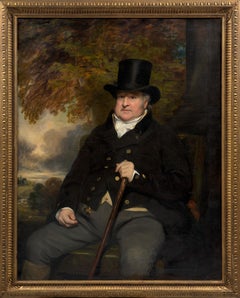
19th Century by Sir Henry Raeburn Portrait of a landowner Oil on canvas
Located in Milano, Lombardia
Sir Henry Raeburn (Stockbridge, Edinburgh, UK, 1756 - Edinburgh, UK, 1823) Title: Portrait of a landowner Year: Early 19th century, 1803 Medium: Oil on canvas Dimensions: Without fra...
Category

Early 19th Century Old Masters Portrait Paintings

Materials

Canvas, Oil

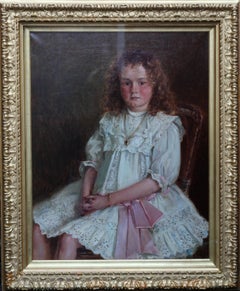
Portrait of a Young Welsh Girl - Enid Richards - British Edwardian Staithes art
By Ernest Higgins Rigg
Located in Hagley, England
A fine portrait oil on canvas by noted British Staithes listed artist Ernest Higgins Rigg. It is a super Edwardian portrait of Enid Richards and was painted at Govilon in Wales in 1...
Category

1910s Realist Portrait Paintings

Materials

Oil

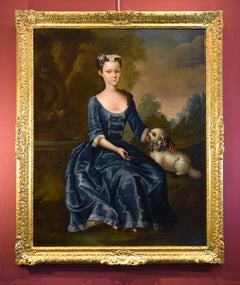
Portrait Woman Knapton Paint Oil on canvas 18th Century Old master English Art
Located in Riva del Garda, IT
George Knapton (London 1698 - 1778), attributable Portrait of a young aristocratic maiden sitting by a fountain in a garden in the company of a lamb Oil on canvas (127 x 102 cm - Fr...
Category

18th Century Old Masters Paintings

Materials

Oil

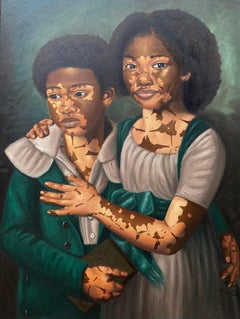
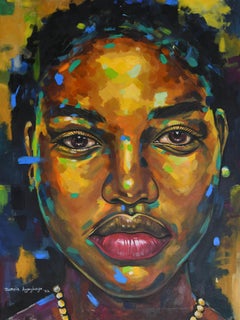
Sweet and Sour - 21st Century, Contemporary, Figurative, Portrait, Young Girls
Located in Ibadan, Oyo
Shipping Procedure Ships in a well-protected tube from Nigeria This work is unique, not a print or other type of copy. Accompanied by a Certificate of Authenticity (Issued by the Gal...
Category

21st Century and Contemporary Contemporary Figurative Paintings

Materials

Canvas, Oil

At the Mirror
Located in New Orleans, LA
the most important American Impressionists of his age. While many of his contemporaries focused on the landscape, Frieseke gained his inspiration from the figural, and in particular the theme of femininity. His works capture female figures engaging in traditionally feminine roles — strolling in the garden or posed in a domestic interior. At the Mirror...
Category

Early 20th Century Impressionist Nude Paintings

Materials

Oil, Canvas

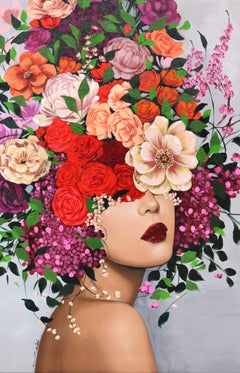
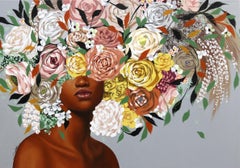
Margarite - Original Large Vibrant Floral Sally K Figurative Artwork
Located in Los Angeles, CA
Lebanese American artist Sally K.'s captivating floral portraits are both mesmerizing and empowering. Her pop-realistic paintings are inspired by strong, feminine women, celebrating ...
Category

21st Century and Contemporary Contemporary Portrait Paintings

Materials

Gold Leaf

Original Painting French Barbizon School 19th Century
Located in Saint-Ouen, FR
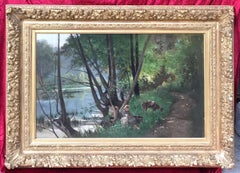
MORIN Charles Camille (1846 – 1919) The Girl with goats by the river Oil on canvas signed low left Old frame gilded with leaves Dim canvas : 58 X 91 cm Dim Frame : 88 X 112 cm MORI...
Category

1890s Barbizon School Landscape Paintings

Materials

Oil

Resurrection Christ Tiziano 16/17th Century paint Oil on canvas Old master Italy
By Tiziano Vecellio (Pieve di Cadore 1490 - Venice 1576)
Located in Riva del Garda, IT
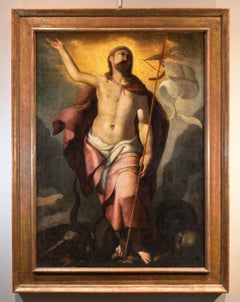
The Resurrection of Christ Follower of Tiziano Vecellio (Pieve di Cadore 1490 - Venice 1576)   Venetian school of the late 16th/early 17th century Oil on canvas 108 x 78 cm. - Framed 129 x 99 cm. This jewel of the Venetian school, a work executed between the 16th and 17th centuries by a Venetian artist, illustrates the episode of the Resurrection of Christ: as reported in the Gospel of Matthew (Matthew 28:1-7) the event is accompanied by an explosion of light and glow, with the figure of Christ rising into the sky. Christ's face, serene and victorious, looks up towards the Light and the Infinite, in contrast to his majestic figure, here constructed with the appearance of a classical sculpture, contrasted by an intensely luminous background. The Risen One firmly holds in His hand the banner (white with a red cross) of the Resurrection, also known as the flag of St. George, which iconographically represents His victory over death, while raising His right hand in a blessing act. With his feet he crushes a snake and a skull, a sign of Christ's triumph over sin and death. The painting belongs to the Venetian school and presents clear reminiscences with the works of Titian Vecellio...
Category

17th Century Old Masters Paintings

Materials

Oil

Red Roses - Large Textural Layered Painted Canvas Colorful Figurative Artwork
Located in Los Angeles, CA
Dynamic and abstract figurative artworks come to life through the hands of Amadou Opa Bathily, an artist deeply connected to movement. Born in Bamako in 1987, his journey into the wo...
Category

2010s Contemporary Portrait Paintings

Materials

Canvas, Mixed Media

"Elvis", Denied Andy Warhol Silver Black Pop Art Painting by Charles Lutz
Located in Brooklyn, NY
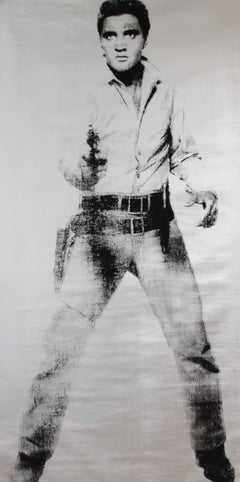
Elvis, Metallic Silver and Black Full Length Silkscreen Painting by Charles Lutz Silkscreen and silver enamel painted on vintage 1960's era linen with Artist's Denied stamp of the Andy Warhol Art Authentication Board. 82" x 40" inches 2010 Lutz's 2007 ''Warhol Denied'' series gained international attention by calling into question the importance of originality or lack thereof in the work of Andy Warhol. The authentication/denial process of the [[Andy Warhol Art Authentication Board]] was used to create value by submitting recreations of Warhol works for judgment with the full intention for the works to be formally marked "DENIED". The final product of the conceptual project being "officially denied" "Warhol" paintings authored by Lutz. Based on the full-length Elvis Presley paintings by Pop Artist Andy Warhol in 1964, this is likely one of his most iconic images, next to Campbell's Soup Cans and portraits of Jackie Kennedy, Marilyn Monroe, Liz Taylor, and Marlon Brando. This is the rarest of the Elvis works from the series, as Lutz sourced a vintage roll of 1960's primed artist linen which was used for this one Elvis. The silkscreen, like Warhol's embraced imperfections, like the slight double image printing of the Elvis image. Lutz received his BFA in Painting and Art History from Pratt Institute and studied Human Dissection and Anatomy at Columbia University, New York. Lutz's work deals with perceptions and value structures, specifically the idea of the transference of values. Lutz's most recently presented an installation of new sculptures dealing with consumerism at Frank Lloyd Wright's Fallingwater House in 2022. Lutz's 2007 Warhol Denied series received international attention calling into question the importance of originality in a work of art. The valuation process (authentication or denial) of the Andy Warhol Art Authentication Board was used by the artist to create value by submitting recreations of Warhol works for judgment, with the full intention for the works to be formally marked "DENIED" of their authenticity. The final product of this conceptual project is "Officially DENIED" "Warhol" paintings authored by Lutz. Later in 2013, Lutz went on to do one of his largest public installations to date. At the 100th Anniversary of Marcel Duchamp's groundbreaking and controversial Armory Show, Lutz was asked by the curator of Armory Focus: USA and former Director of The Andy Warhol Museum, Eric Shiner to create a site-specific installation representing the US. The installation "Babel" (based on Pieter Bruegel's famous painting) consisted of 1500 cardboard replicas of Warhol's Brillo Box (Stockholm Type) stacked 20 ft tall. All 1500 boxes were then given to the public freely, debasing the Brillo Box as an art commodity by removing its value, in addition to debasing its willing consumers. Elvis was "the greatest cultural force in the Twentieth Century. He introduced the beat to everything, and he changed everything - music, language, clothes, it's a whole new social revolution." Leonard Bernstein in: Exh. Cat., Boston, The Institute of Contemporary Art and traveling, Elvis + Marilyn 2 x Immortal, 1994-97, p. 9. Andy Warhol "quite simply changed how we all see the world around us." Kynaston McShine in: Exh. Cat., New York, Museum of Modern Art (and traveling), Andy Warhol: Retrospective, 1996, p. 13. In the summer of 1963 Elvis Presley was just twenty-eight years old but already a legend of his time. During the preceding seven years - since Heartbreak Hotel became the biggest-selling record of 1956 - he had recorded seventeen number-one singles and seven number-one albums; starred in eleven films, countless national TV appearances, tours, and live performances; earned tens of millions of dollars; and was instantly recognized across the globe. The undisputed King of Rock and Roll, Elvis was the biggest star alive: a cultural phenomenon of mythic proportions apparently no longer confined to the man alone. As the eminent composer Leonard Bernstein put it, Elvis was "the greatest cultural force in the Twentieth Century. He introduced the beat to everything, and he changed everything - music, language, clothes, it's a whole new social revolution." (Exh. Cat., Boston, The Institute of Contemporary Art (and traveling), Elvis + Marilyn 2 x Immortal, 1994, p. 9). In the summer of 1963 Andy Warhol was thirty-four years old and transforming the parameters of visual culture in America. The focus of his signature silkscreen was leveled at subjects he brilliantly perceived as the most important concerns of day to day contemporary life. By appropriating the visual vernacular of consumer culture and multiplying readymade images gleaned from newspapers, magazines and advertising, he turned a mirror onto the contradictions behind quotidian existence. Above all else he was obsessed with themes of celebrity and death, executing intensely multifaceted and complex works in series that continue to resound with universal relevance. His unprecedented practice re-presented how society viewed itself, simultaneously reinforcing and radically undermining the collective psychology of popular culture. He epitomized the tide of change that swept through the 1960s and, as Kynaston McShine has concisely stated, "He quite simply changed how we all see the world around us." (Exh. Cat., New York, Museum of Modern Art (and traveling), Andy Warhol: Retrospective, 1996, p. 13). Thus in the summer of 1963 there could not have been a more perfect alignment of artist and subject than Warhol and Elvis. Perhaps the most famous depiction of the biggest superstar by the original superstar artist, Double Elvis is a historic paradigm of Pop Art from a breath-taking moment in Art History. With devastating immediacy and efficiency, Warhol's canvas seduces our view with a stunning aesthetic and confronts our experience with a sophisticated array of thematic content. Not only is there all of Elvis, man and legend, but we are also presented with the specter of death, staring at us down the barrel of a gun; and the lone cowboy, confronting the great frontier and the American dream. The spray painted silver screen denotes the glamour and glory of cinema, the artificiality of fantasy, and the idea of a mirror that reveals our own reality back to us. At the same time, Warhol's replication of Elvis' image as a double stands as metaphor for the means and effects of mass-media and its inherent potential to manipulate and condition. These thematic strata function in simultaneous concert to deliver a work of phenomenal conceptual brilliance. The portrait of a man, the portrait of a country, and the portrait of a time, Double Elvis is an indisputable icon for our age. The source image was a publicity still for the movie Flaming Star, starring Presley as the character Pacer Burton and directed by Don Siegel in 1960. The film was originally intended as a vehicle for Marlon Brando and produced by David Weisbart, who had made James Dean's Rebel Without a Cause in 1955. It was the first of two Twentieth Century Fox productions Presley was contracted to by his manager Colonel Tom Parker, determined to make the singer a movie star. For the compulsive movie-fan Warhol, the sheer power of Elvis wielding a revolver as the reluctant gunslinger presented the zenith of subject matter: ultimate celebrity invested with the ultimate power to issue death. Warhol's Elvis is physically larger than life and wears the expression that catapulted him into a million hearts: inexplicably and all at once fearful and resolute; vulnerable and predatory; innocent and explicit. It is the look of David Halberstam's observation that "Elvis Presley was an American original, the rebel as mother's boy, alternately sweet and sullen, ready on demand to be either respectable or rebellious." (Exh. Cat., Boston, Op. Cit.). Indeed, amidst Warhol's art there is only one other subject whose character so ethereally defies categorization and who so acutely conflated total fame with the inevitability of mortality. In Warhol's work, only Elvis and Marilyn harness a pictorial magnetism of mythic proportions. With Marilyn Monroe, whom Warhol depicted immediately after her premature death in August 1962, he discovered a memento mori to unite the obsessions driving his career: glamour, beauty, fame, and death. As a star of the silver screen and the definitive international sex symbol, Marilyn epitomized the unattainable essence of superstardom that Warhol craved. Just as there was no question in 1963, there remains still none today that the male equivalent to Marilyn is Elvis. However, despite his famous 1968 adage, "If you want to know all about Andy Warhol, just look at the surface of my paintings" Warhol's fascination held purpose far beyond mere idolization. As Rainer Crone explained in 1970, Warhol was interested in movie stars above all else because they were "people who could justifiably be seen as the nearest thing to representatives of mass culture." (Rainer Crone, Andy Warhol, New York, 1970, p. 22). Warhol was singularly drawn to the idols of Elvis and Marilyn, as he was to Marlon Brando and Liz Taylor, because he implicitly understood the concurrence between the projection of their image and the projection of their brand. Some years after the present work he wrote, "In the early days of film, fans used to idolize a whole star - they would take one star and love everything about that star...So you should always have a product that's not just 'you.' An actress should count up her plays and movies and a model should count up her photographs and a writer should count up his words and an artist should count up his pictures so you always know exactly what you're worth, and you don't get stuck thinking your product is you and your fame, and your aura." (Andy Warhol, The Philosophy of Andy Warhol (From A to B and Back Again), San Diego, New York and London, 1977, p. 86). The film stars of the late 1950s and early 1960s that most obsessed Warhol embodied tectonic shifts in wider cultural and societal values. In 1971 John Coplans argued that Warhol was transfixed by the subject of Elvis, and to a lesser degree by Marlon Brando and James Dean, because they were "authentically creative, and not merely products of Hollywood's fantasy or commercialism. All three had originative lives, and therefore are strong personalities; all three raised - at one level or another - important questions as to the quality of life in America and the nature of its freedoms. Implicit in their attitude is a condemnation of society and its ways; they project an image of the necessity for the individual to search for his own future, not passively, but aggressively, with commitment and passion." (John Coplans, "Andy Warhol and Elvis Presley," Studio International, vol. 181, no. 930, February 1971, pp. 51-52). However, while Warhol unquestionably adored these idols as transformative heralds, the suggestion that his paintings of Elvis are uncritical of a generated public image issued for mass consumption fails to appreciate the acuity of his specific re-presentation of the King. As with Marilyn, Liz and Marlon, Warhol instinctively understood the Elvis brand as an industrialized construct, designed for mass consumption like a Coca-Cola bottle or Campbell's Soup Can, and radically revealed it as a precisely composed non-reality. Of course Elvis offered Warhol the biggest brand of all, and he accentuates this by choosing a manifestly contrived version of Elvis-the-film-star, rather than the raw genius of Elvis as performing Rock n' Roll pioneer. A few months prior to the present work he had silkscreened Elvis' brooding visage in a small cycle of works based on a simple headshot, including Red Elvis, but the absence of context in these works minimizes the critical potency that is so present in Double Elvis. With Double Elvis we are confronted by a figure so familiar to us, yet playing a role relating to violence and death that is entirely at odds with the associations entrenched with the singer's renowned love songs. Although we may think this version of Elvis makes sense, it is the overwhelming power of the totemic cipher of the Elvis legend that means we might not even question why he is pointing a gun rather than a guitar. Thus Warhol interrogates the limits of the popular visual vernacular, posing vital questions of collective perception and cognition in contemporary society. The notion that this self-determinedly iconic painting shows an artificial paradigm is compounded by Warhol's enlistment of a reflective metallic surface, a treatment he reserved for his most important portraits of Elvis, Marilyn, Marlon and Liz. Here the synthetic chemical silver paint becomes allegory for the manufacture of the Elvis product, and directly anticipates the artist's 1968 statement: "Everything is sort of artificial. I don't know where the artificial stops and the real starts. The artificial fascinates me, the bright and shiny..." (Artist quoted in Exh. Cat., Stockholm, Moderna Museet and traveling, Andy Warhol, 1968, n.p.). At the same time, the shiny silver paint of Double Elvis unquestionably denotes the glamour of the silver screen and the attractive fantasies of cinema. At exactly this time in the summer of 1963 Warhol bought his first movie camera and produced his first films such as Sleep, Kiss and Tarzan and Jane Regained. Although the absence of plot or narrative convention in these movies was a purposely anti-Hollywood gesture, the unattainability of classic movie stardom still held profound allure and resonance for Warhol. He remained a celebrity and film fanatic, and it was exactly this addiction that so qualifies his sensational critique of the industry machinations behind the stars he adored. Double Elvis was executed less than eighteen months after he had created 32 Campbell's Soup Cans for his immortal show at the Ferus Gallery, Los Angeles in July and August 1962, and which is famously housed in the Museum of Modern Art, New York. In the intervening period he had produced the series Dollar Bills, Coca-Cola Bottles, Suicides, Disasters, and Silver Electric Chairs, all in addition to the portrait cycles of Marilyn and Liz. This explosive outpouring of astonishing artistic invention stands as definitive testament to Warhol's aptitude to seize the most potent images of his time. He recognized that not only the product itself, but also the means of consumption - in this case society's abandoned deification of Elvis - was symptomatic of a new mode of existence. As Heiner Bastian has precisely summated: "the aura of utterly affirmative idolization already stands as a stereotype of a 'consumer-goods style' expression of an American way of life and of the mass-media culture of a nation." (Exh. Cat., Berlin, Neue Nationalgalerie (and traveling), Andy Warhol: Retrospective, 2001, p. 28). For Warhol, the act of image replication and multiplication anaesthetized the effect of the subject, and while he had undermined the potency of wealth in 200 One Dollar Bills, and cheated the terror of death by electric chair in Silver Disaster # 6, the proliferation of Elvis here emasculates a prefabricated version of character authenticity. Here the cinematic quality of variety within unity is apparent in the degrees to which Presley's arm and gun become less visible to the left of the canvas. The sense of movement is further enhanced by a sense of receding depth as the viewer is presented with the ghost like repetition of the figure in the left of the canvas, a 'jump effect' in the screening process that would be replicated in the multiple Elvis paintings. The seriality of the image heightens the sense of a moving image, displayed for us like the unwinding of a reel of film. Elvis was central to Warhol's legendary solo exhibition organized by Irving Blum at the Ferus Gallery in the Fall of 1963 - the show having been conceived around the Elvis paintings since at least May of that year. A well-known installation photograph shows the present work prominently presented among the constant reel of canvases, designed to fill the space as a filmic diorama. While the Elvis canvases...
Category

21st Century and Contemporary Pop Art Figurative Paintings

Materials

Enamel

[Bruce Sargeant (1898-1938)] Man with Ropes and Rings
Located in New York, NY
Oil on canvas mounted to Masonite Signed in red, u.r. $7000.00 + $350.00 framing This artwork is offered by ClampArt, located in New York City. “Bruce Sargeant is a mythic figure ...
Category

21st Century and Contemporary Realist Portrait Paintings

Materials

Canvas, Oil, Masonite

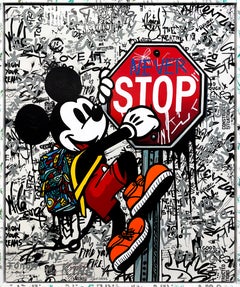
The Climber (Mickey Mouse), large original painting with custom painted frame
Located in Aventura, FL
Original acrylic painting on canvas. Hand signed on front; signed and titled on verso by Jozza. Canvas size: 48 x 40 inches. Frame size: 49.75 x 41.62 x 2 (white floating frame hand ...
Category

2010s Street Art Portrait Paintings

Materials

Canvas, Acrylic

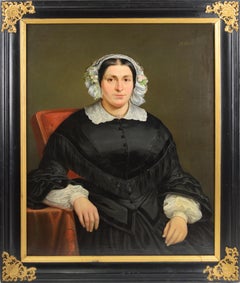
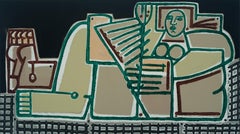
Portrait of Gerardina Van Osch by Dutch artist Johan Hendrik Neuman (Dutch)
Located in Soquel, CA
A beautiful realist mid 19th century portrait of Gerardina Van Osch (Dutch, 1819-1898) by Jan Hendrik Neuman (Johan Heinrich Neuman) (German, 1819-1898). S...
Category

Mid-19th Century Realist Figurative Paintings

Materials

Linen, Oil

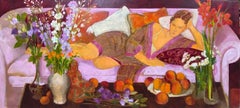
Raquel. Large format interior with woman portrait and still-life
Located in Segovia, ES
"Raquel" is an interior scene of a young woman, stretched out comfortably on a sofa, surrounded by flowers and fruit. She gazes placidly at the artist, who is portraying her dressed in a nightgown and a colorful dressing gown. Oil on canvas. 2003 Measurements: 90 x 200 cm / 35,43 x 78,74" The rich range of colors used and the relaxed gesture of the model envelop the atmosphere of comfort that prevails in the works of this author because, according to his words: “When I use a model I want her to be very comfortable, rested, calm and relaxed. I am not interested in movement in my work, as it always ends up too artificial for my taste and would interfere with the ambiance I am trying to create”. The flattened perspectives, the fractured surfaces, and the graphic stylizations refer to the cubism of Picasso and Juan Gris. There are echoes of Modigliani in the treatment of his female models and we can detect an homage to Gauguin and Matisse, in his playful and sensual manipulation of color. In 2003 Ediciones Sammer publishes in a deluxe edition the book Alfredo Roldán written by the sculptor David Gamella where a large part of his work is reproduced. This painting, Raquel, is reproduced on the cover of the book and also inside on a double page (294-295). ABOUT THE ARTIST Alfredo Roldán (Madrid- Spain, 1965) is a self-taught artist who, at the age of 22, began selling his works at street markets. In 1994 he won the award granted by the City Council of Madrid with the painting “El Baño Azul”, which now hangs in The Museum of Modern Art of Madrid. That year he began to work with the renowned British dealer...
Category

Early 2000s Modern Portrait Paintings

Materials

Canvas, Oil

Sleeping Girls - contemporary, figurative, portrait, acrylic, oil on board
Located in Bloomfield, ON
This realistic painting, a portrait of children, is by internationally recognized artist Daniel Hughes. Daniel Hughes is known best perhaps for his true-to-life figurative paintings. Early in his life, Hughes was strongly influenced by the work of his artist mother and her friends, many of whom were renowned British artists. He grew up drawing…never in color books but on six-foot lengths of computer paper. Hughes was especially drawn to the figurative paintings of British artists of the 1950s. His aesthetic focuses on a realistic interpretation, composition, light, harmony, and emotion. Hughes' work, like this acrylic and charcoal painting of two little girls sleeping...
Category

2010s Realist Portrait Paintings

Materials

Oil, Board

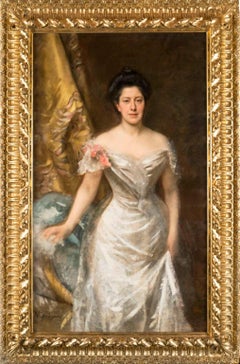
Dipinto Figurativo toscano ritratto femminile nobile belle époque del XIX secolo
Located in Florence, IT
Ritratto femminile (olio su tela, 154,5 x 92 cm; con cornice dorata e intagliata, 188 x 123,5 cm). È firmato in basso a sinistra MGordigiani. Il nostro dipinto, a figura di tre-qua...
Category

Late 19th Century Art Nouveau Portrait Paintings

Materials

Canvas, Oil

Purpose of Existence 8
Located in Ibadan, Oyo
Shipping Procedure FREE Shipping Worldwide Ships in a well-protected tube from Nigeria This work is unique, not a print or other type of copy. Accompanied by a Certificate of Authent...
Category

21st Century and Contemporary Contemporary Portrait Paintings

Materials

Canvas, Acrylic

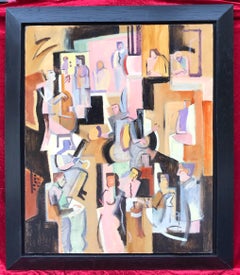
Jazz Musicians
Located in Saint-Ouen, FR
Jacques Henri GUYOT (1946) Jazz Musicians Oil on Wood with modern black wood frame Size panel : 100 X 78 cm Size frame : 120 X 98 cm Certificate fr...
Category

1980s Cubist Portrait Paintings

Materials

Oil

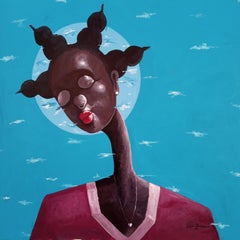
Healing 2 - 21st Century, Contemporary, Figurative Portrait, Women, Blue, Africa
Located in Ibadan, Oyo
It takes a long time to heal as a human in this situation blue helps in calming the mind both physically and mentally blue also indicates serenity and contentment. Shipping Procedur...
Category

21st Century and Contemporary Neo-Expressionist Figurative Paintings

Materials

Canvas, Acrylic

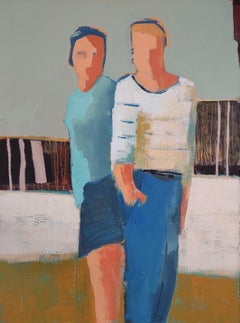
Couple, Original Painting
Located in San Francisco, CA

Artist Comments
Two figures stand side by side. Their faceless features strip away their identity, focusing on their presence and connection. Simple, strong shapes express thei...

Category

21st Century and Contemporary Contemporary Figurative Paintings

Materials

Acrylic

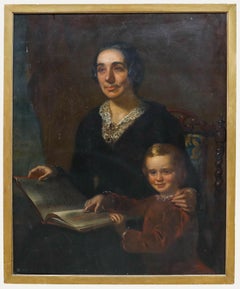
Large Late 19th Century Oil - Portrait of a Mother Child
Located in Corsham, GB
This intimate 19th-century portrait captures a tender moment between a mother and child, both engaged in reading an illustrated book. The arrangement of the composition creates a sen...
Category

Late 19th Century Portrait Paintings

Materials

Oil

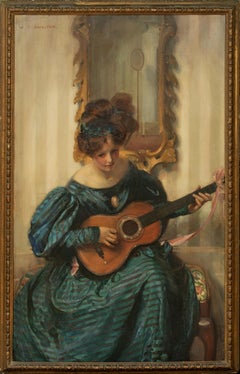
Portrait of a Lady Playing The Guitar, 19th Century by WALTER ERNEST WEBSTER
Located in Blackwater, GB
Portrait of a Lady Playing The Guitar, early 20th Century by WALTER ERNEST WEBSTER (1877-1959) Large early 20th Century portrait of a lady playing the guitar, oil on canvas by Wal...
Category

Early 20th Century Portrait Paintings

Materials

Canvas, Oil

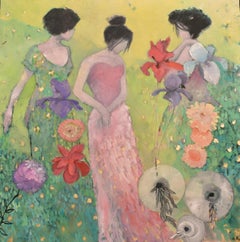
Flowers and Figures, Oil Painting
Located in San Francisco, CA

Artist Comments
Three figures in colorful dresses stand gracefully amidst a lush, fantasy garden. Oversized flowers in soft pastel tones add a surreal feel to the scene. The ...

Category

21st Century and Contemporary Contemporary Figurative Paintings

Materials

Oil

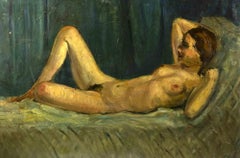
Nude - Painting by Antonio Feltrinelli - 1930s
Located in Roma, IT
Nude is an orignal modern artwork realized by Antonio Feltrinelli in 1930s. Mixed colored oil painting on canvas. Not signed. Antonio Feltrinell...
Category

1930s Modern Figurative Paintings

Materials

Paint, Oil

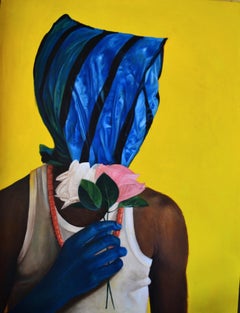
Random Thought
Located in Ibadan, Oyo
"Random Thought," a captivating creation by artist John Ali, invites viewers into the enigmatic realm of introspection. The artwork features a young man, his head covered with nylon, adorned by an intricate African bead necklace...
Category

21st Century and Contemporary Conceptual Portrait Paintings

Materials

Canvas, Oil

Random Thought
Random Thought
$2,480 Sale Price
20% Off
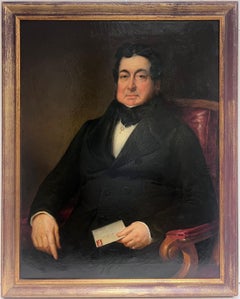
Very Large Mid 19th Century Victorian Portrait English Gentleman Seated Leather
Located in Cirencester, Gloucestershire
The Victorian English Gentleman Portrait of a Man seated in a leather chair, holding a letter in his hand. oil on canvas , framed framed: 41 x 33 inches canvas: 36 x 28 inches prove...
Category

Mid-19th Century Victorian Portrait Paintings

Materials

Oil, Canvas

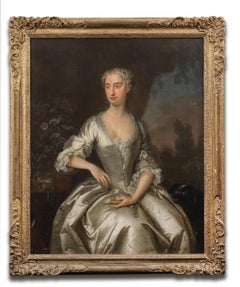
Portrait of Ann Austen, nee Grey
Located in London, GB
Signed 'BDandridge/ pinxit' lower left Provenance By descent through the sitter's family to The Collection of R. W. Vivian-Neal of Poundisford Park, Somerset, from whom acquired by With Lane Fine Art, UK, where purchased by the present owners in 1996 Literature 'Poundisford Park, Somerset' in Country Life, 22 December 1934, ill. A.W. and C.M. Vivian-Neal, Poundisford Park, Somerset: A catalogue of pictures and furniture, Taunton 1939, cat. nos. 11 and 13 This is a portrait of Ann Austen, nee Grey, three-quarter-length seated in a landscape with her dog. Painted in a superb white satin dress, she holds horn spectacles and a spectacle case...
Category

Mid-18th Century English School Portrait Paintings

Materials

Oil

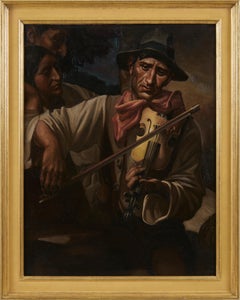
The Stonecutter s Evening, Early 20th Century American Scene Oil, Man w/ Violin
Located in Beachwood, OH
Frank Nelson Wilcox (American, 1887-1964) The Stonecutter's Evening, c. 1915 Oil on canvas Signed lower right 36 x 27.5 inches 42.25 x 34 inches, framed Frank Nelson Wilcox (October 3, 1887 – April 17, 1964) was a modernist American artist and a master of watercolor. Wilcox is described as the "Dean of Cleveland School painters," though some sources give this appellation to Henry Keller or Frederick Gottwald. Wilcox was born on October 3, 1887 to Frank Nelson Wilcox, Sr. and Jessie Fremont Snow Wilcox at 61 Linwood Street in Cleveland, Ohio. His father, a prominent lawyer, died at home in 1904 shortly before Wilcox' 17th birthday. His brother, lawyer and publisher Owen N. Wilcox, was president of the Gates Legal Publishing Company or The Gates Press. His sister Ruth Wilcox was a respected librarian. In 1906 Wilcox enrolled from the Cleveland School of Art under the tutelage of Henry Keller, Louis Rorimer...
Category

1910s American Modern Figurative Paintings

Materials

Oil

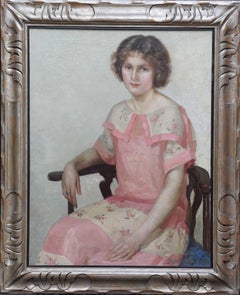
Portrait of a Lady in Pink Dress - British 1920 s Art Deco portrait oil painting
Located in Hagley, England
This lovely British Art Deco portrait oil painting is by noted portrait artist James Penniston Barraclough. It was painted in 1923 and is signed and dated lower right. The compositio...
Category

1920s Art Deco Portrait Paintings

Materials

Oil

Portrait of Violet Ann Gilbert - British 1920s art oil painting exh Paris Salon
Located in Hagley, England
A stunning portrait oil painting of Violet Ann Gilbert which was painted by James Peter Quinn in 1929 and was exhibited at The Paris Salon of that year. A beautiful portrait of a young woman from the nineteen twenties. In excellent condition and framed in the original period frame. This is a fine painting by a noted listed artist and a great example of an early 20th century portrait painting. Signed lower left. Provenance. Exhibited at the Paris Salon 1929, labels verso. Condition. Oil on canvas in excellent condition, image size 40 inches by 30 inches. Housed in its original gallery frame, framed size is 47 by 37 inches. Excellent condition. James Peter Quinn (1869-1951) was born on 4 December 1869 at 60 Bourke Street, Melbourne, third son of John Quinn, restaurant-keeper born in Antigua, West Indies, and his English wife Ann, née Long. Little is known of Quinn's childhood and early education; both parents died when he was young. His guardians apprenticed him to an engraver, but he undertook part-time studies at the school of design, National Gallery of Victoria, under Frederick McCubbin in 1887-89, and at the school of painting under George Folingsby and Bernard Hall in 1890-93. Awarded several student prizes, he won the gallery's travelling scholarship in 1893. Quinn went to London in 1894 but quickly left for Paris where he studied at the Académie Julian, at the Académie des Beaux-Arts under Jean Paul Laurens, and with Colarossi and Delécluse. He returned to London about 1902 and married fellow art-student Blanche Louise Guernier there on 29 September. By 1904 he had exhibited with the Royal Academy of Arts and went on to establish a reputation as a highly successful portrait painter. His finest and most sensitive work was produced before 1910. His family were the subjects of many paintings, including 'Mère et Fils', awarded an honourable mention at the Old Salon, Paris, in 1912. He also painted many self-portraits. His many commissioned works included portraits of Joseph Chamberlain, the Duchess of York and, later, the Duke of Windsor. In 1918-19 he was an official war artist with the Australian Imperial Force in France, and exhibited war paintings at the Grafton Galleries, London. In 1919, with George Coates, he was an official artist to the Canadian War Records. He was a council-member of the London Portrait Society, and a member of the Royal Society of Portrait Painters and the Royal Institute of Oil Painters, exhibiting regularly with them and the Royal Academy, and in Paris with the Old and New salons. Quinn's sudden return to Australia in December 1935, alone, followed the death of his gifted artist-son René. He held exhibitions at the Fine Art Society's Gallery, Melbourne, in 1936 and the Royal South Australian Society of Arts Gallery the next year. Quinn ostensibly returned as an acclaimed artist, was invited to rejoin the Victorian Artists' Society he had joined first in 1888, and was its president (but for one year) in 1937-50. Yet a coolness existed. Though he had little in common with the modernist painters of the period, his commitment to a tolerant brotherhood of artists found no allies among the aggressively conservative old guard. In 1937 he clashed publicly with (Sir) Robert Menzies who in opening a V.A.S. exhibition denigrated modern art. In spite of the affection felt for him by many artists and students, Quinn was somewhat isolated. He continued to exhibit, winning the Crouch prize, Ballarat Fine Art Gallery, in 1941. In the mid-1940s he taught briefly at the National Gallery school. A lover of good food, wine and conversation, Quinn delighted in mixing with all classes. Frequenting the haunts of journalists, writers and the more Bohemian fringe, he was easily recognizable with his bow tie, grey curly hair and cigarette dangling from the corner of his mouth. Survived by one son, he died of cancer on 18 February 1951 at Prahran and was buried in St Kilda cemetery. His war portraits are held by the Australian War...
Category

1920s Art Deco Portrait Paintings

Materials

Oil

French School c.1900 Oil - The Sisters
Located in Corsham, GB
A charming oil study depicting two young girls and their spaniel dog in a pastoral setting. The artist takes inspiration from 18th century portraiture, using a soft palette and roman...
Category

Early 20th Century Portrait Paintings

Materials

Oil

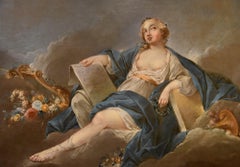
Allegory Poetry Trémolières Paint 18th Century OIl on canvas Old master France
Located in Riva del Garda, IT
Pierre Charles Trémolières (Cholet, 1703 - Paris, 1739) Allegory of Poetry (the Muse Calliope) Oil on canvas (86 x 112 cm - In original lacquered frames 122 x 95 cm.) Work ac...
Category

18th Century Old Masters Paintings

Materials

Oil

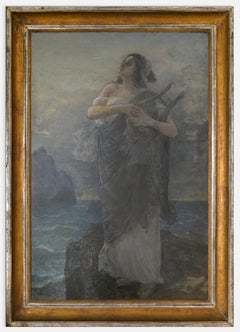
Lady with Harp - Oil Paint by Symbolist Painter - 19th Century
Located in Roma, IT
Lady with harp is a modern artwork realized by Symbolist Painter of late 19 Century. Symbolistic painting of a lady with harp standing on a rock by the sea. Mixed colored oil on ca...
Category

19th Century Modern Portrait Paintings

Materials

Oil

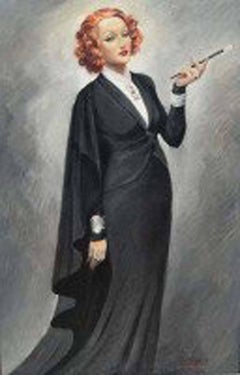
Portrait of Marelen Dietrich
Located in West Hollywood, CA
Jean Dominique Van Caulert, (1897-1979), although most often associated with his celebrity portraits and works for the theater, he was also a true symbolist in the tradition of the B...
Category

1930s Art Deco Figurative Paintings

Materials

Oil

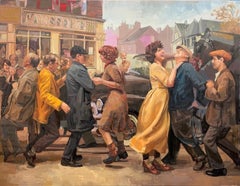
Dancing Plague - Colorful and Joyous Painting of a Dancing Crowd - Ben Duke
Located in Chicago, IL
**This artwork is on exhibition and if purchased will be available to ship after June 15, 2025 Choreomania refers to a phenomenon that occurred during the medieval and early modern ...
Category

21st Century and Contemporary Contemporary Figurative Paintings

Materials

Canvas, Oil

Melanie - Original Sally K Figurative Artwork
Located in Los Angeles, CA
Lebanese American artist Sally K.'s captivating floral portraits are both mesmerizing and empowering. Her pop-realistic paintings are inspired by strong, femi...
Category

21st Century and Contemporary Contemporary Portrait Paintings

Materials

Canvas, Acrylic

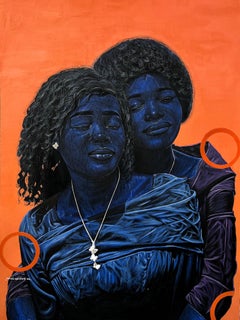
Where Love Resides(We are Sisters) -21st Century, Contemporary, Figurative Women
Located in Ibadan, Oyo
Shipping Procedure Ships in a well-protected tube from Nigeria This work is unique, not a print or other type of copy. Accompanied by a Certificate of Authenticity (Issued by the Gal...
Category

21st Century and Contemporary Contemporary Portrait Paintings

Materials

Canvas, Charcoal, Mixed Media, Acrylic

Woman VIII - XXI Century Contemporary Oil Tempera on Canvas Painting, Portrait
Located in Warsaw, PL
ARTIST: Joanna Rusinek (1979) Polish contemporary painter. Diploma at the Academy of Fine Arts in Gdańsk in 2007 at the Graphics Studio under the supervision of prof. Jadwiga Okras...
Category

21st Century and Contemporary Feminist Portrait Paintings

Materials

Canvas, Oil, Tempera

Happiness. Figurative Acrylic Painting, Minimalism, Pop art, Polish art
Located in Warsaw, PL
Contemporary figurative acrylic on canvas painting by Polish artist Joanna Woyda. Painting is in minimalistic, pop art style. The artwork depicts a girl standing on the shoreline, sh...
Category

2010s Pop Art Figurative Paintings

Materials

Canvas, Acrylic

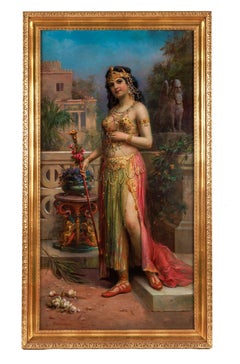
Emanuel Oberhauser (Austrian, 1854 - 1919) Full Length "Orientalist Queen" Oil
Located in Queens, NY
Emanuel Oberhauser (Austrian, 1854 - 1919) An Exceptional quality full length oil on canvas painting of a Young Orientalist Queen / Odalisque. 19th ...
Category

19th Century Portrait Paintings

Materials

Oil

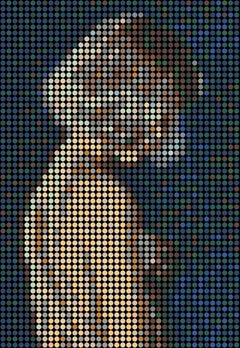
Dimitri Likissas - Pensive Solitaire, Painting 2022
Located in Stamford, CT
Series: Figurative Oil Enamel Paint on Canvas I consider each colored dot to be like a person. You and me and everyone. Together we all make up that image shown. You will notice tha...
Category

2010s Contemporary Abstract Paintings

Materials

Canvas, Oil, Acrylic

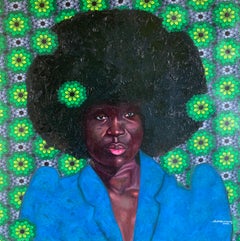
Regal Beauty 1
Located in Ibadan, Oyo
Regal Beauty 1 is an oil painting that showcases the elegance and majesty of a black African woman. The subject is depicted with an afro hairstyle and a tribal mark on her face, which highlights her cultural identity and connection to her African roots. The Ankara fabric provides the backdrop, adding texture and depth to the piece and making the subject stand out even more. The oil on Ankara fabric medium creates a stunning visual effect, bringing out the richness of the colors and capturing the subject's beauty and strength. This painting serves as a tribute to the beauty, elegance, and resilience of African women and is a powerful reminder of the importance of cultural appreciation and representation. Shipping Procedure: Ships in a well-protected tube from Nigeria. This work is unique, not a print or other type of copy. Accompanied by a Certificate of Authenticity. About Artist Bakare Babatunde...
Category

21st Century and Contemporary Expressionist Portrait Paintings

Materials

Fabric, Oil

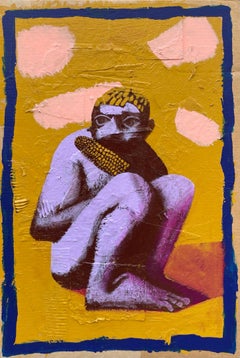
Summer Gold and Corn - Contemporary Art, Figurative, Yellow
Located in Baden-Baden, DE
Summer Gold and Corn, 2021 acrylic on cardboard 119 H x 79 W cm 46 27/32 H x 31 7/64 W cm The series of painted cardboards by Alexandru Rădvan is about our moments of 'respiro' abo...
Category

2010s Contemporary Figurative Paintings

Materials

Acrylic, Cardboard

Abstraction. Contemporary Abstract Oil Painting, Colorful, Dynamic, Polish art
Located in Warsaw, PL
Approxiate dimensions of this painting are 140 x 110 cm, unstretched canvas is 157 x 113,5 cm Abstract painting by Polish artist living in USA Monika Rossa. Painting in style of ges...
Category

21st Century and Contemporary Contemporary Figurative Paintings

Materials

Canvas, Oil

"The Three B s of Music" Beethoven, Bach, Brahms, An Extremely Rare Painting
Located in Queens, NY
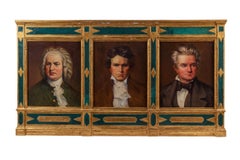
"The Three B's of Music" Beethoven, Bach, and Brahms, An Extremely Rare Oil Painting, C. 1880 "A true music lovers dream" - A true work of art. A very rare and collectible oil on canvas triptych painting depicting portraits of "The Three Bs of Classical Music": Bach, Beethoven, and Brahms - Housed in a fine carved and painted frame in gold gilt and green paint by Frederick Harer, with musical scores underneath each portrait. The paintings appear to be unsigned. The frame is signed on the back "F. W. Harer" and dated 1918. Each canvas: 17" high x 14" wide Outside frame: 29" high x 52.5" wide Provenance: Academy of Music, Philadelphia PA. Very good condition overall, no damages noted. Paintings are relined, some gold gilt highlights are rubbed in some areas of the frame. Frederick Harer was an American painter, sculptor and etcher, best known for his skill as a gilder and frame maker. He produced frames for many of the Pennsylvania Impressionist painters, including Edward Redfield and Daniel Garber. Today, having a Harer frame on a Pennsylvania Impressionist painting...
Category

19th Century Portrait Paintings

Materials

Canvas, Oil

Empress II - Original Sally K Figurative Portrait Artwork on Canvas
Located in Los Angeles, CA
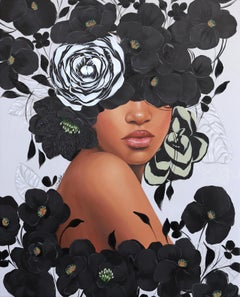
Lebanese American artist Sally K.'s captivating floral portraits are both mesmerizing and empowering. Her pop-realistic paintings are inspired by strong, feminine women, celebrating the individuality and inherent strength of the female experience. Each painting features endless floral arrangements that frame the mysterious visages of beautiful women, creating a stunning celebration of floral abstraction and wild, fanciful coloration. Lavish in application and luxurious in composition, Sally K.'s work is inspired by pop art, culture, and fashion, resulting in a powerful, visually stunning artwork that captures the essence of femininity. This monochrome 47-inch high by 38-inch wide painting is created with acrylic paint with green paint accents on canvas. It is stretched, wired, and ready to hang. This floral figurative artwork is signed by the artist on the front of the artwork. The sides are a continuation of the painting and it is stretched, wired, and ready to hang. Free local Los Angeles area delivery. Convenient U.S. and global shipping is available. A certificate of authenticity issued by the art gallery is included. Sally K. is an Ohio-born artist of Lebanese heritage who spent her formative years in Saudi Arabia before attending high school and college in Beirut. She graduated with distinction from the Lebanese American University of Beirut, earning a BA in Fine Arts. After moving back to the United States in 2013, Sally K. and her family eventually relocated once more to Qatar in 2019. Sally's multicultural background and diverse experiences inform her artistic vision, resulting in a unique style that blends Middle Eastern and Western influences. Sally K's work is a celebration of femininity, strength, and individuality, reflecting her own journey as a woman and artist. Her captivating portraits of contemporary women are a masterful blend of abstract expressionism and portrait painting, featuring vibrant blooms that create a dreamlike aura around her powerful subjects. Her paintings not only capture the beauty of women but also their confidence and strength, conveying a powerful femininity that inspires and empowers. With alluring, flirtatious, and demure features, Sally's portraits radiate sensuality, independence, and confidence - the very qualities that define strong women. Sally's portraits are intensely personal, as each woman she paints is an extension of her own feelings, thoughts, and experiences. Through her work, she captures the qualities that captivate her in other women - the qualities she admires and strives to gain for herself. Her paintings are a celebration of the complexities and strengths of women, conveyed through a masterful use of color, texture, and composition. Sally K's use of occlusion, a technique where she covers the eyes of the figures, adds a layer of depth and complexity to her pop-realistic artworks. This technique creates a sense of mystery and intrigue that invites the viewer to contemplate the inner life of the subjects, while the lack of eye contact encourages a deeper emotional connection with the painting. As a result, viewers are able to engage with the piece on a more personal and intimate level, experiencing a range of emotions and reactions that are unique to them. The sense of mystery and depth allows for a more immersive and personalized experience, making Sally K's works truly captivating and thought-provoking. Sally draws inspiration from photography, pop culture, and fashion as well as artists ranging from the pop art of Willem de Kooning and Jackson Pollock to the gilded florals and figures of Gustav Klimt. Her highly regarded paintings have been featured in group and solo shows in Beirut, Dubai, Italy, Switzerland, and the USA. They have been collected worldwide. Notable collectors include Jesse McCartney and Kelly Clarkson. REPRESENTATION Artspace Warehouse, Los Angeles, USA EXHIBITIONS 2024 Affordable Art Fair, New York, NY 2024 Artspace Warehouse, Los Angeles, CA 2024 Affordable Art Fair, Austin, TX 2023 Artspace Warehouse, Los Angeles, CA 2022 “Identity with a Chance of Imperfection”, Artspace Warehouse, Los Angeles, CA 2022 “Saturate Euphoria”, Artspace Warehouse, Los Angeles, CA 2021 Affordable Art Fair New York, NY 2021 “Splatters of Life”, Artspace Warehouse, Los Angeles, CA 2020 LA Art Show, CA 2020 Art Palm Springs, CA 2019 Affordable Art Fair Hong Kong 2019 Affordable Art Fair New York 2019 Artspace Warehouse, Los Angeles, CA 2018 "Colored Whipped Cream," Artspace Warehouse, Los Angeles, CA 2018 Threshold Art Gallery, Los Angeles, CA 2018 484 North Gallery, Laguna Beach 2013 Beirut Art Beat 2009 Lebanese Artists Association 2009 Gallery Surface Libre 2008 Lebanese Painters Exhibition 2007 Café De Prague Hamra 2007 Cream Saifi Village 2007 Matignion Gallery, Horsh Tabet 2007 Drops Batroun (permanent) 2007 Cloud Nine Jemaizeh (permanent) 2007 Tribecca Monnot 2006 Art Lounge, Beirut, Lebanon 2006 MILK Jemaizeh (permanent) 2006 Gauche Caviar Jemaizeh (permanent) 2006 ESCWA Riad El Solh 2006 Tapas Jemaizeh (permanent) 2006 Zinc Achrafieh 2006 Blush Monot 2006 The Basement Jemaizeh 2005 Solo Gallery Show, Art Lounge, Beirut 2005 Zinc Achrafieh 2005 Tribecca Monot Café 2004 Paul Guiragossian...
Category

21st Century and Contemporary Art Nouveau Portrait Paintings

Materials

Canvas, Mixed Media, Acrylic

Eva By Bruno Paoli - Figurative Painting
Located in Carmel, CA
Certificate of authenticity and artist catalogue are included. Bruno Paoli (1915-2005) Teaching the masters helped create this contemporary master. Bruno was a professor of art in F...
Category

1990s Contemporary Figurative Paintings

Materials

Canvas, Oil

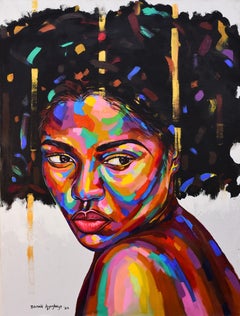
Vision of Hope 5
Located in Ibadan, Oyo
Shipping Procedure FREE Shipping Worldwide Ships in a well-protected tube from Nigeria This work is unique, not a print or other type of copy. Accompanied by a Certificate of Authenticity (Issue by The Galley) I was inspired to paint the portrait of an African girl, so people could see life through her lens. For you to see what it is for a disadvantaged, underprivileged child growing up in a world that doesn't care about them. Yet despite all of this, what is it that you see when you look into his eyes? Every child regardless of their background has the right to Education, grow up in a healthy environment, proper feeding and agriculture, clean water, adequate medical program, economical development, and skilled programs, All these bring immediate and lasting solutions to children and families living in extreme poverty and provides a greater future. - I choose to use my art as a voice for all those children who do not have one. To the governments and other civil organizations who have a moral responsibility to stand up and be counted, that time is now. - About the Artist Damola Ayegbayo...
Category

21st Century and Contemporary Contemporary Portrait Paintings

Materials

Canvas, Acrylic

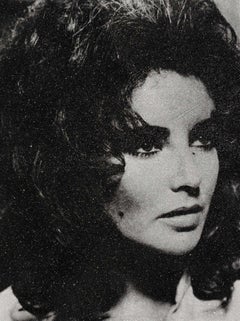
Elizabeth Taylor
Located in PARIS, FR
Orignal and unique artwork by Russell Young. Acrylic paint, enamel and diamond dust screen print on linen, unframed 62 x 48 inches, from the series "Diamond Dust". Dark colors, hand...
Category

2010s Pop Art Portrait Paintings

Materials

Enamel

Elizabeth Taylor
Elizabeth Taylor
$17,600 Sale Price
20% Off
Figurative/Portrait_Earth Tones_Woman on Lawn Blanket_America Martin
Located in Laguna Beach, CA
America Martin "Woman on Lawn Blanket" Oil & Acrylic on Canvas 45 x 80 in. 46.75 x 81.75 in Framed Exploring the identity of both her namesake and country, LA-based America Martin ...
Category

2010s Contemporary Figurative Paintings

Materials

Canvas, Oil, Acrylic

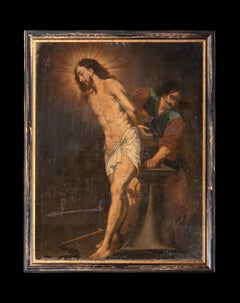
The Flagellation of Christ, 17th Century Italian School Old Master
Located in Blackwater, GB
The Flagellation of Christ, 17th Century Italian School Fine huge 17th Century Italian Old Master depiction of the Flagellation of Christ, oil on canvas. Excellent quality full len...
Category

17th Century Portrait Paintings

Materials

Canvas, Oil

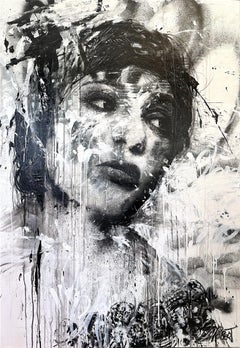
"Au Jour Le Jour" From Day to Day, B&W Portrait Street Art Pop Painting Canvas
Located in New York, NY
This particular piece depicts an anonymous portrait of a beautiful woman in Black and White, titled "Au Jour Le Jour" translating to "From Day to Day". Inspired by the every day, JM Robert...
Category

2010s Street Art Portrait Paintings

Materials

Canvas, Ink, Mixed Media, Acrylic

Venus Paolo Fiammingo Paint Oil on canvas Old master 16th Century Italian Art
Located in Riva del Garda, IT
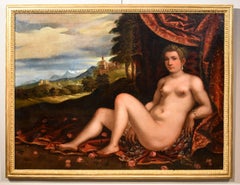
Pauwels Franck, known as Paolo Fiammingo (Antwerp, 1540 - Venice, 1596) Venus lying in a landscape Oil on canvas 116 x 150 cm. In antique frame 136 x 170 cm. The work is accompanied by a critical card by Dr. Federica Spadotto The splendid painting proposed sees portrayed, bare and stretched out on a red brocade cloth in gold sprinkled with roses, a refined and sensual Venus, in a composition with a profound symbolic value, and arriving at the perfect representation of the Renaissance woman who, like Venus, becomes an allegory love, eros, beauty and fertility. The canvas is part of the prestigious Venetian artistic and cultural environment of the second half of the sixteenth century, whose distinctive distinctive trait can be traced back to its cosmopolitan vocation. This characteristic, as Dr. Spadotto noted in her in-depth study, belongs to the same physiology of the Venetian capital, that is, being a distinctly commercial city located in a strategic point with respect to trade. Representing one of the liveliest ports in the Mediterranean also meant witnessing the continuous passage not only of goods, but of men, ideas, suggestions from distant countries, which influenced not only the taste of their people, but above all art. This happened thanks to the circulation of prints, as well as pictorial specimens, to which are added the stays of great foreign artists and, above all, the permanence in the capital of a non-negligible number of Dutch, Flemish and German masters. An emblematic case in this regard comes from Pauwels Franck (Antwerp, 1540 - Venice, 1596), better known as Paolo Fiammingo, who established himself in his native city at a young age - in 1561 a figure enrolled in the Guild of San Luca - and arrived in Venice in 1573. . He resided in Venice from 1584 until his death, although the stylistic and formal references of some of his works have led critics to believe that in previous years he had undertaken a journey to central Italy, or to Florence and Rome, where he would have metabolized the lively cultural debate that permeated these cities and which, on the other hand, seemed completely absent in Venice. Here Paolo will be fascinated by the sense of color and by the atmospheric component fixed on the canvas by Jacopo Tintoretto (Venice 1518 - 1594), of which he becomes a collaborator, to undergo, around 1590, the suggestion of Paolo Caliari...
Category

16th Century Old Masters Paintings

Materials

Oil

Portrait of Bridget Drury Lady Shaw, formerly Viscountess Kilmorey
Located in London, GB
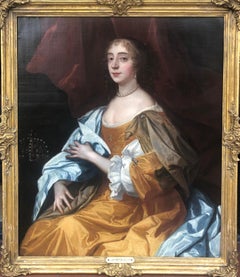
Sir Peter Lely (Soest 1618 – 1680 London) Portrait of lady with a crown, possibly Bridget Drury Lady Shaw, formerly Viscountess Kilmorey, later Lady Baber (d.1696) c.1665 Oil on canvas 46 1/2 x 40 3/4 inches, Framed 42 1/4 x 36 1/4 inches, Unframed Inscribed left [……….]Isabella James Mulraine wrote the following for this piece: This portrait dates to the middle of the 1660s, the decade when Lely’s career took off as successor to Sir Anthony van Dyck. At the Restoration Charles II had appointed him Principal Painter to the King and paid a pension £200 per annum ‘as formerly to Sr. Vandyke...’1 Lely had trained in Haarlem and he was in his early twenties when he came to London in 1643. He was an astute businessman and a wise courtier. In 1650 he painted a portrait of Oliver Cromwell (Birmingham Museum and Art Gallery) while maintaining links with the Royalist exiles through the 1650s. He had arrived in England as a painter of small-scale portraits and lush scenes of nymphs in landscapes in a Dutch style. His experience of Van Dyck in English collections transformed his painting. His lavish and alluring vision of Arcadia exactly captured the spirit of the Court and as Principal Painter he dominated English portraiture for the next twenty years. Lely ran a highly efficient studio along Netherlandish lines, employing a team of specialists like the drapery painter John Baptist Gaspars and young artists-in-training like Nicolas de Largilliere. He had numerous rivals during that period, and by 1670 he had introduced numbered standard poses to speed up production, while collaborating with printmakers for further revenue and advertising. He died in 1680 of a stroke while painting, working to the last. The portrait, painted at a date when Lely’s poses and execution were still individual and inventive shows a lady sitting at three-quarter length facing away from the viewer. She has begun to turn towards the viewer, a pose with a long pedigree in art, first used by Leonardo da Vinci in the Mona Lisa (Louvre). She steadies her blue drapery where it might slip from her arm with the movement, a flash of realism beautifully captured. Like Van Dyck, Lely painted his female sitters in a timeless costume rather than contemporary fashion, showing a loose gown and floating silk draperies. It presented the sitter as a classical ideal. The portrait would not date. The saffron dress may be the work of a drapery painter but the brown scarf must be by Lely himself, and appears unfinished, broadly sketched in behind the shoulder. The delicate blue glaze and nervous highlights suggest shimmering translucence. Lely was a master of painting hands – his hand studies are marvels of drawing – and the lady’s hands are superb, exactly drawn, delicately modelled and expressive. The fidgety gestures, clutching the gown, fiddling with the edge of the scarf, give the portrait psychological bite, suggesting the personality behind the calm courtier’s expression, adding to the sense shown in the look of the eyes and mouth that the lady is about to speak. The portrait’s language is Vandykian. The inspiration comes directly from Van Dyck’s English portraits of women. Lely owned Van Dyck’s Portrait of Lady Elizabeth Thimbleby and Dorothy Viscountess Andover (National Gallery, London) and the sitter’s costume quotes Lady Andover’s saffron dress and brown scarf. But Lely paints a generation who sat nearer to the ground and through a dialogue of expression and gesture he shows sitters who are more flesh and blood than Van Dyck’s. The background with a column and curtain is different to those shown in most of Lely’s portraits of women. They tend to include trees or fountains, with a glimpse of landscape. But there are other examples. A portrait of the King’s reigning mistress, Barbara Villiers Duchess of Cleveland...
Category

1660s Portrait Paintings

Materials

Oil

Phaedra and Her Horse Pegasus
Located in Bozeman, MT
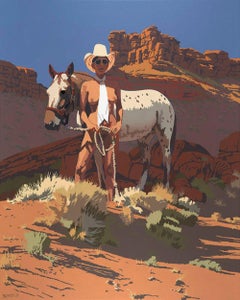
One of the originators of the Western pop art movement, Billy Schenck incorporates techniques from photorealism with a pop art sensibility to both exalt and poke fun at images of the...
Category

2010s Pop Art Portrait Paintings

Materials

Canvas, Oil

Portrait of Alan Sims with Bird Nest - British Edwardian art oil painting
Located in Hagley, England
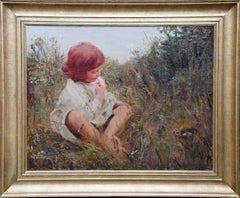
This lovely British Edwardian Impressionist portrait oil painting is by noted artist Charles Henry Sims. Painted circa 1910, the young child in the painting is Alan Sims, the artist'...
Category

1910s Impressionist Portrait Paintings

Materials

Oil

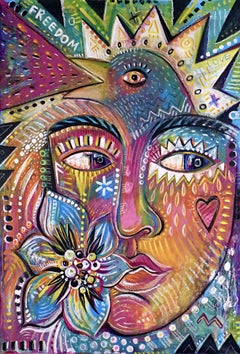
"FREEDOM" colorful painting with flower, bird and girl.
Located in CÓRDOBA, ES
Original art by DARIA KUSTO The magic flow reality.. Acrylic on canvas Shipped From Spain.
Category

2010s Contemporary Figurative Paintings

Materials

Acrylic

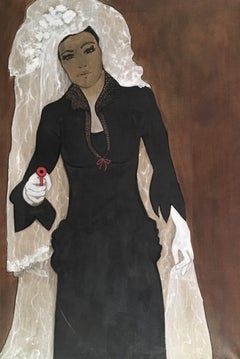
Girl with the Gun 1990 s Stylised Portrait Signed Oil Painting
Located in Cirencester, Gloucestershire
Girl with the Gun, Stylised Portrait, Signed Oil Painting by Larissa Ickx, Belgian 20th century Signed on the lower right hand corner Oil painting on canvas, unframed Canvas size: 47...
Category

1990s Impressionist Portrait Paintings

Materials

Oil

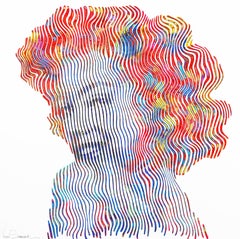
Marilyn Monroe The Smile Is Forever - Textural Colorful Square Portrait Painting
Located in Los Angeles, CA
Playing with the interaction between positive and negative space, strong colors on neutral backgrounds, Canadian artist Virginie Schroeder creates pop art portraits and iconic pop cu...
Category

21st Century and Contemporary Pop Art Portrait Paintings

Materials

Canvas, Mixed Media, Acrylic

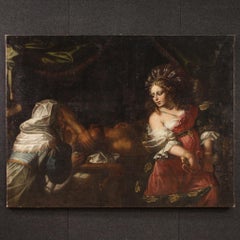
18th Century Oil on Canvas Biblical Italian Painting Judith and Holofernes
Located in Vicoforte, IT
Wonderful Italian painting from the first half of the 18th century. Oil on canvas artwork depicting a fascinating biblical story, the beheading of the Babylonian leader Holofernes by...
Category

1720s Figurative Paintings

Materials

Canvas, Oil

Recently Viewed

View All