Items Similar to Portrait of a Young Boy - Oil on Canvas Circa 1850
Want more images or videos?
Request additional images or videos from the seller
1 of 10
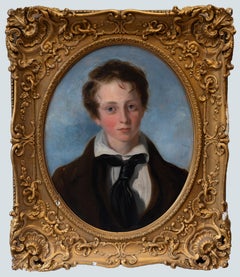
Portrait of a Young Boy - Oil on Canvas Circa 1850ca. 1850
ca. 1850
$3,447.41
£2,584.16
€2,900
CA$4,765.94
A$5,188.26
CHF 2,769.62
MX$62,634.23
NOK 34,824.57
SEK 32,367.15
DKK 22,091.97
About the Item
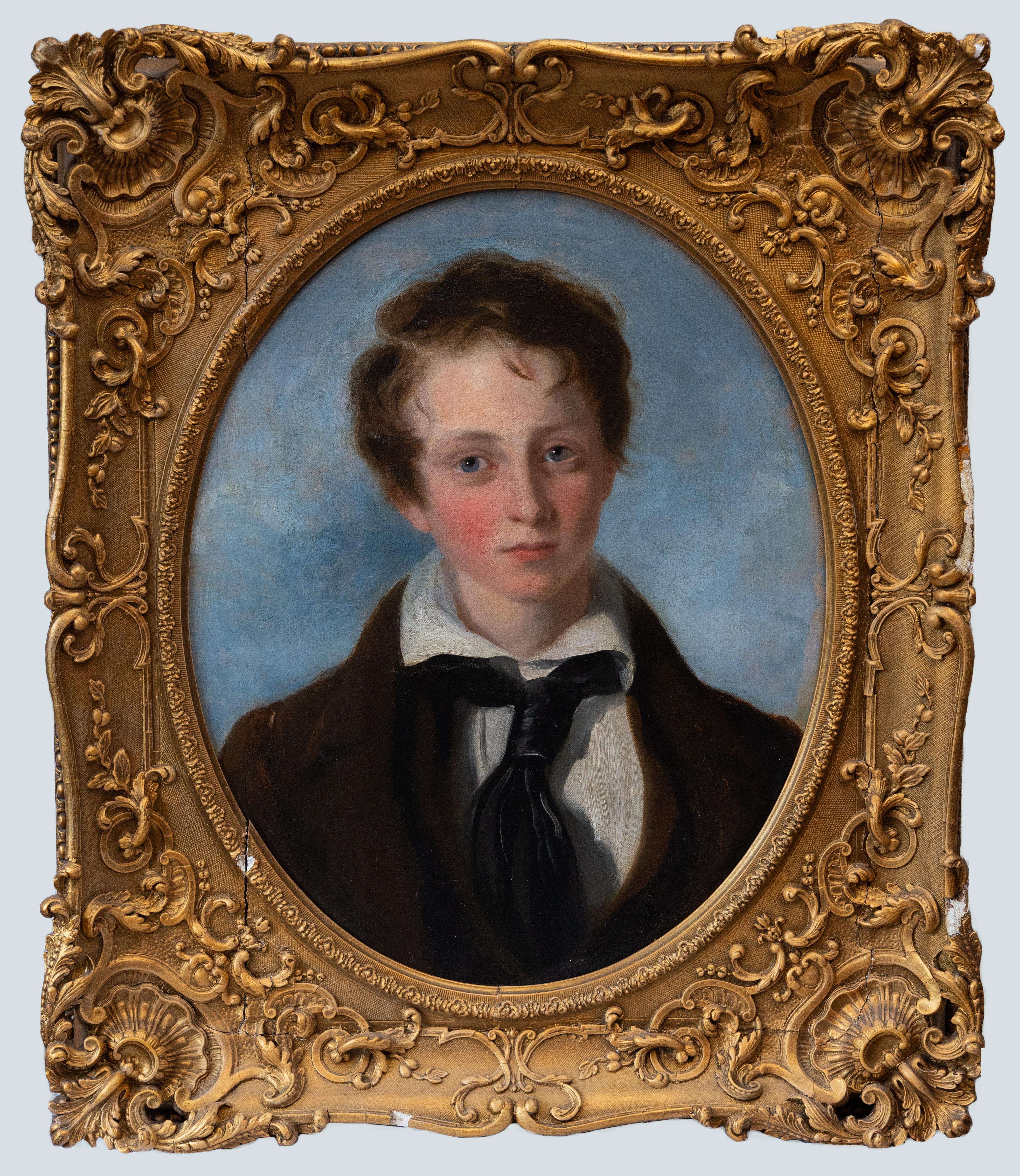
Oval Portrait of a Young Boy (Johan Gustaf Moll, 1843–1912), attributed to Carl Ferdinand Sohn (1805–1867)
An intimate oval portrait of a young boy. Mounted in an oval gilt wood period frame which is original. The painting is unsigned. The reverse of the frame and stretcher reads: “konstnär Carl Ferdinand Sohn 1805–1867” and “Barnporträtt af Johan Gustaf Moll f.1843 d.1912 G.m. Agda Friis.” (Artist Carl Ferdinand Sohn 1805–1867) and (Child portrait of Johan Gustaf Moll b. 1843 d. 1912 inherited by Agda Fris)
Provenance: Johan Gustaf Moll, then his wife Agda Fris and kept in the family until present day. The restrained palette, smooth handling, and refined delineation of features align with mid-nineteenth-century Düsseldorf portrait practice, for which Sohn was widely admired. His portraits—especially of children and women—are noted for an idealizing yet psychologically attentive tone, qualities consistent with the present work’s poised, inward-looking characterization.
Carl Ferdinand Sohn was born in Berlin in 1805 and became one of the leading figures of the Düsseldorf School of Painting. At eighteen he entered the studio of Wilhelm von Schadow, following his teacher to Düsseldorf when Schadow was appointed director of the academy. Sohn’s early formation combined a poetic, Romantic sensibility with close study from nature—an approach he later passed on to generations of students. In 1832 he was named Professor at the Düsseldorf Academy, where he would exert lasting influence.
Travel played a formative role. During 1830–1831 he visited Italy, absorbing Venetian color and the compositional breadth of Titian, Veronese, and Palma Vecchio—elements that informed the warm tonality and elegant classicism of his portraits. As his reputation grew, Sohn was overwhelmed by portrait commissions from across Europe. Notably, he was among the few academy masters to teach women in his private studio, a practice that broadened access to professional training.
Within Sohn’s oeuvre, portraits of children occupy a meaningful niche alongside his lyrical-romantic history scenes. Hallmarks relevant to the present attribution include the softly modeled flesh tones, gently idealized physiognomy, and measured finish associated with Düsseldorf portrait conventions in the 1840s–1850s—years when Sohn balanced teaching with a thriving portrait practice.
The sitter of this portrait Johan Gustaf Moll (b. 1843, d. 1912) later as an adult served as a director at Skånes Enskilda Bank’s Stockholm office—a concise confirmation of his subsequent career in Swedish banking.
- Creation Year:ca. 1850
- Dimensions:Height: 28.35 in (72 cm)Width: 21.66 in (55 cm)Depth: 1.58 in (4 cm)
- Medium:
- Circle Of:Carl Ferdinand Sohn (1805 - 1867, German)
- Period:
- Condition:The painting is in good condition.
- Gallery Location:Stockholm, SE
- Reference Number:1stDibs: LU2608216842992
About the Seller
5.0
Gold Seller
Premium sellers maintaining a 4.3+ rating and 24-hour response times
1stDibs seller since 2023
33 sales on 1stDibs
Typical response time: <1 hour
- ShippingRetrieving quote...Shipping from: Stockholm, Sweden
- Return Policy
More From This Seller
View AllColorful Portrait of Bearded Man - Oil on Cardboard 1940´s
Located in Stockholm, SE
The Portrait of a Bearded Man is an early work by Swedish artist Rune Kurt Haries Lagerbrink, who occasionally signed his works as "R. Lager." Painted in oil on cardboard. The old fr...
Category
1940s Other Art Style Portrait Paintings
Materials
Oil, Cardboard
$941 Sale Price
50% Off
Russian Princess Olga Meyendorff, born Gorchakov - 19th Century Portrait
Located in Stockholm, SE
Portrait of Princess Olga Gorchakov by female 19th century artist Elise Hügel.
An oval portrait of Princess Olga Gortschakoff (1838–1926), here pictured soon after her marriage to Baron Friedrich Adeldagus Felix von Meyendorff, becoming Baroness von Meyendorff, signed Elise Hügel and dated 1858. Executed in oil on canvas, the work shows a young Olga in her early 20´s...
Category
1850s Other Art Style Portrait Paintings
Materials
Canvas, Oil
$2,092 Sale Price
20% Off
19th Century Neoclassical Scene - Psyche, Oil on Canvas
By Otto Bache
Located in Stockholm, SE
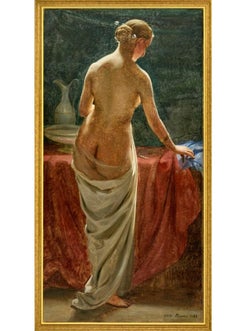
In this neoclassical oil on canvas signed and dated “Otto Bache 1864”, the artist depicts Psyche standing with her back turned to the viewer beside a red draped table. Her hair is arranged in a tight knot, secured with a hairpin adorned with two large pearls. She holds a light drapery that covers her legs, while the rest of her body remains nude. With her head turned toward the right, she gazes downward toward the table, where a blue gown or drapery lies, the garment she is about to put on.
Her softly illuminated profile emerges as she turns in the light falling from the upper left, creating a striking backlight that heightens the contrast along the contours of her body. On the richly red draped table before her rest her jewellery and, to her left, a large amphora-shaped jug and a tazza bowl. The light descending from above to the left defines the composition with sharp contrasts between brightness and shadow, revealing the delicate modelling of Psyche’s form and lending the scene a quiet sense of introspection and grace.
Exhibited: Winkel & Magnussen October 1915 no. 5, ill. p. 5.
Otto Bache was born in 1839 in Roskilde, Denmark, and died in 1927 in Copenhagen.
At the age of only eleven he was admitted to the Royal Danish Academy of Fine Arts in Copenhagen where he studied drawing and painting under the supervision of artists such as Wilhelm Marstrand. His early training gave him a basis in the Danish “Golden Age” tradition of realism and naturalism, but he went on to travel and extend his horizons. In 1866 he received an Academy travel-scholarship and went to Paris, then Italy (1867–68).
The influence of Paris is often noted: his palette became richer, his handling freer, his light stronger, and his subjects broader. Later in his career, from around 1887, he held the post as professor and on various occasions director of the Royal Danish Academy.
Bache’s early work reflects his rigorous academic training: careful drawing, subdued palette and interest in genre scenes and rural life. After his travel in Paris and Italy he adopted a somewhat more robust handling of color and light, but still remained essentially realist and narrative in approach.
He painted portraits, animal and hunting subjects, genre scenes, and large history-paintings depicting key moments from Danish history.
In particular, during the 1880s and 1890s when he was commissioned to execute large history canvases for the Museum of National History at Frederiksborg Castle and similar institutions, depicting events such as the exploits of Danish soldiers...
Category
1860s Other Art Style Figurative Paintings
Materials
Oil
Italian Landscape, Ariccia and The Alban Mountains - Oil on Paper 1850´s
Located in Stockholm, SE
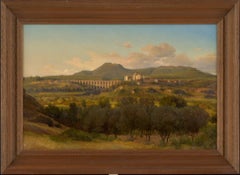
View of the Ariccia Bridge and the Alban Hills
This finely executed plein air landscape depicts the monumental bridge of Ariccia and the town with the surrounding Alban Hills, painted by German landscape artist Joachim Ludwig Heinrich Daniel Bünsow (born 1821 in Kiel, died 1910 in the same city). Executed in oil on paper mounted on cardboard, the work dates from his Italian period between 1853 and 1858. Not signed.
Bünsow received his artistic training at the Royal Danish Academy of Fine Arts in Copenhagen from 1839 to 1848, studying under Johann Ludwig Lund and Christoffer Wilhelm Eckersberg. In 1844, the Copenhagen Art Association acquired his painting "Tellingstedt in Dithmarschen." Following his studies, he traveled to Dresden, where he became associated with the circle around Johan Christian Dahl. A scholarship from the Copenhagen Academy enabled Bünsow to reside in Rome from 1853 to 1858. During this period, his landscapes evolved from the finely toned, naturalistic style of his early work to more atmospheric and idealized compositions, influenced by Louis Gurlitt.
Bünsow's early works from his time in Copenhagen are characterized by fine tonality and naturalistic rendering, reflecting the style of his teacher Christoffer Wilhelm Eckersberg. His Italian landscapes, however, exhibit a more atmospheric and idealized approach, influenced by Louis Gurlitt. Notably, Bünsow produced high-quality drawings during his time in Rome, some of which are preserved in the Kunsthalle zu Kiel.
Historical Context: The Ariccia Bridge
In the early 19th century, the local authorities sought to improve the Appian Way's safety and accessibility. The solution involved constructing bridges to span the Ariccia valley and adjacent ravines. In 1843, Pope Gregory XVI commissioned a six-arched bridge to address the elevation differences. Following his death in 1846, Pope Pius IX continued the project, entrusting architect Ireneo Aleandri with the design and Giuseppe Bertolini with the execution.
Completed in 1854, the bridge stands as a significant 19th-century engineering achievement. Featuring three tiers of elegant neoclassical arches inspired by Roman art, it measures 59 meters in height and 312 meters in length. Travertine columns at both ends commemorate the Roman milestones...
Category
1850s Other Art Style Landscape Paintings
Materials
Paper, Oil, Cardboard
$4,564 Sale Price
20% Off
Free Shipping
Portrait Gustav Wilhelm Palm - 19th Century Pencil and Pastel on Paper
Located in Stockholm, SE
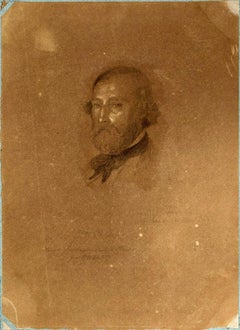
Portrait of Gustaf Wilhelm Palm (1810–1890) by Lorenz Frølich (1820-1908)
Signed with monogram and dated May 1849. Pencil and pastel on paper. 29.5 × 21 cm.
This portrait of the Swed...
Category
1840s Naturalistic Portrait Drawings and Watercolors
Materials
Paper, Pastel, Carbon Pencil
Cloud Study - 19th Century Oil on Paper
Located in Stockholm, SE
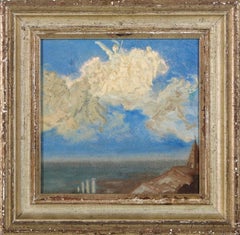
Cloud study by a rocky coastline overlooking the sea. To the right of the composition stands a large maritime marker, while in the lower left a few ship masts emerge in the distance....
Category
19th Century Other Art Style Landscape Paintings
Materials
Paper, Oil, Wood Panel
$1,474 Sale Price
20% Off
You May Also Like
Antique Portrait of Noble Boy
Located in Los Angeles, CA
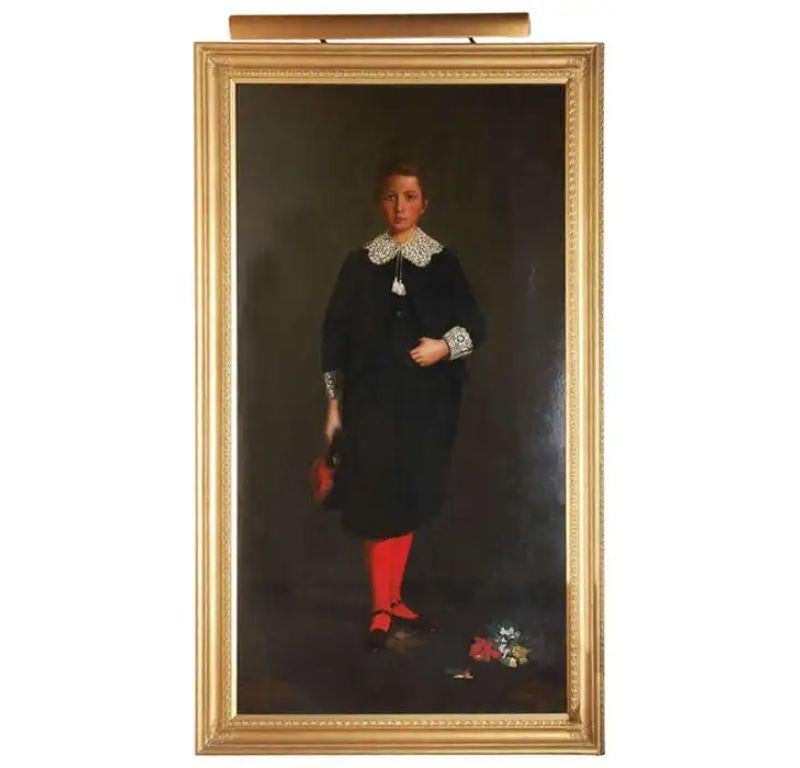
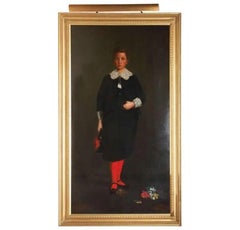
Beautiful, early 19th century, oil on canvas painting of a French noble boy in a luxurious, two-piece, velvet suit trimmed in intricate lace, and a pair of striking, crimson stocking...
Category
1810s Paintings
Materials
Canvas, Oil
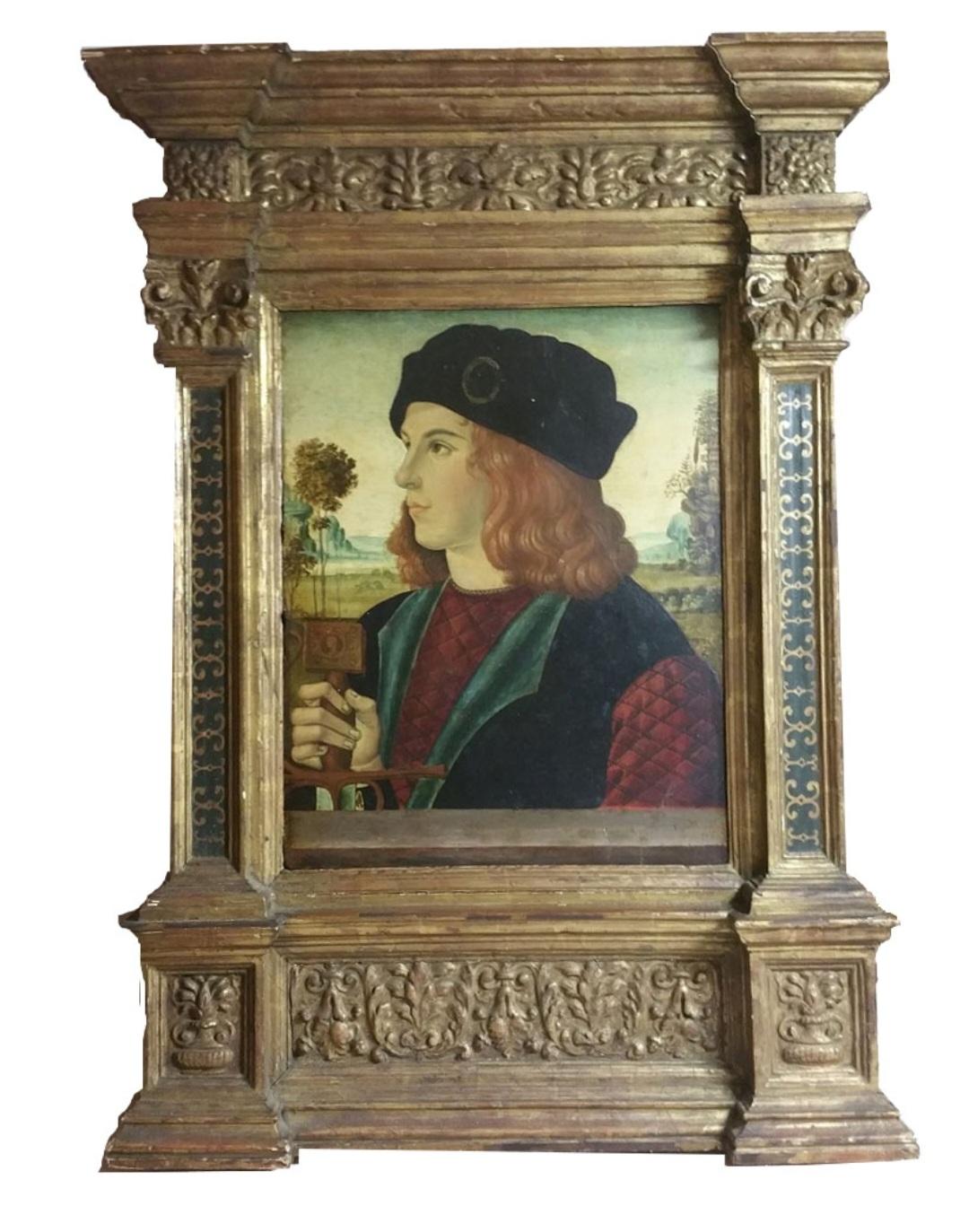
Portrait of a Young Boy
Located in Saratoga Springs, NY
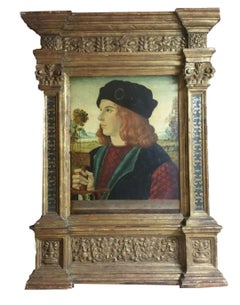
Attributed Federico Icilio Joni (1866-1946, North Italian Sienese)
“Portrait of a Young Boy”
17 ¾ x 14” (on poplar panel)
Icilio Federico J...
Category
19th Century Old Masters Figurative Paintings
Materials
Oil, Panel
$20,000
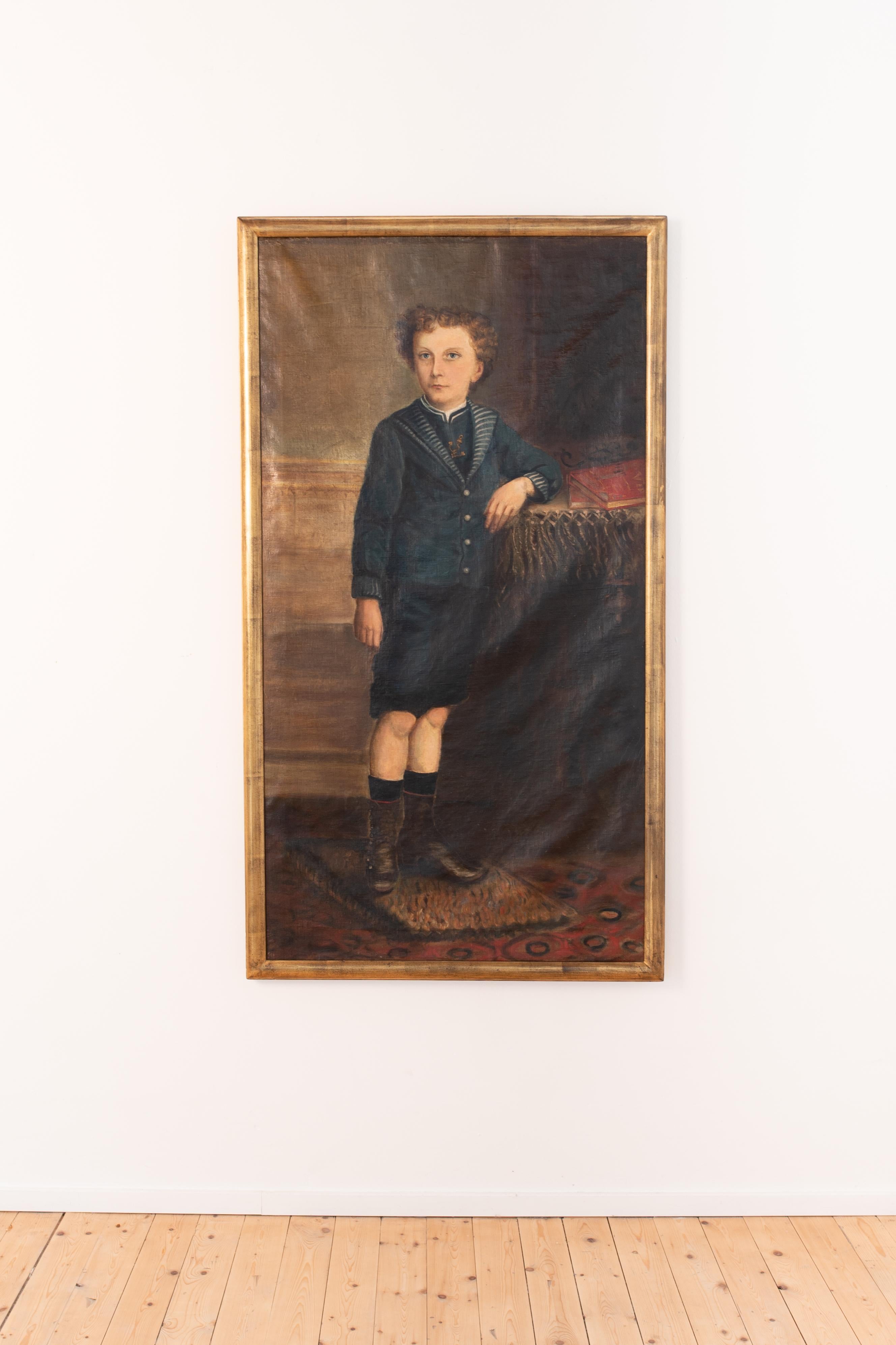
Portrait of a young sailor boy
Located in Oostende, BE
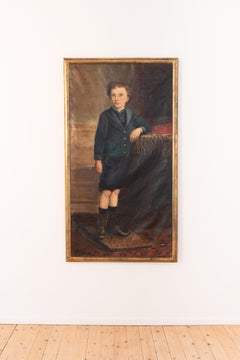
Oil on canvas, portrait painting of a young sailor boy.
Category
Early 20th Century Portrait Paintings
Materials
Canvas
Portrait of a Young Man
By (After) Rembrandt van Rijn
Located in London, GB
Pupil of Rembrandt
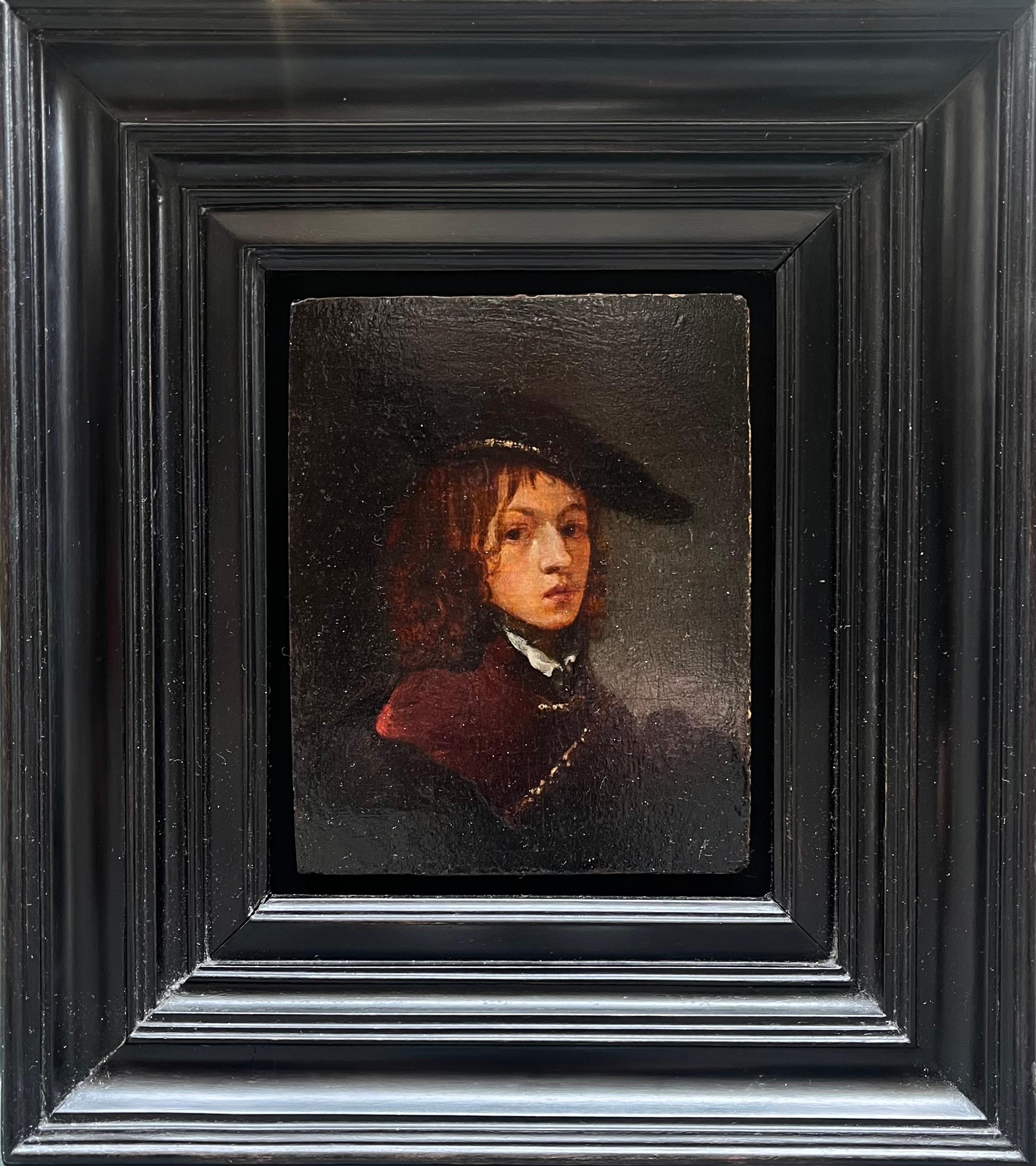
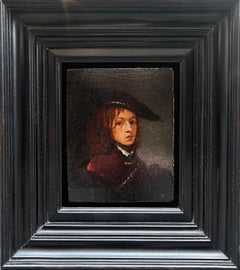
Portrait of a Young Man
17th Century
Oil on oak panel
Image size: 4 1/4 x 5 inches (11 x 13 cm)
Dutch ebonised frame
This small portrait is of a young man, staring inquisitively out towards the viewer. The realism of his appearance is striking, with great care taken in the depiction of the man’s features - for example, his full lips and the slight bump in the bridge of his nose. The man wears a rich burgundy doublet and a black cap and is adorned with gold accessories, indicating a degree of wealth - it is likely that this is a miniature portrait for a wealthy patron. The warm flesh tones of this painting and the intricate rendering of the man’s curly brown hair demonstrate the artistry of the painter, who has successfully captured the image of youth within his brushstrokes.
Rembrandt’s Pupils
Upon completing his artistic education, Rembrandt opened a studio and began to take students - the first of which were Gerrit Dou and Isaac Jouderville. The studio functioned as an art school, in which materials and guidance were provided - contrary to the studios of his peers, Rembrandt did not offer lodging to his pupils. The families of prospective pupils had to pay Rembrandt 100 guilders (enough for a house at the time) for this artistic education, and the profits from any works produced by pupils under Rembrandt would be paid to the master rather than kept by the student-artist - this contributed substantially to the master’s income.When taking on pupils, Rembrandt looked for those who could already paint, and guided their styles to reflect his. By choosing pupils who were somewhat experienced artists, Rembrandt had an array of painters that could be involved at any stage of assisting with the creation of his works - in this way, Rembrandt’s pupils often functioned as studio assistants as well. In order to perfect Rembrandt’s style, pupils would paint copies of their teacher’s works, sometimes adding their own distinct variations. They would use the same subjects and models as Rembrandt himself, and would accompany him on outdoor trips to paint nature and landscapes. The extensive copying and utilisation of same source materials has rendered Rembrandt’s work and the work of his pupils difficult to differentiate, even in the modern era.At least 50 pupils were taught by Rembrandt, with many continuing on to become his studio assistants. A few graduated into successful artists in their own right - for example, Govaert Flinck...
Category
17th Century Portrait Paintings
Materials
Oak, Oil, Panel
Portrait of a boy, English School 19th century
Located in GB
This charming 19th-century portrait, painted in the manner of the English School, depicts a young boy set against a soft sky-blue background, lending the composition a gentle luminos...
Category
19th Century Portrait Paintings
Materials
Canvas, Oil
Profile of a young boy
Located in Genève, GE
Work on cardboard
Golden wooden frame
42 x 34 x 3.5 cm
Category
19th Century Portrait Paintings
Materials
Oil
$1,688