1 of 4
Charles BealeLate 17th Century Oil on Canvas Portrait of a Lady by Charles Beale (1660-1714)1690
1690
$13,868.62List Price
About the Item
- Creator:Charles Beale (1660 - 1714)
- Creation Year:1690
- Dimensions:Height: 37.25 in (94.62 cm)Width: 13 in (33.02 cm)Depth: 2.5 in (6.35 cm)
- Medium:
- Movement Style:
- Period:Late 17th Century
- Condition:
- Gallery Location:London, GB
- Reference Number:Seller: 12211stDibs: LU115224069091
Authenticity Guarantee
In the unlikely event there’s an issue with an item’s authenticity, contact us within 1 year for a full refund. DetailsMoney-Back Guarantee
If your item is not as described, is damaged in transit, or does not arrive, contact us within 7 days for a full refund. Details24-Hour Cancellation
You have a 24-hour grace period in which to reconsider your purchase, with no questions asked.Vetted Professional Sellers
Our world-class sellers must adhere to strict standards for service and quality, maintaining the integrity of our listings.Price-Match Guarantee
If you find that a seller listed the same item for a lower price elsewhere, we’ll match it.Trusted Global Delivery
Our best-in-class carrier network provides specialized shipping options worldwide, including custom delivery.You May Also Like
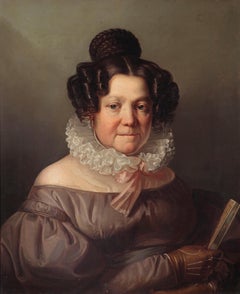
19th Century By Giuseppe Molteni Portrait of a Woman Oil on Canvas
Located in Milano, Lombardia
Giuseppe Molteni (Affori (Milano), Italy, 1800 - Milano, Italy, 1867)
Title: Portrait of a Woman
Medium: Oil on canvas
Dimensions: without frame 67 × 55 cm - with frame 91.5 x 80 cm
...
Category
19th Century Old Masters Portrait Paintings
Materials
Canvas, Oil
$26,325 Sale Price
20% Off
H 26.38 in W 21.66 in D 1.97 in
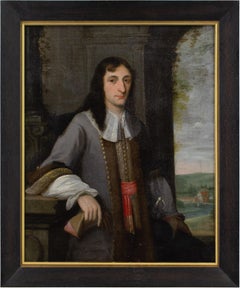
17th-Century Flemish School, Portrait Of A Gentleman In A Justaucorps, Oil
Located in Cheltenham, GB
This fine late 17th-century Flemish portrait depicts a distinguished gentleman wearing a justaucorps, black cloak, white shirt, vest, leather gloves, and breeches. He’s carrying a wi...
Category
1670s Old Masters Portrait Paintings
Materials
Canvas, Oil
$3,936
H 22.5 in W 18.5 in
Answer Within
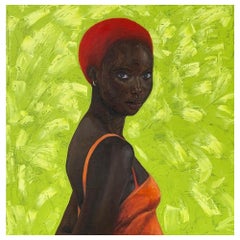
Located in Ibadan, Oyo
Painting
Ships in a well-protected tube from Nigeria
This work is unique, this is not a print or other type of copy.
Accompanied by a Certificate of Authenticity (Issued by the Gallery)
Category
21st Century and Contemporary Old Masters Portrait Paintings
Materials
Canvas, Oil
Portrait of Conrad Friedrich Hurlebusch, Early 18th Century Oil Painting
By Dominicus van der Smissen
Located in London, GB
Dominicus van der Smissen
Early 18th Century
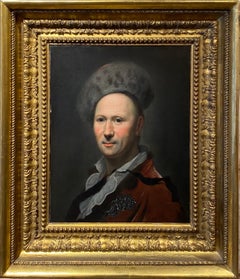
Portrait of Conrad Friedrich Hurlebusch
Oil on canvas
Image size: 20½ x 16¼ inches
Period gilt frame
This is a portrait of Conrad Friedrich Hurlebusch, composer, Kapellmeister and organist, whom Van der Smissen most probably portrayed during his stay in Hamburg, Brunswick or Amsterdam. The identification is based on the reproduction of the portrait which was engraved by Pieter Anthony Wakkerdak (1740- 1774).
Van der Smissen has reduced the face of the sitters to an egg-shaped oval in three-quarter view, applying diminution to one half of the figure’s torso, which is farther away from the viewer. This partial side view, with the head turned to look at the viewer over the shoulder, creates spatial depth and brings the figure to life by avoiding the stiffness of a frontal depiction.
Because the artist chose to highlight the figure from above, a distinct shadow is cast under the tip of the nose, in the shape of a triangle. This is an often recurring and almost ‘signature’-like feature in Van der Smissen’s oeuvre.
Hurlebusch's garments are of a very high quality and serve to reflect the sitter’s wealth, status and elegance. During this period, gentlemen often shaved their heads in order to facilitate the wearing of a wig, which wouldbe worn with a suit. Here Hurlebusch has been depicted in a luxurious turban-like cap lined with lynx fur, a highly fashionable and expensive material at the time.
Over his shirt, he wears a velvet fur-lined gown adorned with decorative clasps fashioned from silver braid. The elegant informality of his appearance can be seen in his unbuttoned shirt and the unfastened black ribbon hanging from his button hole, which has been artfully arranged into a fluttering drape by the portraitist.
The Sitter
Hurlebusch was born in Brunswick, Germany. He received the first instructions in his field from his father Heinrich Lorenz Hurlebusch, who was also a musician. As an organ virtuoso, he toured Europe, visiting Vienna, Munich and Italy.
From 1723 to 1725 he was Kapellmeister in Stockholm; later he became Kapellmeister in Bayreuth and Brunswick, and lived in Hamburg from 1727 to 1742, where he had contact with fellow composers Johann Mattheson and Georg Philipp Telemann. He made his living composing, performing and teaching.
In 1735 and 1736, he is believed to have visited Johann Sebastian Bach in Leipzig, who promoted Hurlebusch’s compositions as the local seller...
Category
Early 18th Century Old Masters Portrait Paintings
Materials
Canvas, Oil
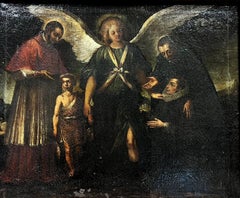
Fine Italian Old Master Oil Painting Angel
Saints Appearing to Figures
Located in Cirencester, Gloucestershire
Artist/ School: Italian Old Master, 18th century
Title: Angel and Saints appearing to figures, one dressed in a white ruff collar.
Medium: oil on canvas...
Category
Early 18th Century Old Masters Figurative Paintings
Materials
Canvas, Oil
$4,758 Sale Price
30% Off
H 22 in W 26 in
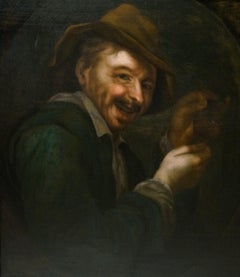
Antique oil paining, A laughing man with an upturned glass, Dutch golden age
Located in DEVENTER, NL
Anonymous, 18th century
Inspired by a painting by Petrus Staverenus (1610/1612 – 1654-07-28/1664-07-28) from a series of Five Senses
'Taste: A laughing man...
Category
18th Century Old Masters Portrait Paintings
Materials
Canvas, Oil
$1,960
H 29.34 in W 23.63 in
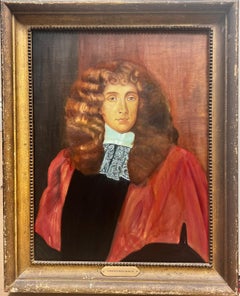
Fine British Aristocratic Portrait of a Nobleman Lord Jeffreys of Wem
Located in Cirencester, Gloucestershire
Portrait of Lord Jeffreys of Wem
British School, 20th century (presumably after an earlier work)
oil painting on canvas, framed
framed: 30.5 x 24.5 inches
canvas: 26 x 20 inches
prov...
Category
20th Century Old Masters Portrait Paintings
Materials
Oil, Canvas
$951 Sale Price
30% Off
H 35.5 in W 28.5 in
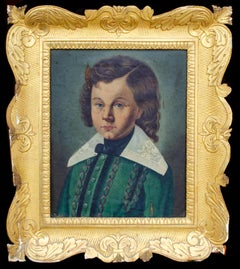
Portrait of a Young Prince, 19th c., by Mystery Artist
Located in New York, NY
Mystery Artist
Untitled (Young Prince), c. 1800-1900
Oil on canvas
16 x 13 in.
Framed: 23 x 19 1/2 x 2 in.
Category
19th Century Old Masters Portrait Paintings
Materials
Canvas, Oil
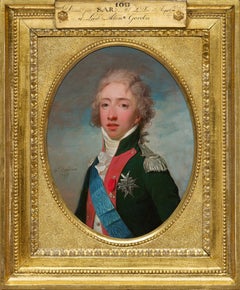
Two royal portraits (the Duc d
Angoulême and the Duc de Berry) by H.P. Danloux
Located in PARIS, FR
These two royal portraits are a major historical testimony to the stay of the Comte d'Artois (the future Charles X) and his family in Edinburgh in 1796-1797. Given by the sitters to Lord Adam Gordon, the Governor of Edinburgh, and kept by family descent to this day, these two portraits provide us with a vivid and spontaneous image of the Duc d’Angoulême and his brother the Duc de Berry. Danloux, who had emigrated to London a few years before, demonstrate his full assimilation of the art of British portrait painters in the brilliant execution of these portraits.
1. Henri-Pierre Danloux, a portraitist in the revolutionary turmoil
Born in Paris in 1753, Henri-Pierre Danloux was first a pupil of the painter Nicolas-Bernard Lépicié (1735 - 1784) and then, in 1773, of Joseph-Marie Vien (1716 - 1809), whom he followed to Rome when, at the end of 1775, Vien became Director of the Académie de France. In Rome he became friends with the painter Jacques-Louis David (1748 - 1825).
Returning to France around 1782, he settled in Lyon for a few years before returning to Paris in 1785. One of his first portraits was commissioned by the Baroness d'Etigny, the widow of the former Intendant of the Provinces of Gascony, Bearn and Navarre Antoine Mégret d'Etigny (1719 – 1767). He then became close to his two sons, Mégret de Sérilly and Mégret d'Etigny, who in turn became his patrons. In 1787, this close relationship with the d'Etigny family was further strengthened by his marriage to Antoinette de Saint-Redan, a relative of Madame d'Etigny. After his marriage, he left for Rome and did not return to France until 1789. It was during the winter of 1790-1791 that he painted one of his masterpieces, the portrait of Baron de Besenval. Set in a twilight atmosphere, this portrait of an aristocrat who knows that his death is imminent symbolizes the disappearance of an erudite and refined society which would be swept away by the French Revolution.
The Jacobin excesses led Danloux to emigrate to England in 1792; many members of his family-in-law who remained in France were guillotined on 10 May 1794. Danloux enjoyed great success as a portrait painter in England before returning to France in 1801.
During his stay in England, Danloux was deeply under the influence of English portraitists: his colors became warmer (as shown by the portrait of the Duc d'Angoulême that we are presenting), and his execution broader.
2. Description of the two portraits and biographical details of the sitters
The Duc d'Angoulême (1775-1844) was the eldest son of the Comte d'Artois, the younger brother of King Louis XVI (the future King Charles X), and his wife Marie-Thérèse of Savoie. He is shown here, in the freshness of his youth, wearing the uniform of colonel-general of the "Angoulême-Dragons" regiment.
He is wearing the blue cordon of the Order of the Holy Spirit, which was awarded to him in 1787, and two decorations: the Cross of Saint-Louis and the Maltese Cross, as he was also Grand Prior of the Order of Malta.
Born on 16 August 1775 in Versailles, Louis-Antoine d'Artois followed his parents into emigration on 16 July 1789. In 1792, he joined the émigrés’ army led by the Prince de Condé. After his stay in Edinburgh (which will be further discussed), he went to the court of the future King Louis XVIII, who was in exile at the time, and in 1799 married his first cousin Marie-Thérèse Charlotte of France, the daughter of Louis XVI and the sole survivor of the royal family. The couple had no descendants. He became Dauphin of France in 1824, upon the accession to the throne of his father but played only a minor political role, preferring his military position as Grand Admiral. Enlisted in Spain on the side of Ferdinand VII, he returned home crowned with glory after his victory at Trocadero in 1823.
He reigned for a very short time at the abdication of Charles X in 1830, before relinquishing his rights in favor of his nephew Henri d'Artois, the Duc de Bordeaux. He then followed his father into exile and died on 3 June 1844 in Gorizia (now in Italy).
His younger brother, the Duc de Berry, is shown in the uniform of the noble cavalry of the émigrés’ Army. He is wearing the blue cordon of the Order of the Holy Spirit, awarded to him in May 1789, and the Cross of Saint-Louis (partly hidden by his blue cordon).
Born on 24 January 1778 in Versailles, Charles-Ferdinand d'Artois also followed his parents into emigration and joined the émigrés’ army in 1792. After his stay in Edinburgh, he remained in Great Britain, where he had an affair with Amy Brown...
Category
1790s Old Masters Portrait Paintings
Materials
Canvas, Oil, Wood Panel
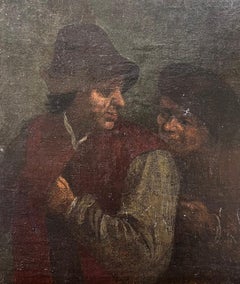
Fine 17th Century Dutch Old Master Oil Painting Two Topers in Deep Conversation
Located in Cirencester, Gloucestershire
Topers in Deep Conversation
Dutch School, mid 17th entury
circle of David Teniers (Dutch 1610-1690)
oil on canvas
canvas: 8 x 7 inches
provenance: private collection, France
conditio...
Category
Mid-17th Century Old Masters Figurative Paintings
Materials
Oil, Canvas
$1,760 Sale Price
30% Off
H 11 in W 9 in
Recently Viewed
View AllMore Ways To Browse
John Dryden
John F Kennedy Painting
Lace Dress Painting
Lord Nelson Painting
Mongolian Oil Painting
Native American Chief Paintings
Officer 18th Century
Oil Painting King Louis
Oil Portrait Woman 1920s
Painting Of Bourbon
Philippe Mercier
Portrait Antique Pre 1900 Paintings
Portrait James Ii
Portrait Tsar
President Portrait Oil
Rabbi Reading
Raiman Rodriguez
Rick Beerhorst