Items Similar to Apollo Van Haarlem Paint 17th Century Oil on canvas Old master Mythological Art
Video Loading
Want more images or videos?
Request additional images or videos from the seller
1 of 17
Apollo Van Haarlem Paint 17th Century Oil on canvas Old master Mythological Art1600-1650
1600-1650
$13,547.20
£10,133.51
€11,310
CA$18,667.39
A$20,520.01
CHF 10,772.91
MX$243,997.70
NOK 138,348.63
SEK 126,020.65
DKK 86,193.93
About the Item
Cornelis Cornelisz. van Haarlem (Haarlem 1562–1638)Workshop
Apollo tending the flocks of Admetus
Oil on canvas 93 x 69 cm In frame 92 x 116 cm
The foreground is dominated by the powerful figure of the Greek god Apollo, dressed in a single drape that leaves most of his athletic body uncovered: the god of the arts and music holds his lyre, one of his most iconic attributes, in his hands; with the same arm, he holds a shepherd's crook: an unusual tool for this deity, but one that allows us to understand the particular episode in which he is involved.
The subject refers, in particular, to the mythical episode in which Apollo was punished by Zeus for exterminating the Cyclopes and forced to serve a mortal for nine years: his sentence was to protect, as a shepherd, the flocks of King Admetus (king of Pherae, in Thessaly).
This particular episode is very interesting because it also tells us about the origin of the lyre as an instrument sacred to the god: in the Homeric hymns, it is said that Hermes, messenger of the gods, played a joke on Apollo: he stole his sheep and then used the intestines of some of them to create a lyre.
When Apollo, enraged, managed to track him down, he fell in love with this instrument with its heavenly sound and left Hermes the cattle in exchange for the lyre, which then became one of his most iconic symbols.
As for the origin of the painting, it is easy to attribute its authorship to a Flemish school artist active between the 17th and 18th centuries, but still linked to the culture of the late Mannerist period, with strong Italian influences.
This explains its attribution to the workshop of Cornelis van Haarlem (Haarlem 1562–1638), one of the most representative artists of Northern Mannerism and one of the founders of the so-called “Haarlem School”, an important painting movement active in this Dutch city, whose members favoured mythological subjects, known for their powerful and muscular figures, dynamic compositions and bright colours, in keeping with the Italian Mannerist style.
In particular, the painting draws inspiration from an iconographic prototype created by Bartholomaeus Spranger: observing one of his works entitled “Without Ceres and Bacchus, Venus cools down” (Sine Cerere et Baccho Friget Venus), it is possible to see how the powerful figure of Bacchus, distinguished by a virile pose and highly emphasised musculature, has been extrapolated to give him the identity of Apollo instead.
It is well known that the members of this movement, primarily Cornelis van Haarlem, were strongly influenced by Spranger, who was known for his elongated figures, especially nudes, and whose works were widely distributed through prints.
“Without Ceres and Bacchus, Venus grows cold”, Jan Muller, Dutch (print), from Bartholomeus Spranger, circa 1597
ADDITIONAL INFORMATION:
The painting is sold complete with an attractive gilded frame and comes with a certificate of authenticity and a descriptive iconographic card.
We take care of and organise the transport of purchased works, both in Italy and abroad, using professional and insured carriers.
If you would like to see this or other works in person, we would be delighted to welcome you to our new gallery in Riva del Garda, at Viale Giuseppe Canella 18. We look forward to seeing you!
Please contact us for any information or to arrange a visit, we will be happy to assist you.
- Creation Year:1600-1650
- Dimensions:Height: 45.67 in (116 cm)Width: 36.23 in (92 cm)
- Medium:
- Movement Style:
- Circle Of:Cornelis Van Haarlem (Haarlem 1562–1638)
- Period:
- Condition:
- Gallery Location:Riva del Garda, IT
- Reference Number:1stDibs: LU988117372032
About the Seller
4.9
Platinum Seller
Premium sellers with a 4.7+ rating and 24-hour response times
Established in 2017
1stDibs seller since 2018
271 sales on 1stDibs
Typical response time: 1 hour
- ShippingRetrieving quote...Shipping from: Riva del Garda, Italy
- Return Policy
More From This Seller
View AllDiana Boullogne Mythological Paint Oil on canvas old master 17/18th Century
Located in Riva del Garda, IT
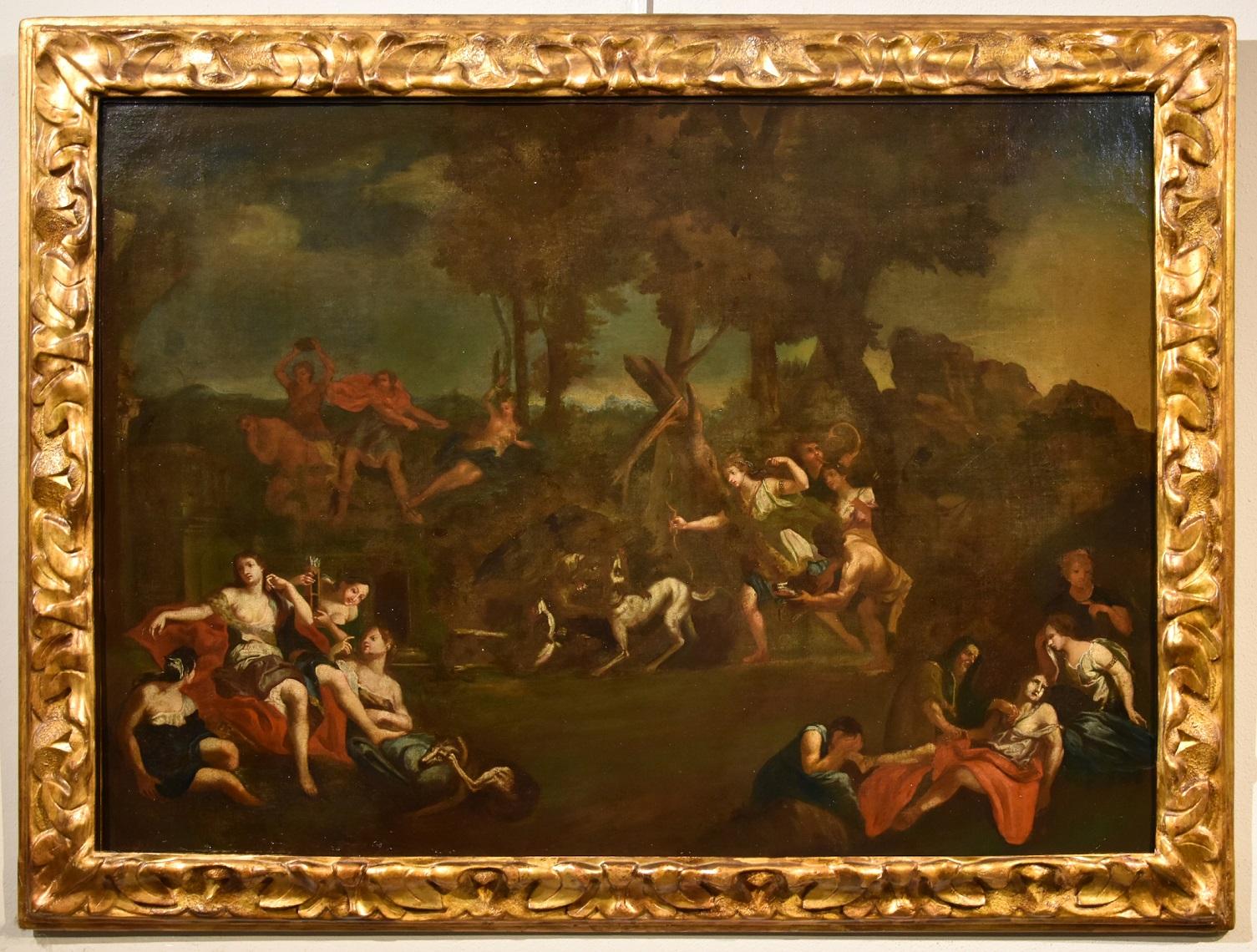
Bon Boullogne (Paris, 1649 - Paris, 1717) workshop of
Episodes from the myth of Diana
oil painting on canvas
Dimensions: 84 x 114 cm.
with antique frame 100 x 132 cm.
The beautiful painting proposed shows a series of episodes taken from the myth of the divinity Diana, the Roman divinity of hunting, forests and wild animals, masterfully captured in this valuable painting, which shows a luxuriant wood, a favorite place of the divinity, as a theater of his adventures.
The composition opens, on the left, with a sort of presentation of the divinity, portrayed as an attractive young girl, surrounded by her faithful Nymphs, one of whom holds her quiver with arrows, and by one of her beloved dogs. hunting her.
The 'story' continues in the central part where we can see the divinity during a wild boar hunt...
Category
Late 17th Century Old Masters Paintings
Materials
Oil
$8,470 Sale Price
20% Off
Aristotle Phyllis Spranger 16/17th Century Paint Oil on canvas Old master
Located in Riva del Garda, IT
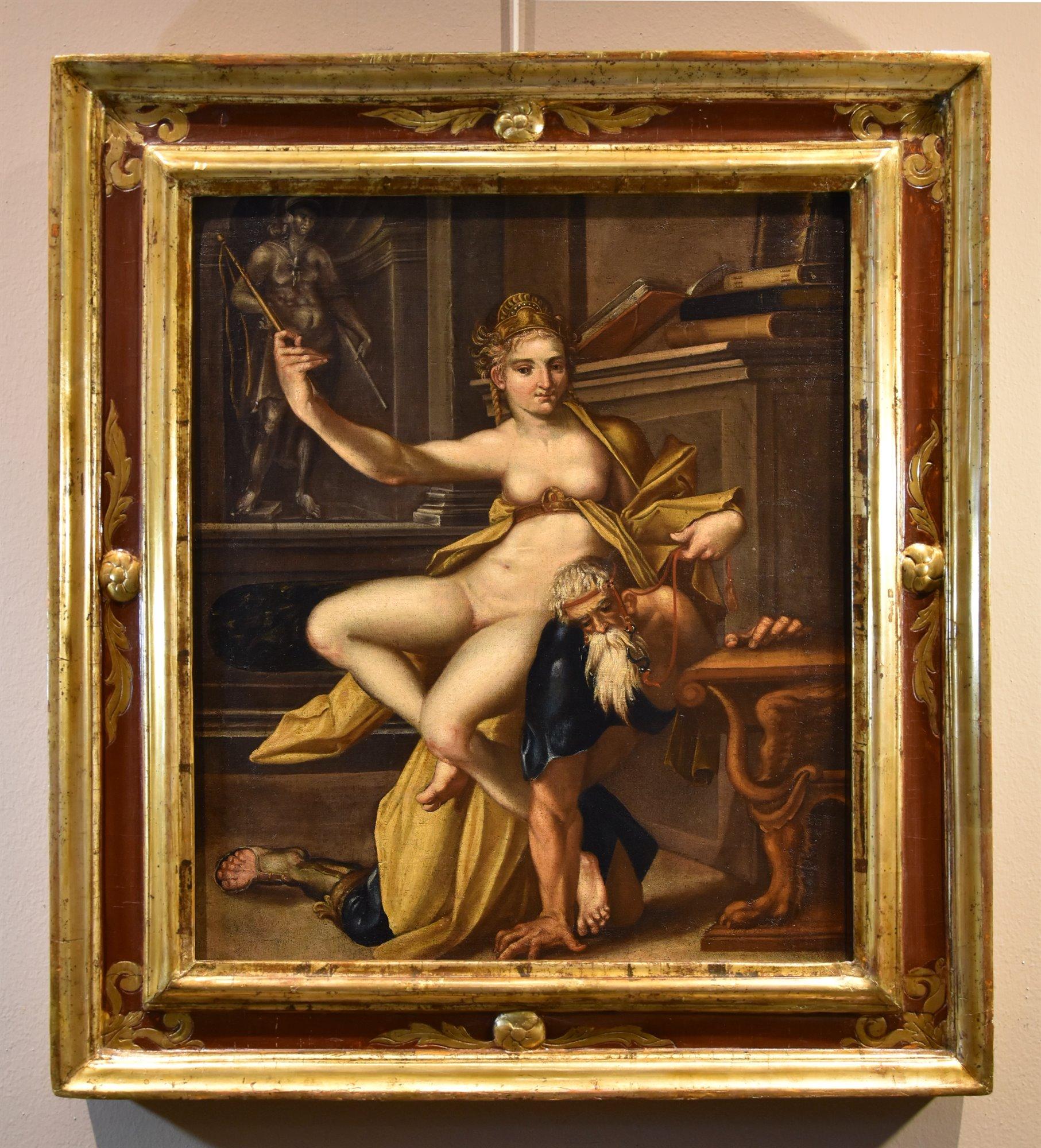
Bartholomäus Spranger (Antwerp, 1546 – Prague, 1611) workshop
Aristotle and Phyllis
Oil on canvas 64 x 54 cm In frame 79 x 72 cm
The curious subject of this painting, quite...
Category
16th Century Old Masters Paintings
Materials
Oil
$9,716 Sale Price
20% Off
Landscape Hunt Miel Paint 17th Century Oil on canvas Flemish Old master
Located in Riva del Garda, IT
Jan Miel (Antwerp, 1599 - Turin, 1663)
attributable
Return from the Hunt
Oil on canvas (51 x 66 cm Framed 74 x 89 cm)
Tous les détails sont disponibles sur le LIEN suivant
The wor...
Category
17th Century Old Masters Paintings
Materials
Oil
$5,854 Sale Price
20% Off
Bacchanale Mythological Carpioni Paint Oil on canvas 17th Century Old master Art
Located in Riva del Garda, IT
Giulio Carpioni (Venice, 1613 - Vicenza, 1678), Attributable to
Bacchanale
Oil on canvas 98 x 132 cm. - In frame 120 x 154 cm.
This high-quality, beautifully preserved painti...
Category
17th Century Old Masters Paintings
Materials
Oil
$15,945 Sale Price
20% Off
Triumph Bacchus Mythological Spoede Paint 18th Century Oil on canvas Old master
Located in Riva del Garda, IT
Jean Jacques Spoede (Antwerp 1680 - Paris 1757)
Triumph of Bacchus
Oil on canvas 66 x 83 cm. - In frame 84 x 101 cm.
In this fascinating painting, attributed to Jean Jacque...
Category
18th Century Old Masters Paintings
Materials
Oil
$10,962 Sale Price
20% Off
Saint John Baptist Venusti Paint 16th Century Oil on canvas Old master Italy Art
Located in Riva del Garda, IT
Marcello Venusti (Mazzo di Valtellina 1510 - Rome 1579) workshop/circle
Saint John the Baptist
Oil on canvas (65 x 50 cm. - In frame 74 x 58 cm.)
The work depicts Saint John...
Category
16th Century Old Masters Paintings
Materials
Oil
$4,360 Sale Price
20% Off
You May Also Like
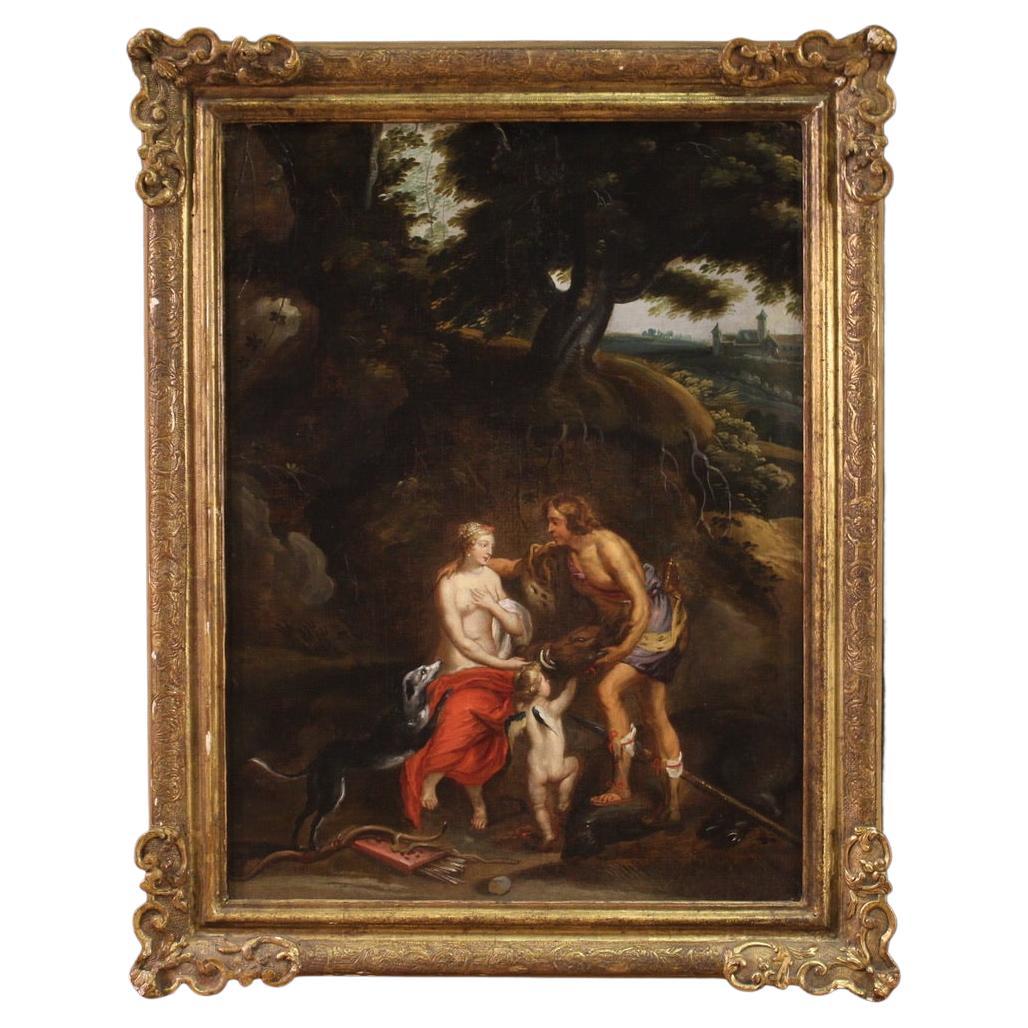
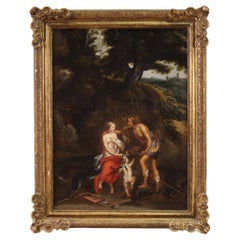
17th Century Oil on Canvas Flemish Mythological Antique Painting, 1660
Located in Vicoforte, Piedmont
A splendid 17th century Flemish painting. Oil on canvas artwork depicting a mythological subject of great charm, Meleager offers the boar's head to Atalanta. The Fates had predicted ...
Category
Antique 1660s Dutch Paintings
Materials
Canvas
$8,624 Sale Price
20% Off
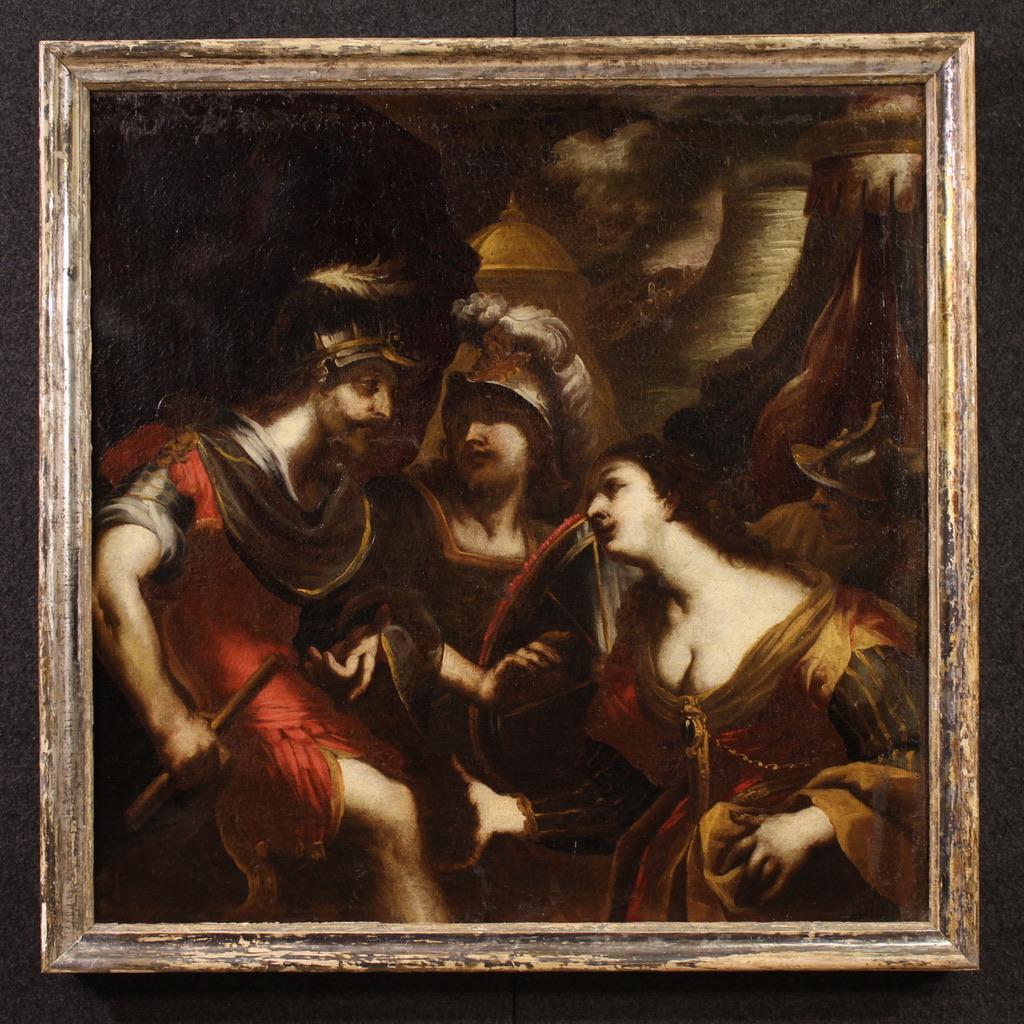
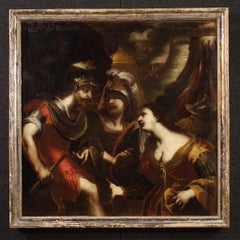
17th Century Oil on Canvas Antique Italian Mythological Painting, 1640
By Valerio Castello
Located in Vicoforte, IT
A magnificent 17th-century Italian painting. This artwork oil on canvas depicts a famous episode from the Iliad, the dispute between Agamemnon and Achilles over Briseis. During the T...
Category
1640s Figurative Paintings
Materials
Canvas, Oil
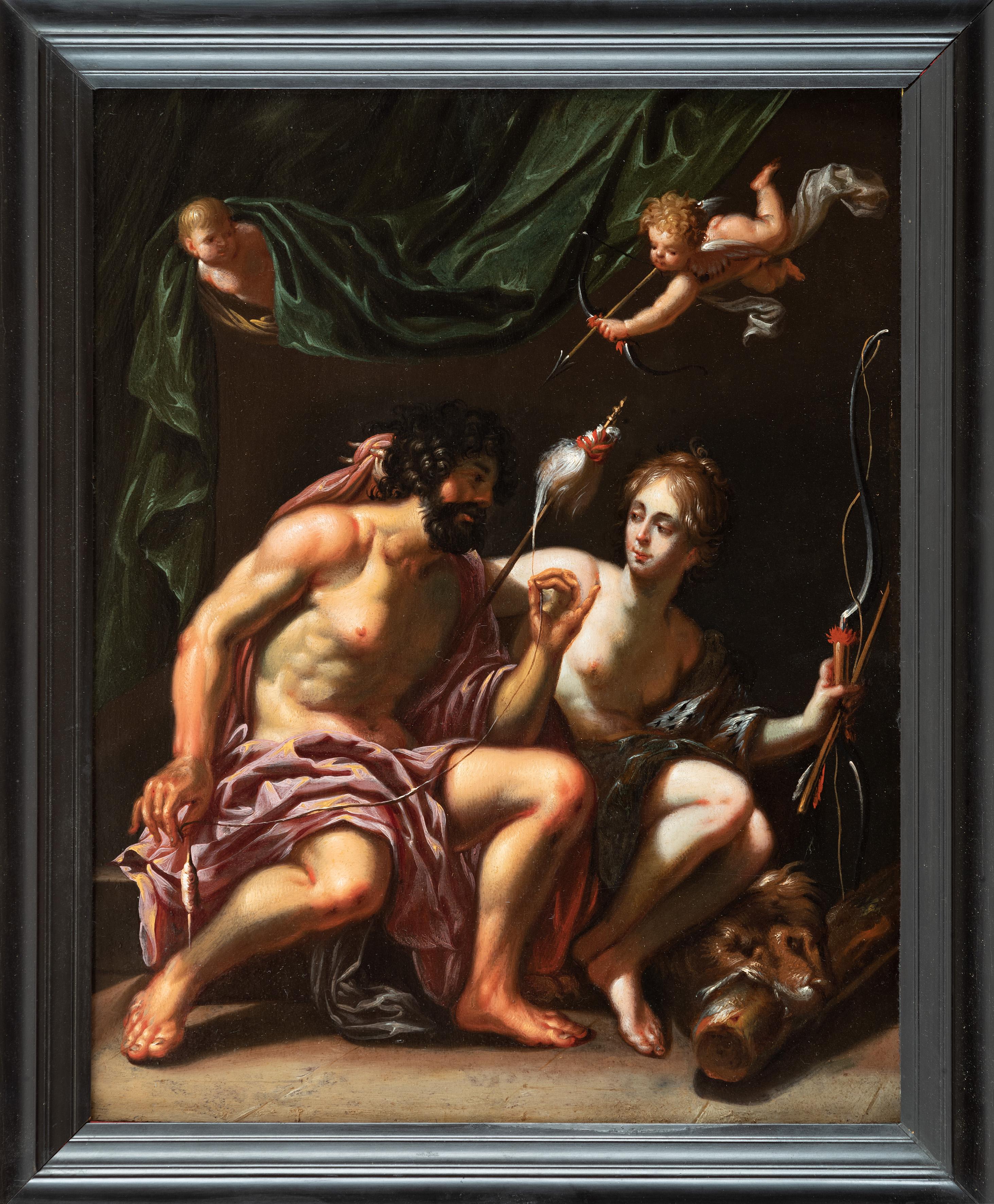
Hercules and Omphale, Old Master Painting, Mannerism, Baroque, Mythology, Prague
Located in Greven, DE
Hercules and Omphale
Oil on panel, 52 x 41 cm
According to legend, Hercules had to make atonement and became a slave to the Lydian queen Omphale. When she found out who her slave was, she married him. Falling for his mistress and made effeminate by the luxury of court life, the former hero allowed himself to become the laughing stock of the court. He dressed in women's clothes, spun wool and did other women's work, whereas Omphale wore his lion's skin and carried a wooden club. When the time of punishment was over, the hero realised his delusion and left Omphale.
So far, the painting could not be clearly assigned to an artist. Nevertheless, it impresses with its fluid and convincing painting, whose colourfulness and conception are reminiscent of the Prague School around Bartholomäus Spranger.
This work follows an engraving and an etching made by Michel Dorigny in 1643 after a design by Simon Vouet. It shows the same scene but the print differs in minor details from the present painting (see e.g. the head of the lion) and the treatment of the faces seems to be painted more detailed and refined.
So far there is no painting...
Category
17th Century Baroque Figurative Paintings
Materials
Oil, Panel

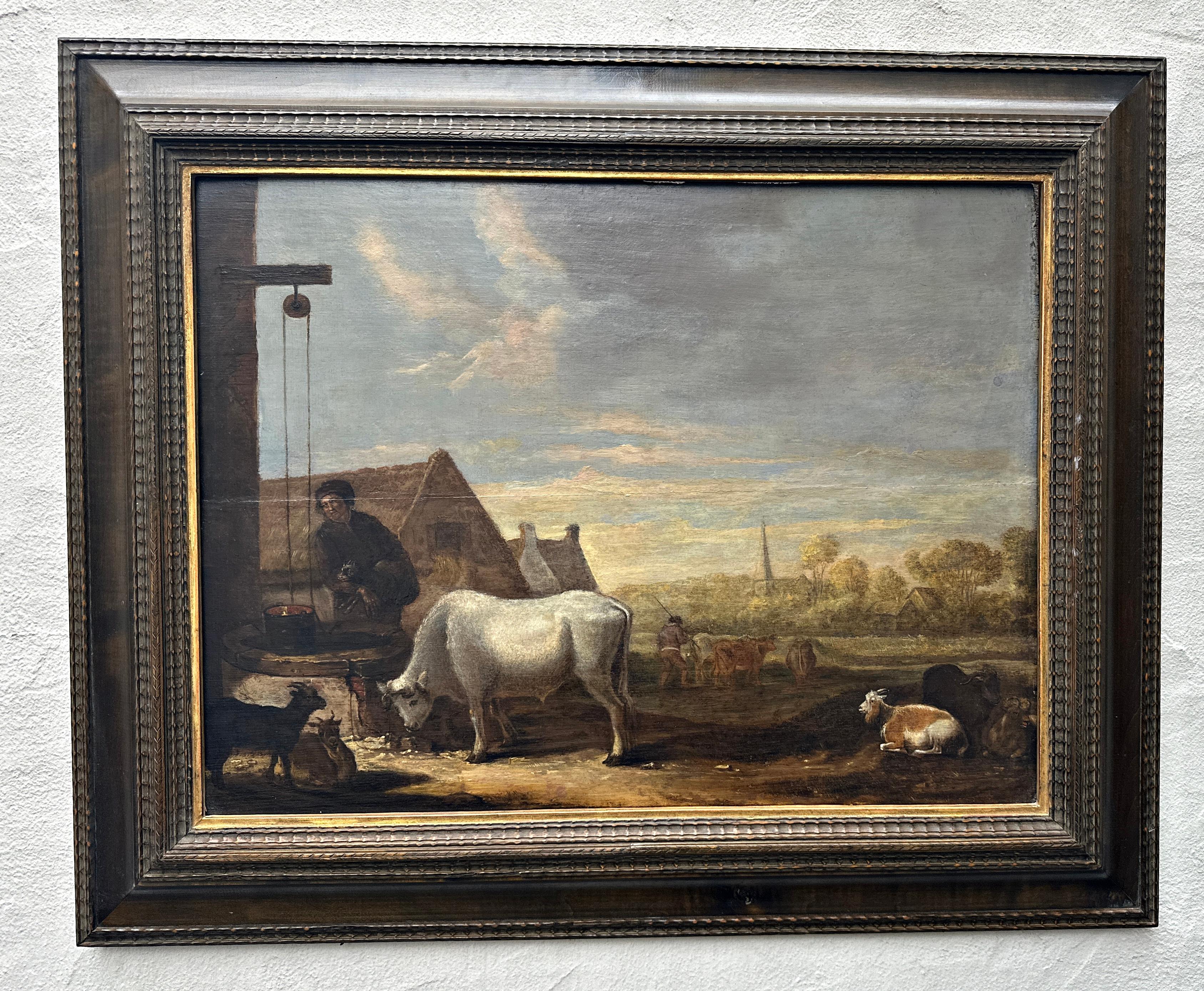
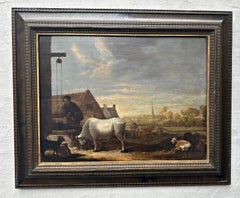
Old Master Oil on Wood 17th Century Flemish Netherlands Holland
Located in Eltville am Rhein, DE
Dutch Master
17th Century
Farmer at the Well with Goats and Cows
Oil on Wood
Size: approx. 48 x 63 cm
Frame: 68 x 83 cm
Age-related condition, old restorations (see photos)
Viewing...
Category
17th Century Old Masters Landscape Paintings
Materials
Oil
Old Master 17th Century Male Nude Zeus and Ganymede
Located in New York, NY
This exquisite 19th Century Old Master Oil painting depicts Zeus enshrouded and Ganymede, the most beautiful of mortals and a her...
Category
17th Century Old Masters Figurative Paintings
Materials
Oil

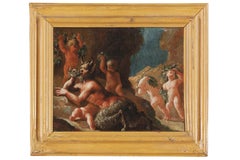
18th century By French Maestro Bacchanal Oil on canvas
Located in Milano, Lombardia
18th Century French Maestro
Title: Bacchanal
Medium: Oil on canvas
Dimensions: without frame 24 x 30 cm - with frame 33.5 x 39 cm
Antique shaped wooden frame lacquered in mustard col...
Category
18th Century Old Masters Figurative Paintings
Materials
Canvas, Oil
$10,732 Sale Price
20% Off