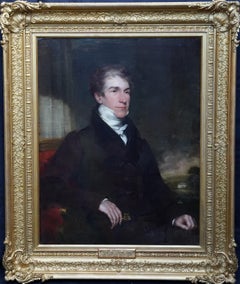
Items Similar to Alfred Baldwin, Esq.
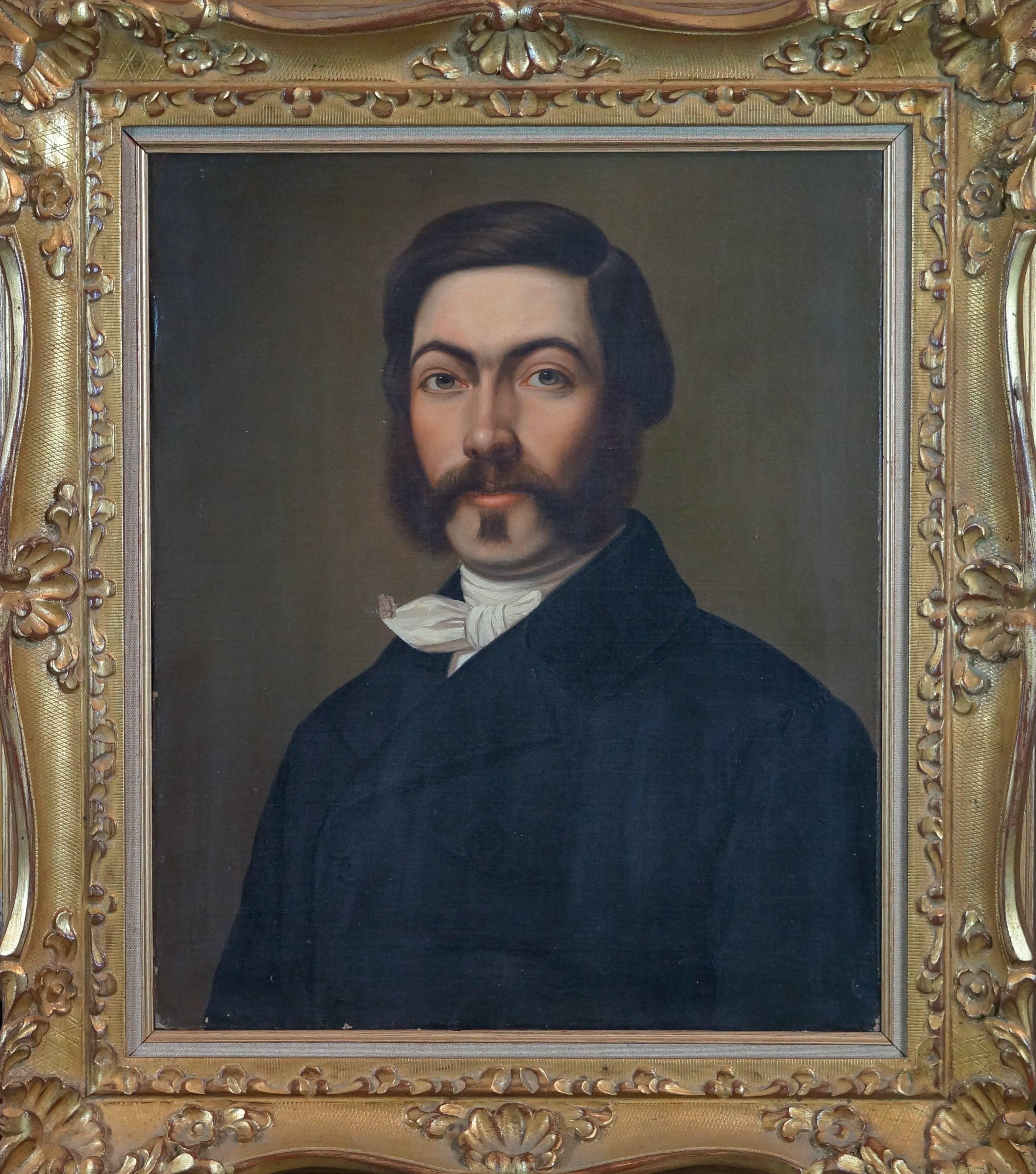

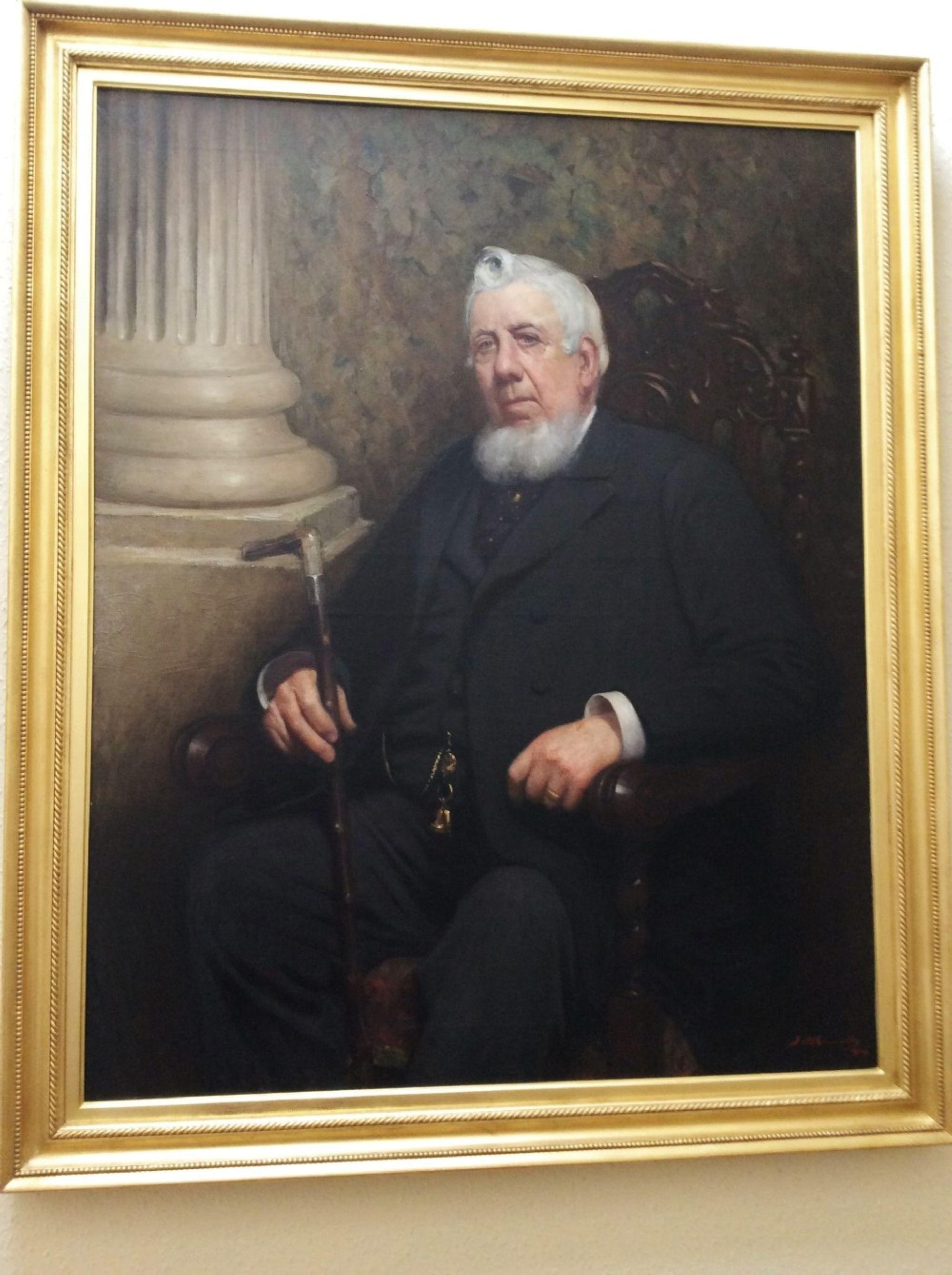
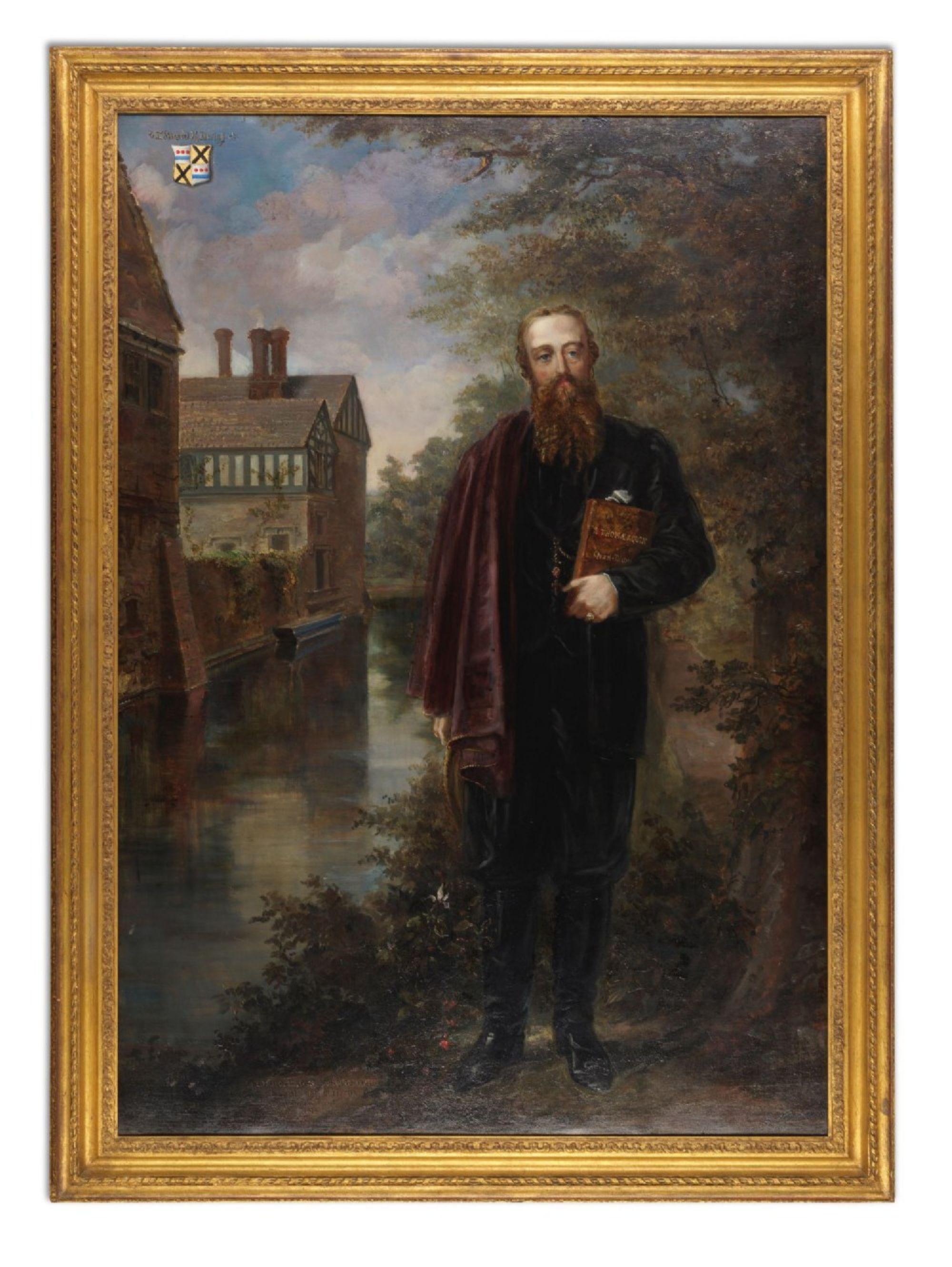
Want more images or videos?
Request additional images or videos from the seller
1 of 8
Edward John PoynterAlfred Baldwin, Esq.1878
1878
$62,699.78
£45,000
€52,870.59
CA$85,779.13
A$90,690.65
CHF 48,734.66
MX$1,089,208.64
NOK 610,244.41
SEK 558,418.65
DKK 394,826.78
About the Item
Oil on unlined canvas, stamped
26 x 21¼ inches; 66.5 x 54 cm
Framed dimensions: 95.5 x 83.5 cm
‘Wood
Co 190 Brompton Road London SW’
Signed with monogram and dated ‘1878’, centre right
Original frame carved and gilded by William A. Smith, trade label to reverse
Collections:
Alfred Baldwin (1841-1908);
Stanley Baldwin, 1st Earl Baldwin of Bewdley (1867-1947), son of the above;
Oliver Baldwin, 2nd Earl Baldwin of Bewdley (1899-1858), son of the above;
Arthur Baldwin, 3rd Earl Baldwin of Bewdley (1904-1976), brother of the above;
Edward Baldwin, 4th Earl Baldwin of Bewdley (1938-2021), son of the above;
Baldwin sale, Sotheby’s, 3 July 2022, lot.144;
Lowell Libson
Jonny Yarker Ltd.
Exhibited:
London, Royal Academy, 1879, no. 199 (as Alfred Baldwin, Esq)
This striking portrait was exhibited at the Royal Academy in 1879 when Edward Poynter was at the peak of his career as a painter. The sitter, Alfred Baldwin, was Poynter’s brother-in-law and the father of the future Prime Minister, Stanley Baldwin. Poynter and Baldwin were each married to daughters of George Browne Macdonald and formed part of a remarkable family circle; the two elder Macdonald sisters were married to John Lockwood Kipling, father of Rudyard Kipling, and to Sir Edward Coley Burne-Jones. Through marriage this brought together two of the most prominent artists of the late nineteenth century (Poynter and Burne-Jones), a pioneering designer and art educator (Kipling) and a major manufacturer and politician (Baldwin). Poynter’s portrait shows Baldwin as a prosperous late Victorian industrialist; with luxuriant beard, dark frock coat, watch chain and gold pince nez, albeit a nineteenth-century plutocrat reimagined as a sixteenth-century Venetian senator. Poynter’s portrait in its characterisation, lush painterliness and palette recalls the portraiture of Titian, Tintoretto and Veronese, whilst the acid green background suggests Poynter’s interest in Florentine models such as Bronzino and Rosso di Fiorentino.
Edward Poynter was born and trained in Paris, first in the atelier of Charles Gleyre, before enrolling in the École des Beaux-Arts. Poynter’s years in Paris with fellow students James McNeill Whistler, George Du Maurier’s Thomas Lamont and Thomas Armstrong was later celebrated in Du Maurier’s best-selling novel Trilby (1894). Poynter’s Continental training contributed to his success with both exhibition machines and decorative work. In 1868 Poynter travelled to Venice to study Venetian mosaics in preparation for an ambitious multifigured hemicycle in mosaic which he had been commissioned to complete for the new lecture theatre at the South Kensington Museum, London. In 1871 Poynter was appointed the first Slade Professor at University College, London, during his five-year tenure he was responsible for introducing the principles of French art education into the English system. The 1870s was Poynter’s most prolific decade, he completed a sequence of powerful exhibition works resulting in his election as a Royal Academician in 1876.
On 9 August 1866 the double wedding took place at St Peter’s, Wolverhampton of the sisters Agnes and Louisa Macdonald to Poynter and Alfred Baldwin. Louisa Baldwin was the only one of her sisters not to marry an artist, although she had modelled for Burne-Jones in her youth. By contrast Baldwin was a successful iron master, running the family forge at Wilden in Worcestershire. Responsible for a rapid growth of the firm, Baldwin established himself as a liberal employer and hugely successful businessman. The closeness of Louisa and Agnes Macdonald almost certainly explains the present portrait, commissioned by Baldwin in 1878.
Poynter’s carefully observed portrait communicates something of the self-assurance of the successful 37-year-old Baldwin. Dramatically lit, so half the face appears in shadow, Poynter places Baldwin close to the picture plane and eliminated all extraneous detail. This contrasts with many of Poynter’s most celebrated paintings of the period, many of which revelled in the details of fashionable aesthetic interiors. One answer for this departure may have been Baldwin himself, the successful industrialist, with his thick beard and dark clothes may have reminded Poynter of sixteenth-century Venetian portraiture. Whilst Poynter does not explicitly imitate a specific model, the visual components were surely arranged to suggest the depiction of some Renaissance merchant? Although finely worked and consistent with Poynter’s French academic training, there are passages of fluid paint and rich brushstrokes, suggesting Poynter was conscious of emulating Venetian technique. The painting is housed in the original grand, carved and gilt frame which evokes sixteenth-century Florentine examples. The frame retains its original trade label identifying it as the work of William A. Smith of 14 Charles Street. Smith was much patronised by leading painters in the 1870s, Holman Hunt described the business as possibly the best gilder and carvers in London, a considerable recommendation at a time when most frames were made using gesso.
This imposing portrait is therefore both a remarkable depiction of a Victorian industrialist and a deeply personal painting celebrating a singular bond between artist and sitter. Poynter and Baldwin were at the heart of one of the most remarkable family groups of nineteenth-century Britain. Preserved in excellent condition, unlined and in its original frame, this portrait has remaining in the Baldwin family until now.
- Creator:Edward John Poynter (1826 - 1919, British)
- Creation Year:1878
- Dimensions:Height: 26.19 in (66.5 cm)Width: 21.26 in (54 cm)
- Medium:
- Movement Style:
- Period:
- Condition:
- Gallery Location:London, GB
- Reference Number:1stDibs: LU1507217298962
About the Seller
5.0
Recognized Seller
These prestigious sellers are industry leaders and represent the highest echelon for item quality and design.
1stDibs seller since 2021
5 sales on 1stDibs
- ShippingRetrieving quote...Shipping from: Mitchum, United Kingdom
- Return Policy
More From This Seller
View AllSir Charles Frederick
Located in London, GB
Oil on canvas
50 x 40 inches; 127 x 101.6 cm
Framed dimensions: 151.5 x 127 cm
Inscribed on plinth: ‘VOTIS X ET XX’
Not signed
Painted c.1748
Collections:
Christie’s London, 23rd December 1954, lot.272;
J. Singer;
Somerville
Simpson Ltd, London, by 1985;
The Matthiesen Gallery, London;
Richard Feigen, New York;
Matthew Rutenberg, New York to 2019;
Lowell Libson and Jonny Yarker Ltd.
Literature:
Stella Rudolph, La Pittura del’ 700 a Roma, Milan, 1983, reproduced pl.133;
Jacob Simon, Handel, a celebration of his life and times 1685-1759, exh. cat. London, (National Portrait Gallery), 1985, no.196;
Catherine Whistler, Baroque
Later Paintings in the Ashmolean Museum, London, 2016, pp.102-105, reproduced p.104
Exhibited:
London, National Portrait Gallery, Handel, a celebration of his life and times 1685-1759, 1985-86, no.196, reproduced p.198
This powerful portrait of the antiquarian and courtier Sir Charles Frederick was completed in 1748 by the Roman painter Andrea Casali. Frederick, as comptroller of the royal laboratory, one of the ‘great officers’ of the Board of Ordinance at Woolwich, had just been responsible for the famed pyrotechnic display celebrating the Peace of Aix-la-Chapelle: the so-called ‘Royal Fireworks’ for which George Frederick Handel composed music. Casali’s portrait pays tribute to Frederick’s role as comptroller of the royal laboratory, showing him with a firing diagram and mortar, it also points to Frederick’s interests as an antiquarian with the inclusion of antique relief. Casali had first met Frederick in Rome in 1738, where he had painted his portrait, Frederick subsequently encouraged Casali to travel to London. This probably accounts for the unusual format; rather than a modern man of science, Casali casts Frederick as an alchemist bent on some mystic discovery, as such, it is one of the most unusual portraits of the period.
Andrea Casali was a pupil of Sebastiano Conca and then of Francesco Trevisani, who recommended him to the Spanish court in 1736. He enjoyed some success in Rome as a painter of frescoes and altarpieces, notably a large cycle of Scenes from the Life of St Dominic at the cloister of S. Sisto Vecchio, for which he was made a Knight of the Golden Spur in 1729. Casali began painting Grand Tourist portraits in Rome around 1738. His first portrait of Sir Charles Frederick is dated that year Ashmolean Museum, Oxford), it casts Frederick as a focused scholar, showing him seated at an elaborately carved console table, hard at work. In common with other Grand Tour portraiture of the period, Casali includes a famous Roman landmark in the background, in this case the façade of the Pantheon. Horace Walpole noted that it was thanks to the encouragement of ‘Mr Frederick and his Friends at Rome’ that Casali travelled to London in 1741.
Charles Frederick was a fascinating Augustan polymath. Born at Fort St George, Madras, where his father, Sir Thomas Frederick, was governor, he successively matriculated at New College, Oxford (1725), was called to the Middle Temple (1728), became a Fellow of the Royal Society (1731) and Director of the Society of Antiquaries (1735). His interests were wide ranging. Frederick was an amateur architect, he designed the monument to Lucy, Lady Lyttleton, in Hagley Church and the monument to Thomas Miller, bishop of Waterford, in Highclere church, Hampshire. He was a numismatist and collector of antiquities, as well as an amateur scientist. It was in the last capacity that he was appointed comptroller of the royal laboratory at Woolwich and clerk of the deliveries in 1746, this was the most junior of the ‘great officers’ who made up the membership of the royal Board of Ordnance. This appointment came through the good offices of the master-general of the Ordnance, a fellow antiquarian, John, 2nd Duke of Montagu. As comptroller, Frederick was responsible for the fireworks celebration of the treaty of Aix-la-Chapelle, for which Handel composed his celebrated music. As Horace Walpole wrote to his cousin, Henry Seymour Conway:
‘Charles Frederick has turned all his virtu into fireworks, and, by his influence with the Ordnance has prepared such a spectacle for the proclamation of Peace as is to surpass all its predecessors of bouncing memory. It is to open with a concert of fifteen hundred hands, and conclude with so many thousand crackers all set to music, that all the men killed in the war are to be wakened with a crash, as if it was the day of judgement, and fall a-dancing, like the troops in the Rehearsal. I wish you could see him making squibs of his papillotes, and bronzed over with a patina of gunpowder, and talking himself still hoarser on the superiority that his fireworks will have over the Roman naumachia.’
Performed in Green Park, the fireworks were mounted on a temporary structure designed by the architect Giovanni Niccolò Servandoni decorated by Adrea Soldi and Casali.
Casali’s second portrait of Frederick was completed following the success of the firework display. In this remarkable image, we discover Frederick at work, dressed in almost monastic garb, pouring over an impossibly large tome propped on an antique altar. The altar is identifiable as a Roman relief depicting Victory writing on a shield, the original is at Villa Medici in Rome, but was engraved by Pietro Santi Bartoli...
Category
18th Century Old Masters Portrait Paintings
Materials
Canvas, Oil
Self-Portrait
By John Hamilton Mortimer
Located in London, GB
Oil on canvas
30 x 25 ⅛ inches; 762 x 638 mm
Verso: after Sir Joshua Reynolds, a self-portrait
Not signed
Painted c. 1758
Collections:
Philip Gell (1775–1842), Hopton Hall, Derbyshire;
By inheritance at Hopton Hall to his daughter, Isabella, who married William Pole Thornhill, who renounced Hopton and its contents in favour of his kinsman, Henry Chandos-Pole-Gell (1829–1902);
By descent to his son, Brigadier General Harry Chandos-Pole-Gell (1872–1934), who sold Hopton Hall in 1918 and moved the family to Newnham Hall, Northamptonshire;
By descent to his son, Lt Colonel John Chandos-Pole (1909–1993), Newnham Hall;
Thence by descent until 2015, when acquired
By descent to 2015;
Lowell Libson
Jonny Yarker Ltd.
Literature:
Algernon Graves and Walter V. Cronin, A History of the works of Sir Joshua Reynolds P.R.A., London, 1901, IV, p. 1394.
David Manning...
Category
18th Century Old Masters Portrait Paintings
Materials
Canvas, Oil
Regency portrait drawing of Arabella Graham-Clarke
By John Downman
Located in London, GB
Collections:
The sitter, and by descent;
Christie's, 19th March 1928, lot 6;
Private collection to 2019
Literature:
G.C. Williamson, John Downman, A.R.A., his Life and Works, Lon...
Category
Early 19th Century Old Masters Portrait Drawings and Watercolors
Materials
Pencil, Watercolor
A Pair of Portraits
By Francis Cotes
Located in London, GB
Pastel on paper stretched on canvas
Each 23 ¼ x 19 ¾ inches; 59 x 50 cm
Framed dimensions, each: 83 x 67.5 cm
Both signed ‘F. Cotes Px 1751’
Collections:
Captain Penton;
Christie’...
Category
18th Century Old Masters Portrait Paintings
Materials
Canvas, Paper, Pastel
Eustace-Hyacinthe Langlois, called Langlois de L
Arche
Located in London, GB
Plaster
480 mm; 19 inches diameter
Inscribed: ‘H. Langlois du Pont de l’Arche Archeologue Peintre Graveur
par son ami P. J. David (D Angers) 1838’
Collections:
Sotheby’s, 22nd May...
Category
19th Century Old Masters Figurative Sculptures
Materials
Plaster
Eighteenth-century Irish portrait of the Rev. Henry Dabzac
By Hugh Douglas Hamilton
Located in London, GB
Pastel on paper, oval
9 x 7 ¼ inches; 230 x 185 mm
Inscribed on the verso:
‘The Revd Henry Dabzac D.D./ late Senior Fellow of/ Trinity College Dublin/ ever to be lamented by all that knew/ Him. Extensive learning, zeal, gently tempered/ by a spirit of charity & above all, a strong/ faith & a piety deservedly gained/ the character of a great and good man./ This exceptional man died 12th May 1790/ This picture was his give to Jane [Mary] Crofton, his sincerely [missing] sister.’
Collections:
Rev. Dr Henry Dabzac gift to his sister, Jane Crofton (d.1797);
Sir Hugh Crofton (1763-1834);
By descent to 1990;
Private collection, Dorset to 2020.
Literature:
Robert Staveley, Traces of Past and Present, Dublin, 1895, p.74;
Neil Jeffares, Dictionary of Pastellists Before 1800, online edition, no.J3751247
This characteristic pastel portrait by Hugh Douglas Hamilton was made early in his career; it depicts precisely the kind of education, well-connected Irish sitter who fuelled his success. The Reverend Henry Dabzac was from a distinguished Huguenot family, a celebrated academic historian, Dabzac received the Donegall lectureship in 1764 and from 1785 was Librarian and Senior Fellow of Trinity College, Dublin. According to his earliest biographer, Hamilton was the son of a peruke-maker based in Crow Street, Dublin. As Anne Hodge has pointed out, this places Hamilton’s father at the heart of the city: Crow street was a narrow thoroughfare formed part of the busy warren of streets bordered by the old Houses of Parliament and Trinity College at one end, and by Dublin Castle at the other. It is perhaps telling that in this early portrait, Hamilton shows Dabzac in a splendid powdered wig and his clerical bands. In 1754 Hamilton was apprenticed to James Mannin, a ‘pattern drawer’ who two years later was appointed master of the school of ornament at the Dublin Society’s drawing school, run by Robert West. Here Hamilton took the first prize in the 1755 competition, winning a premium of £1/16/. Hamilton developed a popular and profitable method of making pastel likenesses of sitters in a distinctive oval format. Hamilton developed a technique of using a sharpened pastel to hatch shaded areas of the features and, in the case of this portrait of Dabzac, the white powdered wig, which is drawn with particular care. In 1764 Hamilton moved to London where this small, oval pastels proved...
Category
18th Century Old Masters Portrait Drawings and Watercolors
Materials
Pastel
You May Also Like
Sir Beauchamp, 1880-90 - oil paint, 73x62 cm, framed
Located in Nice, FR
Oil on canvas with its original frame.
Category
1880s Academic Portrait Paintings
Materials
Oil
19th Century Oil - Portrait of A.H. Christie
Located in Corsham, GB
A well-executed portrait of a gentleman in profile. This portrait was acquired alongside another of the same sitter. A label to the reverse of the other piece identifies the sitter a...
Category
19th Century Portrait Paintings
Materials
Oil
Portrait Of A Gentleman George Williams Kenworthy by John Dalziel Kenworthy
Located in York, GB
John Dalziel Kenworthy portrait of a gentleman . Fine, large and imposing oil on canvas housed in a gilt frame.
The sitter is unidentified, he has an aristocratic and characterful lo...
Category
Early 1900s Old Masters Portrait Paintings
Materials
Oil
19th century portrait , oil on canvas , Baddesley Clinton, by R Dering
Located in York, GB
19th century, oil, Baddesley Clinton THE PHILOSOPHERS MORNING WALK R Dering
Here is a fine painting of Edward H Derring of Baddesley Clinton , a national trust property near solihul...
Category
19th Century Old Masters Figurative Paintings
Materials
Oil
Realist European painter - 19th century figure painting - Portrait of a gentlema
Located in Varmo, IT
European Painter (19th century) - Portrait of a Gentleman.
13.5 x 10 cm without frame, 18.5 x 15.5 cm with frame.
Watercolor on paper, in original 19th century frame (not signed).
...
Category
19th Century Realist Figurative Paintings
Materials
Paper, Watercolor
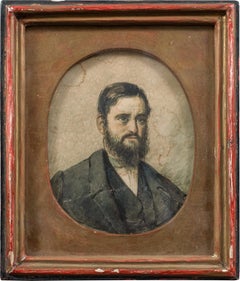
$725 Sale Price
40% Off
Portrait of William Cooper - British Victorian art male portrait oil painting
By Thomas Lawrence
Located in Hagley, England
This superb Victorian portrait oil painting is attributed to circle of Thomas Lawrence. Painted circa 1836 the sitter is William Henry Cooper, of Pains Hill, Cobham, Surrey and Hig...
Category
1830s Victorian Portrait Paintings
Materials
Oil