Want more images or videos?
Request additional images or videos from the seller
1 of 7
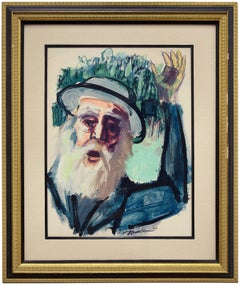
Ervin B. NussbaumChassidic Rabbi, Judaica Expressionist Painting1966
1966
$2,500List Price
About the Item
- Creator:Ervin B. Nussbaum (1914-1996, American)
- Creation Year:1966
- Dimensions:Height: 24.25 in (61.6 cm)Width: 20.25 in (51.44 cm)
- Medium:
- Movement Style:
- Period:
- Condition:
- Gallery Location:Surfside, FL
- Reference Number:1stDibs: LU38211344332
About the Seller
4.9
Platinum Seller
Premium sellers with a 4.7+ rating and 24-hour response times
Established in 1995
1stDibs seller since 2014
1,846 sales on 1stDibs
Typical response time: 1 hour
Authenticity Guarantee
In the unlikely event there’s an issue with an item’s authenticity, contact us within 1 year for a full refund. DetailsMoney-Back Guarantee
If your item is not as described, is damaged in transit, or does not arrive, contact us within 7 days for a full refund. Details24-Hour Cancellation
You have a 24-hour grace period in which to reconsider your purchase, with no questions asked.Vetted Professional Sellers
Our world-class sellers must adhere to strict standards for service and quality, maintaining the integrity of our listings.Price-Match Guarantee
If you find that a seller listed the same item for a lower price elsewhere, we’ll match it.Trusted Global Delivery
Our best-in-class carrier network provides specialized shipping options worldwide, including custom delivery.You May Also Like
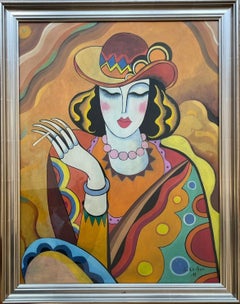
"Woman with a Cigarette", Hugo Scheiber (1873-1950)
By Hugó Scheiber
Located in Paris, FR
Hugo Scheiber (1873-1950) was a Hungarian painter of Jewish origins. He started as a self-taught artist. He was initially inspired by Impressionism before evolving towards Expression...
Category
1920s Expressionist Portrait Paintings
Materials
Gouache, Cardboard
$12,902
H 25.2 in W 19.1 in
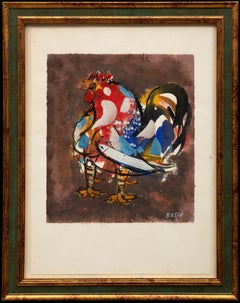
MId Century Animal Portrait: "Rooster" Pierre Bosco (1909-1993)
By Pierre Bosco
Located in SANTA FE, NM
"Rooster"
Pierre Bosco, (1909-1993)
Gouache on paper
10 x 9 (18 x 14 frame) inches
Pierre Bosco showed an interest in art at an early age. His commitment and dedication to painting...
Category
1960s Expressionist Animal Paintings
Materials
Paper, Gouache
$2,375
H 18 in W 14 in
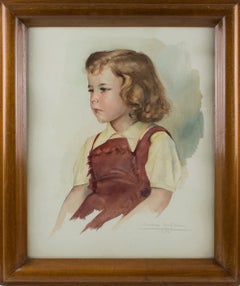
Portrait of Young Girl Gouache Painting by Max Moreau, circa 1950
By Max Moreau
Located in Atlanta, GA
1950s Portrait in Gouache by Belgian Artist Max Moreau (1902–1992)
A beautifully executed mid-century portrait depicting a young girl with gentle features and a serene expression, ev...
Category
1950s Expressionist Portrait Paintings
Materials
Paper, Gouache
$4,500
H 30.32 in W 25.19 in D 2.38 in
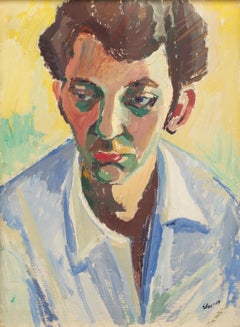
Portrait of a Man by Swedish Artist Martin Eder, 1954, Gouache on Masonite
By Martin Eder
Located in Stockholm, SE
Martin Eder was a Swedish drawing teacher, artist and ceramicist. Martin was born on the island of Gotland and spent a lot of time there, he also lived in Sala. Martin was a curious ...
Category
1950s Expressionist Mixed Media
Materials
Masonite, Gouache
$2,269
H 13.51 in W 10.16 in
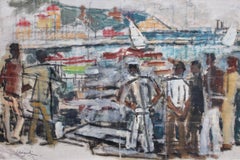
Sailors in the Port of Nice
By Alfred Salvignol
Located in London, GB
'Sailors in the Port of Nice', mixed media - gouache, pastel and oil on paper, by Alfred Salvignol (circa 1950s). The Port of Nice is one of the key hubs of Nice and, in fact, of the entire French Riviera, standing out as one of the main harbours for the boats which sail across the Mediterranean Sea. It accommodates both the ships operated by ferry companies and the private yachts of visitors who come to Nice by sea. The artist here depicts a group of crusty sailors watching...
Category
1950s Expressionist Mixed Media
Materials
Paper, Pastel, Oil, Gouache
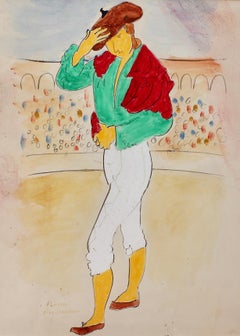
La Montera
By Pierre Ambrogiani
Located in London, GB
'La Montera', gouache, watercolour and ink on art paper, by Pierre Ambrogiani (circa 1960s). The artist created many artworks with bullfighting as theme. In this case, a single torer...
Category
1960s Expressionist Portrait Drawings and Watercolors
Materials
Paper, Watercolor, Gouache
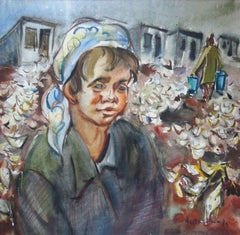
Collective farmer. 1980, watercolor on paper, 57, 5x58 cm
Located in Riga, LV
Collective farmer. 1980, watercolor on paper, 57,5x58 cm
Dzidra Bauma (1930)
Dzidra Bauma works in watercolor technique. She paint figural compositions,...
Category
1980s Expressionist Portrait Paintings
Materials
Paper, Watercolor
$917 Sale Price
20% Off
H 22.64 in W 22.84 in D 0.04 in
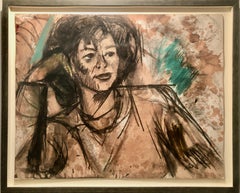
Portrait Of A Young Model Work On Paper
By Alexander Rutsch
Located in Lake Worth Beach, FL
Portrait Of A Young Model Work On Paper
Rutsch is always "scribbling and scrabbling." He is an artist of the purest breed—an artist who has no choice but to paint. He is a chosen traveler of the depths of existence; a man who follows a longing to explore his inner self and relate his findings with the energy and identity of the universe.
The celebrated Austrian artist approaches painting and sculpture as he lives life—with the eyes of a child and the hand of a poet. Constantly in the quest for rhythms of form and vibrations of color, he catches those "sparks in the shadow" and evidences their fullest reality and beauty in his creations.
Each of his paintings is a careful construction as it is a spontaneous act of love. While he might attribute certain artistic expressions to "coincidence," his inspiration comes from such diverse sources as: memories, dreams, sounds, numbers, telephone poles and drift wood. Rutsch has an affinity to vibrant colors, strong contours and rich brush strokes which are apparent in his oils, mixed media works and ink drawings. He has a sensitivity to the unusual, the discarded and a fondness for the ugly as well as the chaotic. These, he often transforms into poignant welded steel abstractions.
Rutsch has an aversion to politics, citing dates and expounding upon honors achieved. There is no talk about 'profound symbolism' in his work and as Carlo McCormick writes in the introduction to Rutsch's monograph, "Meaning is not a seed that Rutsch plants, nurtures and then harvests. It is what grows wild in a volcanic swamp of fossilized, decaying and new-born fancies—as an afterthought and aftershock." Alexander Rutsch is not concerned with interpretations; he is, however, passionate about the process of making art and surrenders his entire being as an instrument to the act of creation.
The geometry of his imagination overflows with figures, profiles and penetrating strong eyes—windows to a deeper place. Their vitality and sensuality pulsate through the "dreamscapes" of Rutsch's created worlds. At times romantic, yet always wild with energy, human forms and experiences are essential to the artist's vocabulary.
The son of opera singers and a singer himself, Rutsch speaks of "the art of painting as the art of silence" and the job of the painter "to dedicate himself to the silence." He adds though, "that this silence is the greatest existing sound in the universe." One wonders why then, if painting is "the art of silence," that Rutsch's paintings scream with sound. Sometimes melancholy, sometimes sensual, sometimes dissonant and sometimes whispering, the rhythms are always rich in the celebration of life and our shared humanity.
Painter, sculptor and poet, Rutsch's oeuvre over the past four decades is tremendous. Celebrated and collected especially in Vienna, Paris, Brussels and New York, he studied with renowned teachers like Boeckl and Dorowsky and collaborated with such geniuses as Salvador Dali. Having left Vienna in the fifties, Rutsch moved to Paris and took the city's art scene by storm. There, Picasso was so enthralled with a portrait Rutsch has done of him that, in a state of great excitement, he countersigned it.
Biography
Alexander Rutsch was born in Russia in 1916 but raised in Belgrade, Yugoslavia. After studying voice in Austria he became an opera singer like his parents, but after WWII, Rutsch's love for visual expression propelled him to change careers. He was a painter, sculptor, philosopher, musician, singer and poet. His life as a romantic is reflected in his work, as he sought to perfect his soul and humanity, "I paint my dreams," said Rutsch.
"My dreams are color and life. They soar in my head like millions of symphonies. I can never stop building dreams."
In 1952, after studying under Josef Dobrowsky, Josef Hoffmann and Herbert Boeckl at the Vienna Academy of Fine Arts, Alexander Rutsch received a scholarship to study in France. There he made contacts and began collaborations with his contemporaries, Picasso and Dali. Rutsch said of his experiences with Picasso, "Picasso played a short but important moment in my life in Paris that affected my entire artistic future. I learned from him that it is not important if art is not aesthetically finished. It can be raw, uncooked, rough. If an artist feels he has said it—it is not important to polish or finish it. Because of Picasso, I learned that if I don't feel the need to finish—I don't have to." In 1954 he exhibited his work at the Salon Artistique International de Saceux and won first prize for abstract painting, the first of may awards received during his prolific career.
During the 13 years he lived in Paris, Rutsch exhibited in many prominent galleries there and throughout Europe. In 1958, The City of Paris awarded him the prestigious Arts, Science and Letters Silver Medal. In 1966, Jean Desvilles presented his prize winning film "Le Monde de Rutsch" at the Cannes Film Festival and the Venice Biennial. In 1968 Rutsch moved to Pelham, New York where he continued to work in his studio and exhibit in galleries and museums worldwide.
Rutsch's work, as seen through his mastery of many art forms—sculpture, painting, print-making, and drawing, and a wide variety of other media has been described as "vibrating showers of lines, bold geometries, wounded anatomically rambling scrap-wood skeletons...
Category
1980s Expressionist Portrait Paintings
Materials
Watercolor, Charcoal, Oil Pastel
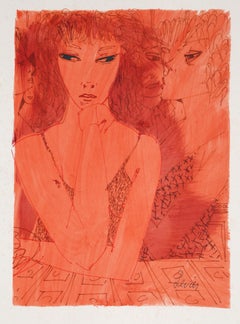
Red Lady, Watercolor Painting by Charles Levier
By Charles Levier
Located in Long Island City, NY
Artist: Charles Levier, French (1920 - 2003)
Title: Red Lady
Year: circa 1970
Medium: Watercolor on paper, signed l.l.
Size: 16 x 11 inches
Paper Size: 25 x 1...
Category
1970s Expressionist Portrait Paintings
Materials
Watercolor
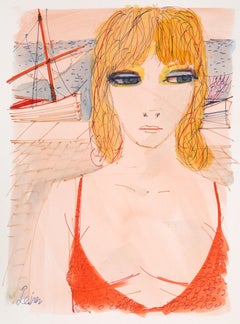
Blonde in Red Swim Suit, Expressionist Watercolor by Charles Levier
By Charles Levier
Located in Long Island City, NY
Artist: Charles Levier, French (1920 - 2003)
Title: Blonde I
Year: circa 1960
Medium: Watercolor on paper, signed l.l.
Size: 16 x 11 inches
Paper Size: 25 x 19.5 in. (63.5 x 49.53 cm)
Category
1970s Expressionist Portrait Paintings
Materials
Watercolor
More From This Seller
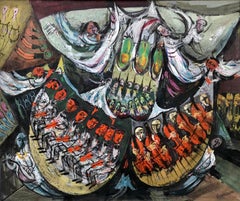
View AllModernist Orchestra Musical Gouache Painting Boston Expressionist
By David Aronson
Located in Surfside, FL
Very vibrant, dynamic orchestra scene reminiscent of the work of Mopp (Max Oppenheim)
David Aronson, (1923-2015) son of a rabbi, was born in Lithuania in 1923 and immigrated to America at the age of five. He settled in Boston, Massachusetts where he studied at the school of the Museum of Fine Arts under Karl Zerbe, a German painter well known in the early 1900s. Aronson later taught at the school of the Museum of Fine Arts for fourteen years and founded the School of Fine Art at Boston University where he is today a professor emeritus. An internationally renowned sculptor & painter, Aronson has won acclaim for his interpretation of themes from the Hebrew Talmud and Kabala. His best known works include bronze castings, encaustic paintings, and pastels. His work is included in many important public and private collections, and has been shown in several museum retrospectives around the country. He is considered to be one of the most important 20th century American artists.
At twenty-two David Aronson had his first one-man show at New York's Niveau Gallery. The next year, six of his Christological paintings were included in the Fourteen Americans exhibition at Manhattan's Museum of Modern Art where Aronson’s work was included alongside abstract expressionists Arshile Gorky, Robert Motherwell and Isamu Noguchi. In the 1950s, Aronson turned more toward his Jewish heritage for the inspiration for his art. Folklore as well as Kabalistic and other transcendental writings influenced his work greatly. The Golem (a legendary figure, brought to life by the Maharal of Prague out of clay to protect the Jewish community during times of persecution) and the Dybbuk (an evil spirit that lodges itself in the soul of a living person until exorcised) frequently appear in his work.
In the sixties, Aronson turned to sculpture. His work during this period is best exemplified by a magnificent 8’ x 4’ bronze door which now stands at the entrance to Frank Lloyd Wright's Johnson Foundation Conference Center for the Arts in Racine, Wisconsin. In the seventies and eighties, Aronson continued his work in pastel drawings, paintings, and sculptures, often exploring religion and the frailties of man's nature. During this time, in addition to a traveling retrospective exhibition and many one-man shows in New York, Los Angeles, Chicago, and Boston at the Pucker-Safrai Gallery on Newbury Street, Aronson won many awards and became a member of the National Academy of Design in New York. Two years ago he retired from teaching to work full-time in his studio in Sudbury, Massachusetts.
included in the catalog
Contemporary Religious Imagery in American Art
Catalog for an exhibition held at the Ringling Museum of Art, March 1-31, 1974.
Artists represented: David Aronson, Leonard Baskin, Max Beckmann, Hyman Bloom, Fernando Botero, Paul Cadmus, Marvin Cherney, Arthur G. Dove, Philip Evergood, Adolph Gottlieb, Jonah Kinigstein, Rico Lebrun, Jack Levine, Louise Nevelson, Barnett Newman, Abraham Rattner, Ben Shahn, Mark Tobey, Max Weber, William Zorach and others.
Selected Awards
1990, Certificate of Merit, National Academy of Design
1976, Purchase Prize, National Academy of Design
1976, Joseph Isidore Gold Medal, National Academy of Design
1976, Purchase Prize in Drawing, Albrecht Art Museum
1975, Isaac N. Maynard Prize for Painting, National Academy of Design
1973, Samuel F. B. Morse Gold Medal, National Academy of Design
1967, Purchase Prize, National Academy of Fine Arts
1967, Adolph and Clara Obrig Prize, National Academy of Design
1963, Gold Medal, Art Directors Club of Philadelphia
1961, 62, 63, Purchase Prize, National Institute of Arts and Letters
1960, John Siimon Guggenheim Fellowship
1958, Grant in Art, National Institute of Arts and Letters
1954, First Prize, Tupperware Annual Art Fund Award
1954, Grand Prize, Third Annual Boston Arts Festival
1953, Second Prize, Second Annual Boston Arts Festival
1952, Grand Prize, First Annual Boston Arts Festival
1946, Traveling Fellowship, School of the Museum of Fine Arts
1946, Purchase Prize, Virginia Museum of Fine Arts
1944, First Popular Prize, Institute of Contemporary Art
1944, First Judge's Prize, Institute of Contemporary Art
Selected Public Collections
Art Institute of Chicago
Virginia Museum of Fine Arts
Bryn Mawr College
Brandeis University
Tupperware Museum, Orlando, Florida
DeCordova Museum
Museum of Modern Art Print Collection, New York
Atlanta University
Atlanta Art...
Category
20th Century Expressionist Figurative Paintings
Materials
Gouache, Board
Chassidic Rabbi, Judaica Expressionist Painting
By Ervin B. Nussbaum
Located in Surfside, FL
In this painting, Nussbaum depicts a Rabbi as his subject; a recurrent figure in his body of work. The artist uses gestural marks and vibrant blue colors in this composition.
Nussba...
Category
20th Century Expressionist Portrait Paintings
Materials
Gouache
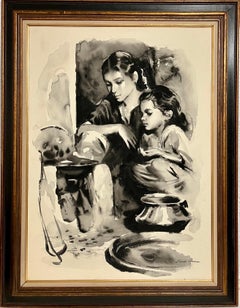
Large Gouache Original Painting Mother
Daughter Sandu Liberman Israeli Judaica
By Sandu Liberman
Located in Surfside, FL
framed 36 X 28 board 30 X 21.75
Sandu Liberman (Romanian-Israeli) was born in Yasi, Romania in 1923. between 1946 and 1953 he took part in the state art shows in Bucharest. in 1952 ...
Category
20th Century Modern Figurative Paintings
Materials
Paper, Gouache
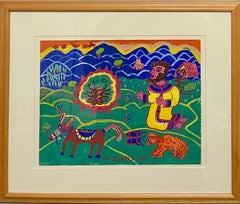
Malcah Zeldis Folk Art Gouache Moses Bible Painting Self Taught Outsider Artist
Located in Surfside, FL
MALCAH ZELDIS (American-Israeli, b. 1931)
Moses and the burning bush, 1982, gouache on paper,
Hand signed and dated lower middle.
Paper 9''h, 11-3/4''w. Framed 14.5 X 17.5
Provenance: Estate of Laura...
Category
1980s Folk Art Figurative Paintings
Materials
Paper, Gouache
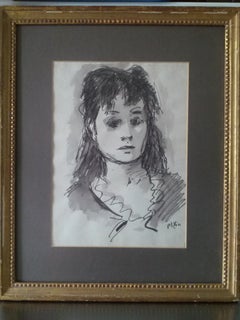
Beautiful Woman watercolor painting by Robert Philipp
By Robert Philipp
Located in Surfside, FL
A sensitive portrait beautifully rendered in watercolor and gouache.
Mid century. I am guessing from the 1940s
it is not dated.
Robert Philipp (February 2, 1895 – November 22, 1981)...
Category
1940s Portrait Paintings
Materials
Watercolor, Gouache
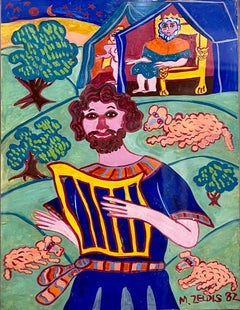
Malcah Zeldis Folk Art Gouache Painting King David Self Taught Outsider Artist
Located in Surfside, FL
MALCAH ZELDIS (American-Israeli, b. 1931),
''David and Saul'', 1982,
Gouache on paper
Hand signed and dated lower right, titled in pencil on paper verso.
Provenance: Estate of Laura Fisher...
Category
1980s Folk Art Figurative Paintings
Materials
Paper, Gouache
Still Thinking About These?
All Recently ViewedMore Ways To Browse
Dior 1996
Portrait Rabbi
Rabbi Painting Portrait
Judaica Rabbi Portrait
Military Portrait
Portrait Rabbi
Blue Lady Painting
Antique 18th Century English Frames
Man With Beard
Warhol Brillo
Child 18th Century Painting Portrait
1950s Portrait Oil Paintings
Oil Painting Lady With Hat
Oil Paintings Philadelphia
American School Portrait
Portrait Of A Man French 18th Century
Warhol Brillo Box
17th Century Portrait Of Women