Want more images or videos?
Request additional images or videos from the seller
1 of 10

George Romney
Portrait of a Gentleman, traditionally identified as Edward Addison, Esq., 1780s

1780s

$25,748.12
£18,500
€21,766.95
CA$35,340.58
A$37,343.17
CHF 20,083.35
MX$447,067.21
NOK 251,620.94
SEK 230,448.26
DKK 162,573.64

About the Item

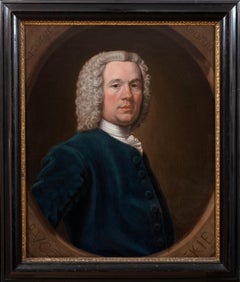
George Romney (1734-1802) Portrait of a Gentleman, traditionally identified as Edward Addison, Esq., c.1780s Oil on canvas In a period carved and gilded swept frame 76.3 x 63.2 cm.; (within frame) 100.5 x 88 cm. Provenance: Thomas Humphry Ward (1845-1926), London; From whom acquired by Thomas Agnew Sons, London, no. 2096 (NGA27/1/1/10, p. 68); From whom acquired by Nathaniel Thayer III (1851-1911), Boston, 9 May 1907; By whose executors sold, American Art Association-Anderson Galleries, New York, 25 April 1935, lot 69; Where acquired by Felix Gouled Gallery, New York; Plaza Art Galleries, New York; Nathan B. Spingold (1886-1958), New York; By whom sold, Parke-Bernet Galleries, New York, 2 March 1950, lot 46; Where acquired by Kleemann Gallery, New York; Anonymous sale, Sotheby’s, New York, 5 April 1990, lot 224; Private collection, United States; Anonymous sale, Sotheby’s, London, 9 April 2025, lot 77. Exhibition History: Reputedly the Worcester Art Museum, Worcester, Massachusetts (probably loaned by Pauline Revere Thayer prior to 1935). Literature: American Art Association-Anderson Galleries, Notable Paintings (New York, N.Y.: American Art Association-Anderson Galleries, 25 April 1935), p. 50 Ernst R. Beyard, Art at Auction in America (Silver Spring, M.D.: Krexpress, 1991), p. 166 Alex Kidson, George Romney: A Complete Catalogue of his Paintings (London: Paul Mellon Centre for Studies in British Art), vol. I, p. 113; reproduced vol. III, p. 713 (no. 1552) Bolesław Mastai, Mastai’s Classified Directory of American Art and Antique Dealers (s.n.: New York, 1950), p. 508 Parke-Bernet, Old Masters (New York, N.Y.: Parke-Bernet, 2 March 1950), reproduced p. 56 Sotheby’s, Old Master Paintings (New York, N.Y.: Sotheby’s, 5 April 1990) Thomas Humphry Ward and W. Roberts, Romney, A Biographical and Critical Essay with a Catalogue Raisonné of his Works (London: Thomas Agnew Sons, 1904), vol. II, p. 2 Archival Witt Library, Courtauld Institute of Art (British School, 243041) Witt Library, Courtauld Institute of Art (British School, 243042) Witt Library, Courtauld Institute of Art (British School, 243040) Painted in half-length, Romney’s subject wears a powdered tie-wig, fastened en queue with a black ribbon, alongside a stock and cravat underneath a dark blue jacket trimmed with brass buttons. A warm tonal background loosely suggests a landscape beyond. Measuring 30 x 25 inches, the portrait is of the standard size of Romney’s half-length commissions ‒ for which he would have charged some 25-30 guineas for this period. The broad and opaque handling belongs stylistically to the artist’s output of the late 1780s, a spell of great productivity which averaged about a portrait a day during the season. The work is compositionally close to that of Sir George Gunning Bt. (1753-1825), painted in 1786, which would suggest a proximity of creation. Romney reworked this evidently satisfactory arrangement, down to the highlight on the gentlemen’s left shoulders and unfastening of the lower jacket buttons. The sitter has traditionally been identified as Edward Addison Esq., a merchant of 22 Surrey Street, Strand, since its earliest record as no. 2096 in the stock book of Thomas Agnew Sons. Addison was divorced from his wife Jane Campbell (1771-1851) in 1801, who became the first woman to successfully petition Parliament for a divorce following Addison’s ‘incestuous’ adultery with her sister, Jessy Campbell, only three years after their marriage. Addison soon fled abroad to Hamburg to avoid the award of some £5,000 in damages and costs to Jessy’s husband, equating to over £300,000 in modern terms. Notably, Campbell attained custody of the couple’s two children and was free to remarry. The portrait was acquired by Agnew’s in 1907 from the author and journalist Thomas Humphry Ward (1845-1926), who in 1904 had published an extensive catalogue and biography on the artist. Ward sold the present portrait along with another by Romney and one by Lawrence, having previously sold Romney’s portrait of Jane Dawkes Robinson to Agnew’s in 1906. Ward presumably acted as an agent on behalf of Romney owners with whom he had likely become acquainted in compiling his catalogue. The present portrait was bought from Agnew’s on 9 May by the prominent banker and railroad executive Nathaniel Thayer III. Subsequent owners included the motion picture executive Nathan B. Spingold, who likely kept the work at his townhouse of 12 East 77th Street, a property formerly owned by Reginald Claypoole Vanderbilt (1880-1925). Spingold along with his wife Frances assembled an outstanding and diverse collection, honoured with the Nate and Frances Spingold Collection exhibition at the Metropolitan Museum of Art in 1960. Alex Kidson in his comprehensive catalogue of the artist’s works records the present portrait as no. 1552, although questions the traditional identification of Edward Addison on the basis that there is no record of him having sat for Romney. Addison’s wife (as she was then) was painted by Romney in 1788, attending eight sittings between 21 February and 18 March. The portrait was delivered to Addison at Surrey Street on 26 May, who paid Romney on 19 June. Addison was also visited by Romney on 11 January 1790, most likely in connection with his commission for Sir Archibald Campbell, Jane Campbell’s uncle. Addison received the portrait eight days after Campbell’s death, and paid Romney 70 guineas on the 15th. Though it is not clear whether Ward simply maintained or in fact suggested the identification of Addison, his studies at Brasenose College, Oxford, happened to coincide with Jane Campbell’s grandson by her second marriage, Duncan Pocklington (1841-1870). It is not implausible that a portrait of Addison might have passed by descent, and Pocklington introduced his half-relations (and the portrait) to Ward. Romney was born in December 1734 in Dalton-in-Furness, Cumbria, the third of eleven children to John Romney, a joiner and cabinet-maker, and his wife Anne. The Romney family lived in High Cocken cottage, where Romney spent a decade apprenticed to his father after leaving education in Dendron at the age of eleven. Developing upon a natural ability to work wood, Romney carved and gilded furniture, and made flutes and violins; though his early talent for portraiture attracted the attention of Daniel Gardner’s mother, who commissioned a portrait of herself and persuaded Romney’s father to allow artistic study. A local artist named John Williamson taught Romney informally, and at the age of 21 he moved to Kendal to begin an apprenticeship with Christopher Steele (himself a former student Carle van Loo). Romney was freed from his indentures after Steele had eloped with a young heiress. Romney fell ill with fever and was nursed by the daughter of his landlady, A Miss Mary Abbot who he would marry in 1756 after Abbot fell pregnant. Romney worked in Kendal, with professional visits to York, Lancaster, Manchester and Cheshire, and trained his younger brother Paul. He went on to London in 1762, concentrating on history scenes. He won second prize in the Royal Society of Arts competition in 1763, though his award of 50 guineas was dubiously reduced to 25 guineas. He travelled to Paris the following year, meeting Jean-Baptiste Greuze and Claude Vernet. He again won the second prize in the RSA competition, and after important society introductions enjoyed significant commissions and exhibition successes. In 1773 he travelled to Italy to study the masters, arriving in Rome in June where a letter of introduction allowed him an audience with Pope Clement XIV, who authorised scaffolding to be erected in the Apostolic Palace for Romney to study Raphael’s frescoes. Romney returned to London after two years in Rome. Upon his penniless return to London in 1775, Romney took a long lease on Francis Cotes’ house at 32 Cavendish Square. Consolidating his poor finances with a number of important commissions, he joined Reynolds and Gainsborough as a leading portraitist ‒ despite resisting urges to join the Royal Academy, to the contempt and jealousy of the older Reynolds. Romney was thereabouts introduced to Emma Hamilton (later mistress to Lord Nelson), who became the muse reproduced in over 60 portraits and mythological scenes. Romney left his studio at 32 Cavendish Square to Hampstead in 1796, though after costly building work and bad health had abandoned the house two years later. He returned to his wife Mary in Kendal after their long separation, and was nursed by her until his death in 1802. He is buried at St Mary’s Church, Dalton-in-Furness. Some two thousand of Romney’s works survive in public collections, a testament to the artist’s stamina and popularity of his distinctly buoyant though natural style. Bibliography and further reading: Alex Kidson, George Romney; 1734-1802 (Princeton, N.J.: Princeton University Press, 2002) Alex Kidson, George Romney: A Complete Catalogue of his Paintings, 3 vols. (London: Paul Mellon Centre for Studies in British Art) Barry E. Mclean-Eltham, George Romney: Paintings in Public Collections (Kendall: Romney Society, 1996) Humphry Ward and W. Roberts, Romney: A Biographical and Critical Essay, with a Catalogue Raisonné of his Works, 2 vols. (London: T. Agnew and Sons, 1904)
  • Creator:
    George Romney (1734 - 1802, English)
  • Creation Year:
    1780s
  • Dimensions:
    Height: 39.57 in (100.5 cm)Width: 34.65 in (88 cm)
  • Medium:
  • Movement Style:
  • Period:
    1780-1789
  • Condition:
  • Gallery Location:
    Henley-on-Thames, GB
  • Reference Number:
    1stDibs: LU2820216422252

More From This Seller

View All
Portrait of an artistic Gentleman, c. 1720s
By John Vanderbank
Located in Henley-on-Thames, England
John Vanderbank (London 1694 - London 1739) Portrait of an artistic Gentleman, c. 1720s Three-quarter-length, wearing a turban Oil on canvas 125.5 x 101.7 cm.; (within frame) 145.6...
Category

1720s Old Masters Portrait Paintings

Materials

Oil

Portrait of a senior naval officer, c. 1740s
By Thomas Hudson
Located in Henley-on-Thames, England
Thomas Hudson (Devon 1701 - London 1779) Portrait of a senior naval officer, c. late 1740s Probably a captain or admiral; half-length, holding a telescope, with a warship beyond Oil on canvas 91.3 x 71.1 cm.; (within frame) 114.3 x 93.8 cm. (Unsigned) Provenance: Christie’s, London, 22 November 1985, lot 105 (as Thomas Hudson); Private collection, United Kingdom; Haynes Fine Art, Broadway, Worcestershire; Where acquired, private collection, United States, 16 August 1988; Neal Auction, New Orleans, 14 September 2025, lot 302 (as Attributed to Thomas Hudson); Where acquired by Haveron Fine Art. Literature: Bridgeman Art Library, The Bridgeman Art Library (London: The Library, 1995), p. 89 Christie’s, London, Important English Pictures (London: Christie’s, 22 November 1985) Archival: Witt Library, Courtauld Institute of Art (no. 061487); Heinz Archive and Library, National Portrait Gallery, 1725-50, Thomas Hudson: Men Authentic (1) (Box) This attractive and quintessential half-length is exemplary of Hudson’s leading portrait practice, produced in the years immediately preceding his decade-long dominance over the London market, beginning in 1749. The work is stylistically typical of Hudson's prime 1750s output, displaying a deliberate refinement of his technique: namely the emphasis of directional brushstrokes, which sensitively follow the contours of the facial features. However, since the sitter wears civilian dress and not a naval uniform (introduced officially in April 1748), a late 1740s date of creation is most likely. Displaying the merits of Hudson's evolving handling, a distinctive feathery quality is combined here with a striking chiaroscuro effect, which Hudson borrowed directly from Rembrandt. Amalgamating the rich colouring of the Rococo with a mannered Baroque posing, Hudson renders the senior naval officer with a characteristic presence. Resting one hand assuredly at his hip, the finely worked telescope illustrates the officer’s seniority; the warship sailing on the horizon beyond provides further indication of his commanding rank. The telescope is held by a hand modelled with sculptural poise, and the typically Van Dyck manner (seen elsewhere, e.g. Princess Amelia Sophia Eleonore of Great Britain, YCBA B2001.2.246) further illustrates Hudson's studied grounding. The sitter wears civilian clothes, and not the naval uniform first introduced in 1748 (which officers afterwards invariably chose to be shown in). His red waistcoat is of a type popular amongst British officers before 1748, perhaps inspired by French naval uniforms. The officer has previously been suggested as Edward Henry Sartorius, of the prominent naval Sartorius family; however, this identification is improbable on biographical and documentary grounds. Hudson was regularly commissioned by leading naval officers, and produced highly satisfactory portraits praised for their great likeness and genteel swagger. He charged 24 guineas for a standard 50 x 40 inch half-length in the 1750s period, and the present work (somewhat smaller in size) would have cost not much less. Comparable works include those of Admirals of the Fleet George Anson, 1st Baron Anson, and Sir John Norris; Admiral Sir George Pocock; Admiral Sir Peter Warren; Vice-Admiral The Honourable John Byng; and Rear-Admiral Richard Tyrrell. The present portrait is particularly similar in composition to Hudson’s Portrait of a Flag Officer of The White Squadron, which similarly employs the narrative device of a telescope held at a dynamic angle across the composition, with a warship to the left side of the officer’s retracted arm. Thomas Hudson (Devon 1701 - London 1799) Thomas Hudson rose to become the leading British portraitist of the mid-18th century, albeit in close competition with his Scottish counterpart Allan Ramsay. Born in Devon, Hudson studied alongside George Knapton under Jonathan Richardson the Elder (marrying his daughter in 1725, expressly against Richardson’s wishes), and inherited a dignified formality jointly derived from Van Loo. His work is first recorded in 1728, and between 1730-40 he practised in Bath and the West Country, where in addition to portrait commissions, he was employed to retouch and reline old pictures. He returned permanently to London thereafter, and devised a series of stock poses to which he would return with variation throughout his career. Beginning in 1745 with the death of Richardson and the departure of Van Loo, Hudson became the city’s most successful portraitist, and embarked on ambitious defining works such as his Portrait of Theodore Jacobsen ‒ not drastically unlike the continental heights of Pompeo Batoni in conception. Profiting from his success, he relocated from Lincoln’s Inn Fields to a house in Great Queen Street previously inhabited by Van Loo, and one door down from Kneller’s old rooms. An exceptionally productive period began in 1749 which lasted until the late 1750s. Among this output were highly praised portraits of the Prince and Princess of Wales, commissions for most of the preeminent aristocrats, and superlative group portraits including Benn’s Club of Aldermen, and those of the Thistlethwayte, Marlborough and Radcliffe families. Hudson relocated to King Street, Covent Garden, operating a prolific studio operation which resulted in some four hundred paintings ‒ of which at least eighty were engraved. A prodigious assembly of young pupils included Sir Joshua Reynolds (1740-3), Joseph Wright of Derby (1751-3, 1756), Richard Cosway, John Hamilton Mortimer, and the drapery painters Joseph and Alexander van Aken (also employed by Ramsay). As one later reviewer expressed: ‘Hudson, his art may well display to sight / Who gave Mankind a Reynolds and a Wright’ (Miles, ‘Introduction’). The ambitious young Reynolds made many drawings from classical statuary under Hudson’s instruction, and wrote home that, ‘While doing this I am the happiest creature Alive (sic.)’ (Sweetser, p.12). However, he was later dismissed from his pupilage some two years prematurely for refusing to carry a painting to Van Aken’s studio in the rain. It was at this point that Reynolds returned to Plymouth (Devonport), and produced some thirty portraits of the local gentry (including one example presently owned by Haveron Fine Art). Hudson was one of a number of artists who congregated in Old Slaughter’s Coffee House, alongside Hogarth, Ramsay, Hayman, and Rysbrack. Together they supported Thomas Coram’s Foundling Hospital, of which they each belonged to the 600 governors (in whom Hudson met many of his future clients), and promoted the building as London’s first public space of artistic exhibition. He visited the Netherlands and France for five weeks in 1748 accompanied by St Martin’s Lane colleagues, and was arrested with Hogarth for making drawings of the Bastille fortifications. He afterwards stayed in Rome and Naples in 1752 with Roubiliac, meeting Reynolds twice on the return journey. He returned to England and bought a house at Cross Deep, Twickenham (upstream from Pope’s villa), and made an effective museum of the space. He lived there with his second wife, a wealthy widow named Mrs Fynes. Having been involved with early attempts to establish a royal academy of the arts, Hudson exhibited at the Society of Arts in 1761 and 1766, although he had effectively retired from painting by the latter date. His last painting was in 1767, and he died at Twickenham in January 1779 aged seventy-eight. Hudson was also exceptional for the extensive collection of artworks which he amassed during his lifetime. The collection was thoroughly impressive in extent, and included outstanding Old Masters: Breughel, Canaletto, van Dyck, Hals, Holbein, Kneller, Lely, Michelangelo, Parmigianino, Poussin, Raphael, Rembrandt, Rubens, Tintoretto, Titian, Vasari, and Velázquez. His earliest recorded purchase was in 1741, and he spent heavily at the sale of his father-in-law, even buying works jointly with Van Aken. Likewise, at the posthumous 1750 sale of Van Aken, Hudson spent £215 on the second day (nearly half that day’s sale total). As a pupil, Reynolds had been sent to bid for Hudson in Lord Oxford’s sale of 1742, and proudly recalled having been greeted with a handshake by Hudson’s friend Pope at another picture sale. Hudson also collected extensively from within his own generation, acquiring works by contemporaries including Gainsborough, Reynolds, Richardson, Rysbrack, Vanderbank, and his predecessor Van Loo. Following his death, the works were dispersed in two sales at Messrs. Langford, with the finer works sold at Christie’s in 1785 after the death of his second wife. However, his connoisseurship was not without flaw ‒ having outbid Benjamin Wilson for a Rembrandt drawing, Wilson etched and printed a new ‘Rembrandt’ plate...
Category

1750s Old Masters Portrait Paintings

Materials

Oil

Portrait of George Gordon, 7th Laird of Buckie (1707-1756)
By John Alexander
Located in Henley-on-Thames, England
John Alexander (Scottish, 1686-1766) Portrait of George Gordon, 7th Laird of Buckie (Scottish, 1707-1756), c. 1743 Oil on canvas In a carved ebonised frame, with gilded inner slight...
Category

1740s Old Masters Portrait Paintings

Materials

Oil

Portrait tête d’expression portrait study of a gentleman
Located in Henley-on-Thames, England
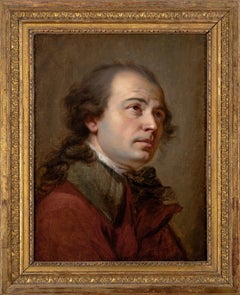
French Academic School, 18th century Portrait tête d’expression study of a gentleman, c. 1780-90 Oil on canvas 46.1 x 35 cm.; (within frame) 57.5 x 46.6. cm. Provenance: Private Co...
Category

1780s French School Portrait Paintings

Materials

Oil

Portrait of the artist’s cousin, Gladys Coombs (1899-1963), c. 1920-25
Located in Henley-on-Thames, England
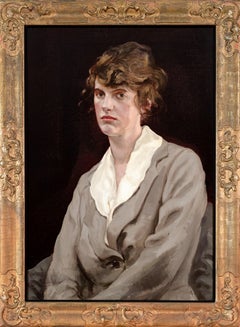
John George Hookham (1899-1972) Portrait of the artist’s cousin, Gladys Coombs (1899-1963), c. 1920-25 With a figure study verso Oil on canvas In an attractive, stylised ‘Lely’ type ...
Category

1920s Post-Impressionist Portrait Paintings

Materials

Oil

Portrait study of a Lady, wearing precious stones and pearls
Located in Henley-on-Thames, England
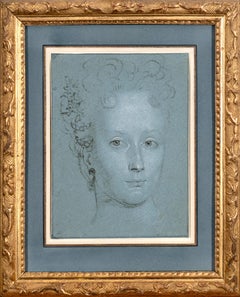
Adriaen van der Werff (1659-1722) (attrib.) Portrait study of a Lady, wearing precious stones and pearls Black and white chalk, heightened with white, on blue paper Inscribed verso, ...
Category

17th Century Rococo Portrait Drawings and Watercolors

Materials

Chalk

You May Also Like

Portrait of Lady Caroline Price
By George Romney
Located in Miami, FL
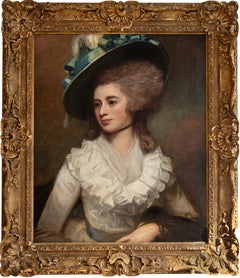
DESCRIPTION: Perhaps the best Romney in private hands. If Vogue Magazine existed in the late 18th century, this image of Lady Caroline Price would be ...
Category

1970s Old Masters Portrait Paintings

Materials

Oil, Canvas

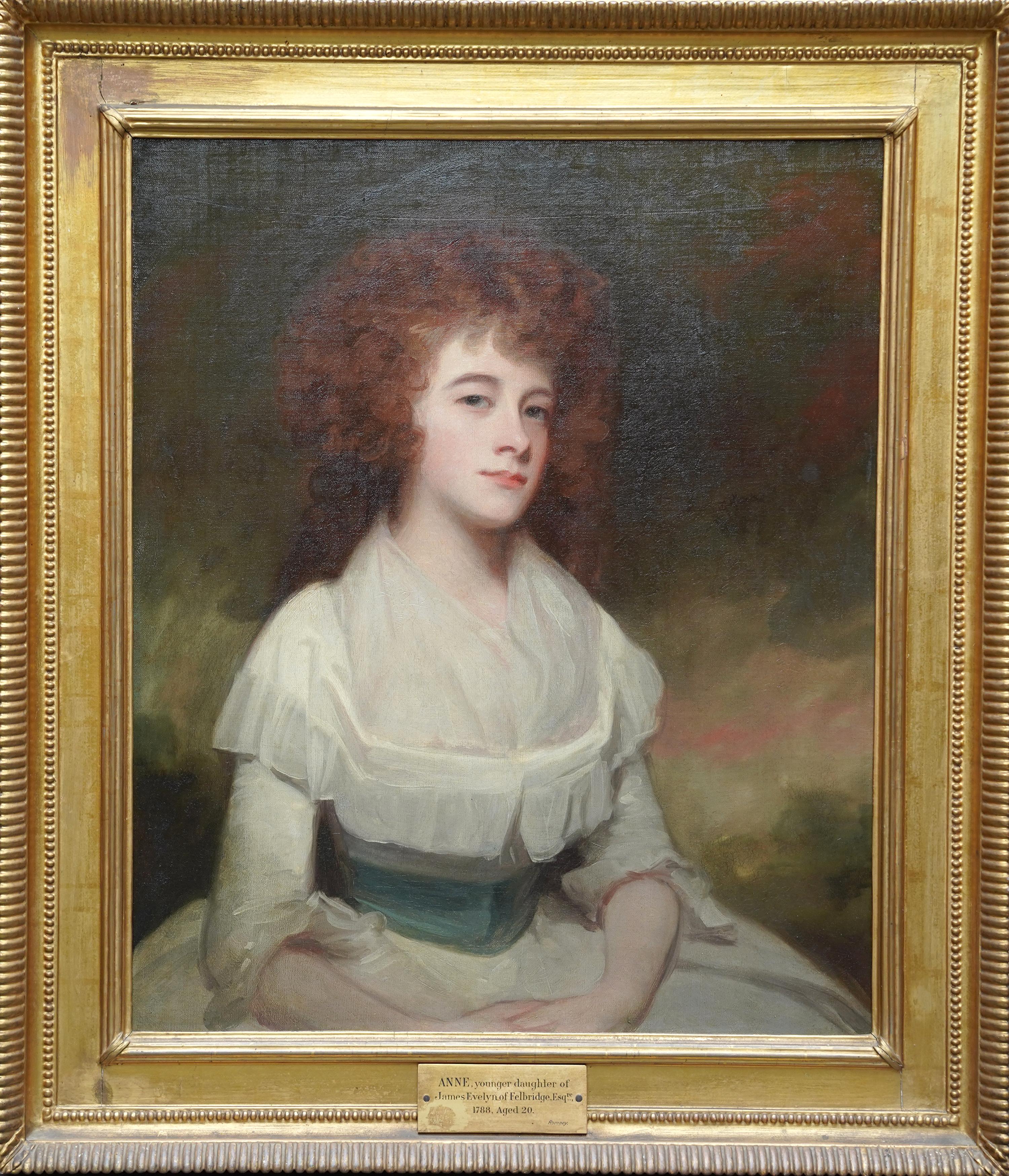
Portrait of Anne Evelyn - British 18thC Old master oil painting excellent prov.
By George Romney
Located in Hagley, England
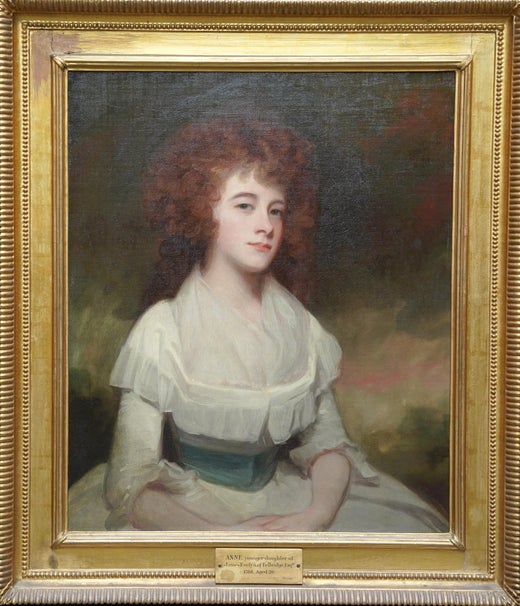
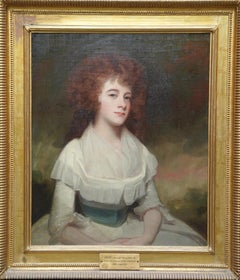
This stunning British 18th century Old Master portrait oil painting, with exceptional provenance, is by noted artist George Romney. It was painted in 1788, commissioned by James Evelyn of Felbridge as it is of his younger daughter Anne, aged 20 years old. James was a Doctor of Law and Anne's mother was his second wife, Jane. Felbridge house, Anne's home, was in the village of Godstone in Surrey. This superb oil painting is a seated portrait of Anne, wearing a white dress with a green sash, her forearms exposed and her hands in her lap. Anne is blessed with the most wonderful long auburn curly hair and is visually stunning. Her body is partly turned away from the artist/viewer and she is slightly gazing down at us with confident, clear eyes. Anne is pictured in a landscape with a dramatic sky behind her. Romney's brushwork on her dress, hair and the background is superb. The delicate detailing of her facial features is also stunning. Sometimes Old Master portraits can be a little staid, but this one of Anne with her wild auburn hair and bold look is just magnificent. This is a fantastic example of George Romney's work and of an 18th century British Old Master with exceptional detailed provenance. Name plate states: Anne, younger daughter of James Evelyn of Fellbridge Esq. 1788, aged 20. Romney. Provenance. With Charles Cecil Cope Jenkinson, 3rd Earl of Liverpool (1784-1851) With The Hon. Henry Berkeley Portman (1860-1923), Later 3rd Viscount Portman; with Emma, Viscountess Portman (1862-1929) By 1926; with her daughter Lady Moyra Dawson-Damer (1897-1962) Thence by family descent. Painted in 1788. There are various labels verso. Mentioned in Lord Hawkesbury's Catalogues of Portraits at Compton Place and at Buxted Park, in Sussex, 1903, p.18, no. 3, at Buxted Park, as in the 'Dining Room, South Wall'. Further Bibliography: Gower (R. S.) Romney, London, 1904, p. 175 Kidson (Alex) George Romney, A Complete Catalogue of his Paintings, New Haven and London: Yale University Press, 2015, I, p. 205, no. 422 (illus).Ward (Humphrey) and Roberts (William) Romney: A Biographical and Critical Essay, London: T Agnew & Sons, 1904, p. 51 Condition. Oil on canvas. Image size 30 inches by 24 inches and in good condition. Frame. Housed in an ornate gilt frame with name plate, 37 inches by 31 inches and in good condition. George Romney (1734-1802) was born in Dalton-on-Furness, Lancashire, on 15 December 1734, the third of the eleven children of John Romney and Anne Simpson. Leaving school at the age of eleven, he worked for eight years in his father's cabinetmaking workshop before being apprenticed to a local painter, Christopher Steele, with whom he served for two years, from 1755 to 1757, in Kendal, York, and Lancaster. He married a Kendal girl, Mary Abbot...
Category

1780s Old Masters Portrait Paintings

Materials

Oil

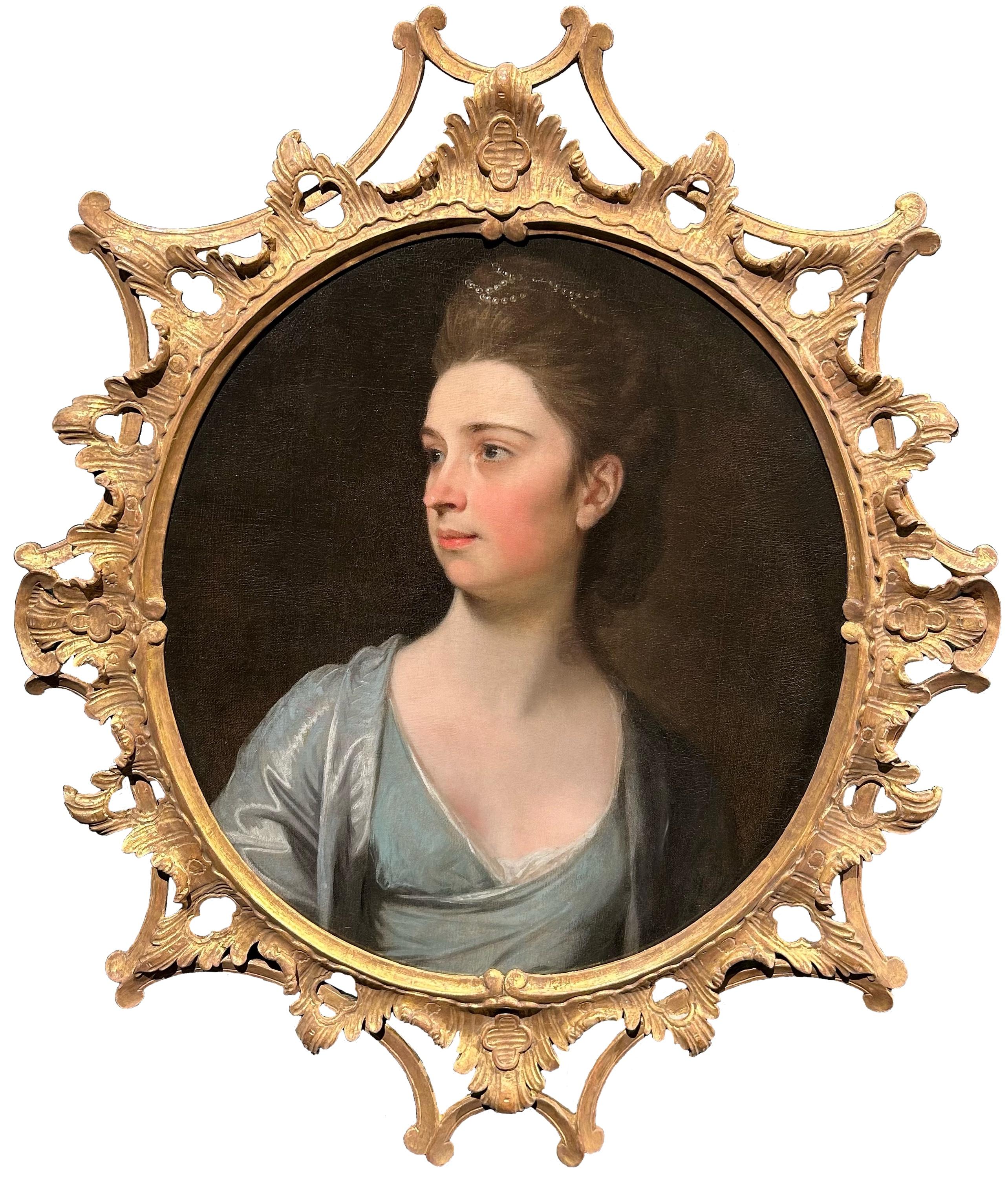
Portrait of Lady Anne Dutton, Oil on canvas, 18th English Century Painting
By George Romney
Located in London, GB
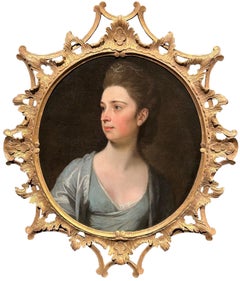
Oil on canvas, unsigned Image size: 22 x 20 inches (22.75 x 51 cm) Pierced gilt carved frame Provenance Commissioned by James Lenox Dutton (1713-1777) Sherborne House, Dorset Family descent This half-length portrait shows the sitter with her head and eyes looking over her shoulder, to the right. She is dressed in a delicate blue dress and blue shawl with her hair tied up away from her face. The composition of the painting is simple but effective; the woman stands out and is the undeniable focus of the viewer's attention. George Romney's artistic style is characterised by its focus on the beauty and elegance of human forms. Here, one can appreciate his ability to capture the delicacy of facial features and the soft textures of clothing. In addition, Romney has used a soft and diffuse brushstroke technique that creates a light and soft effect in the work. The dark and diffused background highlights the young woman's figure even more, creating an effect of depth and realism. The sitter of this painting is likely Anne Dutton, the daughter of James Lenox Dutton and Jane Bond. Anne Dutton (1743-1821) was the 13 x great great granddaughter of King Edward III, and married politician Samuel Blackwell. Anne sat for portraits by Francis Cotes which bear a striking resemblance to this portrait, and her father was a known patron of Romney. George Romney Romney was a fashionable portrait painter of late 18th-century English society. In his portraits Romney avoided delving into the character or sensibilities of the sitter. His great success with his society patrons depended largely on just this ability for dispassionate flattery. Line rather than colour dominates; the flowing rhythms and easy poses of Roman classical sculpture underlie the smooth patterns of his compositions. From 1755 to 1757 Romney was the pupil of Christopher Steele, an itinerant portrait and genre painter. Romney’s career began when he toured the northern English counties painting portraits for a few guineas each. In 1762 he went to London. His history painting The Death of General Wolfe won him an award from the Society of Arts; nonetheless he turned almost immediately to portrait painting. In 1764 he paid his first visit to Paris, where he was befriended by Joseph Vernet. Romney especially admired the work of Nicolas Le Sueur, whose use of the antique strongly appealed to him. In 1773 he went to Italy for two years, where he studied Raphael’s Stanze frescoes in Rome, Titian’s paintings...
Category

18th Century Portrait Paintings

Materials

Canvas, Oil

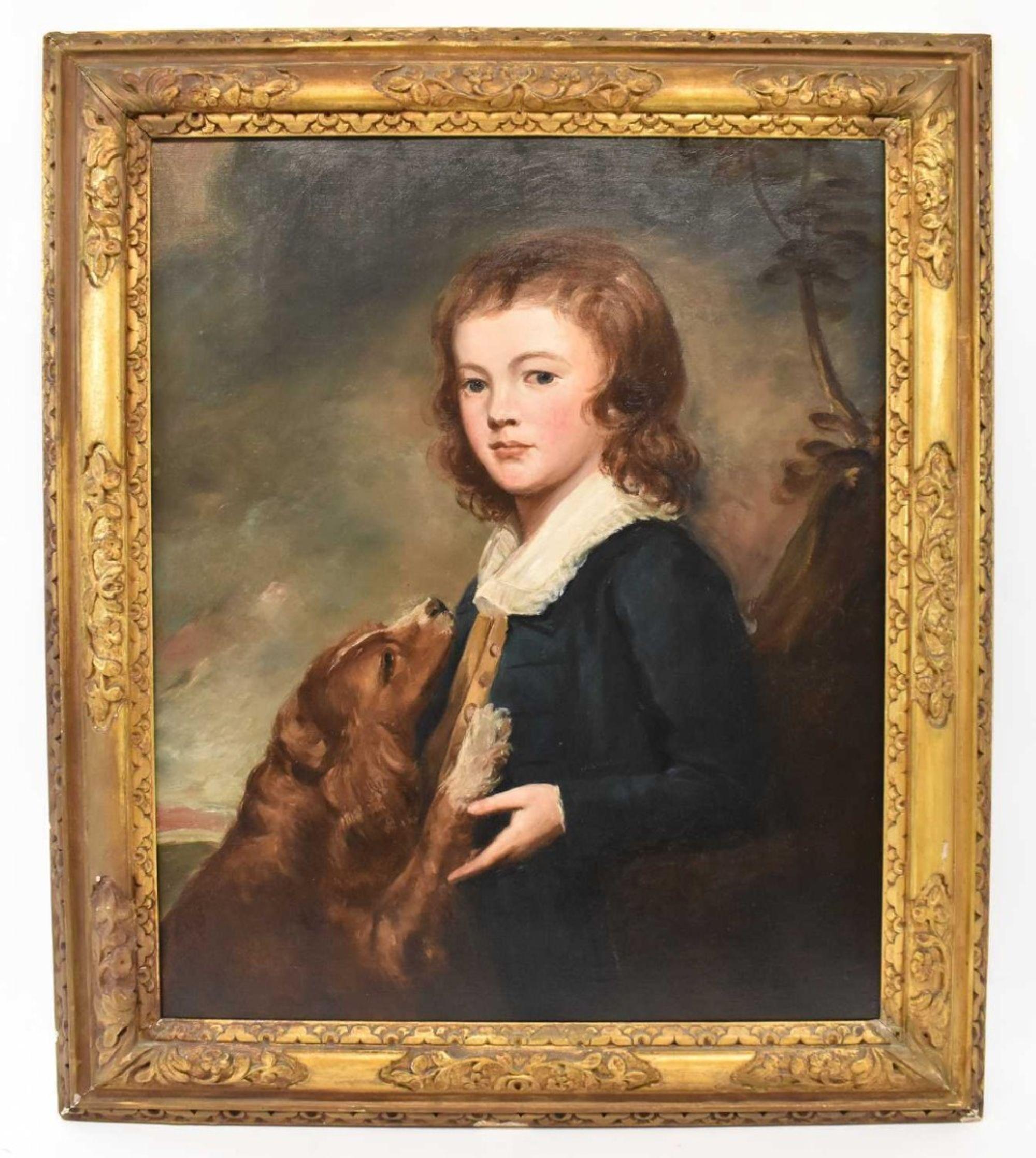
GEORGE ROMNEY(after)19th century portrait The Hon.Reverend Anchitel Grey as a Bo
By George Romney
Located in York, GB
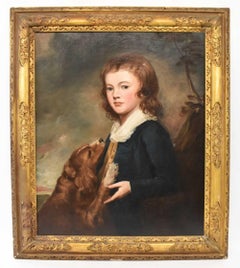
A fine painting after George Romney of The Hon.Reverend Anchitel Grey (1774 – 1833) as a Boy The painting depicts a boy aged about ten, standing, turned to the left, gazing at the spectator, wearing a blue coat, and white linen collar, a spaniel with its paws on his chest. Shoulder length brown hair. Trees in the background on the right, distant horizon with cloudy sky on the left. The sitter was the third son of George Harry Grey, 5th Earl of Stamford (1765-1845) and Lady Henrietta Cavendish-Bentinck (died 4th June 1827), daughter of the 2nd Duke of Portland...
Category

19th Century Old Masters Portrait Paintings

Materials

Oil

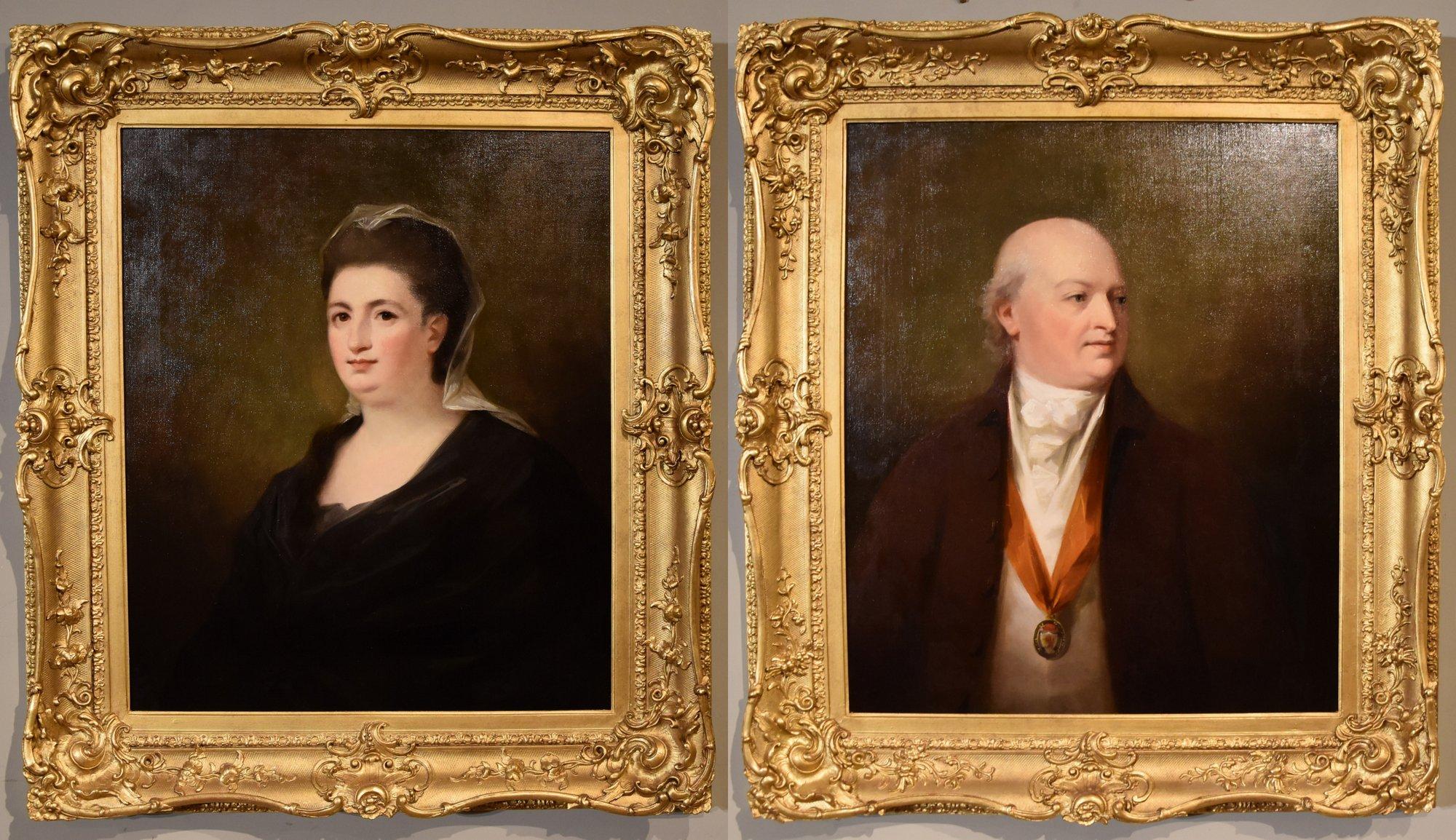
Oil Painting by George Romney "Portraits of a Lady and Gentleman"
By George Romney
Located in Mere, GB
Oil Painting Pair circle of by George Romney "Portraits of a Lady and Gentleman" 1734 - 1802 Romney was a leadway society portrait painter of the Georgian ear...
Category

1780s Portrait Paintings

Materials

Oil

English Georgian Man in Red Coat Portrait
By George Romney
Located in Queens, NY
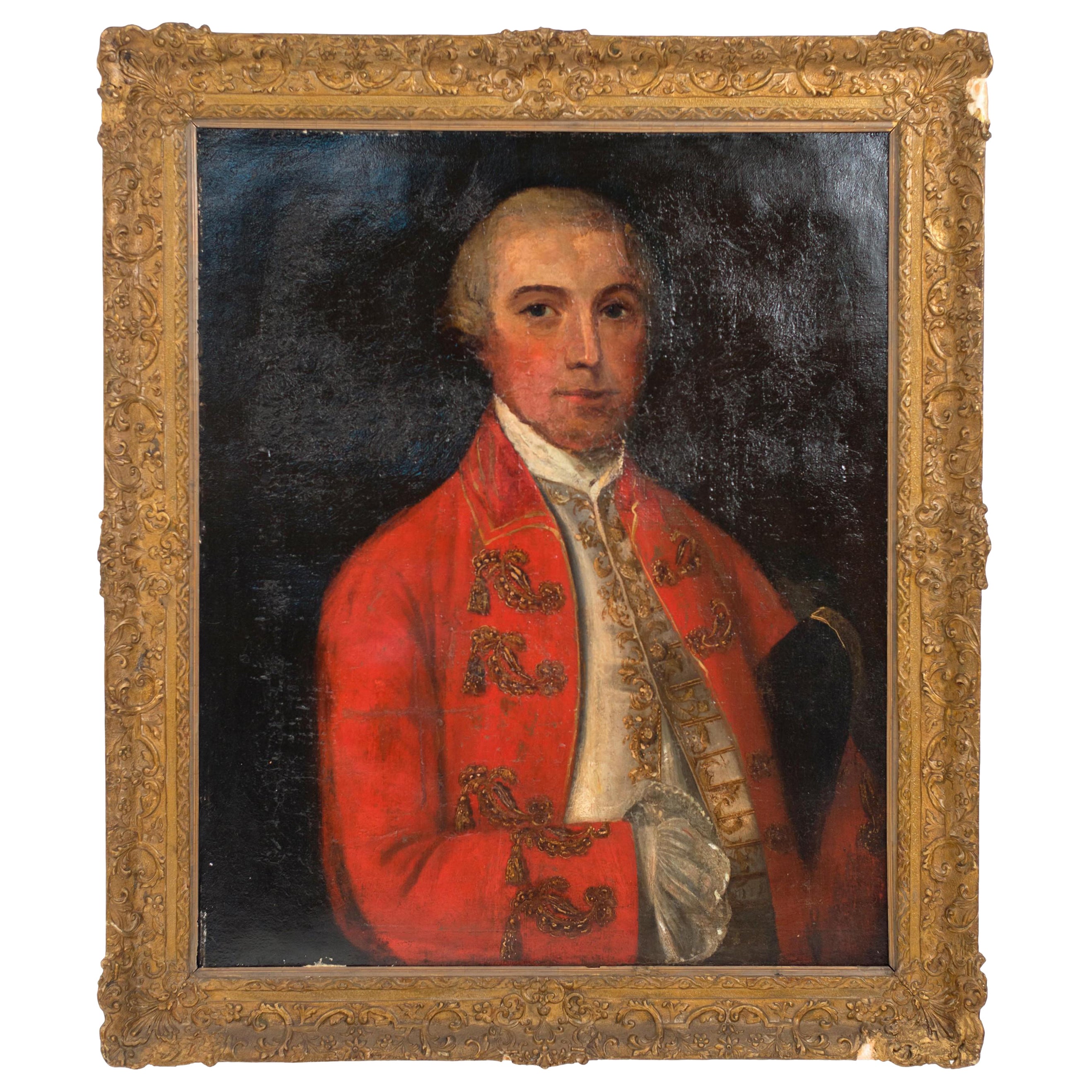
English Georgian gilt framed oil painting portrait of man in red coat with vest (att: Geo. Romney)
Category

20th Century British Georgian Paintings

Materials

Paint