Items Similar to The painter (self-portrait) sketch
Want more images or videos?
Request additional images or videos from the seller
1 of 15
Jacques Martin-FerrièresThe painter (self-portrait) sketch1925
1925
$35,776.17
£26,636.22
€30,000
CA$49,447.03
A$52,572.40
CHF 28,429.57
MX$625,364.72
NOK 356,120.73
SEK 325,244.18
DKK 228,592.54
About the Item
Jac MARTIN-FERRIÈRES
(Saint-Paul Cap de Joux 1893 – Neuilly sur Seine 1972)
The Painter (Self-Portrait) - Sketch
Oil on canvas
H. 65 cm; W. 65 cm
Signed lower left, dated 1925
Exhibition label no. 62 previously affixed to the canvas and replaced on the back
Original frame and canvas
Provenance: Private collection, Bordeaux
Born in the heart of the Tarn region, Jacques Martin grew up in an artistic universe where the rigor of drawing and the search for light were naturally transmitted. Trained by his father, the great Henri Martin, then by Fernand Cormon and Ernest Laurent, he developed a technical mastery early on, nourished by this sensitivity to painting. Holding a degree in science, he applied his knowledge of chemistry to experimenting with pigments and the search for new pictorial textures.
From the 1920s onwards, he exhibited at the Salon and received several distinctions, including a silver medal and the Prix National in 1925. His style, initially marked by his father's pointillism, gradually asserted itself. Jac Martin-Ferrières (the name he adopted to distance himself from his father's image) distanced himself from the avant-garde and chose a personal path, faithful to a style of painting characterized by sincerity, light, and reality.
A great traveler, he toured Italy, Greece, Spain, and Portugal. Each journey enriched his palette: Mediterranean blues, Provence ochres, and the silvery reflections of the sea became recurring motifs in a work dominated by color. His landscapes, bustling harbors, still lifes, and bouquets reflect a profound joy for painting. He also excelled in religious settings, such as those of Saint-Christophe-de-Javel in Paris or Saint-Louis in Marseille, combining monumentality and fervor.
A war injury temporarily removed him from large-scale painting, but his transformed vision gained in intensity. The light became more interior, more meditative. In his mature canvases, the colors vibrate without unnecessary brightness, conveying the peace of a man in harmony with his vision.
In the early 1920s, Jac Martin-Ferrières sought to renew his artistic approach. Aware of the limitations to which his Post-Impressionist research was leading him, he also wished to free himself from a paternal influence that had become too present. Henri Martin's shadow, benevolent but invasive, weighed on his work: constant demands, demanding judgments, material dependence. In this environment where life and work merged, the son felt the need to exist on his own.
An ambitious thirty-something, Martin-Ferrières saw the Parisian Salons as an opportunity to establish himself in the eyes of both the public and critics. He devoted all his energy to them, gradually establishing a more personal and vigorous style. In 1923, he presented to the French Artists a monumental Christ on the Cross—a canvas over three meters high, the result of extensive preparatory work. Through a play of contrasts between light and dark tones, between hieratic figures and dramatic movement, he created a scene of great spiritual intensity. Christ, suspended above a procession of mourners, dominates a landscape opening onto a luminous depth. Awarded a silver medal, the work was acquired by the French government and deposited two years later at the Notre-Dame-de-Québec church.
In 1925, Martin-Ferrières recaptured the spirit of the composition of his Christ on the Cross, depicting himself in a large Self-Portrait in the Open Air, entitled The Painter. This bold new work marks a decisive step. It shows the painter at work, facing his canvas, in a luminous landscape inspired by the Lot region. The decorative elements—easel, drawing boards, painted sketch (ours), and the stony ground of the causse—express the rigor of the work and the passion for the motif. With a sure gesture, the painter dominates the composition, his gaze inviting the viewer to enter into this moment of creation.
With its power and mastery, The Painter won the Prix National du Salon. The work was exhibited that same year at the Carnegie Institute in Pittsburgh, where his father had presented his paintings two years earlier. The accompanying scholarship—12,000 francs, accompanied by a mandatory six-month stay abroad—opened a new period of discovery for Jac Martin-Ferrières. Like Henri Martin forty years earlier, he naturally chose Italy, the homeland of light and color.
Our painting, in which the canvas is left in reserve on numerous occasions, is a formidable work of modernity, preparatory to this great work, now considered his masterpiece. Several preparatory drawings for the figure are known and are on deposit at the Musée du Pays de Cocagne in Lavaur, such as the large final painting (205 x 205 cm). Another self-portrait presented in the recent 2023 exhibition dedicated to the painter at the same museum shows only his bust in front of the landscape.
- Creator:Jacques Martin-Ferrières (1893 - 1972, French)
- Creation Year:1925
- Dimensions:Height: 25.6 in (65 cm)Width: 25.6 in (65 cm)
- Medium:
- Movement Style:
- Period:
- Condition:
- Gallery Location:BELEYMAS, FR
- Reference Number:1stDibs: LU1857217044972
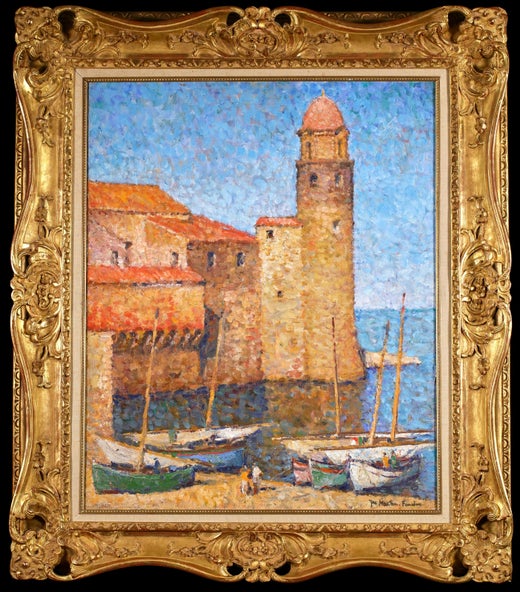
Jacques Martin-Ferrières
A painter remarkable for his highly personal portraits, still-life and landscape views, Jacques Martin-Ferrières was the son of the great Post-Impressionist painter Henri Martin (1860-1943). He studied with his father and with Frederic Cormon (1845-1924). Like his father, Martin-Ferrières became a master at reproducing the scintillating effects of light on canvas. Despite his father’s strong influence, though, Jac developed a technique that was uniquely his own: paint is applied in swift and short brushstrokes of opaque color, at times overlapping and at times separated, revealing a pale ground layer and producing a mosaic-like surface. Martin-Ferrières was awarded many national prizes, including an honorable mention at the Salon of 1920, a silver medal in 1923, the National Prize in 1925, and a Gold Medal and Legay-Lebrun Prize in 1928. He was a regular and respected exhibitor at the annual Salon des Artistes Français. Martin-Ferrieres interrupted his painting career to serve in the French resistance movement during World War II. Although he lost an eye while a prisoner of war, he resumed his art efforts around 1950. His works were shown in Paris in 1965 at an exhibition of landscapes and snow paintings, displaying his use of the thick, impastic surface which gave his paintings depth and a shimmering quality. A retrospective of his work in Paris in 1965 confirmed his respected status. Selected Museum Collections: Boca Raton Museum of Art; Musée Malraux, Le Havre
About the Seller
3.0
Vetted Professional Seller
Every seller passes strict standards for authenticity and reliability
Established in 2017
1stDibs seller since 2022
7 sales on 1stDibs
- ShippingRetrieving quote...Shipping from: BELEYMAS, France
- Return Policy
More From This Seller
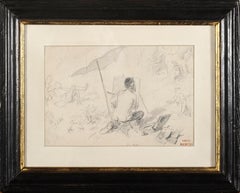
View AllThe outdoor painter
Located in BELEYMAS, FR
Clément Auguste Andrieux
(Paris 1829 – Samois-sur-Seine 1880)
The Open-Air Painter
Graphite on paper
H. 16.5 cm; W. 24.5 cm visible
Sale stamp lower right
Provenance: Studio sale, 1...
Category
1870s French School Portrait Drawings and Watercolors
Materials
Paper
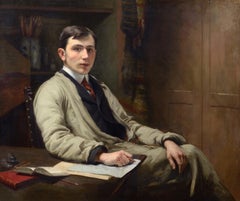
Portrait of young man - The artist
s son
Located in BELEYMAS, FR
Auguste-Joseph Delécluse
(Roubaix 1855 - Paris 1928)
Portrait of the artist's son, Eugène Delécluse
Oil on canvas
H. 98 cm; W. 116 cm
Signed lower right
1903
Exhibition: 1903, Salon...
Category
Early 1900s French School Portrait Paintings
Materials
Canvas, Oil
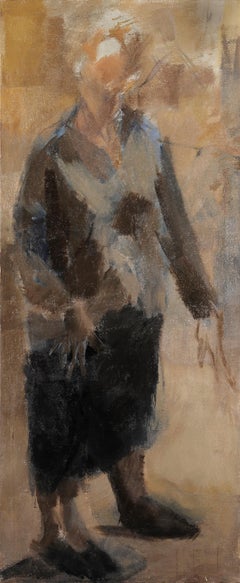
Artist self-portrait
By Élisabeth Dujarric de La Rivière
Located in BELEYMAS, FR
Elisabeth DUJARRIC de LA RIVIÈRE
(Jouy-en-Josas 1930 – Excideuil 2005)
Artist's self-portrait
Oil on canvas
H. 171 cm; L. 70 cm
Signed on the back
Provenance: Private collection, Périgord
Born in the heart of the Bièvre valley, a few kilometers from Versailles...
Category
1950s Cubist Portrait Paintings
Materials
Canvas, Oil
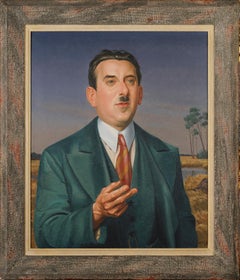
Portrait of a French man
By Jean Despujols
Located in BELEYMAS, FR
Jean DESPUJOLS
(Salles 1886 – Shreveport 1965)
Portrait of a Henri Martin, mayor of Saint Médard en Jalles (Gironde)
Oil on canvas
H. 75 cm; L. 60 cm
Signed lower right
around 1920/2...
Category
1920s French School Portrait Paintings
Materials
Canvas, Oil
Portrait of the model and future wife of the painter : Almerinda Caira
Located in BELEYMAS, FR
François-Maurice ROGANEAU
(Bordeaux 1883 - Aix-en-Provence 1973)
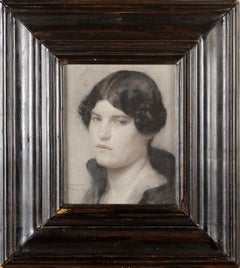
Portrait of the model and future wife of the painter: Almerinda Caira
Graphite, charcoal, and sanguine on paper
H. 25...
Category
1910s French School Portrait Paintings
Materials
Paper, Graphite
Presumed artist self-portrait
Located in BELEYMAS, FR
Louis-Gabriel BLANCHET
(Versailles, 1701 – Rome, 1772)
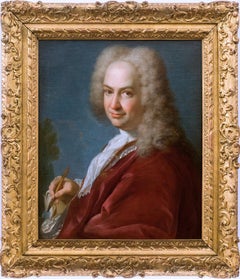
Presumed self-portrait of the artist
Oil on canvas
H. 73 cm; W. 60 cm
Circa 1730
Originally presented in a Restoration period frame with a "Mignard" cartouche, this beautiful painting initially appeared to us as a work from northern Italy. However, it exuded a rather French form of refinement, suggesting that its artist may have assimilated a dual influence from both sides of the Alps.
We thank our colleague and friend Philippe Mendès for spontaneously and judiciously "bringing out" the name of Louis-Gabriel Blanchet, a Romanized French portraitist, whose spirit and stylistic characteristics we clearly recognize here.
Blanchet's "French" years, before his final departure for Rome in 1728, following his winning of the second Grand Prix for painting after Subleyras in 1727, are extremely poorly documented. His father, Gabriel, was valet to Blouin, himself Louis XIV's first valet at the time. According to Thierry Lefrançois, Blanchet was one of the few students of Nicolas Bertin (1667-1736), whose studio he is said to have joined in the early 1720s. At a baptism on March 24, 1724, where he was godfather, he is mentioned as a painter in the picture store of the Duke of Antin, the director of buildings between 1708 and 1736. At this time, he was probably already married to Jeanne Quément, with whom he had a daughter also named Jeanne, who would marry Nicolas Aviet, the son of a valet in the queen's wardrobe, in Versailles in 1738.
When Blanchet arrived in Rome in October 1728, he was accompanied by Subleyras, Trémolières, and Slodtz. He enjoyed the goodwill of Vleughels, the director of the Académie de France, which had been based at the Palazzo Mancini since 1725, even though the latter was not always kind to our resident. From 1732, he was under the protection of the Duke of Saint-Aignan when he took up his post as ambassador to Rome. Along with Slodtz and Subleyras, they formed a trio of friends, joined by Joseph Vernet shortly after his arrival in Rome in 1734. Slodtz and Blanchet, on the occasion of Subleyras's marriage in 1739, were there to attest that their friend was not bound by any marital commitment, and Blanchet was a witness at Vernet's wedding in 1745.
It is most likely from these early years in Rome that our portrait of the artist dates, the expression and turn of his face irresistibly reminiscent of a self-portrait. The still relatively youthful features may correspond to Blanchet's thirty-something years, and the fluffy wig was still fashionable at this time.
The painting fits well with the depiction of a young painter wanting to display both the beginnings of success and a certain simplicity or restraint. A slight smile expresses a form of assurance in this man with a gentle, sincere gaze and a face radiating a keen sense of wit. We find here the air of intimacy present in almost all of Blanchet's portraits, even those from the 1750s and 1760s, as well as an almost complicity with the viewer. The spirit of the painting is quite close to that of the presumed portrait of Bouchardon (painted around 1730) and the portrait of Pannini, painted in 1736, but it possesses a more natural quality, notably thanks to the absence of decorum. Our work exhibits the characteristics of Blanchet's paintings: elegance, luminosity (especially in the whites), vibrant and refined colors (here, the harmony of the garnet of the garment and the slate blue of the background, whose uniformity is tempered by a very sketched landscape and a grove of greenery), light complexions, rather rosy cheekbones, often full lips, and rather tight framing.
According to the Academy's rules, Blanchet's stay should have ended in the spring of 1732, but, for reasons unknown, he remained in the Eternal City until his death, as did his friend Subleyras, with whom he shared accommodation until the late 1730s. The latter regularly called upon him to collaborate on his paintings, such as The Meal at Simon's. Through Saint-Aignan's intervention, Blanchet was employed in the late 1730s by the Stuart princely family, then exiled in Italy. He notably produced copies (now lost) after Liotard of the portraits of Charles Edward and Henry Benedict, the sons of James III Stuart. The latter also commissioned three other portraits (now in the National Portrait Gallery in London), whose more formal character contrasts with the intimate spirit of Blanchet's portraits. Blanchet frequented English painters, such as the landscape painter Richard Wilson, and studied with the Scottish portraitist Katherine Read...
Category
1730s French School Portrait Paintings
Materials
Oil, Canvas
You May Also Like
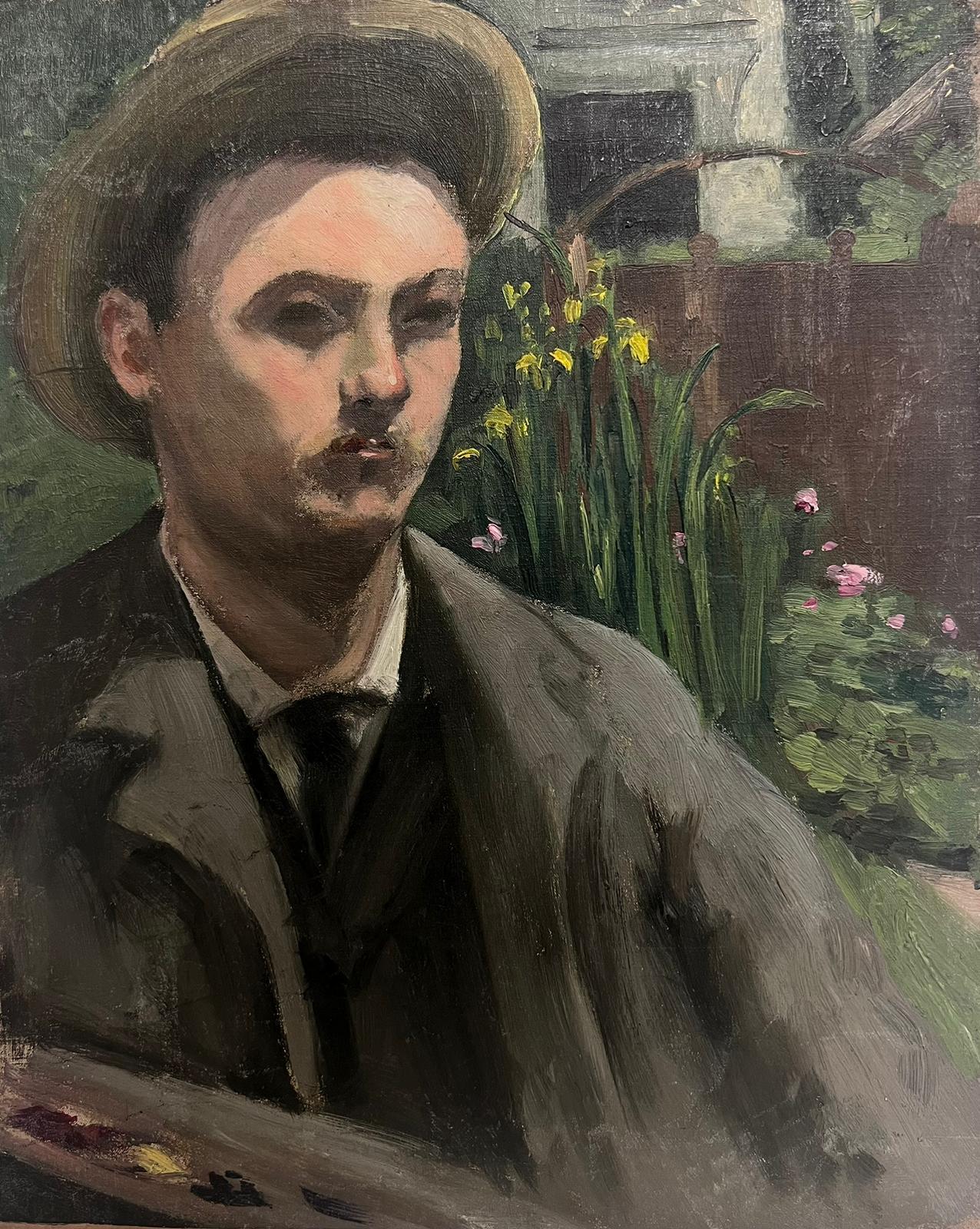
19th Century French Impressionist Self Portrait Artist with Palette Oil Sketch
Located in Cirencester, Gloucestershire
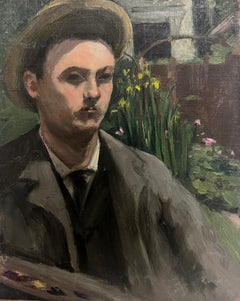
Self Portrait of the Artist
French Impressionist painter of the late 19th century
oil on canvas
canvas: 11 x 9 inches
provenance: private collection, France
condition: very good and ...
Category
Late 19th Century Impressionist Figurative Paintings
Materials
Oil, Canvas
$1,753 Sale Price
20% Off
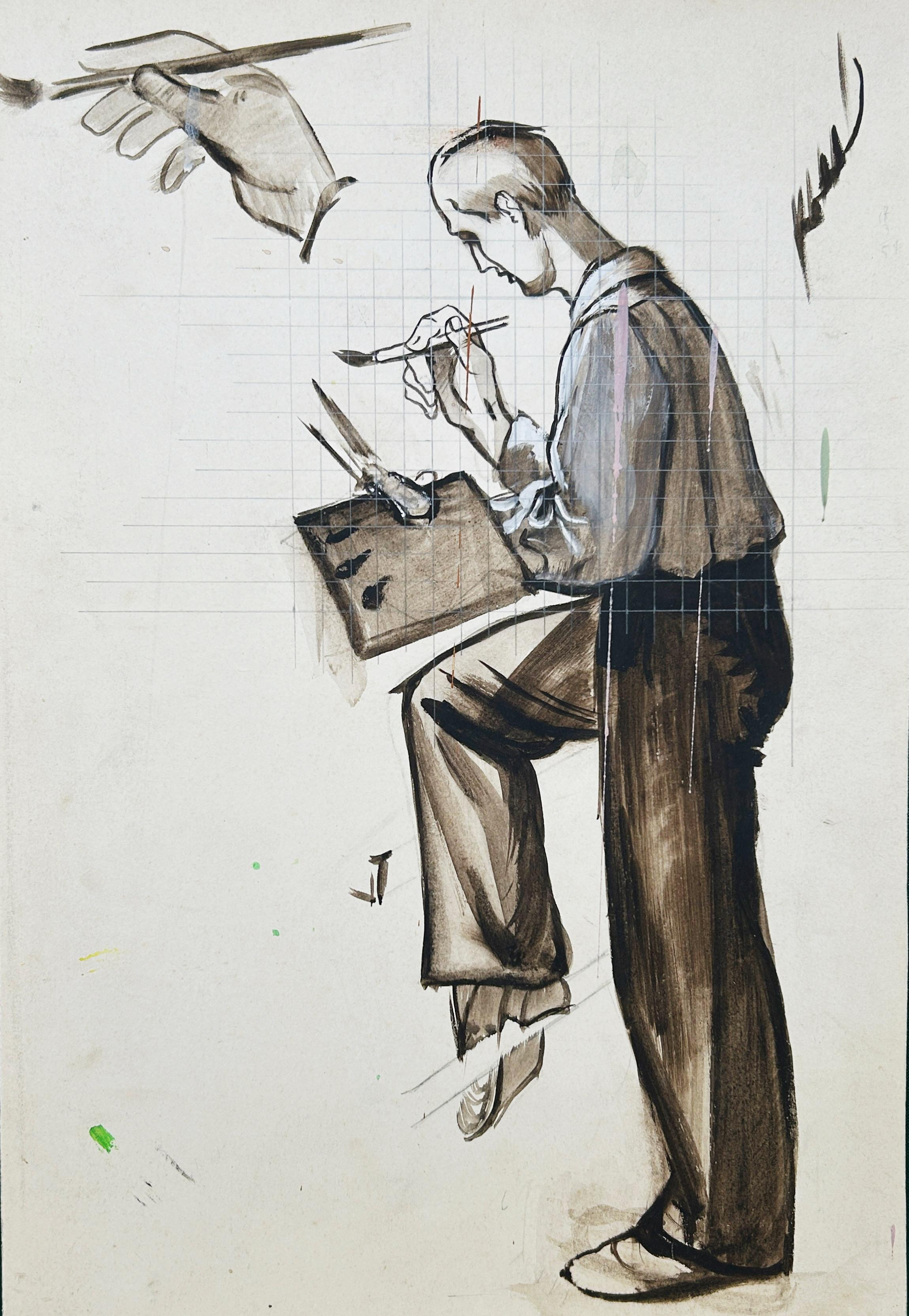
Jean Burkhalter, The Painter, circa 1925
By Jean Burkhalter
Located in PARIS, FR
Jean BURKHALTER (1895-1982)
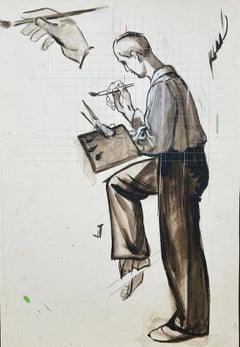
The Painter, circa 1925
Brown wash, highlights of white gouache on board
48 × 32 cm
Provenance : artist's workshop
Born in Auxerre (Burgundy, France) i...
Category
Mid-20th Century Portrait Paintings
Materials
Gouache, Ink, Watercolor
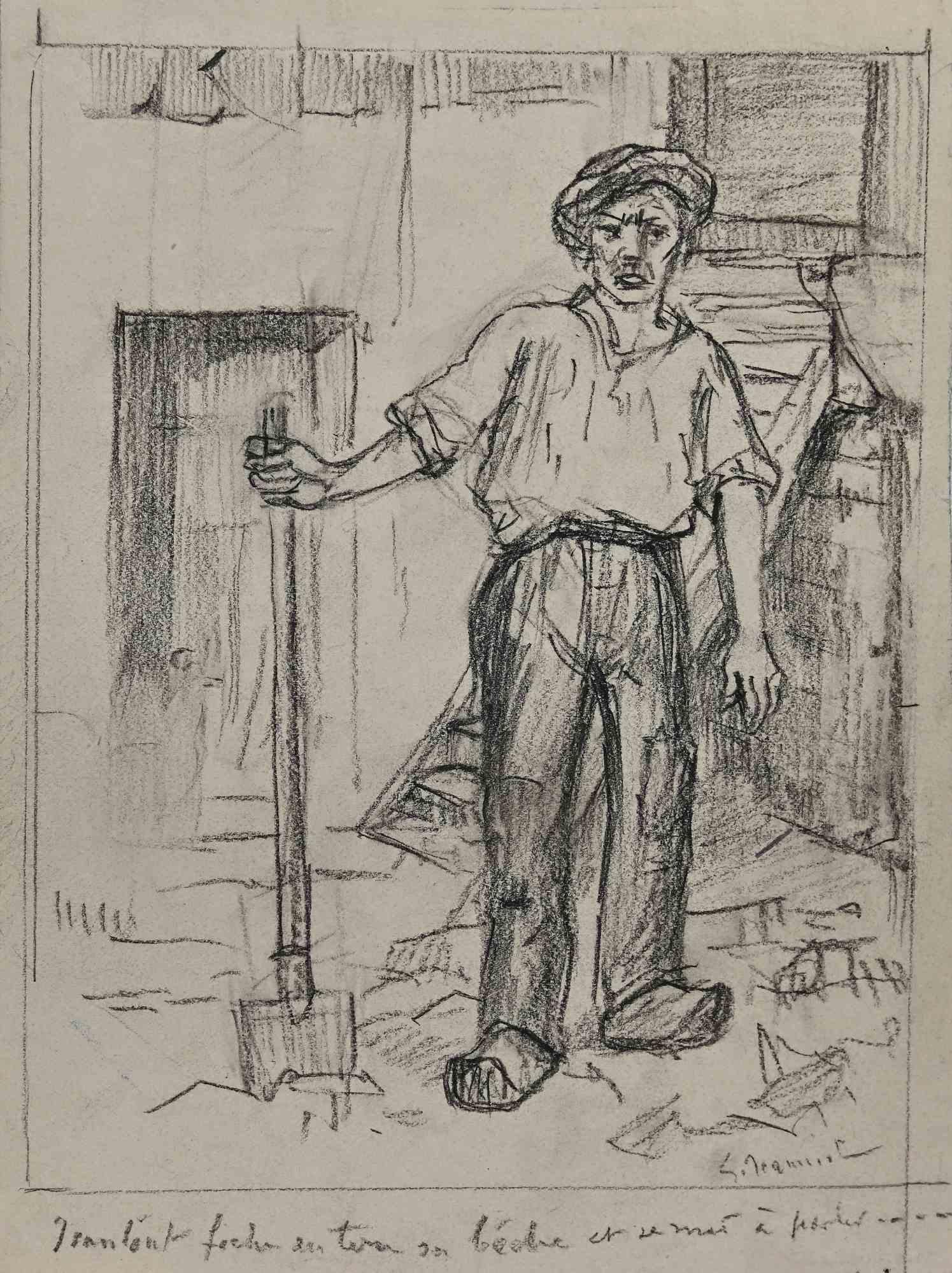
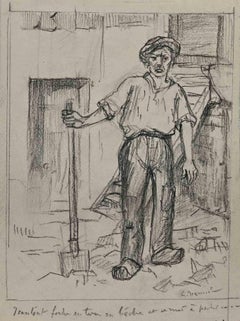
Worker - Original Drawing By Pierre Georges Jeanniot - Early 20th century
By Pierre Georges Jeanniot
Located in Roma, IT
Worker is an original Drawing on paper realized by the painter Pierre Georges Jeanniot (1848-1934).
Drawing in carbon Pencil.
Hand-signed on the lower.
Good conditions except for ...
Category
Early 20th Century Modern Portrait Drawings and Watercolors
Materials
Pencil
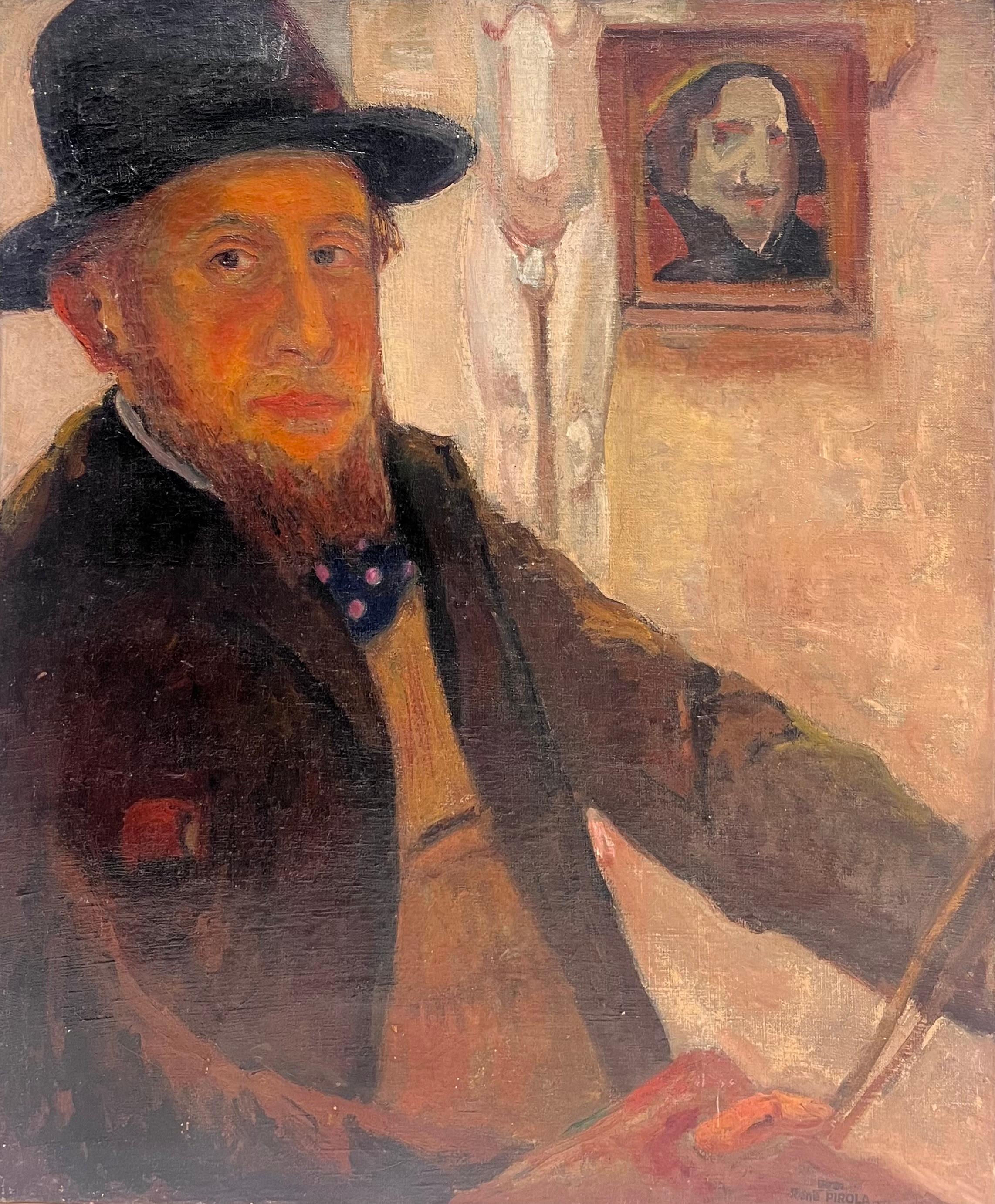
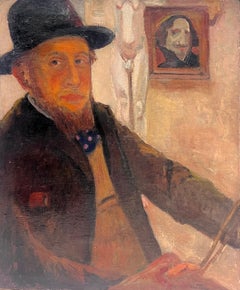
Antique French Impressionist Self Portrait of Artist 1900
s Oil Painting canvas
Located in Cirencester, Gloucestershire
Self Portrait of the Artist
by René PIROLA (French, 1878 - 1912)
stamped with artists mark
oil on canvas, framed
framed: 27 x 22 inches
canvas: 26 x 21.5 inches
Provenance: private ...
Category
Early 20th Century Post-Impressionist Portrait Paintings
Materials
Oil
$1,380 Sale Price
20% Off
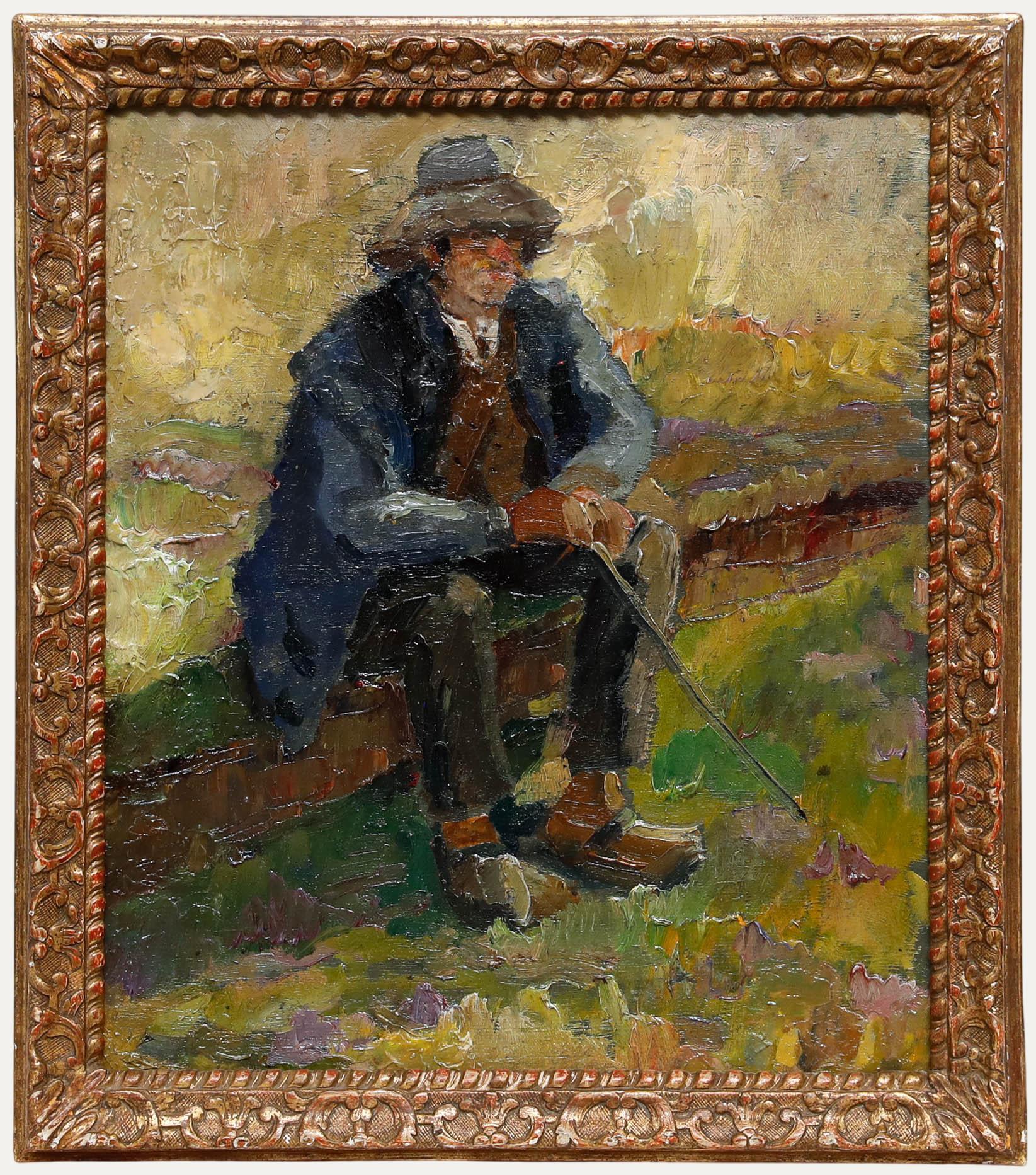
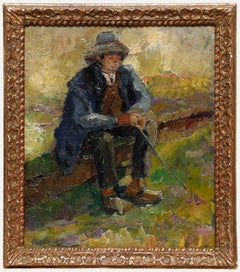
French School Early 20th Century Oil - Ramblers
Resting Spot
Located in Corsham, GB
A charming rural portrait of a rambler resting on a log, captured with loose brushwork in an impasto style. The sitter is dressed in a brown waistcoat, blue blazer and wide-brimmed h...
Category
20th Century Portrait Paintings
Materials
Oil
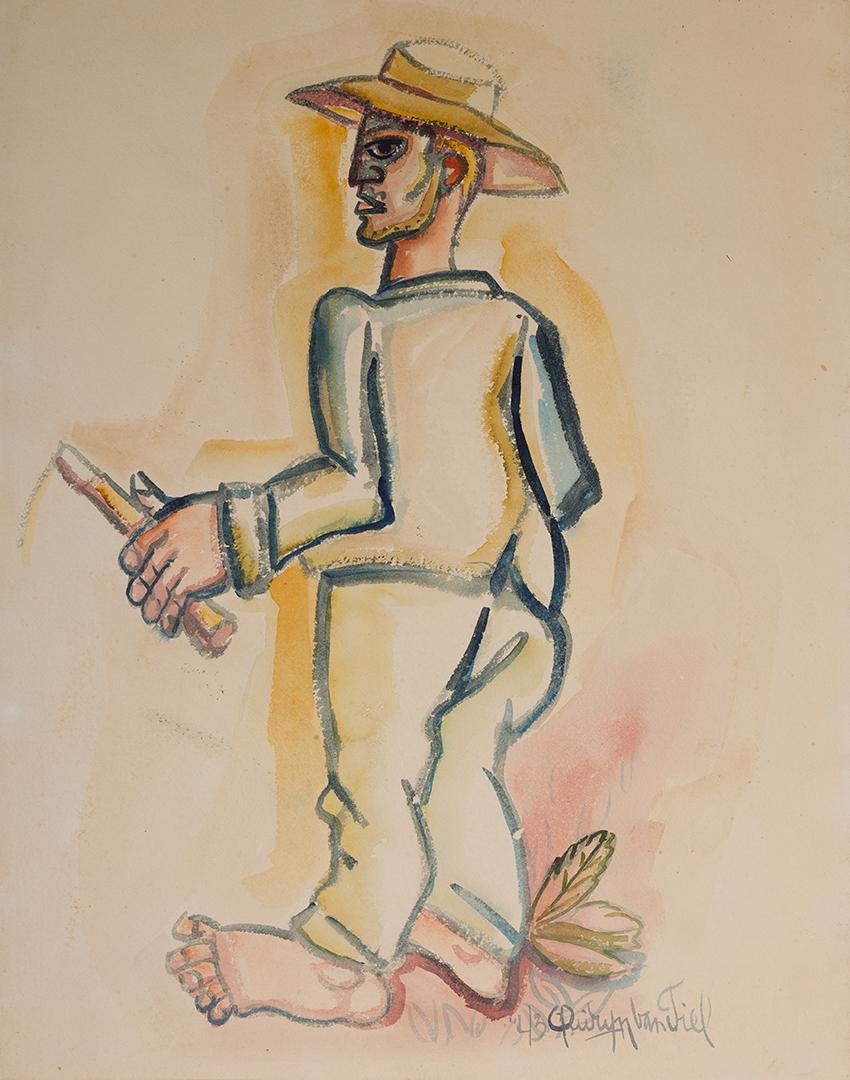
Portrait of a painter
Located in BLARICUM, NL
QUIRIJN VAN TIEL
Rotterdam 1900-1967 Rhoon
PORTRAIT OF THE PAINTER
1943
Watercolor on paper
68 x 53 cm.
Signed and dated: lower right ‘Quirijn van T...
Category
1940s Expressionist Portrait Drawings and Watercolors
Materials
Watercolor