Items Similar to 18th century portrait of sisters Lady Catherine and lady Jane Brydges
Want more images or videos?
Request additional images or videos from the seller
1 of 15
James Maubert18th century portrait of sisters Lady Catherine and lady Jane BrydgesCirca 1730
Circa 1730
$47,723.06
£35,000
€40,611.42
CA$65,704.54
A$71,905.72
CHF 37,995.86
MX$858,242.33
NOK 484,874.56
SEK 443,457.25
DKK 303,346.20
About the Item
This large double portrait depicts the sisters Lady Catherine and Lady Jane Brydges, the daughters of John Brydges, the Marquess of Carnarvon (1703-1727). They are seated on a stone ledge within in an idealised park landscape with a stone fountain on one side and sumptuous silk drapery to the other. They hold a garland of flowers by a blue silk ribbon around a lamb seated between them, a representation of romantic pastoral simplicity which was popular in English painting at the time.
Oil on canvas in a period 'Lely' panel frame with attached title plates.
Canvas: 116 x 150cm (45 1/2 x 59in)
Frame size: 137 x 172cm (54 x 67 1/2in)
Provenance: By descent through the eldest daughter Catherine to the Hoskyns branch of the family to the present day, who by marriage were also the descendants of Sir Christopher Wren.
A photograph of the painting is held in the National Portrait Gallery archive in London, dated 1955 and noted as being the property of Sir John Hoskyns, who later became a prominent politician in Thatcher's government.
Catherine (1725-1807) and Jane (1727-1776) were the daughters of John Brydges, Marquess of Carnarvon, Viscount Wilton and heir apparent to the Duke of Chandos and Catherine Tollemarche, daughter of Lionel, 3rd Earl of Dysart. Their eldest daughter, Catherine, shown wearing the russet gown with a blue mantel, married firstly William Berkeley Lyon and secondly in 1753, Edwyn Francis Stanhope of Stanwell House, Middlesex, with whom she had two children, Edwyn Francis in 1754 and Catherine in 1755. Catherine Stanhope married Sir Hungerford Hoskyns, 6th Baronet of Harewood Park, Herefordshire in 1774.
The younger daughter Jane Brydges, shown wearing a yellow silk gown, married her cousin, James Brydges of Pinner, but had no children.
James Maubert was born in Dublin in 1666, the son of a French Huguenot.
He was the pupil of Gaspar Smitz, the Dutch born artist who specialised in portraits, flowers and fruits, who came to England shortly after the Restoration in 1660 and lived in Dublin from the mid 1660's until his death in 1668.
The diarist George Vertue, who knew Maubert and who relied on him as a source for certain anecdotes concerning artists that appear in his Notebooks, states ‘Mr Maubert had his first instruction in drawing and painting from him in Dublin’.
Maubert worked for the Bathurst family, the Herberts and painted portraits of the Duchess of Bolton. As in the present portrait, two of these also demonstrate Maubert’s preference for including decorative flowers in his compositions, often using honeysuckle which was said to have been one of his favourite flowers.
Like many artists of the period, Godfrey Kneller and Michael Dahl had a marked influence on his work, acknowledged at the time by Vertue in his notebooks.
He noted that Maubert was 'a good Ingenious civil man ... he not only paints from the Life but is very skillful in painting of fruits
flowers. his draperys are well dispos'd
natural'
- Creator:James Maubert (1666 - 1746)
- Creation Year:Circa 1730
- Dimensions:Height: 53.94 in (137 cm)Width: 67.72 in (172 cm)
- Medium:
- Movement Style:
- Period:
- Condition:
- Gallery Location:Bath, GB
- Reference Number:1stDibs: LU95216237932
About the Seller
5.0
Vetted Professional Seller
Every seller passes strict standards for authenticity and reliability
Established in 2002
1stDibs seller since 2015
37 sales on 1stDibs
Associations
The British Antique Dealers
AssociationLAPADA - The Association of Arts
Antiques DealersInternational Confederation of Art and Antique Dealers
Associations
- ShippingRetrieving quote...Shipping from: Bath, United Kingdom
- Return Policy
More From This Seller
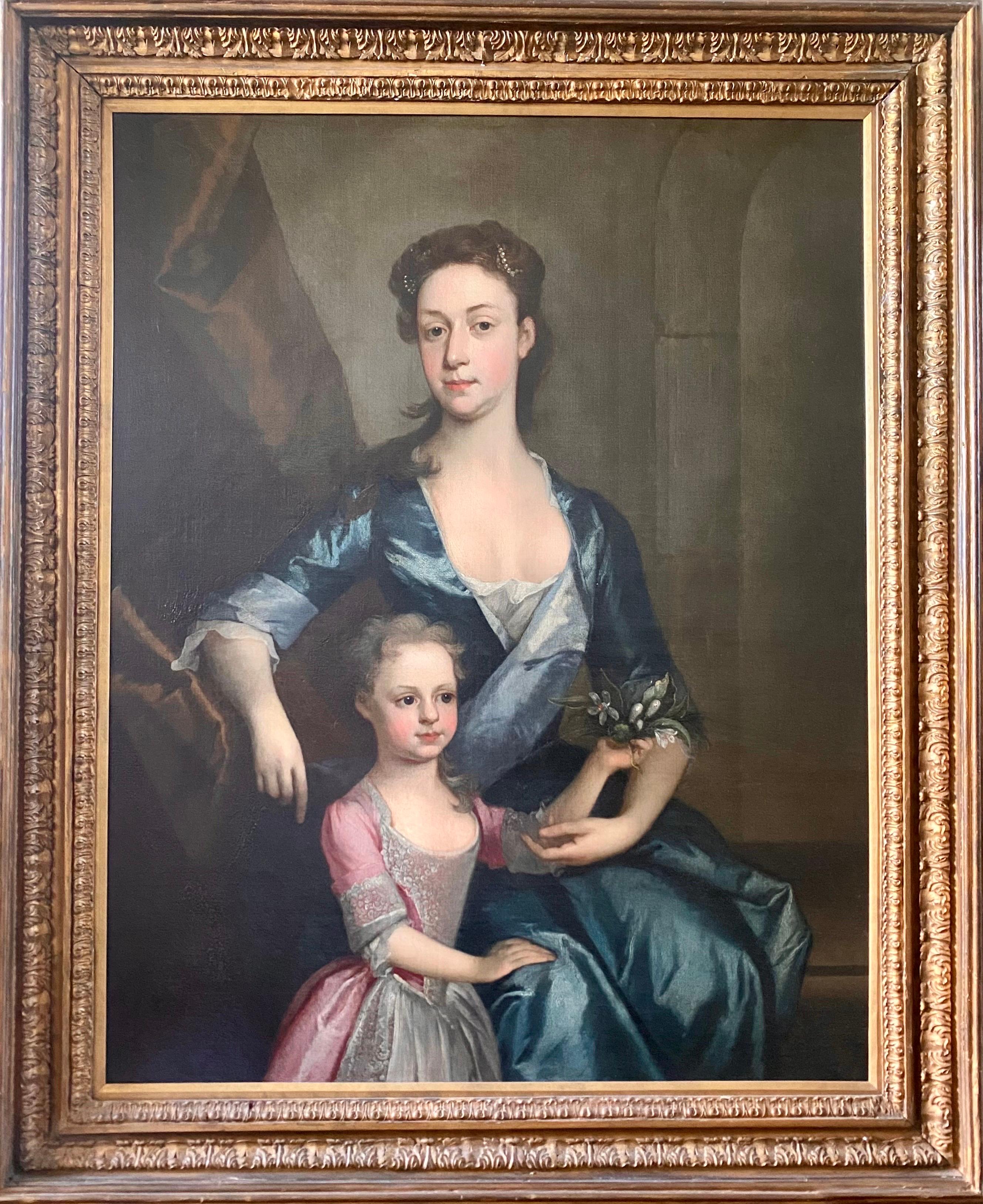
View AllEnglish 18th century portrait of a Lady and her Daughter in an interior
By (attributed to) Joseph Highmore
Located in Bath, Somerset
Portrait of a lady, three-quarter length, wearing a blue silk gown, seated in a classical interior, with her daughter in a pink gown standing beside her holding a sprig of blossom. T...
Category
Early 18th Century Old Masters Portrait Paintings
Materials
Oil
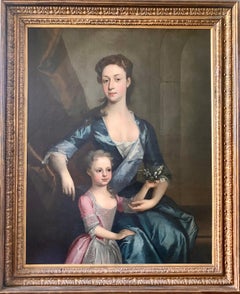
English 18th century portrait of Henrietta Pelham-Holles, Duchess of Newcastle.
By Charles Jervas
Located in Bath, Somerset
Portrait of Henrietta Pelham-Holles (née Godolphin) (1701-1776), Duchess of Newcastle, standing in a wooded landscape with a river beyond, three-quarter length wearing an ivory silk ...
Category
1720s Old Masters Portrait Paintings
Materials
Canvas, Oil
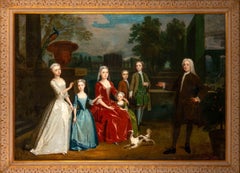
18th century painting of the Dalbiac family in the gardens of a country house
By Charles Philips
Located in Bath, Somerset
The painting depicts James (Jacques) Dalbiac, his wife Louise (ne de la Porte) and their five children, James, Charles, Louise, Marianne and Martha in the ornamental gardens of a grand country estate.
The extensive gardens extend into the distance with gardeners working in the background and figures strolling through the avenues of trees. A peacock and peahen can be seen on the wall to the left and a potted orange tree to the right. Louise Dalbiac holds an orange taken from the orange tree, aluding to the family's faith and their loyalty to the protestant King William of Orange and their adopted country.
The Dalbiacs were wealthy London silk and velvet merchants of French Huguenot origin who had fled France at the end of the 17th century to escape persecution for their protestant faith. England offered safe refuge and their skills and industriousness allowed them to establish one of the most successful businesses in London's Spitalfields which became a new centre of the silk trade, effectively leading to the collapse of the once dominant French silk industry. Both sons, James and Charles followed their father and Uncle into the family business, successfully growing the family's fortune and each going on to own their own country estates.
A conversation piece is a genre of painting used to describe group portraits of families and friends, often depicted with their servants and family pets and set within an elegantly furnished interior or the garden of a grand country house. They were a celebration of the intimacy of family relations as well as a sign of status, property and the power of succession. The informality of conversation pieces grew popular in 18th century England, allowing the sitters to present themselves in a more relaxed pose, perhaps engaged in intellectual conversation or showing their talents or interests. In this present portrait, the Dalbiacs are shown richly dressed and and at leisure in a grand country house setting, conveying their success and cultural and social aspirations.
Charles Philips (c.1703–1747) was an English artist known for painting a number of portraits and conversation pieces for noble and Royal patrons in the mid-eighteenth century. He was the son of portrait painter Richard Philips...
Category
Early 18th Century Old Masters Portrait Paintings
Materials
Canvas, Oil
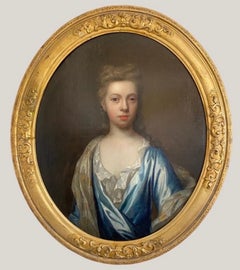
English 18th century portrait of a lady, Circle of Thomas Murray (1663-1735)
Located in Bath, Somerset
An early 18th century portrait of a young lady, half length, wearing a blue silk gown with white chemise and gold trimmed cloak draped across her arm and shoulders. Her sensitively observed soft expression and skilfully painted youthful 'dewy' complexion are reminiscent of the portrait style of John Closterman whose work Murray would have been familiar with, being a close colleague of Murray's teacher, John Riley.
An old label on the reverse identifies the sitter as a young Princess Charlotte...
Category
Early 18th Century Old Masters Portrait Paintings
Materials
Canvas, Oil
$8,175 Sale Price
20% Off
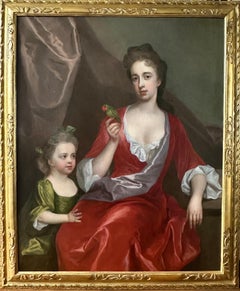
A portrait of a lady and her daughter with an exotic bird
By Michael Dahl
Located in Bath, Somerset
A portrait of a lady three-quarter length, seated in an interior, wearing a red silk gown draped in a pink silk sash with an exotic bird perched on her hand and one arm resting on a stone plinth, her young daughter wearing a green silk gown standing at her side.
Oil on canvas, housed in a period 'Lely' giltwood frame.
This double portrait was painted at the height of Dahl's career in circa 1715 when Dahl had become firmly established as one of the leading portrait painters in Britain. Although the identities of the sitters are currently unknown, it is a sensitive depiction of a close and affectionate bond between a mother and daughter, with the young girl's hand resting affectionately on her mothers lap. The tamed exotic bird adds a charming decorative element which also serves to convey the high social status of the lady, given only the very wealthy would be able to own such a rare and expensive pet and the lively colouring of the bird's feathers is reflected in the colours of the sitters' silk gowns.
Provenance: Private collection, London
Michael Dahl (Stockholm 1659-1743 London) was born in Stockholm in Sweden and studied under Martin Hannibal (d 1741) and later with David Klöcker Ehrenstrahl. In 1682 he travelled to London, where he became acquainted with Godfrey Kneller and Henry Tilson, and in 1685 he left for Europe with Tilson, working briefly in Paris before continuing to Venice and Rome, where they stayed for about two years. In Rome Dahl converted to Roman Catholicism and gravitated towards the circle of Christina, former Queen of Sweden, who sat for him (Grimsthorpe Castle, Lincs). He returned to England with Tilson via Frankfurt and arrived in London in 1689, staying in England for the remainder of his career.
During Dahl's absence, Kneller had consolidated his supremacy in London as the most fashionable portrait painter, but Dahl rapidly became Kneller’s closest competitor. His patrons probably had roots in the Swedish diplomatic circles, but it expanded as a result of his ability and his agreeable personality. His prices were lower than those of Kneller and he favoured softer, more diffused, colour tones and could respond to his sitters with sincerity and humanity. Politically, Kneller supported the ascendant Whigs while Dahl was a Tory, but they frequently painted the same sitters from both parties, and in spite of fundamental differences in technique and temperament, their work was sometimes similar in appearance.
Dahl was prolific but rarely signed his work, and comparatively few of his portraits were engraved in mezzotint, the method used by Kneller to widen his reputation. By 1690 he had painted the aged Duke of Schomberg (engraved by William Faithorne) and Prince George of Denmark (London, Kensington Palace). He was ignored by William III but received commissions from Princess Anne, including one for a portrait of herself (Oakly Park, Ludlow, Salop). He also painted the future Duke and Duchess of Marlborough, and his informal portrait of the Duchess (Althorp House, Northants), formerly attributed to Kneller, is perhaps the most intimate of all images of her.
During the 1690s he secured the patronage of Charles Seymour, the ‘Proud’ 6th Duke of Somerset, who ordered a series of seven full-length portraits of notable contemporary beauties from Dahl (1690s; Petworth House, W. Sussex, NT). This was originally a scheme similar to Kneller’s more famous ‘Hampton Court Beauties’, but the portraits were subsequently reduced to three-quarter-length formats. The features of the sitters are not individualized, but they possess a decorative, languorous glamour that recalls Lely rather than Kneller. Somerset gave Dahl further employment over the next 25 years.
In 1698, following the death of Klöcker Ehrenstrahl, Dahl was offered the post of court painter at Stockholm, which he apparently refused, preferring to remain in London at his studio in Leicester Fields, near the Swedish legation. In about 1700 he was joined by a young compatriot, Hans Hysing, who worked with him for many years. Dahl seems not to have married until after 1708, He had a son Michael (d. 1741), also a painter, of whose work nothing is known, and two daughters.
After the accession of Queen Anne in 1701, she and Prince George sat for a number of official portraits. His royal patronage ceased with Queen Anne’s death, and when Dahl refused to paint the infant Duke of Cumberland in 1722. He was suspected of Jacobite sympathies, and relations had cooled between him and the Swedish legation. However, his practice continued to prosper, and he acquired another important patron in Edward Harley, 2nd Earl of Oxford, who shared his political views and whose circle included the architect James Gibbs and the poets Matthew Prior and Alexander Pope, all of whom Dahl painted. Oxford commissioned several portraits of himself. In the earliest (1719; Welbeck Abbey...
Category
Early 18th Century Old Masters Portrait Paintings
Materials
Canvas, Oil
$26,179 Sale Price
20% Off
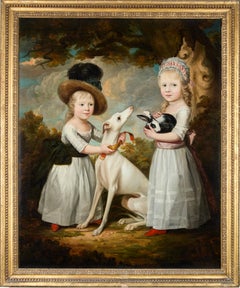
Portrait of two young girls with a whippet and a rabbit in a wooded landscape
Located in Bath, Somerset
Portrait of two young girls in a wooded landscape, standing full-length, one attaching a red collar on a seated white whippet and the other holding her pet black and white rabbit. Ci...
Category
18th Century Old Masters Portrait Paintings
Materials
Canvas, Oil
You May Also Like
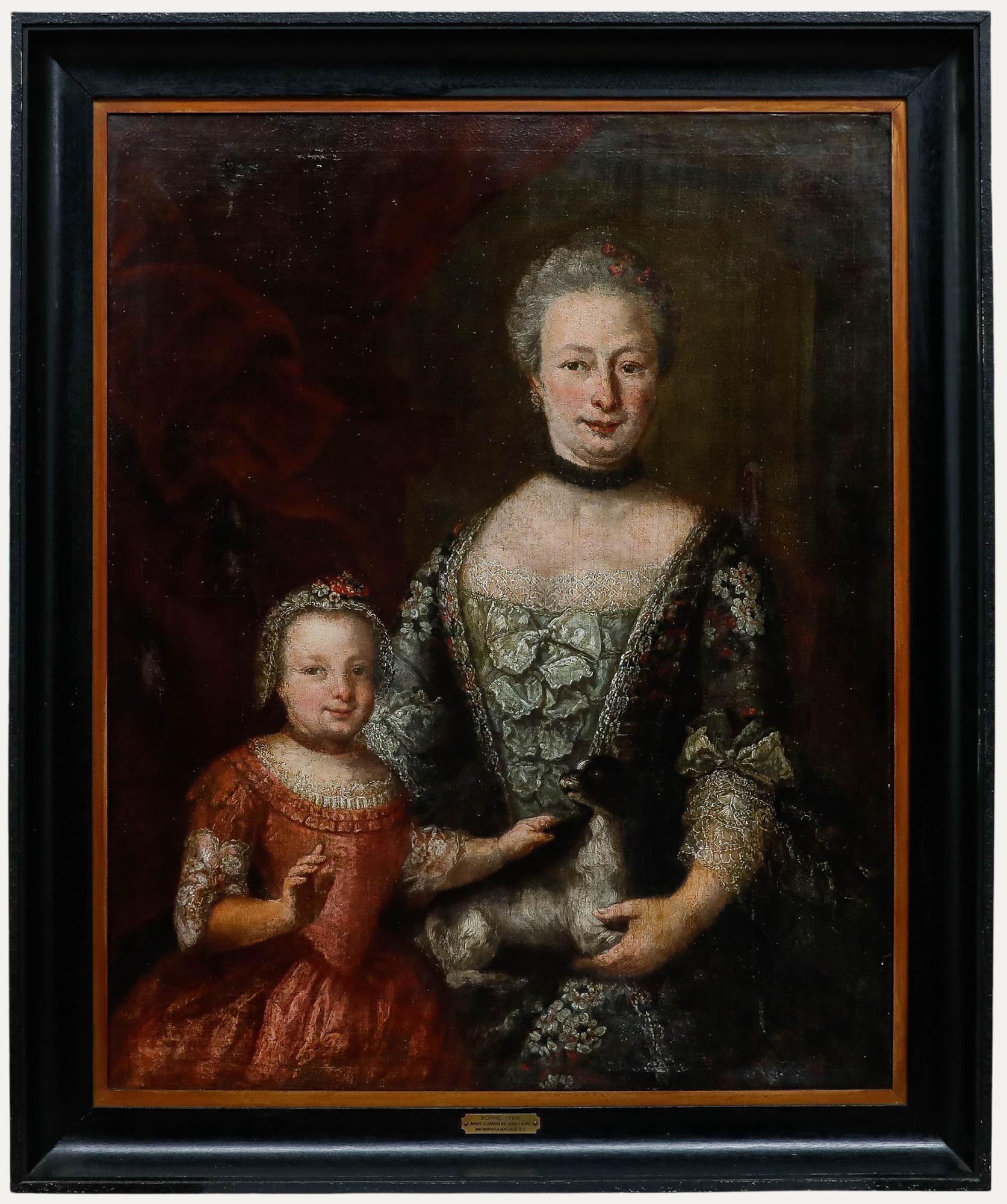
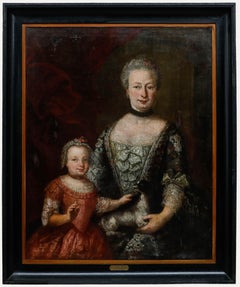
Borne - European School 18th Century Oil, Anna and Adelaide
Located in Corsham, GB
A delightfully tender 18th-century family portrait depicting mother and daughter - Anna and Adelaide - with their cherished spaniel. The artist beautifully conveys the intimate bond ...
Category
Early 18th Century Portrait Paintings
Materials
Oil
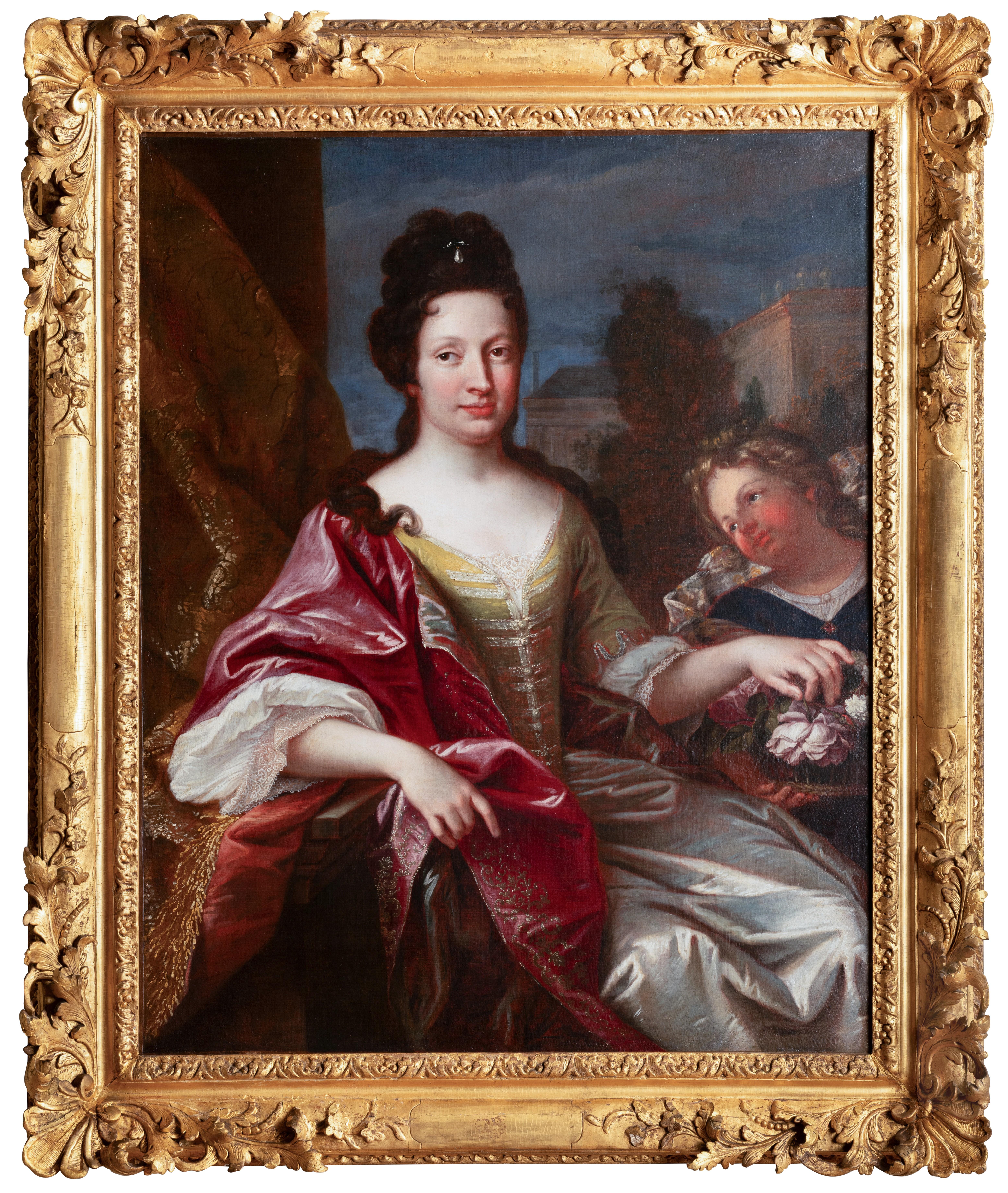
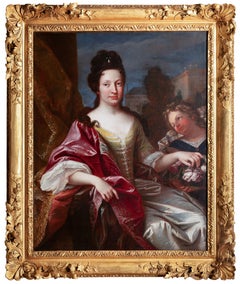
Portrait of the French Princess, late 17th c. French school
Located in PARIS, FR
Portrait of the Princess of Conti - Attributed to Louis Ferdinand Elle the Younger (1648-1717)
Late 17th century French school
Oil on canvas, h. 100 cm, l. 80 cm
Important Louis XIV ...
Category
Late 17th Century Old Masters Portrait Paintings
Materials
Canvas, Oil
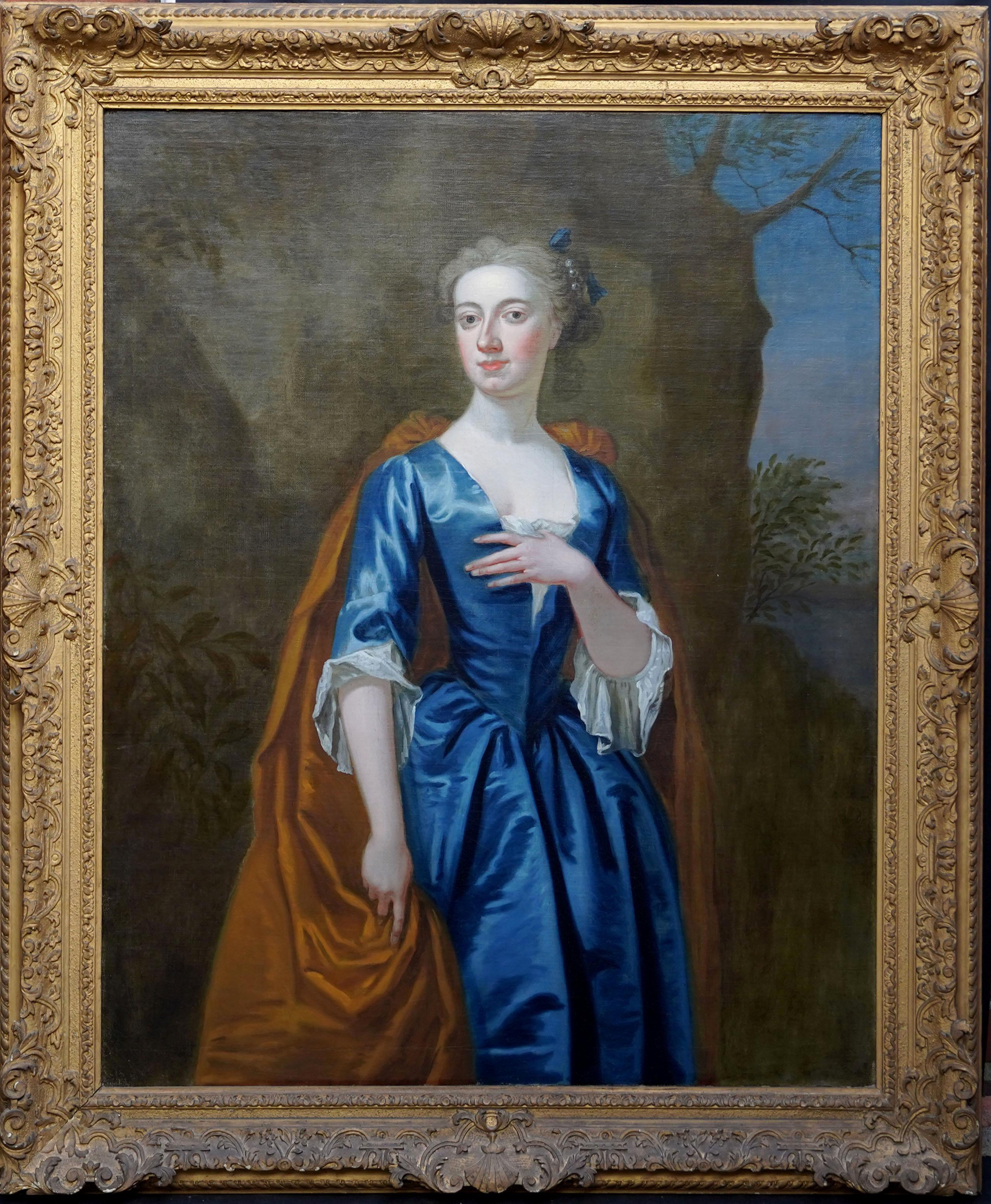
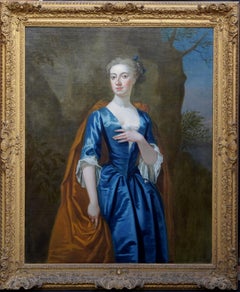
Portrait of Mrs James Hoste - British 18th century art portrait oil painting
By John Vanderbank
Located in Hagley, England
This superb large three quarter length British Old Master portrait in a landscape oil painting is attributed to circle of John Vanderbank the Younger. Painted circa 1738 the sitter is Mrs James Hoste of South Wootton and Sandringham, nee Hammond. She was the daughter of Anthony Hamond and Susan Walpole, daughter of Robert Walpole, and was sister to Robert, 1st Earl of Oxford. She married Major James Hoste of Sandringham, Norfolk, and they had two daughters. The sheen of her blue satin dress against her gold cloak is stunning. A really lovely 18th century portrait with excellent provenance.
Inscribed with sitter details lower left.
Provenance. By descent within the family of the sitter at West Acre High House, Norfolk;
Cheffins, Cambridge, 'West Acre High House' sale, 24 November 2010, Lot 519; Wood Hall, Arkesden, Essex.
Literature: 'Portraits in Norfolk Houses', Prince Duleep Singh, 1927, No. 36.
Sitter's details on two labels verso.
Condition. Oil on canvas, image size is 50 inches by 40 inches and in good condition.
Frame. Housed in an ornate gilt frame, 58 inches by 48 inches framed and in good condition.
John Vanderbank (1694-1739) was an English portraitist and book illustrator, who enjoyed a high reputation for a short while during the reign of King George...
Category
18th Century Old Masters Portrait Paintings
Materials
Oil
$13,080 Sale Price
20% Off
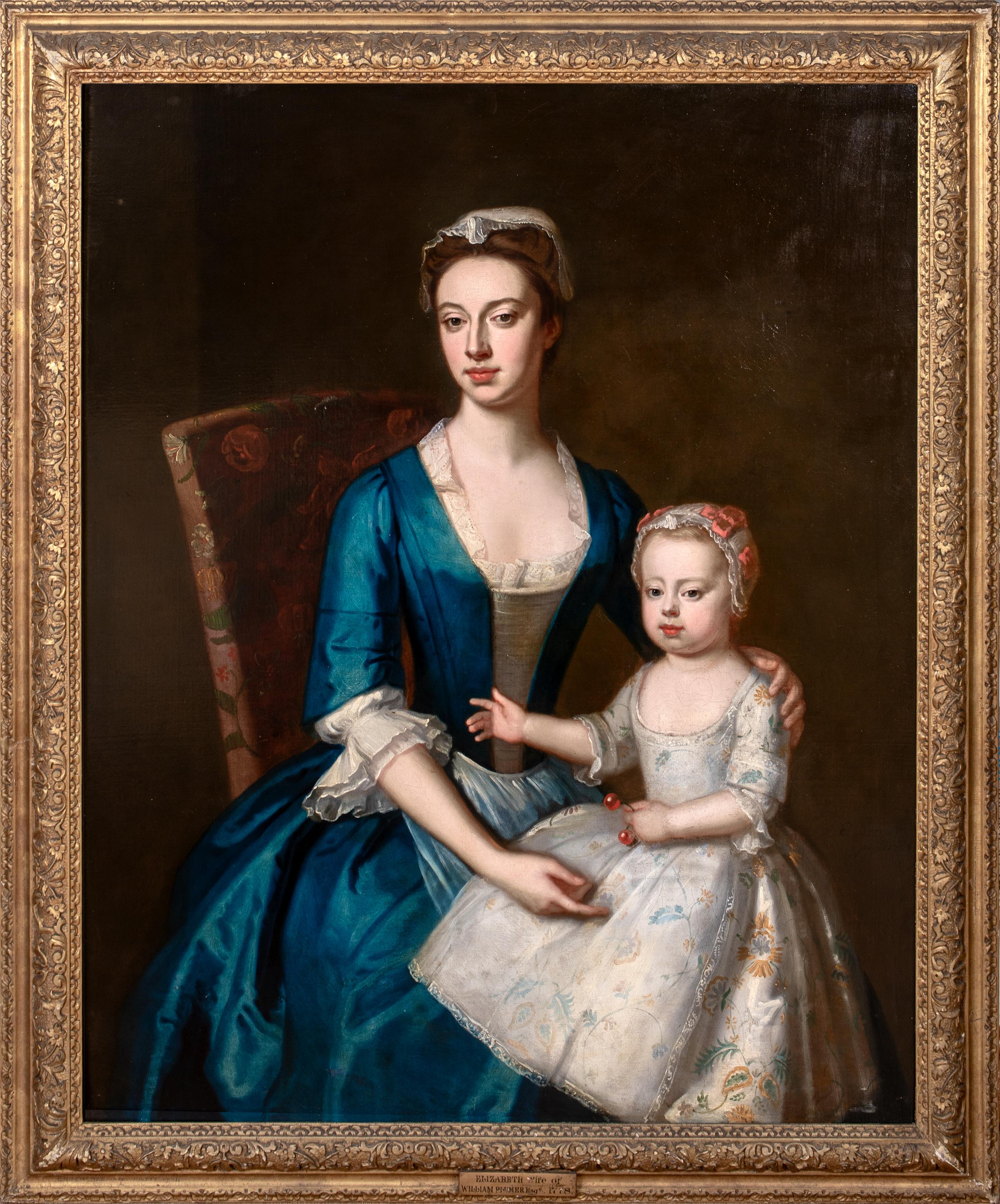
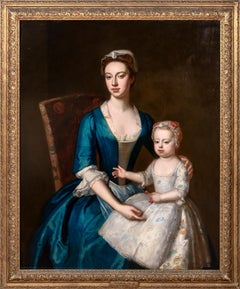
Portrait Of Elizabeth Plumer (nee Byde)
Daughter, circa 1735
By Enoch Seeman
Located in Blackwater, GB
Portrait Of Elizabeth Plumer (nee Byde) & Daughter, circa 1735
by ENOCH SEEMAN (1694-1744)
Large 1735 portrait of Elizabeth Plumer & her daughter holding a rattle, oil on canvas by...
Category
18th Century Portrait Paintings
Materials
Canvas
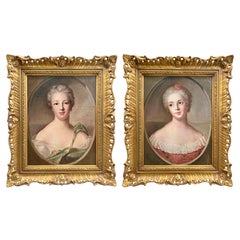
Pair of English Oil Paintings on Canvas,
Sisters
Located in Tarzana, CA
A charming pair of late 18th English century oil paintings on canvas. Each painting portrays a portrait of a young lady in oval within carved giltwood fra...
Category
Antique Early 18th Century English Paintings
Materials
Canvas, Giltwood
$6,950 / item
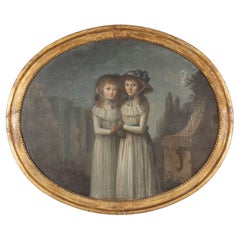
Early 19th Century English Oil on Canvas Painting of Regency Twin Sisters
Located in Gloucestershire, GB
Wonderful early 19th Century English oil on canvas oval painting of sisters.
In the naive style, the two central girls are dress in Regency clothes and standing together in a classi...
Category
Antique Early 19th Century English Regency Decorative Art
Materials
Canvas, Paint
More Ways To Browse
Antique Duchess
18th Century French Romantic Painting
Antique Silk Ribbon
George Vertue
Wren Painting
French Huguenot
Sir Christopher Wren
George Gower
Joan Cruspinera
John Eaton
Lionel Ellis
Old Master Family Portrait
Painted Birkin
Race Car Painting
Rosie Huntington
Scholar Oil Painting
Spanish Jewish
Terry Shelbourne