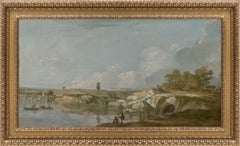
Want more images or videos?
Request additional images or videos from the seller
1 of 5
Johan Zoffany18th century portrait of the painter Nathaniel Dance1770s
1770s
$65,518.31List Price
About the Item
- Creator:Johan Zoffany (1733 - 1810, German)
- Creation Year:1770s
- Dimensions:Height: 6 in (15.24 cm)Width: 4.5 in (11.43 cm)
- Medium:
- Movement Style:
- Period:
- Condition:Painting preserved in excellent condition, housed in a giltwood frame.
- Gallery Location:London, GB
- Reference Number:1stDibs: LU150727730712
About the Seller
5.0
Recognized Seller
These prestigious sellers are industry leaders and represent the highest echelon for item quality and design.
1stDibs seller since 2021
5 sales on 1stDibs
Authenticity Guarantee
In the unlikely event there’s an issue with an item’s authenticity, contact us within 1 year for a full refund. DetailsMoney-Back Guarantee
If your item is not as described, is damaged in transit, or does not arrive, contact us within 7 days for a full refund. Details24-Hour Cancellation
You have a 24-hour grace period in which to reconsider your purchase, with no questions asked.Vetted Professional Sellers
Our world-class sellers must adhere to strict standards for service and quality, maintaining the integrity of our listings.Price-Match Guarantee
If you find that a seller listed the same item for a lower price elsewhere, we’ll match it.Trusted Global Delivery
Our best-in-class carrier network provides specialized shipping options worldwide, including custom delivery.You May Also Like
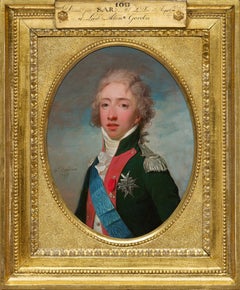
Two royal portraits (the Duc d
Angoulême and the Duc de Berry) by H.P. Danloux
Located in PARIS, FR
These two royal portraits are a major historical testimony to the stay of the Comte d'Artois (the future Charles X) and his family in Edinburgh in 1796-1797. Given by the sitters to Lord Adam Gordon, the Governor of Edinburgh, and kept by family descent to this day, these two portraits provide us with a vivid and spontaneous image of the Duc d’Angoulême and his brother the Duc de Berry. Danloux, who had emigrated to London a few years before, demonstrate his full assimilation of the art of British portrait painters in the brilliant execution of these portraits.
1. Henri-Pierre Danloux, a portraitist in the revolutionary turmoil
Born in Paris in 1753, Henri-Pierre Danloux was first a pupil of the painter Nicolas-Bernard Lépicié (1735 - 1784) and then, in 1773, of Joseph-Marie Vien (1716 - 1809), whom he followed to Rome when, at the end of 1775, Vien became Director of the Académie de France. In Rome he became friends with the painter Jacques-Louis David (1748 - 1825).
Returning to France around 1782, he settled in Lyon for a few years before returning to Paris in 1785. One of his first portraits was commissioned by the Baroness d'Etigny, the widow of the former Intendant of the Provinces of Gascony, Bearn and Navarre Antoine Mégret d'Etigny (1719 – 1767). He then became close to his two sons, Mégret de Sérilly and Mégret d'Etigny, who in turn became his patrons. In 1787, this close relationship with the d'Etigny family was further strengthened by his marriage to Antoinette de Saint-Redan, a relative of Madame d'Etigny. After his marriage, he left for Rome and did not return to France until 1789. It was during the winter of 1790-1791 that he painted one of his masterpieces, the portrait of Baron de Besenval. Set in a twilight atmosphere, this portrait of an aristocrat who knows that his death is imminent symbolizes the disappearance of an erudite and refined society which would be swept away by the French Revolution.
The Jacobin excesses led Danloux to emigrate to England in 1792; many members of his family-in-law who remained in France were guillotined on 10 May 1794. Danloux enjoyed great success as a portrait painter in England before returning to France in 1801.
During his stay in England, Danloux was deeply under the influence of English portraitists: his colors became warmer (as shown by the portrait of the Duc d'Angoulême that we are presenting), and his execution broader.
2. Description of the two portraits and biographical details of the sitters
The Duc d'Angoulême (1775-1844) was the eldest son of the Comte d'Artois, the younger brother of King Louis XVI (the future King Charles X), and his wife Marie-Thérèse of Savoie. He is shown here, in the freshness of his youth, wearing the uniform of colonel-general of the "Angoulême-Dragons" regiment.
He is wearing the blue cordon of the Order of the Holy Spirit, which was awarded to him in 1787, and two decorations: the Cross of Saint-Louis and the Maltese Cross, as he was also Grand Prior of the Order of Malta.
Born on 16 August 1775 in Versailles, Louis-Antoine d'Artois followed his parents into emigration on 16 July 1789. In 1792, he joined the émigrés’ army led by the Prince de Condé. After his stay in Edinburgh (which will be further discussed), he went to the court of the future King Louis XVIII, who was in exile at the time, and in 1799 married his first cousin Marie-Thérèse Charlotte of France, the daughter of Louis XVI and the sole survivor of the royal family. The couple had no descendants. He became Dauphin of France in 1824, upon the accession to the throne of his father but played only a minor political role, preferring his military position as Grand Admiral. Enlisted in Spain on the side of Ferdinand VII, he returned home crowned with glory after his victory at Trocadero in 1823.
He reigned for a very short time at the abdication of Charles X in 1830, before relinquishing his rights in favor of his nephew Henri d'Artois, the Duc de Bordeaux. He then followed his father into exile and died on 3 June 1844 in Gorizia (now in Italy).
His younger brother, the Duc de Berry, is shown in the uniform of the noble cavalry of the émigrés’ Army. He is wearing the blue cordon of the Order of the Holy Spirit, awarded to him in May 1789, and the Cross of Saint-Louis (partly hidden by his blue cordon).
Born on 24 January 1778 in Versailles, Charles-Ferdinand d'Artois also followed his parents into emigration and joined the émigrés’ army in 1792. After his stay in Edinburgh, he remained in Great Britain, where he had an affair with Amy Brown...
Category
1790s Old Masters Portrait Paintings
Materials
Canvas, Oil, Wood Panel
Portrait of William Herbert, 3rd Earl of Pembroke, Early 17th Century Portrait
Located in London, GB
English School, (circa 1600)
Portrait of William Herbert, 3rd Earl of Pembroke
Oil on panel, oval
Image size: 29¼ x 23⅞ inches
Painted wooden frame
Provenance:
176, Collection of Francis Greville, 1st Earl of Warwick.
The Trustees of the Lord Brooks’ Settlement, (removed from Warwick Castle).
Sotheby’s, London, 22nd March 1968, lot 81.
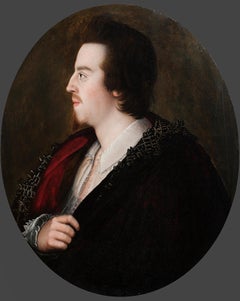
Painted onto wooden panel, this portrait shows a dark haired gentleman in profile sporting an open white shirt. On top of this garments is a richly detailed black cloak, decorated with gold thread and lined with a sumptuous crimson lining. With the red silk inside it’s all very expensive and would fall under sumptuary laws – so this is a nobleman of high degree.
It’s melancholic air conforms to the contemporary popularity of this very human condition, evident in fashionable poetry and music of the period. In comparison to our own modern prejudices, melancholy was associated with creativity in this period.
This portrait appeared in the earliest described list of pictures of Warwick castle dating to 1762. Compiled by collector and antiquary Sir William Musgrave ‘taken from the information of Lord & Lady Warwick’ (Add. MSS, 5726 fol. 3) is described;
‘8. Earl of Essex – an original by Zuccharo – seen in profile with black hair. Holding a black robe across his breast with his right hand.’
As tempting as it is to imagine that this is a portrait of Robert Devereux, the 2nd Earl Essex, we might take this with a pinch of salt. Its identification with this romantic and fatal Elizabethan might well have been an attempt to add romance to Warwick Castle’s walls. It doesn’t correspond all that well with Essex’s portraits around 1600 after his return from Cadiz. Notably, this picture was presumably hung not too far away from the castle’s two portraits of Queen Elizabeth I. The first, and undoubtedly the best, being the exquisite coronation portrait that was sold by Lord Brooke in the late 1970s and now hangs in the National Portrait Gallery. The second, described as being ‘a copy from the original at Ld Hydes’, has yet to resurface.
The portrait eventually ended up being hung in the State Bedroom of Warwick Castle.
Archival documents present one other interesting candidate. The Greville family’s earliest inventory of paintings, made in 1630 at their home Brooke House in Holborn, London, describes five portraits of identified figures. All five belonged to the courtier, politician and poet Sir Fulke Greville (1554-1628), 1st Baron Brooke, and were hung in the ‘Gallerie’ of Brooke House behind yellow curtains. One of them was described as being of ‘Lord of Pembrooke’, which is likely to have been William Herbert (1580-1630), 3rd Earl of Pembroke. William was the eldest son of Greville’s best friend’s sister Mary Sidney, and was brought up in the particularly literary and poetically orientated household which his mother had supported. Notably, the 3rd Earl was one of the figures that Shakespeare’s first folio was dedicated to in 1623.
The melancholic air to the portrait corresponds to William’s own pretensions as a learned and poetic figure. The richness of the robe in the painting, sporting golden thread and a spotted black fabric, is indicative of wealth beyond that of a simple poet or actor. The portrait’s dating to around the year 1600 might have coincided with William’s father death and his own rise to the Pembroke Earldom. This period of his life too was imbued with personal sadness, as an illicit affair with a Mary Fitton had resulted in a pregnancy and eventual banishment by Elizabeth I to Wilton after a short spell in Fleet Prison. His illegitimate son died shortly after being born. Despite being a close follower of the Earl of Essex, William had side-stepped supporting Devereux in the fatal uprising against the Queen and eventually regained favour at the court of the next monarch James I.
His linen shirt is edged with a delicate border of lace and his black cloak is lined on the inside with sumptuous scarlet and richly decorated on the outside with gold braid and a pattern of embroidered black spots.
Despite the richness of his clothes, William Herbert has been presented in a dishevelled state of semi-undress, his shirt unlaced far down his chest with the ties lying limply over his hand, indicating that he is in a state of distracted detachment. It has been suggested that the fashion for melancholy was rooted in an increase in self-consciousness and introspective reflection during the late 16th and early 17th centuries.
In contemporary literature melancholy was said to be caused by a plenitude of the melancholy humor, one of the four vital humors, which were thought to regulate the functions of the body. An abundance of the melancholia humor was associated with a heightened creativity and intellectual ability and hence melancholy was linked to the notion of genius, as reflected in the work of the Oxford scholar Robert Burton, who in his work ‘The Anatomy of Melancholy’, described the Malcontent as ‘of all others [the]… most witty, [who] causeth many times divine ravishment, and a kind of enthusiamus… which stirreth them up to be excellent Philosophers, Poets and Prophets.’ (R. Burton, The Anatomy of Melancholy, London, 1621 in R. Strong, ‘Elizabethan Malady: Melancholy in Elizabethan and Jacobean Portraits’, Apollo, LXXIX, 1964).
Melancholy was viewed as a highly fashionable affliction under Elizabeth I, and her successor James I, and a dejected demeanour was adopted by wealthy young men, often presenting themselves as scholars or despondent lovers, as reflected in the portraiture and literature from this period. Although the sitter in this portrait is, as yet, unidentified, it seems probable that he was a nobleman with literary or artistic ambitions, following in the same vain as such famous figures as the aristocratic poet and dramatist, Edward de Vere...
Category
Early 17th Century Old Masters Portrait Paintings
Materials
Oil, Wood Panel
$73,708
H 29.25 in W 23.75 in
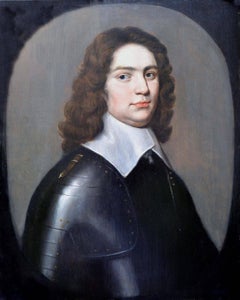
Portrait of a Gentleman, 17th Century Dutch Old Masters Oil
Located in London, GB
Circle of Gerard van Honthorst
1592 - 1656
Portrait of a Gentleman
Oil on wooden panel
Image size: 29 x 23 inches
Contemporary gilt frame
Gerard van Honthorst was a Dutch Golden Age...
Category
17th Century Old Masters Portrait Paintings
Materials
Oil, Wood Panel
1920 Cesare Ciani Credited Italian Macchiaiolo Portrait Painting
By Cesare Ciani
Located in Roma, IT
1920 Cesare Ciani Credited Italian Macchiaiolo Portrait Painting
A beautiful, intense painting, although it is not signed, is attributed to the great Macchiaioli painter Cesare Cian...
Category
1920s Old Masters Portrait Paintings
Materials
Oil, Wood Panel
$1,539
H 17.72 in W 13 in D 0.2 in
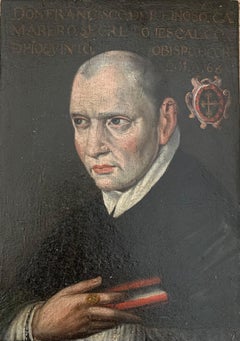
Spanish school. Secretary of Pope Pius V, abbot of Husillos, bishop of Córdoba.
Located in Firenze, IT
Portrait of Francisco de Reynoso y Baeza.
Secretary of Pope Pius V, abbot of Husillos and bishop of Córdoba. Francisci de Reynoso.
Early 17th century.
Small-format portrait from the late Renaissance period.
Spanish school.
Size: Cm 19 x Cm 13.5
Oil on wooden panel.
On the back the fine tablet is strengthened (already in ancient times) by a sheet of parchment.
About 1600-1610.
As often in Mannerist / Late Renaissance portraits, the image of the character is accompanied by the writing that runs at the top, adding a celebratory, historicising touch to the effigy. Let's bring back the sentence here:
DON FRANCISCO DE REINOSO. CAMARERO SECRETO IESCALCO PIO QUINTO OBISCOPO CORDOBA. 68 (? O 7?)
(1534, Autillo de Campos, Spain - 1601, Córdoba)
Francisco de Reynoso was a Spanish cleric, chief chamberlain, and secretary to Pope Pius V, abbot of Husillos, and bishop of Córdoba.
He was the fourth of eleven children. His father was the seventh Lord of Autillo de Campos, and his mother was Juana de Baeza y de las Casas, daughter of Manuel de Baeza, a lawyer of the Royal Council and at the Court of Valladolid.
Francisco de Reynoso was deeply devoted to the Virgin Mary and showed a strong inclination toward religion and piety from an early age.
He studied Latin, arts, and theology at the University of Salamanca.
In 1562, he traveled to Rome with his brothers Pedro and Luis.
In January 1566, following the death of Pope Pius IV, Cardinal Antonio Michele Ghislieri was elected pope, becoming Pius V. From this period until Ghislieri's death in 1572, Francisco de Reynoso served as his chief chamberlain and secretary.
After Pope Pius V died, Francisco de Reynoso returned to Spain and lived for several years in the city of Palencia, where his brother Manuel was a canon.
He supported the Society of Jesus when it was established in Palencia, providing alms to the school's clergy and funding chairs of Letters and Theology at his own expense, as well as donating a significant number of books.
During the brief outbreak of the Black Plague...
Category
17th Century Old Masters Portrait Paintings
Materials
Parchment Paper, Oil, Wood Panel
$1,514 Sale Price
20% Off
Free Shipping
H 7.49 in W 5.32 in
Angelic Cherubs with Classical Figure in Wilderness Finely Painted Preparatory
Located in Cirencester, Gloucestershire
Figure with Cherubim in Wilderness
Italian School, 17th century
oil painting on wood panel
framed 13 x 11 inches
condition: overall for its age very good, though the work is most likely a preparatory...
Category
17th Century Old Masters Figurative Paintings
Materials
Oil, Wood Panel
$2,840 Sale Price
20% Off
H 13 in W 11 in D 1 in
Dutch Old Master Portrait of Maurits, Prince of Orange-Nassau, Oil on Panel
Located in London, GB
In 1607, the Delft city council decided to commission a portrait of Stadholder Maurits of Nassau for the town hall, with Michiel van Mierevelt as the chosen artist due to the passing...
Category
17th Century Old Masters Portrait Paintings
Materials
Oil, Wood Panel
$10,584
H 37.8 in W 33.47 in D 2.37 in
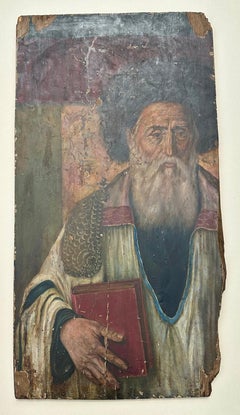
19th century Oil portrait of a Hungarian Rabbi
Located in Woodbury, CT
This 19th-century oil on panel portrait depicts a Hungarian Rabbi, characterized by his traditional attire and solemn expression. The Rabbi is portrayed with a long, white beard and ...
Category
1890s Old Masters Figurative Paintings
Materials
Oil, Wood Panel
$5,167 Sale Price
35% Off
Free Shipping
H 11.62 in W 6.3 in
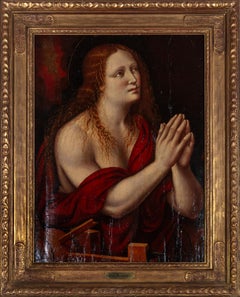
19th century classical religious oil painting portrait female subject red dark
By Giovanni Pietro Rizzoli
Located in Milwaukee, WI
"Caterina d'Alexandria (Saint Catherine of Alexandria)" is a copy oil painting on wood panel, after Italian artist Giampietrino (Giovanni Pietro Riz...
Category
19th Century Old Masters Portrait Paintings
Materials
Oil, Wood Panel
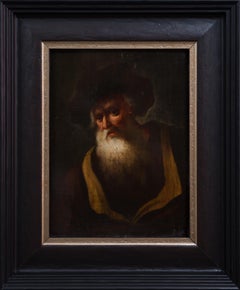
Portrait of an Old Bearded Man With a Black Cap
Located in Stockholm, SE
We are pleased to offer a captivating portrait, most likely painted in the late 18th century, attributed to an artist within the circle of Christian Wilhelm Ernst Dietrich. This oil ...
Category
Late 18th Century Old Masters Portrait Paintings
Materials
Oil, Wood Panel
$2,842
Free Shipping
H 14.18 in W 11.82 in
More From This Seller
View AllSir Charles Frederick
Located in London, GB
Oil on canvas
50 x 40 inches; 127 x 101.6 cm
Framed dimensions: 151.5 x 127 cm
Inscribed on plinth: ‘VOTIS X ET XX’
Not signed
Painted c.1748
Collections:
Christie’s London, 23rd December 1954, lot.272;
J. Singer;
Somerville
Simpson Ltd, London, by 1985;
The Matthiesen Gallery, London;
Richard Feigen, New York;
Matthew Rutenberg, New York to 2019;
Lowell Libson and Jonny Yarker Ltd.
Literature:
Stella Rudolph, La Pittura del’ 700 a Roma, Milan, 1983, reproduced pl.133;
Jacob Simon, Handel, a celebration of his life and times 1685-1759, exh. cat. London, (National Portrait Gallery), 1985, no.196;
Catherine Whistler, Baroque
Later Paintings in the Ashmolean Museum, London, 2016, pp.102-105, reproduced p.104
Exhibited:
London, National Portrait Gallery, Handel, a celebration of his life and times 1685-1759, 1985-86, no.196, reproduced p.198
This powerful portrait of the antiquarian and courtier Sir Charles Frederick was completed in 1748 by the Roman painter Andrea Casali. Frederick, as comptroller of the royal laboratory, one of the ‘great officers’ of the Board of Ordinance at Woolwich, had just been responsible for the famed pyrotechnic display celebrating the Peace of Aix-la-Chapelle: the so-called ‘Royal Fireworks’ for which George Frederick Handel composed music. Casali’s portrait pays tribute to Frederick’s role as comptroller of the royal laboratory, showing him with a firing diagram and mortar, it also points to Frederick’s interests as an antiquarian with the inclusion of antique relief. Casali had first met Frederick in Rome in 1738, where he had painted his portrait, Frederick subsequently encouraged Casali to travel to London. This probably accounts for the unusual format; rather than a modern man of science, Casali casts Frederick as an alchemist bent on some mystic discovery, as such, it is one of the most unusual portraits of the period.
Andrea Casali was a pupil of Sebastiano Conca and then of Francesco Trevisani, who recommended him to the Spanish court in 1736. He enjoyed some success in Rome as a painter of frescoes and altarpieces, notably a large cycle of Scenes from the Life of St Dominic at the cloister of S. Sisto Vecchio, for which he was made a Knight of the Golden Spur in 1729. Casali began painting Grand Tourist portraits in Rome around 1738. His first portrait of Sir Charles Frederick is dated that year Ashmolean Museum, Oxford), it casts Frederick as a focused scholar, showing him seated at an elaborately carved console table, hard at work. In common with other Grand Tour portraiture of the period, Casali includes a famous Roman landmark in the background, in this case the façade of the Pantheon. Horace Walpole noted that it was thanks to the encouragement of ‘Mr Frederick and his Friends at Rome’ that Casali travelled to London in 1741.
Charles Frederick was a fascinating Augustan polymath. Born at Fort St George, Madras, where his father, Sir Thomas Frederick, was governor, he successively matriculated at New College, Oxford (1725), was called to the Middle Temple (1728), became a Fellow of the Royal Society (1731) and Director of the Society of Antiquaries (1735). His interests were wide ranging. Frederick was an amateur architect, he designed the monument to Lucy, Lady Lyttleton, in Hagley Church and the monument to Thomas Miller, bishop of Waterford, in Highclere church, Hampshire. He was a numismatist and collector of antiquities, as well as an amateur scientist. It was in the last capacity that he was appointed comptroller of the royal laboratory at Woolwich and clerk of the deliveries in 1746, this was the most junior of the ‘great officers’ who made up the membership of the royal Board of Ordnance. This appointment came through the good offices of the master-general of the Ordnance, a fellow antiquarian, John, 2nd Duke of Montagu. As comptroller, Frederick was responsible for the fireworks celebration of the treaty of Aix-la-Chapelle, for which Handel composed his celebrated music. As Horace Walpole wrote to his cousin, Henry Seymour Conway:
‘Charles Frederick has turned all his virtu into fireworks, and, by his influence with the Ordnance has prepared such a spectacle for the proclamation of Peace as is to surpass all its predecessors of bouncing memory. It is to open with a concert of fifteen hundred hands, and conclude with so many thousand crackers all set to music, that all the men killed in the war are to be wakened with a crash, as if it was the day of judgement, and fall a-dancing, like the troops in the Rehearsal. I wish you could see him making squibs of his papillotes, and bronzed over with a patina of gunpowder, and talking himself still hoarser on the superiority that his fireworks will have over the Roman naumachia.’
Performed in Green Park, the fireworks were mounted on a temporary structure designed by the architect Giovanni Niccolò Servandoni decorated by Adrea Soldi and Casali.
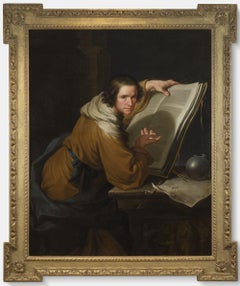
Casali’s second portrait of Frederick was completed following the success of the firework display. In this remarkable image, we discover Frederick at work, dressed in almost monastic garb, pouring over an impossibly large tome propped on an antique altar. The altar is identifiable as a Roman relief depicting Victory writing on a shield, the original is at Villa Medici in Rome, but was engraved by Pietro Santi Bartoli...
Category
18th Century Old Masters Portrait Paintings
Materials
Canvas, Oil
Alfred Baldwin, Esq.
By Edward John Poynter
Located in London, GB
Oil on unlined canvas, stamped
26 x 21¼ inches; 66.5 x 54 cm
Framed dimensions: 95.5 x 83.5 cm
‘Wood & Co 190 Brompton Road London SW’
Signed with monogram and dated ‘1878’, centr...
Category
19th Century Old Masters Portrait Paintings
Materials
Canvas, Oil
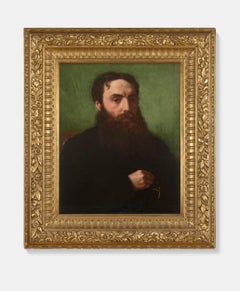
Self-Portrait
By John Hamilton Mortimer
Located in London, GB
Oil on canvas
30 x 25 ⅛ inches; 762 x 638 mm
Verso: after Sir Joshua Reynolds, a self-portrait
Not signed
Painted c. 1758
Collections:
Philip Gell (1775–1842), Hopton Hall, Derbyshire;
By inheritance at Hopton Hall to his daughter, Isabella, who married William Pole Thornhill, who renounced Hopton and its contents in favour of his kinsman, Henry Chandos-Pole-Gell (1829–1902);
By descent to his son, Brigadier General Harry Chandos-Pole-Gell (1872–1934), who sold Hopton Hall in 1918 and moved the family to Newnham Hall, Northamptonshire;
By descent to his son, Lt Colonel John Chandos-Pole (1909–1993), Newnham Hall;
Thence by descent until 2015, when acquired
By descent to 2015;
Lowell Libson
Jonny Yarker Ltd.
Literature:
Algernon Graves and Walter V. Cronin, A History of the works of Sir Joshua Reynolds P.R.A., London, 1901, IV, p. 1394.
David Manning...
Category
18th Century Old Masters Portrait Paintings
Materials
Canvas, Oil
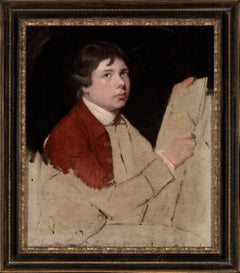
A Pair of Portraits
By Francis Cotes
Located in London, GB
Pastel on paper stretched on canvas
Each 23 ¼ x 19 ¾ inches; 59 x 50 cm
Framed dimensions, each: 83 x 67.5 cm
Both signed ‘F. Cotes Px 1751’
Collections:
Captain Penton;
Christie’...
Category
18th Century Old Masters Portrait Paintings
Materials
Canvas, Paper, Pastel
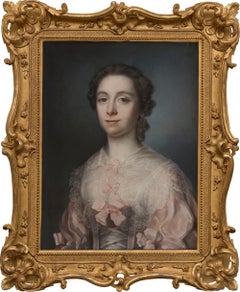
A young couple returning from the fields
Located in London, GB
Oil on panel
13 ⅜ x 9 ⅞ inches; 34 x 25 cm
Framed dimensions: 43.4 x 34.3 cm
Not signed
c. 1730s
Collections:
James Brydges, Duke of Chandos;
Chandos sale, Christopher Cock, Lond...
Category
18th Century Old Masters Figurative Paintings
Materials
Panel, Oil
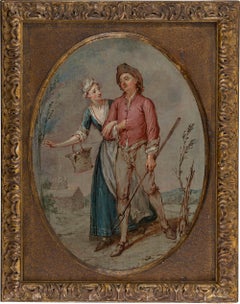
The Valley of the River Severn with a distant view of Shrewsbury
By Richard Wilson
Located in London, GB
Oil on canvas
20 x 37 ¼ inches; 50.8 x 94.6 cm
Framed dimensions: 67.5 x 110.5 cm
Not signed
c.1744-1745
Collections:
Possibly John Charles Middleton (1757-1793);
Revd Frederick M...
Category
18th Century Old Masters Landscape Paintings
Materials
Canvas, Oil