Items Similar to Self-Portrait
Want more images or videos?
Request additional images or videos from the seller
1 of 8
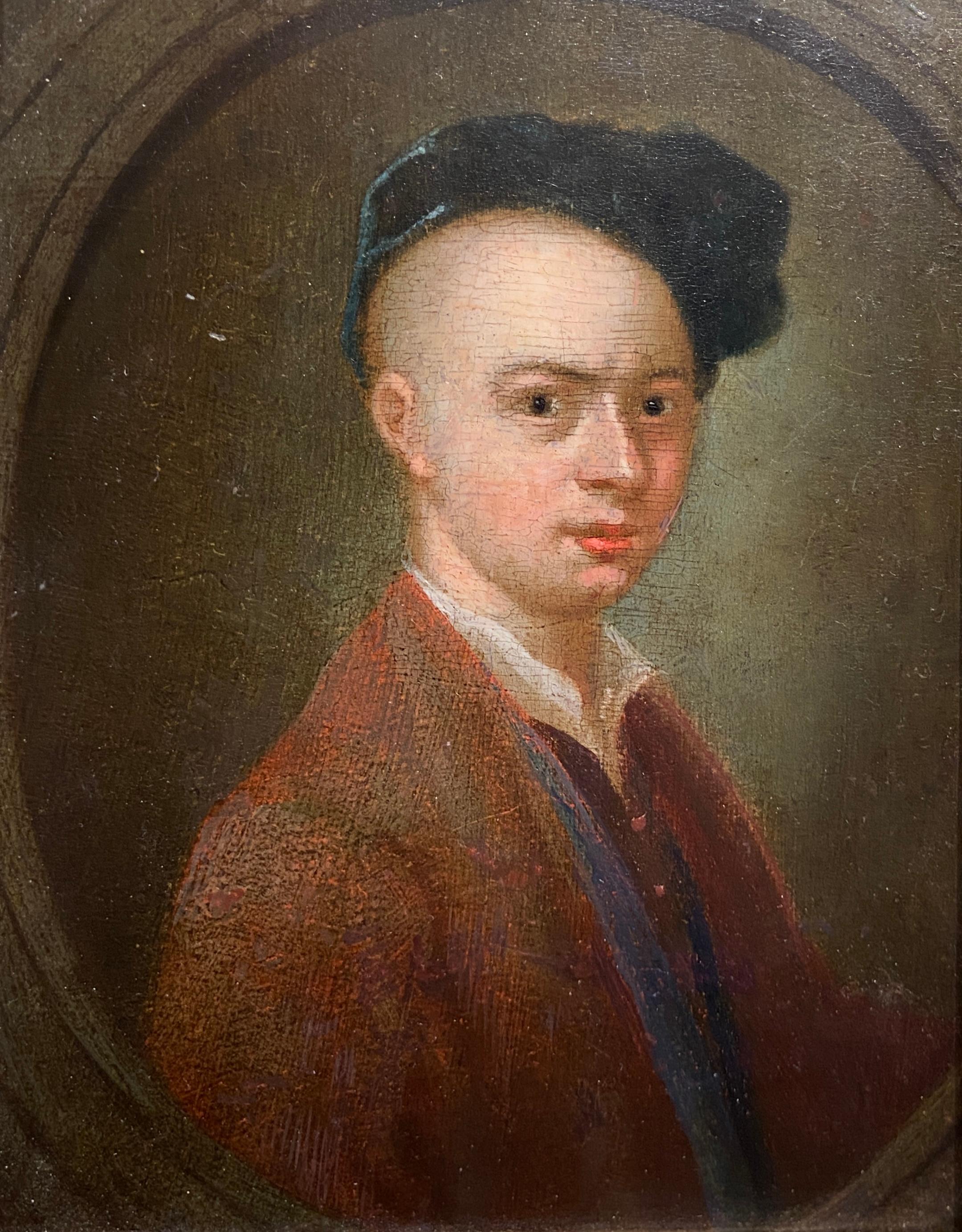
John Hamilton MortimerSelf-Portrait1758
1758
$229,899.19
£165,000
€193,858.81
CA$314,523.47
A$332,532.39
CHF 178,693.74
MX$3,993,765.03
NOK 2,237,562.82
SEK 2,047,535.05
DKK 1,447,698.18
About the Item
Oil on canvas
30 x 25 ⅛ inches; 762 x 638 mm
Verso: after Sir Joshua Reynolds, a self-portrait
Not signed
Painted c. 1758
Collections:
Philip Gell (1775–1842), Hopton Hall, Derbyshire;
By inheritance at Hopton Hall to his daughter, Isabella, who married William Pole Thornhill, who renounced Hopton and its contents in favour of his kinsman, Henry Chandos-Pole-Gell (1829–1902);
By descent to his son, Brigadier General Harry Chandos-Pole-Gell (1872–1934), who sold Hopton Hall in 1918 and moved the family to Newnham Hall, Northamptonshire;
By descent to his son, Lt Colonel John Chandos-Pole (1909–1993), Newnham Hall;
Thence by descent until 2015, when acquired
By descent to 2015;
Lowell Libson
Jonny Yarker Ltd.
Literature:
Algernon Graves and Walter V. Cronin, A History of the works of Sir Joshua Reynolds P.R.A., London, 1901, IV, p. 1394.
David Manning, Sir Joshua Reynolds: A Complete Catalogue of his Paintings, New Haven and London, 2000, p. 48, no. 13c.
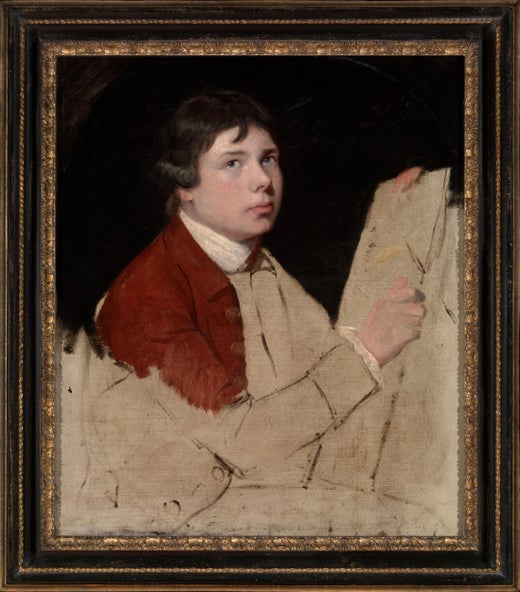
This sensitively handled oil is the earliest recorded self-portrait by John Hamilton Mortimer, executed circa 1758, shortly after Mortimer had entered the studio of Thomas Hudson. It was in Hudson’s studio that Mortimer met Joseph Wright of Derby, with whom he had a life-long friendship and working relationship. Previously unpublished, this painting sheds significant light on Mortimer’s working practices and on the activities of young artists in the 1750s, the decade before the foundation of the Royal Academy. Its rediscovery also underlines what a compelling and intelligent painter Mortimer was, raising significant questions about his relationship with Wright of Derby. The work is also unfinished offering valuable insights into the working methods of British painters at a transitional moment in the emergence of an indigenous school of art.
John Hamilton Mortimer was born in Eastbourne, Sussex the fifth and youngest child of Thomas Mortimer, a mill owner and customs officer. The landscape painter and diarist, Joseph Farington recorded that Mortimer: ‘he began to draw when very young.’ In 1756 or 1757 Mortimer's father paid £100 for him to work in the studio of Thomas Hudson. By the 1750s an artistic system had emerged in Britain which meant drawing from the antique and life model were largely taught in a series of private organisations – including the St Martin’s Lane Academy and Shipley’s drawing academy – whilst the practical role of a painter was learnt in the atelier of an established master. In Hudson’s studio, we know, Mortimer would have been taught to draw, initially by copying old master drawings or prints from Hudson’s own collection. Hudson would also have instructed Mortimer in the use of oil paint, a fact which is significant when considering the confident execution of the present boldly handled work.
Mortimer’s earliest biographers tell us that he grew tired of Hudson’s studio regime and left after a year. Hudson’s most famous student, Joshua Reynolds, similarly rebelled over the repetitive nature of Hudson’s teaching method. Mortimer worked instead with the painter and political radical, Robert Edge Pine.
We have a sense of Mortimer’s powers as a draughtsman at this period from a series of highly finished drawings after sculptures and life-drawings preserved in the collection of the Society of Arts. Two of the life drawings are signed and dated 1758 and 1759, they were probably made at the St Martin’s Lane Academy. Mortimer was awarded a premium by the Society of Arts for the second drawing, the Minutes recording ‘Drawings of Human Figures from living Models at Academy of Artists in St. Martin’s Lane, in Chalks, by Young Men under 24 years to divide 30 Guineas… 1759 John Mortimer pupil of Mr Pine, 2nd share.’ At the same time Mortimer was drawing from casts. An article in The Monthly Magazine noted:
‘whilst he was here [with Hudson], and for a considerable time afterwards, he attended the Duke of Richmond’s Gallery, which was, indeed, his school, and where his assiduity, his exertions, and his opening powers were so much noticed by Cipriani, and the late Mr Moser, that they represented him so favourably to the illustrious nobleman… that he wished very much to have retained him in his house.’
Mortimer did not become the ‘house’ painter to Charles Lennox, 3rd Duke of Richmond, but it is notable that his ‘opening powers’ were recognised by contemporaries.
A series of nine black and white chalk character studies preserved in the Sir John Soane’s Museum date from roughly 1758. Showing different heads observed from oblique angles, the studies show the influence of Giovanni-Battista Piazzetta and the Irish portraitist Thomas Frye, whose own head studies published as mezzotints were extremely popular. The drawings betray Mortimer’s interest in certain viewpoints and physiognomic stylisations. For example, he seems to have been attracted to showing figures from below; many of the sitters are shown with distinctive flared nostrils, upturned noses and small, sharply drawn mouths, with heavily shadowed lower-lips.
These features are all apparent in Mortimer’s earliest self-portrait. A remarkably confident work made at the beginning of his training, the present portrait combines several important themes which would be consistent features of his career.
The first is self-portraiture itself. Mortimer, like his older friend Joseph Wright of Derby, was fascinated by self-portraiture. Wright produced numerous images of himself over his career beginning with a romantic depiction in Van Dyck costume now in Derby Museum and Art Gallery. Possibly painted when Wright was working in Hudson’s studio for the second time, it is similar in approach and handling to our self-portrait by Mortimer. The sitter in our portrait is instantly recognisable as Mortimer from his later self-portraits. Four years after beginning the present study, he produced another self-portrait, which he exhibited at the Society of Artists in 1762. John Sunderland identified the work with a painting formerly in the collection of Mortimer’s descendants which is now known only from a poor quality black and white photograph. It is notable that his first exhibited work, at the first exhibition of living British art in London, was a self-portrait. Like Wright, Mortimer continued to produce self-portraits throughout his career. In the mid-1760s Mortimer painted a conversation piece of himself, his father, Thomas and brother Charles Smith now in the Yale Center for British Art in New Haven. Mortimer is the seated figure in the foreground of the Yale conversation piece, his features – the retroussé nose, the short, dark hair, thick bottom lip and slight dimple in the chin – are the same, but older than in our portrait.
The second is artistic education. Again, like Wright, Mortimer was clearly fascinated by the process of learning to paint and draw and like Wright he produced a series of celebrated images of artists at work. The most instructive is a famous self-portrait of himself seated at a drawing board with a student, presumably correcting the student’s drawing of the casts laid on the table in front of them. The painting is known in two versions, in the second, now in the Royal Academy of Arts, London, Mortimer included the sculptor Joseph Wilton, who had supervised his own time drawing in the Duke of Richmond’s academy. In 1769 Mortimer was appointed a director of the Maiden Lane Academy by the Society of Artists and was required to set the life model along with Ozias Humphry, Robert Edge Pine, George Stubbs, Joseph Wright and Johan Zoffany. According to the Minutes of the Society of Artists, Mortimer was required: ‘to wait upon Dr [William] Hunter and… desire the favour of him to dissect a human figure for the use of the Academy.’
This newly discovered self-portrait is therefore particularly important as it combines these two ideas, showing, as it does, Mortimer at work. Although unfinished, Mortimer depicts himself holding a drawing board, presumably in the process of making a study with a porte crayon. Mortimer’s upturned eyes and concentrated expression possibly suggests that he was attempting to depict himself in the process of drawing a sculpture or cast, given the date, probably at the Duke of Richmond’s Sculpture Gallery. That Mortimer painted this study is also instructive. Given that in 1758 Mortimer was still apprenticed to Thomas Hudson, he would naturally be learning to handle oil. The blond ground, use of liquid brown paint to block in the costume and the careful build-up of colour, all accords with Hudson’s own technique. So too does the format, Mortimer has shown himself in a feigned oval, similar to many of Hudson’s most successful portraits of the period and a format Mortimer himself adopts in his portraiture of the 1760s.
John Hamilton Mortimer is one of the most innovative and impressive history painters of the mid-eighteenth century. In this precautious early self-portrait, Mortimer demonstrates his ability as a painter. A powerful, unfinished work, the portrait looks ahead to Mortimer’s great series of self-portraits. Its provenance also ties the portrait to one of Mortimer’s most important projects and to his long standing friend, Joseph Wright of Derby shedding important light on their work together.
- Creator:John Hamilton Mortimer (1740 - 1779, English)
- Creation Year:1758
- Dimensions:Height: 30.01 in (76.2 cm)Width: 25.12 in (63.8 cm)
- Medium:
- Movement Style:
- Period:
- Condition:
- Gallery Location:London, GB
- Reference Number:1stDibs: LU1507217299142
John Hamilton Mortimer
John Hamilton Mortimer was a British figure and landscape painter and printmaker, known for romantic paintings set in Italy, works depicting conversations and works drawn in the 1770s portraying war scenes, similar to those of Salvator Rosa. Mortimer became President of the Society of Artists in 1774, five years before his death, at age 39.
About the Seller
5.0
Recognized Seller
These prestigious sellers are industry leaders and represent the highest echelon for item quality and design.
1stDibs seller since 2021
5 sales on 1stDibs
- ShippingRetrieving quote...Shipping from: Mitchum, United Kingdom
- Return Policy
More From This Seller
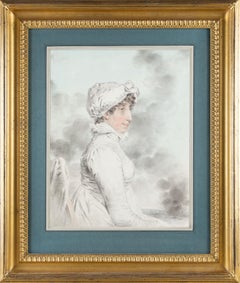
View AllRegency portrait drawing of Arabella Graham-Clarke
By John Downman
Located in London, GB
Collections:
The sitter, and by descent;
Christie's, 19th March 1928, lot 6;
Private collection to 2019
Literature:
G.C. Williamson, John Downman, A.R.A., his Life and Works, Lon...
Category
Early 19th Century Old Masters Portrait Drawings and Watercolors
Materials
Pencil, Watercolor
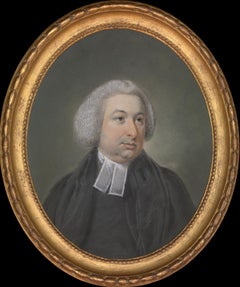
Eighteenth-century Irish portrait of the Rev. Henry Dabzac
By Hugh Douglas Hamilton
Located in London, GB
Pastel on paper, oval
9 x 7 ¼ inches; 230 x 185 mm
Inscribed on the verso:
‘The Revd Henry Dabzac D.D./ late Senior Fellow of/ Trinity College Dublin/ ever to be lamented by all that knew/ Him. Extensive learning, zeal, gently tempered/ by a spirit of charity & above all, a strong/ faith & a piety deservedly gained/ the character of a great and good man./ This exceptional man died 12th May 1790/ This picture was his give to Jane [Mary] Crofton, his sincerely [missing] sister.’
Collections:
Rev. Dr Henry Dabzac gift to his sister, Jane Crofton (d.1797);
Sir Hugh Crofton (1763-1834);
By descent to 1990;
Private collection, Dorset to 2020.
Literature:
Robert Staveley, Traces of Past and Present, Dublin, 1895, p.74;
Neil Jeffares, Dictionary of Pastellists Before 1800, online edition, no.J3751247
This characteristic pastel portrait by Hugh Douglas Hamilton was made early in his career; it depicts precisely the kind of education, well-connected Irish sitter who fuelled his success. The Reverend Henry Dabzac was from a distinguished Huguenot family, a celebrated academic historian, Dabzac received the Donegall lectureship in 1764 and from 1785 was Librarian and Senior Fellow of Trinity College, Dublin. According to his earliest biographer, Hamilton was the son of a peruke-maker based in Crow Street, Dublin. As Anne Hodge has pointed out, this places Hamilton’s father at the heart of the city: Crow street was a narrow thoroughfare formed part of the busy warren of streets bordered by the old Houses of Parliament and Trinity College at one end, and by Dublin Castle at the other. It is perhaps telling that in this early portrait, Hamilton shows Dabzac in a splendid powdered wig and his clerical bands. In 1754 Hamilton was apprenticed to James Mannin, a ‘pattern drawer’ who two years later was appointed master of the school of ornament at the Dublin Society’s drawing school, run by Robert West. Here Hamilton took the first prize in the 1755 competition, winning a premium of £1/16/. Hamilton developed a popular and profitable method of making pastel likenesses of sitters in a distinctive oval format. Hamilton developed a technique of using a sharpened pastel to hatch shaded areas of the features and, in the case of this portrait of Dabzac, the white powdered wig, which is drawn with particular care. In 1764 Hamilton moved to London where this small, oval pastels proved...
Category
18th Century Old Masters Portrait Drawings and Watercolors
Materials
Pastel
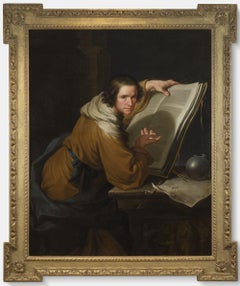
Sir Charles Frederick
Located in London, GB
Oil on canvas
50 x 40 inches; 127 x 101.6 cm
Framed dimensions: 151.5 x 127 cm
Inscribed on plinth: ‘VOTIS X ET XX’
Not signed
Painted c.1748
Collections:
Christie’s London, 23rd December 1954, lot.272;
J. Singer;
Somerville
Simpson Ltd, London, by 1985;
The Matthiesen Gallery, London;
Richard Feigen, New York;
Matthew Rutenberg, New York to 2019;
Lowell Libson and Jonny Yarker Ltd.
Literature:
Stella Rudolph, La Pittura del’ 700 a Roma, Milan, 1983, reproduced pl.133;
Jacob Simon, Handel, a celebration of his life and times 1685-1759, exh. cat. London, (National Portrait Gallery), 1985, no.196;
Catherine Whistler, Baroque
Later Paintings in the Ashmolean Museum, London, 2016, pp.102-105, reproduced p.104
Exhibited:
London, National Portrait Gallery, Handel, a celebration of his life and times 1685-1759, 1985-86, no.196, reproduced p.198
This powerful portrait of the antiquarian and courtier Sir Charles Frederick was completed in 1748 by the Roman painter Andrea Casali. Frederick, as comptroller of the royal laboratory, one of the ‘great officers’ of the Board of Ordinance at Woolwich, had just been responsible for the famed pyrotechnic display celebrating the Peace of Aix-la-Chapelle: the so-called ‘Royal Fireworks’ for which George Frederick Handel composed music. Casali’s portrait pays tribute to Frederick’s role as comptroller of the royal laboratory, showing him with a firing diagram and mortar, it also points to Frederick’s interests as an antiquarian with the inclusion of antique relief. Casali had first met Frederick in Rome in 1738, where he had painted his portrait, Frederick subsequently encouraged Casali to travel to London. This probably accounts for the unusual format; rather than a modern man of science, Casali casts Frederick as an alchemist bent on some mystic discovery, as such, it is one of the most unusual portraits of the period.
Andrea Casali was a pupil of Sebastiano Conca and then of Francesco Trevisani, who recommended him to the Spanish court in 1736. He enjoyed some success in Rome as a painter of frescoes and altarpieces, notably a large cycle of Scenes from the Life of St Dominic at the cloister of S. Sisto Vecchio, for which he was made a Knight of the Golden Spur in 1729. Casali began painting Grand Tourist portraits in Rome around 1738. His first portrait of Sir Charles Frederick is dated that year Ashmolean Museum, Oxford), it casts Frederick as a focused scholar, showing him seated at an elaborately carved console table, hard at work. In common with other Grand Tour portraiture of the period, Casali includes a famous Roman landmark in the background, in this case the façade of the Pantheon. Horace Walpole noted that it was thanks to the encouragement of ‘Mr Frederick and his Friends at Rome’ that Casali travelled to London in 1741.
Charles Frederick was a fascinating Augustan polymath. Born at Fort St George, Madras, where his father, Sir Thomas Frederick, was governor, he successively matriculated at New College, Oxford (1725), was called to the Middle Temple (1728), became a Fellow of the Royal Society (1731) and Director of the Society of Antiquaries (1735). His interests were wide ranging. Frederick was an amateur architect, he designed the monument to Lucy, Lady Lyttleton, in Hagley Church and the monument to Thomas Miller, bishop of Waterford, in Highclere church, Hampshire. He was a numismatist and collector of antiquities, as well as an amateur scientist. It was in the last capacity that he was appointed comptroller of the royal laboratory at Woolwich and clerk of the deliveries in 1746, this was the most junior of the ‘great officers’ who made up the membership of the royal Board of Ordnance. This appointment came through the good offices of the master-general of the Ordnance, a fellow antiquarian, John, 2nd Duke of Montagu. As comptroller, Frederick was responsible for the fireworks celebration of the treaty of Aix-la-Chapelle, for which Handel composed his celebrated music. As Horace Walpole wrote to his cousin, Henry Seymour Conway:
‘Charles Frederick has turned all his virtu into fireworks, and, by his influence with the Ordnance has prepared such a spectacle for the proclamation of Peace as is to surpass all its predecessors of bouncing memory. It is to open with a concert of fifteen hundred hands, and conclude with so many thousand crackers all set to music, that all the men killed in the war are to be wakened with a crash, as if it was the day of judgement, and fall a-dancing, like the troops in the Rehearsal. I wish you could see him making squibs of his papillotes, and bronzed over with a patina of gunpowder, and talking himself still hoarser on the superiority that his fireworks will have over the Roman naumachia.’
Performed in Green Park, the fireworks were mounted on a temporary structure designed by the architect Giovanni Niccolò Servandoni decorated by Adrea Soldi and Casali.
Casali’s second portrait of Frederick was completed following the success of the firework display. In this remarkable image, we discover Frederick at work, dressed in almost monastic garb, pouring over an impossibly large tome propped on an antique altar. The altar is identifiable as a Roman relief depicting Victory writing on a shield, the original is at Villa Medici in Rome, but was engraved by Pietro Santi Bartoli...
Category
18th Century Old Masters Portrait Paintings
Materials
Canvas, Oil
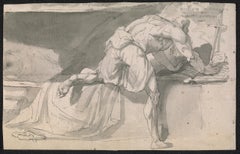
Eighteenth century Old Master drawing - St Jerome
By John Hamilton Mortimer
Located in London, GB
Pen, ink and wash
Framed dimensions: 9 ½ x 11 ¼ inches
Drawn c. 1763
This small, powerful study shows St Jerome contemplating the bible with a cross and sk...
Category
18th Century Old Masters Figurative Drawings and Watercolors
Materials
Ink, Pen
A Pair of Portraits
By Francis Cotes
Located in London, GB
Pastel on paper stretched on canvas
Each 23 ¼ x 19 ¾ inches; 59 x 50 cm
Framed dimensions, each: 83 x 67.5 cm
Both signed ‘F. Cotes Px 1751’
Collections:
Captain Penton;
Christie’...
Category
18th Century Old Masters Portrait Paintings
Materials
Canvas, Paper, Pastel
Alfred Baldwin, Esq.
By Edward John Poynter
Located in London, GB
Oil on unlined canvas, stamped
26 x 21¼ inches; 66.5 x 54 cm
Framed dimensions: 95.5 x 83.5 cm
‘Wood & Co 190 Brompton Road London SW’
Signed with monogram and dated ‘1878’, centr...
Category
19th Century Old Masters Portrait Paintings
Materials
Canvas, Oil
You May Also Like
Portrait of John Manners later 7th Duke of Rutland
By Margaret Sarah Carpenter
Located in Douglas, Isle of Man
Margaret Sarah Carpenter 1793-1872, was an English portrait painter. She was one of the foremost portrait painters in the 19th Century, she ex...
Category
1830s Portrait Paintings
Materials
Oil, Panel
George Byng Later 7th Viscount Torrington
Located in Douglas, Isle of Man
Robert Frain active 1829-1877, was a Scottish painter. There is very little biographical information regarding Frain, however he was active in the first quarter to the third quarter ...
Category
1820s Portrait Paintings
Materials
Canvas, Oil
Self-Portrait - Royal Academy Founding Member, 18th Century
By Francis Hayman
Located in London, GB
Francis Hayman RA
1708–1776
Self-Portrait
Oil on oak panel
Image size: 8 x 6¼ inches
Contemporary gilt frame
This newly discovered work is the earliest known self portrait by Francis Hayman, dated to the mid to late 1720’s. The small scale of the portrait gives it a strong sense of intimacy. Whereas clients would often dress themselves in their best clothes for a sitting, Hayman has portrayed himself in informal attire, with his shirt unbuttoned and a wig cap.
Born in 1708 to a respectable Devonshire family, his training began at the tender age of ten under the tutelage of the historical painter Robert Brown, who was probably an uncle. By the 1730’s he is known to have been engaged in painting scenery for the popular theatres on Goodman’s Fields and Drury Lane. He established a studio on St Martin’s Lane, and demonstrated his versatility as one of the most
important painters of his time in portraits, illustration and history painting.
Indeed, he was one of the first English painters deemed to have the skill and proficiency to rival that of the foreign masters, such as Holbein and Kneller, who were brought in by the court to make up for the perceived shortcomings of the native artists. Led by William Hogarth, Hayman and other artists began to create a new movement in the English art world. Thomas Gainsborough was one of his pupils, whom he is said to have introduced to the more lascivious and debauched underbelly of London life.
After mostly making his living as an illustrator, in the 1740’s Hayman was commissioned by the proprietor of the Vauxhall Pleasure Gardens, Jonathan Tyers, to produce a series of four large celebratory canvases depicting British victories from the Seven Years War. His association with Tyers continued, and over the next ten years he produced a number of large decorative paintings...
Category
18th Century Old Masters Portrait Paintings
Materials
Oak, Oil Pastel
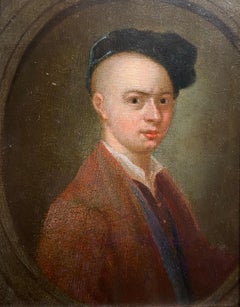
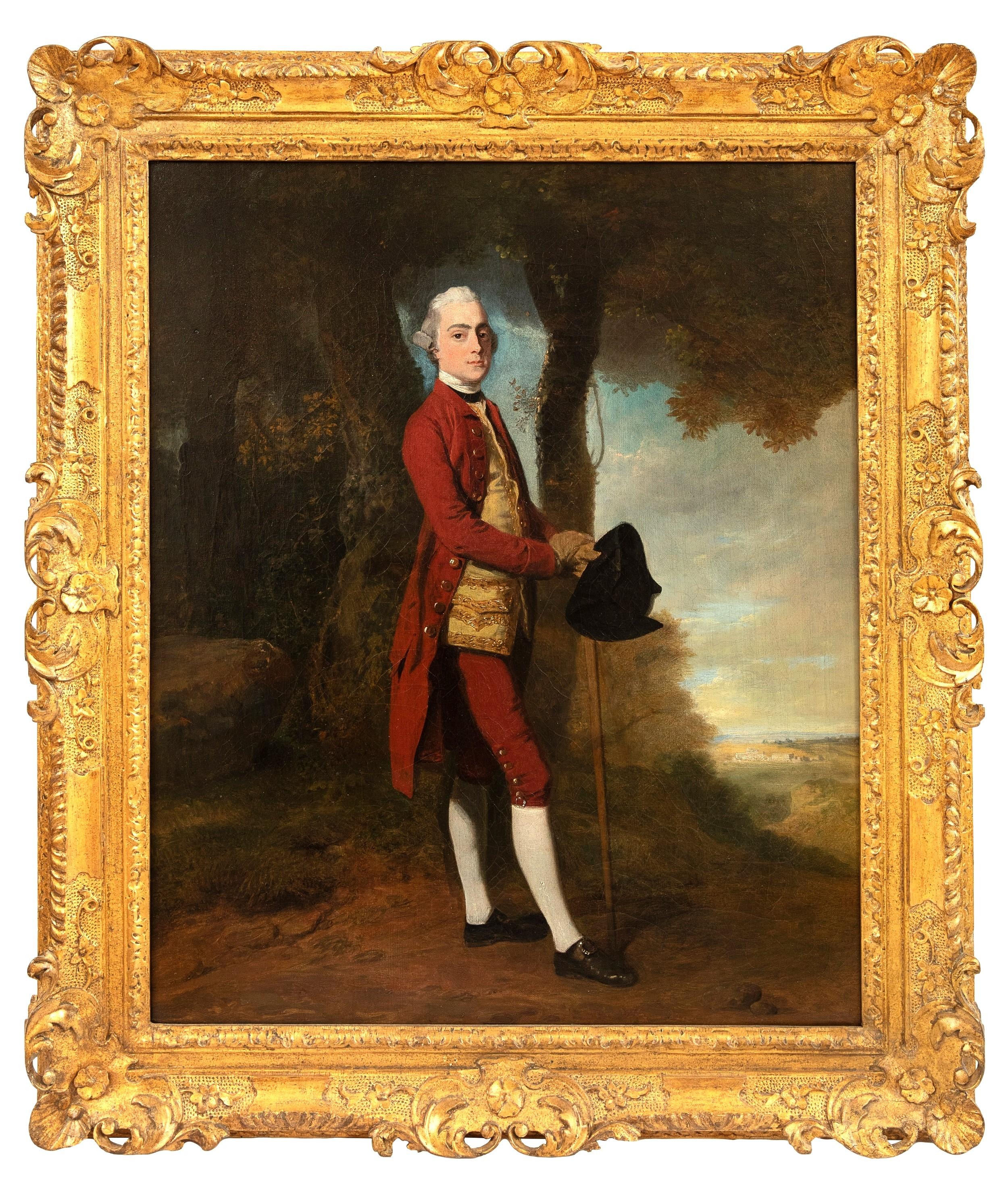
An English 18th century portrait of James Stanley, standing in a landscape
By John Hamilton Mortimer
Located in Bath, Somerset
Portrait of James Stanley (1750 - 1810), circa 1775-1778, full-length, wearing a red coat and breeches and a gold embroidered waistcoat, hold...
Category
1770s English School Portrait Paintings
Materials
Canvas, Oil, ABS
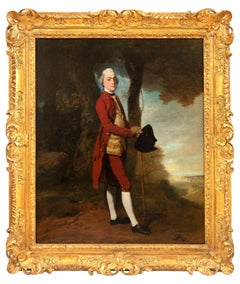
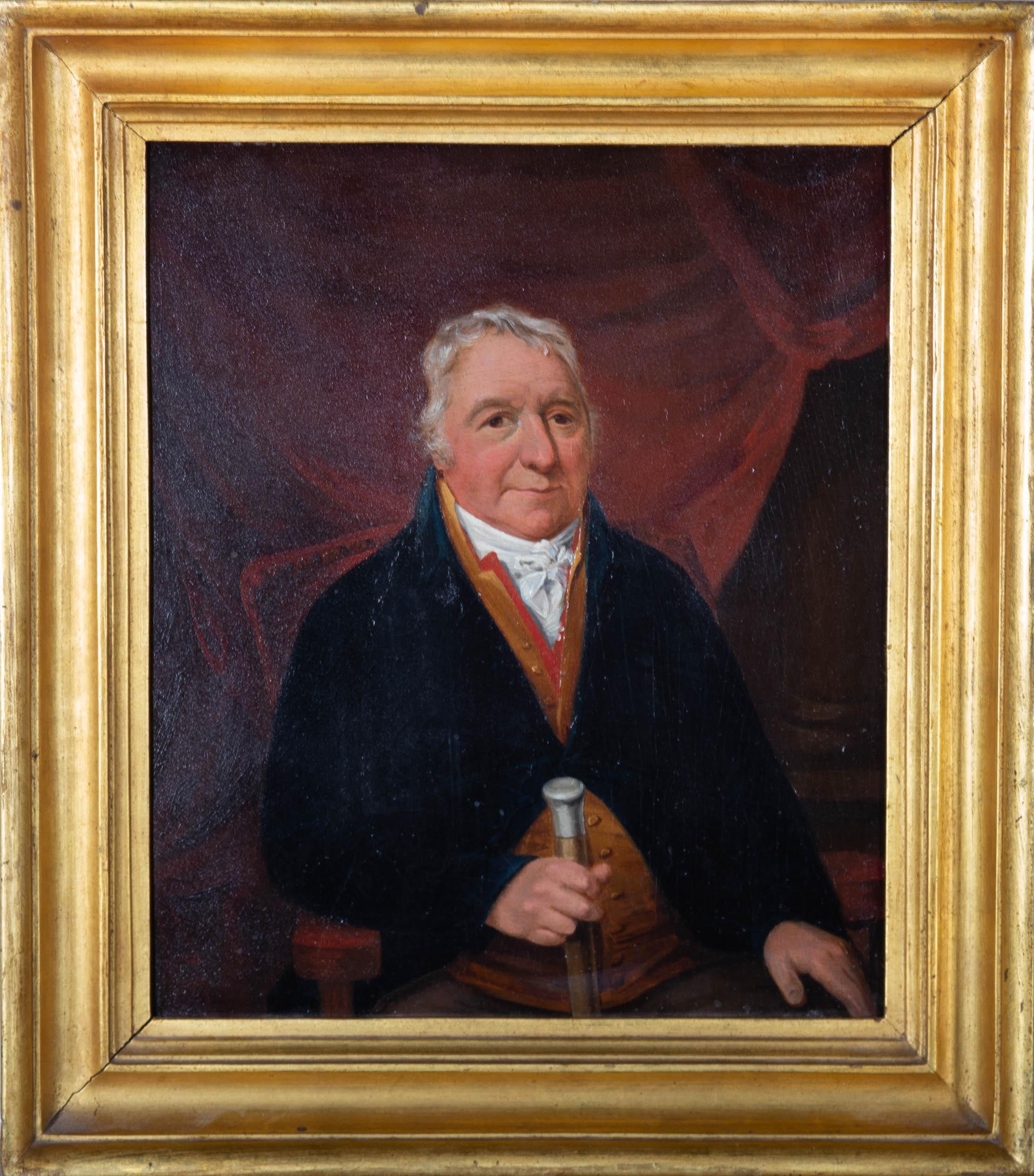
Henry Wyatt (1794-1840) - 1817 Oil, Georgian Gentleman
By Henry Wyatt
Located in Corsham, GB
A truly exquisite example of Georgian portraiture, this characterful painting is in remarkable condition, an overall, beautiful, historical object. The painting, by the renowned Henry Wyatt, shows the sitter (S. S. Lloyd Esquire), in a red high backed chair in front of luxurious red velvet drapery...
Category
Early 19th Century Portrait Paintings
Materials
Oil
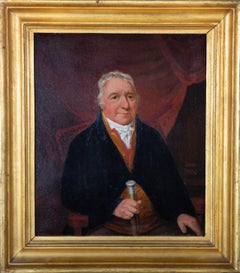
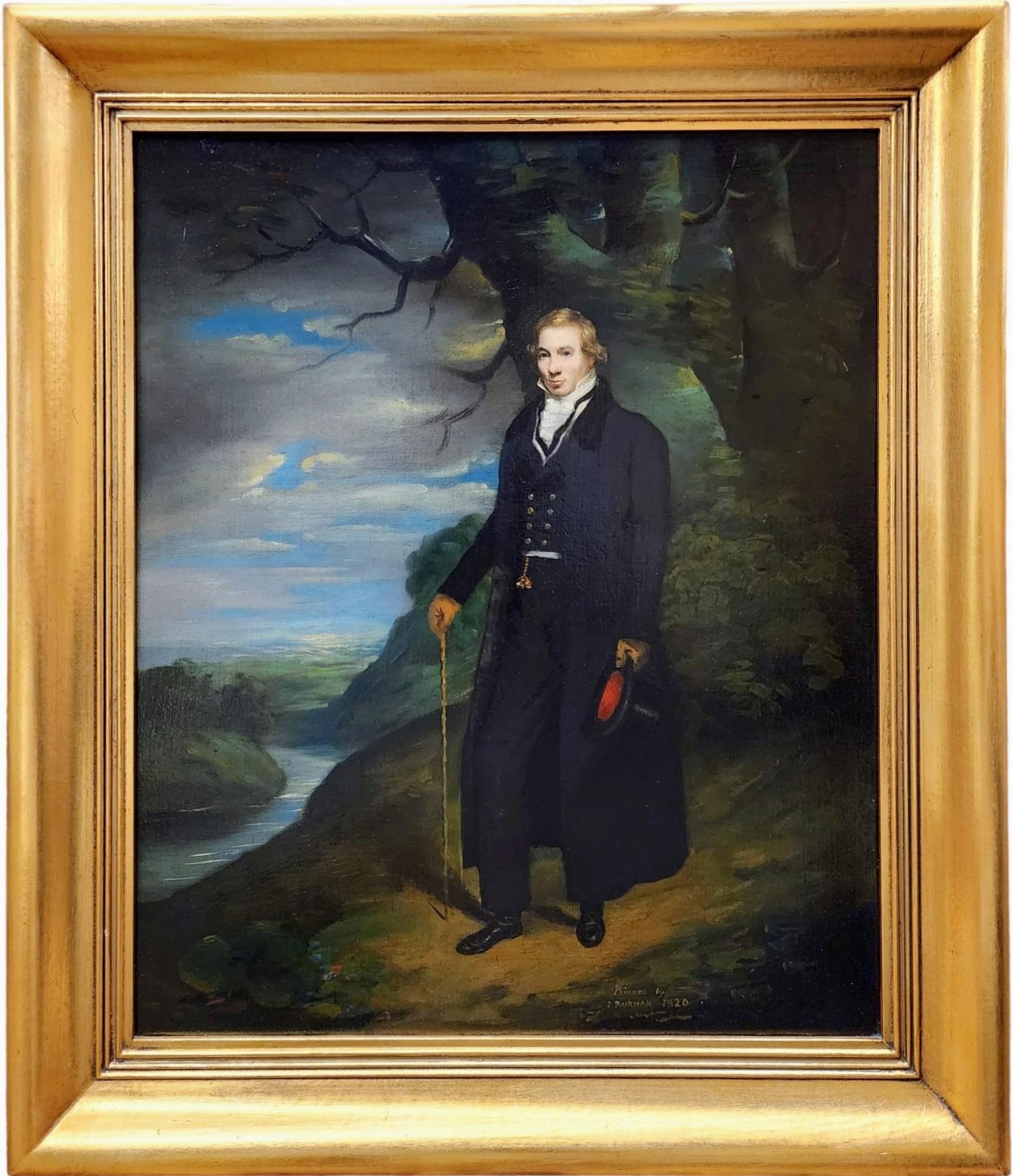
Portrait of a Gentleman in a Landscape, Scottish Portraiture, Portrait, Wealthy
Located in Grand Rapids, MI
John Pairman (Scottish, 1788 - 1843)
Signed: J Pairman 1820 (Lower, Right)
" Portrait of a Gentleman ", 1820
Oil on Canvas
22 1/4" x 18 5/8"
Housed in a 2 3/4" Husar Frame
Ove...
Category
Early 19th Century Portrait Paintings
Materials
Canvas, Oil