Items Similar to Portrait of a Lady White Silk Dress
Red Drapery, Signed Dated 1739 Vanderbank
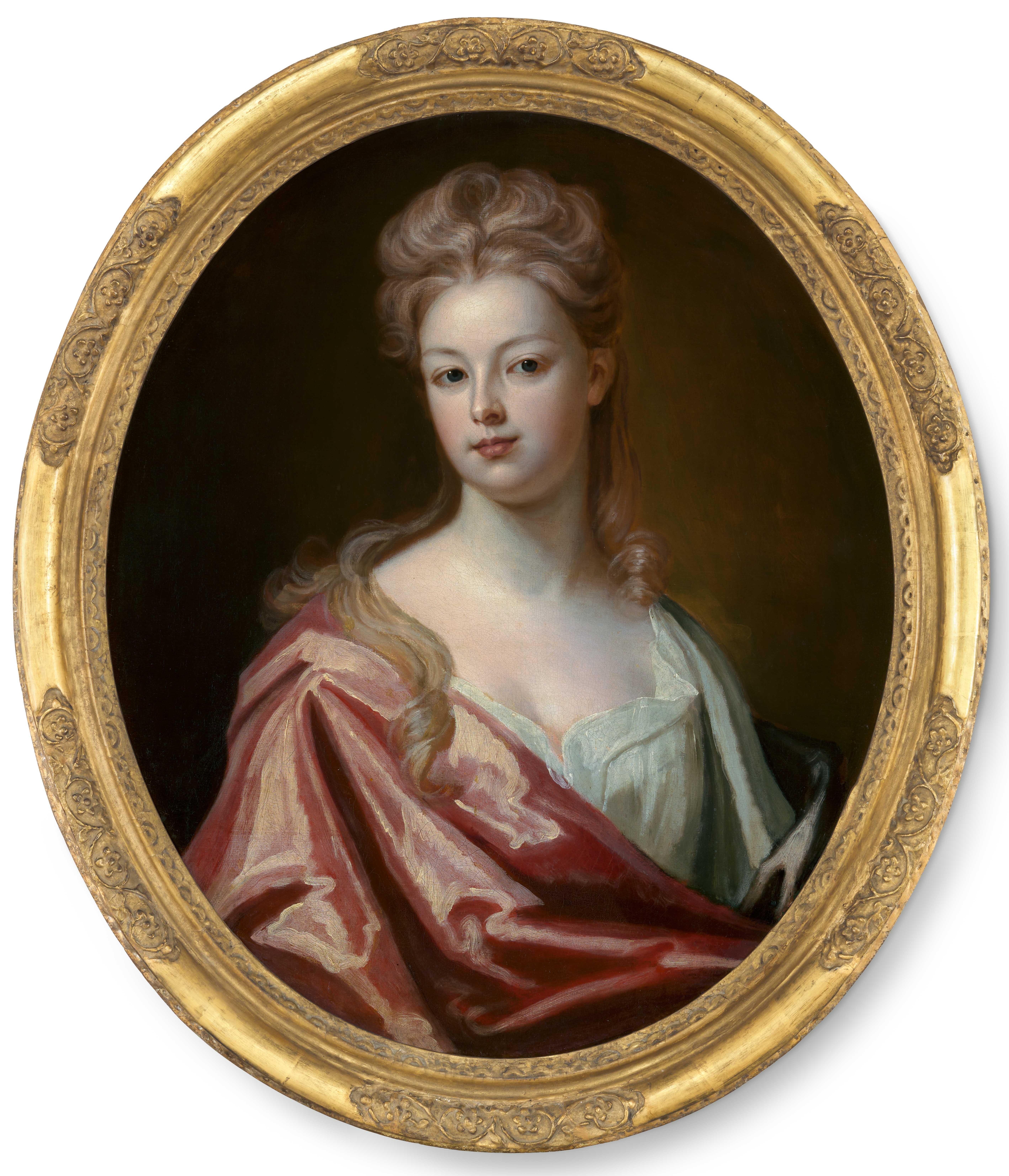
Want more images or videos?
Request additional images or videos from the seller
1 of 12
John VanderbankPortrait of a Lady White Silk Dress
Red Drapery, Signed Dated 1739 VanderbankSigned and Dated 1739
Signed and Dated 1739
$29,284.05
£21,250
€24,865.56
CA$40,077.42
A$43,640.50
CHF 23,088.13
MX$526,287.83
NOK 293,760.02
SEK 268,558.46
DKK 185,706.27
About the Item
Portrait of a Lady in an White Silk Dress
Red Drapery
Signed and Dated 1739
John Vanderbank (1694–1739)
This is an exceptional, rare, and highly desirable late work by John Vanderbank, an artist who was amongst the leading native portraitists of early Georgian London. Presented by Titan Fine Art, this signed and dated 1739 work—the final year of the artist’s life - is preserved in notably fine condition. Ambitious in scale and refined in execution, it combines the best qualities sought in early Georgian portraiture: a commanding, life-present sitter, virtuoso handling of satin and jewels, and an eloquent visual programme that communicates lineage, rank, and cultivated identity with quiet assurance.
The sitter is shown three-quarter length, seated within a softly idealised landscape. Vanderbank’s mature portrait language is strongly evident: the balance of grandeur and intimacy, the confident drawing of hands, and the controlled use of tonal contrast to create a vivid sense of presence. The face is modelled with restraint and warmth; the eyes engage directly, and the expression is self-possessed rather than theatrical—an image of assured social standing. The landscape is not a literal topography but a refined estate-coded setting: a cultivated outdoor world that signals leisure, property, and the values of landed life.
The costume aligns precisely with the late 1730s and supports the inscribed date of 1739. The white silk gown is an expensive and socially legible choice: white silk was luxurious, difficult to keep pristine, and therefore a direct signal of wealth, leisure, and refined household command. The bodice is cut low and edged with lace; sleeves are finished with lace engageantes, consistent with elite London fashion of the period.
Across her lap and shoulder falls a generous sweep of red silk drapery, painted with bravura understanding of satin’s reflective surface—one of the areas in which Vanderbank excelled. This red is not merely decorative; it is a compositional device that warms the palette, flatters the sitter’s complexion, and adds movement and theatrical richness without resorting to overt allegory.
The bodice is fastened down the centre with a striking sequence of diamond-set clasps or jewelled fasteners. Their faceted highlights are placed with deliberate clarity to register as genuine luxury. In early Georgian portraiture, such diamond ornaments were among the most legible markers of rank: jewellery integrated into dress as part of a coherent “courtly” language of refinement.
A key feature of this portrait is the sitter’s right hand, raised to the bodice not to hold anything but to touch the diamond fastenings—a calculated gesture that draws the viewer’s eye to the hand itself. The ring is worn on the little finger and is presented conspicuously, isolated against pale flesh and satin. This is not incidental. The gesture is staged so the ring becomes a primary point of meaning. In eighteenth-century British portraiture, a ring worn on the little finger (pinky ring) often functions differently from a ring placed on the ring finger. A pinky ring in this context reads less as a simple marital announcement (as a ring-finger band might) and more as a marker of rank, lineage, and cultivated elite identity. Here, it is a legible sign of social position—an emblem of inherited distinction or family standing.
The left-hand margin contains a climbing vine with leaves and small blossoms, including blue, bell-shaped flowers, small white blooms, and a single yellow flower as a chromatic accent. Because the sitter does not hold or touch these flowers, they function as environmental symbolism rather than a personal token. Such estate-garden flora supports the portrait’s broader social language: cultivated nature, stability, and continuity—codes closely associated with landed life and aristocratic values. Rather than a sentimental love emblem, this planting reads as an extension of the setting: a quiet visual reinforcement of refinement and cultivated taste, balancing the glitter of diamonds and the sheen of satin with the softness of greenery.
With its ambitious scale, estate-coded landscape, restrained luxury, and the signalling of lineage through a pinky ring—the portrait most strongly suggests a sitter from the landed gentry or minor aristocracy, perhaps a baronet’s or peer’s circle, painted in London at the height of early Georgian fashion. Court-adjacent connections remain plausible (Vanderbank moved in elite spheres), but the image does not insist upon court office or royal household identity. Instead, it projects secure rank and long-term dynastic standing rather than transition or achievement.
Her likely life would have centered on estate sociability, household governance, and family continuity, with portraiture serving as a tool of lineage-making—an image intended for prominent display within a country-house interior. By the late 1730s, portraiture sat at the centre of elite self-fashioning. Large oil portraits were statements of legitimacy and taste, designed to anchor the visual genealogy of a family. Vanderbank’s clientele sought precisely what this picture offers: aristocratic ease, fashionable splendour, and a convincing expression of permanence.
The national moment adds a compelling dimension. 1739 saw Britain entering conflict with Spain (the War of Jenkins’ Ear), a period of rising imperial tension. The painting thus becomes a quietly potent artefact of Georgian identity—serene self-possession set against a changing world.
While the signature and date provide direct evidence of authorship (“Jn Vanderbank / fecit 1739”), the stylistic case is equally persuasive. Vanderbank’s mature manner is visible in the luminous modelling of pink/blue flesh (Vanderbank excelled in the “bold pigmentation in the flesh where pink tones are painted thinly over cooler greys to suggest glowing skin”), the controlled brilliance of satin and jewels, and the sophisticated staging of the sitter against landscape. The hands—often the test of an artist—are elegantly drawn and confidently painted. The overall harmony, the interplay of cool whites and warm pinks, and the integrated refinement of figure and setting align with Vanderbank’s best late work.
The portrait likely descended within the sitter’s family until the early 20th century. In the nineteenth century it was in the collection of the well-known Bond Street dealer Eugene Benjamin of 168 New Bond Street, London (earlier, of 169 New Bond Street), active in the trade of works of art and high-quality decorative objects. Following his death, Christie, Manson
Woods dispersed his entire stock in November 1898 in a substantial multi-day auction. The reverse of the painting (on the stretcher) preserves the Christie’s inventory stencil “476 W” and handwritten chalk date “Nov. 23–98” consistent with this sale. These archival graffiti confirm that our portrait was in the 1898 sale and has remained on its original stretcher since that time, adding documentary interest beyond the front-facing image.
Benjamin’s standing in the trade is evidenced by the scale and success of his estate sale. The fact that Christie's devoted a multi-day auction to liquidating his stock, and that it drew nearly £8,000 in 1898, speaks to his reputation and the quality of objects he dealt in. Little is published about Benjamin’s personal life; he was likely in his forties at the time of his death, and his enterprise may have been a family business (indeed, records show a Joseph Benjamin – possibly a relative – and Eugene Benjamin together executing a will in the 1880s, hinting at family ties in the antiques trade).
The fine carved and gilded eighteenth-century frame is richly ornamented with scrolling foliage and executed with a quality appropriate to an elite commission.
This portrait stands apart for its completeness and clarity: a late, signed, dated Vanderbank of 1739, preserved in fine condition, fine gilded frame, with meaningful verso evidence and a provenance rooted in the historic Bond Street trade. Its subtle iconography is especially compelling: the sitter’s staged hand gesture presents a pinky ring not as a sentimental flourish but as a confident signal of lineage and rank, while the garden vine underscores cultivated estate identity. This is an unusually vivid statement of early Georgian aristocratic self-fashioning.
John Vanderbank was among the most gifted and ambitious English portrait painters of the early Georgian period. Born in London in 1694 into an artistic family—his father was a tapestry-weaver and engraver of Flemish descent—he received early training in draughtsmanship before entering the studio and academy of Sir Godfrey Kneller, the dominant portraitist in England at the turn of the eighteenth century. There, Vanderbank absorbed the grand manner of court portraiture while developing a more vivid, painterly approach to colour and form.
By the late 1710s, Vanderbank had established himself independently and was producing large-scale portraits for elite patrons including Sir Isaac Newton and Queen Caroline.
In 1720, Vanderbank co-founded a pioneering drawing academy in St Martin’s Lane. The academy placed a strong emphasis on life drawing from nude models, including female models—an advanced and controversial practice in Britain at the time. This academy played a crucial role in the development of professional artistic training in London and helped lay the groundwork for later institutions, including the St Martin’s Lane Academy associated with Hogarth and, ultimately, the Royal Academy.
Despite his artistic success, Vanderbank repeatedly fell into debt; these difficulties curtailed his productivity and prevented him from consolidating the position his talent warranted. He died prematurely in December 1739, aged only forty-five, likely of consumption. Although his career was shortened, Vanderbank is now recognised as one of the most accomplished native English portraitists of his generation—an artist who bridged the world of Kneller and the later achievements of Reynolds, and whose best works, particularly those from his final years, stand among the finest expressions of early Georgian portraiture.
Provenance
With art dealer Mr Eugene Benjamin, of 168 New Bond Street, London;
Posthumous sale of his stock, (four day sale of the entire stock, total 567 items, of which 85 were pictures) Christie's London, 23-26 November 1898 [lot 552], sold to Solomon;
Private collection, Paris, by 2015
Measurements:
Height 144cm, Width 121cm framed (Height 56.75”, Width 47.5” framed)
- Creator:John Vanderbank (1694 - 1739, British)
- Creation Year:Signed and Dated 1739
- Dimensions:Height: 56.7 in (144 cm)Width: 47.64 in (121 cm)Depth: 2.76 in (7 cm)
- Medium:
- Movement Style:
- Period:
- Condition:The condition is very good and can be hung and enjoyed immediately. The painting has passed a strict condition assessment by a professional conservator prior to going on sale.
- Gallery Location:London, GB
- Reference Number:1stDibs: LU1199117427952
John Vanderbank
John Vanderbank (9 September 1694 – 23 December 1739) was an English painter who enjoyed a high reputation during the last decade of King George I's reign and remained in high fashion in the first decade of King George II's reign. George Vertue's opinion was that only intemperance and extravagance prevented Vanderbank from being the greatest portraitist of his generation, his lifestyle bringing him into repeated financial difficulties and leading to an early death at the age of only 45. John Vanderbank first studied composition and painting under his father and then the painter Jonathan Richardson, before becoming one of Sir Godfrey Kneller's earliest pupils in 1711 at his art academy in Great Queen Street, neighbouring his father's tapestry workshop. After Sir James Thornhill took over from Kneller in 1718, Vanderbank continued his studies there for two years before founding an academy of his own in 1720.
About the Seller
5.0
Vetted Professional Seller
Every seller passes strict standards for authenticity and reliability
Established in 1998
1stDibs seller since 2019
45 sales on 1stDibs
- ShippingRetrieving quote...Shipping from: London, United Kingdom
- Return Policy
More From This Seller
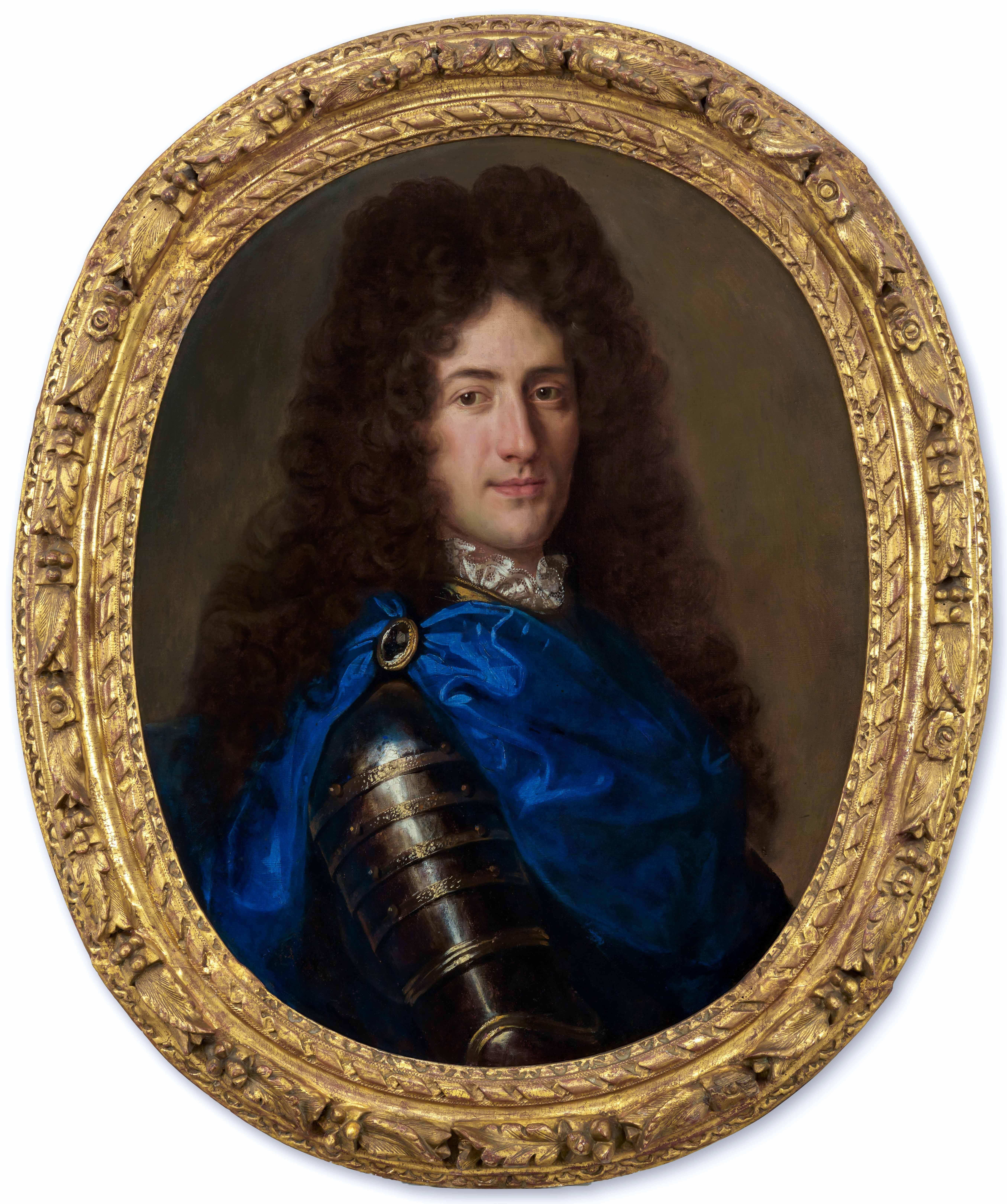
View AllPortrait Gentleman Armour, Blue Cloak, Diamond Brooch c.1700 French Carved Frame
By Joseph Vivien
Located in London, GB
Portrait of a Gentleman in Armour and Azure Cloak with Diamond Brooch c.1700
Attributed to Joseph Vivienne (1657-1735)
The sitter in this superb portrait, offered by Titan Fine Art...
Category
17th Century Old Masters Portrait Paintings
Materials
Oil, Cotton Canvas
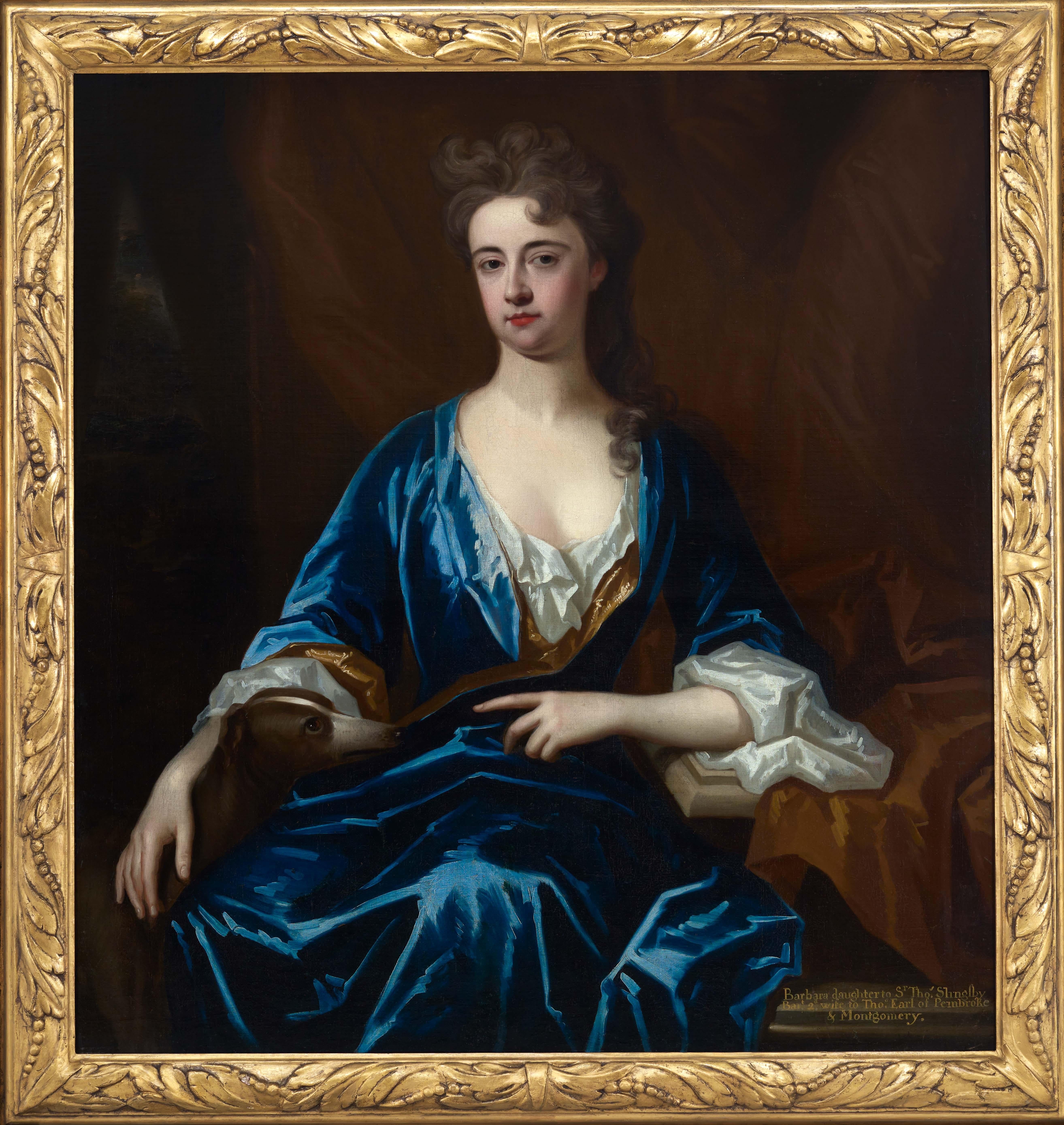
Portrait of Lady, Barbara Herbert, Countess of Pembroke c.1708, Large Painting
Located in London, GB
Portrait of Barbara Herbert, Countess of Pembroke c.1708
Charles d’Agar (1669-1723)
This magnificent large-scale portrait, presented by Titan Fine Art, depicts the British court of...
Category
17th Century Old Masters Portrait Paintings
Materials
Cotton Canvas, Oil
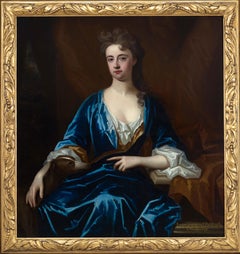
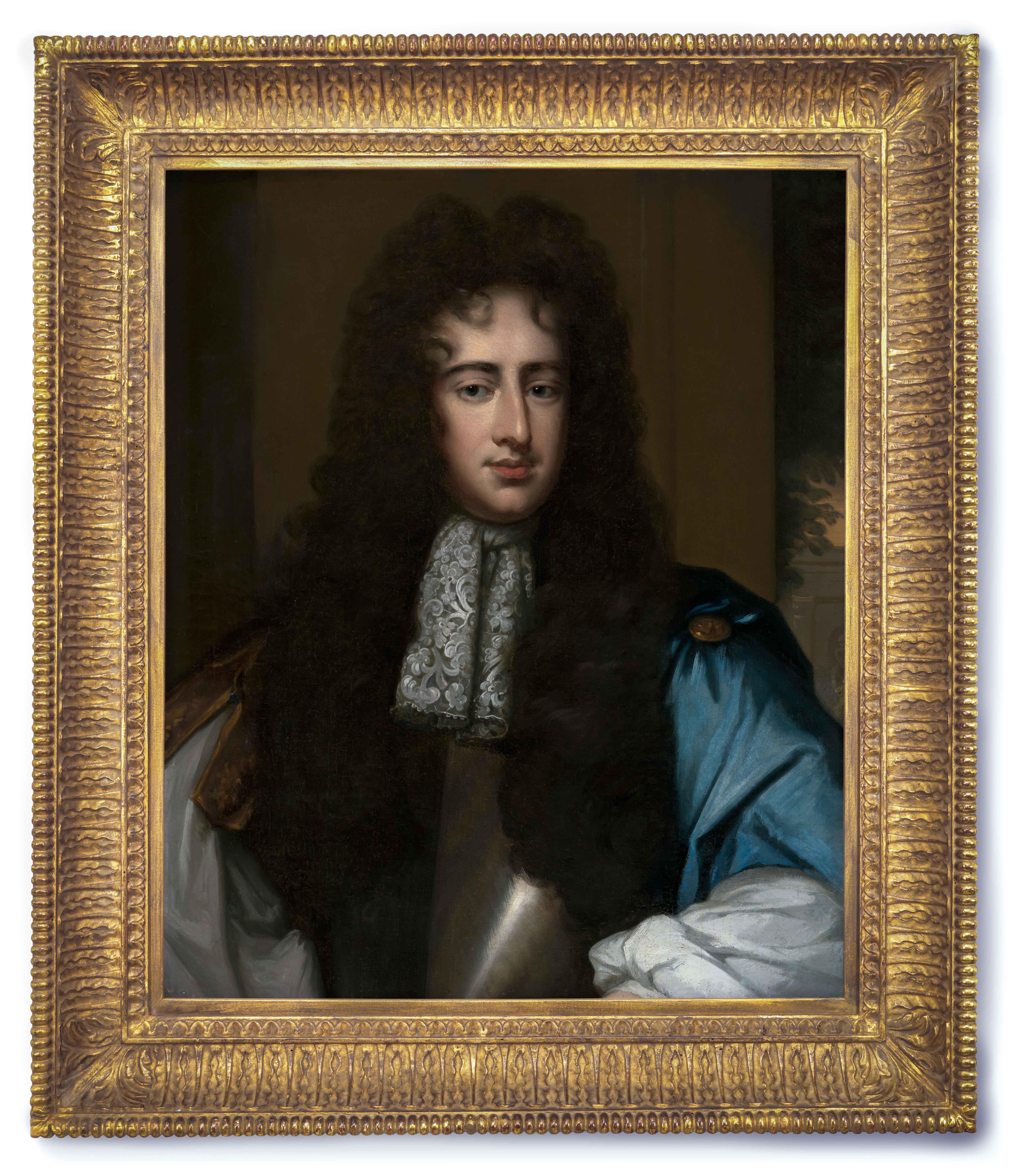
Portrait of Gentleman, Sir Henry Hobart, Blue Cloak
cravat, Wissing oil canvas
By Willem Wissing
Located in London, GB
Portrait of a Gentleman, Sir Henry Hobart Blue Cloak and cravat c.1683-1684
Attributed to Willem Wissing (1656-1687)
This impressive portrait, presented by Titan Fine Art, depicts t...
Category
17th Century Old Masters Portrait Paintings
Materials
Cotton Canvas, Oil
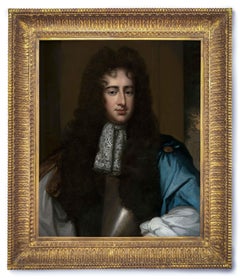
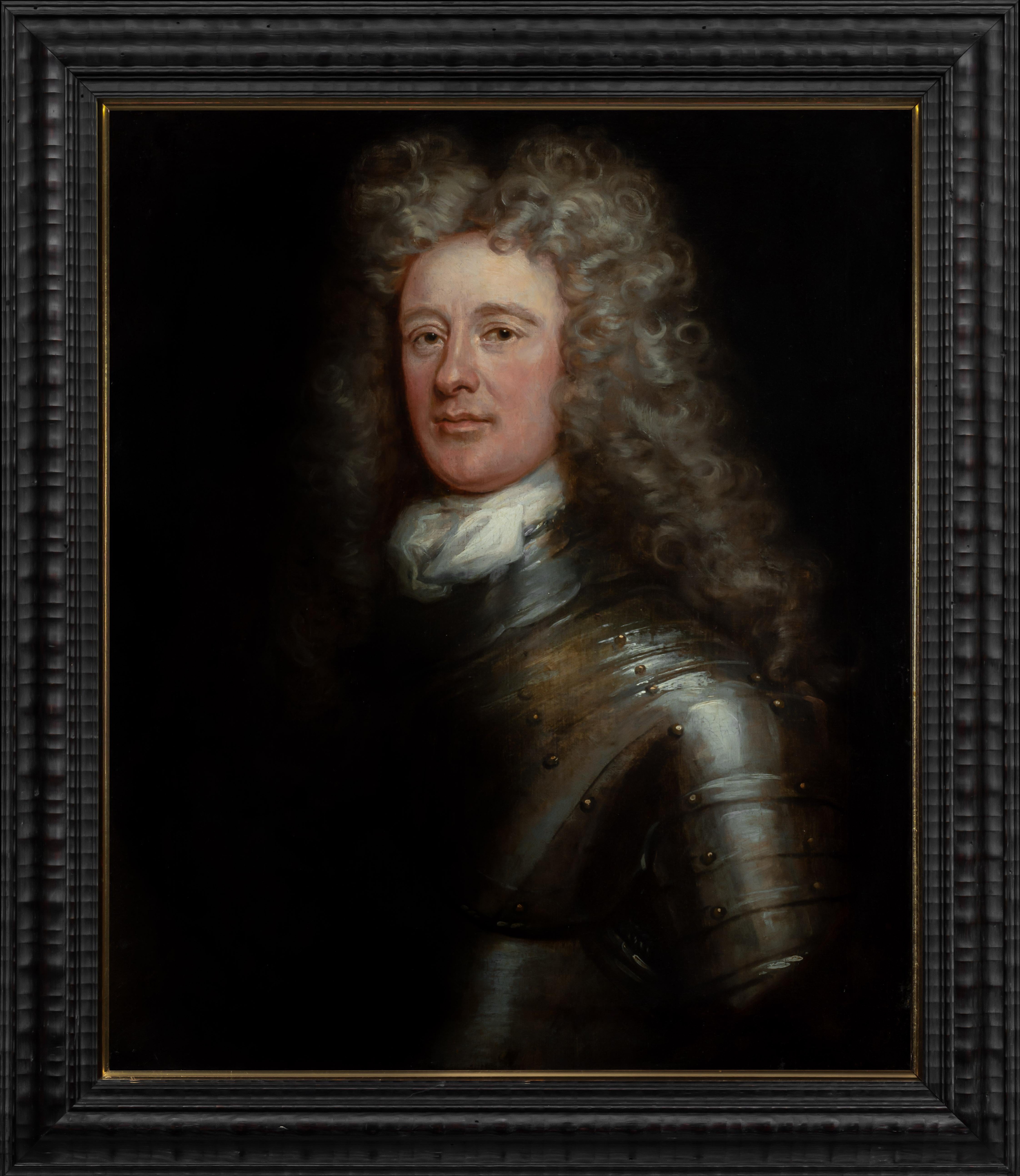
Portrait of a Gentleman, David Erskine, 13th Laird of Dun, Wearing Armour c.1700
Located in London, GB
The gentleman in this exquisite oil on canvas portrait, presented by Titan Fine Art, is shown with the grandiloquence characteristic of the English School of painting. He is portray...
Category
17th Century Old Masters Portrait Paintings
Materials
Oil, Canvas
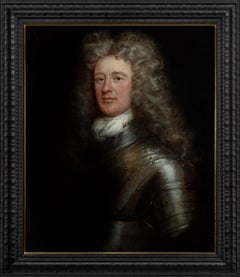
Portrait of a Lady, Mrs Wray in a Silk Dress
Pink Wrap c.1698, Oil on canvas
By Michael Dahl
Located in London, GB
Portrait of a Lady, Mrs Wray in a Silk Dress & Pink Wrap c.1698
Circle of Michael Dahl (1659-1743)
This delightful work, presented by Titan Fine Art, is a fine example of British po...
Category
17th Century Old Masters Portrait Paintings
Materials
Cotton Canvas, Oil
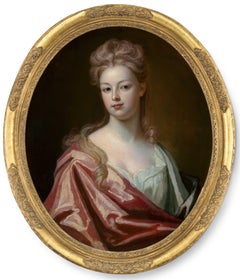
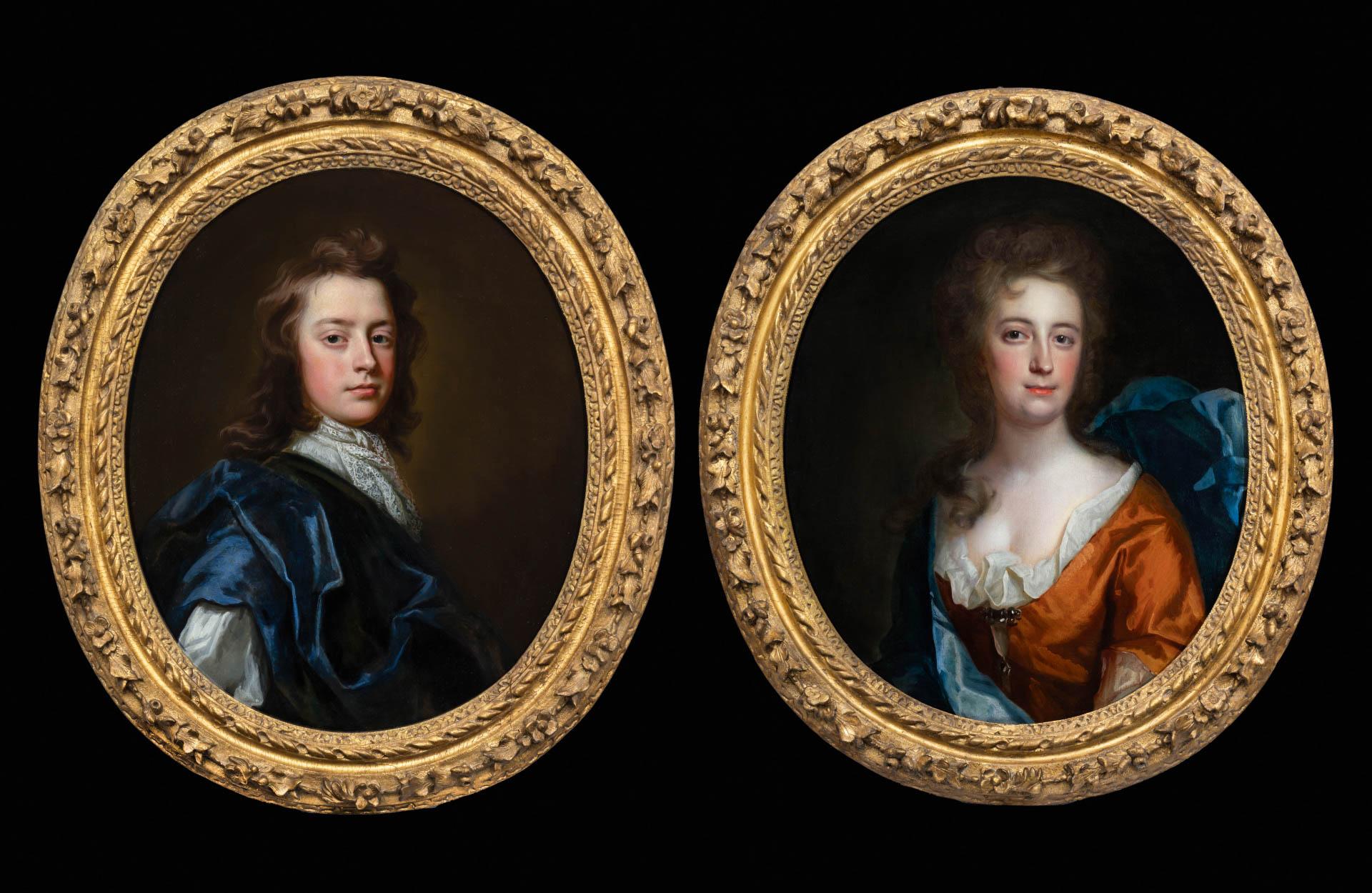
Portrait of Gentleman in blue, Portrait of Lady, oval pair Fine Carved Frames
Located in London, GB
Portrait of a Gentleman with Blue Cloak and Portrait of a Lady in Russet Dress c.1697
Thomas Murray (1663-1735)
These fascinating portraits are exquisite examples of portraiture in ...
Category
17th Century Old Masters Portrait Paintings
Materials
Oil, Canvas

You May Also Like
Oil Portrait of a Victorian Lady, c. 1850
Located in Chicago, IL
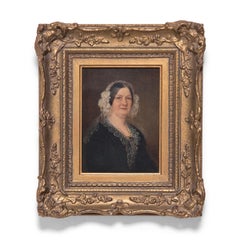
Painted in the 19th century, this exquisite miniature portrait wonderfully exemplifies realism in traditional oil painting. The small artwork is painted in the conventional portraiture style of the Old Masters, and achieves soft realism with fine brushwork and a subdued, neutral palette. The half length portrait depicts a fine Victorian woman dressed in all black with a delicate lace collar and bonnet. She wears a ruby broach...
Category
Mid-19th Century Old Masters More Art
Materials
Oil
European Portrait of a Priest
Located in Milford, NH
A fine European portrait of a priest, oil on canvas, probably dating to the 17th or 18th century, unsigned, with original stretcher, minor surface losses and damage, craquelure, edge...
Category
17th Century Portrait Paintings
Materials
Canvas, Oil

"Army of Snorkelers" - Mirrored Female Swimmer Portrait Painting
Located in West Hollywood, CA
This large horizontal 37 inch high and 76 inch wide original oil painting on canvas is wired and ready to hang. The detail in this artwork is astounding. The crimson red tones make t...
Category
2010s Contemporary Portrait Paintings
Materials
Canvas, Oil

"The Shining 2" - Colorful Female Figurative Swimmer Portrait Painting
Located in West Hollywood, CA
This 36 inch square original oil painting on canvas is wired and ready to hang. The detail in this artwork is astounding. The crimson red tones make the female swimmers portrait real...
Category
2010s Contemporary Portrait Paintings
Materials
Canvas, Oil

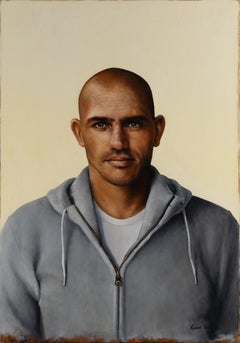
Robert K. White "Kelly Slater" Oil on Canvas, Realist Portrait of Surf Legend
Located in Miami, FL
ROBERT KENNETH WHITE – "KELLY SLATER"
Oil on Canvas ⚜ Hand Signed Lower Right ⚜ Frameless Display
A PORTRAIT OF FOCUS, LEGACY, AND DEPTH
Rendered with near-photographic precision, ...
Category
2010s Realist Portrait Paintings
Materials
Canvas, Oil
Robert K. White "Girl with Red Hair" Signed Oil, Contemporary Realist Portrait
Located in Miami, FL
ROBERT KENNETH WHITE – "GIRL WITH RED HAIR"
Oil on Canvas ⚜ Hand Signed Lower Right ⚜ Frameless Display
A PORTRAIT STUDY OF STRENGTH AND INTROSPECTION
In this emotionally charged p...
Category
2010s Realist Portrait Paintings
Materials
Canvas, Oil