Want more images or videos?
Request additional images or videos from the seller
1 of 10
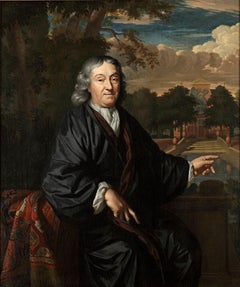
Portrait of VOC Governor Rijcklof van Goens (1619-1682) in 1656 , 37 yrs of age1656
1656
$74,517.83List Price
About the Item
- Attributed to:Jürgen Ovens (1623 - 1678, Danish)
- Creation Year:1656
- Dimensions:Height: 45.28 in (115 cm)Width: 31.5 in (80 cm)Depth: 1.58 in (4 cm)
- Medium:
- Movement Style:
- Period:Mid-17th Century
- Framing:Frame IncludedFraming Options Available
- Condition:
- Gallery Location:Amsterdam, NL
- Reference Number:1stDibs: LU147128029322
About the Seller
No Reviews Yet
Vetted Professional Seller
Every seller passes strict standards for authenticity and reliability
1stDibs seller since 2021
Authenticity Guarantee
In the unlikely event there’s an issue with an item’s authenticity, contact us within 1 year for a full refund. DetailsMoney-Back Guarantee
If your item is not as described, is damaged in transit, or does not arrive, contact us within 7 days for a full refund. Details24-Hour Cancellation
You have a 24-hour grace period in which to reconsider your purchase, with no questions asked.Vetted Professional Sellers
Our world-class sellers must adhere to strict standards for service and quality, maintaining the integrity of our listings.Price-Match Guarantee
If you find that a seller listed the same item for a lower price elsewhere, we’ll match it.Trusted Global Delivery
Our best-in-class carrier network provides specialized shipping options worldwide, including custom delivery.You May Also Like
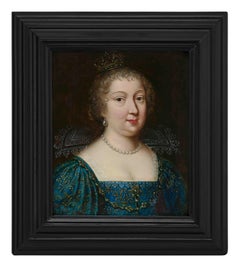
Portrait of Lady, Maria Therese of Spain, Queen of France, 17th Century Panel
Located in London, GB
Portrait of Maria Therese of Spain, Queen of France, 17th Century
Circle of Henri and Charles Beaubrun
Not signed
This distinguished seventeenth-century portrait of Maria Theresa o...
Category
17th Century Old Masters Portrait Paintings
Materials
Oil, Wood Panel
$8,603
H 10.44 in W 9.26 in D 1.19 in
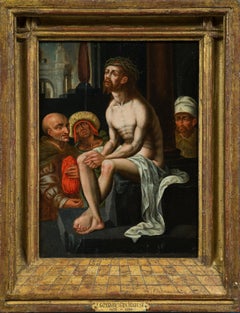
Christ on the Cold Stone – After Jan Gossaert (Mabuse)
Located in Stockholm, SE
This striking devotional image, painted by a follower of Jan Gossaert, represents one of the most influential compositions of the Northern Renaissance: Christ on the Cold Stone, or C...
Category
16th Century Old Masters Figurative Paintings
Materials
Oil, Wood Panel
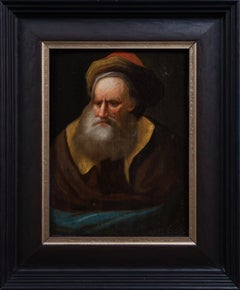
Portrait of an Old Bearded Man
Located in Stockholm, SE
We are pleased to offer a captivating portrait, most likely painted in the late 18th century, attributed to an artist within the circle of Christian Wilhelm Ernst Dietrich. This oil ...
Category
Late 18th Century Old Masters Portrait Paintings
Materials
Oil, Wood Panel
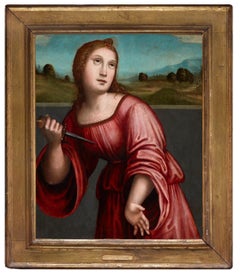
Lucretia, by Giacomo Raibolini Francia. Detto il Francia. Oil on panel, framed
Located in New York, NY
Giacomo used to paint with his brother Giulio, identifying their works with the monogram «I I». The strong influence of his father, Francesco, is undeniable in all his works, althoug...
Category
16th Century Old Masters Figurative Paintings
Materials
Oil, Wood Panel
$18,000
Free Shipping
H 25.6 in W 19.3 in D 1.19 in
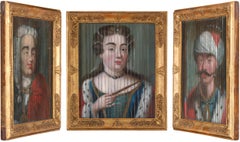
Tri-Directional Portrait Commemorating the Russo-Turkish War
Located in New Orleans, LA
Austrian School
18th Century
Tri-Directional Portrait Commemorating the Russo-Turkish War
Oil on wooden strips
This extraordinary tri-directional portrait exemplifies the rare innovation known as a triscenorama, capturing a pivotal diplomatic moment through ingenious artistic technique. Employing triangularly cut wooden strips, this remarkable work simultaneously depicts three imperial figures central to the Russo-Turkish War of 1735-1739: Empress Anna Ivanovna Romanova of Russia when viewed directly, Holy Roman Emperor Charles VI from the left and Ottoman Sultan Mahmud I from the right, commemorating the Treaty of Nissa that concluded this significant European conflict.
The portrait utilizes an exceptionally rare optical technique that predates modern movable imaging technology. When observed from different angles, the painted triangular wooden strips create a transformative effect, revealing entirely different imperial portraits as the viewer shifts position. The precision required to execute such a work demonstrates remarkable technical mastery, as the artist had to conceptualize three distinct portraits as well as the meticulous arrangement of the panels. This sophisticated manipulation of perspective creates an interactive viewing experience considered revolutionary for its time.
Almost certainly created by an Austrian artist, this diplomatic artwork likely served as a commemorative piece marking the Treaty of Nissa, signed in September 1739. The treaty concluded Russia's ambitious campaign to secure access to the Black Sea while countering Ottoman raids in Ukraine and the Caucasus regions. Given its exceptional quality and historical significance, this portrait was possibly commissioned by Emperor Charles VI himself, potentially serving as a diplomatic gift to either Empress Anna or Sultan Mahmud I during the treaty negotiations.
Under Empress Anna's leadership, Russia sought to counter devastating raids from Ottoman allies, particularly the Crimean Tatars...
Category
18th Century Old Masters Portrait Paintings
Materials
Wood, Oil, Wood Panel
$148,500
H 18.88 in W 15.88 in D 2 in
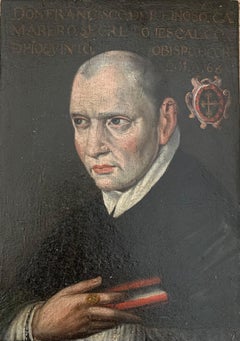
Spanish school. Secretary of Pope Pius V, abbot of Husillos, bishop of Córdoba.
Located in Firenze, IT
Portrait of Francisco de Reynoso y Baeza.
Secretary of Pope Pius V, abbot of Husillos and bishop of Córdoba. Francisci de Reynoso.
Early 17th century.
Small-format portrait from the late Renaissance period.
Spanish school.
Size: Cm 19 x Cm 13.5
Oil on wooden panel.
On the back the fine tablet is strengthened (already in ancient times) by a sheet of parchment.
About 1600-1610.
As often in Mannerist / Late Renaissance portraits, the image of the character is accompanied by the writing that runs at the top, adding a celebratory, historicising touch to the effigy. Let's bring back the sentence here:
DON FRANCISCO DE REINOSO. CAMARERO SECRETO IESCALCO PIO QUINTO OBISCOPO CORDOBA. 68 (? O 7?)
(1534, Autillo de Campos, Spain - 1601, Córdoba)
Francisco de Reynoso was a Spanish cleric, chief chamberlain, and secretary to Pope Pius V, abbot of Husillos, and bishop of Córdoba.
He was the fourth of eleven children. His father was the seventh Lord of Autillo de Campos, and his mother was Juana de Baeza y de las Casas, daughter of Manuel de Baeza, a lawyer of the Royal Council and at the Court of Valladolid.
Francisco de Reynoso was deeply devoted to the Virgin Mary and showed a strong inclination toward religion and piety from an early age.
He studied Latin, arts, and theology at the University of Salamanca.
In 1562, he traveled to Rome with his brothers Pedro and Luis.
In January 1566, following the death of Pope Pius IV, Cardinal Antonio Michele Ghislieri was elected pope, becoming Pius V. From this period until Ghislieri's death in 1572, Francisco de Reynoso served as his chief chamberlain and secretary.
After Pope Pius V died, Francisco de Reynoso returned to Spain and lived for several years in the city of Palencia, where his brother Manuel was a canon.
He supported the Society of Jesus when it was established in Palencia, providing alms to the school's clergy and funding chairs of Letters and Theology at his own expense, as well as donating a significant number of books.
During the brief outbreak of the Black Plague...
Category
17th Century Old Masters Portrait Paintings
Materials
Parchment Paper, Oil, Wood Panel
$1,538 Sale Price
20% Off
Free Shipping
H 7.49 in W 5.32 in
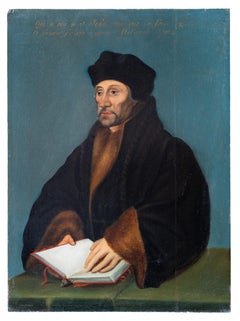
Erasmus of Rotterdam
By English School
Located in GB
Hans Holbein the Younger (1497/98 – 1543) was one of the greatest painters of the Northern Renaissance. Born in Augsburg, Germany, he was the son of Hans Holbein the Elder, also a pa...
Category
19th Century Old Masters Portrait Paintings
Materials
Oil, Wood Panel
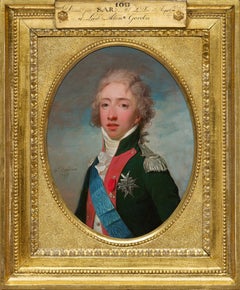
Two royal portraits (the Duc d
Angoulême and the Duc de Berry) by H.P. Danloux
Located in PARIS, FR
These two royal portraits are a major historical testimony to the stay of the Comte d'Artois (the future Charles X) and his family in Edinburgh in 1796-1797. Given by the sitters to Lord Adam Gordon, the Governor of Edinburgh, and kept by family descent to this day, these two portraits provide us with a vivid and spontaneous image of the Duc d’Angoulême and his brother the Duc de Berry. Danloux, who had emigrated to London a few years before, demonstrate his full assimilation of the art of British portrait painters in the brilliant execution of these portraits.
1. Henri-Pierre Danloux, a portraitist in the revolutionary turmoil
Born in Paris in 1753, Henri-Pierre Danloux was first a pupil of the painter Nicolas-Bernard Lépicié (1735 - 1784) and then, in 1773, of Joseph-Marie Vien (1716 - 1809), whom he followed to Rome when, at the end of 1775, Vien became Director of the Académie de France. In Rome he became friends with the painter Jacques-Louis David (1748 - 1825).
Returning to France around 1782, he settled in Lyon for a few years before returning to Paris in 1785. One of his first portraits was commissioned by the Baroness d'Etigny, the widow of the former Intendant of the Provinces of Gascony, Bearn and Navarre Antoine Mégret d'Etigny (1719 – 1767). He then became close to his two sons, Mégret de Sérilly and Mégret d'Etigny, who in turn became his patrons. In 1787, this close relationship with the d'Etigny family was further strengthened by his marriage to Antoinette de Saint-Redan, a relative of Madame d'Etigny. After his marriage, he left for Rome and did not return to France until 1789. It was during the winter of 1790-1791 that he painted one of his masterpieces, the portrait of Baron de Besenval. Set in a twilight atmosphere, this portrait of an aristocrat who knows that his death is imminent symbolizes the disappearance of an erudite and refined society which would be swept away by the French Revolution.
The Jacobin excesses led Danloux to emigrate to England in 1792; many members of his family-in-law who remained in France were guillotined on 10 May 1794. Danloux enjoyed great success as a portrait painter in England before returning to France in 1801.
During his stay in England, Danloux was deeply under the influence of English portraitists: his colors became warmer (as shown by the portrait of the Duc d'Angoulême that we are presenting), and his execution broader.
2. Description of the two portraits and biographical details of the sitters
The Duc d'Angoulême (1775-1844) was the eldest son of the Comte d'Artois, the younger brother of King Louis XVI (the future King Charles X), and his wife Marie-Thérèse of Savoie. He is shown here, in the freshness of his youth, wearing the uniform of colonel-general of the "Angoulême-Dragons" regiment.
He is wearing the blue cordon of the Order of the Holy Spirit, which was awarded to him in 1787, and two decorations: the Cross of Saint-Louis and the Maltese Cross, as he was also Grand Prior of the Order of Malta.
Born on 16 August 1775 in Versailles, Louis-Antoine d'Artois followed his parents into emigration on 16 July 1789. In 1792, he joined the émigrés’ army led by the Prince de Condé. After his stay in Edinburgh (which will be further discussed), he went to the court of the future King Louis XVIII, who was in exile at the time, and in 1799 married his first cousin Marie-Thérèse Charlotte of France, the daughter of Louis XVI and the sole survivor of the royal family. The couple had no descendants. He became Dauphin of France in 1824, upon the accession to the throne of his father but played only a minor political role, preferring his military position as Grand Admiral. Enlisted in Spain on the side of Ferdinand VII, he returned home crowned with glory after his victory at Trocadero in 1823.
He reigned for a very short time at the abdication of Charles X in 1830, before relinquishing his rights in favor of his nephew Henri d'Artois, the Duc de Bordeaux. He then followed his father into exile and died on 3 June 1844 in Gorizia (now in Italy).
His younger brother, the Duc de Berry, is shown in the uniform of the noble cavalry of the émigrés’ Army. He is wearing the blue cordon of the Order of the Holy Spirit, awarded to him in May 1789, and the Cross of Saint-Louis (partly hidden by his blue cordon).
Born on 24 January 1778 in Versailles, Charles-Ferdinand d'Artois also followed his parents into emigration and joined the émigrés’ army in 1792. After his stay in Edinburgh, he remained in Great Britain, where he had an affair with Amy Brown...
Category
1790s Old Masters Portrait Paintings
Materials
Canvas, Oil, Wood Panel
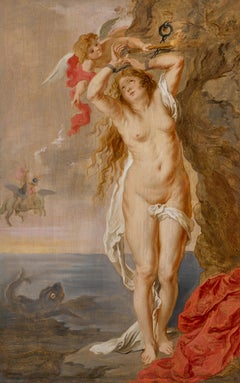
Perseus and Andromeda
By David Teniers the Younger
Located in Paris, Île-de-France
DAVID TENIERS THE YOUNGER (1610–1690)
Perseus and Andromeda
Oil on panel
42.5 × 26.7 cm (16³⁄₄ × 10¹⁄₂ in.)
Unsigned
Provenance
• Possibly Archduke Leopold Wilhelm of Habsburg (16...
Category
1650s Old Masters Nude Paintings
Materials
Oil, Panel, Wood Panel
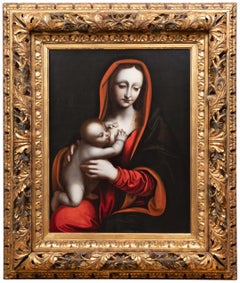
Virgin with Child, studio of Giampietrino (Milano 1495-1550), 16th century Italy
Located in PARIS, FR
Virgin with Child,
studio of Giovanni Pietro Rizzoli, known as Giampietrino (active Milan 1495-1550)
Not signed
Oil on poplar panel, h. 63 cm (24.8 in), w. 49 cm (19.29 in)
Important...
Category
16th Century Old Masters Figurative Paintings
Materials
Oil, Wood Panel
$35,936
H 37 in W 31.1 in
More From This Seller
View AllMale and female portrait, both in silk kimono, possibly textile dealers
By Christoffel Lubieniecki
Located in Amsterdam, NL
CHRISTOFFEL LUBIENIECKI (1659-1729)
Pair of portraits of a gentleman and a lady, both in silk kimono, before a country house (circa 1680)
Indistinctly signed “C.......” on a box under the man’s left hand
Oil on canvas, 79.5 x 67 cm each
Both sitters are portrayed wearing a silk “Japanese” coat. During the second half of the seventeenth the Japanese silk coat, an adapted Japanese kimono, became a real vogue in the Dutch elite. The exclusive Dutch trade contacts with Japan can explain the popularity of the kimono-style silk coats in the Netherlands. Everybody who could afford one, dressed in such a fashionable and comfortable coat and, like the present sitters, some proud owners had themselves portrayed in a “Japanese” coat often together with an oriental carpet to underline their standing and international connections. These portraits are the work of the Polish-born portraitist Christoffel Lubieniecki (also known as Lubienitski, Lubinitski or Lubiniecki)
Lubieniecki was first trained in Hamburg under Julian Stuhr and after 1675 in Amsterdam under Adriaen Backer and Gerard de Lairesse. He specialized in landscapes, generally of an Italianate character, and in portraits. The loving execution of these contented burghers, enjoying the garden vistas of their country house, places him alongside Amsterdam portraitists such as Constantijn Netscher and Michiel van Musscher...
Category
1680s Old Masters Portrait Paintings
Materials
Canvas, Oil
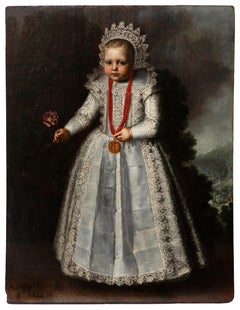
Portrait of a girl with a rose and a red coral necklace (c. 1631)
Located in Amsterdam, NL
David Finsonius (Veere 1597- Bergen op Zoom 1646/1648)
Portrait of a girl with a rose and a red coral necklace
With traces of the artist’s signature and annotated AETATIS S.V. 2 1⁄2 Ao 1631
Oil on panel, H. 104.5 x 79.5 cm
Provenance:
Purchased by Jonkheer Helenus Marius Speelman (1857-1909), Kasteel de Wittenburg; thence by
descent
The work shows a strong resemblance to a portrait by Finsonius in the North Brabant Museum. This
signed and dated "Girl with Basket and Cherries" (Inv. 15529), was painted just a year later, in 1632.
Not only are the paintings remarkably similar in overall size and format, in painting style, and in the
positioning of the girls in full length in their white lace dresses. They are also connected by the
iconographic scheme of the respective coral necklaces, each with a gold memorial medal hanging
from it. Although they are of course individuals, the faces are very similar in their depictions of
features such as eyes, nose, and lips. This points to the same technique applied by the same painter.
Finally, the handwriting is almost the same on the works by Finsonius known so far.
About the painter, David Finson named 'Finsonius' (related to the better-known Louis Finson...
Category
17th Century Dutch School Portrait Paintings
Materials
Oil, Wood Panel
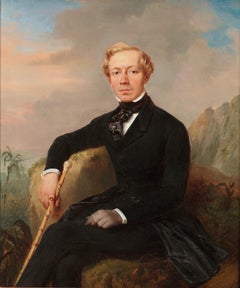
Self-portrait in Indonesian Landscape
Located in Amsterdam, NL
Abraham Johannes Romswinckel (1810-1856)
Self-portrait in Indonesian landscape
Inscribed Abr. Joh. Romswinckel, geb. Batavia 17 Oct. 1810, overl...
Category
1820s Romantic Portrait Paintings
Materials
Canvas, Oil
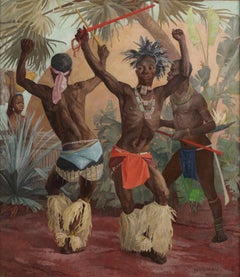
Zulu Dancers
Located in Amsterdam, NL
‘Zulu Dancers’
Signed bottom right Hardman, titled on a sticker at the reverse and with address Walton End, Walton Lane, Bosham, Chichester, and Price 45 gns.
Oil on board, 99 x 87...
Category
20th Century Expressionist Nude Paintings
Materials
Oil, Board
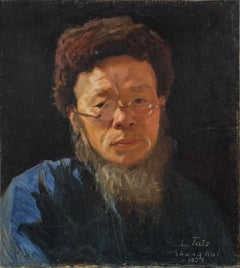
Portrait of a Chinese Man
Located in Amsterdam, NL
Lazlo Tatz (Hungary 1888 - Philippines 1951)
Portrait of a Chinese man
Oil on canvas, H. 50 x W. 44.5 cm
Tatz studied in Budapest and Paris, and in 1931 h...
Category
Early 20th Century Portrait Paintings
Materials
Canvas, Oil
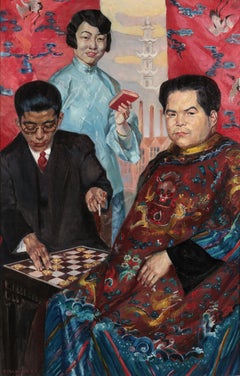
A Chinese Company playing Droughts
Located in Amsterdam, NL
ERWIN BINDEWALD (1897-1950)
Two men playing draughts, a girl with the red book standing behind them
Signed and dated E. Bindewald d.j., 27
Oil on canvas, 140.5 x 90.5 cm
In black and gilt gesso frame.
Note:
Bindewald was born in Charlottenburg. He moved to Berlin in 1914 where he studied till 1924 at the Berliner Kunst Akademie. Bindewald travelled in Europe, but mainly stayed in Germany and certainly never was in China. This painting was made in Europe, presumably in the China Town of Berlin. Bindewald received several commisions in Germany from factory owners who wanted their factories painted inside, usually with workers, as well as outside. In the present painting the sitter on the right seems to be a man with a Manchurian background, wearing the brown coat reserved for the highest aristocracy in China.
In China the black sleeve-ends completely cover the hands, indicating that the high aristocracy does not have to do any manuel labour. This man clearly is not a factory worker but he possibly is the (co)- owner of the factory in the background and as such might need his hands to do at least some writing. The man on the left in the modern Western suit...
Category
1920s Art Deco Portrait Paintings
Materials
Canvas, Oil