Want more images or videos?
Request additional images or videos from the seller
1 of 5
Mario De FerranteSelf Portraitc1930
c1930
$2,400List Price
About the Item
- Creator:Mario De Ferrante (1898 - 1992, American)
- Creation Year:c1930
- Dimensions:Height: 30 in (76.2 cm)Width: 24 in (60.96 cm)
- Medium:
- Movement Style:
- Period:
- Condition:
- Gallery Location:Los Angeles, CA
- Reference Number:Seller: http://www.papillongallery.com/mario_de_ferrante.html1stDibs: LU39103950
About the Seller
5.0
Vetted Professional Seller
Every seller passes strict standards for authenticity and reliability
Established in 1972
1stDibs seller since 2011
409 sales on 1stDibs
Authenticity Guarantee
In the unlikely event there’s an issue with an item’s authenticity, contact us within 1 year for a full refund. DetailsMoney-Back Guarantee
If your item is not as described, is damaged in transit, or does not arrive, contact us within 7 days for a full refund. Details24-Hour Cancellation
You have a 24-hour grace period in which to reconsider your purchase, with no questions asked.Vetted Professional Sellers
Our world-class sellers must adhere to strict standards for service and quality, maintaining the integrity of our listings.Price-Match Guarantee
If you find that a seller listed the same item for a lower price elsewhere, we’ll match it.Trusted Global Delivery
Our best-in-class carrier network provides specialized shipping options worldwide, including custom delivery.You May Also Like
Antique American School Post Impressionist Modern Portrait Framed Oil Painting
Located in Buffalo, NY
Antique American school modernist portrait painting. Housed in a period frame. Measuring 29 by 33 inches overall and 20 by 24 painting alone.
Category
1930s Modern Portrait Paintings
Materials
Canvas, Oil
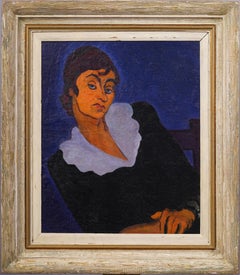
$1,775
H 33 in W 29 in D 2 in
A Ballynakill Woman.
By Gerald Leslie Brockhurst
Located in Storrs, CT
A Ballynakill Woman. c. 1926. Oil on canvas. 30 x 25. Housed in an elegant gold leaf frame. Signed 'Brockhurst' in green paint, in the blanket, lower right. Provenance: Provenance...
Category
Early 20th Century Modern Portrait Paintings
Materials
Oil
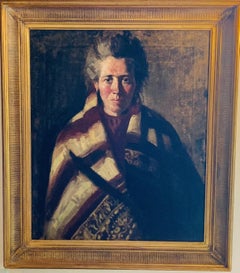
$27,000 Sale Price
40% Off
H 37 in W 33 in D 3.5 in
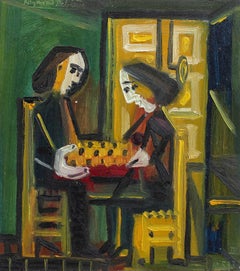
The Chess Match
By Raymond Debieve
Located in London, GB
'The Chess Match', oil on cardstock paper, by Raymond Debiève (1973). Rich colours, bold, painterly brush strokes and an unusual subject for a work of art, Debiève has created this s...
Category
1970s Modern Portrait Paintings
Materials
Oil, Board
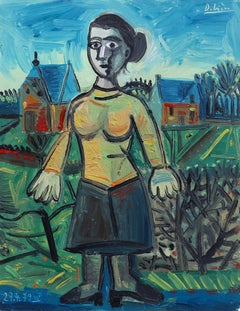
Woman with Yellow Blouse
By Raymond Debieve
Located in London, GB
'Woman with Yellow Blouse', oil on cardstock paper (1979), by Raymond Debiève. Here the artist paints a woman posing in front of her home under a blue sk...
Category
1970s Modern Portrait Paintings
Materials
Paper, Oil
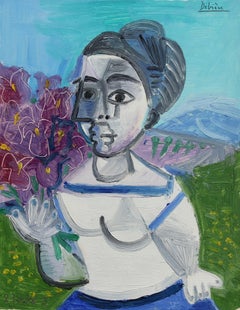
Portrait of Woman with Irises
By Raymond Debieve
Located in London, GB
'Portrait of Woman with Irises', oil on cardstock paper (1976), by Raymond Debiève. Here the artist paints a young woman holding a bunch of enchantin...
Category
1970s Modern Portrait Paintings
Materials
Oil, Board
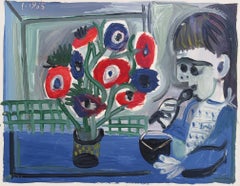
Boy with Anemones
By Raymond Debieve
Located in London, GB
'Boy with Anemones', oil on cardstock paper, by Raymond Debiève (1965). Here the artist paints a young boy having his breakfast with a beautiful bouquet of an...
Category
1960s Modern Portrait Paintings
Materials
Oil, Board
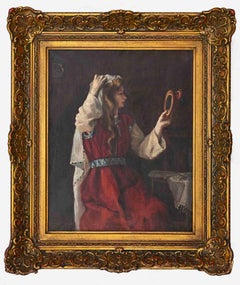
A Young Oriental Woman Looking at the Mirror-Oil on Canvas - 19th Century
Located in Roma, IT
A young woman is an original modern artwork realized in Late 19th Century.
Mixed colored oil on canvas.
The artwork depicts a young woman with veil and mirror.
Unreadible signatur...
Category
19th Century Modern Figurative Paintings
Materials
Canvas, Oil
$1,435
H 16.15 in W 13.19 in D 0.04 in
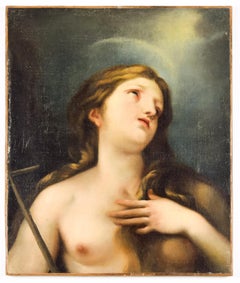
Mary Magdalene - Oil on Canvas by Italian School 19th cent.
Located in Roma, IT
Oil on canvas. cm 60.5 x 2 x 50
Nice Oil painting (Italian School of XIX century) with a rapid sign and intense colors backgrpound. Some color cracking on left margin and top edge, ...
Category
18th Century Modern Figurative Paintings
Materials
Oil
$4,786
H 23.82 in W 19.69 in
Nylons and Bric-a-Brac by Orovida Pissarro - Oil painting
By Orovida Pissarro
Located in London, GB
*UK BUYERS WILL PAY AN ADDITIONAL 20% VAT ON TOP OF THE ABOVE PRICE
Nylons and Bric-a-Brac by Orovida Pissarro (1893-1968)
Oil on canvas
73 x 60 cm (28 ³/₄ x 23 ⁵/₈ inches)
Signed and dated upper right Orovida 1951
Provenance
Estate of the artist
With John Bensusan-Butt, cousin of the artist
G Hassell, 25th November 1988
With John Noott, 10th June 1992
Literature
K L Erickson, Orovida Pissarro: Painter and Print-Maker with A Catalogue Raisonné of Paintings, (doctoral thesis), Oxford, 1992, Appendices, no. 141 (illustrated)
Exhibition
London, Redfern Gallery, Recent Paintings: Orovida, 3rd-26th January 1952, no. 51
Artist biography
Orovida Camille Pissarro, Lucien and Esther Pissarro’s only child, was the first woman in the Pissarro family as well as the first of her generation to become an artist. Born in Epping, England in 1893, she lived and worked predominantly in London where she became a prominent member of several British arts clubs and societies.
She first learned to paint in the Impressionist style of her father, but after a brief period of formal study with Walter Sickert in 1913 she renounced formal art schooling. Throughout her career, Orovida always remained outside of any mainstream British art movements. Much to Lucien's disappointment she soon turned away from naturalistic painting and developed her own unusual style combining elements of Japanese, Chinese, Persian and Indian art. Her rejection of Impressionism, which for the Pissarro family had become a way of life, together with the simultaneous decision to drop her famous last name and simply use Orovida as a ‘nom de peintre’, reflected a deep desire for independence and distance from the weight of the family legacy.
Orovida's most distinctive and notable works were produced from the period of 1919 to 1939 using her own homemade egg tempera applied in thin, delicate washes to silk, linen or paper and sometimes embellished with brocade borders. These elegant and richly decorative works generally depict Eastern, Asian and African subjects...
Category
1950s Modern Figurative Paintings
Materials
Canvas, Oil
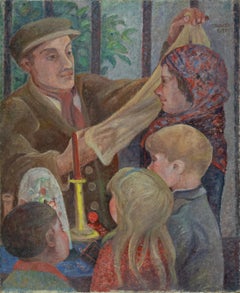
$10,242
H 28.75 in W 23.63 in
The Fortune Teller by Orovida Pissarro - Oil painting
By Orovida Pissarro
Located in London, GB
*UK BUYERS WILL PAY AN ADDITIONAL 20% VAT ON TOP OF THE ABOVE PRICE
The Fortune Teller by Orovida Pissarro (1893-1968)
Oil on canvas
60 x 73 cm (23 ⁵/₈ x 28 ³/₄ inches)
Signed and d...
Category
1950s Modern Figurative Paintings
Materials
Canvas, Oil
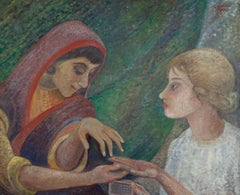
$11,198
H 23.63 in W 28.75 in
More From This Seller
View AllBLONDE WITH ART DECO NECKLACE
Located in Los Angeles, CA
Biography from the niece of the artist from during his lifetime. Paintings acquired from the artist.s estate.
Max Turner
1925 - 2019
Max Lamar Turner Painter, Sculptor, Teacher and Author.
Max Turner was born in Omaha, Nebraska on July 28, 1925. His father was Lance Howard Turner and his mother Mary Irene Turner. In 1927, his family moved to Bingham Canyon, Utah where Max's father extracted copper from a creek that he had diverted to pass through his garage. The town was located in a narrow canyon on the eastern face of the Oquirrh Mountains. In 1938, when Max was 13, his family moved to Midvale, Utah. After completing high school, Max went to work laying rail until he was inducted into the U.S. Navy to serve during W.W. II.
There he took an aptitude test and was initially assigned to the medical corp., later transferring to the dental unit. Max was stationed at Port Hueneme, Ventura County, California through the end of the war. When he was discharged in 1946, he remained in Southern California, living in the Los Angeles area. He met a man named Larry Torres and they formed a partnership to do silk screen work primarily for the Colby Poster Printing Company. This lasted about 10 years until the Colby building caught fire and burned down. In 1958, Max began working for Slade Novelty company that made doll parts using a product called plastisol. A year later, Max began producing plastic parts through his own business. One day, a couple of kids brought in a shrunken skull they had made and asked Max if he could reproduce it. Max said he could and he looked around for a business to work with for this task. He ultimately decided he could create his own machine shop to make molds. As a result, Max purchased a lathe, drill press, grinder and other tools to create his own machine shop and went into business making molds. He built a clientele and in 1973, he moved his machine shop to Glendale, California.
Painter, Sculptor, Teacher and Author:
Max recalls the day when his interest in art took a new direction. He happened to be in a paint store to purchase some supplies when he saw a card posted on a wall that read, "Come paint with Connie Marlo". Max had been interested in art since his youth and he was frequently impressed with paintings displayed by local artists at various community events.
Consequently, he decided to go to Connie's Saturday morning art class at a studio on North La Brea Avenue (between Sunset and Hollywood) in Los Angeles. But, as fate would have it, he immediately took a detour from this class when he found a piece of paper on the floor of the studio referencing another art class dealing with compositions, patterns, rhythms and color harmony. The instructor's name was Hal Reed, a former art student of the Russian/American Master, Nicolai Fechin. Hal owned the building (previously the Will Foster Studio) and had founded the Art League of Los Angeles. When Max found Hal, he asked Hal if he could join his class. Hal said "No, the class was full" but he said Max could monitor the class in the back of the classroom. Max took him up on the offer and began observing the weekly class.
During the class, Hal told his students that they should practice what they were learning by going to "live model" classes. Max began attending these classes where he learned how to draw figures. After a few months, Hal and Max became good friends. Hal was so impressed with Max's work that he offered Max the opportunity to teach at another location that Hal was opening in the San Fernando Valley. Max accepted the offer and began teaching his own art class. For Max, it was a quick jump from learning to teaching. Max then found that several of his students had to commute to his art class from the west end of the "Valley". To better serve this group of students, Max decided to relocate to another studio in Calabasas.
Max continued teaching, and at this time he was producing very impressive portraits, both oil paintings and charcoal drawings from live models (Max never worked from photos). Max demonstrated real talent, and the style of his drawings and paintings were being compared to those of Nicolai Fechin. And, like Fechin, Max also had an interest in sculpting. One day, Max decided to design and cast a bronze owl sculpture to put in his Calabasas Fine Art Gallery. Later, someone approached Max when he was at the foundry and asked him about his success selling the owl sculpture. The individual who asked this question was convinced that there was a broader market for these sculptures and he ordered a dozen of the owl sculptures from Max. This encouraged Max to do more castings. Some of the new castings were antique sculptures he found and reproduced. As this new business grew, he decided to establish his own foundry, employing up to 15 workers. The business continued for many years, up until the late 1990's when Max got tired of the foundry business and sold it.
Max, who was now in his 70's, decided to move on to his next venture as an artist, dedicating himself to doing the actual sculpting of original art. He loved the creativity of sculpting and he had his sculptures cast at local foundries, ironically the same ones that used to be his competition. Max was now fully engaged in his new artistic direction and, over time, he produced a large body of work. He created very impressive sculptures, including about 100 full-size sculptures. He sold some of these to high-end clientele, the Foundry at SLS Las Vegas, and to Hollywood studios.
Even though Max now seemed to be totally in his element, he somehow also found time to continue to teach painting classes at the California Art Institute in Westlake Village in Los Angeles. At the institute, he specialized in figure work. Max continued to draw, paint and teach, but he says he stopped sculpting when he turned 90.
Max produced four books showcasing his drawings and paintings. The first is "Faces, The Drawings of Max Turner", copyright 2000, that showcases nearly 100 of his portrait drawings. Within the "Acknowledgements" section, he lists Hal Reed and Joseph Nordmann, two former students of Nicolai Fechin.
In 2006, Max produced his second book titled "Figures and Faces", reflecting not only portraits but also figure drawings and paintings. It is a wonderful book of Max's work, but it is currently difficult to find. The third book is titled "Faces 2, The Paintings and Drawings of Max Turner", copyright 2009, which includes 75 portrait paintings and drawings. In the "Preface" of this book, Max describes growing up in a small and isolated mining town during the Great Depression. He states that as a kid, he had little exposure of any culture or view of what the rest of the world was like. His neighbor was the trash collector and Max would sometimes go through his truck looking for anything of value. Among other things, he found magazines like Cosmopolitan, Good Housekeeping and Red Book, with covers that frequently showed drawings or paintings of faces. Max states that these images were the very first source of inspiration for him. He says that he began looking more carefully at people's faces and if they had character, he would draw them. By drawing them, Max says that he was making them part of his world, his world of "Faces".
In 2018, Max published his newest book showcasing his drawings and paintings. It is titled "Max Turner's Figure Sketches". This softbound book includes 76 pages and over 120 drawings and paintings. In the Introduction, Max explains "I have found that when approaching the figure, one should begin with the gesture. After having captured the essence or feeling of the pose, one can then proceed to build on it." The figure sketches in this wonderful book reflect a Master's work that consistently captures the "gesture"-showing the emotion, movement and expression.
Two more books are on the horizon for Max, both dealing with his passion for sculpting. His first, "The Sculpture of Max Turner" is a compilation of his commercial and noncommercial pieces throughout his career. The second, "Terra Cotta Sculpture by Max Turner" is a complete collection of figures done at the California Art Institute. These much anticipated books should be out later in 2018.
Max now considers himself primarily a sculptor. But others in the art world are more than impressed with his drawings and paintings as well. His portraits are often described as having a Fechin-esque appearance, referring to the style of Nicolai Fechin. When Max observed those first art classes given by Hal Reed, it should be noted that Hal had previously been a student of the Russian/American Master Nicolai Fechin in the early to mid-1950's. In fact, Hal was a student in the last art class that Fechin taught before he unexpectedly died in 1955. Hal was so strongly influenced by Fechin that he later produced two 30-minute art instruction videos as part his Art Video Productions wherein he specifically described Fechin techniques that he learned in Fechin's class. The Fechin style and techniques were in play when Max later met Hal. Over the years, many of Max's art students, art collectors, gallery owners, as well as the Director of the Monterey Museum of Art have commented on the Fechin-esque qualities of Max's wonderful charcoal drawings and paintings. So, while Max may consider himself primarily a sculptor, his drawings and paintings are also impressive and very much sought after.
When Nicolai Fechin died in 1955, three of the nine students in his last art class became life-long friends. Max subsequently became friends with not only Hal Reed, but also with prior Fechin students Joseph Nordmann and Albert Londraville...
Category
1990s Modern Figurative Paintings
Materials
Canvas, Oil

$650 Sale Price
48% Off
LADY WITH PICK FAN
Located in Los Angeles, CA
Biography from the niece of the artist from during his lifetime. Paintings acquired from the artist.s estate.
Max Turner
1925 - 2019
Max Lamar Turner Painter, Sculptor, Teacher and Author.
Max Turner was born in Omaha, Nebraska on July 28, 1925. His father was Lance Howard Turner and his mother Mary Irene Turner. In 1927, his family moved to Bingham Canyon, Utah where Max's father extracted copper from a creek that he had diverted to pass through his garage. The town was located in a narrow canyon on the eastern face of the Oquirrh Mountains. In 1938, when Max was 13, his family moved to Midvale, Utah. After completing high school, Max went to work laying rail until he was inducted into the U.S. Navy to serve during W.W. II.
There he took an aptitude test and was initially assigned to the medical corp., later transferring to the dental unit. Max was stationed at Port Hueneme, Ventura County, California through the end of the war. When he was discharged in 1946, he remained in Southern California, living in the Los Angeles area. He met a man named Larry Torres and they formed a partnership to do silk screen work primarily for the Colby Poster Printing Company. This lasted about 10 years until the Colby building caught fire and burned down. In 1958, Max began working for Slade Novelty company that made doll parts using a product called plastisol. A year later, Max began producing plastic parts through his own business. One day, a couple of kids brought in a shrunken skull they had made and asked Max if he could reproduce it. Max said he could and he looked around for a business to work with for this task. He ultimately decided he could create his own machine shop to make molds. As a result, Max purchased a lathe, drill press, grinder and other tools to create his own machine shop and went into business making molds. He built a clientele and in 1973, he moved his machine shop to Glendale, California.
Painter, Sculptor, Teacher and Author:
Max recalls the day when his interest in art took a new direction. He happened to be in a paint store to purchase some supplies when he saw a card posted on a wall that read, "Come paint with Connie Marlo". Max had been interested in art since his youth and he was frequently impressed with paintings displayed by local artists at various community events.
Consequently, he decided to go to Connie's Saturday morning art class at a studio on North La Brea Avenue (between Sunset and Hollywood) in Los Angeles. But, as fate would have it, he immediately took a detour from this class when he found a piece of paper on the floor of the studio referencing another art class dealing with compositions, patterns, rhythms and color harmony. The instructor's name was Hal Reed, a former art student of the Russian/American Master, Nicolai Fechin. Hal owned the building (previously the Will Foster Studio) and had founded the Art League of Los Angeles. When Max found Hal, he asked Hal if he could join his class. Hal said "No, the class was full" but he said Max could monitor the class in the back of the classroom. Max took him up on the offer and began observing the weekly class.
During the class, Hal told his students that they should practice what they were learning by going to "live model" classes. Max began attending these classes where he learned how to draw figures. After a few months, Hal and Max became good friends. Hal was so impressed with Max's work that he offered Max the opportunity to teach at another location that Hal was opening in the San Fernando Valley. Max accepted the offer and began teaching his own art class. For Max, it was a quick jump from learning to teaching. Max then found that several of his students had to commute to his art class from the west end of the "Valley". To better serve this group of students, Max decided to relocate to another studio in Calabasas.
Max continued teaching, and at this time he was producing very impressive portraits, both oil paintings and charcoal drawings from live models (Max never worked from photos). Max demonstrated real talent, and the style of his drawings and paintings were being compared to those of Nicolai Fechin. And, like Fechin, Max also had an interest in sculpting. One day, Max decided to design and cast a bronze owl sculpture to put in his Calabasas Fine Art Gallery. Later, someone approached Max when he was at the foundry and asked him about his success selling the owl sculpture. The individual who asked this question was convinced that there was a broader market for these sculptures and he ordered a dozen of the owl sculptures from Max. This encouraged Max to do more castings. Some of the new castings were antique sculptures he found and reproduced. As this new business grew, he decided to establish his own foundry, employing up to 15 workers. The business continued for many years, up until the late 1990's when Max got tired of the foundry business and sold it.
Max, who was now in his 70's, decided to move on to his next venture as an artist, dedicating himself to doing the actual sculpting of original art. He loved the creativity of sculpting and he had his sculptures cast at local foundries, ironically the same ones that used to be his competition. Max was now fully engaged in his new artistic direction and, over time, he produced a large body of work. He created very impressive sculptures, including about 100 full-size sculptures. He sold some of these to high-end clientele, the Foundry at SLS Las Vegas, and to Hollywood studios.
Even though Max now seemed to be totally in his element, he somehow also found time to continue to teach painting classes at the California Art Institute in Westlake Village in Los Angeles. At the institute, he specialized in figure work. Max continued to draw, paint and teach, but he says he stopped sculpting when he turned 90.
Max produced four books showcasing his drawings and paintings. The first is "Faces, The Drawings of Max Turner", copyright 2000, that showcases nearly 100 of his portrait drawings. Within the "Acknowledgements" section, he lists Hal Reed and Joseph Nordmann, two former students of Nicolai Fechin.
In 2006, Max produced his second book titled "Figures and Faces", reflecting not only portraits but also figure drawings and paintings. It is a wonderful book of Max's work, but it is currently difficult to find. The third book is titled "Faces 2, The Paintings and Drawings of Max Turner", copyright 2009, which includes 75 portrait paintings and drawings. In the "Preface" of this book, Max describes growing up in a small and isolated mining town during the Great Depression. He states that as a kid, he had little exposure of any culture or view of what the rest of the world was like. His neighbor was the trash collector and Max would sometimes go through his truck looking for anything of value. Among other things, he found magazines like Cosmopolitan, Good Housekeeping and Red Book, with covers that frequently showed drawings or paintings of faces. Max states that these images were the very first source of inspiration for him. He says that he began looking more carefully at people's faces and if they had character, he would draw them. By drawing them, Max says that he was making them part of his world, his world of "Faces".
In 2018, Max published his newest book showcasing his drawings and paintings. It is titled "Max Turner's Figure Sketches". This softbound book includes 76 pages and over 120 drawings and paintings. In the Introduction, Max explains "I have found that when approaching the figure, one should begin with the gesture. After having captured the essence or feeling of the pose, one can then proceed to build on it." The figure sketches in this wonderful book reflect a Master's work that consistently captures the "gesture"-showing the emotion, movement and expression.
Two more books are on the horizon for Max, both dealing with his passion for sculpting. His first, "The Sculpture of Max Turner" is a compilation of his commercial and noncommercial pieces throughout his career. The second, "Terra Cotta Sculpture by Max Turner" is a complete collection of figures done at the California Art Institute. These much anticipated books should be out later in 2018.
Max now considers himself primarily a sculptor. But others in the art world are more than impressed with his drawings and paintings as well. His portraits are often described as having a Fechin-esque appearance, referring to the style of Nicolai Fechin. When Max observed those first art classes given by Hal Reed, it should be noted that Hal had previously been a student of the Russian/American Master Nicolai Fechin in the early to mid-1950's. In fact, Hal was a student in the last art class that Fechin taught before he unexpectedly died in 1955. Hal was so strongly influenced by Fechin that he later produced two 30-minute art instruction videos as part his Art Video Productions wherein he specifically described Fechin techniques that he learned in Fechin's class. The Fechin style and techniques were in play when Max later met Hal. Over the years, many of Max's art students, art collectors, gallery owners, as well as the Director of the Monterey Museum of Art have commented on the Fechin-esque qualities of Max's wonderful charcoal drawings and paintings. So, while Max may consider himself primarily a sculptor, his drawings and paintings are also impressive and very much sought after.
When Nicolai Fechin died in 1955, three of the nine students in his last art class became life-long friends. Max subsequently became friends with not only Hal Reed, but also with prior Fechin students Joseph Nordmann and Albert Londraville...
Category
1990s Modern Figurative Paintings
Materials
Canvas, Oil
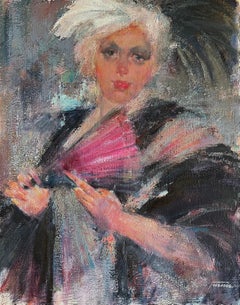
$450 Sale Price
64% Off
PORTRAIT OF ANHALT PORTRAIOT
By Morton Dimondstein
Located in Los Angeles, CA
"PORTRAIT OF ANHALT PORTRAIOT"
FILM MAKER
OIL ON PAPER
C.1970
17.5 X 22.5 INCHES
Morton Dimondstein
1920-2000
At the age of seventeen Morton Dimondstein enrolled in ...
Category
1970s Figurative Paintings
Materials
Oil, Rag Paper
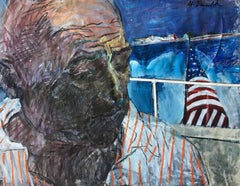
$1,200 Sale Price
38% Off
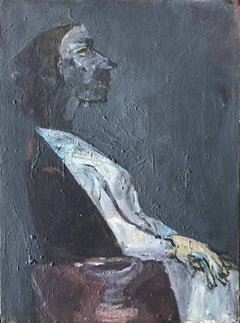
PROFILE OF A WOMAN
By Morton Dimondstein
Located in Los Angeles, CA
"PROFILE OF A WOMAN"
OIL ON PANEL
C.1960
PAINTED IN ITALY
16 X 12 INCHES
Morton Dimondstein
1920-2000
At the age of seventeen Morton Dimondstein enrolled in the American Artists School and then the Art Students League in New York City, where he studied painting, drawing, and printmaking with Anton Refregier, Harry Sternberg, and Kimon Nicolaides.
After serving in the 387th Field Artillery Battalion during World War II, Dimondstein continued his studies at the Otis Art Institute in Los Angeles. He was one of the first artists to produce serigraphic prints on the West Coast, marketing them as affordable art in galleries and retail stores.
His prints and oil paintings garnered several awards during this post-war period, including an A.C.A. Gallery international competition for a one- man show in New York City.
In 1951 he moved to Mexico, where he attended the Instituto Politécnico Nacional and studied art with José Gutiérrez and David Alfaro Siqueiros. During his three years in Mexico, Dimondstein worked as a staff artist and instructor in visual education for UNESCO and was a member of the Taller de Gráfica Popular.
After moving back to Los Angeles, Dimondstein served as the art editor of the California Quarterly from 1953 to 1956. He briefly worked for the Saul Bass advertising firm where he designed books and book jackets, and collaborated on the ad campaigns for films such as William Wyler’s “The Big Country” and Otto Preminger’s “St. Joan.” Dimondstein received industry recognition for the images he created, but cranking out art for commercial ventures with strict deadlines was not for him.
He chose to leave that world in favor of working as an independent artist and art teacher. Over the years he taught at the Kann Art Institute, the New School of Art, the University of Southern California in Los Angeles, and the School of Fine Art which he established with UCLA faculty member Martin Lubner...
Category
1960s Figurative Paintings
Materials
Oil, Rag Paper
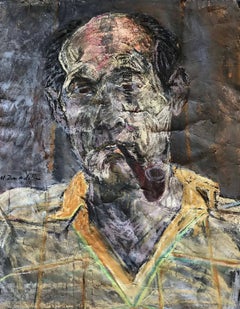
PORTRAIT OF CHARLIE KELLER
By Morton Dimondstein
Located in Los Angeles, CA
"PORTRAIT OF CHARLIE KELLER"
ARTIST
OIL ON PAPER
C.1970
23 X 17.5 INCHES
Morton Dimondstein
1920-2000
At the age of seventeen Morton Dimondstein enrolled in the American Artists School and then the Art Students League in New York City, where he studied painting, drawing, and printmaking with Anton Refregier, Harry Sternberg, and Kimon Nicolaides.
After serving in the 387th Field Artillery Battalion during World War II, Dimondstein continued his studies at the Otis Art Institute in Los Angeles. He was one of the first artists to produce serigraphic prints on the West Coast, marketing them as affordable art in galleries and retail stores.
His prints and oil paintings garnered several awards during this post-war period, including an A.C.A. Gallery international competition for a one- man show in New York City.
In 1951 he moved to Mexico, where he attended the Instituto Politécnico Nacional and studied art with José Gutiérrez and David Alfaro Siqueiros. During his three years in Mexico, Dimondstein worked as a staff artist and instructor in visual education for UNESCO and was a member of the Taller de Gráfica Popular.
After moving back to Los Angeles, Dimondstein served as the art editor of the California Quarterly from 1953 to 1956. He briefly worked for the Saul Bass advertising firm where he designed books and book jackets, and collaborated on the ad campaigns for films such as William Wyler’s “The Big Country” and Otto Preminger’s “St. Joan.” Dimondstein received industry recognition for the images he created, but cranking out art for commercial ventures with strict deadlines was not for him.
He chose to leave that world in favor of working as an independent artist and art teacher. Over the years he taught at the Kann Art Institute, the New School of Art, the University of Southern California in Los Angeles, and the School of Fine Art which he established with UCLA faculty member Martin Lubner...
Category
1970s Figurative Paintings
Materials
Oil, Rag Paper
$1,200 Sale Price
31% Off
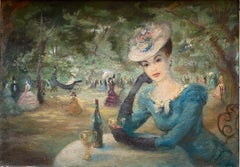
Lady in the Paris Park
Located in Los Angeles, CA
Beautiful young lady in a Paris Park, signed, Original Frame, listed size includes the frame.
Category
1950s Impressionist Figurative Paintings
Materials
Oil, Panel
$788 Sale Price
49% Off
Still Thinking About These?
All Recently ViewedMore Ways To Browse
Italian Futurism
Mario De Ferrante
19th Century Portrait Young Man
Portrait Of Child
Antique Royal Portraits
17th And 18th Century Portraits
Male Portrait Paintings
1920 Oil Portraits
Antique Family Portraits
Russia Portrait
Gentleman Oil Portrait
French School 18th Century
Gilt Framed Woman Portrait Oil Paintings
Impressionist Portrait Of A Young Girl
16th Century Portrait Oil Paintings
Portrait Of A Woman Reading
Painted Portrait Girl In Pink
Oil On Panel Portrait