Want more images or videos?
Request additional images or videos from the seller
1 of 10
Nathaniel Dance-Holland18th Century Oil Painting Portrait of a Military Officerc. 1760-68
c. 1760-68
$25,790.04List Price
About the Item
- Creator:Nathaniel Dance-Holland (1735 - 1811, English)
- Creation Year:c. 1760-68
- Dimensions:Height: 36.5 in (92.71 cm)Width: 32 in (81.28 cm)
- Medium:
- Movement Style:
- Period:1750-1759
- Condition:
- Gallery Location:London, GB
- Reference Number:1stDibs: LU67335306571
About the Seller
5.0
Vetted Professional Seller
Every seller passes strict standards for authenticity and reliability
Established in 1990
1stDibs seller since 2017
46 sales on 1stDibs
Typical response time: 1 to 2 days
Authenticity Guarantee
In the unlikely event there’s an issue with an item’s authenticity, contact us within 1 year for a full refund. DetailsMoney-Back Guarantee
If your item is not as described, is damaged in transit, or does not arrive, contact us within 7 days for a full refund. Details24-Hour Cancellation
You have a 24-hour grace period in which to reconsider your purchase, with no questions asked.Vetted Professional Sellers
Our world-class sellers must adhere to strict standards for service and quality, maintaining the integrity of our listings.Price-Match Guarantee
If you find that a seller listed the same item for a lower price elsewhere, we’ll match it.Trusted Global Delivery
Our best-in-class carrier network provides specialized shipping options worldwide, including custom delivery.You May Also Like
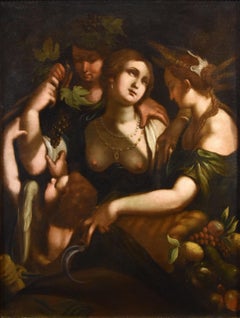
Venus Bacchus Ceres Paggi 17th Century Paint Oil on canvas Old master Mythologic
Located in Riva del Garda, IT
Giovanni Battista Paggi (Genoa 1554 – Genoa 1627)
Venus, Bacchus and Ceres (Parallel title: ‘Sine Cerere et Baccho, friget Venus’)
Oil on canvas
103 x 78 cm. - Framed 125 x 100 cm.
...
Category
17th Century Old Masters Paintings
Materials
Oil
$11,781 Sale Price
20% Off
H 49.22 in W 39.38 in
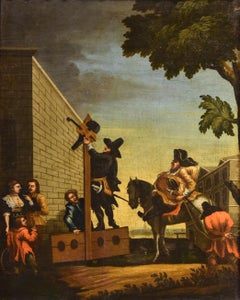
Hudibras Triomphante Hogarth Paint Oil on canvas 18th Century Paint Old master
Located in Riva del Garda, IT
18th century English painter
William Hogarth (London 1697 - 1764) School of
Hudibras Triomphante (from the poem by Samuel Butler)
Circa 1740, England
Oil on canvas (62 x 50 cm. - F...
Category
18th Century Old Masters Paintings
Materials
Oil
$6,076 Sale Price
20% Off
H 32.68 in W 27.96 in
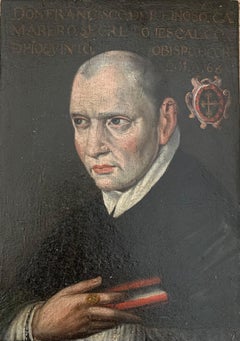
Spanish school. Secretary of Pope Pius V, abbot of Husillos, bishop of Córdoba.
Located in Firenze, IT
Portrait of Francisco de Reynoso y Baeza.
Secretary of Pope Pius V, abbot of Husillos and bishop of Córdoba. Francisci de Reynoso.
Early 17th century.
Small-format portrait from the late Renaissance period.
Spanish school.
Size: Cm 19 x Cm 13.5
Oil on wooden panel.
On the back the fine tablet is strengthened (already in ancient times) by a sheet of parchment.
About 1600-1610.
As often in Mannerist / Late Renaissance portraits, the image of the character is accompanied by the writing that runs at the top, adding a celebratory, historicising touch to the effigy. Let's bring back the sentence here:
DON FRANCISCO DE REINOSO. CAMARERO SECRETO IESCALCO PIO QUINTO OBISCOPO CORDOBA. 68 (? O 7?)
(1534, Autillo de Campos, Spain - 1601, Córdoba)
Francisco de Reynoso was a Spanish cleric, chief chamberlain, and secretary to Pope Pius V, abbot of Husillos, and bishop of Córdoba.
He was the fourth of eleven children. His father was the seventh Lord of Autillo de Campos, and his mother was Juana de Baeza y de las Casas, daughter of Manuel de Baeza, a lawyer of the Royal Council and at the Court of Valladolid.
Francisco de Reynoso was deeply devoted to the Virgin Mary and showed a strong inclination toward religion and piety from an early age.
He studied Latin, arts, and theology at the University of Salamanca.
In 1562, he traveled to Rome with his brothers Pedro and Luis.
In January 1566, following the death of Pope Pius IV, Cardinal Antonio Michele Ghislieri was elected pope, becoming Pius V. From this period until Ghislieri's death in 1572, Francisco de Reynoso served as his chief chamberlain and secretary.
After Pope Pius V died, Francisco de Reynoso returned to Spain and lived for several years in the city of Palencia, where his brother Manuel was a canon.
He supported the Society of Jesus when it was established in Palencia, providing alms to the school's clergy and funding chairs of Letters and Theology at his own expense, as well as donating a significant number of books.
During the brief outbreak of the Black Plague...
Category
17th Century Old Masters Portrait Paintings
Materials
Parchment Paper, Oil, Wood Panel
$1,526 Sale Price
20% Off
Free Shipping
H 7.49 in W 5.32 in
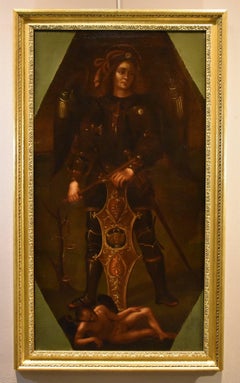
Saint Michael Archangel 17th Century Paint Oil on canvas Lombard School
Located in Riva del Garda, IT
17th century Lombard painter
Saint Michael Archangel
Oil on canvas
139 x 75 cm. - Framed 156 x 91 cm
Antique painting with St. Michael the Archangel, immortalised full-length as a ...
Category
17th Century Old Masters Paintings
Materials
Oil
$10,665 Sale Price
20% Off
H 61.42 in W 35.83 in
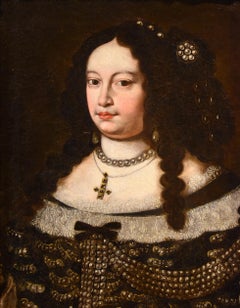
Portrait Duchess Woman 17th Century Paint Van Gelder Oil on canvas Old master
Located in Riva del Garda, IT
Jan van Gelder, Italianised as Giovanni Vangheldri (Antwerp 1621 – Modena 1685)
Portrait of the Duchess Vittoria Farnese d'Este (Parma, 1618 – Modena, 1649) wife of Francesco I d'E...
Category
17th Century Old Masters Paintings
Materials
Oil
$9,301 Sale Price
20% Off
Free Shipping
H 36.23 in W 30.32 in
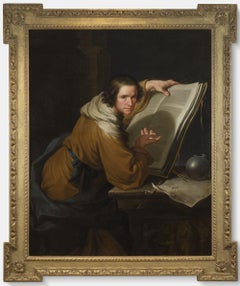
Sir Charles Frederick
Located in London, GB
Oil on canvas
50 x 40 inches; 127 x 101.6 cm
Framed dimensions: 151.5 x 127 cm
Inscribed on plinth: ‘VOTIS X ET XX’
Not signed
Painted c.1748
Collections:
Christie’s London, 23rd December 1954, lot.272;
J. Singer;
Somerville
Simpson Ltd, London, by 1985;
The Matthiesen Gallery, London;
Richard Feigen, New York;
Matthew Rutenberg, New York to 2019;
Lowell Libson and Jonny Yarker Ltd.
Literature:
Stella Rudolph, La Pittura del’ 700 a Roma, Milan, 1983, reproduced pl.133;
Jacob Simon, Handel, a celebration of his life and times 1685-1759, exh. cat. London, (National Portrait Gallery), 1985, no.196;
Catherine Whistler, Baroque
Later Paintings in the Ashmolean Museum, London, 2016, pp.102-105, reproduced p.104
Exhibited:
London, National Portrait Gallery, Handel, a celebration of his life and times 1685-1759, 1985-86, no.196, reproduced p.198
This powerful portrait of the antiquarian and courtier Sir Charles Frederick was completed in 1748 by the Roman painter Andrea Casali. Frederick, as comptroller of the royal laboratory, one of the ‘great officers’ of the Board of Ordinance at Woolwich, had just been responsible for the famed pyrotechnic display celebrating the Peace of Aix-la-Chapelle: the so-called ‘Royal Fireworks’ for which George Frederick Handel composed music. Casali’s portrait pays tribute to Frederick’s role as comptroller of the royal laboratory, showing him with a firing diagram and mortar, it also points to Frederick’s interests as an antiquarian with the inclusion of antique relief. Casali had first met Frederick in Rome in 1738, where he had painted his portrait, Frederick subsequently encouraged Casali to travel to London. This probably accounts for the unusual format; rather than a modern man of science, Casali casts Frederick as an alchemist bent on some mystic discovery, as such, it is one of the most unusual portraits of the period.
Andrea Casali was a pupil of Sebastiano Conca and then of Francesco Trevisani, who recommended him to the Spanish court in 1736. He enjoyed some success in Rome as a painter of frescoes and altarpieces, notably a large cycle of Scenes from the Life of St Dominic at the cloister of S. Sisto Vecchio, for which he was made a Knight of the Golden Spur in 1729. Casali began painting Grand Tourist portraits in Rome around 1738. His first portrait of Sir Charles Frederick is dated that year Ashmolean Museum, Oxford), it casts Frederick as a focused scholar, showing him seated at an elaborately carved console table, hard at work. In common with other Grand Tour portraiture of the period, Casali includes a famous Roman landmark in the background, in this case the façade of the Pantheon. Horace Walpole noted that it was thanks to the encouragement of ‘Mr Frederick and his Friends at Rome’ that Casali travelled to London in 1741.
Charles Frederick was a fascinating Augustan polymath. Born at Fort St George, Madras, where his father, Sir Thomas Frederick, was governor, he successively matriculated at New College, Oxford (1725), was called to the Middle Temple (1728), became a Fellow of the Royal Society (1731) and Director of the Society of Antiquaries (1735). His interests were wide ranging. Frederick was an amateur architect, he designed the monument to Lucy, Lady Lyttleton, in Hagley Church and the monument to Thomas Miller, bishop of Waterford, in Highclere church, Hampshire. He was a numismatist and collector of antiquities, as well as an amateur scientist. It was in the last capacity that he was appointed comptroller of the royal laboratory at Woolwich and clerk of the deliveries in 1746, this was the most junior of the ‘great officers’ who made up the membership of the royal Board of Ordnance. This appointment came through the good offices of the master-general of the Ordnance, a fellow antiquarian, John, 2nd Duke of Montagu. As comptroller, Frederick was responsible for the fireworks celebration of the treaty of Aix-la-Chapelle, for which Handel composed his celebrated music. As Horace Walpole wrote to his cousin, Henry Seymour Conway:
‘Charles Frederick has turned all his virtu into fireworks, and, by his influence with the Ordnance has prepared such a spectacle for the proclamation of Peace as is to surpass all its predecessors of bouncing memory. It is to open with a concert of fifteen hundred hands, and conclude with so many thousand crackers all set to music, that all the men killed in the war are to be wakened with a crash, as if it was the day of judgement, and fall a-dancing, like the troops in the Rehearsal. I wish you could see him making squibs of his papillotes, and bronzed over with a patina of gunpowder, and talking himself still hoarser on the superiority that his fireworks will have over the Roman naumachia.’
Performed in Green Park, the fireworks were mounted on a temporary structure designed by the architect Giovanni Niccolò Servandoni decorated by Adrea Soldi and Casali.
Casali’s second portrait of Frederick was completed following the success of the firework display. In this remarkable image, we discover Frederick at work, dressed in almost monastic garb, pouring over an impossibly large tome propped on an antique altar. The altar is identifiable as a Roman relief depicting Victory writing on a shield, the original is at Villa Medici in Rome, but was engraved by Pietro Santi Bartoli...
Category
18th Century Old Masters Portrait Paintings
Materials
Canvas, Oil
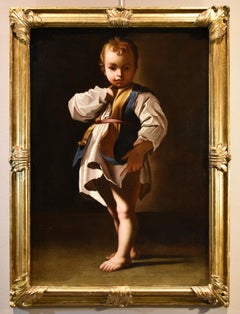
Portrait Child Schedoni 17th Century Paint Oil on canvas Old master
Located in Riva del Garda, IT
Bartolomeo Schedoni (Modena 1578 - Parma 1615) workshop of
Portrait of a child (Alessandro Farnese?)
First half 17th century
Oil on canvas (95 x 66 cm. - In frame 109 x 80)
This i...
Category
17th Century Old Masters Paintings
Materials
Oil
$12,153 Sale Price
20% Off
H 42.92 in W 31.5 in
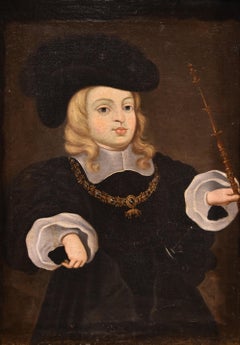
Charles Ii King Spain Child Del Mazo Paint 17th Century Oil on canvas Old master
Located in Riva del Garda, IT
Attributed to Juan Bautista Martínez del Mazo (Castile 1611 - Madrid 1667) pupil and collaborator of Diego Velázquez
Portrait of Charles II, King of Spain, as a child (1661 -1700)
Spain, c. 1670 Oil on canvas 68 x 49 cm. - In antique frame 96 x 75 cm.
The analysis of this portrait, and in particular the style with which its features have been outlined, brings us back to the great tradition of the 17th century Spanish school.
The portrait depicts the young King Charles II of Spain, dressed in typical Spanish fashion, the youngest and only son of Philip IV of Spain and his second wife Maria Anna of Austria, as well as the last of the Habsburg dynasty to rule Spain. which portrayed the young ruler in full length at the age of four (dated 1665), dressed in a black suit and cape, and a large feathered...
Category
17th Century Old Masters Paintings
Materials
Oil
$7,193 Sale Price
20% Off
H 37.8 in W 29.53 in
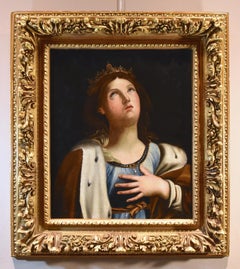
Saint Catherine Religious Reni 17th Century Paint Oil on canvas Old master Italy
Located in Riva del Garda, IT
Guido Reni (Bologna 1575 - 1642) Workshop of
Probably Gian Domenico Cerrini, the Cavalier Perugino (Perugia 1609 - Rome 1681)
Saint Catherine of Alexandria Oil on canvas 65 x 5...
Category
17th Century Old Masters Paintings
Materials
Oil
$8,061 Sale Price
20% Off
H 36.62 in W 32.29 in
19th Century Historical English Painting David Wilkie
By Sir David Wilkie
Located in Roma, IT
Sir David Wilkie RA (18 November 1785 – 1 June 1841)
“The Parish Beadle”
Oil on canvas
Although unsigned, this beautiful painting is undoubtedly an original work by David Wilkye as...
Category
Early 19th Century Old Masters Figurative Paintings
Materials
Canvas, Oil
$8,347
H 23.94 in W 35.75 in D 5.91 in
More From This Seller
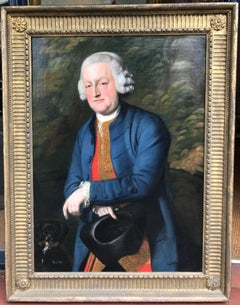
View All18th Century Oil Painting Portrait of Phillip, 6th Viscount Wenman.
By Nathaniel Dance-Holland
Located in London, GB
Sir Nathaniel Dance-Holland (1750-1811) was an English portrait painter and one of the founding members of the Royal Academy in 1768. Justly celebrated in his lifetime he won several...
Category
Late 18th Century Old Masters Portrait Paintings
Materials
Oil
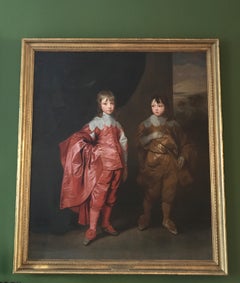
Double Portrait Oil Painting Brothers George, 2nd Duke Buckingham
Lord Francis
By (After) Anthony Van Dyck
Located in London, GB
Aftrer Anthony VAN DYCK - maybe Studio (1599, Antwerp – 1641, London) Flemish
Double Portrait of George Villiers, 2nd Duke of Buckingham (1628-1687) & Lord Francis Villiers (1629-1648)
Oil on Canvas
170 x 147 cm
Anthony Van Dyck (1599-1641)
No painter has done more to define an era than Anthony van Dyck. He spent only seven and a half years of his short life (1599- 1641) in England. He grew up in Antwerp, where his precocious talent was recognised by Peter Paul Rubens, the greatest painter of his age. He worked in Rubens’s studio and imitated his style as a religious artist, painting biblical scenes redolent of the lush piety of the counter-reformation. But soon he was on the move. In 1620, he visited London for a few months, long enough to paint a history picture, The Continence of Scipio, for the royal favourite, George Villiers, Marquess of Buckingham, and a portrait of his other English patron, the great art collector, Thomas Howard, 2nd Earl of Arundel.
After a stint in Italy, making imposing portraits of the wealthy aristocracy and sketching and copying works by Titian, he returned to the Spanish Netherlands in 1627, becoming court artist to Archduchess Isabella before departing for The Hague in 1631 to paint the Dutch ruler Frederick Henry, Prince of Orange. Charles I’s invitation in 1632 led Van Dyck back to London where he was knighted, paid an annual salary of £200 and installed in a house in Blackfriars with a special jetty at which the royal barge might tie up when the King was visiting his studio. By this time Van Dyck was recognised as the leading court painter in Europe, with Velazquez at the court of Philip IV of Spain his only rival. He also excelled as a superbly observant painter of children and dogs.
Van Dyck’s notoriety in depicting children led to the introduction of groups of children without their parents as a new genre into English painting (amongst other new genres).
For the next 300 years, Van Dyck was the major influence on English portraiture. Nearly all the great 18th Century portraitists, from Pompeo Batoni and Allan Ramsay to Thomas Gainsborough and Joshua Reynolds, copied Van Dyck’s costumes, poses and compositions.
George Duke of Buckingham & his brother Francis Villiers
Painted in 1635, this double portrait was originally commissioned by Charles I, who raised the two brothers after their father, George Villiers, was assassinated in 1628. Together with their sister, Lady Mary Villiers, they enjoyed the King’s favour absolutely. Francis whose absolute ‘inimitable handsomeness’ was noted by Marvell (who was killed in a skirmish near Kingston upon Thames). The young duke who commanded a regiment of horse at the Battle of Worcester, remained closely associated with Charles II, held a number of high offices after the Restoration and was one of the most cynical and brilliant members of the King’s entourage, immortalised as ‘Zimri’ in Dryden’s Absalom and Achitopbel. As a young man he had sold his father’s great collection of pictures in the Spanish Netherlands, many of them to the Archduke Leopold Willhelm.
Painted for Charles I and placed near the portrait of their sister in the Gallery at St James’ Palace. The handling of both costumes is very rich, and the heads are very carefully and sensitively worked. That of the younger boy in particular is more solidly built up than the lower part of the figure. A preparatory drawing for the younger boy is in the British Museum.
There are copies at, e.g., Highclere Castle...
Category
17th Century Old Masters Portrait Paintings
Materials
Oil
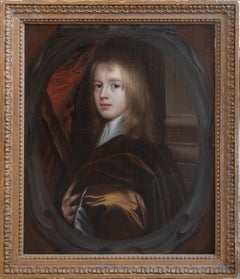
17th Century Oil Painting Portrait of a Young English Boy
By Gerard Soest
Located in London, GB
Gerard SOEST (1600 - 1681)
Portrait of a Young Boy
oil on canvas
35.5 x 30.5 inches inc. frame
Gerard Soest (circa 1600 – 11 February 1681), also known as Gerald Soest, was a portra...
Category
17th Century Old Masters Portrait Paintings
Materials
Oil
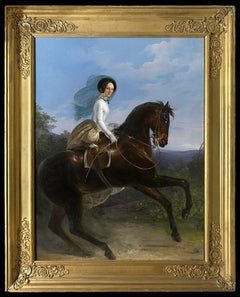
C19th Portrait Princesse de Joinville of Brazil - Spectacular fit for a palace
By Henri d
Ainecy Montpezat
Located in London, GB
Portrait of Princess de Joinville riding a Bay Horse
Henri d’Aincy, Le Comte Monpezat (French 1817-1859)
Painted circa 1837-9
oil on canvas
113 x 92 inches (including frame)
92 x 70 inches (unframed)
Provenance – from a private royal collection
This magnificent portrait depicts Princess de Joinville, the daughter of Pedro I, Emperor of Brazil and the King of Portugal. Through her illustrious family she was directly related Alexander III and Nicholas II of Russia and the Russian royal family, as well as to many of the great ruling families of Europe.
The work clearly confirms Monpezat as one of the most accomplished equestrian portrait painters in France in the early nineteenth century. In terms of scale, quality and dramatic power, it must surely be considered amongst his finest works. The stance of the powerful thoroughbred - in half rear - emphasises the calm nature and courage of the Princess.
Francisca of Brazil (1824-98) married a son of Louis Philippe I, the King of the French, and had three children. Born at the Imperial Palace of Saint Christopher, her youngest brother was the future Pedro II...
Category
1830s Old Masters Portrait Paintings
Materials
Oil
$293,134 Sale Price
20% Off
Free Shipping
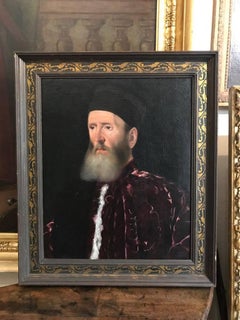
16th Century Italian Renaissance Old Master Portrait of a Procuratore
By Jacopo Bassano
Located in London, GB
Jacopo BASSANO (c. 1510-1592, Italian)
Portrait of a Procuratore
Oil on canvas
30 ¼ x 26 inches (including frame)
Provenance: Lucien Bonaparte’s Collection (as Portrait of Doge Priuli, Tiziano); Rich-mond, Virginia Museum, Portrait of Doge Lorenzo Priuli.
The painting is a portrait of a man half-length, on a black background. It is a three-quarter portrait, according to a custom very common in the genre of portraiture in sixteenth century. The man is wearing a decorated...
Category
16th Century Old Masters Portrait Paintings
Materials
Oil
$242,444 Sale Price
20% Off
Free Shipping
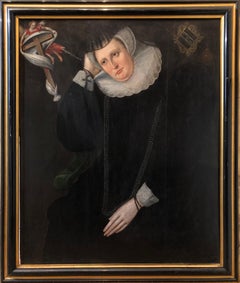
Lady Dormore - A 16th Century Portrait of a key member of Shakespeare
s England
Located in London, GB
Lady Dormer, Mary Browne
c. 1592
oil on panel
35 x 29 inches, unframed;
41 x 34.75 inches, inc. frame
Inscribed 'Lady Dormore'
Mary married Henry Wriothesley, 2nd Earl of Southampton who gave birth to Henry Wriothesley, 3rd Earl of Southampton - one of the great figures in Shakespears"s circle and founder of the Virginia company, developers of Virginia USA.
Henry Wriothesley, born 6 October 1573 at Cowdray House, Sussex, was the only son of Henry Wriothesley, 2nd Earl of Southampton, by Mary Browne, the only daughter of Anthony Browne, 1st Viscount Montague, and his first wife, Jane Radcliffe.[5] He had two sisters, Jane, who died before 1573, and Mary (c. 1567 – 1607), who in June 1585 married Thomas Arundell, 1st Baron Arundell of Wardour.[6]
After his father's death, Southampton's mother married firstly, on 2 May 1595, as his second wife, Sir Thomas Heneage (d. 17 October 1595), Vice-Chamberlain of the Household, and secondly, between 5 November 1598 and 31 January 1599, Sir William Hervey. She died in November 1607.[7]
Early life
When his father died on 4 October 1581 Southampton inherited the earldom and landed income valued at £1097 6s per annum. His wardship and marriage were sold by the Queen to her kinsman, Charles, Lord Howard of Effingham, for £1000. According to Akrigg, Howard then "entered into some further agreement, of which no documentation can now be found, which transferred to Lord Burghley personally the custody and marriage of the young Earl, but left Howard holding his lands", and late in 1581 or early in 1582 Southampton, then eight years of age, came to live at Cecil House in the Strand.[8]
In October 1585, at age twelve, Southampton entered St John's College, Cambridge,[9] graduating M.A. on 6 June 1589.[10] His name was entered at the Gray's Inn legal society before he left the university, and he was admitted on 29 February 1588.[11]
On Southampton's 16th birthday, 6 October 1589, Lord Burghley noted Southampton's age in his diary, and by 1590 Burghley was negotiating with Southampton's grandfather, Anthony Browne, 1st Viscount Montague, and Southampton's mother, Mary, for a marriage between Southampton and Lord Burghley's eldest granddaughter, Elizabeth Vere, daughter of Burghley's daughter, Anne Cecil, and Edward de Vere...
Category
16th Century Old Masters Figurative Paintings
Materials
Oil
Still Thinking About These?
All Recently ViewedMore Ways To Browse
18th Century Dutch Paintings
18th Century Painting Dutch
18th Century Military Portrait
17th C Dutch Portraits
18th Century Military Portrait
18th Century Portrait Of Lady By A Sweden
18th Century Scottish Portrait
Alois Priechenfried
Ambrose Mcevoy
Antoine Pesne
Charles Laval
Duke Of Manchester
Earl Of Coventry
Einstein Signed
Elizabeth Spencer
Emile Wauters
Emily Young
Flapper Girl Painting