Items Similar to Portrait of Lady Diana Bruce in Blue Dress
Cut Sleeves c.1660-1670, Peter Lely
Want more images or videos?
Request additional images or videos from the seller
1 of 15
Sir Peter LelyPortrait of Lady Diana Bruce in Blue Dress
Cut Sleeves c.1660-1670, Peter Lelycirca 1660-1670
circa 1660-1670
$12,461.85
£9,050
€10,583.76
CA$17,050.92
A$18,552.70
CHF 9,823.42
MX$223,201.62
NOK 124,735.60
SEK 114,124.34
DKK 79,075.40
About the Item
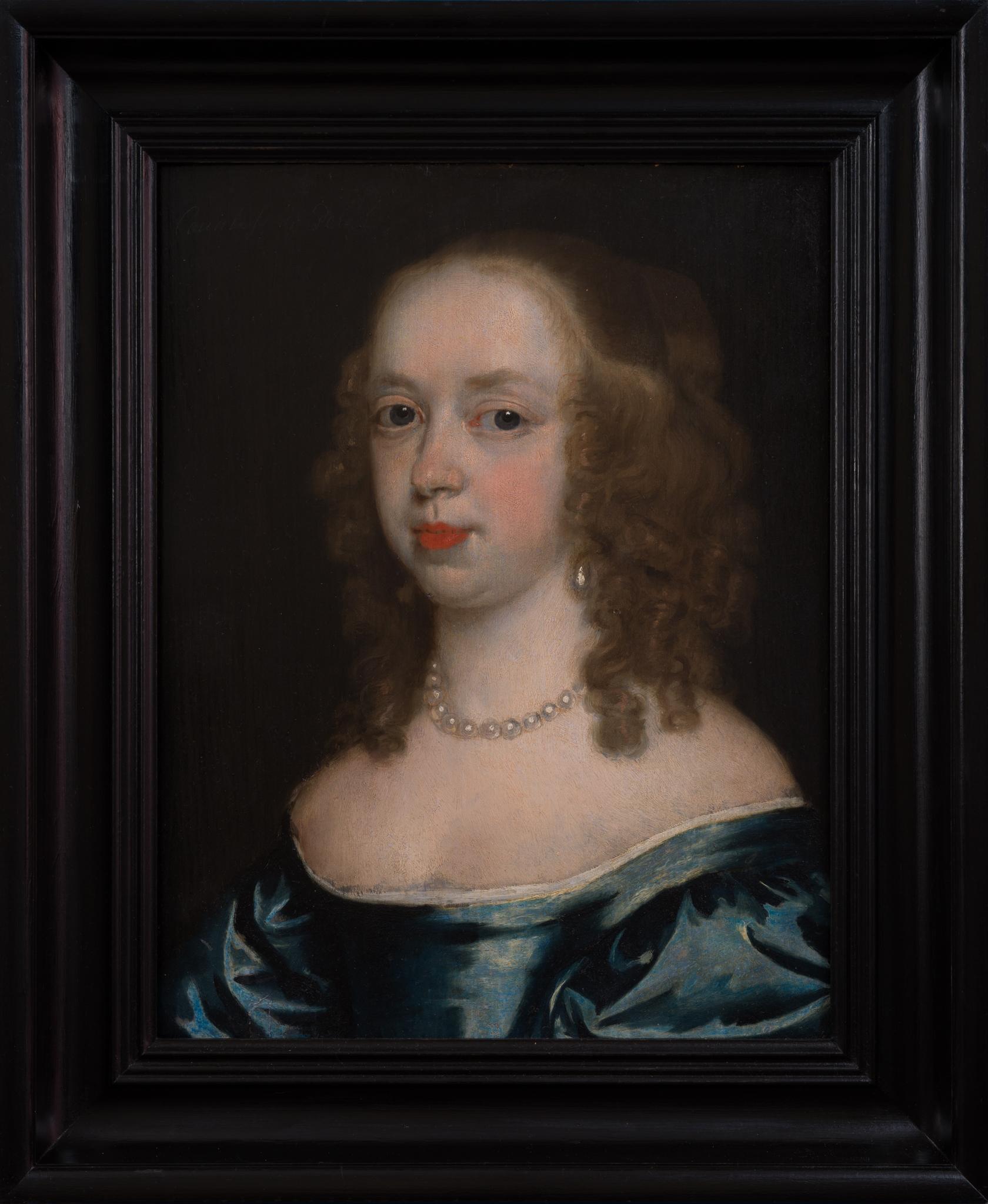
Portrait of Lady Diana Bruce in a Blue Dress with Cut Sleeves c.1660-1670
Circle of Sir Peter Lely (1616-1680)
Presented by Titan Fine Art is a captivating portrait of the noble Lady Diana Bruce; it is an exemplary work from the highly fashionable and influential circle of Sir Peter Lely. Created circa 1660-1670, this striking painting offers a rare glimpse into the opulent world of the English Restoration court and aristocracy, a period of cultural resurgence and political intrigue following the turbulent years of the English Civil War and the Interregnum.
The subject of this portrait is Lady Diana Bruce, a woman of truly remarkable lineage and social standing in the seventeenth century. Born around 1648, she was the daughter of Robert Bruce, 1st Earl of Ailesbury, and Lady Diana Grey. Her aunt was the ill-fated Lady Jane Grey (1537-1554), the nominal Queen of England for just nine days in 1553 during the tumultuous succession crisis following the death of King Edward VI.
Lady Diana's life was marked by two marriages and a tragically early death. On January 29, 1666, she married her first husband, Sir Seymour Shirley, 5th Baronet. They lived at the Shirley family seat, Staunton Harold Hall in Leicestershire. She bore him one son, Robert Shirley, who was born posthumously after Sir Seymour's death in 1667. She married her second husband, Sir John Manners (later 1st Duke of Rutland), on November 10, 1671. The couple resided at the historic Belvoir Castle in Leicestershire (see photo), the magnificent family home of the Manners family since 1067. Their time together was short-lived; Lady Diana tragically died there in childbirth on July 15, 1672, at the approximate age of 24. She was buried in the church at Bottesford, Leicestershire, where many members of the Manners family were interred. Her brief life, though constrained by the expectations for women of her rank to secure advantageous marriages and produce heirs, left a notable mark on the history of two prominent aristocratic families.
The Bruce, Shirley, and Manners Families
The Bruce family has a long and distinguished history, tracing its roots back to Robert the Bruce, King of Scots. The family rose to immense prominence, and her father was created 1st Earl of Ailesbury during the Restoration. The family's history intertwined with the highest levels of British peerage.
The Shirley family was an ancient and influential gentry family in Leicestershire, seated at Staunton Harold Hall from the fifteenth century. They were staunch Royalists and High Anglicans during the turbulent English Civil War and Commonwealth periods. Sir Robert Shirley, 4th Baronet (Lady Diana's first husband's relative), famously built a church on his estate in 1653, during a time when such acts of Anglican worship were suppressed by Oliver Cromwell's regime. This act of defiance led to his imprisonment in the Tower of London, where he died. Lady Diana married Sir Seymour Shirley, 5th Baronet, in 1666, briefly linking her Bruce lineage with this notably defiant Royalist family.
The Manners family, holders of the title Duke of Rutland, have been based at Belvoir Castle in Leicestershire since 1067. The castle itself, largely rebuilt over the centuries after destruction during conflicts like the Civil War, is a major symbol of aristocratic power and stability. John Manners, the man Lady Diana married as her second husband, was a Whig politician who played a role in the political landscape of the Glorious Revolution, temporarily hosting Princess Anne at Belvoir Castle during her flight from London. The family was known for its political influence and immense wealth, continuing to be prominent figures in British high society and politics for centuries.
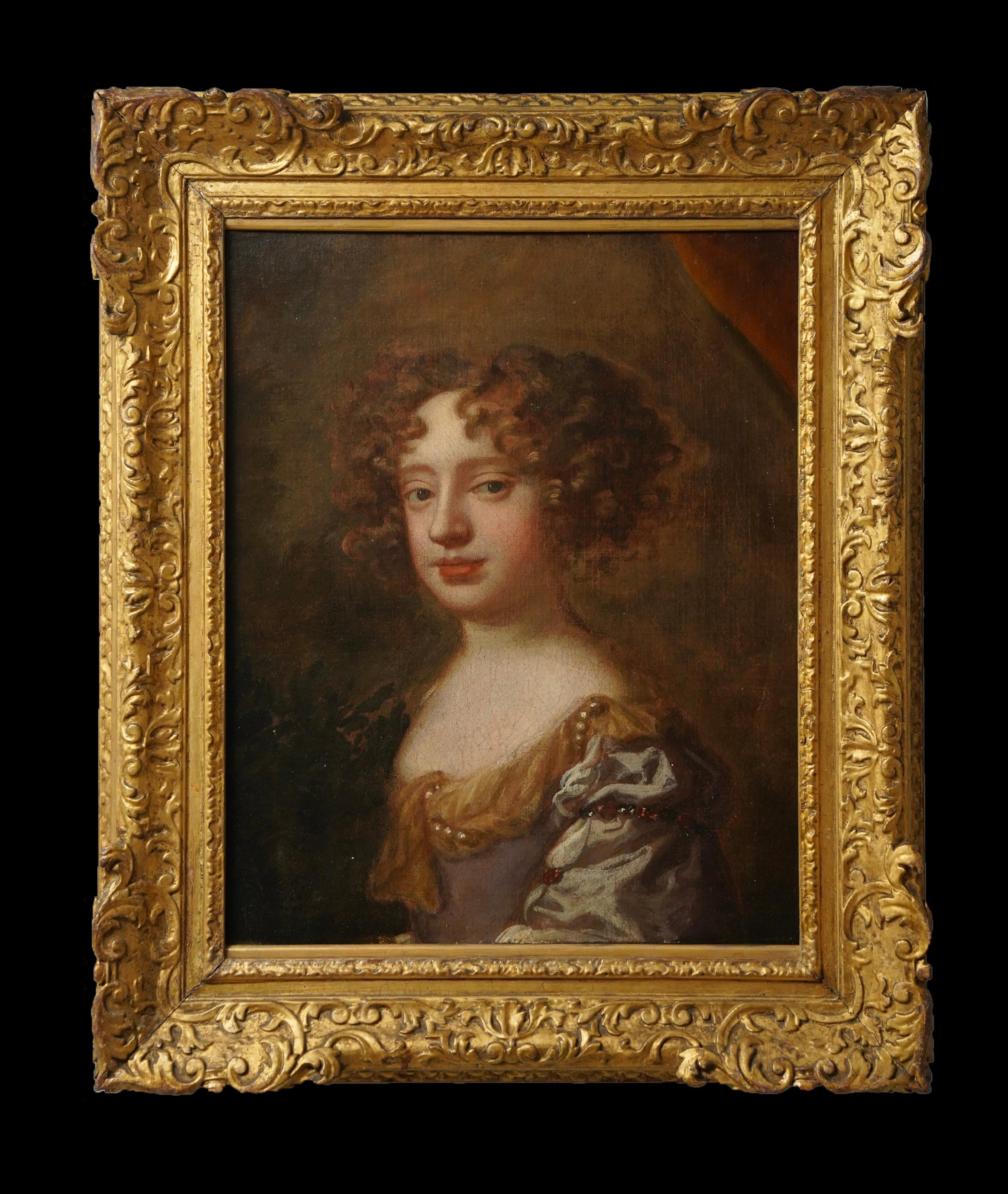
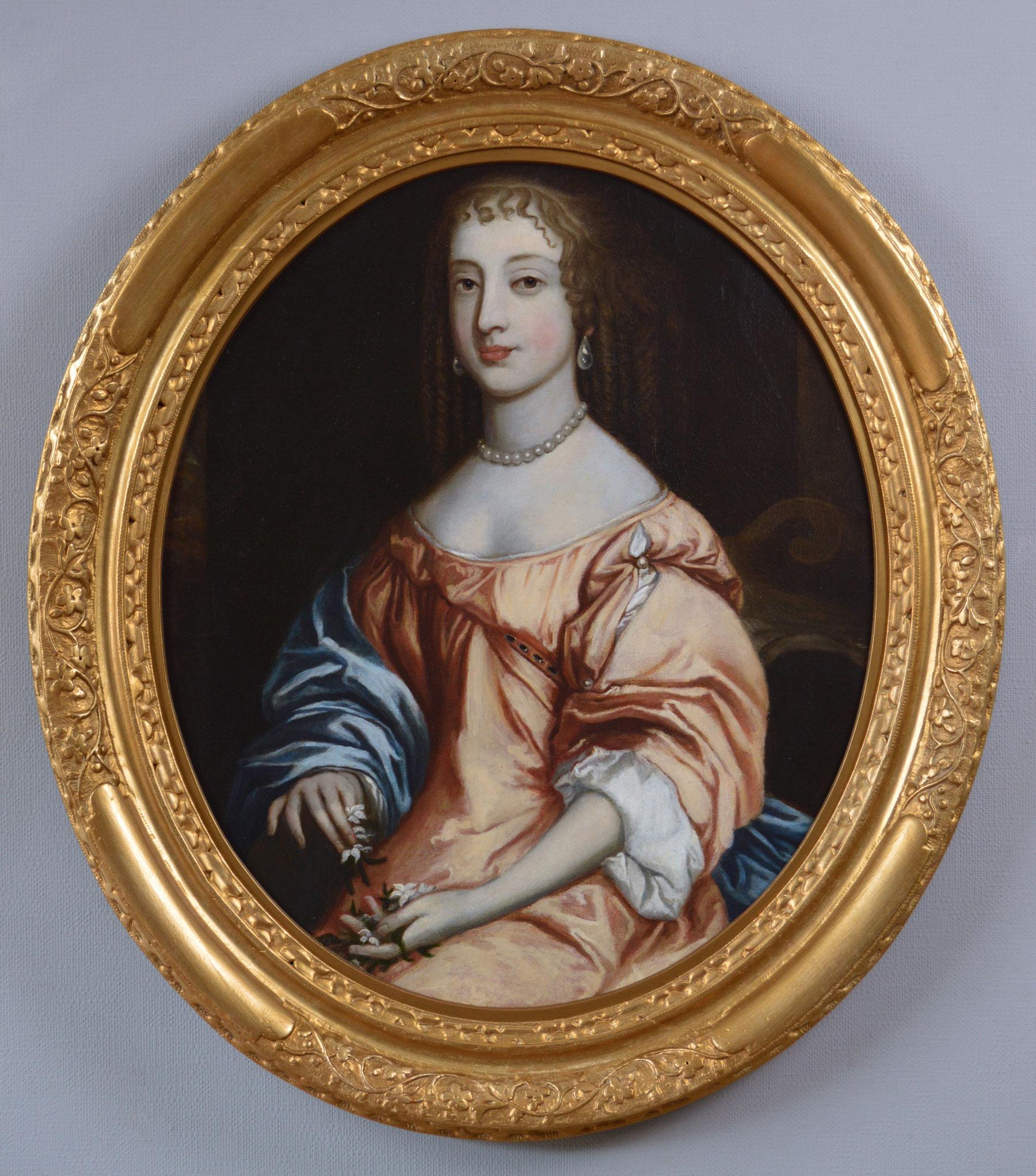
In this portrait, Lady Diana Bruce is presented in the height of Restoration fashion, a style popularised by Lely that emphasised wealth, elegance, and a studied languor. She wears a striking gown of shimmering blue silk or satin, a luxurious fabric that highlights her high social status. The vibrant blue pigment itself would have been costly. The dress features fashionable slashed sleeves and a low, décolletage neckline revealing a white chemise or undergarment beneath.
Her presentation is further enhanced by exquisite jewellery. She wears a prominent pearl necklace, a classic symbol of purity, status, and wealth in the seventeenth century. Pearls also adorn her hair, which is styled in the soft ringlets favoured at court. Her posture is formal yet relaxed, characteristic of Lely's "beauties." This cultivated image was crucial for aristocratic women; it projected stability, good taste, and an appropriate level of refinement, making the painting an important historical artifact illustrating the visual language of power and gentility of the era. A full-length version of this portrait is in the National Gallery Scotland.
This painting serves as a vital historical document, reflecting life in the English countryside during a transformative era. The Restoration period (1660-1700) was a time of immense social and political change. With the monarchy restored, the austere Puritan lifestyle of the Commonwealth period gave way to a more vibrant, pleasure-seeking culture. The aristocracy largely maintained their power and influence through their vast country estates. Life in the country for a noblewoman like Lady Diana would have involved managing a large household, social visits, and fulfilling familial duties, all within a hierarchical society that was still recovering from civil war. This portrait, in its elegance and formal pose, speaks to the stability and social order the restored monarchy sought to project.
As an exquisite piece from the circle of one of England's most important portraitists, this painting not only captures the likeness of a specific individual but also encapsulates the style, values, and history of the English Restoration. It is a work of art that resonates with historical significance and aesthetic mastery.
Sir Peter Lely (1618–1680), a Dutch-born artist who established his career in London, was the preeminent portrait painter of his era, serving as Principal Painter to King Charles II. Known for his technical proficiency and ability to capture an "air of sensuous languor," Lely defined the aesthetic of the Restoration court. His studio was a bustling enterprise, efficiently producing numerous portraits for high-ranking individuals. Lely often focused on the sitter's face, with skilled assistants completing the rest of the work, a common practice that allowed him to manage an immense workload. The present painting, produced within this dynamic circle, showcases the rich colour, masterful rendering of textiles, and elegance characteristic of Lely's style, a visual echo of the full-length version held in the collection of the National Galleries Scotland.
Provenance
The painting is documented to have been sold at Christie's, London, on May 17, 1935, listed as Lot 136, as: "Sir P. Lely, Portrait of a Lady, blue dress with pearl ornaments – in a painted oval". This established provenance adds another layer to its rich story, connecting it to a long tradition of art appreciation and collection.
Measurements: Height 88cm, Width 79cm framed (Height 34.5”, Width 31” framed)
Not signed
- Creator:Sir Peter Lely (1618 - 1680, Dutch)
- Creation Year:circa 1660-1670
- Dimensions:Height: 34.65 in (88 cm)Width: 31.11 in (79 cm)Depth: 2.37 in (6 cm)
- Medium:
- Movement Style:
- Period:
- Condition:The condition is very good and can be hung and enjoyed immediately. The painting has passed a strict condition assessment by a professional conservator prior to going on sale.
- Gallery Location:London, GB
- Reference Number:1stDibs: LU1199117213852
Sir Peter Lely
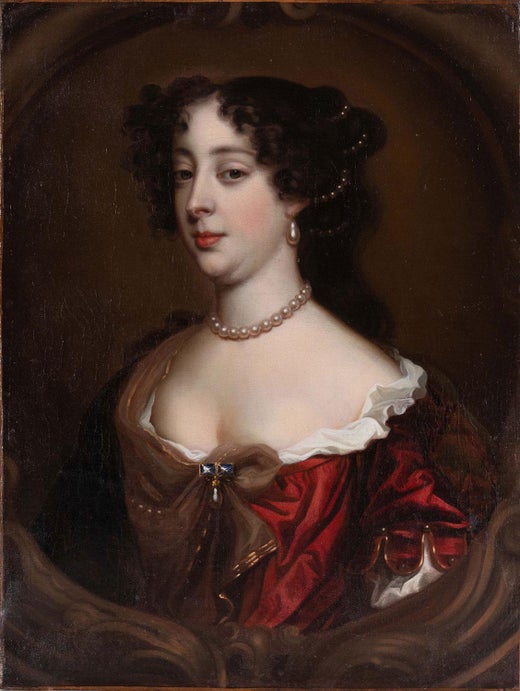
Sir Peter Lely (1618-1680) was born in Germany at Soest in Westphalia in 1618. Though his family name was van der Faes, he assumed the name Lely after the lily that was carved on the gable of his father’s home in The Hague. He moved to England in 1641, the year that Van Dyck died, and succeeded Van Dyck. He was court painter to Kind Charles I and King Charles II. By working for many of the patrons of the late van Dyck, Lely rapidly established himself as one of the country’s most important portrait painters.
About the Seller
5.0
Vetted Professional Seller
Every seller passes strict standards for authenticity and reliability
Established in 1998
1stDibs seller since 2019
45 sales on 1stDibs
- ShippingRetrieving quote...Shipping from: London, United Kingdom
- Return Policy
More From This Seller
View AllPortrait of Mary Hooper née Davie, Blue Dress, Seated in a Parkland, Provenance
By Jonathan Richardson the Elder
Located in London, GB
Portrait of Mary Hooper (née Davie) in a Blue Dress & Seated in a Parkland c. 1715–1725
Jonathan Richardson the Elder (1667–1745)
This portrait, presented by Titan Fine Art, is of p...
Category
18th Century Old Masters Portrait Paintings
Materials
Canvas, Oil
Portrait of Lady, Barbara Herbert, Countess of Pembroke c.1708, Large Painting
Located in London, GB
Portrait of Barbara Herbert, Countess of Pembroke c.1708
Charles d’Agar (1669-1723)
This magnificent large-scale portrait, presented by Titan Fine Art, depicts the British court of...
Category
17th Century Old Masters Portrait Paintings
Materials
Cotton Canvas, Oil
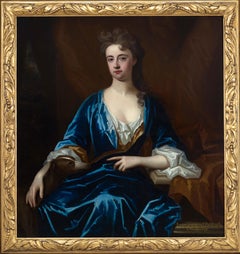
Portrait of Lady, Maria Therese of Spain, Queen of France, 17th Century Panel
Located in London, GB
Portrait of Maria Therese of Spain, Queen of France, 17th Century
Circle of Henri and Charles Beaubrun
Not signed
This distinguished seventeenth-century portrait of Maria Theresa o...
Category
17th Century Old Masters Portrait Paintings
Materials
Oil, Wood Panel
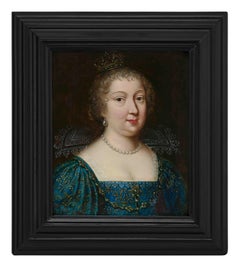
Portrait of lady, Mary Hammond in Rich Attire, Jewels, Lace c.1618-22 Historical
By Cornelius Johnson
Located in London, GB
Portrait of Mary Hammond in Sumptuous Attire, Jewels and Lace c.1618-22
Circle of Cornelius Johnson (1593-1661)
This portrait of a lady, presented by Titan Fine Art, is an exquisite example of early seventeenth-century portraiture, remarkable both for the lavishness of its subject’s attire and for the distinguished provenance that has accompanied it across four centuries that adds a rich layer of historical significance. It was once part of the notable collection of Sir William Temple, 1st Baronet (1628–1699) at Moor Park, a stately mansion in Hertfordshire. Temple was a diplomat, essayist, philosopher, and the patron of Jonathan Swift. He was a key participate at an important period in English history, helping not only to negotiate the Triple Alliance, but also the marriage between William of Orange and Princess Mary. His collection at Moor Park was well known in its day, reflecting both his cultivated taste in art and literature and his international connections.
Its fabulous attire, rendered with almost microscopic attention, is not merely decorative but emblematic of a world in which visual display was a language of power. Its provenance, stretching from the English country house and Enlightenment scholarship to modernist circles, forms a microcosm of cultural exchange across four centuries. Thus, the portrait of Mary Hammond stands as both a masterpiece of early seventeenth-century craftsmanship and a witness to the grand narrative of collecting and connoisseurship—a testament to the enduring fascination of beauty, status, and history intertwined.
By tradition the portrait depicts Mary Hammond (born c.1602), who was Sir William Temple’s mother, and the daughter of the royal physician who served James I, Dr John Hammond (c.1555–1617) and whose family owned Chertsey Abbey in Surrey. The woman appears between 18 and 25 years old, and Mary would be about 18–20 when the portrait was painted circa 1620, therefore this matches the apparent age of the sitter and the fashion perfectly.
Mary stood at the intersection of learned/courtly and gentry worlds. On 22 June 1627 she married her first cousin (a common practice for consolidating family wealth and influence during that era.) Sir John Temple (1600-1677) at St Michael, Cornhill in the City of London. The couple resided nearby, at Blackfriars. Her marriage to Sir Temple placed her at the heart of the social and political circles that shaped British history.
The couple had at least five children, and they became highly significant historical figures:
The eldest son, Sir William Temple, 1st Baronet, became a distinguished diplomat, statesman, and essayist, famous for his role in the Triple Alliance and as a patron and mentor to the writer Jonathan Swift – our portrait was in his collection. Their daughter, Martha Temple, later Lady Giffard, was a notable figure in her own right. She became her brother William's first biographer and a respected letter-writer, providing a rare female perspective on the events and high society of the time. Another son, also named Sir John Temple, became Attorney General for Ireland and was involved in the turbulent politics surrounding the English Civil War and the Act of Settlement in Ireland.
Mary died in November 1638 after giving birth to twins and was buried at Penshurst, Kent. The family's connection to Penshurst Place is a major point of interest as this historic manor was the seat of the Sidney family, a major aristocratic and literary dynasty.
The portrait was in the collection of the Mary’s son, Sir William Temple. From there it descended to his daughter, and then to her nephew, the Reverend Nicholas Bacon of Spixworth Park, Norfolk (his mother was Dorothy Temple who died in 1758). Indeed, by this time, many Temple relics were in the collection at Spixworth including the engagement ring of the illustrious Dorothy Osborne, Lady Temple, wife of Sir William Temple. The portrait thus linked two prominent English families—the Temples and the Bacons—for generations. It is listed in a Spixworth Park inventory of 27 October 1910 by the local collector and art historian, Prince Duleep Singh. He described it with characteristic precision as: “No. 69. Lady Half Length, body and face turned towards the sinister, hazel eyes upwards to the dexter, red hair dressed low and over the ears, a jewelled coronet behind, pearl ear-rings tied with black strings. Dress: black, bodice cut low and square, with lace all round the opening and over shoulders, sleeves with double slashes showing red lining and lace under, falling thin pleated lace collar, black strings tied behind it, a jewel suspended on a black string round the neck, and a double row of agate and silver beads all round to the shoulders. M. In brown veined stone frame. Age 30. Date c.1620. It is called ‘Dutch portrait from Moor Park, mentioned by Nicholas Bacon of Coddenham and Shrubland as a very valuable painting.’
A few years later, when Robert Bacon Longe’s executors sold the contents of Spixworth Park (19–22 May 1912), the portrait appeared as lot 262, described as: “A very valuable half-length portrait on panel, ‘Dutch Lady, with deep lace collar and pearl and amethyst necklace, pendant, and ear-rings, and auburn hair, with coronet’ Early Dutch School 1620.” Following this sale the painting entered the collection of David and Constance Garnett, prominent literary figures of the early twentieth century, before being gifted to Andre Vladimervitch Tchernavin by 1949, and subsequently passed by him to the present owners in 1994.
The two great houses associated with the painting, Moor Park and Spixworth Park, further underscore its pedigree. Moor Park, in Hertfordshire, was among the grandest country estates of seventeenth-century England—its gardens famously redesigned by Sir William Temple himself and later influencing landscape design across Europe. Sir William's Temple's secretary was Jonathan Swift, who lived at Moor Park between 1689 and 1699. Swift began to write "A Tale of the Tub" and "The Battle of the Books" at Moor Park.
Spixworth Park, near Norwich, was an Elizabethan country house in Spixworth, Norfolk, located just north of the city of Norwich. It was home to successive generations of the Bacon family, one of Norfolk’s most distinguished dynasties (later, the Bacon Longe family), who were considerable land owners (owning Reymerston Hall, Norfolk, Hingham Hall, Norfolk, Dunston Hall, Norfolk, Abbot's Hall, Stowmarket, and Yelverton Hall, Norfolk). Spixworth Hall and the surrounding parkland remained in the Longe family for 257 years until 1952, when it was demolished.
Rendered with meticulous precision and sumptuous detail, the painting depicts an elegantly dressed woman—her poise, costume, and jewels all communicating a message of wealth, refinement, and social rank. Every brushstroke conveys an artist deeply attuned to the textures of luxury and the nuances of feminine dignity.
The sitter’s attire is nothing short of magnificent. Her bodice and sleeves are fashioned from the finest black silk or satin, the fabric absorbing and reflecting light in equal measure, suggesting both depth and lustre. Around her shoulders lies an opulent lace ruff—a deep, radiating lace collar worked in such intricate detail that it testifies to both the artist’s technical skill and the sitter’s extravagant taste. Lace of this quality, especially Venetian or Flemish bobbin lace, was one of the costliest materials available in early seventeenth-century Europe, its weight worth more than gold, and was a marker of prestige that rivalled jewels in value. The painter has taken great care to delineate every loop and scallop of the lace, achieving an almost tactile realism. Pale skin was also a desired beauty standard, sometimes accentuated with contrasting black ribbons or strings.
Her jewels amplify this display of affluence. Matching earrings and a delicate coronet or jewelled hair ornament with a feather adorn her hair, which is styled in the modest yet fashionable manner of the time. These details are far from decorative excess—they serve as visual emblems of social standing, refinement, and lineage. Portraits of this kind were statements of both identity and aspiration, intended to project a family’s prosperity and moral virtue to posterity.
The portrait was most likely painted in London around 1618-1622. The low-cut, décolletage-revealing neckline was fashionable in the courts of England and France during the late Elizabethan and Jacobean eras (c. 1590s-1610s), this style did not prevail in the public fashion of the Low Countries at this time. This style of lace ruff — delicate needle lace with geometric openwork — was fashionable from c.1615 to 1622, and the jewelled caul (hair net) and lace edging over a stiffened coif are consistent with high-status English women’s portraiture between 1610–1620. The puffed sleeve slash and the use of pink satin beneath black velvet belong squarely to the late Jacobean...
Category
17th Century Old Masters Portrait Paintings
Materials
Oil, Panel
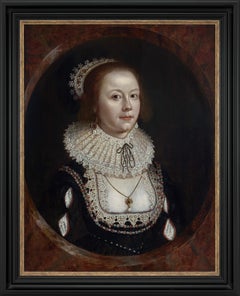
Portrait of a Lady, Mrs Wray in a Silk Dress
Pink Wrap c.1698, Oil on canvas
By Michael Dahl
Located in London, GB
Portrait of a Lady, Mrs Wray in a Silk Dress & Pink Wrap c.1698
Circle of Michael Dahl (1659-1743)
This delightful work, presented by Titan Fine Art, is a fine example of British po...
Category
17th Century Old Masters Portrait Paintings
Materials
Cotton Canvas, Oil
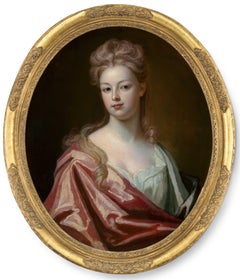
Portrait of a Young Lady in White Dress, probably British c. 1730–1740, painting
Located in London, GB
Portrait of a Young Lady, probably British c.1730–1740
Attributed to Jeremiah Davison (c. 1695–1745)
What makes this portrait immediately compelling is its directness: the sitter’s ...
Category
18th Century Old Masters Portrait Paintings
Materials
Oil, Canvas
You May Also Like
English 17th century portrait of a lady
By Sir Peter Lely
Located in Bath, Somerset
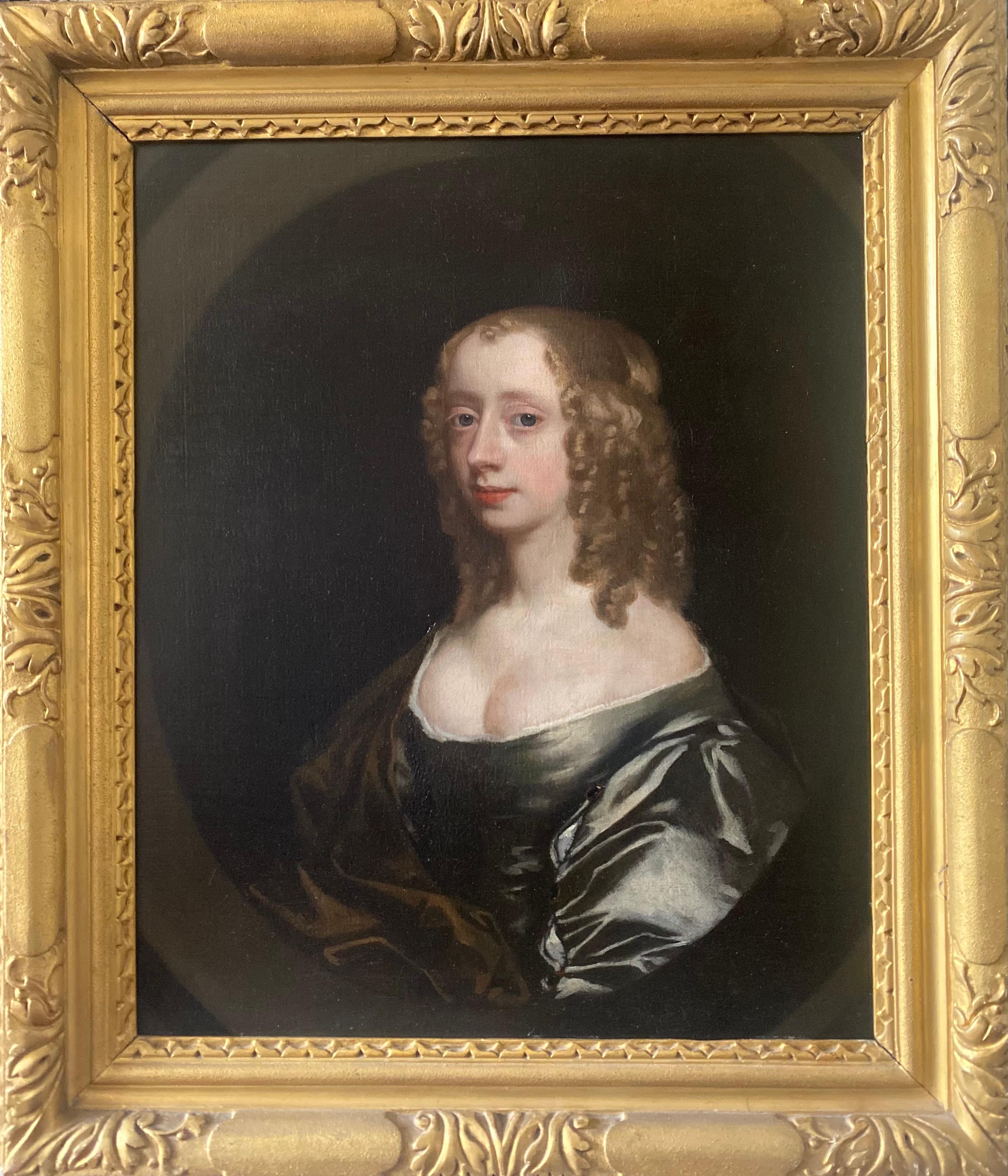
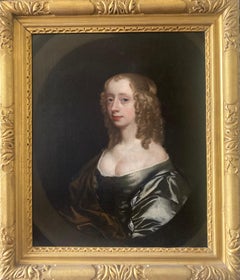
A 17th century English portrait of a lady by Sir Peter Lely (1618-1680), half-length in a painted feigned oval, wearing a green silk gown with chestnut coloured cloak over one shoulder, her fair hair curled in the fashionable ringlet style of the period. Oil on canvas in an English giltwood 'Lely' frame.
We are grateful to Diana Dethloff and Catharine MacLeod (who are currently working on a Lely catalogue raisonné) for their confirmation of Lely as the artist from photograph analysis of this previously unidentified early work.
Provenance:
Private collection Nottingham until 2021
Mellors and Kirk sale December 2000, lot 1173
The sitter is likely to have been from an upper class or aristocratic family in court circles, who were the main source of Lely`s patronage. The simple composition serves to highlight the beauty of the sitter through portraying her pale decolletage and complexion, set against the gentle gaze of her blue eyes, the soft blush of her cheeks and her full red lips.
Peter Lely (1618-1680) was originally of dutch origin and became Principle Painter to the King in 1661, following in the footsteps of Van Dyck who had died in 1641. He dominated the portrait painting scene in England for over 20 years, creating a distinctive 'court look' in his work which had a strong influence on many other artists. He had an extremely successful and popular portrait practice which meant that he soon had to develop production methods that could accommodate the high demand for portraits, and also for copies and versions of them which were given as gifts to family and courtiers. The use of studio assistants was a common practice for busy artists and as with Van Dyck, Lely is known to have used specialist assistants to execute particular parts of his paintings. Artists who worked in Lely`s studio included John Baptist Gaspars who specialised in drapery painting, William Wissing, John Greenhill...
Category
17th Century Baroque Portrait Paintings
Materials
Canvas, Oil
$24,235 Sale Price
20% Off
Portrait of Bridget Drury Lady Shaw, formerly Viscountess Kilmorey
By Sir Peter Lely
Located in London, GB
Sir Peter Lely (Soest 1618 – 1680 London)
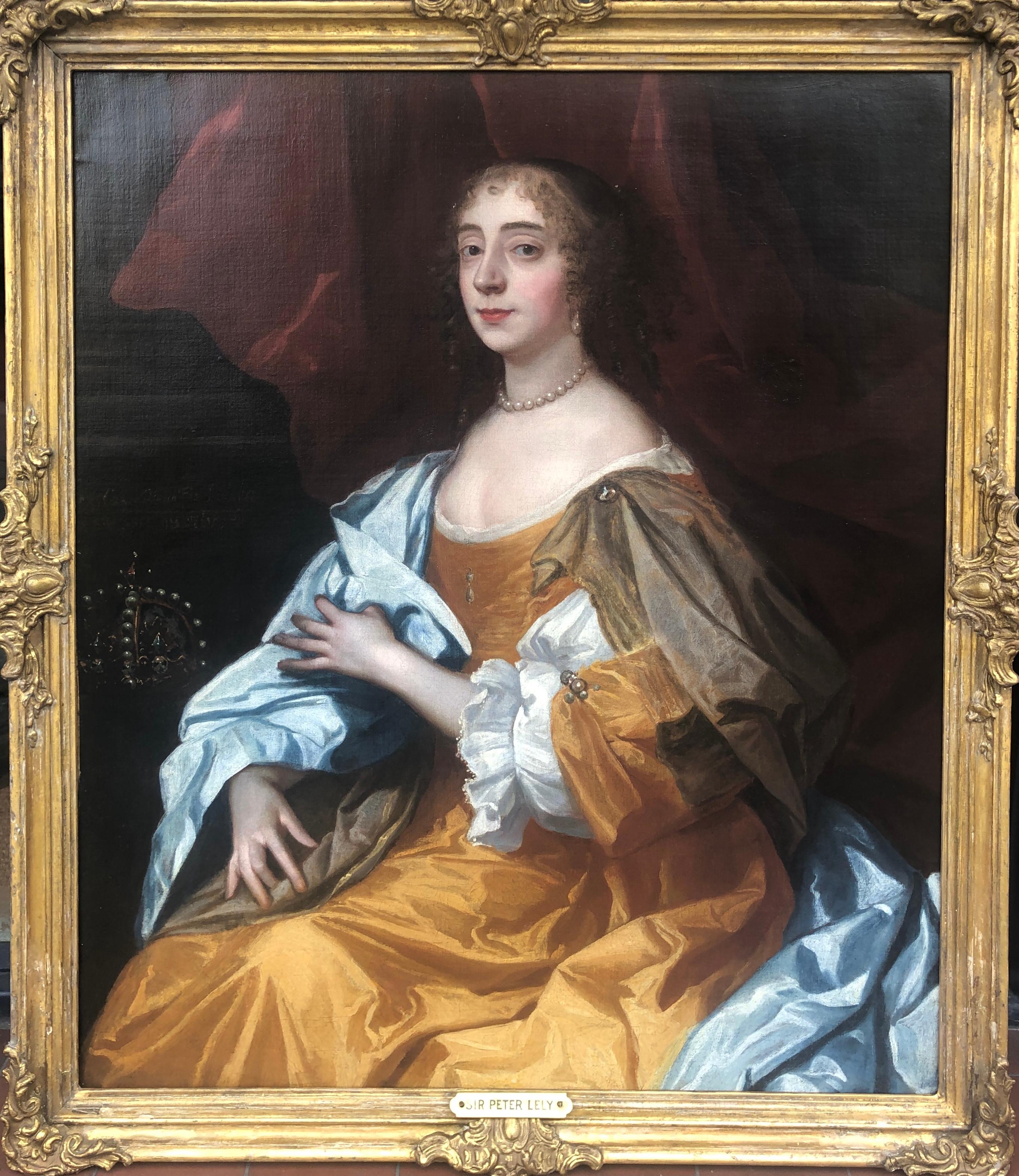
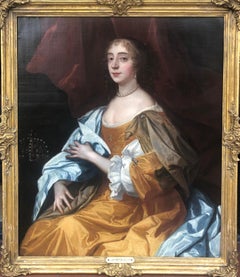
Portrait of lady with a crown, possibly Bridget Drury Lady Shaw, formerly Viscountess Kilmorey, later Lady Baber (d.1696) c.1665
Oil on canvas
46 1/2 x 40 3/4 inches, Framed
42 1/4 x 36 1/4 inches, Unframed
Inscribed left [……….]Isabella
James Mulraine wrote the following for this piece:
This portrait dates to the middle of the 1660s, the decade when Lely’s career took off as successor to Sir Anthony van Dyck. At the Restoration Charles II had appointed him Principal Painter to the King and paid a pension £200 per annum ‘as formerly to Sr. Vandyke...’1 Lely had trained in Haarlem and he was in his early twenties when he came to London in 1643. He was an astute businessman and a wise courtier. In 1650 he painted a portrait of Oliver Cromwell (Birmingham Museum and Art Gallery) while maintaining links with the Royalist exiles through the 1650s. He had arrived in England as a painter of small-scale portraits and lush scenes of nymphs in landscapes in a Dutch style. His experience of Van Dyck in English collections transformed his painting. His lavish and alluring vision of Arcadia exactly captured the spirit of the Court and as Principal Painter he dominated English portraiture for the next twenty years. Lely ran a highly efficient studio along Netherlandish lines, employing a team of specialists like the drapery painter John Baptist Gaspars and young artists-in-training like Nicolas de Largilliere. He had numerous rivals during that period, and by 1670 he had introduced numbered standard poses to speed up production, while collaborating with printmakers for further revenue and advertising. He died in 1680 of a stroke while painting, working to the last.
The portrait, painted at a date when Lely’s poses and execution were still individual and inventive shows a lady sitting at three-quarter length facing away from the viewer. She has begun to turn towards the viewer, a pose with a long pedigree in art, first used by Leonardo da Vinci in the Mona Lisa (Louvre). She steadies her blue drapery where it might slip from her arm with the movement, a flash of realism beautifully captured. Like Van Dyck, Lely painted his female sitters in a timeless costume rather than contemporary fashion, showing a loose gown and floating silk draperies. It presented the sitter as a classical ideal. The portrait would not date.
The saffron dress may be the work of a drapery painter but the brown scarf must be by Lely himself, and appears unfinished, broadly sketched in behind the shoulder. The delicate blue glaze and nervous highlights suggest shimmering translucence. Lely was a master of painting hands – his hand studies are marvels of drawing – and the lady’s hands are superb, exactly drawn, delicately modelled and expressive. The fidgety gestures, clutching the gown, fiddling with the edge of the scarf, give the portrait psychological bite, suggesting the personality behind the calm courtier’s expression, adding to the sense shown in the look of the eyes and mouth that the lady is about to speak. The portrait’s language is Vandykian. The inspiration comes directly from Van Dyck’s English portraits of women. Lely owned Van Dyck’s Portrait of Lady Elizabeth Thimbleby and Dorothy Viscountess Andover (National Gallery, London) and the sitter’s costume quotes Lady Andover’s saffron dress and brown scarf. But Lely paints a generation who sat nearer to the ground and through a dialogue of expression and gesture he shows sitters who are more flesh and blood than Van Dyck’s.
The background with a column and curtain is different to those shown in most of Lely’s portraits of women. They tend to include trees or fountains, with a glimpse of landscape. But there are other examples. A portrait of the King’s reigning mistress, Barbara Villiers Duchess of Cleveland...
Category
1660s Portrait Paintings
Materials
Oil
$71,603 Sale Price
20% Off
Free Shipping
Portrait of a lady in blue dress ”Countess of Peterborough”
Located in Stockholm, SE
This exquisite portrait, with its new attribution to Theodore Russel, is believed to depict Lady Penelope O'Brien, daughter of Barnabas O'Brien, the sixth Earl of Thomond, and wife of the Earl of Peterborough, whom she married in 1644. The painting thus belongs to a historically significant period, capturing the refined elegance of the time.
The portrait has a prestigious provenance from Elleholms Hofgård, a historic estate in Mörrums socken, Blekinge, Sweden. Elleholms Hofgård, whose two-story, timber-framed main building was constructed in 1730 and expanded in 1804, has changed ownership several times since the 17th century. The ancestors of the present owners acquired the estate in 1915, and from the 20th century until 2023, this painting was prominently displayed in the estate’s main building, making it an integral part of the estate’s history.
Theodore Russel, an English portrait artist born in 1614, studied under the renowned Sir Anthony van Dyck, whose influence can be seen in Russel’s meticulous style. Russel often painted on cabinet-sized panels, such as this one, which measures approximately 39 x 31 cm. This preference for panels is a notable characteristic that sets him apart from contemporary artists like Sir Peter Lely, who exclusively used canvas. The size of the panel is a key reason for the reattribution to Russel from Peter lely, as Lely never used panels for his works. This distinctive format, along with Russel’s characteristic style, strongly supports the new attribution.
Russel, the son of Nicasius Rousseel, a goldsmith and jeweler to James I and Charles I, refined his skills under the mentorship of his uncle, the famous portrait painter Cornelis Janssen. He also worked as an assistant and copyist for van Dyck, further honing his artistic style. This captivating portrait exemplifies Russel’s craftsmanship, reflecting the elegance of the period’s fashion and the artist's refined techniques.
oil on wood panel
with indistinct inscription Countess of Peter[...] upper left.
with inscription on the reverse: ”Countess of Peterborough. P. Lely 1670. S Beatty Picture Restorer [...] Warwick”.
unframed 39 x 31 cm = 15.35 x 12.2 inches
framed 52 x 41.5 cm = 20.47 x 16.34 inches
Condition:
The portrait has just been restored by a professional art conservator in Stockholm and is now in a very good condition. The colors are vivid, and the skin tones appear more natural than before. It is a very fine painting. The frame is newly made and included.
Provenance:
Elleholms Hofgård, Mörrums socken, Blekinge, Sweden **;
Stockholms Auktionsverk, Fine Art & Antiques Autumn...
Category
17th Century Old Masters Portrait Paintings
Materials
Oil, Wood Panel
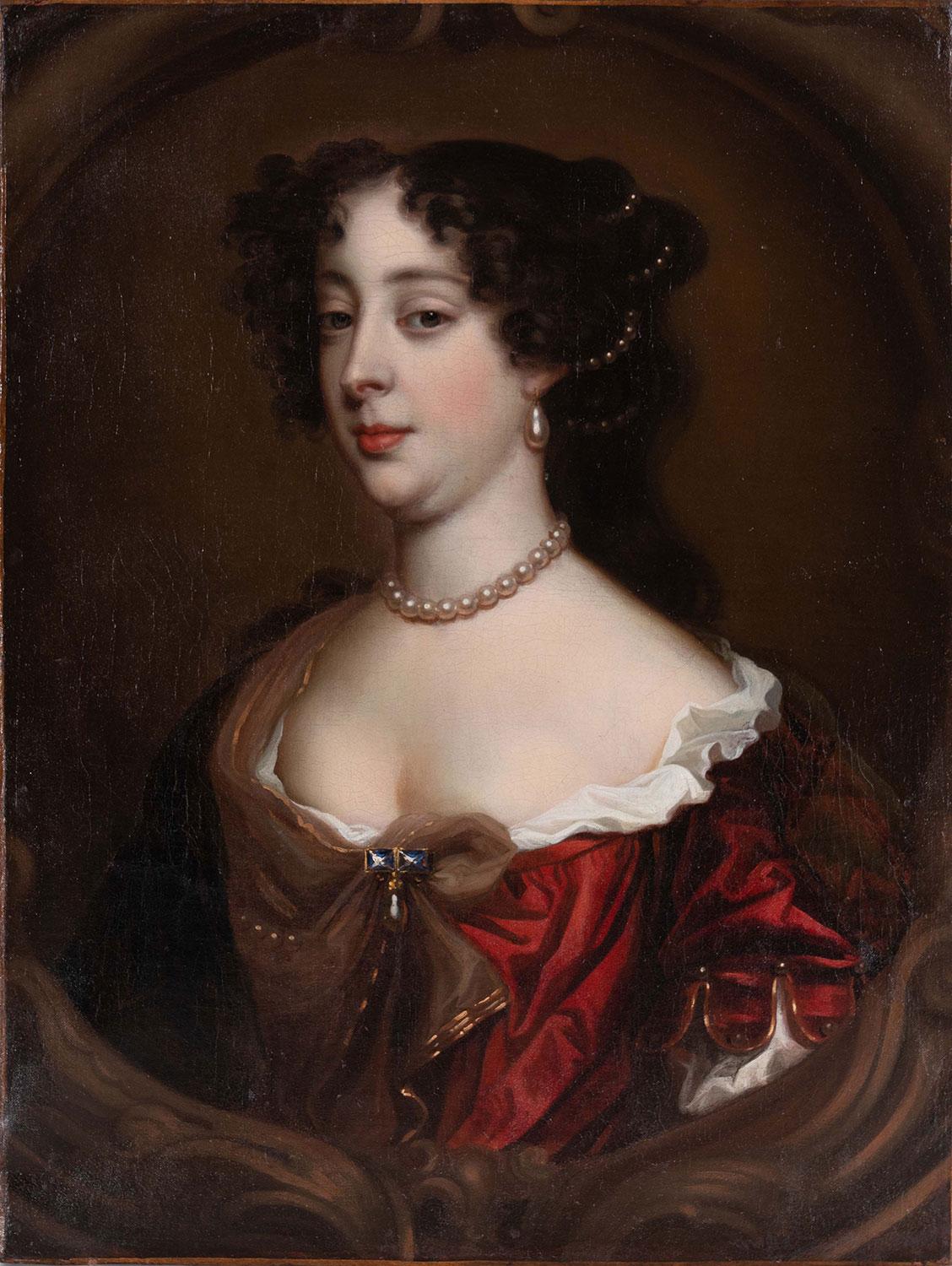
Portrait of Barbara Palmer 1st Duchess of Cleveland
By Sir Peter Lely
Located in Taunton, GB
Portrait of Barbara Palmer 1st Duchess of Cleveland 1640-1709, half-length wearing a red dress and portrayed within a cartouche.
Circa 1680
Oil On...
Category
17th Century Portrait Paintings
Materials
Oil
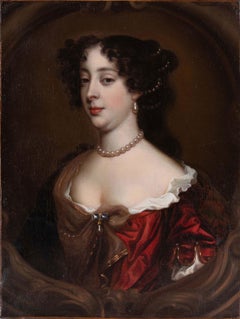
Studio of Sir Peter Lely, Portrait of Lady Anne (later Queen Anne)
By Studio of Sir Peter Lely
Located in Oxford, GB
Studio of Sir Peter Lely (1618-1680)
Portrait of Lady Anne (1665–1714), later Queen
Oil on canvas
20⅞ x 16¾ in.
c.1678
Provenance
Capt. H. A. N. Forte of Polock, West Somerset;
Chri...
Category
17th Century Old Masters Portrait Paintings
Materials
Oil
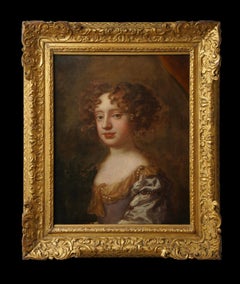
17th Century portrait oil painting of a lady
Located in Nr Broadway, Worcestershire
Circle of Sir Peter Lely
Dutch, (1618-1680)
Portrait of a Lady, traditionally identified as Princess Henrietta Anne Stuart
Oil on canvas
Image...
Category
17th Century Portrait Paintings
Materials
Canvas, Oil
