Want more images or videos?
Request additional images or videos from the seller
1 of 6
Sir William Beechey18th Century Portrait Painting of a Young Girl Wearing a Pink Bonnetc.1780
c.1780
$5,824.30List Price
About the Item
- Creator:Sir William Beechey (1753 - 1839, British)
- Creation Year:c.1780
- Dimensions:Height: 11.42 in (29 cm)Width: 9.65 in (24.5 cm)
- Medium:
- Movement Style:
- Period:1780-1789
- Condition:
- Gallery Location:Bath, GB
- Reference Number:1stDibs: LU9526754522
About the Seller
5.0
Vetted Professional Seller
Every seller passes strict standards for authenticity and reliability
Established in 2002
1stDibs seller since 2015
37 sales on 1stDibs
Associations
The British Antique Dealers
AssociationLAPADA - The Association of Arts
Antiques DealersInternational Confederation of Art and Antique Dealers
Associations
Authenticity Guarantee
In the unlikely event there’s an issue with an item’s authenticity, contact us within 1 year for a full refund. DetailsMoney-Back Guarantee
If your item is not as described, is damaged in transit, or does not arrive, contact us within 7 days for a full refund. Details24-Hour Cancellation
You have a 24-hour grace period in which to reconsider your purchase, with no questions asked.Vetted Professional Sellers
Our world-class sellers must adhere to strict standards for service and quality, maintaining the integrity of our listings.Price-Match Guarantee
If you find that a seller listed the same item for a lower price elsewhere, we’ll match it.Trusted Global Delivery
Our best-in-class carrier network provides specialized shipping options worldwide, including custom delivery.You May Also Like
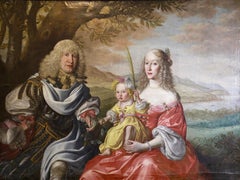
SIMON PETER TILEMANN, Family Portrait, 1658, Old Master. Baroque Rococo Painting
By Simon Peter Tilemann
Located in Berlin, DE
Extremely decorative and large oil painting from the 17th century.
Restored in places.
Signed and dated Simon Peter Tileman 1658 fecit 'lower right
Dimensions without frame.
From Wikipedia, the free encyclopedia:
Simon Peter Tilemann (1601, Lemgo – 1668, Vienna), was a German Baroque painter who was active Bremen, Kassel and Italy.
According to Houbraken he first learned to paint flowers and he had a daughter who could paint flowers in watercolors. He was a good landscape painter who spent many years in Italy, but later switched to portrait painting and who painted the portrait of Ferdinand...
Category
1650s Old Masters Portrait Paintings
Materials
Canvas, Oil
$39,941 Sale Price
20% Off
H 54.73 in W 72.45 in
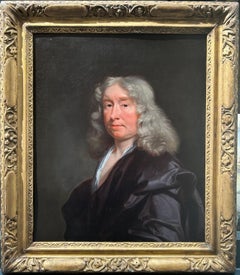
Portrait of William Chiffinch
By John Riley
Located in London, GB
John Riley
1646 – 1691
Portrait of William Chiffinch (c.1602-88)
Oil on canvas
Image size: 30 x 25 inches
Original frame
Another version of this can be found in the Dulwich Pictur...
Category
1680s Old Masters Portrait Paintings
Materials
Canvas, Oil
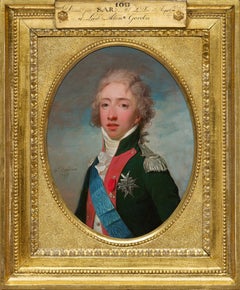
Two royal portraits (the Duc d
Angoulême and the Duc de Berry) by H.P. Danloux
Located in PARIS, FR
These two royal portraits are a major historical testimony to the stay of the Comte d'Artois (the future Charles X) and his family in Edinburgh in 1796-1797. Given by the sitters to Lord Adam Gordon, the Governor of Edinburgh, and kept by family descent to this day, these two portraits provide us with a vivid and spontaneous image of the Duc d’Angoulême and his brother the Duc de Berry. Danloux, who had emigrated to London a few years before, demonstrate his full assimilation of the art of British portrait painters in the brilliant execution of these portraits.
1. Henri-Pierre Danloux, a portraitist in the revolutionary turmoil
Born in Paris in 1753, Henri-Pierre Danloux was first a pupil of the painter Nicolas-Bernard Lépicié (1735 - 1784) and then, in 1773, of Joseph-Marie Vien (1716 - 1809), whom he followed to Rome when, at the end of 1775, Vien became Director of the Académie de France. In Rome he became friends with the painter Jacques-Louis David (1748 - 1825).
Returning to France around 1782, he settled in Lyon for a few years before returning to Paris in 1785. One of his first portraits was commissioned by the Baroness d'Etigny, the widow of the former Intendant of the Provinces of Gascony, Bearn and Navarre Antoine Mégret d'Etigny (1719 – 1767). He then became close to his two sons, Mégret de Sérilly and Mégret d'Etigny, who in turn became his patrons. In 1787, this close relationship with the d'Etigny family was further strengthened by his marriage to Antoinette de Saint-Redan, a relative of Madame d'Etigny. After his marriage, he left for Rome and did not return to France until 1789. It was during the winter of 1790-1791 that he painted one of his masterpieces, the portrait of Baron de Besenval. Set in a twilight atmosphere, this portrait of an aristocrat who knows that his death is imminent symbolizes the disappearance of an erudite and refined society which would be swept away by the French Revolution.
The Jacobin excesses led Danloux to emigrate to England in 1792; many members of his family-in-law who remained in France were guillotined on 10 May 1794. Danloux enjoyed great success as a portrait painter in England before returning to France in 1801.
During his stay in England, Danloux was deeply under the influence of English portraitists: his colors became warmer (as shown by the portrait of the Duc d'Angoulême that we are presenting), and his execution broader.
2. Description of the two portraits and biographical details of the sitters
The Duc d'Angoulême (1775-1844) was the eldest son of the Comte d'Artois, the younger brother of King Louis XVI (the future King Charles X), and his wife Marie-Thérèse of Savoie. He is shown here, in the freshness of his youth, wearing the uniform of colonel-general of the "Angoulême-Dragons" regiment.
He is wearing the blue cordon of the Order of the Holy Spirit, which was awarded to him in 1787, and two decorations: the Cross of Saint-Louis and the Maltese Cross, as he was also Grand Prior of the Order of Malta.
Born on 16 August 1775 in Versailles, Louis-Antoine d'Artois followed his parents into emigration on 16 July 1789. In 1792, he joined the émigrés’ army led by the Prince de Condé. After his stay in Edinburgh (which will be further discussed), he went to the court of the future King Louis XVIII, who was in exile at the time, and in 1799 married his first cousin Marie-Thérèse Charlotte of France, the daughter of Louis XVI and the sole survivor of the royal family. The couple had no descendants. He became Dauphin of France in 1824, upon the accession to the throne of his father but played only a minor political role, preferring his military position as Grand Admiral. Enlisted in Spain on the side of Ferdinand VII, he returned home crowned with glory after his victory at Trocadero in 1823.
He reigned for a very short time at the abdication of Charles X in 1830, before relinquishing his rights in favor of his nephew Henri d'Artois, the Duc de Bordeaux. He then followed his father into exile and died on 3 June 1844 in Gorizia (now in Italy).
His younger brother, the Duc de Berry, is shown in the uniform of the noble cavalry of the émigrés’ Army. He is wearing the blue cordon of the Order of the Holy Spirit, awarded to him in May 1789, and the Cross of Saint-Louis (partly hidden by his blue cordon).
Born on 24 January 1778 in Versailles, Charles-Ferdinand d'Artois also followed his parents into emigration and joined the émigrés’ army in 1792. After his stay in Edinburgh, he remained in Great Britain, where he had an affair with Amy Brown...
Category
1790s Old Masters Portrait Paintings
Materials
Canvas, Oil, Wood Panel
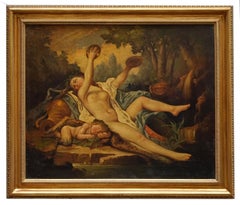
ALLEGORICAL SCENE - Giovanni Faliero - Italy Oil on Canvas Painting
By Giovanni Faliero
Located in Napoli, IT
Allegorical Scene - Giovanni Faliero Italia 2009 - Oil on canvas cm. 90x110.
This beautiful oil on canvas is the personal reinterpretation of the magnificent painting “Bacchant playing the Cymbals” by Jean-Simon Berthélemy, a French painter of the 18th century. Here we admire a mythological scene showing a naked bacchant playing cymbals next to a wooded stream, with a small sleeping faun...
Category
Early 2000s Old Masters Portrait Paintings
Materials
Canvas, Oil
$4,517
H 41.34 in W 49.22 in
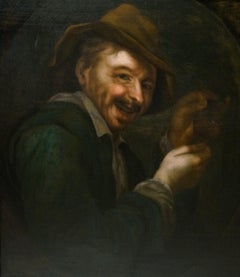
Antique oil paining, A laughing man with an upturned glass, Dutch golden age
Located in DEVENTER, NL
Anonymous, 18th century
Inspired by a painting by Petrus Staverenus (1610/1612 – 1654-07-28/1664-07-28) from a series of Five Senses
'Taste: A laughing man...
Category
18th Century Old Masters Portrait Paintings
Materials
Canvas, Oil
$1,961
H 29.34 in W 23.63 in
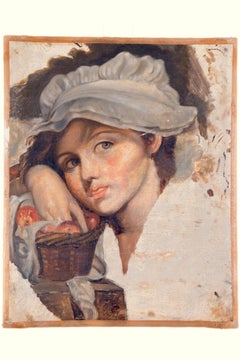
Young Girl with a Basket of Fruit
By Jean-Baptiste Greuze
Located in Paris, Île-de-France
French School, late 18th century, circle of Jean-Baptiste Greuze (1725–1805)
Young Girl with a Basket of Fruit
Oil on canvas, preparatory work,
Unsigned
39 x 31 cm
Provenance:
Pri...
Category
1790s Old Masters Portrait Paintings
Materials
Canvas, Oil
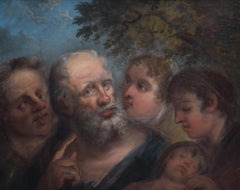
Asklepios and His Followers
Located in Stockholm, SE
This captivating work belongs to Elias Martin’s later period, characterized by his exploration of historical, biblical, and mythological themes. As Mikael Ahlund, Director of the Gus...
Category
1810s Old Masters Figurative Paintings
Materials
Canvas, Oil
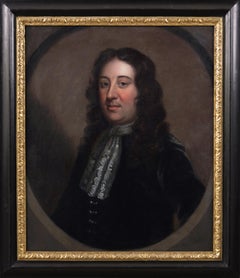
17th Century portrait oil painting of a gentleman
By John Riley
Located in Nr Broadway, Worcestershire
Circle of John Riley
British, (1646-1691)
Portrait of a Gentleman
Oil on canvas
Image size: 29 inches x 24 inches
Size including frame: 36 inches x 31 inch...
Category
17th Century Old Masters Portrait Paintings
Materials
Canvas, Oil
18th Century portrait oil painting of a gentleman
Located in Nr Broadway, Worcestershire
Follower of Enoch Seeman the Younger
German, (1694-1744)
Portrait of Gilbert Sympkin
Oil on canvas
Image size: 29.25 inches x 24.5 inches
Size including frame: 38 inches x 33.25 inches
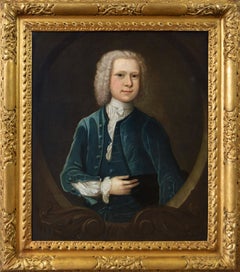
A fine three quarter length portrait of a gentleman traditionally identified as Gilbert Simpkin (Sympkin), follower of Enoch Seeman the younger, C1720. The portrait is set in a feigned sculptured oval cartouche, a device used to give a sense of depth. The sitter is depicted wearing a fashionable blue jacket and matching waistcoat with a white chemise and lace jabot. He wears a powdered wig in the fashionable style of the day and is posed holding his hat under his left arm with the fingers of his right hand stretched out. At court, long fingers signified wealth, culture and intelligence. The painting has clearly been executed by an artist of great ability who has been influenced by Enoch Seeman the younger.
Gilbert Simpkin (Sympkin) was born in London on 24 August 1683, the son of John Simpkin and Susannah Butler. His grandfather was also called Gilbert Simpkin. He entered Oxford University in 1700 where he studied at St John’s College. In 1702, he became a student of Middle Temple, which at the time was one of the world’s most important centres of legal education. He later settled in Plymouth and then Bristol. He died in Bristol on 15 May, 1744 and was buried at Bristol Cathedral. He remained unmarried and the portrait may well have been commissioned to commemorate when he was first Called to the Bar or perhaps had established his own practice.
Enoch Seeman or Seemann the younger was born in Danzig, Germany now Gdansk, Poland in 1694. His father was Enoch Seeman Senior, an artist of Flemish origin and his brothers Isaac, Noah and Abraham also became artists. He came to London with his father and brothers around 1704 and established himself as a portrait artist. From 1717 he became painter to the Royal court painting...
Category
18th Century Old Masters Portrait Paintings
Materials
Canvas, Oil
$6,372
H 38 in W 33.25 in D 2.5 in
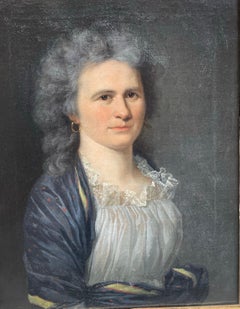
Neoclassical Female Portrait. Chemise à la reine and Shawl. Germany, ca 1790
Located in Firenze, IT
Neoclassical Female Portrait with Shawl and Chemise à la Reine, German School, circa 1790
Oil on canvas, 52 × 64 cm including original giltwood frame
A refined portrait of a woman f...
Category
Late 18th Century Old Masters Portrait Paintings
Materials
Canvas, Oil
$1,604
H 25.4 in W 20.48 in
More From This Seller
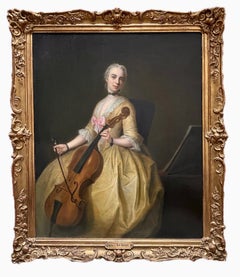
View All18th century portrait of the artist’s daughter, Catharina, playing the cello
By Balthasar Denner
Located in Bath, Somerset
The sitter, seated in a yellow silk gown trimmed with a pink bow playing the cello, is believed to be the artist Balthazar Denner's eldest daughter Catharina (1715-1744), after his marriage to Esther Winter in Hamburg in 1712. She is also recognisable in another portrait of the Denner family in the Hamburg Kunsthalle, painted circa 1740 by the artist's son, Jacob Denner (1722-1765). Oil on canvas in a period giltwood frame.
Provenance: Private collection, Northern Germany
Professor Helmut Borsch-Supan, Berlin, confirmed the authenticity of the painting after examining it in 2013. The painting will also be included in the forthcoming catalogue raisonnée of the artist, by Ute Mannhardt.
Balthasar Denner...
Category
Early 18th Century Old Masters Portrait Paintings
Materials
Canvas, Oil
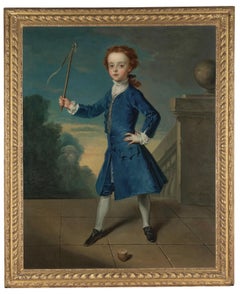
18th century portrait painting of a boy with a spinning top on a garden terrace
Located in Bath, Somerset
Portrait of a young boy, full-length in a blue velvet coat and breeches, standing on a stone terrace in a garden landscape, playing with a spinning top. Signed and dated ' Phil. Merc...
Category
1740s Old Masters Portrait Paintings
Materials
Canvas, Oil
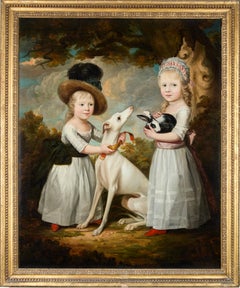
Portrait of two young girls with a whippet and a rabbit in a wooded landscape
Located in Bath, Somerset
Portrait of two young girls in a wooded landscape, standing full-length, one attaching a red collar on a seated white whippet and the other holding her pet black and white rabbit. Ci...
Category
18th Century Old Masters Portrait Paintings
Materials
Canvas, Oil
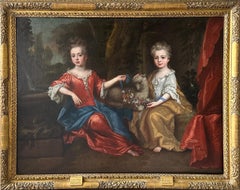
18th century portrait of sisters Lady Catherine and lady Jane Brydges
By James Maubert
Located in Bath, Somerset
This large double portrait depicts the sisters Lady Catherine and Lady Jane Brydges, the daughters of John Brydges, the Marquess of Carnarvon (1703-1727). They are seated on a stone...
Category
Early 18th Century Old Masters Portrait Paintings
Materials
Canvas, Oil
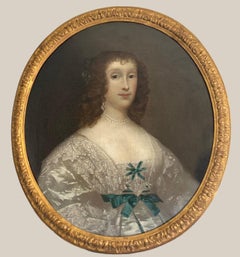
17th century portrait of lady in an ivory silk gown and lace collar
By Cornelius Johnson
Located in Bath, Somerset
Circle of Cornelius Johnson (1593-1661), a 17th century portrait of a lady, bust-length oval, wearing an ivory silk gown with blue silk bows and lace c...
Category
Early 17th Century Old Masters Portrait Paintings
Materials
Canvas, Oil
$16,445 Sale Price
25% Off
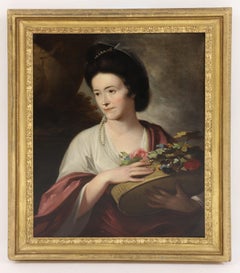
18th century English portrait of a lady beside an urn, with a basket of flowers
By Tilly Kettle
Located in Bath, Somerset
Portrait of a lady wearing a white gown with a red cloak, pearls in her hair and draped over one shoullder, standing beside a classical urn with a basket of flowers, c.1765.
The portrait is believed to be a companion portrait of a John (1741-1816) or James (1751-1807) Durno which is housed in an identical frame. The sitter is possibly either the wife of John who was Janes Byres of Stonywood or John and James's sister Elizabeth. (James never married). The Durno family were based around the Aberdeen area of Scotland and John was an advocate in the area and then later a customs official in Jamaica. James was a successful timber merchant, spending time in the Baltic before being made His Majesty's Consul in Memel, Prussia.
The portrait is likely to have been painted before Tilly travelled to India in 1768, when John, Jane and Elizabeth would have been in their twenties.
We are gtrateful to Mark Beattie for sharing his family knowlege and research on the portrait.
Provenance:
With W. C. Beattie in the mid 19th century, and by descent through the family
Private collection, Kent
With thanks to Hugh Belsey who has confirmed this to be the work of Tilly Kettle from photographs.
Tilly Kettle (1735-1786) was born in London, the third of six children by Henry Kettle (c.1704-c.1773), a coach painter, and his wife Ann. He attended William Shipley...
Category
18th Century Old Masters Portrait Paintings
Materials
Canvas, Oil
Still Thinking About These?
All Recently ViewedMore Ways To Browse
Salisbury Antique
Samuel Johnson
Marsha P Johnson
Martin Kavel
Masri Hayssam On Sale
Matador Costume
Mr And Mrs Howard
Oil On Tin Portraits
Oil Painting Portait
Painting Babushka
Peter Max Asia
Portuguese Painting Old
Princess Diana Signed
Puritan Oil Painting
Puyet Jose
Raimundo De Madrazo Y Garreta
Robert Menzies
Romero Britto Original