Items Similar to Portrait of Water Bearers, Africa - British 1920
s Orientalist art oil painting
Want more images or videos?
Request additional images or videos from the seller
1 of 15
Gerald Spencer PrysePortrait of Water Bearers, Africa - British 1920
s Orientalist art oil paintingCirca 1925
Circa 1925
$7,468.81
$9,336.0120% Off
£5,440
£6,80020% Off
€6,394.35
€7,992.9420% Off
CA$10,355.84
CA$12,944.7920% Off
A$11,136.83
A$13,921.0420% Off
CHF 5,954.89
CHF 7,443.6120% Off
MX$134,307.05
MX$167,883.8120% Off
NOK 75,303.62
NOK 94,129.5220% Off
SEK 68,611.29
SEK 85,764.1120% Off
DKK 47,779.98
DKK 59,724.9720% Off
About the Item
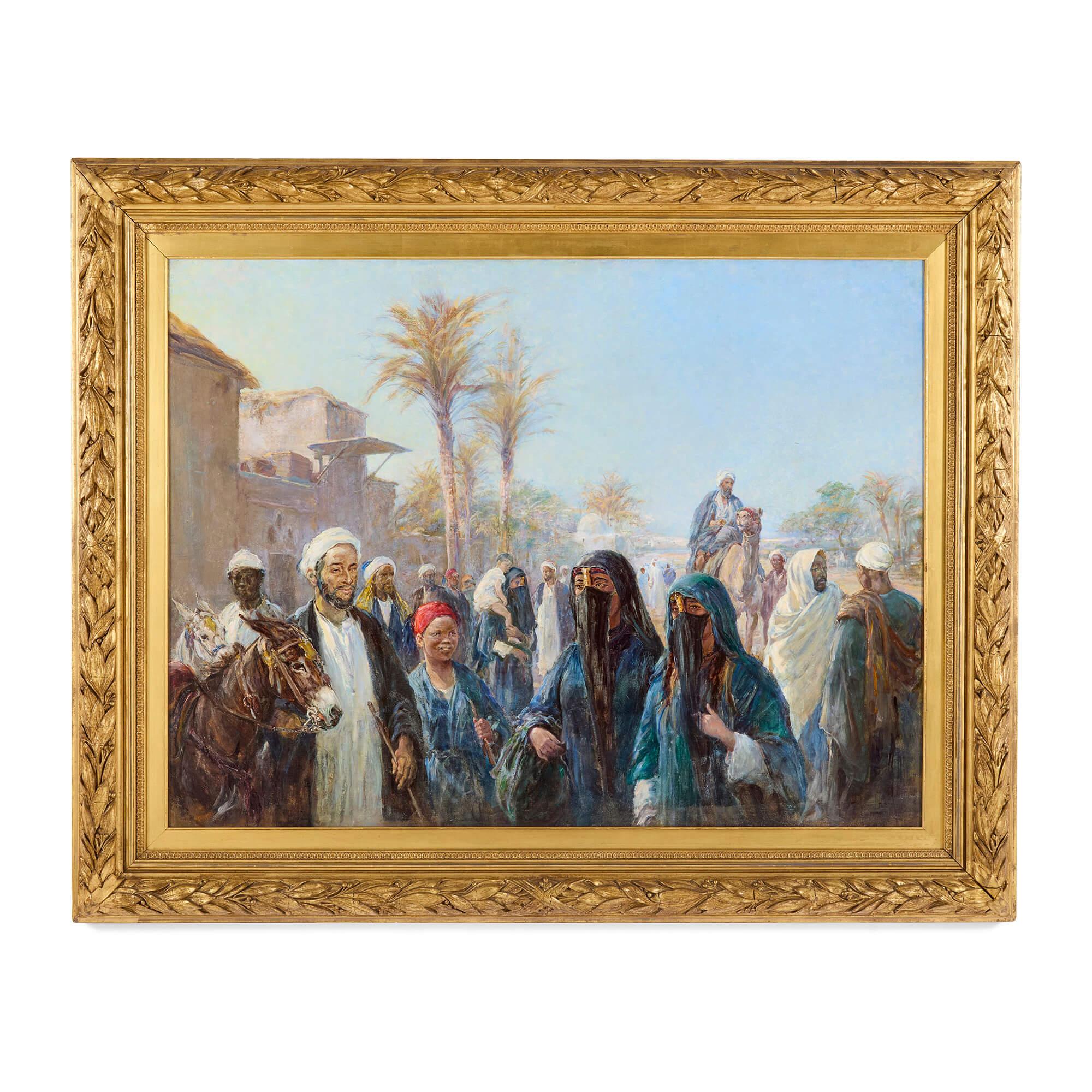
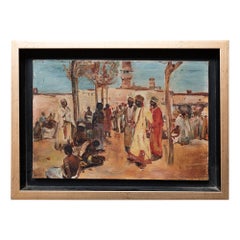
This superb vibrant Orientalist Post Impressionist oil painting is by noted British artist Gerald Spencer Pryse. It was painted about 1925 when Pryse was visiting Morocco and Northern Africa. The painting depicts three women carrying water in vessels on their heads and dressed from the waist downwards in colourful cloth. Painted from a low vantage point, the women tower in the foreground. Beyond them are more figures in white or dark clothing, all beneath a clear blue sky. The vibrancy of the clothing and the pinks on white is tremendous. A really superb example of Pryse's time in North Africa and of his ability to perfectly capture the scenes he saw around him.
Provenance: From the artist's estate.
Condition. Oil on canvas, 30 inches by 25 inches and in good condition.
Frame. Housed in a complementary frame, 37 inches by 32 inches and in good condition.
Gerald Spencer Pryse (1882–1956) was a British artist and lithographer. Born at Ashton, Pryse studied in London and Paris, and first won a prize at the Venice International Exhibition in 1907. In the same year, he joined the Fabian Society, and helped to found The Neolith, a periodical of literature and the fine arts; the journal was printed in lithography. He was a regular exhibitor at the Senefelder Club, and contributed works to Punch, the Strand Magazine, and The Graphic. During the Great War, Pryse produced a considerable body of lithographic work, some of it in colour under the title Autumn Campaign (1914). This was based on his time in France and Belgium at the beginning of the war when he drove around in a Mercedes carrying lithographic stones in the back. He served as a dispatch rider for the Belgian government and was present at the Siege of Antwerp. The artist wrote a memoir of this time entitled Four Days: an account of a journey in France made between 28 and 31 August 1914, published by John Lane in 1932. Pryse also saw some of the Battle of the Marne and the Aisne but was back in Belgium to record the fall of Ostend and the subsequent retirement along the River Yser. Pryse also worked with the Indian Army in France and several of his lithographs depict scenes of Indian troops. Later, he served as a captain in the Queen Victoria's Rifles, King's Royal Rifle Corps, and was mentioned in dispatches. His main action was in the Third Battle of Ypres where he won the Military Cross, the 1914 Star, the Order of the Crown of Belgium, the Croix de Guerre. By the end of 1916, Pryse had made an application to become a war artist, and towards the end of the war, was granted permission to sketch at the front and he was able to record the conditions of trench warfare in numerous water-colour drawings, but many of these were lost in the German offensive of 1918. The remaining drawings were exhibited later in London and were described as having a freshness and authenticity that were not always apparent in the works of the official war artists. Unfortunately, many of these were destroyed by enemy action during the Second World War. He left the regiment at the end of the war but re-joined it in 1921 when the battalion was stationed at Wormwood Scrubs for three months during a coal strike. During the war, he also designed a number of posters including several published by Frank Pick for the Underground Electric Railways Company of London in London, as well as for the Labour Party, The British Red Cross, and for the Empire Marketing Board. One of his most famous posters, entitled The Only Road for an Englishman, shows a regiment of British soldiers marching through a ruined town. Pryse was one of the illustrators selected by Percy Bradshaw for inclusion in his The Art of the Illustrator (1917–1918). He worked in Hammersmith from 1914 to 1925, but in 1925 travelled to Morocco and observed some of the fighting there against the French. He returned to the country and lived there for some years after 1950. Pryse was commissioned in 1924 to create a series of lithographs for the British Empire Exhibition illustrating the extent and variety of life within the British Empire. His work was part of the art competitions at the 1928 Summer Olympics and the 1932 Summer Olympics. In 1932 he married Muriel Anstace Theodora, daughter of the Rev. Laurence Farrall, and they had three daughters, one of whom, Tessa Spencer Pryse, later a landscape artist, became an art student against her father's wishes. He died at Cranford House, Stourton, Worcestershire on 28 November 1956 aged 74.
- Creator:Gerald Spencer Pryse (1882 - 1956, Welsh)
- Creation Year:Circa 1925
- Dimensions:Height: 32 in (81.28 cm)Width: 37 in (93.98 cm)Depth: 2 in (5.08 cm)
- Medium:
- Movement Style:
- Period:
- Condition:
- Gallery Location:Hagley, GB
- Reference Number:1stDibs: LU853113391702
About the Seller
5.0
Platinum Seller
Premium sellers with a 4.7+ rating and 24-hour response times
1stDibs seller since 2018
473 sales on 1stDibs
Typical response time: <1 hour
- ShippingRetrieving quote...Shipping from: Hagley, United Kingdom
- Return Policy
More From This Seller
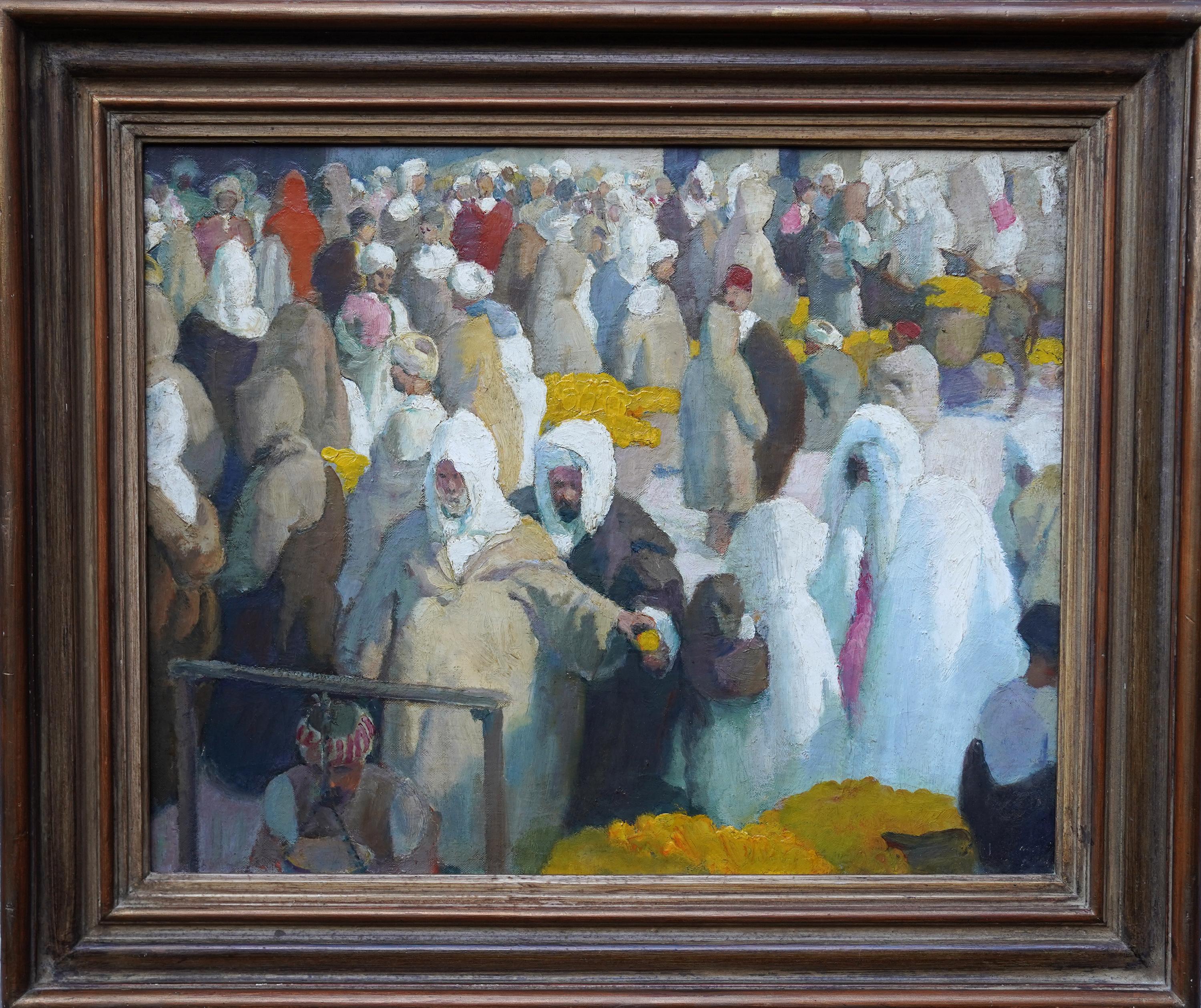
View AllTangiers Lemon Market - British 1920
s Oriental Figural art oil painting
By Gerald Spencer Pryse
Located in Hagley, England
This superb vibrant Oriental Post Impressionist oil painting is by noted British artist Gerald Spencer Pryse. It was painted circa 1925 when Pryse first visited Morocco. He was so en...
Category
1920s Post-Impressionist Figurative Paintings
Materials
Oil
Sheep Shearers, Tangiers - British 1920
s Orientalist figurative oil painting
By Gerald Spencer Pryse
Located in Hagley, England
This superb vibrant Orientalist Post Impressionist oil painting is by noted British artist Gerald Spencer Pryse. It was painted about 1925 when Pryse was visiting Morocco and Norther...
Category
1920s Post-Impressionist Animal Paintings
Materials
Oil
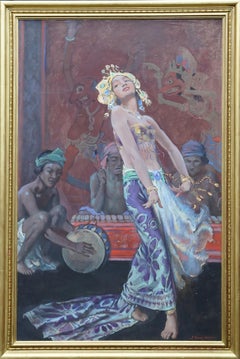
Balinese Dancer - British 1920
s art portrait oil painting Musician Music Dance
By John Young Hunter
Located in Hagley, England
This stunning British 1920's tempera oil on board painting is by noted artist John Young Hunter. It was painted circa 1927 and the composition is a f...
Category
1920s Art Deco Portrait Paintings
Materials
Tempera
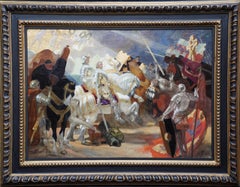
Onward Christian Soldiers - British Edwardian 1911 art religious oil painting
By Frank Owen Salisbury
Located in Hagley, England
This striking British Edwardian religious oil painting is by noted artist Francis 'Frank' Owen Salisbury or Frank O'Salisbury as he is largely known. Painted in 1911 it is a figurative landscape of soldiers on the battlefield. The two central characters, the 'Christian Soldiers' from the early crusades have halos and ride through the chaos on white horses. Shafts on light with angels illuminate them and also a crucifix. A very powerful Edwardian religious oil painting and an excellent example of O'Salisbury's work. painted in oil and illuminated in gold leaf.
Signed and dated with monogram lower right 1911.
Provenance. From Castle of Park, Aberdeenshire.
A version of this painting was exhibited at the Royal Academy London in 1911 entitled the Passing of War.
Condition. Oil on canvas, 36 inches by 24 inches unframed and in good condition.
Frame. Housed a complementary frame, 44 inches by 32 inches framed and in good condition.
Francis ("Frank") Owen Salisbury (18 December 1874 – 31 August 1962) was an English artist who specialised in portraits, large canvases of historical and ceremonial events, stained glass and book illustration. In his heyday he made a fortune on both sides of the Atlantic and was known as "Britain’s Painter Laureate". His art was steadfastly conservative and he was a vitriolic critic of Modern Art – particularly of his contemporaries Picasso, Chagall and Mondrian. His father, Henry Salisbury, described himself as a "plumber, decorator and ironmonger" (his mother was Susan Hawes), yet his son Frank would become one of the greatest society artists of his generation. One of 11 children, Salisbury was such a delicate child that he was educated at home, in the main by his student teacher sister, Emilie. He had only a few weeks formal schooling and began work by repairing bicycles at his father’s Cycle Depot in Harpenden. Uncertain as to his ability to find and maintain a job, the family determined that he be apprenticed, at the age of 15, to Henry James Salisbury, his eldest brother, who managed a major stained glass company in Alma Road, St Albans. He rapidly acquired all the practical skills of a stained glass artist and exhibited exceptional skills in the painterly detail that was applied to glass before its final firing. This led to his brother sponsoring him to attend Heatherley’s School of Art three days a week to further a career in painting. He then won a scholarship to the Royal Academy Schools which he attended for five years and where he won two silver medals and two scholarships, including the Landseer scholarship which funded his to travel to Italy in 1896. In due course he would have seventy exhibits accepted for the annual Royal Academy Summer Exhibitions, from 1899 until 1943, though he was never offered membership, which reportedly disappointed him very much. In 1901 he married Alice Maude (d. 1951), daughter of C. Colmer Greenwood, with whom he had several children, including twin daughters Monica and Sylvia. His first Royal Academy exhibit was a portrait of Alice and he often painted pictures of their children. It is for portraiture that he is best known. His speed in producing portraits stemmed from his painting his own twin daughters every morning for an hour and his career began with child portraiture and his painting the Hertfordshire gentry and members of the Harpenden Methodist Church. He had a studio at his home, Sarum Chase. A providential meeting with Lord Wakefield, founder of Castrol Oils and a Methodist philanthropist, saw his introduction to society portraiture. Salisbury’s being selected to paint the Boy Cornwell in the Battle of Jutland then brought him to the notice of Royalty. Lord Wakefield then arranged for him to paint President Woodrow Wilson whilst he was in London, but Wilson departed for Paris and the opportunity was lost. It was to be John W. Davis, American Ambassador to London, who encouraged Salisbury to go to the USA; Davis had met Salisbury at art receptions and had admired his child portraits. Twenty-five members of the Royal House of Windsor sat for Salisbury and he was the first artist to paint HM Queen Elizabeth II. In 1919 he painted a mural for the Royal Exchange, London National Peace Thanksgiving Service on the steps of St Paul’s Cathedral, 6th July 1919. He painted Winston Churchill on more occasions than any other artist; the two iconic images of Churchill – The Siren Suit and Blood, Sweat and Tears are both Salisbury images. Mayoral regalia was a ready made requisite for the Salisbury style with Councillor Sam Ryder (of Ryder Cup fame) as Mayor of St Albans being the most famous of his civic images. Other significant portraits include those of Richard Burton, Andrew Carnegie (posthumous), Sir Alan Cobham, Sir Robert Ludwig Mond, Maria Montessori...
Category
1910s Realist Figurative Paintings
Materials
Oil
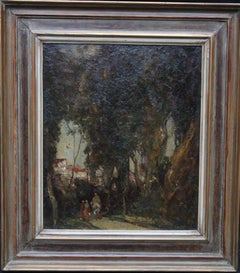
Village Gossip - British early 20th century art wooded landscape oil painting
By Joseph Vickers De Ville
Located in Hagley, England
This lovely oil painting is by noted 19th century born Wolverhampton artist Joseph Vickers De Ville. The Wolverhampton gallery is home to many of his works, some of which are usually...
Category
Early 20th Century Realist Landscape Paintings
Materials
Oil
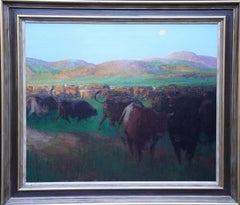
Cattle in a Landscape North Africa - British 20s Post Impressionist oil painting
By Gerald Spencer Pryse
Located in Hagley, England
This superb vibrant Post Impressionist African landscape oil painting is by noted British artist Gerald Spencer Pryse. It was painted about 1925 when Pryse was visiting Morocco and N...
Category
1920s Post-Impressionist Animal Paintings
Materials
Oil
You May Also Like
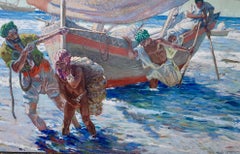
French North African early 20th century Impressionist, Fishermen coming ashore
Located in Woodbury, CT
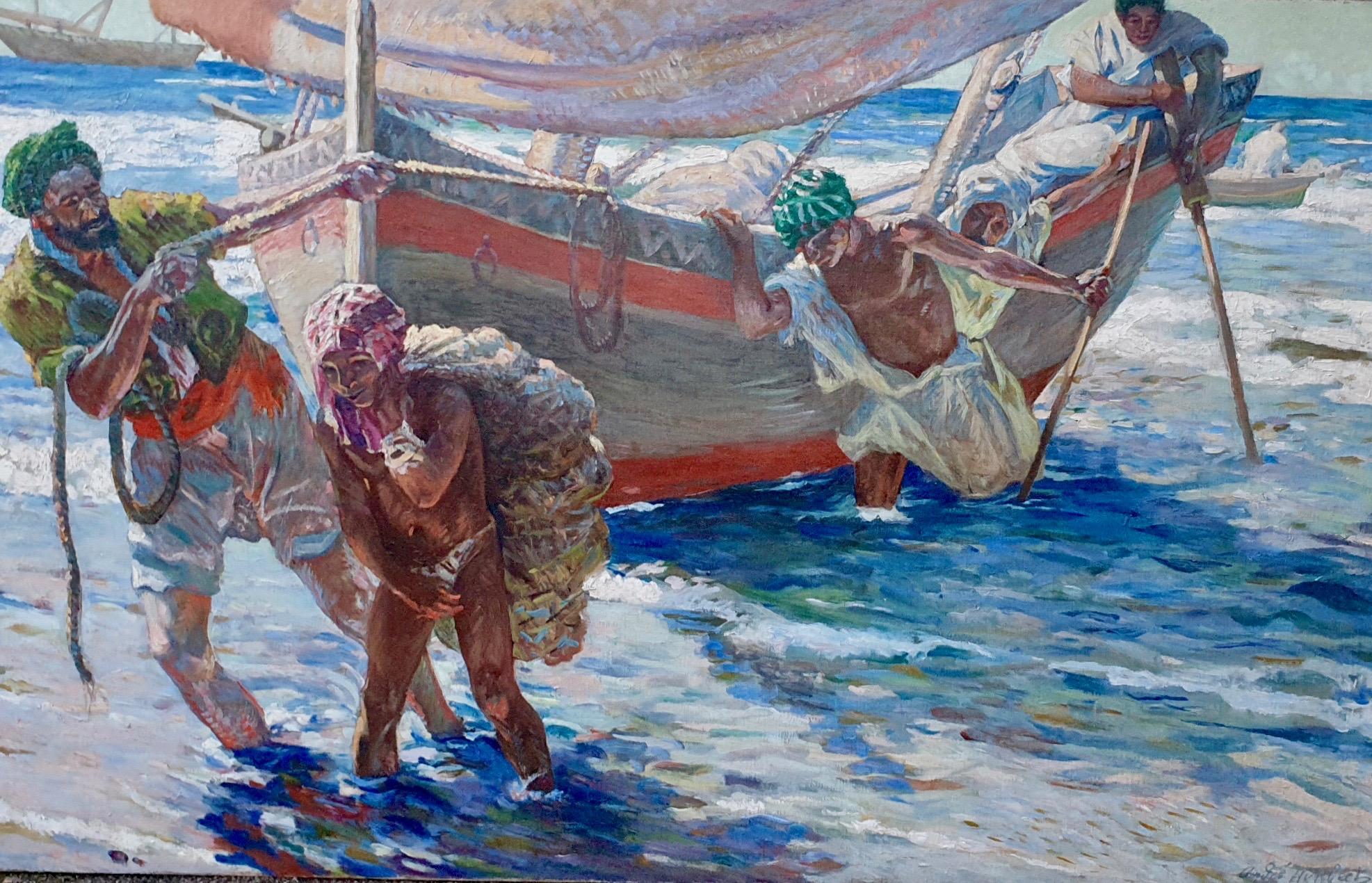
French North African early 20th-century Impressionist, Fishermen coming ashore with their daily catch.
André Humbert was born in Paris on the 27th of November. He was a student of t...
Category
Early 1900s Impressionist Figurative Paintings
Materials
Canvas, Oil
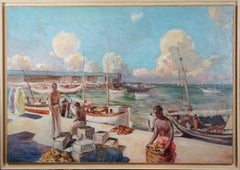
Port D
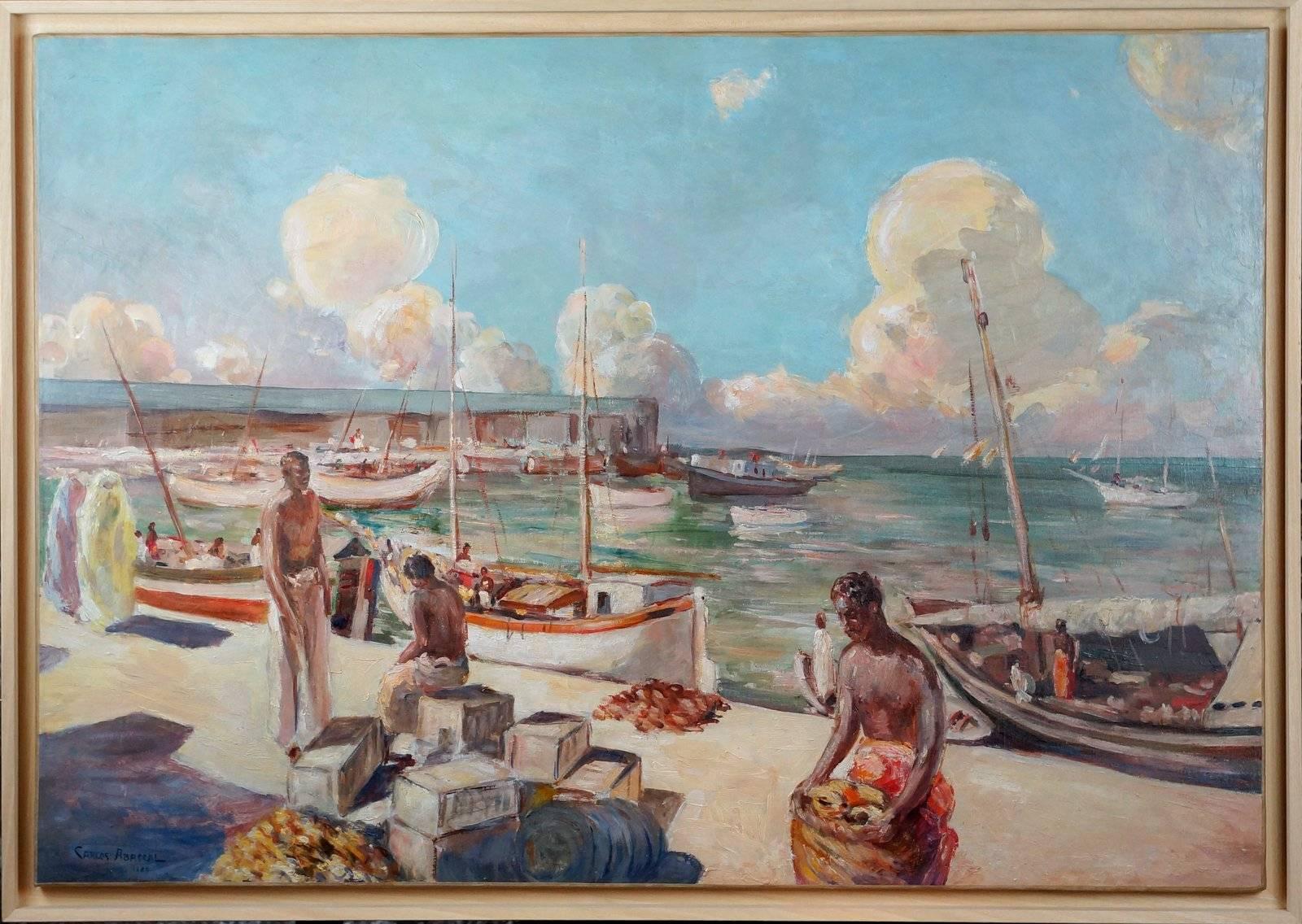
Afrique, 1927 - oil paint, 84x122 cm., framed
By Carlos Abascal
Located in Nice, FR
Oil on canvas, signed lower left.
Carlos Abascal est un peintre orientaliste et illustrateur espagnol né à Madrid en 1878. Il a peint à l’huile et à l’aquarelle des scènes de genre...
Category
1920s Post-Impressionist Figurative Paintings
Materials
Oil
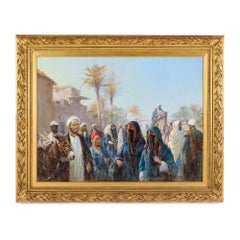
Large Antique Orientalist Oil Painting by Heywood Hardy
By Heywood Hardy
Located in London, GB
Large antique Orientalist oil painting by Heywood Hardy
British, c. 1900
Canvas: Height 79cm, width 104cm
Frame: Height 105cm, width 129cm, depth 7cm
This remarkable oil painting by...
Category
Early 20th Century Figurative Paintings
Materials
Canvas, Oil
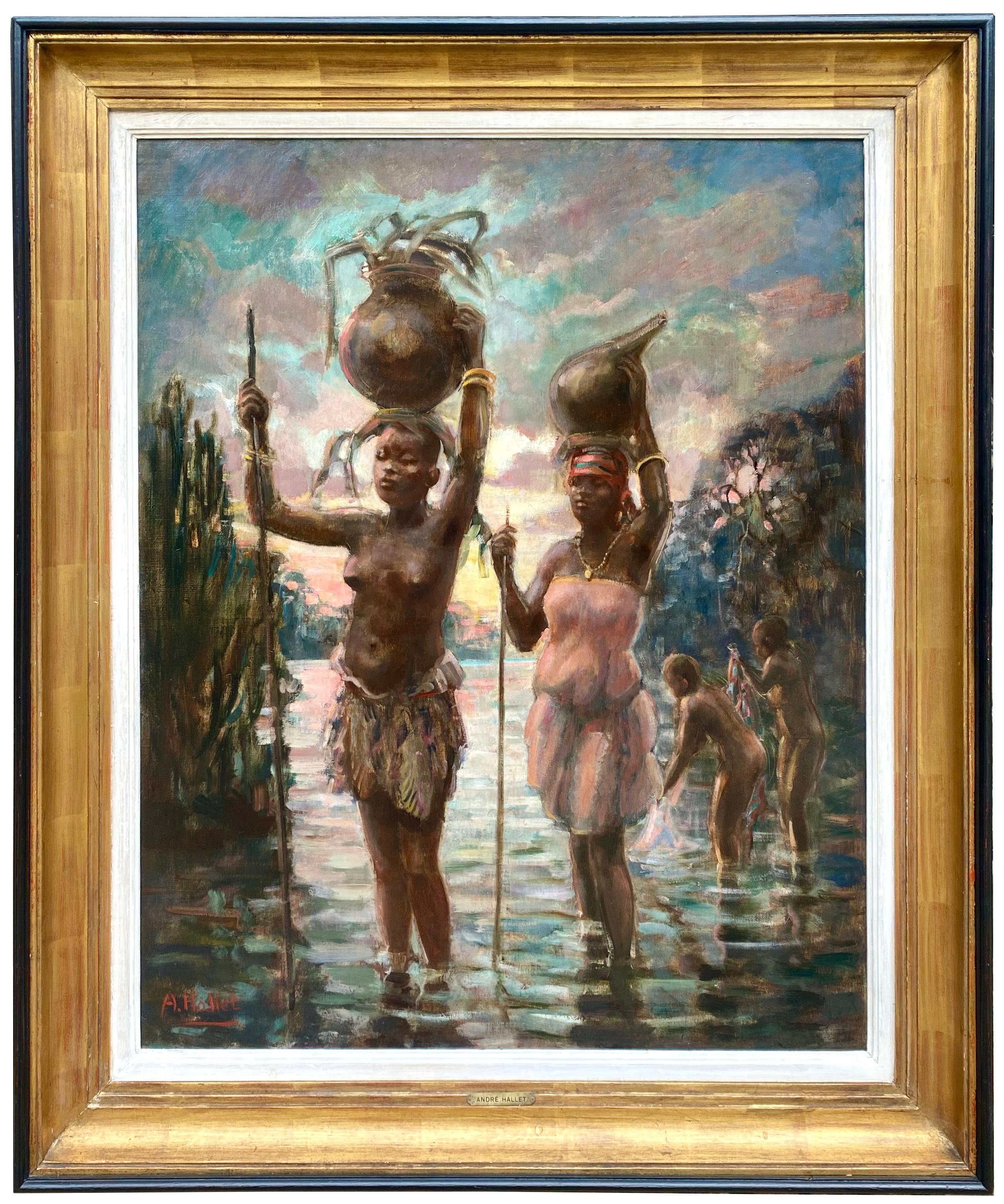
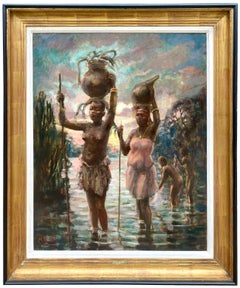
The Water Carriers
by André Hallet, Liège, Belgium 1890 – 1959 Kisenyi, Rwanda
By André Hallet
Located in Knokke, BE
André Hallet
Liège, Belgium 1890 – 1959 Kisenyi, Rwanda
Belgian Painter
'The Water Carriers'
Signature: signed lower left 'A. Hallet', placed and named on reverse
Medium: oil on canvas
Dimensions: image size 100 x 80,5 cm, frame size 120,5 x 100,5 cm
Biography: Hallet André was born in the Liege in 1890, emerged as a luminary in the world of Belgian post-impressionist painting. His oeuvre, a testament to his profound talent, has graced the walls of over 60 museums worldwide, including the venerable Louvre in Paris, France.
Hallet’s artistic repertoire was as expansive as it was breathtaking. He wielded his brush with mastery in a multitude of genres, creating enchanting landscapes, bustling cityscapes, serene garden views, captivating marine scenes, evocative genre depictions, and intimate portraits that breathed life onto his canvases.
The journey of André Hallet’s artistry began under the tutelage and guidance of R. Heintz. He honed his craft further at the Academy in Liege.
It was in the South of France that Hallet discovered the transcendent allure of light and the sun, infusing his work with a cheerful and impressionistic burst of color. The vibrant hues of his palette mirrored the radiant landscapes he encountered in Flanders and the Mediterranean, from the sun-kissed shores of Southern France to the picturesque vistas of Italy.
In 1920, Hallet embarked on a new chapter, working in the enchanting city of Bruges before ultimately settling in Leuven. Each location left its mark on his art, contributing to the rich tapestry of his creative journey.
A turning point in Hallet’s life came in 1934 when the Belgian government sent him to Congo. Later, in 1947, he found his home on the shores of Lake Kivu in Kisenyi, present-day Rwanda. It was here that he would spend the remainder of his life, captivated by the mesmerizing beauty of the African landscape. He passed away in 1959, leaving a lasting legacy.
During his time in Africa, Hallet forged a deep connection with Tutsi king Mwambi Matura III of Ruanda-Burundi. This relationship inspired a series of exquisitely detailed portraits, offering a glimpse into the regal splendor of the king’s family...
Category
Early 20th Century Post-Impressionist Portrait Paintings
Materials
Canvas, Oil
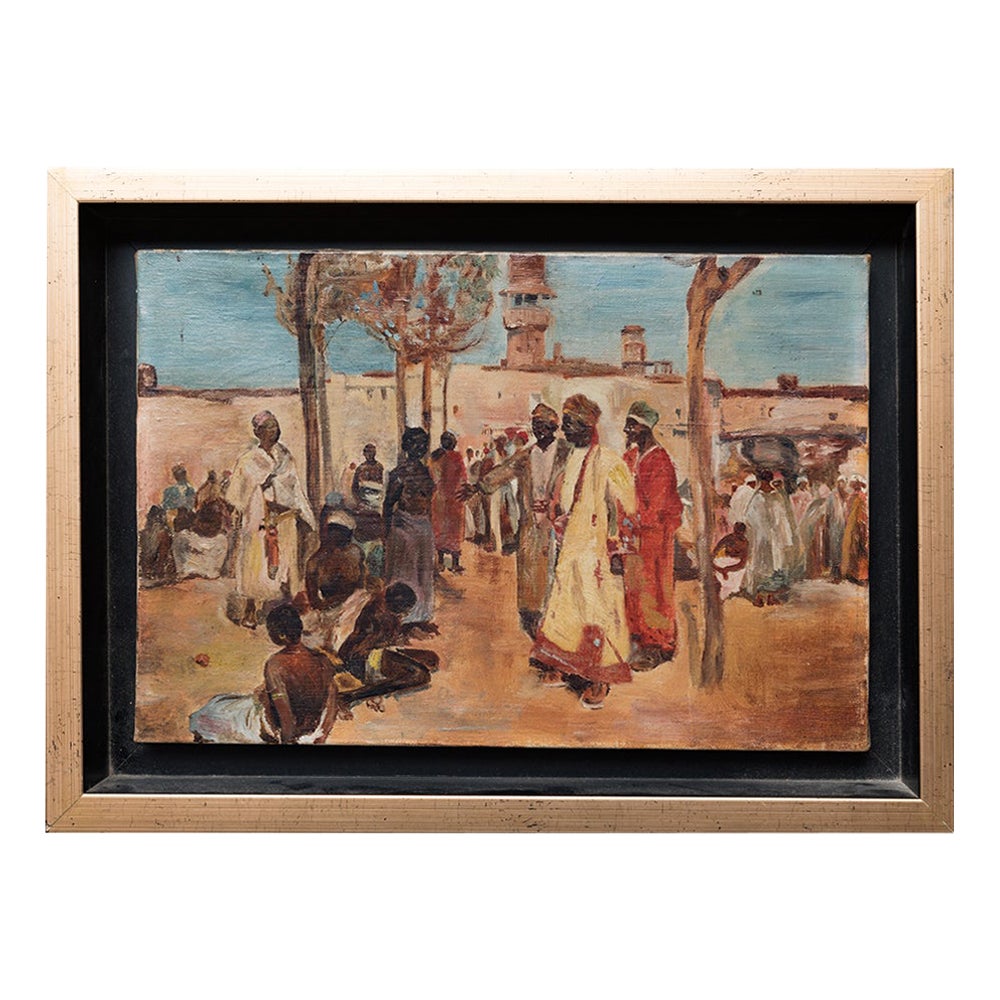
Late 19th, Early 20th Century, English Painting Orientalist School
Located in Marbella, ES
English orientalist school; late 19th - early 20th century.
"Slave market".
Oil on canvas.
Presents stamps on the back.
Measurements: 26,5 x 36 cm; 27 x 37 cm (frame).
The orien...
Category
Antique Early 1900s English Paintings
Materials
Canvas
“North African Man, c. 1916-21” by Caleb Arnold Slade, American Portrait Oil
By Caleb Arnold Slade
Located in Yardley, PA
“North African Man, c. 1916-21” by Caleb Arnold Slade (American, 1882-1961)
Inspired by Slade’s travels in Algeria and Tunisia, this remarkable portrait depicts a young man standing...
Category
Early 20th Century American Impressionist Portrait Paintings
Materials
Canvas, Oil

More Ways To Browse
British Empire
Siege Antique
Used Rifles
Empire Marketing Board
Antique Rifles
Britains Soldiers
John Lane
The Empire Strikes Back Poster
African Antiques
Audrey Hepburn Tiffanys
Kobe Bryant
Portrait 16th Century Oil
Portrait Of Ferdinand
Woman Smoking
17th Century English Portraits
1930s British Paintings
Audrey Hepburn Pop Art
Girl With Braids