Items Similar to Portrait tête d’expression portrait study of a gentleman
Want more images or videos?
Request additional images or videos from the seller
1 of 10
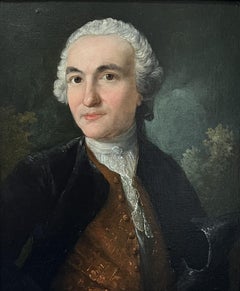
UnknownPortrait tête d’expression portrait study of a gentleman1780
1780
$10,622.60
£7,750
€9,065.05
CA$14,699.75
A$15,778.80
CHF 8,401.40
MX$186,882.21
NOK 106,170.79
SEK 96,963.54
DKK 67,720.05
About the Item
French Academic School, 18th century
Portrait tête d’expression study of a gentleman, c. 1780-90
Oil on canvas
46.1 x 35 cm.; (within frame) 57.5 x 46.6. cm.
Provenance:
Private Collection, Switzerland, until 2020;
Private Collection, United Kingdom.
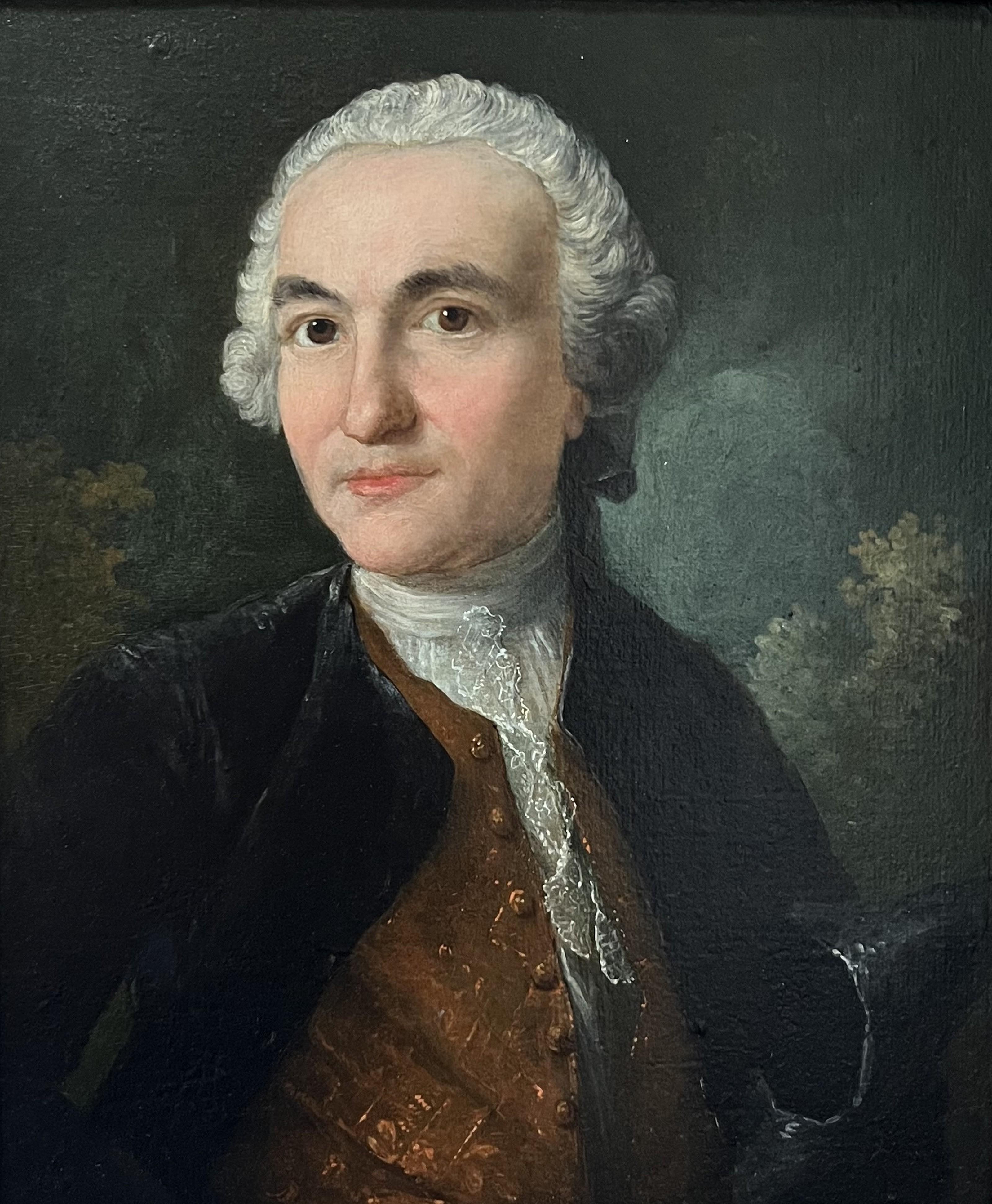
Modelled with an almost metaphysical consideration, this skilled study is a strong example of the tête d’expression, an academic practice developed in France around 1750. A formal competition of the same name was established within the Académie Royale in 1759 (the concours de la tête d’expression), with the purpose of advancing pupils’ proficiency in expressing a breadth of human expression. Here, the subject is not the sitter himself, but the gentle contemplation which preoccupies him: pupils were required to negotiate between individualisation and generalisation. Here, the sitter’s head is tilted and with a distant, upward gaze; a deliberate white stroke moistens the corner of his eye, both animating the passion of the particular meditation, and giving life to its originator. Comparison with other tête d’expression dates the work to approximately 1780-90, which alongside the sitter’s hair ‒ being unpowered and not a wig ‒ confirms the work as that of the late 18th century. His dress further comprises a red coat with a dark collar and loosely tied cravat, which swells in a flurry of broad strokes beneath his chin. It is probable that the work was created by a pupil of the Académie, perhaps in submission to the Prix de Rome.
France’s academic hierarchy had traditionally prioritised history painting over portraiture, but a developing interest in physiognomy had begun to permeate the artistic output of the mid-18th century. Of only two stages of academic study which considered portraiture, the concours de la tête d’expression was required of each Prix de Rome aspirant. Designed to compensate for the limitations of traditional sculpture study, submissions typically codified varying facial structures or emotional expressions, and examined a given emotion (stubbornness, inspiration, melancholy, e.g.). Compelling within the viewer a degree of psychological interpretation, the exercise greatly expanded the significance of human expression, as ‘the source of life, movement and eloquence, the very soul of painting and the ultimate intellectual and spiritual challenge to the artist’ (Percival, p. 65). Leading proponents of the tête d’expression included Jean-Baptiste Greuze and Elisabeth-Louise Vigée Le Brun, whose studies routinely circulated the market and established the dominating style. Female sitters were typically preferred, whose enthusiastic ‘passions’ often possessed a certain eroticism for the works’ vastly male audience.
The present work is a confident example of the genre, and particularly close in handling to the work of Jacques-Augustin-Catherine Pajou (1766-1828) and Jean-Louis Laneuville (1756-1826). Formulating a distinctive technique of its own, areas of subtle blending are overlaid with more assertive brushwork, particularly the roundly shaped touches of colour which form the nostrils and right eye. The generous colouring of the upper face ‒ pink, yellow and blue pigments are married within one passage ‒ and shaved jawline contribute to a marvellous depth. More so, a subtle chiaroscuro effect shades the left half of the face, consisting only of an unfinished layer of two of translucent pigment. Naturally concerned with the face itself, less labour has been taken with the gentleman’s fashion, which is loosely though confidently worked. Indeed, the dark jacket collar appears translucent above a broader white shirt collar beneath. Possibly the natural result of pigment degradation, this might otherwise suggest the later reworking or addition of the garment ‒ perhaps a pentimenti of the artist, or the fashionable completion to a head study with the purpose of increasing the painting’s value on the market. The partially translucent tonal ground is lighted with dramatic emphasis around the sitter’s silhouette. Typical of such studies, this mode was favoured by François-André Vincent, Guillaume Voiriot, Antoine Vestier, and Alexander Roslin, among others.
I am most grateful to Laura Auricchio and Jean-Pierre Cuzin for their consideration of the present work.
Bibliography and further reading:
Sarah Betzer, Ingres and the Studio: Women, Painting, History (Pennsylvania, Pennsylvania State University Press, 2012)
Yuriko Jackall, Jean-Baptiste Greuze et Ses Têtes d’expression la Fortune d’un Genre (Paris: CTHS, 2022)
Melissa Percival, The Appearance of Character: Physiognomy and Facial Expression in Eighteenth-Century France (Leeds: W. S. Maney and Son Ltd., 1999)
- Creation Year:1780
- Dimensions:Height: 22.64 in (57.5 cm)Width: 18.35 in (46.6 cm)
- Medium:
- Movement Style:
- Period:1780-1789
- Condition:The work is in good condition commensurate with age.
- Gallery Location:Henley-on-Thames, GB
- Reference Number:1stDibs: LU2820216026802
About the Seller
No Reviews Yet
Vetted Professional Seller
Every seller passes strict standards for authenticity and reliability
Established in 2024
1stDibs seller since 2024
- ShippingRetrieving quote...Shipping from: Henley-on-Thames, United Kingdom
- Return Policy
More From This Seller
View AllPortrait of an artistic Gentleman, c. 1720s
By John Vanderbank
Located in Henley-on-Thames, England
John Vanderbank (London 1694 - London 1739)
Portrait of an artistic Gentleman, c. 1720s
Three-quarter-length, wearing a turban
Oil on canvas
125.5 x 101.7 cm.; (within frame) 145.6...
Category
1720s Old Masters Portrait Paintings
Materials
Oil
Portrait of a senior naval officer, c. 1750s
By Thomas Hudson
Located in Henley-on-Thames, England
Thomas Hudson (Devon 1701 - London 1779)
Portrait of a senior naval officer, c. 1750s
Probably a captain or admiral; half-length, holding a telescope, with a warship beyond
Oil on canvas
91.3 x 71.1 cm.; (within frame) 114.3 x 93.8 cm.
(Unsigned)
Provenance:
Christie’s, London, 22 November 1985, lot 105 (as Thomas Hudson);
Private collection, United Kingdom;
Haynes Fine Art, Broadway, Worcestershire;
Where acquired, private collection, United States, 16 August 1988;
Neal Auction, New Orleans, 14 September 2025, lot 302 (as Attributed to Thomas Hudson);
Where acquired by Haveron Fine Art.
Literature:
Bridgeman Art Library, The Bridgeman Art Library (London: The Library, 1995), p. 89
Christie’s, London, Important English Pictures (London: Christie’s, 22 November 1985)
Archival:
Witt Library, Courtauld Institute of Art (no. 061487);
Heinz Archive and Library, National Portrait Gallery, 1725-50, Thomas Hudson: Men Authentic (1) (Box)
This attractive and quintessential half-length is exemplary of Hudson’s leading portrait practice, produced at the height of his decade-long dominance over the London market beginning in 1749. Typical of Hudson's 1750s output, the portrait was likely made after his five-week visit to Rome and Naples, and bares the stylistic merits of this continental excursion. Indeed, the trip seemed to fortify a gradual refinement of Hudson’s technique: namely the emphasis of directional brushstrokes, which sensitively follow the contours of the facial features. The resulting feathery quality is combined here with a striking chiaroscuro effect, which Hudson borrowed directly from Rembrandt. Amalgamating the rich colouring of the Rococo with a mannered Baroque posing, Hudson renders the senior naval officer with a characteristic presence.
Resting one hand assuredly at his hip, the finely worked telescope illustrates the officer’s seniority; the warship sailing on the horizon beyond provides further indication of his commanding rank. The telescope is held by a hand modelled with sculptural poise, and the typically Van Dyck manner (seen elsewhere, e.g. Princess Amelia Sophia Eleonore of Great Britain, YCBA B2001.2.246) further illustrates Hudson's studied grounding. Despite the apparent stylistic placement of the work, an earlier date is possible, since the officer wears civilian clothes and not the naval officer’s uniform first introduced in 1747 (which officers afterwards invariably chose to be shown in). The officer has previously been suggested as Edward Henry Sartorius, of the prominent naval Sartorius family; however, this identification is improbable on biographical and documentary grounds.
Hudson was regularly commissioned by leading naval officers, and produced highly satisfactory portraits praised for their great likeness and genteel swagger. He charged 24 guineas for a standard 50 x 40 inch half-length in the 1750s period, and the present work (somewhat smaller in size) would have cost not much less. Comparable works include those of Admirals of the Fleet George Anson, 1st Baron Anson, and Sir John Norris; Admiral Sir George Pocock; Admiral Sir Peter Warren; Vice-Admiral The Honourable John Byng; and Rear-Admiral Richard Tyrrell. The present portrait is particularly similar in composition to Hudson’s Portrait of a Flag Officer of The White Squadron, which similarly employs the narrative device of a telescope held at a dynamic angle across the composition, with a warship to the left side of the officer’s retracted arm.
Thomas Hudson (Devon 1701 - London 1799)
Thomas Hudson rose to become the leading British portraitist of the mid-18th century, albeit in close competition with his Scottish counterpart Allan Ramsay. Born in Devon, Hudson studied alongside George Knapton under Jonathan Richardson the Elder (marrying his daughter in 1725, expressly against Richardson’s wishes), and inherited a dignified formality jointly derived from Van Loo. His work is first recorded in 1728, and between 1730-40 he practised in Bath and the West Country, where in addition to portrait commissions, he was employed to retouch and reline old pictures. He returned permanently to London thereafter, and devised a series of stock poses to which he would return with variation throughout his career. Beginning in 1745 with the death of Richardson and the departure of Van Loo, Hudson became the city’s most successful portraitist, and embarked on ambitious defining works such as his Portrait of Theodore Jacobsen ‒ not drastically unlike the continental heights of Pompeo Batoni in conception. Profiting from his success, he relocated from Lincoln’s Inn Fields to a house in Great Queen Street previously inhabited by Van Loo, and one door down from Kneller’s old rooms. An exceptionally productive period began in 1749 which lasted until the late 1750s. Among this output were highly praised portraits of the Prince and Princess of Wales, commissions for most of the preeminent aristocrats, and superlative group portraits including Benn’s Club of Aldermen, and those of the Thistlethwayte, Marlborough and Radcliffe families.
Hudson relocated to King Street, Covent Garden, operating a prolific studio operation which resulted in some four hundred paintings ‒ of which at least eighty were engraved. A prodigious assembly of young pupils included Sir Joshua Reynolds (1740-3), Joseph Wright of Derby (1751-3, 1756), Richard Cosway, John Hamilton Mortimer, and the drapery painters Joseph and Alexander van Aken (also employed by Ramsay). As one later reviewer expressed: ‘Hudson, his art may well display to sight / Who gave Mankind a Reynolds and a Wright’ (Miles, ‘Introduction’). The ambitious young Reynolds made many drawings from classical statuary under Hudson’s instruction, and wrote home that, ‘While doing this I am the happiest creature Alive (sic.)’ (Sweetser, p.12). However, he was later dismissed from his pupilage some two years prematurely for refusing to carry a painting to Van Aken’s studio in the rain. It was at this point that Reynolds returned to Plymouth (Devonport), and produced some thirty portraits of the local gentry (including one example presently owned by Haveron Fine Art).
Hudson was one of a number of artists who congregated in Old Slaughter’s Coffee House, alongside Hogarth, Ramsay, Hayman, and Rysbrack. Together they supported Thomas Coram’s Foundling Hospital, of which they each belonged to the 600 governors (in whom Hudson met many of his future clients), and promoted the building as London’s first public space of artistic exhibition. He visited the Netherlands and France for five weeks in 1748 accompanied by St Martin’s Lane colleagues, and was arrested with Hogarth for making drawings of the Bastille fortifications. He afterwards stayed in Rome and Naples in 1752 with Roubiliac, meeting Reynolds twice on the return journey. He returned to England and bought a house at Cross Deep, Twickenham (upstream from Pope’s villa), and made an effective museum of the space. He lived there with his second wife, a wealthy widow named Mrs Fynes. Having been involved with early attempts to establish a royal academy of the arts, Hudson exhibited at the Society of Arts in 1761 and 1766, although he had effectively retired from painting by the latter date. His last painting was in 1767, and he died at Twickenham in January 1779 aged seventy-eight.
Hudson was also exceptional for the extensive collection of artworks which he amassed during his lifetime. The collection was thoroughly impressive in extent, and included outstanding Old Masters: Breughel, Canaletto, van Dyck, Hals, Holbein, Kneller, Lely, Michelangelo, Parmigianino, Poussin, Raphael, Rembrandt, Rubens, Tintoretto, Titian, Vasari, and Velázquez. His earliest recorded purchase was in 1741, and he spent heavily at the sale of his father-in-law, even buying works jointly with Van Aken. Likewise, at the posthumous 1750 sale of Van Aken, Hudson spent £215 on the second day (nearly half that day’s sale total). As a pupil, Reynolds had been sent to bid for Hudson in Lord Oxford’s sale of 1742, and proudly recalled having been greeted with a handshake by Hudson’s friend Pope at another picture sale. Hudson also collected extensively from within his own generation, acquiring works by contemporaries including Gainsborough, Reynolds, Richardson, Rysbrack, Vanderbank, and his predecessor Van Loo. Following his death, the works were dispersed in two sales at Messrs. Langford, with the finer works sold at Christie’s in 1785 after the death of his second wife. However, his connoisseurship was not without flaw ‒ having outbid Benjamin Wilson for a Rembrandt drawing, Wilson etched and printed a new ‘Rembrandt’ plate...
Category
1750s Old Masters Portrait Paintings
Materials
Oil
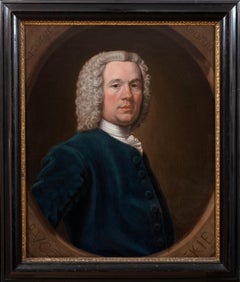
Portrait of George Gordon, 7th Laird of Buckie (1707-1756)
By John Alexander
Located in Henley-on-Thames, England
John Alexander (Scottish, 1686-1766)
Portrait of George Gordon, 7th Laird of Buckie (Scottish, 1707-1756), c. 1743
Oil on canvas
In a carved ebonised frame, with gilded inner slight...
Category
1740s Old Masters Portrait Paintings
Materials
Oil
$8,223 Sale Price
20% Off
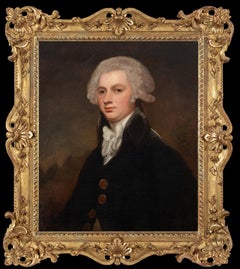
Portrait of a Gentleman, traditionally identified as Edward Addison, Esq., 1780s
By George Romney
Located in Henley-on-Thames, England
George Romney (1734-1802)
Portrait of a Gentleman, traditionally identified as Edward Addison, Esq., c.1780s
Oil on canvas
In a period carved and gilded swept frame
76.3 x 63.2 cm.; ...
Category
1780s Old Masters Portrait Paintings
Materials
Oil
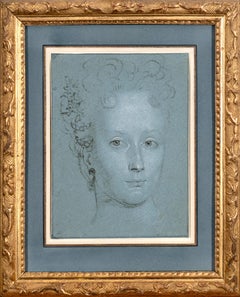
Portrait study of a Lady, wearing precious stones and pearls
Located in Henley-on-Thames, England
Adriaen van der Werff (1659-1722) (attrib.)
Portrait study of a Lady, wearing precious stones and pearls
Black and white chalk, heightened with white, on blue paper
Inscribed verso, ...
Category
17th Century Rococo Portrait Drawings and Watercolors
Materials
Chalk
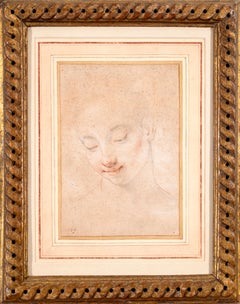
Portrait study of a female head, gazing downwards
Located in Henley-on-Thames, England
Giovanni Battista Vanni (1599-1660), c. 1629
Portrait study of a female head, gazing downwards
Black chalk and sanguine on laid paper, within partial red ink framing lines (inscribed...
Category
1620s Baroque Portrait Drawings and Watercolors
Materials
Chalk
You May Also Like
Men portrait
Located in BELEYMAS, FR
Jean François Marie Bellier
(Paris 1745 – Paris 1836)
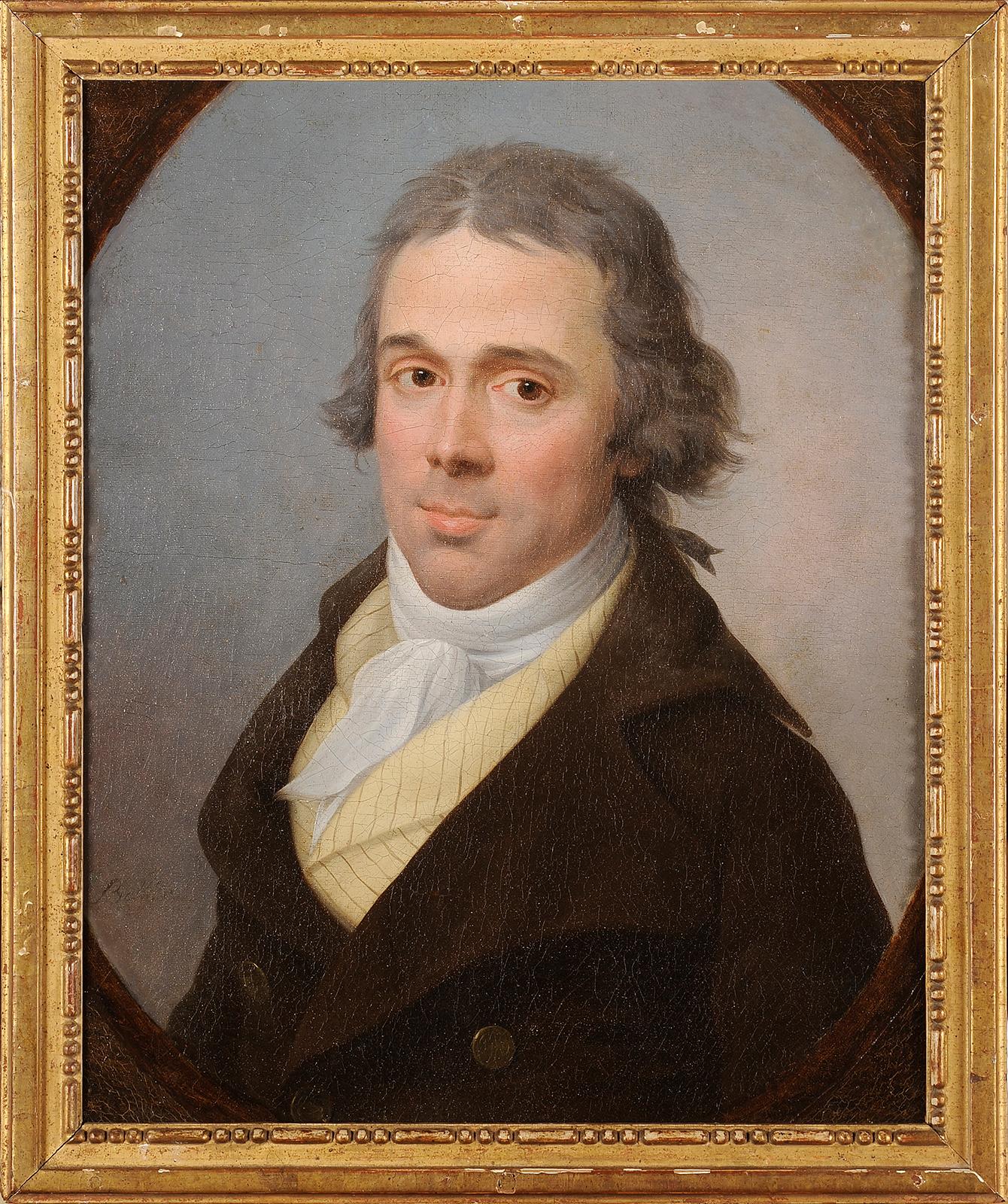
Portrait of a Man
Oil on oval canvas laid flat
H. 45 cm; W. 55 cm
Signed on the left
Circa 1790
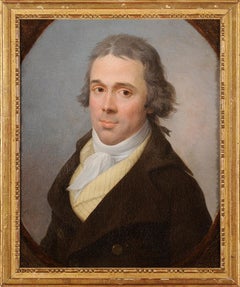
Jean François Marie Bellier occ...
Category
1790s French School Portrait Paintings
Materials
Canvas, Oil
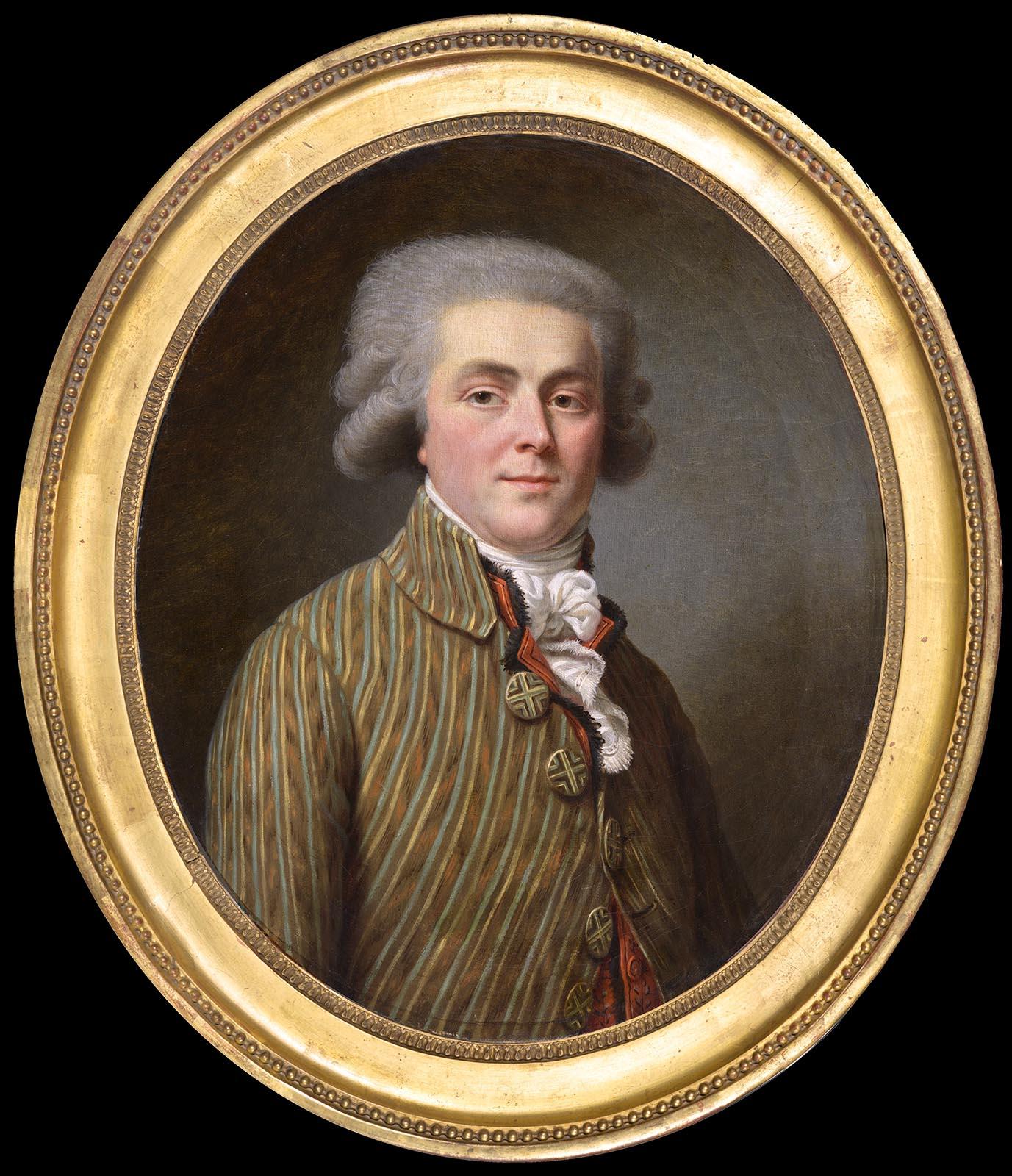
Portrait of a man during French Revolution
Located in BELEYMAS, FR
Antoine VESTIER, attributed to
(Avallon, 1740 - Paris, 1824)
Portrait of a man under the Revolution
Oil on canvas
H. 46 cm; L. 37 cm
Circa 1793-95
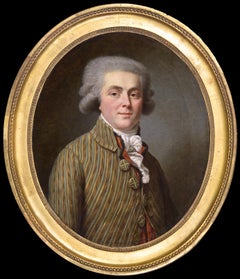
This beautiful unsigned portrait i...
Category
1790s French School Figurative Paintings
Materials
Canvas, Oil
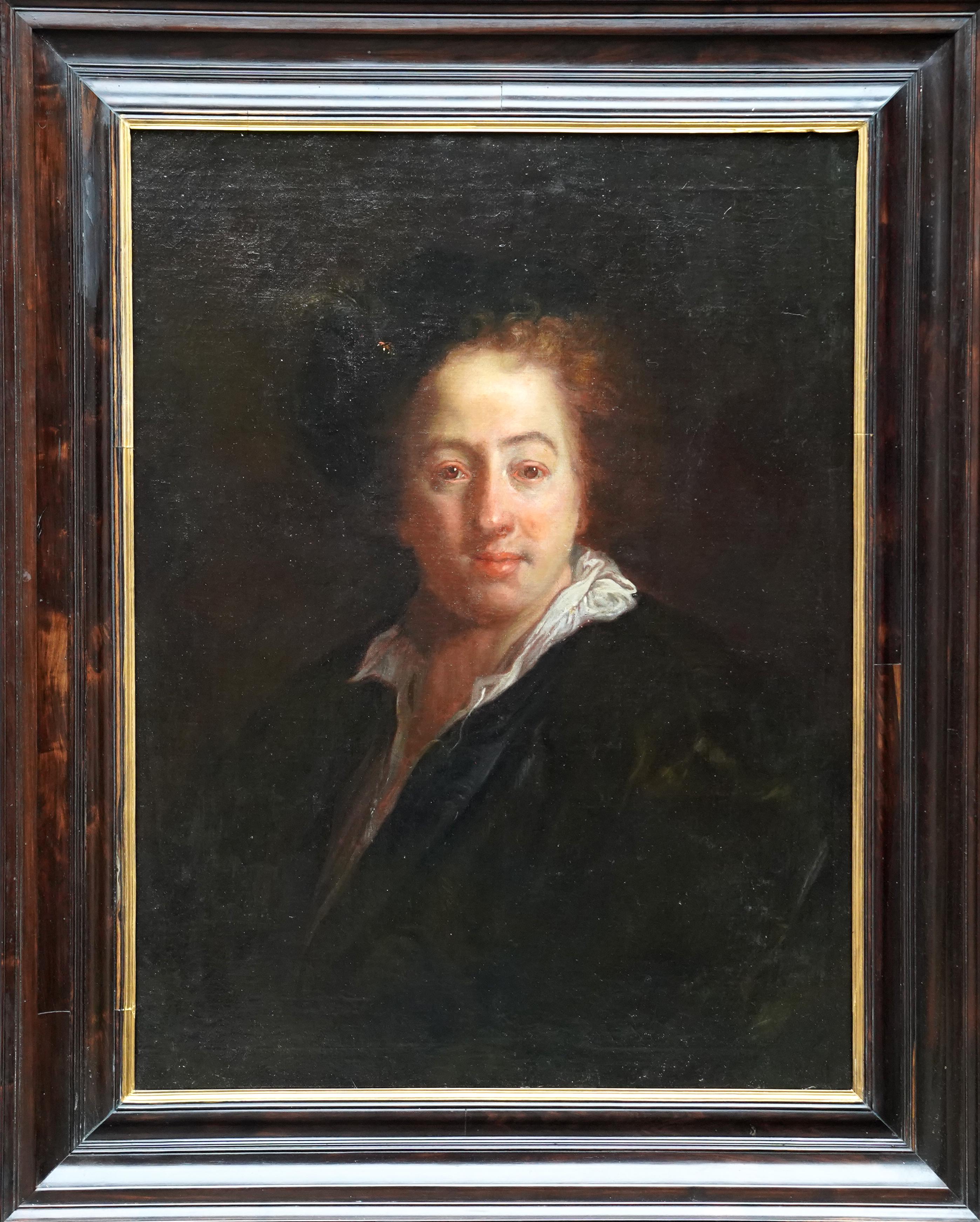
Self Portrait of Artist - French 18th century art Old Master oil painting
Located in Hagley, England
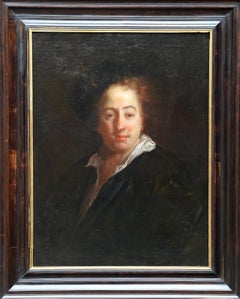
This simply superb French Old Master self portrait oil painting is attributed to portrait artist Alexis Grimou. Painted circa 1720 it is a bust length standing portrait of the artist...
Category
1720s Old Masters Portrait Paintings
Materials
Oil
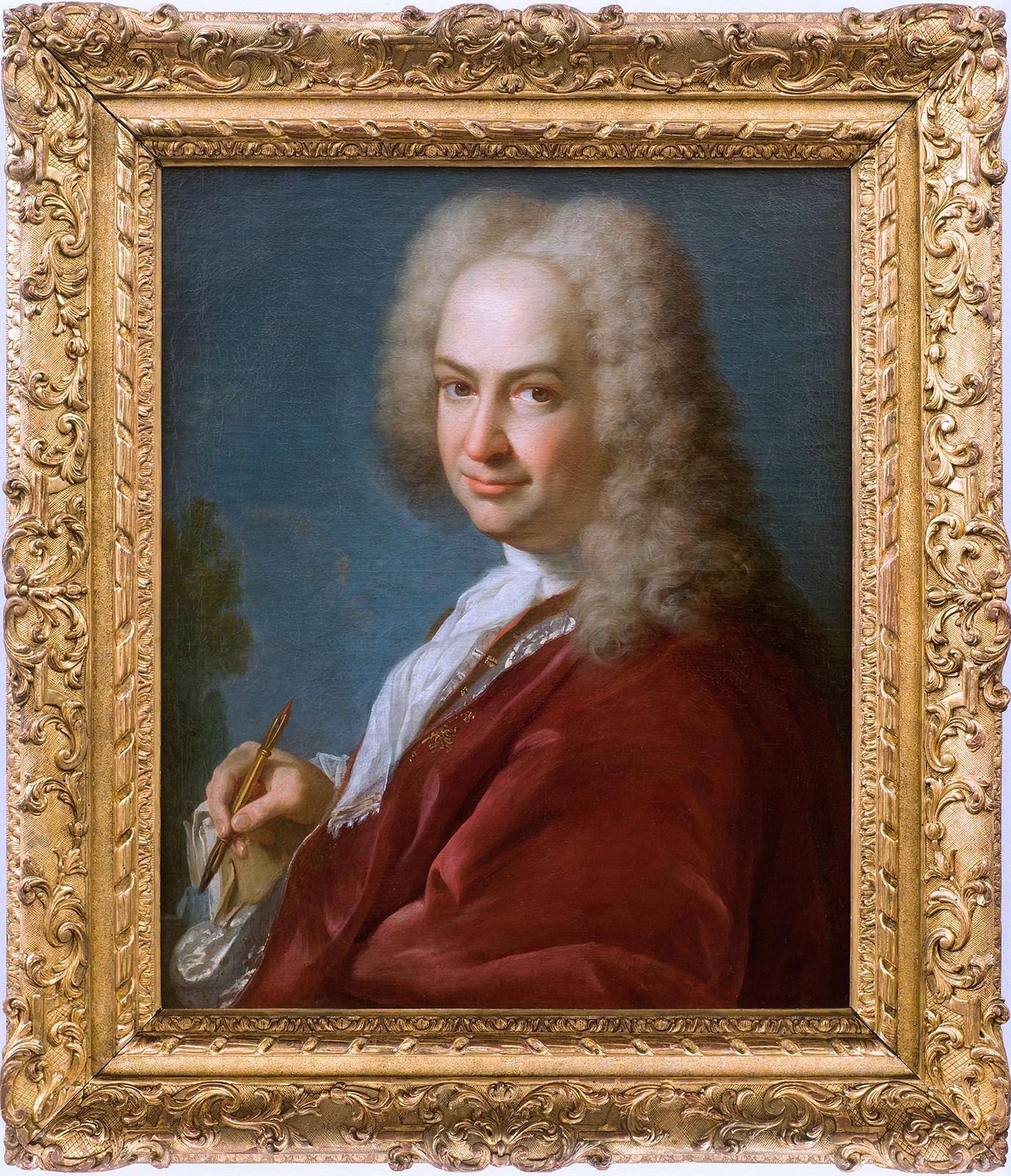
Presumed artist self-portrait
Located in BELEYMAS, FR
Louis-Gabriel BLANCHET
(Versailles, 1701 – Rome, 1772)
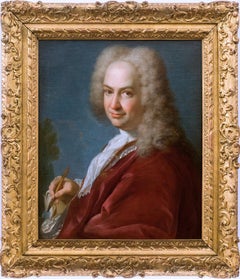
Presumed self-portrait of the artist
Oil on canvas
H. 73 cm; W. 60 cm
Circa 1730
Originally presented in a Restoration period frame with a "Mignard" cartouche, this beautiful painting initially appeared to us as a work from northern Italy. However, it exuded a rather French form of refinement, suggesting that its artist may have assimilated a dual influence from both sides of the Alps.
We thank our colleague and friend Philippe Mendès for spontaneously and judiciously "bringing out" the name of Louis-Gabriel Blanchet, a Romanized French portraitist, whose spirit and stylistic characteristics we clearly recognize here.
Blanchet's "French" years, before his final departure for Rome in 1728, following his winning of the second Grand Prix for painting after Subleyras in 1727, are extremely poorly documented. His father, Gabriel, was valet to Blouin, himself Louis XIV's first valet at the time. According to Thierry Lefrançois, Blanchet was one of the few students of Nicolas Bertin (1667-1736), whose studio he is said to have joined in the early 1720s. At a baptism on March 24, 1724, where he was godfather, he is mentioned as a painter in the picture store of the Duke of Antin, the director of buildings between 1708 and 1736. At this time, he was probably already married to Jeanne Quément, with whom he had a daughter also named Jeanne, who would marry Nicolas Aviet, the son of a valet in the queen's wardrobe, in Versailles in 1738.
When Blanchet arrived in Rome in October 1728, he was accompanied by Subleyras, Trémolières, and Slodtz. He enjoyed the goodwill of Vleughels, the director of the Académie de France, which had been based at the Palazzo Mancini since 1725, even though the latter was not always kind to our resident. From 1732, he was under the protection of the Duke of Saint-Aignan when he took up his post as ambassador to Rome. Along with Slodtz and Subleyras, they formed a trio of friends, joined by Joseph Vernet shortly after his arrival in Rome in 1734. Slodtz and Blanchet, on the occasion of Subleyras's marriage in 1739, were there to attest that their friend was not bound by any marital commitment, and Blanchet was a witness at Vernet's wedding in 1745.
It is most likely from these early years in Rome that our portrait of the artist dates, the expression and turn of his face irresistibly reminiscent of a self-portrait. The still relatively youthful features may correspond to Blanchet's thirty-something years, and the fluffy wig was still fashionable at this time.
The painting fits well with the depiction of a young painter wanting to display both the beginnings of success and a certain simplicity or restraint. A slight smile expresses a form of assurance in this man with a gentle, sincere gaze and a face radiating a keen sense of wit. We find here the air of intimacy present in almost all of Blanchet's portraits, even those from the 1750s and 1760s, as well as an almost complicity with the viewer. The spirit of the painting is quite close to that of the presumed portrait of Bouchardon (painted around 1730) and the portrait of Pannini, painted in 1736, but it possesses a more natural quality, notably thanks to the absence of decorum. Our work exhibits the characteristics of Blanchet's paintings: elegance, luminosity (especially in the whites), vibrant and refined colors (here, the harmony of the garnet of the garment and the slate blue of the background, whose uniformity is tempered by a very sketched landscape and a grove of greenery), light complexions, rather rosy cheekbones, often full lips, and rather tight framing.
According to the Academy's rules, Blanchet's stay should have ended in the spring of 1732, but, for reasons unknown, he remained in the Eternal City until his death, as did his friend Subleyras, with whom he shared accommodation until the late 1730s. The latter regularly called upon him to collaborate on his paintings, such as The Meal at Simon's. Through Saint-Aignan's intervention, Blanchet was employed in the late 1730s by the Stuart princely family, then exiled in Italy. He notably produced copies (now lost) after Liotard of the portraits of Charles Edward and Henry Benedict, the sons of James III Stuart. The latter also commissioned three other portraits (now in the National Portrait Gallery in London), whose more formal character contrasts with the intimate spirit of Blanchet's portraits. Blanchet frequented English painters, such as the landscape painter Richard Wilson, and studied with the Scottish portraitist Katherine Read...
Category
1730s French School Portrait Paintings
Materials
Oil, Canvas
French School 18th century, Portrait of a gentleman, oil
Located in Paris, FR
French School 18th Century
Portrait of a gentleman holding his hat
Oil on paper transferred on wood panel
34 x 27 cm
Not signed which is normal for this type of artwork
In a beautifu...
Category
1760s Old Masters Portrait Paintings
Materials
Oil
Presumed Portrait of Jean-Jacques-Blaise Baloin de Belvèse, Baron de Vennac
Located in BELEYMAS, FR
Marianne Loir
(Paris 1705 – Paris 1783)
Presumed Portrait of Jean-Jacques-Blaise Baloin de Belvèse, Baron de Vennac (?-1781)
Oil on oval canvas
H. 54.5 cm; W. 46 cm
Unsigned
Grandda...
Category
1760s French School Portrait Paintings
Materials
Canvas, Oil

More Ways To Browse
Antique Gentleman
Antique Exercise
Antique White Shirt
Le Brun
Antique Cravat
Antique Tete A Tete
Antique Shirt Collars
Jean Baptiste Greuze
Elisabeth Vigee Le Brun
Francois Guillaume
Alexander Roslin
Bret Reilly
British Officer Painting
Caspar Netscher
Charles Andre Van Loo
Duke Of Somerset
Edward Masters Painting
French Painter Bernard