Items Similar to Portrait of Gentleman, Sir Henry Hobart, Blue Cloak
cravat, Wissing oil canvas
Want more images or videos?
Request additional images or videos from the seller
1 of 13
Willem WissingPortrait of Gentleman, Sir Henry Hobart, Blue Cloak
cravat, Wissing oil canvascirca 1683
circa 1683
$12,632.75
£9,250
€10,880.01
CA$17,543.73
A$18,837.57
CHF 10,136.14
MX$222,924.25
NOK 127,696.93
SEK 116,466.73
DKK 81,292.97
About the Item
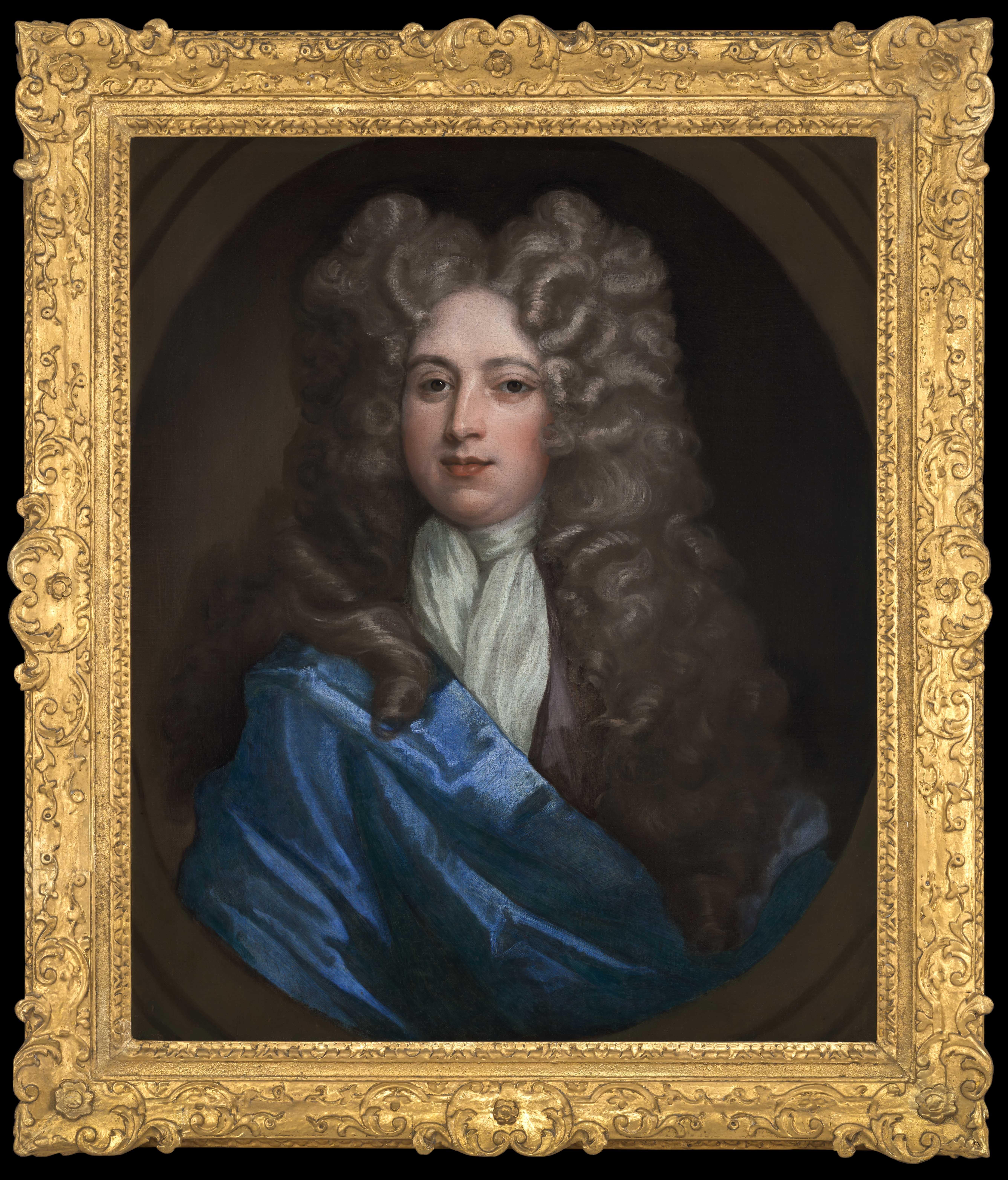
Portrait of a Gentleman, Sir Henry Hobart Blue Cloak and cravat c.1683-1684
Attributed to Willem Wissing (1656-1687)
This impressive portrait, presented by Titan Fine Art, depicts the English nobleman and politician, Sir Henry Hobart (pronounced “Hubbard”), 4th Baronet of Blickling Hall, one of England's greatest Jacobean houses and the supposed birthplace of Henry VII’s second queen, Anne Boleyn. It was painted by William Wissing, whose polished and elegant portraits ensured his meteoric rise from studio assistant in 1680 to royal painter in all but name to King Charles II and his wife Queen Catherine of Braganza in 1683; he had only but one real rival in England, Godfrey Kneller.
The young Sir Henry has been depicted wearing a very long full bottomed wig, a highly polished glistening breastplate under a blue cloak tied at the shoulder with a medallion, brown lappets, white shirt sleeves, and a cross over lace cravat. These immensely expensive items convey wealth and the sitter’s rank in society, for he was a paragon of the wealthy and privileged society that he belonged to; it is the archetypal bust-length portrait for an aristocratic male during the last quarter of the seventeenth century.
Henry Hobart was born in 1657; he was the eldest son to Sir John Hobart, 3rd Baronet and his first wife Mary Hampden. He was educated at Thetford Grammar School and St John's College, Cambridge, graduating in 1675, some four years after he was knighted at Blickling by King Charles II in 1671.
When our sitter succeeded his father as the 4th Baronet in 1683, the family was desperately in debt and Blickling mortgaged to John Pollexfen, a merchant who was evidently used to dealing with the problems of impoverished baronets, who suggested that Sir Henry should find a lady who has between six and seven thousand a year and offered to “recommend such a one”. In the following year, on 9 July 1684, Hobart married Elizabeth Maynard (c.1663-1701), co-heir to Sir Joseph Maynard. A dowry of £10,000 released Blickling from its mortgage. The couple had at least four children, including Henrietta who became the mistress of the Prince of Wales.
The most likely date in which our portrait was painted is 1683 when Hobart succeeded his father as baronet, or in 1684 the year of his marriage – two important life events in which a young noble would commission his portrait at the time.
In 1689 he was appointed an equerry to King William III and also Gentleman of the Horse fought under the King in the Battle of the Boyne. In 1691 he was appointed Vice-Admiral of Norfolk.
In 1698, incensed by rumours that Hobart’s decisive defeat in the elections that year had been brought about by allegations of discreditable conduct at the Battle of the Boyne, Hobart accused his Tory neighbour Oliver Le Neve of circulating the stories and demanded satisfaction. Although Le Neve denied the accusation, they met in a duel on Cawston Heath. Unfortunate for Hobart, Le Neve was a left-handed swordsman, and Hobart was mortally wounded at 41 years of age. As there were no witnesses, the duel was illegal; Le Neve fled to Holland but returned to England two years later, when he was tried and acquitted. Hobart was buried in the Blickling family vault. The duel, one of the last to have been fought with swords in England, is commemorated on the spot by a plinth with an urn bearing the cryptic inscription “HH”, called the Duel Stone (see photo). His only son, succeeded him when he was five years of age, and was eventually created 1st Earl of Buckinghamshire (1673-1756).
The family’s seat is at Blickling Hall, Norfolk, England. Robert Lyminge designed Blickling between 1616 and 1627 for Sir Henry Hobart, lord chief justice of the Common Pleas and 1st Baronet. Sir Henry was one of the "new men" who made a fortune in the law during the reign of Elizabeth I. King Charles II and Queen Catherine of Braganza were probably guests here in 1671.
The house contains a fascinating collection including of furniture, pictures, books, and tapestries of which particularly noteworthy is the huge "Battle of Poltava" tapestry of 1764, probably given to the 2nd Earl of Buckinghamshire by Catherine the Great when he was the British Ambassador to her Court. With approximately 13,000 volumes, the Ellys Library at Blickling is considered one of most important collections of manuscripts and books in England, and the finest library in the care of the National Trust.
A portrait of the sitter, also by Wissing, is in the Great Hall at Blickling (see photo), and in 1927 another was recorded at Heydon Hall in Norfolk. During this period artists frequently painted more than one version of a portrait - they were given to friends and relatives of the sitter or for other homes.
The treatment of the facial features, the armour, and the gross point lace, which has been painstakingly delineated, is very fine. Held in a good quality antique frame.
William (Willem) Wissing was trained at The Hague under Arnold van Ravesteyn (c.1650-1690) and Willem Dougijns (1630-1697). He came to London in 1676 and most probably joined the studio or Sir Peter Lely as an assistant that same year. After Lely’s death in 1680 he effectively took over his business and he scaled the heights of patronage with extraordinary ease, creating an independent practise in 1687, and painted for very important aristocratic patrons. King Charles II was so impressed by a portrait Wissing painted of his son, the Duke of Monmouth, in 1683 that he commissioned his own portrait and that of his Queen Catherine of Braganza.
The painter’s last great patrons were John Cecil 5th Earl of Exeter and his Cecil and Brownlow relatives in Lincolnshire before his career was to be abruptly cut short with his early demise in 1687, aged just 31, giving rise to the sort of romantic apocrypha that attach themselves to genius. At that time, he was staying at the Earl’s seat Burghley House, engaged on his most ambitious work, a vast canvas showing the Earl and his five grandsons at full length. John Vandervaart (whom Wissing collaborated with) took over Wissing’s studio.
Measurements: Height 94cm, Width 80cm, Depth 10cm framed (Height 37”, Width 31.5”, Depth 4” framed)
- Creator:Willem Wissing (1656 - 1687, Dutch)
- Creation Year:circa 1683
- Dimensions:Height: 37.01 in (94 cm)Width: 31.5 in (80 cm)Depth: 3.94 in (10 cm)
- Medium:
- Movement Style:
- Period:
- Condition:The condition is very good and can be hung and enjoyed immediately. The painting has passed a strict condition assessment by a professional conservator prior to going on sale.
- Gallery Location:London, GB
- Reference Number:1stDibs: LU1199117081352
About the Seller
5.0
Vetted Professional Seller
Every seller passes strict standards for authenticity and reliability
Established in 1998
1stDibs seller since 2019
45 sales on 1stDibs
- ShippingRetrieving quote...Shipping from: London, United Kingdom
- Return Policy
More From This Seller
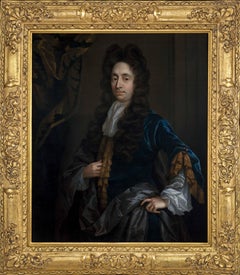
View Allc.1700 Gentleman Portrait with Wig and Blue Cloak, Thomas Murray Oil Painting
Located in London, GB
Portrait of a Gentleman with Periwig and Blue Cloak c.1695-1710
Attributed to Thomas Murray (1663–1734)
This accomplished oil-on-canvas portrait, presented by Titan Fine Art, was al...
Category
17th Century Old Masters Portrait Paintings
Materials
Canvas, Oil
Portrait of a Gentleman in a Blue Coat Standing by a Curtain c.1695, Netscher
Located in London, GB
Portrait of a Gentleman in Blue Coat Standing by Curtain c.1695
Attributed to Constantyn Netscher (c.1668-c.1723), not signed
The gentleman in this portrait has been depicted standi...
Category
17th Century Old Masters Portrait Paintings
Materials
Canvas, Oil
Portrait Gentleman Armour, Blue Cloak, Diamond Brooch c.1700 French Carved Frame
By Joseph Vivien
Located in London, GB
Portrait of a Gentleman in Armour and Azure Cloak with Diamond Brooch c.1700
Attributed to Joseph Vivienne (1657-1735)
The sitter in this superb portrait, offered by Titan Fine Art...
Category
17th Century Old Masters Portrait Paintings
Materials
Oil, Cotton Canvas
Dutch Old Master Portrait of Maurits, Prince of Orange-Nassau, Oil on Panel
Located in London, GB
In 1607, the Delft city council decided to commission a portrait of Stadholder Maurits of Nassau for the town hall, with Michiel van Mierevelt as the chosen artist due to the passing...
Category
17th Century Old Masters Portrait Paintings
Materials
Oil, Wood Panel
Portrait of a Gentleman, David Erskine, 13th Laird of Dun, Wearing Armour c.1700
Located in London, GB
The gentleman in this exquisite oil on canvas portrait, presented by Titan Fine Art, is shown with the grandiloquence characteristic of the English School of painting. He is portray...
Category
17th Century Old Masters Portrait Paintings
Materials
Oil, Canvas
Portrait of Gentleman in blue, Portrait of Lady, oval pair Fine Carved Frames
Located in London, GB
Portrait of a Gentleman with Blue Cloak and Portrait of a Lady in Russet Dress c.1697
Thomas Murray (1663-1735)
These fascinating portraits are exquisite examples of portraiture in ...
Category
17th Century Old Masters Portrait Paintings
Materials
Oil, Canvas

You May Also Like
Sir John Wynn, 5th Baronet
three-quarter-length portrait, oil on canvas
By John Vanderbank
Located in St. Albans, GB
Sir John Wynn, 5th Baronet
Canvas Size: 50 x 40" (127 x 102cm)
Outside Frame Size: 58 x 48" (147 x 122cm)
Sir John Wynn, 5th Baronet (1628 – 11 January ...
Category
1710s English School Portrait Paintings
Materials
Oil
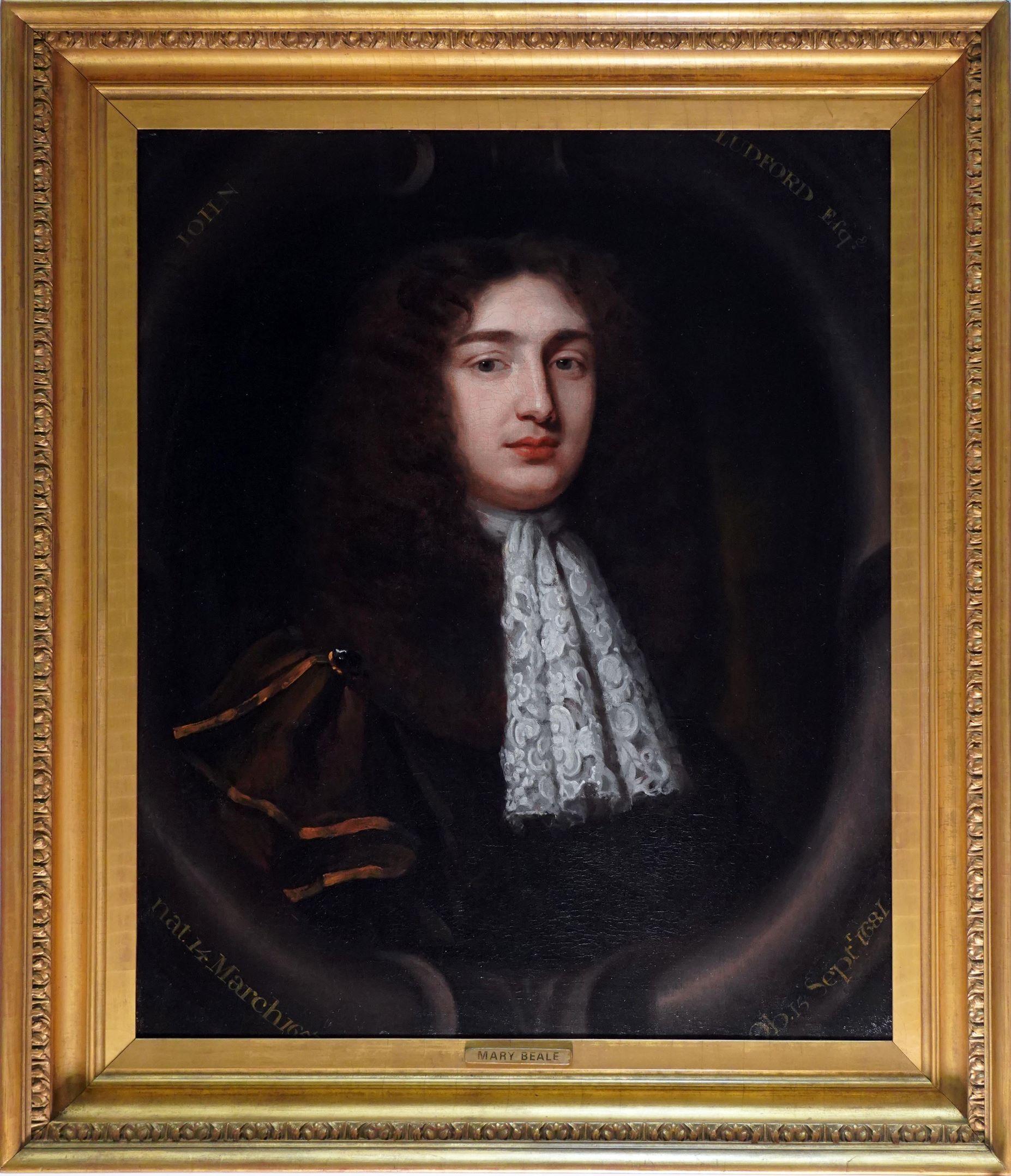
English 17th century portrait of John Ludford Esquire
By Mary Beale
Located in Bath, Somerset
Portrait of John Ludford (1653-1681), wearing a lace jabot and brown and gold trimmed cloak in a feigned stone oval cartouche. Inscribed 'John Ludford, Esq, nat. 14th March 1653, Ob,...
Category
Late 17th Century Baroque Portrait Paintings
Materials
Canvas, Oil
$12,018 Sale Price
20% Off
Old Master Portrait of a Gentleman - British 18th century oil painting
By Michael Dahl
Located in Hagley, England
This stunning 18th century Old Master portrait oil painting is attributed to Swedish born, England based artist Michael Dahl. Painted circa 1690 it is a sumptuous half length portrai...
Category
17th Century Old Masters Portrait Paintings
Materials
Oil
$10,379 Sale Price
20% Off
17th Century portrait oil painting of a gentleman
By John Riley
Located in Nr Broadway, Worcestershire
Circle of John Riley
British, (1646-1691)
Portrait of a Gentleman
Oil on canvas
Image size: 29 inches x 24 inches
Size including frame: 36 inches x 31 inch...
Category
17th Century Old Masters Portrait Paintings
Materials
Canvas, Oil
Portrait of Monsieur Aubert, a ceremonial portrait by Nicolas de Largillière
By Nicolas de Largillière
Located in PARIS, FR
Provenance :
Arnold S. Kirkeby (1901-1962)
Donated by Arnold S. Kirkeby to the Los Angeles County Museum of Art in 1955, where it remained until its sale at Sotheby's, New York on January 10, 1991, lot 82.
Christie's, London, July 7, 2010, lot 186, where it was purchased after the sale by the executors of the will of the late Edmund de Rothschild (1916-2009) for display at Exbury House
The Trustees of Exbury House
Literature :
R. Brown, Bulletin of the Art Division, Los Angeles County Museum, VIII, 1957, pp.8-9, no. 4;
S. Schaefer and P. Husco, European Paintings and Sculpture in the Los Angeles County Museum of Art (Los Angeles, 1987), p. 53 (illustrated and dated c. 1735)
This sumptuous ceremonial portrait, executed around 1725-1730, depicts Monsieur Aubert, the French General Comptroller of Bridges and Roadways, as we learn from a letter on the desk beside our model. The virtuoso treatment of the fabrics, the authoritative yet confident pose, the vigorous treatment of the two hands, are representative of Largillière's talent, here at the peak of his art as portraitist.
The portrait also has a rather extraordinary provenance: donated by Arnold S. Kirkeby, an American hotel magnate and real estate developer, it was exhibited during almost forty years in the collections of the Los Angeles County Museum, before being acquired in 2010 by the executors of Edmund de Rothschild's will to adorn his former home Exbury House (Hampshire), where it remained until its sale in 2022.
1. Nicolas de Largillière, a great European portraitist
Nicolas de Largillière (or Largillierre), one of Europe's premier painters of portraits, history paintings, and still lifes during the late seventeenth century and the first four decades of the eighteenth, was born in Paris in 1656. He was the son of a hatmaker and merchant who moved with his family to Antwerp in 1659. As a boy of nine, he traveled for the first time to London in the company of an associate of his father. After returning to Antwerp more than a year later, his artistic gifts were recognized and his father apprenticed him to Antoni Goubau (1616-1698), a painter genre scenes and landscapes. Something of a prodigy, he was admitted to the painters' Guild of Saint Luke when he was only seventeen. In 1675 he made a second trip to London, where he was employed at Windsor Castle and worked as a restorer under the direction of Italian painter and decorator Antonio Verrio (c. 1639-1707), who brought him to the attention of King Charles II (r. 1660-1685).
At this time Largillière painted several still life paintings in the manner of the Dutch and Flemish masters. Thereafter he practiced this branch of painting with consummate skill, a talent that allowed him to make brilliant use of flowers, fruit, and animals in some of his most ambitious portraits and contemporary history pictures.
In 1679 Largillière settled in Paris, where he specialized in baroque portraiture in the grand manner of Peter Paul Rubens (1577-1640), Anthony van Dyck (1599-1641), and Peter Lely (1618-1680). The Flemish battle painter Adam Frans van der Meulen (1631 or 1632-1690) introduced him to Charles Le Brun (1619-1690) who, as First Painter to King Louis XIV (r. 1643-1715) and director of the Académie royale de peinture et de sculpture, was the predominant figure in France's official art establishment. Upon his acceptance as a candidate for admission to the Académie, he agreed to execute as his diploma picture a large portrait of Le Brun (completed 1686, Paris, Musée du Louvre, eight photo in the gallery) seated in his studio surrounded by the accoutrements of his art and an oil study for the ceiling of Galerie des Glaces at Versailles.
In 1686, Largillière made a final trip to England, where he painted portraits of the newly crowned king, James II (r. 1685-1688) (Greenwich, National Maritime Museum) and his consort Mary of Modena...
Category
1720s Old Masters Portrait Paintings
Materials
Oil
1780 Antique 18c. original oil painting on canvas Portrait of a Nobleman Signed
Located in Palm Coast, FL
This original oil on canvas is a refined and characterful 18th-century British portrait, signed and dated in the lower left: "Js. Jones P.X. 1780." The work depicts a gentleman of st...
Category
Late 18th Century Impressionist Portrait Paintings
Materials
Oil