1 of 6

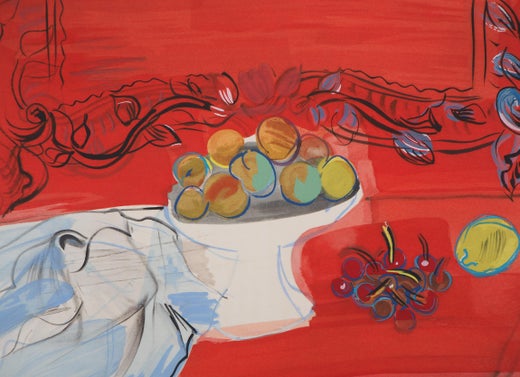
Raoul Dufy
Calèche à Falaise

$658,205.04List Price

You May Also Like

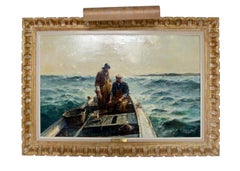
Mid Century Modern Framed Ram Boat Signed Oil Signed Jack Lorimer Gray 1950s 60s
By Jack L. Gray
Located in Keego Harbor, MI
Jack Lorimer Gray, 1927-1981, was born in Halifax, Nova Scotia to Scottish parents. His talents as an artist were spotted by E. Wyly Grier while Gray was still a child. He attended t...
Category

1950s Landscape Paintings

Materials

Oil

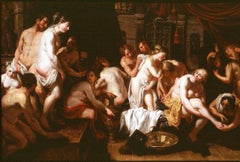
Esther in the Women s House of Ahasuerus
By Artus Wolfort
Located in New York, NY
Born in Antwerp, Artus Wolffordt received his training in Dordrecht where he became a master in 1603 at the age of twenty-two. He returned to his native city in 1615 and initially worked as an assistant to Otto van Veen...
Category

17th Century Old Masters Paintings

Materials

Oil, Panel

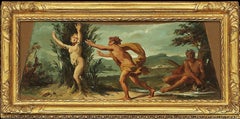
Seven Scenes from the Life of Apollo
By Jacopo Guarana
Located in New York, NY
Attributed to Jacopo Guarana (Verona 1720 – 1808 Venice) Canvas, unsigned The Deeds of Apollo Provenance: Suida-Manning Collection These seven scenes are brilliant evocations o...
Category

18th Century and Earlier Baroque Figurative Paintings

Materials

Oil

Venice Landscape Italian Oil on Canvas Painting in Gilt Wood Frame, Belle Epoque
Located in Firenze, IT
This delightful turn of the century (early 20th century) oil on canvas painting represents an Italian landscape with one of the most famous squares in the world: Piazza San Marco in ...
Category

Early 20th Century Impressionist Landscape Paintings

Materials

Canvas, Oil

Italian 18th Century Oval Religious Oil on Canvas Painting with Saint Dominic
By Francesco de Mura
Located in Firenze, IT
This beautiful Italian 18th Century old masters oil painting on oval canvas with giltwood frame is attributed to Solimena and features a religious scene. In this splendid oval-shaped painting are depicted Saint Dominic...
Category

18th Century Old Masters Figurative Paintings

Materials

Canvas, Oil

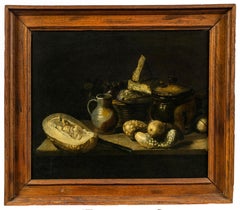
Still Life with Squash, Gourds, Stoneware, and a Basket with Fruit and Cheese
Located in New York, NY
Provenance: Selma Herringman, New York, ca. 1955-2013; thence by descent to: Private Collection, New York, 2013-2020 This seventeenth century Spanish still-life of a laden table, known as a bodegón, stands out for its dramatic lighting and for the detailed description of each object. The artist’s confident use of chiaroscuro enables the sliced-open squash in the left foreground to appear as if emerging out of the darkness and projecting towards the viewer. The light source emanates from the upper left, illuminating the array, and its strength is made apparent by the reflections on the pitcher, pot, and the fruit in the basket. Visible brush strokes accentuate the vegetables’ rough surfaces and delicate interiors. Although the painter of this striking work remains unknown, it is a characteristic example of the pioneering Spanish still-lifes of the baroque period, which brought inanimate objects alive on canvas. In our painting, the knife and the large yellow squash boldly protrude off the table. Balancing objects on the edge of a table was a clever way for still-life painters to emphasize the three-dimensionality of the objects depicted, as well a way to lend a sense of drama to an otherwise static image. The knife here teeters on the edge, appearing as if it might fall off the table and out of the painting at any moment. The shape and consistency of the squash at left is brilliantly conveyed through the light brush strokes that define the vegetable’s fleshy and feathery interior. The smaller gourds—gathered together in a pile—are shrouded partly in darkness and stand out for their rugged, bumpy exterior. The stoneware has a brassy glaze, and the earthy tones of the vessels are carefully modulated by their interaction with the light and shadow that falls across them. The artist has cleverly arranged the still-life in a V-shaped composition, with a triangular slice of cheese standing upright, serving as its pinnacle. Independent still-lifes only became an important pictorial genre in the first years of the seventeenth century. In Italy, and particularly through the revolutionary works of Caravaggio, painted objects became carriers of meaning, and their depiction and arrangement the province of serious artistic scrutiny. Caravaggio famously asserted that it was equally difficult to paint a still-life as it was to paint figures, and the elevation of this new art form would have profound consequences to the present day. In Spain Juan Sanchez Cotan...
Category

17th Century Old Masters Still-life Paintings

Materials

Canvas, Oil

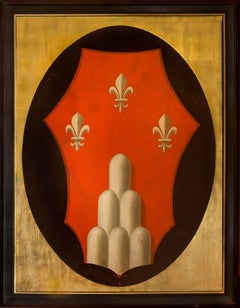
Italian Oil on Canvas Painting Coat of Arms in Gold Leaves Panel and Black Frame
Located in Firenze, IT
This huge Italian 19th century armorial painting features the coat of arms of Montini, a noble Italian family that has among its ancestors the Archbishop of Milan, later known as Pope Paul VI. The large oval canvas has a brown and red background, the latter shaped like a shield, in which six mountains (from the etymology of the surname) and three white fleur de lis are painted. This big scale palatial oil painting...
Category

Late 19th Century Italian School Figurative Paintings

Materials

Oil, Canvas, Wood

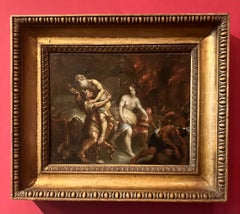
Aeneas Fleeing the Burning of Troy, 17th Century Flemish Oil on Canvas Painting
Located in Firenze, IT
This oil painting on canvas, created by an artist from the 17th Century Flemish School, depicts one of the most significant scenes from Greco-Roman mythology: Aeneas saving his famil...
Category

17th Century Dutch School Figurative Paintings

Materials

Canvas, Oil

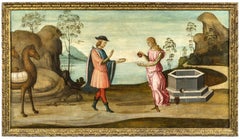
Rebecca at the Well
Located in New York, NY
Provenance: Dr. James Henry Lancashire, Manchester-by-the-Sea, Massachusetts, by 1925; probably by descent to: Private Collection, Cumberland Foreside, Maine, until 2018 This unpublished panel is a characteristic work of the Master of the Apollo and Daphne Legend, an anonymous Florentine painter in the circle of Bartolommeo di Giovanni, Domenico Ghirlandaio, and Sandro Botticelli. The artistic personality of the Master of the Apollo and Daphne Legend was independently recognized by Everett Fahy and Federico Zeri at roughly the same moment in time. Fahy originally dubbed this artist the Master of the Ryerson Panels but later adopted Zeri’s name for the artist, which derives from his eponymous works from the Samuel H. Kress collection (Figs. 1-2). Fahy posited that the artist was most likely a pupil of Ghirlandaio active from roughly 1480 to 1510, and that he may be identifiable with one of Ghirlandaio’s documented pupils to whom no works have been securely attributed, such as Niccolò Cieco, Jacopo dell’Indaco, or Baldino Baldinetti. The present painting was first attributed to this master by Everett Fahy in 1989, who became aware of its existence only after publishing his definitive studies on the artist. The surviving body of work by the Master of the Apollo and Daphne Legend is largely composed of series of panels treating the same theme. In addition to the works illustrating the legend of Apollo and Daphne, there are also series on the themes of Susanna and the Elders and the story of Saint Joseph, among others. The subject of the present panel is drawn from Genesis 24, the story of Isaac. It is possible that our painting relates to another work by the artist depicting the Sacrifice of Isaac formerly in the collection of E. A. McGuire in Dublin, Ireland (Fig. 3), and that these two panels were originally part of a decorative scheme based on the story of Isaac. Although the Master’s paintings of this type have traditionally been considered painted fronts of wedding chests, known as cassoni, the scale of these paintings and the fact that they are often part of a series indicates that they are more likely spalliera panels—paintings set into furniture or the wainscoting of a room. The biblical episode depicted in this painting centers on the theme of marriage, which suggests that this work was likely commissioned for the domestic interior of a newly married couple. The Master has transcribed into paint even the minute details of this Old Testament story, in which Abraham sends a servant to travel by camel to the land of his father and seek out a wife for his son Isaac. The servant is here shown at the well...
Category

15th Century and Earlier Old Masters Figurative Paintings

Materials

Oil, Tempera, Wood Panel

Italian Oil on Alabaster Painting Pompeian Interior Scene in Ormolu Frame
Located in Firenze, IT
This Italian 19th century oil on alabastrer painting depicts an opulent interior in full ancient neoclassical Pompeian style with people festing. The figurative inner scene is painted on a rectangular alabaster slab and housed in a wonderful giltbronze frame resting on casted arrow feet. This is a single section of a bigger surtout de table. You can now use it as a decorative centrepiece on a table or on a console or turn it into a wall decoration. We can provide framing options in this case. The characters enjoy a rich banquet in an elaborate interior, the room renderings...
Category

19th Century Italian School Interior Paintings

Materials

Alabaster, Bronze

Still Thinking About These?

All Recently Viewed