1 of 4
Solomon MugutsoIt stops with me2022
2022
$1,856.87List Price
About the Item
- Creator:Solomon Mugutso (1977, Zimbabwean)
- Creation Year:2022
- Dimensions:Height: 19.69 in (50 cm)Width: 27.56 in (70 cm)Depth: 0.4 in (1 cm)
- More Editions Sizes:aPrice: $1,857
- Medium:
- Period:
- Condition:
- Gallery Location:MADRID, ES
- Reference Number:1stDibs: LU2282211711072
Authenticity Guarantee
In the unlikely event there’s an issue with an item’s authenticity, contact us within 1 year for a full refund. DetailsMoney-Back Guarantee
If your item is not as described, is damaged in transit, or does not arrive, contact us within 7 days for a full refund. Details24-Hour Cancellation
You have a 24-hour grace period in which to reconsider your purchase, with no questions asked.Vetted Professional Sellers
Our world-class sellers must adhere to strict standards for service and quality, maintaining the integrity of our listings.Price-Match Guarantee
If you find that a seller listed the same item for a lower price elsewhere, we’ll match it.Trusted Global Delivery
Our best-in-class carrier network provides specialized shipping options worldwide, including custom delivery.You May Also Like
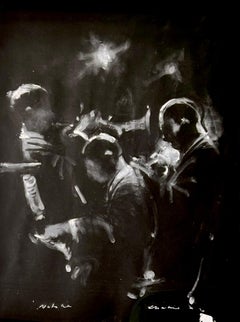
Jazz Trio - Charlie Mackesy, Original Pastel, Musician, Instruments, British
By Charlie Mackesy
Located in Knowle Lane, Cranleigh
An original pastel-on-paper drawing by British artist Charlie Mackesy - Mackesy's clever work and style here, provide us with a glimpse into this atmospheric depiction of a Jazz Trio...
Category
21st Century and Contemporary Contemporary Figurative Paintings
Materials
Charcoal, Pastel
$10,861
H 38.59 in W 48.23 in D 0.99 in
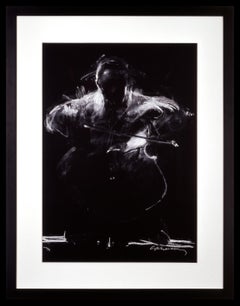
Cellist - Charlie Mackesy, Original Pastel, Musician, Instrument, Dark, British
By Charlie Mackesy
Located in Knowle Lane, Cranleigh
An original pastel-on-paper drawing by British artist Charlie Mackesy - depicting the motion of a musician playing the Cello. Mackesy instantly draws y...
Category
21st Century and Contemporary Contemporary Figurative Paintings
Materials
Charcoal, Pastel
Charlie MackesyCellist - Charlie Mackesy, Original Pastel, Musician, Instrument, Dark, British, 2005
$19,810
H 43.9 in W 34.26 in D 2.56 in
Untitled (Jazz Scene) - Charlie Mackesy, Original Pastel, Musician, Instruments
By Charlie Mackesy
Located in Knowle Lane, Cranleigh
Untitled (Jazz Scene) is an original Charcoal & pastel drawing on paper by British artist Charlie Mackesy. Mackesy's clever work and style here give us a glimpse into this intimate &...
Category
21st Century and Contemporary Contemporary Figurative Paintings
Materials
Charcoal, Pastel
$16,395
H 31.11 in W 41.54 in D 0.79 in
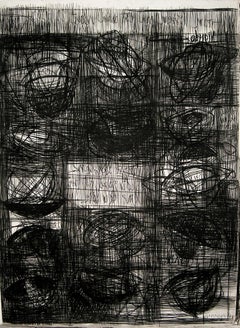
Drawing 13, Series Drawing - Large Format, Charcoal On Paper Panting
By Krzysztof Gliszczyński
Located in Salzburg, AT
The artwork is unframed and will be shipped rolled in a tube
Krzysztof Gliszczyński is Professor for painting on Academy of fine arts Gdansk. ...
Category
Early 2000s Conceptual Figurative Drawings and Watercolors
Materials
Paper, Charcoal
$2,991
H 78.75 in W 59.06 in
Drawing 14, Series Drawing - Large Format, Charcoal On Paper Panting
By Krzysztof Gliszczyński
Located in Salzburg, AT
The artwork is unframed and will be shipped rolled in a tube
Krzysztof Gliszczyński is Professor for painting on Academy of fine arts Gdansk.
Krzysztof Gliszczyński born in Miastko in 1962. Graduated from the Gdańsk Academy of Fine Arts in 1987 in the studio of Prof. Kazimierz Ostrowski. Between 1995 and 2002 founder and co-manager of Koło Gallery in Gdańsk. lnitiator of the Kazimierz Ostrowski Award, con-ferred by the Union of Polish Artists and Designers (ZPAP), Gdańsk Chapter. Dean of the Painting Faculty of the Gdańsk Academy of Fine Arts in the years 2008-2012. Vice Rector for Development and Cooperation of the Gdańsk Academy of Fine Arts in the years 2012-2016. Obtained a professorship in 2011. Currently head of the Third Painting Studio of the Painting Faculty of the Gdańsk Academy of Fine Arts. He has taken part in a few dozen exhibitions in Poland and abroad. He has received countless prizes and awards for his artistic work. He is active in the field of painting, drawing, objects, and video.
Artist Statement
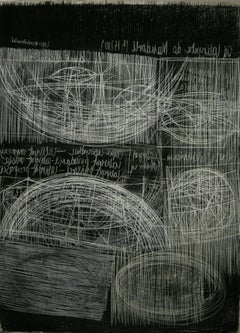
In the 1990s I started collecting flakes of paint – leftovers from my work. I would put fresh ones in wooden formworks, dried ones in glass containers. They constituted layers of investigations into the field of painting, enclosed in dated and numbered cuboids measuring 47 × 10.5 × 10.5 cm. I called those objects Urns. In 2016, I displayed them at an exhibition, moulding a single object out of all the Urns. The Urns inspired me to redefine the status of my work as a painter. In order to do it, I performed a daunting task of placing the layers of paint not in an urn, but on a canvas, pressing each fresh bit of paint with my thumb. In the cycle of paintings Autoportret a’retour, the matter was transferred from painting to painting, expanding the area of each consecutive one. Together, the bits, the residua of paint, kept alive the memory of the previous works. It was a stage of the atomization of the painting matter and its alienation from the traditional concepts and aesthetic relations. Thus, the cycle of synergic paintings was created, as I called them, guided by the feeling evoked in me by the mutually intensifying flakes of paint. The final aesthetic result of the refining of the digested matter was a consequence of the automatism of the process of layering, thumb-pressing, and scraping off again. Just like in an archaeological excavation, attempts are made to unite and retrieve that which has been lost. This avant-garde concept consists in transferring into the area of painting of matter, virtually degraded and not belonging to the realm of art. And yet the matter re-enters it, acquiring a new meaning. The matter I created, building up like lava, became my new technique. I called it perpetuum pictura – self-perpetuated painting. Alchemical concepts allowed me to identify the process inherent in the emerging matter, to give it direction and meaning. In a way, I created matter which was introducing me into the pre-symbolic world – a world before form, unnamed. From this painterly magma, ideas sprung up, old theories of colour and the convoluted problem of squaring the circle manifested themselves again. Just like Harriot’s crystal refracted light in 1605, I tried to break up colour in the painting Iosis. Paintings were becoming symptoms, like in the work Pulp fiction, which at that time was a gesture of total fragmentation of matter and of transcending its boundaries, my dialogue with the works of Jackson Pollock and the freedom brought by his art. The painting Geometrica de physiologiam pictura contains a diagram in which I enter four colours that constitute an introduction to protopsychology, alchemical transmutation, and the ancient theory of colour. It this work I managed to present the identification of the essence of human physiology with art. But the essential aspect of my considerations in my most recent paintings is the analysis of abstraction, the study of its significance for the contemporary language of art and the search for the possibilities of creating a new message. For me, abstraction is not an end in itself, catering to the largely predicable expectations of the viewers. To study the boundary between visibility and invisibility, like in the work Unsichtbar, is to ask about the status of the possibilities of the language of abstraction. The moment of fluidity which I am able to attain results from the matter – matter...
Category
Early 2000s Conceptual Figurative Drawings and Watercolors
Materials
Paper, Charcoal
$2,991
H 78.75 in W 59.06 in
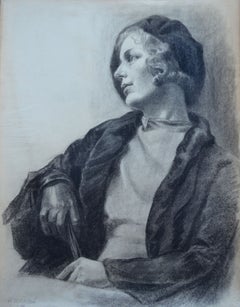
Mademoiselle
By Robert McIntosh
Located in West Hollywood, CA
A rare, early original figurative charcoal by American artist Robert McIntosh(1916-2010)
Robert McIntosh was extremely prolific and exhibited throughout his lifetime, including fi...
Category
1930s Art Deco Figurative Drawings and Watercolors
Materials
Charcoal, Paper
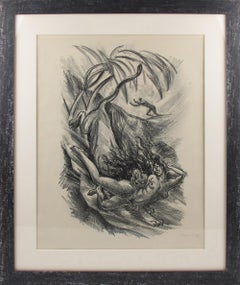
Art Deco Fantasy Charcoal Drawing Lithograph Print by Adolf Uzarski
Located in Atlanta, GA
This stunning charcoal drawing lithograph print on paper depicting a fanciful lion kidnapping a young woman was designed by Adolf Uzarski (1885-1970), a German artist. This drawing i...
Category
1910s Art Deco Figurative Drawings and Watercolors
Materials
Charcoal
$2,900
H 29.75 in W 24.75 in D 2 in
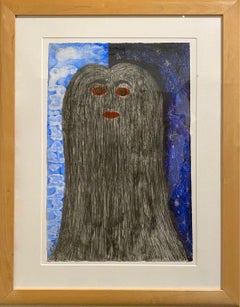
"A Good Witch, " Acrylic and Charcoal Mixed Media Painting on Paper in Wood Frame
Located in Houston, TX
Certainly one of Bert Long’s more humorous artworks, "A Good Witch" exemplifies affection for sincerity, despite obvious levity.
Bert L. Long Jr., was self...
Category
1990s Folk Art Figurative Paintings
Materials
Paper, Charcoal, Acrylic
Price Upon Request
H 23 in W 14.5 in D 1 in
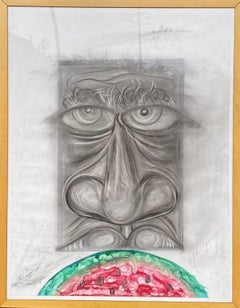
"Feed Me, " Mixed Media Acrylic and Charcoal Figurative Drawing on Paper
Located in Houston, TX
This work bears striking achromatic depiction of a face, contrasted by a vibrant and colorful section of watermelon. The simplicity and levity of the watermelon helps offset the emot...
Category
Early 2000s Folk Art Figurative Drawings and Watercolors
Materials
Paper, Acrylic, Charcoal
Price Upon Request
H 50 in W 38 in D 1.5 in
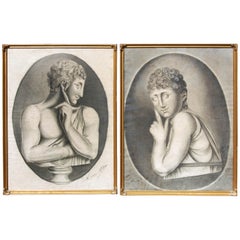
Early 19th Century French Salon Portrait Drawings, a Pair
Located in Rochester, NY
Pair of antique classical French salon drawings. Charcoal on paper. Illegibly signed. In giltwood frames, early 19th century.
# grand tour
Category
Early 19th Century Realist Figurative Paintings
Materials
Charcoal
$475
H 22.5 in W 17.5 in D 1 in
Still Thinking About These?
All Recently ViewedMore Ways To Browse
Trevinos Painting
Vaughan Bass
Vita Solomon
Vladimir Gusev
Walter Gibson
William Notman
William T Williams
Antonio Sotomayor On Sale
Audrey E. Gabrielson On Sale
Igor Pantuhoff
Jes�s Rafael Soto On Sale
John Mundell On Sale
John Whitcomb
John William Haynes Painting
John William Haynes
John William Orth
Jonathan David Batchelor
Karel Frans Philippeau