Items Similar to Still Life
Want more images or videos?
Request additional images or videos from the seller
1 of 10
Fairfield PorterStill Life1959
1959
$185,000
£140,120.32
€160,923.36
CA$259,245.50
A$281,852.13
CHF 149,438.32
MX$3,378,692.37
NOK 1,899,284.37
SEK 1,740,002.70
DKK 1,202,698.32
About the Item
Still Life, 1959
Oil on canvas
31 1/16 x 21 15/16 inches (78.9 x 55.72 cm)
Framed dimensions: 39 1/2 x 29 3/8 inches
Signed and dated lower left: Fairfield Porter 1959
Provenance
Tibor de Nagy Gallery, New York;
Kenneth Wright;
Hirschl
Adler Modern, New York;
Mrs. Felix Rohatyn;
Sotheby's, Property from the Collection of Ambassador and Mrs. Felix Rohatyn;
Questroyal Fine Art, New York;
Private collection, Pennsylvania, 2021 to the present
Exhibitions
Boston, Massachusetts, Museum of Fine Arts, Fairfield Porter: Realist Painter in an Age of Abstraction, January-March 1983, no. 28, p. 103
Houston, Texas, Contemporary Arts Museum; Albany, New York, Albright-Knox Art Gallery; Columbus, Ohio, Columbus Museum of Art; Purchase, New York, Neuberger Museum of Art, State University of New York at Purchase; Portland, Oregon, Portland Art Museum; Miami, Florida, Art Museum of Florida International University, American Still Life, 1945-1983, September 1983-February 1985, pp. 35, 93, illustrated p. 132
New York, Hirschl
Adler Modern, Fairfield Porter, 1907-1975, September 1985, no. 8, n.p.
Literature
Joan Ludman, "Checklist of Paintings by Fairfield Porter," Fairfield Porter: An American Classic, New York, 1992, p. 289.
Joan Ludman, Fairfield Porter: A Catalogue Raisonné of the Paintings, Watercolors, and Pastels, New York, 2001, no. L273, p. 164, illustrated.
The artist and art critic Fairfield Porter, fourth son of the prominent Ruth and John Porter, was born in 1907 in Winnetka, Illinois, a town just outside of Chicago. The Porters spent their summers in Maine, and Porter later stated that “Maine [was his] home more than any other place, and [he belonged] there” (Fairfield Porter, quoted in Fairfield Porter: Realist Painter in an Age of Abstraction, 11). Porter’s parents, an architect (his father) and a poet (his mother), placed a heavy emphasis on an intellectual education, and Porter was raised to be “more scholar and critic” than someone who took inspiration and pleasure from the light, colors, and textures of the world around him. As such, Porter later “needed to disregard his education in order to free himself to paint” (Justin Spring, Fairfield Porter: A Life in Art, 3). But Porter disregarded more than just his education. Porter was descended on both sides from prominent New England families but rarely spoke about his ancestry. This was in part because of his socialist-leaning politics, which were in direct opposition to identification with a hierarchical class structure, but also simply because he wished to be known for his art, rather than be defined by or recognized because of his background. But although Porter largely disavowed his rarefied family history, he was “as much a product of [it] as he was a rebel against it”–– Porter had a lifelong “deep respect for tradition” which is most noticeable in his art through his choice of classical compositions such as the landscape and still life (Spring, 2).
In tracing the path of Porter’s life, one gets the sense that it was spent in a perpetual state of searching. After attending Harvard, Porter spent time travelling the European continent, absorbing the art, culture, and politics primarily of Italy and Russia. In 1928, following his travels, Porter moved to New York City, where he enrolled at the Art Students League. All the while, Porter courted Anne Channing, a childhood acquaintance. After Fairfield and Anne married, they moved often: to Chicago, back to New York City, and finally, to the Southampton village on Long Island, New York. Together they had five children, the first of which, Johnny, was disabled. Given Porter’s initial “ambivalence towards fatherhood,” his family life was often strained, especially as the Porters realized their eldest son required attentive care. However, Fairfield eventually “took up parenting with enthusiasm,” and the love he had for his family is evident in his many paintings depicting Anne and their children (Spring, 91).
The knowledge that Porter “was of two minds about the home life he depicted so beautifully” is central to approaching his artwork. A fellow artist and friend of Porter’s, Jane Freilicher, observed that “an unfinished quality…was part of Fairfield’s aesthetic” and that “the same sort of casualness you find in the household you find in his paintings” (Freilicher quoted in Spring, 173). While this is true, it is perhaps only half of the picture. In Porter’s paintings, there is a high degree of sensuality, and of exploration. While his works do, as Freilicher writes, have an unfinished, casual quality, they also display Porter’s efforts to shed the tight-laced intellectualism of his parents. The more one looks at them, John Ashbery writes, “the less the paintings seem celebrations of atmosphere…but, rather, strong, contentious, and thorny” (Ashery quoted in Fairfield Porter: Realist Painter, 13). This is equally as true as Freilicher’s assessment of Porter. Having grown up in a family that did not value the expression of emotion, Porter struggled throughout his life to both understand and convey his feelings. His paintings thus emerge as an outlet for the emotions he could not otherwise communicate. The reason Porter’s works feel so true, so captivating, is because they are by nature paradoxical: at once soft, casual, and light-filled, but also complicated and truth-telling.
For much of his career, Porter saw himself as a failure. While it is true that he did not attain critical success until near to the end of his life, he was by no means the failure he considered himself to be. Rather, his work was largely misunderstood as a simple and faithful recording of the everyday when in truth, it was so much more. Porter’s work eventually received the recognition it was due and is now owned by such prestigious collections as the Metropolitan Museum of Art, the Smithsonian American Art Museum, the Museum of Modern Art, and many more.
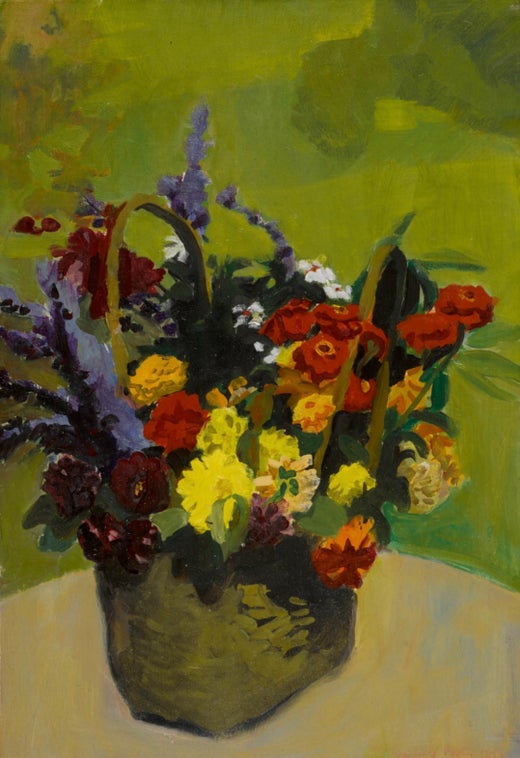
Still Life (1959) is a wonderful demonstration of Porter’s sensual, painterly technique, as well as his mixing of the classical and the contemporary. Porter wrote that “the truest order is what you already find there… when you arrange, you fail” (Porter quoted in Fairfield Porter: Realist Painter, 13). Indeed, the basket of flowers shown in Still Life has the sense of being something found rather than assembled. The way in which the flowers are positioned is reminiscent of a garden or field–– it appears that they were placed in the basket in the same (dis)order of their growth. Furthermore, Porter’s colors are at their best in Still Life, vibrant greens, reds, yellows, and purples working together to form that naturalistic yet deliberate two-sidedness.
The poet and friend of Porter’s, John Ashbery, writes that Porter’s painting “has the vehemence of abstraction, though it speaks another language” (Ashbery quoted in Fairfield Porter: Realist Painter, 13). In Still Life, the passion that Ashbery refers to, the kind often associated with Porter’s abstract expressionist contemporaries, is on full display. This is in part due to Porter’s brilliant use of color, but also because Porter approached his subjects by “drawing the space around them” (John Bernard Myers, “Jottings from a Diary” in Fairfield Porter: Realist Painter, 45). This has the effect of emphasizing the shapes and forms of the primary subject. The result, though achieved through disparate means, is similar to that of abstraction, where the viewer is forced to see a familiar subject in an unfamiliar way. In the case of Still Life, the calculated shapes of the flowers and their purposeful arrangement afford a fresh take on an otherwise simple basket of flowers.
Porter wrote that “painting is a way of making the connection between yourself and everything” (Porter quoted in Fairfield Porter: Realist Painter, 60). Due to Porter’s complicated relationship with self-expression, this quote holds particularly true on a personal level. Painting was Porter’s primary method of articulating his feelings, a fact which makes his work all the more visually compelling; each painting is a glimpse into the mind of a brilliant, multi-faceted man. Painting was thus more than a career for Porter; it was just as much an essential facet of his personal life as it was his professional. Still Life is a wonderful example of Porter’s exploration of the self, a basket of flowers that is at once ordered and disordered, and above all, clearly imbued with his passion for art.
- Creator:Fairfield Porter (1907-1975, American)
- Creation Year:1959
- Dimensions:Height: 31.07 in (78.92 cm)Width: 21.94 in (55.73 cm)
- Medium:
- Movement Style:
- Period:
- Condition:
- Gallery Location:Bryn Mawr, PA
- Reference Number:1stDibs: LU2773217232232
Fairfield Porter
Fairfield Porter was an American painter and critic whose work brought a modern, painterly freshness to representational art at a time when abstraction dominated the mid-20th-century art world. Born on June 10, 1907, in Winnetka, Illinois, Porter studied at Harvard University before training at the Art Students League in New York, where he developed a lifelong interest in both painting and writing. Working primarily in New York City and on Great Spruce Head Island, Maine, Porter created intimate portraits, domestic interiors, and coastal landscapes that reflected the people and places closest to him. His style combined the immediacy of Impressionism with the structure and clarity of modernism, characterized by lush color harmonies, confident brushwork, and a quiet observational sensitivity. Alongside his painting, Porter was an influential art critic, contributing thoughtful essays to Art News, The Nation, and other publications. He championed representational painters during a period when Abstract Expressionism held sway, helping to broaden critical appreciation for figurative art. Porter continued to paint and write until his death on September 18, 1975, leaving behind a body of work celebrated for its warmth, clarity, and deeply personal vision.
About the Seller
5.0
Recognized Seller
These prestigious sellers are industry leaders and represent the highest echelon for item quality and design.
Established in 2001
1stDibs seller since 2024
7 sales on 1stDibs
Typical response time: 1 hour
- ShippingRetrieving quote...Shipping from: Bryn Mawr, PA
- Return Policy
More From This Seller
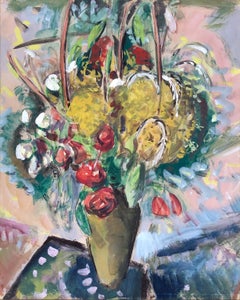
View AllFloral Still Life
Located in Bryn Mawr, PA
Alfred Maurer was born in 1868 in New York City, the son of Louis Maurer, a commercial artist for Currier and Ives. He worked in the family lithographic business as a young man and a...
Category
20th Century American Modern Still-life Paintings
Materials
Gouache
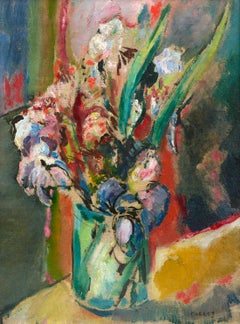
Still Life with Flowers
By Arthur Beecher Carles
Located in Bryn Mawr, PA
Arthur B. Carles
(1882-1952)
Still Life with Flowers
Oil on canvas, 21 1/8 x 16 inches (53.7 x 40.6 cm)
Framed dimensions: 28 x 22 7/8 inches
Signed lower right: CARLES
Provenance
M...
Category
Early 20th Century American Modern Still-life Paintings
Materials
Canvas, Oil
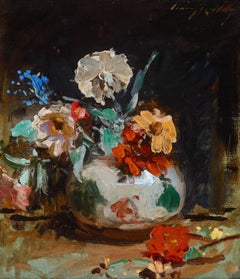
Still Life with Flowers
By Irving Ramsey Wiles
Located in Bryn Mawr, PA
Irving Ramsey Wiles (1861-1948)
Still Life with Flowers, c. 1915
Oil on canvas
14 x 12 inches (35.6 x 30.5 cm)
Signed upper right: Irving R. Wiles
Provenance
Thomas Colville Fine Ar...
Category
1910s American Impressionist Still-life Paintings
Materials
Canvas, Oil
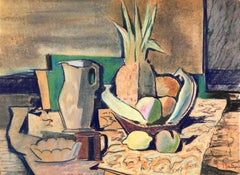
Still Life
By Earl Horter
Located in Bryn Mawr, PA
Best known as an impassioned supporter and avid collector of modern art, Earl Horter was also an artist himself. Largely self-taught, Horter was a highly skilled draftsman and engrav...
Category
1930s American Modern Still-life Drawings and Watercolors
Materials
Paper, Pastel
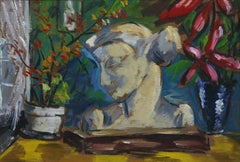
Still Life with Robert Laurent Sculpture
Located in Bryn Mawr, PA
Born in New York City, modernist painter Adelaide Lawson Gaylor studied at the Art Students League and with Kenneth Hayes Miller. She was a member of the Society of Independent Artists, the Salons of America, and the New York Society of Women Artists. She was married to artist Wood Gaylor...
Category
1920s American Modern Still-life Paintings
Materials
Oil, Board
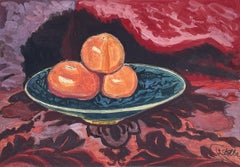
Still Life with Oranges
By Joseph Stella
Located in Bryn Mawr, PA
Still Life with Oranges
Gouache and graphite on paper
15 x 17 inches (38.1 x 43.2 cm)
Framed dimensions: 20 1/2 x 24 1/2 inches
Signed lower right: J Stella
Provenance
Private colle...
Category
Mid-20th Century American Modern Still-life Paintings
Materials
Paper, Gouache, Graphite
You May Also Like
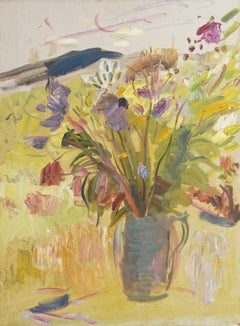
Antique American Sparse Modern Expressionist Flower Still Life Oil Painting
Located in Buffalo, NY
Vintage modernist still life painting. Oil on canvas. Image size, 18L x 24H.
Category
1940s Modern Still-life Paintings
Materials
Canvas, Oil
$636 Sale Price
20% Off
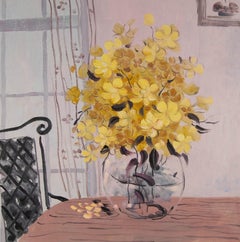
KaDi Pan Still Life Original Oil On Canvas "A Touch Of Yellow"
Located in New York, NY
Title: A Touch Of Yellow
Medium: Oil on canvas
Size: 24 x 24 inches
Frame: Framing options available!
Condition: The painting appears to be in excellent condition.
Note: This p...
Category
Late 20th Century American Impressionist Still-life Paintings
Materials
Canvas, Oil
Full Bloom
By Robert Hallowell
Located in Fairlawn, OH
Full Bloom
Oil on canvass, 28 x 21 1/2 inches
Signed lower right: Robert Hallowell
Provenance: Estate of the artist
Marbella Gallery, New York
Illustrated in Ma...
Category
1930s American Impressionist Still-life Paintings
Materials
Oil
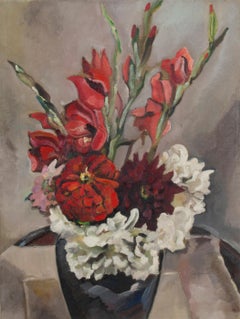
Still Life - Oil on canvas by Gastone Breddo - Mid-20th Century
By Gastone Breddo
Located in Roma, IT
Still life is an artwork realzied by Gastone Breddo in the second half of 90s. Painting from the artist's workshop in Livorno , stamp on the back.
70x 50 cm with frame. Oil on can...
Category
Mid-20th Century Contemporary Still-life Paintings
Materials
Oil
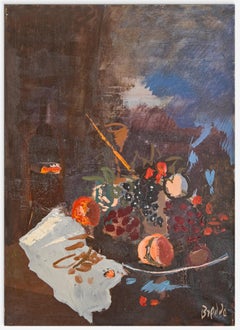
Floral Still Life, Oil on Board Painting by American Artist John F. Leonard
Located in Long Island City, NY
Floral Still Life (44)
John F. Leonard
American (1921–1987)
Date: circa 1965
Oil on Board
Size: 16 in. x 12 in. (40.64 cm x 30.48 cm)
Category
1960s American Modern Still-life Paintings
Materials
Oil, Board
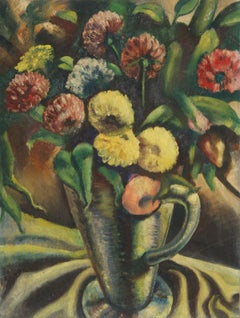
Marguerite S. Pearson Floral Still Life American Impressionist
Located in Rockport, MA
A wonderful floral still life titled "Spring Bouquet" by American Artist, Marguerite S. Pearson a painter in the style of the Boston School. Signed lower right.
Category
20th Century American Impressionist Still-life Paintings
Materials
Oil