Want more images or videos?
Request additional images or videos from the seller
1 of 10
Hunting trophy with a deer and game, adorned with the accoutrements of the chase1700-1720
1700-1720
Price:$17,370.15
$21,567.93List Price
About the Item
- Creation Year:1700-1720
- Dimensions:Height: 45.52 in (115.6 cm)Width: 57.09 in (145 cm)Depth: 3.94 in (10 cm)
- Medium:
- Movement Style:
- Circle Of:Jan Weenix (1642 - 1719, Dutch)
- Period:1700-1709
- Condition:The work is in good and stable condition. Light craquelure throughout the paint surface, commensurate with age. Relined and restored in the c. 1980s, with areas of overpaint focussing around the middle and upper centre.
- Gallery Location:Henley-on-Thames, GB
- Reference Number:1stDibs: LU2820215758032
About the Seller
No Reviews Yet
Vetted Professional Seller
Every seller passes strict standards for authenticity and reliability
Established in 2024
1stDibs seller since 2024
Authenticity Guarantee
In the unlikely event there’s an issue with an item’s authenticity, contact us within 1 year for a full refund. DetailsMoney-Back Guarantee
If your item is not as described, is damaged in transit, or does not arrive, contact us within 7 days for a full refund. Details24-Hour Cancellation
You have a 24-hour grace period in which to reconsider your purchase, with no questions asked.Vetted Professional Sellers
Our world-class sellers must adhere to strict standards for service and quality, maintaining the integrity of our listings.Price-Match Guarantee
If you find that a seller listed the same item for a lower price elsewhere, we’ll match it.Trusted Global Delivery
Our best-in-class carrier network provides specialized shipping options worldwide, including custom delivery.You May Also Like
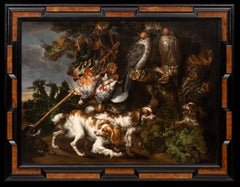
Still Life of Game with Spaniels and Falcons in a Landscape by Carstian Luyckx
Located in SANTA FE, NM
Still Life of Game with Spaniels and Falcons in Landscape Setting
Carstian Luyckx (Flemish, 1623 – c.1675)
Oil on canvas
Circa 1670
Unsigned
43 ½ x 59 1/8 in.; Frame 52 7/8 x 68 7/...
Category
1660s Old Masters Animal Paintings
Materials
Canvas, Oil
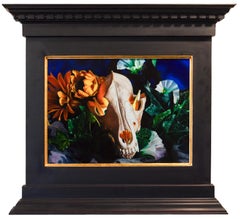
Mockery and Hate - Norse Mythology Still Life with Flowers and Animal Skull
By Matthew Cook
Located in Chicago, IL
Mockery and Hate are the English translations of Sköll and Hati, the Norse mythological wolves that chase the Sun and Moon across the sky and ultimately devour them at Ragnarok. They...
Category
2010s Old Masters Still-life Paintings
Materials
Oil, Acrylic
$10,000
H 33 in W 37 in D 4 in
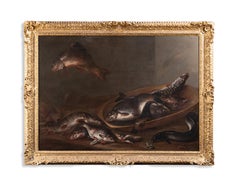
Freshwater fish, an eel and a frog, on a table
Located in Stoke, Hampshire
Isaac Van Duynen (Dordrecht 1628-1679 The Hague)
Freshwater fish, an eel and a frog, on a table
Oil on canvas
Canvas size 37 x 51 in
Framed size 44 x 58 in
Provenance
with Simon Dic...
Category
17th Century Old Masters Animal Paintings
Materials
Oil
18th century portrait of a Spaniel dog with fruit in a wooded landscape.
By Tobias Stranover
Located in Woodbury, CT
Outstanding early 18th-century portrait of a seated Spaniel dog in a landscape with an array of fruits.
Attributed to the work of Tobias Stranover.
...
Category
1730s Old Masters Animal Paintings
Materials
Oil

$19,500
Free Shipping
H 24.5 in W 34.5 in
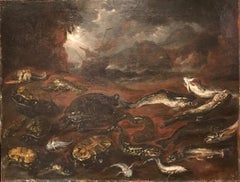
17th Century Oil Painting Still Life: Turtles
Fish with a Ship in Stormy Seas
Located in London, GB
A Still Life of Turtles, An Eel, Pike, Lobsters and other Fish on the Shore, A Ship in the Stormy Seas Beyond
Signed and dated lower left 1640
Inscribed with inventory number lower right: no. 44
Oil on canvas
Framed 29.5 x 37.9 inches
Provenance
Anonymous sale, London, Sotheby's, 15 April 1999, lot 87, (as 'Circle of Giuseppe...
Category
17th Century Old Masters Animal Paintings
Materials
Oil
$24,649 Sale Price
20% Off
Free Shipping
H 29.5 in W 37.9 in
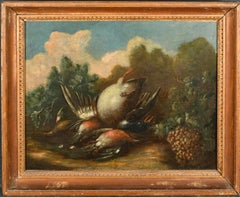
Fine 18th Century Old Master Oil Painting Dead Game in Landscape
Located in Cirencester, Gloucestershire
Still Life with Dead Birds
18th Century Italian School
oil painting on canvas, framed
framed: 17 x 21 inches
canvas: 14 x 18 inches
provenance: private collec...
Category
18th Century Old Masters Animal Paintings
Materials
Oil
$2,026 Sale Price
20% Off
H 17 in W 21 in
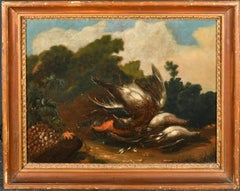
Fine 18th Century Old Master Oil Painting Dead Game in Landscape
Located in Cirencester, Gloucestershire
Still Life with Dead Birds
18th Century Italian School
oil painting on canvas, framed
framed: 16 x 20 inches
canvas: 13 x 17 inches
provenance: privat...
Category
18th Century Old Masters Animal Paintings
Materials
Oil
$2,076 Sale Price
20% Off
H 16 in W 18 in
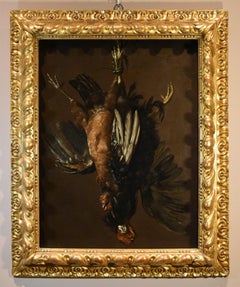
Still-Life Cassana Paint 17/18 Century Oil on canvas Old master Lombard school
Located in Riva del Garda, IT
Giovanni Agostino Cassana (Venice after 1658 - Genoa 1720)
Still life with a pair of gallinaceous birds
Oil on canvas 81 x 63 cm - Framed 100 x 81 cm
Provenance: Sotheby's Mi...
Category
17th Century Old Masters Still-life Paintings
Materials
Oil
$9,790 Sale Price
20% Off
H 39.38 in W 31.89 in
A Tompe l
oeil still life of hanging birds
Located in Stoke, Hampshire
English School, c. 1800
Still life of hanging birds
Oil on panel
Panel size - 8 x 6 in
Framed size - 12 1/2 x 10 1/2 in
This trompe-l'œil still life is a striking example of illusio...
Category
19th Century Old Masters Animal Paintings
Materials
Oil
Exceptional Italian 17th Century Still-Life Painting Wit a Red Parrot and Fruits
By Abraham Brueghel
Located in Rome, IT
17' century Still-life oil on canvas with Fruits and an amazing red parrot background with landscape and garden with architectural elements.
Gilt painted frame .
It is attribute...
Category
Late 17th Century Old Masters Still-life Paintings
Materials
Oil
$65,537
H 57.09 in W 74.81 in D 1.97 in
More From This Seller
View AllPortrait of George Gordon, 7th Laird of Buckie (1707-1756)
By John Alexander
Located in Henley-on-Thames, England
John Alexander (Scottish, 1686-1766)
Portrait of George Gordon, 7th Laird of Buckie (Scottish, 1707-1756), c. 1743
Oil on canvas
In a carved ebonised frame, with gilded inner slight...
Category
1740s Old Masters Portrait Paintings
Materials
Oil
$8,216 Sale Price
20% Off
Portrait of a Gentleman, traditionally identified as Edward Addison, Esq., 1780s
By George Romney
Located in Henley-on-Thames, England
George Romney (1734-1802)
Portrait of a Gentleman, traditionally identified as Edward Addison, Esq., c.1780s
Oil on canvas
In a period carved and gilded swept frame
76.3 x 63.2 cm.; ...
Category
1780s Old Masters Portrait Paintings
Materials
Oil
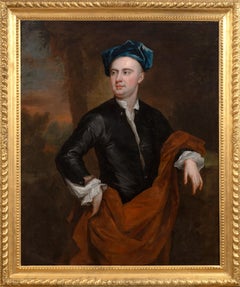
Portrait of an artistic Gentleman, c. 1720s
By John Vanderbank
Located in Henley-on-Thames, England
John Vanderbank (London 1694 - London 1739)
Portrait of an artistic Gentleman, c. 1720s
Three-quarter-length, wearing a turban
Oil on canvas
125.5 x 101.7 cm.; (within frame) 145.6...
Category
1720s Old Masters Portrait Paintings
Materials
Oil
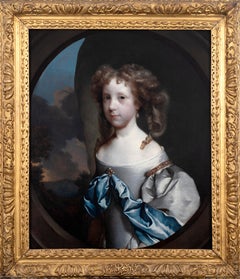
Portrait of a girl, possibly Dorothy Bigg (née Wither) (1661-1717), c. 1674
By Gerard Soest
Located in Henley-on-Thames, England
Gerard Soest (c. 1600-1681)
Portrait of a girl, possibly Dorothy Bigg (née Wither) (1661-1717), c. 1674
Half-length, wearing natural pearl and gemstone jewellery
Oil on canvas
In...
Category
1670s Old Masters Portrait Paintings
Materials
Oil
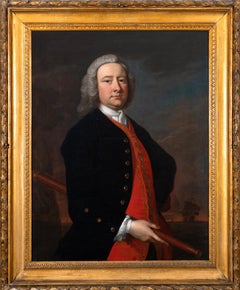
Portrait of a senior naval officer, c. 1750s
By Thomas Hudson
Located in Henley-on-Thames, England
Thomas Hudson (Devon 1701 - London 1779)
Portrait of a senior naval officer, c. 1750s
Probably a captain or admiral; half-length, holding a telescope, with a warship beyond
Oil on canvas
91.3 x 71.1 cm.; (within frame) 114.3 x 93.8 cm.
Provenance:
Christie’s, London, 22 November 1985, lot 105 (as Thomas Hudson);
Private collection, United Kingdom;
Haynes Fine Art, Broadway, Worcestershire;
Where acquired, private collection, United States, 16 August 1988;
Neal Auction, New Orleans, 14 September 2025, lot 302 (as Attributed to Thomas Hudson);
Where acquired by Haveron Fine Art.
Literature:
Bridgeman Art Library, The Bridgeman Art Library (London: The Library, 1995), p. 89
Christie’s, London, Important English Pictures (London: Christie’s, 22 November 1985)
Archival:
Witt Library, Courtauld Institute of Art (no. 061487);
Heinz Archive and Library, National Portrait Gallery, 1725-50, Thomas Hudson: Men Authentic (1) (Box)
This attractive and quintessential half-length is exemplary of Hudson’s leading portrait practice, produced at the height of his decade-long dominance over the London market beginning in 1749. Typical of Hudson's 1750s output, the portrait was likely made after his five-week visit to Rome and Naples, and bares the stylistic merits of this continental excursion. Indeed, the trip seemed to fortify a gradual refinement of Hudson’s technique: namely the emphasis of directional brushstrokes, which sensitively follow the contours of the facial features. The resulting feathery quality is combined here with a striking chiaroscuro effect, which Hudson borrowed directly from Rembrandt. Amalgamating the rich colouring of the Rococo with a mannered Baroque posing, Hudson renders the senior naval officer with a characteristic presence.
Resting one hand assuredly at his hip, the finely worked telescope illustrates the officer’s seniority; the warship sailing on the horizon beyond provides further indication of his commanding rank. The telescope is held by a hand modelled with sculptural poise, and the typically Van Dyck manner (seen elsewhere, e.g. Princess Amelia Sophia Eleonore of Great Britain, YCBA B2001.2.246) further illustrates Hudson's studied grounding. Despite the apparent stylistic placement of the work, an earlier date is possible, since the officer wears civilian clothes and not the naval officer’s uniform first introduced in 1747 (which officers afterwards invariably chose to be shown in). The officer has previously been suggested as Edward Henry Sartorius, of the prominent naval Sartorius family; however, this identification is improbable on biographical and documentary grounds.
Hudson was regularly commissioned by leading naval officers, and produced highly satisfactory portraits praised for their great likeness and genteel swagger. He charged 24 guineas for a standard 50 x 40 inch half-length in the 1750s period, and the present work (somewhat smaller in size) would have cost not much less. Comparable works include those of Admirals of the Fleet George Anson, 1st Baron Anson, and Sir John Norris; Admiral Sir George Pocock; Admiral Sir Peter Warren; Vice-Admiral The Honourable John Byng; and Rear-Admiral Richard Tyrrell. The present portrait is particularly similar in composition to Hudson’s Portrait of a Flag Officer of The White Squadron, which similarly employs the narrative device of a telescope held at a dynamic angle across the composition, with a warship to the left side of the officer’s retracted arm.
Thomas Hudson (Devon 1701 - London 1799)
Thomas Hudson rose to become the leading British portraitist of the mid-18th century, albeit in close competition with his Scottish counterpart Allan Ramsay. Born in Devon, Hudson studied alongside George Knapton under Jonathan Richardson the Elder (marrying his daughter in 1725, expressly against Richardson’s wishes), and inherited a dignified formality jointly derived from Van Loo. His work is first recorded in 1728, and between 1730-40 he practised in Bath and the West Country, where in addition to portrait commissions, he was employed to retouch and reline old pictures. He returned permanently to London thereafter, and devised a series of stock poses to which he would return with variation throughout his career. Beginning in 1745 with the death of Richardson and the departure of Van Loo, Hudson became the city’s most successful portraitist, and embarked on ambitious defining works such as his Portrait of Theodore Jacobsen ‒ not drastically unlike the continental heights of Pompeo Batoni in conception. Profiting from his success, he relocated from Lincoln’s Inn Fields to a house in Great Queen Street previously inhabited by Van Loo, and one door down from Kneller’s old rooms. An exceptionally productive period began in 1749 which lasted until the late 1750s. Among this output were highly praised portraits of the Prince and Princess of Wales, commissions for most of the preeminent aristocrats, and superlative group portraits including Benn’s Club of Aldermen, and those of the Thistlethwayte, Marlborough and Radcliffe families.
Hudson relocated to King Street, Covent Garden, operating a prolific studio operation which resulted in some four hundred paintings ‒ of which at least eighty were engraved. A prodigious assembly of young pupils included Sir Joshua Reynolds (1740-3), Joseph Wright of Derby (1751-3, 1756), Richard Cosway, John Hamilton Mortimer, and the drapery painters Joseph and Alexander van Aken (also employed by Ramsay). As one later reviewer expressed: ‘Hudson, his art may well display to sight / Who gave Mankind a Reynolds and a Wright’ (Miles, ‘Introduction’). The ambitious young Reynolds made many drawings from classical statuary under Hudson’s instruction, and wrote home that, ‘While doing this I am the happiest creature Alive (sic.)’ (Sweetser, p.12). However, he was later dismissed from his pupilage some two years prematurely for refusing to carry a painting to Van Aken’s studio in the rain. It was at this point that Reynolds returned to Plymouth (Devonport), and produced some thirty portraits of the local gentry (including one example presently owned by Haveron Fine Art).
Hudson was one of a number of artists who congregated in Old Slaughter’s Coffee House, alongside Hogarth, Ramsay, Hayman, and Rysbrack. Together they supported Thomas Coram’s Foundling Hospital, of which they each belonged to the 600 governors (in whom Hudson met many of his future clients), and promoted the building as London’s first public space of artistic exhibition. He visited the Netherlands and France for five weeks in 1748 accompanied by St Martin’s Lane colleagues, and was arrested with Hogarth for making drawings of the Bastille fortifications. He afterwards stayed in Rome and Naples in 1752 with Roubiliac, meeting Reynolds twice on the return journey. He returned to England and bought a house at Cross Deep, Twickenham (upstream from Pope’s villa), and made an effective museum of the space. He lived there with his second wife, a wealthy widow named Mrs Fynes. Having been involved with early attempts to establish a royal academy of the arts, Hudson exhibited at the Society of Arts in 1761 and 1766, although he had effectively retired from painting by the latter date. His last painting was in 1767, and he died at Twickenham in January 1779 aged seventy-eight.
Hudson was also exceptional for the extensive collection of artworks which he amassed during his lifetime. The collection was thoroughly impressive in extent, and included outstanding Old Masters: Breughel, Canaletto, van Dyck, Hals, Holbein, Kneller, Lely, Michelangelo, Parmigianino, Poussin, Raphael, Rembrandt, Rubens, Tintoretto, Titian, Vasari, and Velázquez. His earliest recorded purchase was in 1741, and he spent heavily at the sale of his father-in-law, even buying works jointly with Van Aken. Likewise, at the posthumous 1750 sale of Van Aken, Hudson spent £215 on the second day (nearly half that day’s sale total). As a pupil, Reynolds had been sent to bid for Hudson in Lord Oxford’s sale of 1742, and proudly recalled having been greeted with a handshake by Hudson’s friend Pope at another picture sale. Hudson also collected extensively from within his own generation, acquiring works by contemporaries including Gainsborough, Reynolds, Richardson, Rysbrack, Vanderbank, and his predecessor Van Loo. Following his death, the works were dispersed in two sales at Messrs. Langford, with the finer works sold at Christie’s in 1785 after the death of his second wife. However, his connoisseurship was not without flaw ‒ having outbid Benjamin Wilson for a Rembrandt drawing, Wilson etched and printed a new ‘Rembrandt’ plate...
Category
1750s Old Masters Portrait Paintings
Materials
Oil
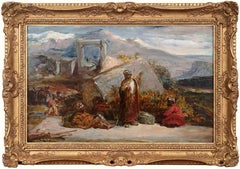
Tribesmen beside ruins at Pinara, Lycia, c. 1844
By William James Muller
Located in Henley-on-Thames, England
William James Müller
Tribesmen beside ruins at Pinara, Lycia, c. 1844
Oil on canvas
Signed indistinctly to the stretcher frame verso, ‘Wm Müller’
35.5 x 55.7 cm.; (within frame) 4...
Category
1840s English School Landscape Paintings
Materials
Oil