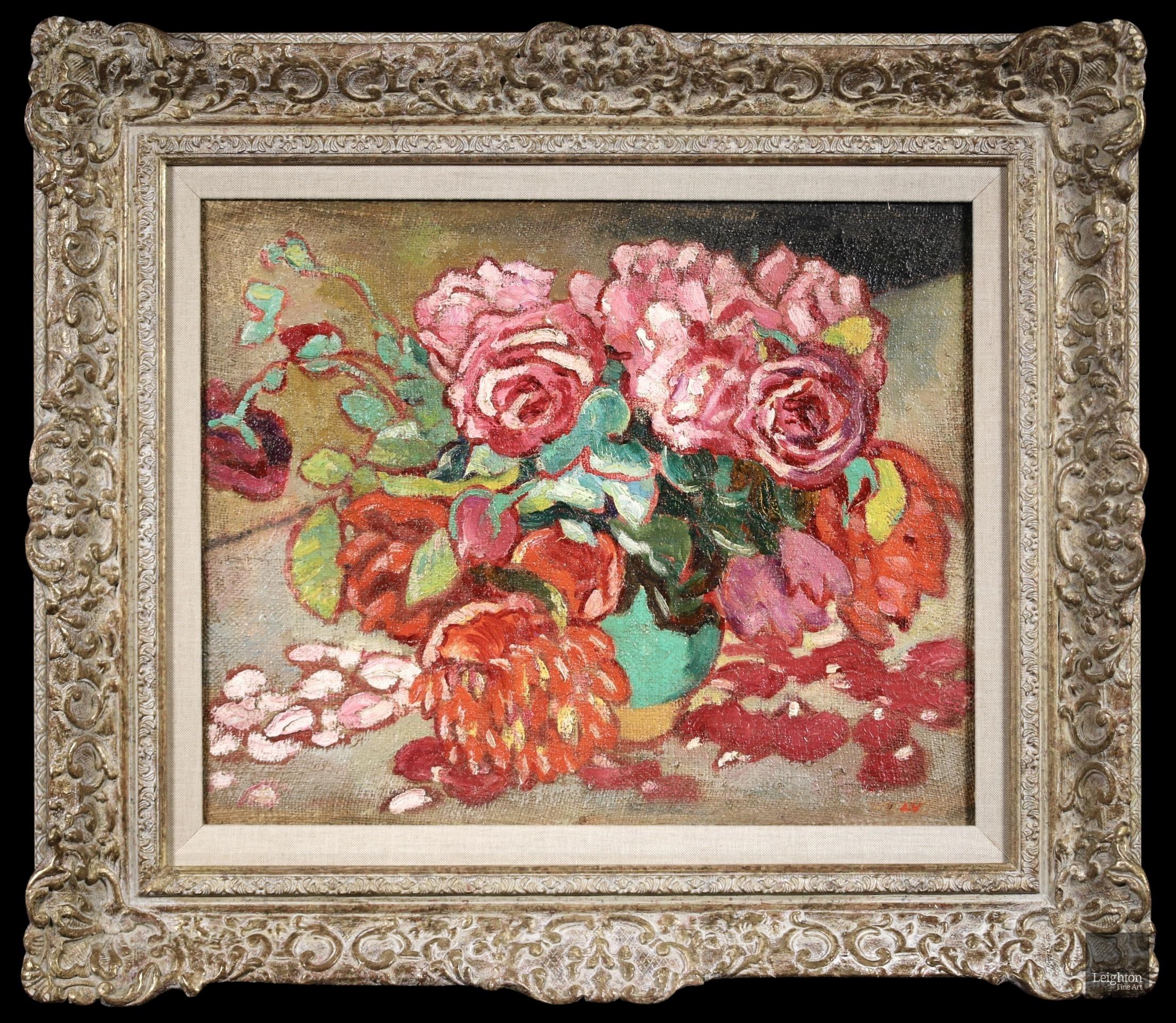
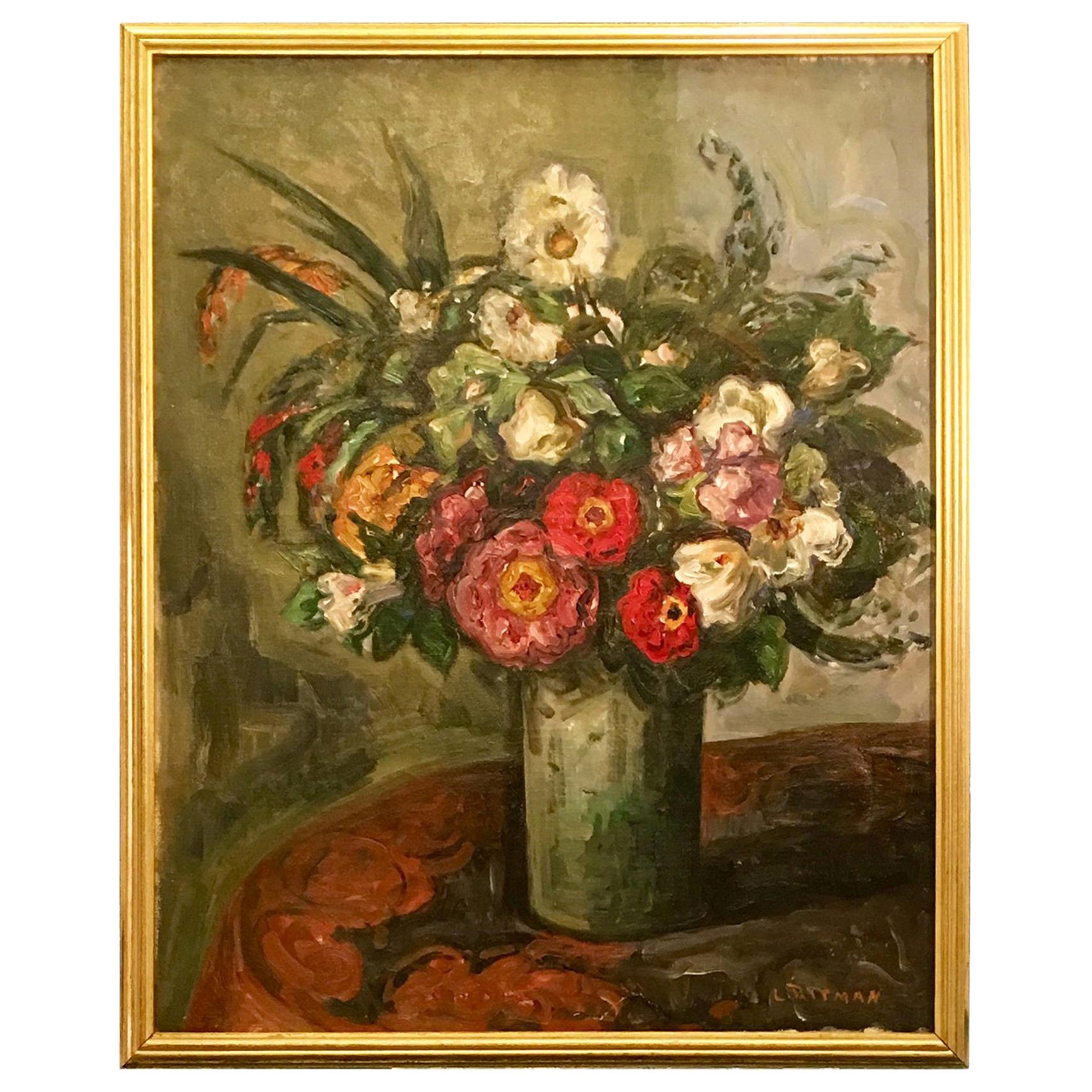
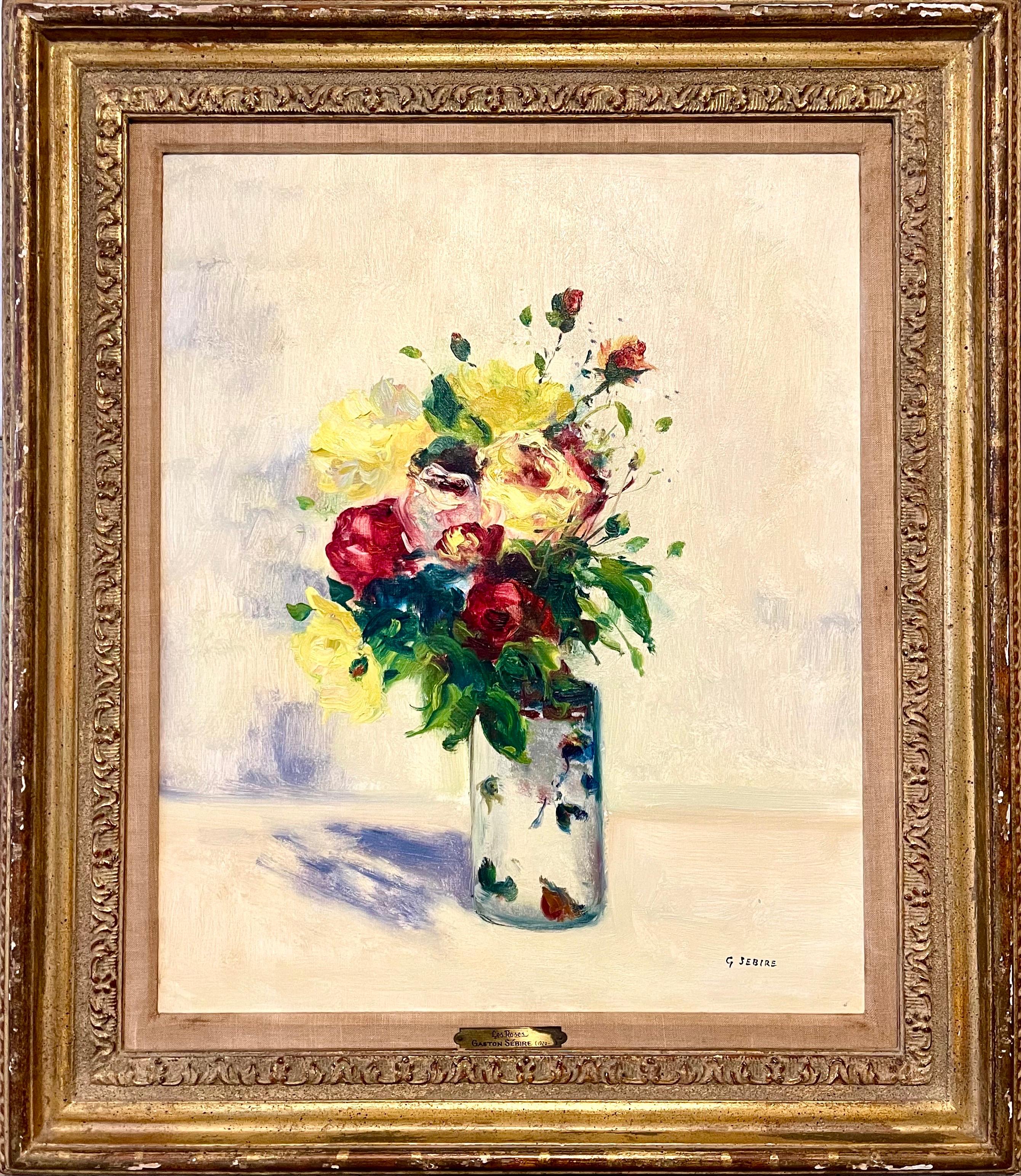
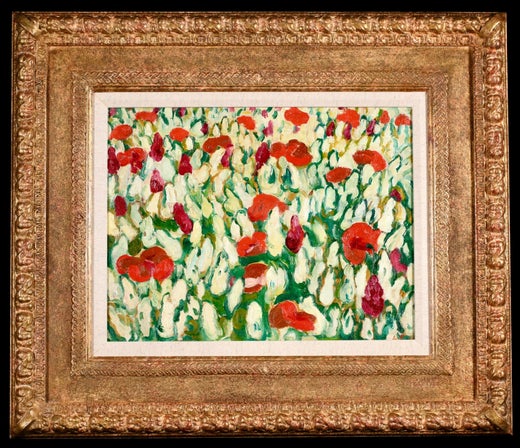
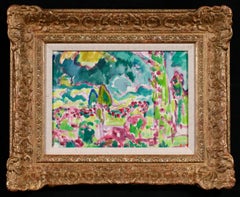
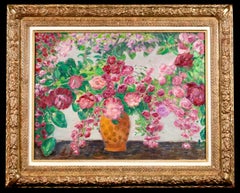
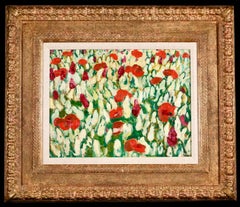
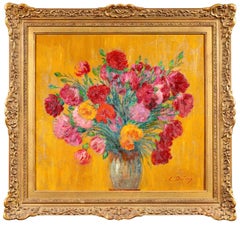
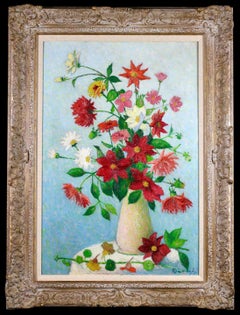
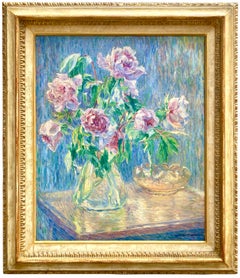
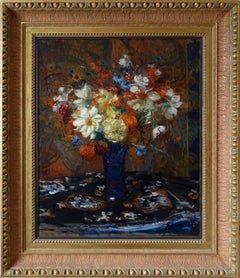
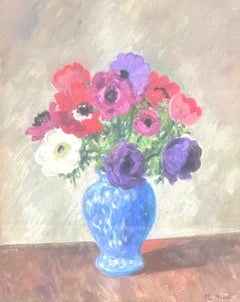
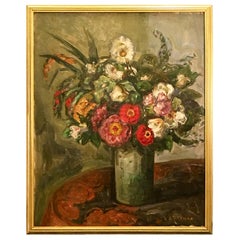
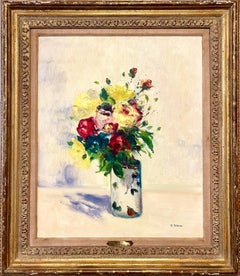
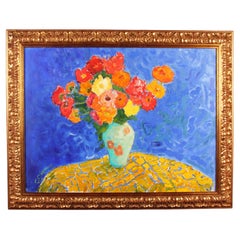
Signed fauvist oil on canvas still life by French post impressionist painter Louis Valtat. The work depicts a green vase filled with roses in different shades of pink set against a yellow background.
Signature:
Signed lower right
Dimensions:
Framed: 25"x25"
Unframed: 16"x16"
Provenance:
Galerie Claude Levin, Paris c. 1965
The Collection of Louis Lavitt, New York
This work is included in the catalogue raisonne of the work of Louis Valtat
J. Valtat, Louis Valtat: Catalogue de l'oeuvre peint, Tome I, Neuchtel, 1977, p. 105, no. 939
Louis Valtat came from a wealthy Dieppe family of shipbuilders. He moved to the Paris region at a young age and completed a classical education at the Lycée Hoche in Versailles. Encouraged in his vocation by his father, himself an amateur painter, he was admitted to the École des Beaux-Arts in 1887. He frequented the studios of Boulanger, Lefebvre and Harpignies before later spending a brief period in the studio of Gustave Moreau. He also studied at the Académie Julian where he met Bonnard, Vuillard, Georges d'Espagnat and Albert André, who became one of his closest friends. He travelled and spent a great deal of time abroad: in England (1894); in Spain with Henri de Montfried (1895); in Banyuls-sur-Mer; in Collioure in the company of Maillol; in Italy (Florence and Venice) (1902); in Algeria (1903); and in Anthéor (regularly from 1899 to 1913). In 1913 he left Anthéor and settled first in Paris, then from 1924 in Choisel in the Chevreuse Valley. He was awarded the Prix Jauvin d'Attainville in the landscape section of the Salon d'Automne in 1890 and was made a Chevalier of the Légion d'Honneur.
In 1895, together with Toulouse-Lautrec and Albert André, Valtat created the sets for an Indian play entitled Terracotta Chariots at the Théâtre de l'Œuvre. During this period he had close links and spent time with the Nabis group, whom he met at the Café Volpini. He was amenable to and influenced by the group's principles, and abandoned the Pointillist technique in favour of a broader brushstroke. He used generous black outlines to delimit areas of uniform, locally applied colour, and he practised a use of colour based on its symbolic resonance and quite independent of the real colour of objects. He was not unconditionally allied to the group, however, and retained his independence. Less intellectual than the Nabis, at least in his art, the spontaneity of his violently contrasting colours was a far cry from the spirituality expressed by artists such as Maurice Denis. These characteristics became more pronounced in his later work.
The periods he spent in the south, particularly Anthéor where he effectively settled for a time and had a house built on the shore at Esterel, constantly brought him face-to-face with the clash of red rocks and the intense blue of the water. This played a determining role in the development of his palette, which was unusually violent for the time. At the first Salon d'Automne in 1903 he showed paintings whose violent colouring was positively Pre-Fauvist. Ambroise Vollard took an interest in him and organised Valtat's first solo exhibition (after Vollard held a Matisse exhibition, but even before holding one of Van Dongen's works). It was thus absolutely to be expected that Valtat be among the artists whose work was shown at the famous exhibition that launched the Fauves, the 1905 Salon d'Automne, at which Valtat - together with Matisse and Marquet - was among those who attracted most critical acclaim. From 1913 Valtat turned his attention more towards Brittany and Normandy, though without losing any of the aggressive quality of his palette.
Louis Valtat revealed a striking unity of style, which has now won him belated recognition, throughout a wide range of subjects: nudes, atmospheric scenes - such as Chez Maxim's (1895) or Merry-go-round (1895-1896), whose contrasting green and red planes in the houses in the background clearly show that he was even then a precursor of Fauvism - but also landscapes of the areas he visited and a great number of still-lifes, often of fruit but sometimes of fish, as in Red Mullets (1931). He also executed woodcuts using side-grain engraving, revitalising the technique together with Vallotton and Maillol. Of course it is clear that art movements do not spring into being overnight and that every revolution, in this sphere as elsewhere, seeks and finds reference points in the past. The Fauves quoted Van Gogh and invoked Cézanne and Gauguin. Nonetheless, after Van Gogh's death in 1890, in 1895 Valtat was certainly one of the only artists drawing in colour, applying it pure and emphasising flowing arabesques, all characteristics soon to become typical of the Fauves. During the last years of his life, after 1948, Valtat lost his sight almost completely and was forced to give up painting.
He was a very wide-ranging painter and executed works from fastidious small formats to vast compositions that could dominate and occupy a wall with ease. His inspiration was rich and varied, and his craftsmanship was both solid and audacious. Indeed, his bold craftsmanship is one of the reasons that he has been re-evaluated, not merely as a fine painter but also as a pioneer.
Louis Valtat took part in group exhibitions including the Salon des Indépendants in Paris (from 1889), the first Salon d'Automne in Paris (1903) and the Salon d'Automne celebrated for introducing the Fauves (1905), as well as the Salon des Tuileries. He also showed his work in solo exhibitions in the Vollard and Druet galleries in Paris. In 1952 the Salon d'Automne held a major retrospective of his work that revealed the quality of Valtat's talent and his place in history to a wider public. Other retrospectives include those at the Musée Galliera in Paris in 1956, at the Fondation Ghez in Geneva in 1969, and at the Musée des Beaux-Arts in Bordeaux in 1995.
Museum and Gallery Holdings:
Bernay: Reading; Sunset over the Seine; Cliffs at Arromanches
Bordeaux (MBA)
Brussels (Mus. royaux)
Chambéry (MBA): Seascape
Geneva: Water-carriers at Arcachon (1897)
Le Havre (Mus. Malraux)
Paris (BNF)
Paris (MNAM-CCI): Still-life with Apples and Tulips; Gladioli and Monkshood; Merry-go-round (1895-1896)
Paris (Mus. d'Orsay)
Paris (Mus. des Arts décoratifs)
Paris (Mus. du Petit Palais)
St Petersburg (Hermitage)