Items Similar to An Exceptional Two-Tiered Fruit Still Life Oil Painting, by Mary Mellen, C. 1850

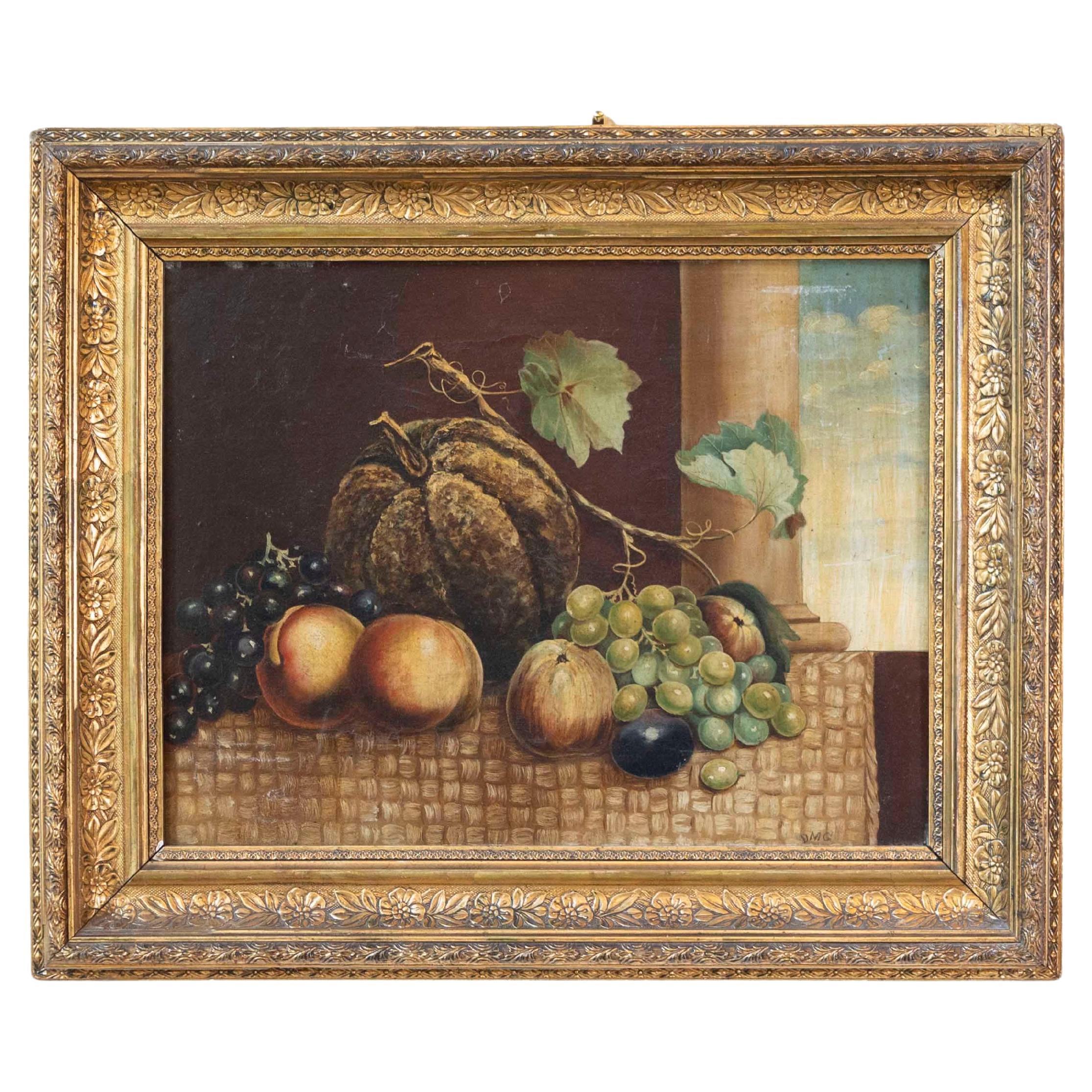
Want more images or videos?
Request additional images or videos from the seller
1 of 12
Mary Blood MellenAn Exceptional Two-Tiered Fruit Still Life Oil Painting, by Mary Mellen, C. 1850C. 1850
C. 1850
$77,000
$110,00030% Off
£58,500.99
£83,572.8430% Off
€67,229.93
€96,042.7530% Off
CA$108,155.94
CA$154,508.4930% Off
A$117,725.02
A$168,178.6030% Off
CHF 62,378.27
CHF 89,111.8230% Off
MX$1,415,821.49
MX$2,022,602.1430% Off
NOK 793,123.86
NOK 1,133,034.0830% Off
SEK 726,810.26
SEK 1,038,300.3730% Off
DKK 502,203.45
DKK 717,433.5030% Off
About the Item
Mary Blood Mellen (American Female Artist, 1819-1882)
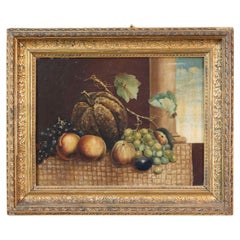
A Large and Exceptional Two-Tiered Fruit Still Life Oil on Canvas Painting, circa 1850
Signed lower right: Mellen
Inscribed possibly by the artist's hand on the stretcher bar: To be sent to Sowle
Ward's for Miss C. A. Rice
This sumptuous two-tier display of fruit and elegant glassware is the largest and most ambitious still-life painting known to have been produced by Mary Blood Mellen (1819-1882), an American Female artist best known for her luminous marines strongly indebted to the style of Fitz Henry Lane. Indeed, still lifes from her hand are extremely rare. The present work is very close to the style of still life popularized by the Prussian-American artist Severin Roesen (1805-1882) who specialized in the genre during the middle decades of the nineteenth century and is signed as Roesen sometimes signed his own efforts, at lower right, as a curly trompe-l'oeil grape tendril, which reads in this case "Mellen."
Until quite recently, Mary Blood Mellen was described in histories of American art exclusively as a copyist, notably of Lane. But as more research into her life and work has been undertaken, that picture of her achievement has been substantially revised and refined. Mellen was, in fact, Lane's pupil, and a copyist of his work. But owing to the skill she developed working with him in his Gloucester studio, Mellen evolved into an artist in her own right, working alongside him as a sometimes collaborator on the same pictures-their work often being so similar that it is frequently difficult to tell it apart. Mellen and Lane also formed a fast friendship. She also painted ravishing moonlit marine compositions of her own invention, as well as nostalgic New England landscapes in her own style.
At a 2007 scholarly conference held at Spanierman Galleries in New York in conjunction with the exhibition, "Fitz Henry Lane and Mary Blood Mellen: Old Mysteries and New Discoveries" held at the Cape Ann Historical Museum, there was a small footnote to the effect that Mellen was also known to have copied works by other artists, including Alfred Bricher and Severin Roesen (See Report on Scholars' Gathering in Association with the Exhibition "Fitz Henry Lane
Mary Blood Mellen: Old Mysteries and New Discoveries," 2007, p. 5.) How she encountered works by those figures, particularly Roesen who was active primarily in New York City and eastern and central Pennsylvania, remains speculative. Certainly, copying other artists' work was an aspect of nearly every artist's training at the time Mellen was active as a painter.
Mellen was born in Vermont in 1819 to parents who were originally from Massachusetts. She was educated at the Quaker's Fryville Seminary in Bolton, Massachusetts, where she would have learned artistic crafts including theorem painting and still life. In 1840, she married the Reverend Charles W. Mellen and moved around for his religious posts. They lived in southern Massachusetts during the 1840s, in upstate New York during the 1850s, and in Dorchester, Massachusetts, in the 1860s. Her brother-in-law's appointment as pastor of the Universalist Church in Gloucester, Massachusetts in April 1855 may have been the event which prompted Mellen to come into contact with Fitz Henry Lane of Gloucester (See J. Wilmerding, "The Lane-Mellen Association," Fitz Henry Lane
Mary Blood Mellen: Old Mysteries and New Discoveries, Spanierman Gallery, New York, 2007, p. 40).
In any event, Mellen's connections with Boston and eastern Massachusetts align with a compelling inscription that can be seen on the reverse of the painting, incised into the stretcher bar in a nineteenth-century hand (possibly Mellen's own?): "To be sent to Sowle
Ward's for Miss C. A. Rice." Sowle
Ward was a Boston gallery that later became the noted firm of Doll and Richards. It operated under the name of Sowle
Ward from 1850 to 1860 and had two different Beacon Hill locations: at 42 Cornhill Street (1850-1855), and at 14 Summer (1856-1860). Since the business changed names both before and after that decade, this strongly suggests that the painting was produced between 1850 and 1860. Miss C. A. Rice was quite possibly the intended recipient of the painting-indeed its first owner.
Whether Mellen's still life is a work of her own invention painted closely in emulation of Roesen, or a direct copy after a lost work by Roesen is unknown. Although it is not a direct copy of any of Roesen's paintings included in Judith O'Toole's catalogue raisonné on the artist, the still life faithfully repeats several of Roesen's favorite props and fruit motifs including the white porcelain compote, champagne flute with two rings near the base, the long slice of watermelon, a sectioned orange with skin still on it, plums in a wicker basket, and a white plate cantilevering over the table edge.
The two-tier composition in the landscape format and the specific motifs represented are both characteristic of Roesen's works from the period between 1850 and 1860. Two especially close comparisons to the present work are in the Brooklyn Museum of Art datable to circa 1860 (O'Toole, Figure 49), and a work formerly in the Amon Carter Museum, Fort Worth, Texas, and now in the D'Amour Museum of Fine Arts, Springfield, Massachusetts (acc. No. 1.94.1) (O'Toole, Figure 13). This work entitled Abundance has dimensions very close to Mellen's painting (35.5 x 49 inches).
The last time this painting appeared on the market was in 1962, at Parke-Bernet Galleries in New York. At the time of that auction, the identity of Mary Blood Mellen was yet largely unknown, and the signature was amusingly and unconvincingly described in the cataloguing as "probably a whimsy of the painter [Roesen], who was known to be something of an inebriate." In Judith O'Toole's catalogue on Roesen, the painting was misdescribed as having been signed "F. Mellon."
PROVENANCE:
[with]Sowle
Ward, Boston, Massachusetts, circa 1850-60;
Possibly Miss C. A. Rice;
Parke-Bernet Galleries, New York, October 17, 1962, no. 78, (as Severin Roesen);
Estate in Larchmont, New York;
Private collection, New York, acquired from the above.
LITERATURE:
Parke-Bernet Galleries, New York, catalogue, October 17, 1962, pp. 44-45, no. 78, illustrated (as Severin Roesen);
J. H. O'Toole, Severin Roesen, London, 1992, p. 65 (erroneously listed as the work of F. Mellon).
Canvas: 35" high x 49" wide
Frame: 48" high x 62" wide
Good condition, ready to hang.
- Creator:Mary Blood Mellen (1819 - 1882, American)
- Creation Year:C. 1850
- Dimensions:Height: 48 in (121.92 cm)Width: 60 in (152.4 cm)
- Medium:
- Period:
- Condition:
- Gallery Location:Queens, NY
- Reference Number:1stDibs: LU1151215034162
About the Seller
5.0
Vetted Professional Seller
Every seller passes strict standards for authenticity and reliability
Established in 1980
1stDibs seller since 2019
15 sales on 1stDibs
- ShippingRetrieving quote...Shipping from: Queens, NY
- Return Policy
More From This Seller
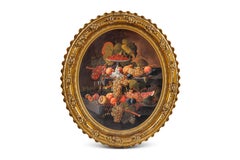
View AllSeverin Roesen (German/American, 1815-1882) Fruit Still Life with Wine Glass
By Severin Roesen
Located in Queens, NY
Severin Roesen (German/American, 1815-1882)
A Magnificent Fruit Still Life with Wine Glass and Compote Oil On Canvas Painting
In a letter ...
Category
19th Century Still-life Paintings
Materials
Canvas, Oil
$55,250 Sale Price
35% Off
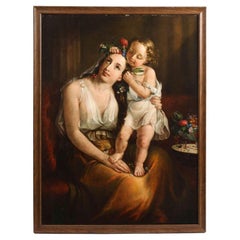
Lilly Martin Spencer (American, 1822-1902) A Portrait of a Mother and Child
By Lilly Martin Spencer
Located in Queens, NY
Lilly Martin Spencer (American, 1822-1902) A Portrait of a Mother and Child
19th Century.
Oil on canvas, signed
Lilly Martin Spencer was one of the most popular and American female genre painters in the mid-nineteenth century. She primarily painted domestic scenes, paintings of women and children...
Category
19th Century Romantic Portrait Paintings
Materials
Oil
$57,000 Sale Price
40% Off
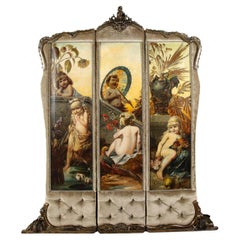
Palatial and Opulent Belle Epoque Giltwood
Oil on Canvas Three-Panel Screen
Located in Queens, NY
A Palatial and Opulent Belle epoque giltwood
oil on canvas three-panel screen, circa 1890.
"Allegory of Youth"
Comprising of three exquisite hand-painted triptych oil on canvas panels of cherubs and putti amongst a peacock, all by Ferdinand Wagner II (German, 1847-1927).
Each panel depicting different playful and joyous scenes of putti and cherubs.
All three-in-one panels within individually carved giltwood and upholstered frames. One panel signed at the lower left: Ferd.Wagner.
A truly magnificent and one of a kind piece, perfect for any room in the home.
Overall: 101" high 85" wide x 5" deep
Very good condition. Ready to place.
Ferdinand Wagner II (German, 1847-1927) was the son of Passau Ferdinand Wagner Senior, a teacher at a vocational art school who began training him professionally at a young age. After traveling to Italy in 1867-1868, he continued with his art studies at The Munich Academy of Arts led by Peter Von Cornelius and Julius Schnorr Von Carolsfeld. Wagner II was influenced by the Munich School of master painters and by his art teacher, Karl von Piloty, who had been teaching at the Munich Art Academy since 1856. Piloty’s approach to historical paintings was influenced by the French art academic Paul Delaroche and by the fine artworks by Rubens and the Venetians.
After his return to Germany he was commissioned to decorate the former the Tenormayer Wine Tavern in Munich, subsequently he received numerous other commissions as a decorator. Ferdinand Wagner II wall paintings and ceiling frescos...
Category
19th Century Romantic Figurative Paintings
Materials
Oil
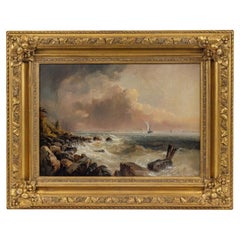
Alfred Copestick, Coastal Scene: New York, Oil on Canvas, 1857
Located in Queens, NY
Alfred Copestick (1837–1859)
Coastal Scene: New York, 1857
Oil on canvas, in the original giltwood frame
14 ¼ x 20 ⅛ in. (canvas)
Signed lower right: A. Copestick NY 1857
Painted at just twenty years of age, Coastal Scene: New York demonstrates Alfred Copestick’s remarkable promise as a marine painter in antebellum America. The scene brims with energy: a single sailboat heels sharply into the wind, its rigging taut against the storm, while foamy waves break against a rugged shoreline. Above, clouds mass and dissolve, illuminated by shafts of storm-lit light. Copestick’s treatment is both romantic and naturalistic, conveying the sublime tension between man, sea, and sky. His confident brushwork captures atmosphere with an immediacy and sensitivity rarely found in so young an artist.
The work survives in its original giltwood frame, richly carved in a mid-nineteenth-century American style, which not only underscores its historical authenticity but also heightens the tonal drama of the painting.
Alfred Copestick came of age during a fertile moment in American painting, when marine art and landscape were central to cultural identity. Though little is known of his formal training, his works suggest familiarity with and admiration for leading marine painters such as James E. Buttersworth, famed for his racing yachts; Francis Augustus Silva, who later developed a luminist style of coastal painting; and earlier masters like Thomas Birch, whose shipwrecks and storm scenes set a precedent for drama at sea.
Copestick also absorbed broader currents in American landscape painting. The Hudson River School, led by Thomas Cole, Asher B...
Category
19th Century Academic Landscape Paintings
Materials
Canvas, Oil
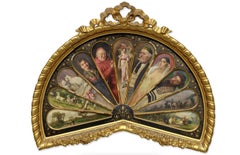
11 Oil Painting Panels in a Majestic Fan Shape, Featuring Isidor Kaufmann
Located in Queens, NY
A Rare and Important Treasure: 11 Oil Painting Panels in a Majestic Fan Shape
Signed by Significant 19th-Century Austrian Artists, Featuring Isidor Kaufmann
A magnificent and unique artistic achievement, this rare and important assemblage of 11 oil painting panels forms a majestic fan shape, uniting the work of significant 19th-century Austrian artists in a singular, breathtaking display. Each oil on panel is signed by the artist, showcasing a rich variety of subjects—ranging from evocative landscapes to compelling portraits—all rendered in the refined and masterful techniques characteristic of the era.
Bringing together the talents of Isidor Kaufmann, Adolf Kaufmann, Carl Reichert, Emma (Edle von Seehof) Müller, Ernst Novak, Johann Hamza...
Category
19th Century Portrait Paintings
Materials
Oil
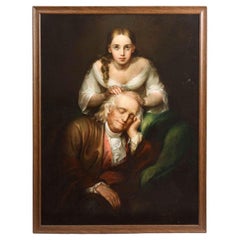
Lilly Martin Spencer (American, 1822-1902) God Bless My Father Portrait Painting
By Lilly Martin Spencer
Located in Queens, NY
Lilly Martin Spencer (American, 1822-1902) A Rare Portrait God Bless My Father.
**Figure 84 from principal book/catalogue on Lilly Martin Spencer.
19th Century.
Oil on canvas, signed
Lilly Martin Spencer was one of the most popular and American female genre painters in the mid-nineteenth century. She primarily painted domestic scenes, paintings of women and children...
Category
19th Century Academic Portrait Paintings
Materials
Oil
Lilly Martin SpencerLilly Martin Spencer (American, 1822-1902) God Bless My Father Portrait Painting
$59,200 Sale Price
60% Off
You May Also Like
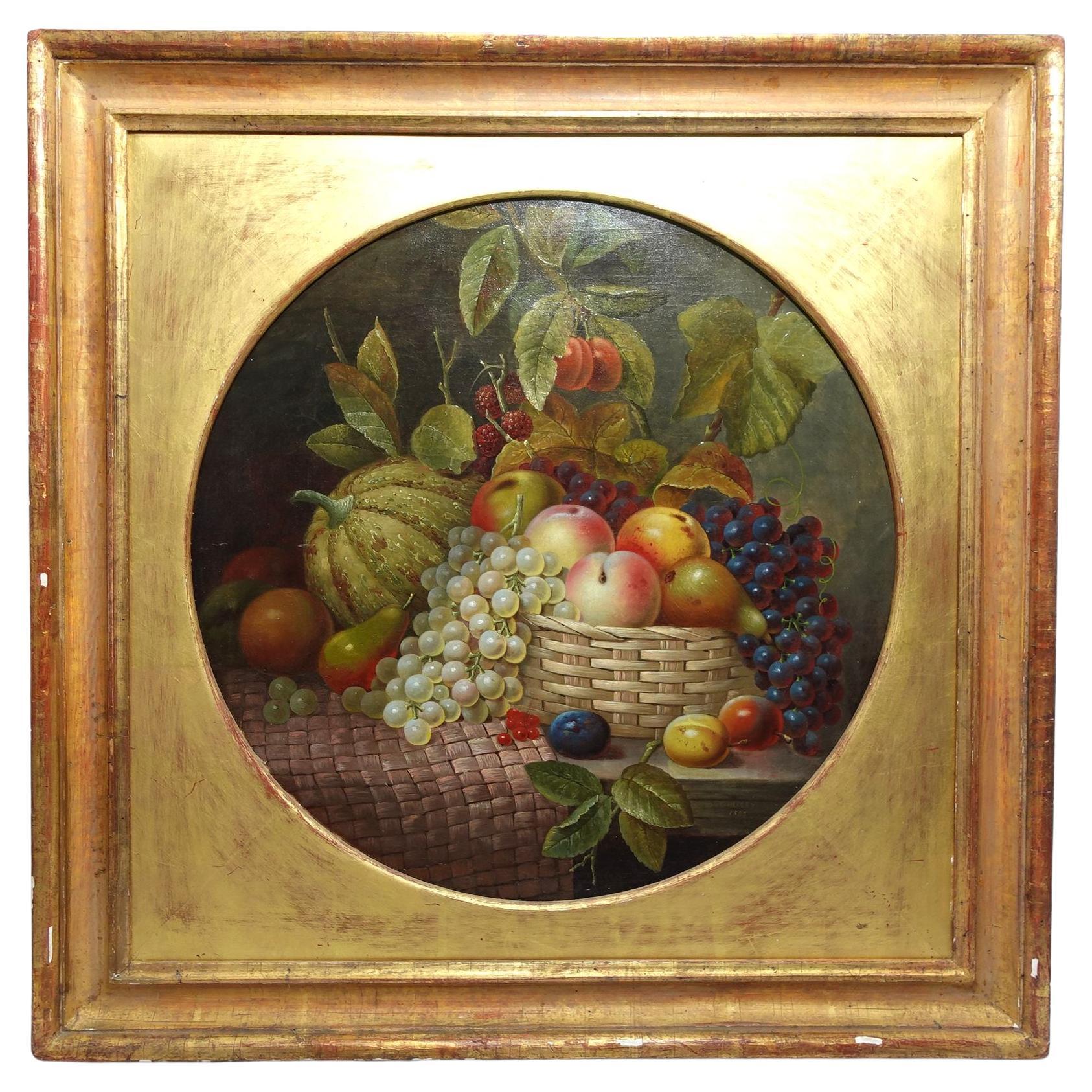
Oil Painting, "Still Life with Fruit", by George Hedley, 1855
Located in Norton, MA
George Hedley (British), 1855
Still Life with Fruit
signed 'G. HEDLEY / 1855' (lower right) oil on canvas
55 x 55 cm (21 5/8 x 21 5/8 in).
framed 74.5 x 74.5 x 4.5 cm. (29 1/3 x 29 1...
Category
Antique 1850s English Paintings
Materials
Canvas, Wood
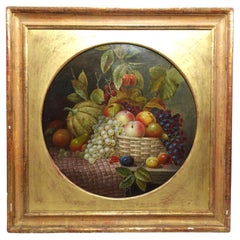
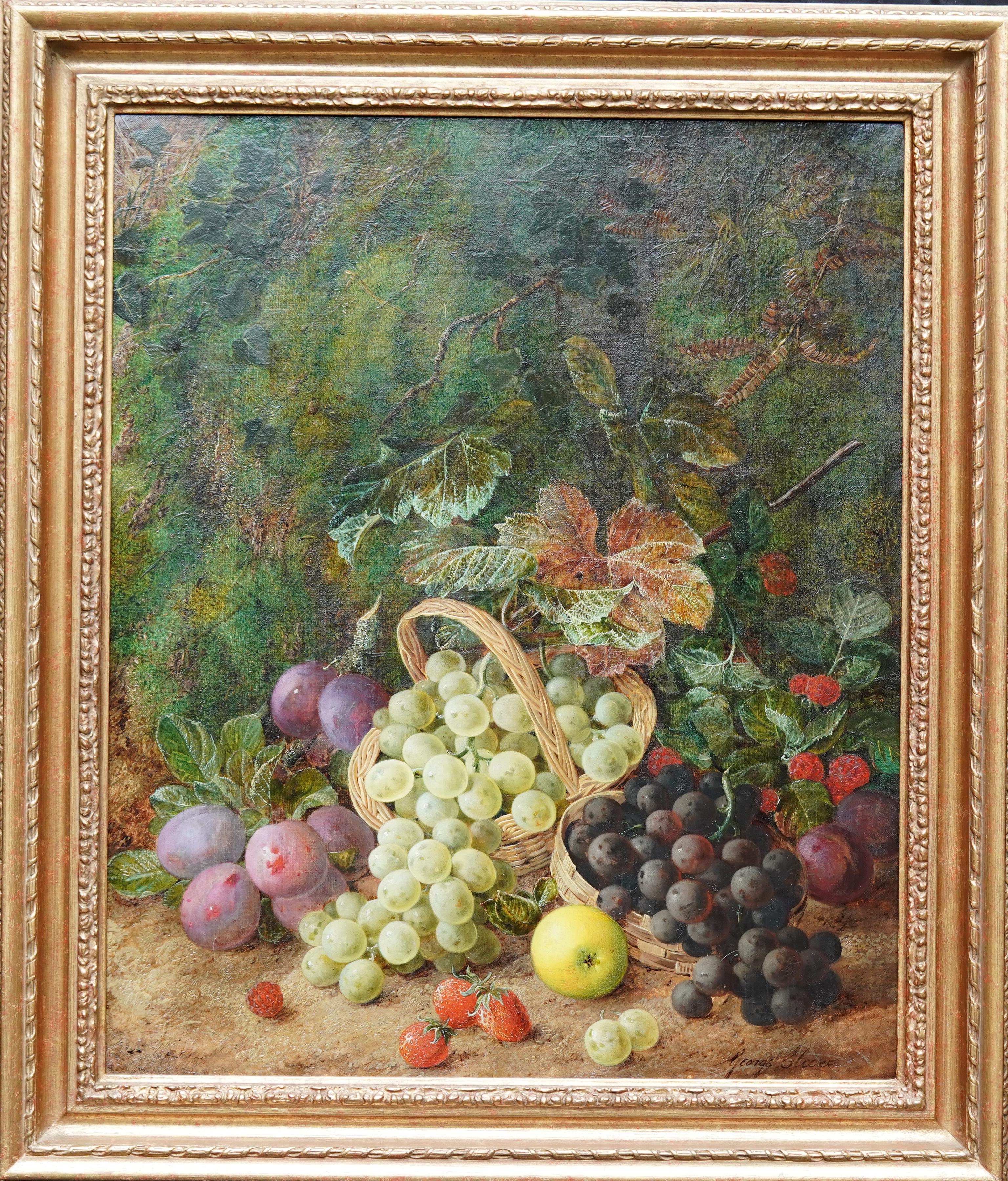
Still Life of Fruit - British 19th century Victorian art oil painting still Life
By George Clare
Located in Hagley, England
This lovely British Victorian still life oil painting is by noted still life painter George Clare. Painted circa1870 the composition is different fruit, including green and red grape...
Category
1870s Victorian Still-life Paintings
Materials
Oil
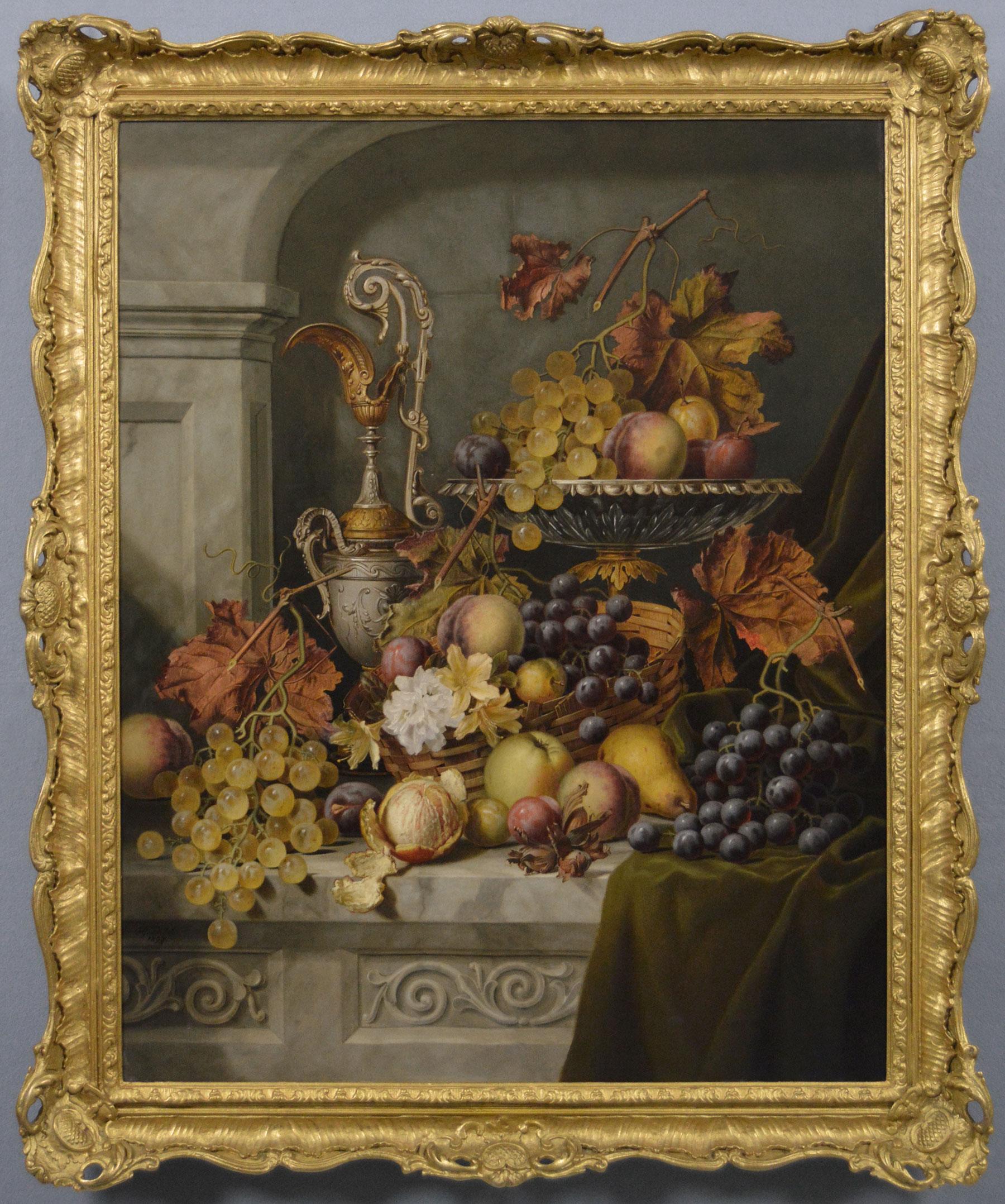
19th Century still life oil painting of autumn fruit
leaves
By Henry George Todd
Located in Nr Broadway, Worcestershire
Henry George Todd
British, (1847-1898)
Autumn’s Bounty
Oil on canvas, signed & dated 1897
Image size: 31.25 inches x 25.5 inches
Size including frame: 37.75 inches x 32 inches
Provenance: Mandell’s Gallery, Norwich
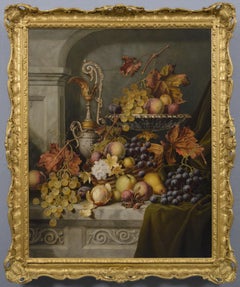
A wonderful autumnal still life painting of fruit by Henry George Todd. Grapes, peaches and plums can be seen arranged in a silver dessert dish and wicker basket perched on a marble ledge. Other fruit are shown resting on the edge of the carved stone table and also draped across a green velvet hanging. Rising up next to the fruit arrangement and framed within an alcove is an ornate silver gilt ewer...
Category
19th Century Victorian Still-life Paintings
Materials
Canvas, Oil
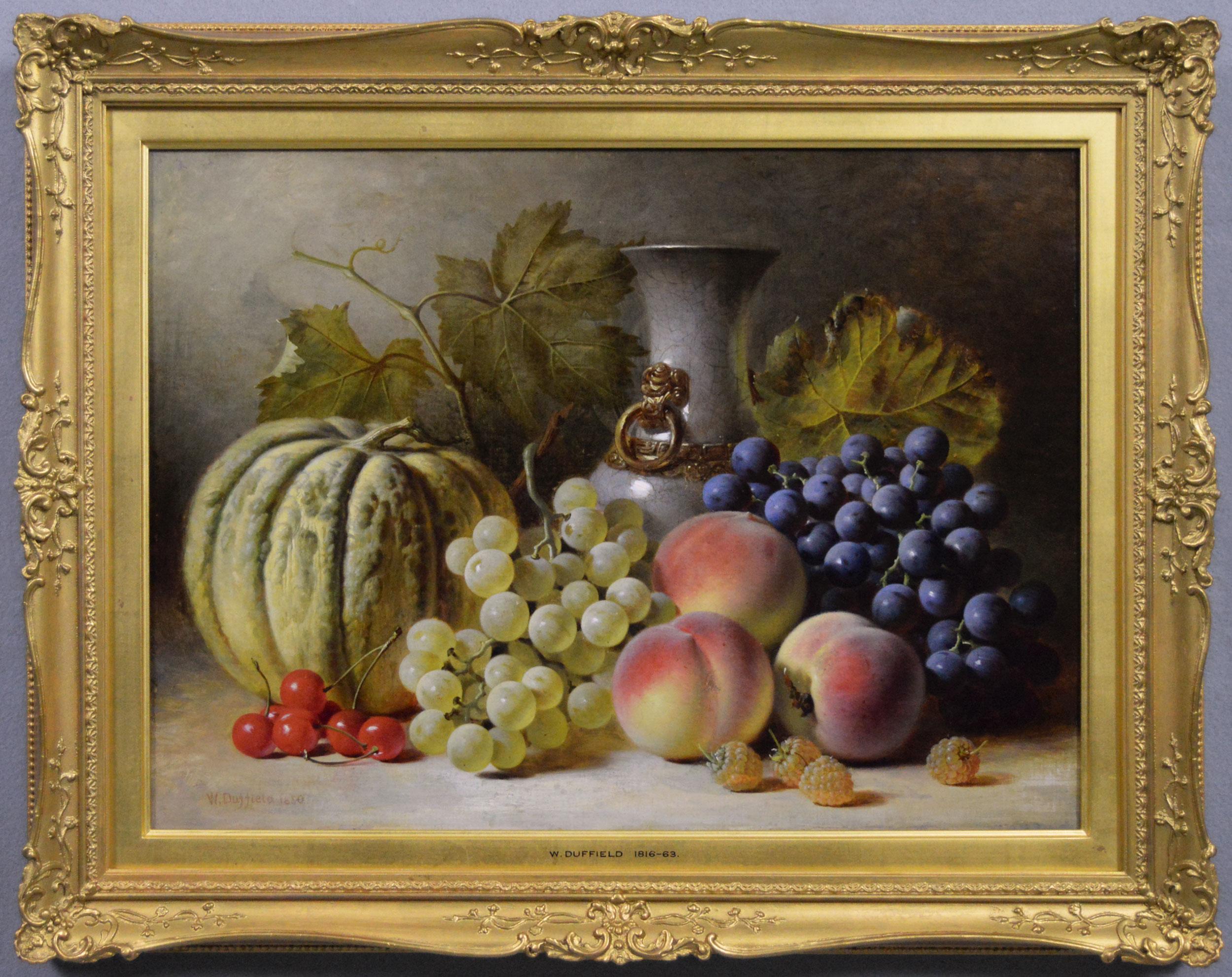
19th Century still life oil painting of fruit
a vase
Located in Nr Broadway, Worcestershire
William Duffield
British, (1816-1863)
Still Life of Fruit
a Vase
Oil on canvas, signed
dated 1850
Image size: 13.5 inches x 18.5 inches
Size including frame: 18.5 inches x 23.5 inches
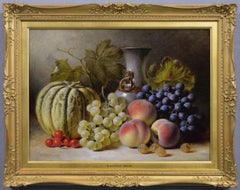
A wonderful still life painting of fruit and a vase by William Duffield. An array of fruit including grapes, peaches and a Melon are depicted grouped together on a table. Nestled behind them can be seen a grey crackle glazed ring handled vase...
Category
19th Century Victorian Still-life Paintings
Materials
Canvas, Oil
19th Century still life oil painting of fruit
birds
Located in Nr Broadway, Worcestershire
Ellen Ladell
British, (1853-1912)
Still Life of Fruit & Exotic Birds
Oil on canvas laid on board, signed
Image size: 17.5 inches x 13.5 inches
Size including frame: 24.75 inches x 20.75 inches
Provenance: Sotheby’s The British Sale, 2003, lot 256
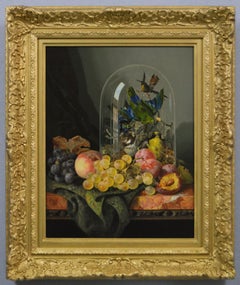
A beautifully painted still life of fruit with a glass dome and taxidermy birds by Ellen Ladell. Grapes, plums and a peach are shown grouped on a floral patterned green cloth at the front of a marble topped table. Behind the fruit is a large glass display dome with an arrangement of exotic taxidermy birds. The reflection in the glass gives the viewer a glimpse of a tall window with a house beyond, adding another dimension to the painting.
Ellen Ladell was born Ellen Maria Levett in Ipswich in 1853 to George and Maria Levett. Her father was a foundry smith and the family lived at 30 Borough Road in Ipswich. She initially worked as a Milliner around 1871 but sought artistic training during her spare time. It is at this point she met and became a pupil of the still life painter Edward Ladell (1821-1886), who at that time was a widower.
Ellen married Edward in Great Yarmouth on 21 October, 1878. The couple initially moved to Torquay where they had their son Kenwyn in 1880, but then decided to settle in Exeter, living at 99 Sidwell Street and setting up a studio at 20 Queen Street. Edward’s influence can been seen in her work as their styles and subject matter share some similarities. However, a number of Ellen’s paintings also included taxidermy under glass...
Category
19th Century Victorian Still-life Paintings
Materials
Canvas, Oil, Board
Italian 19th Century Oil on Canvas Still Life Painting Depicting Fruits
Located in Atlanta, GA
An Italian oil on canvas still life painting from the 19th century depicting fruits in front of a column and an open sky, in giltwood frame. Created in Italy during the 19th century,...
Category
Antique 19th Century Italian Paintings
Materials
Canvas, Giltwood, Paint
More Ways To Browse
American Still Life 19th Century
19th Century Oil Paintings Religious
Antique Props
Antique Amour
Antique Vermont
The Above Gallery
Antique Champagne Flute
Antique Watermelon
Fitz Henry Lane
Antique Theorem
Severin Roesen
Paintings Of Daisies
Paintings Of Strawberries
Persimmon Painting
Willem Kalf
Wine Paintings France
Andre Marchand
Daffodil Vase