Items Similar to Still life of Summer Flowers in a Basket with Fruit.
Want more images or videos?
Request additional images or videos from the seller
1 of 12
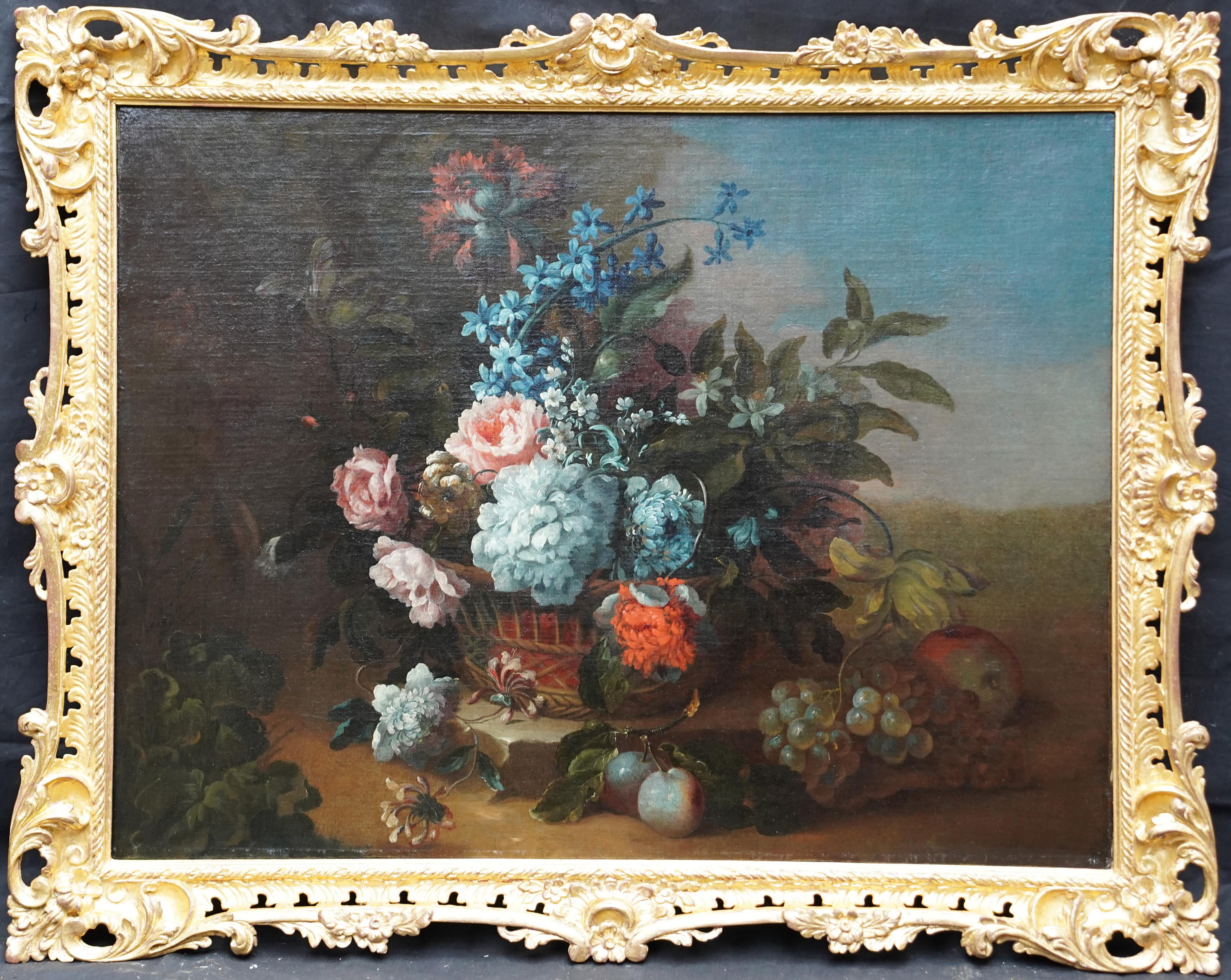
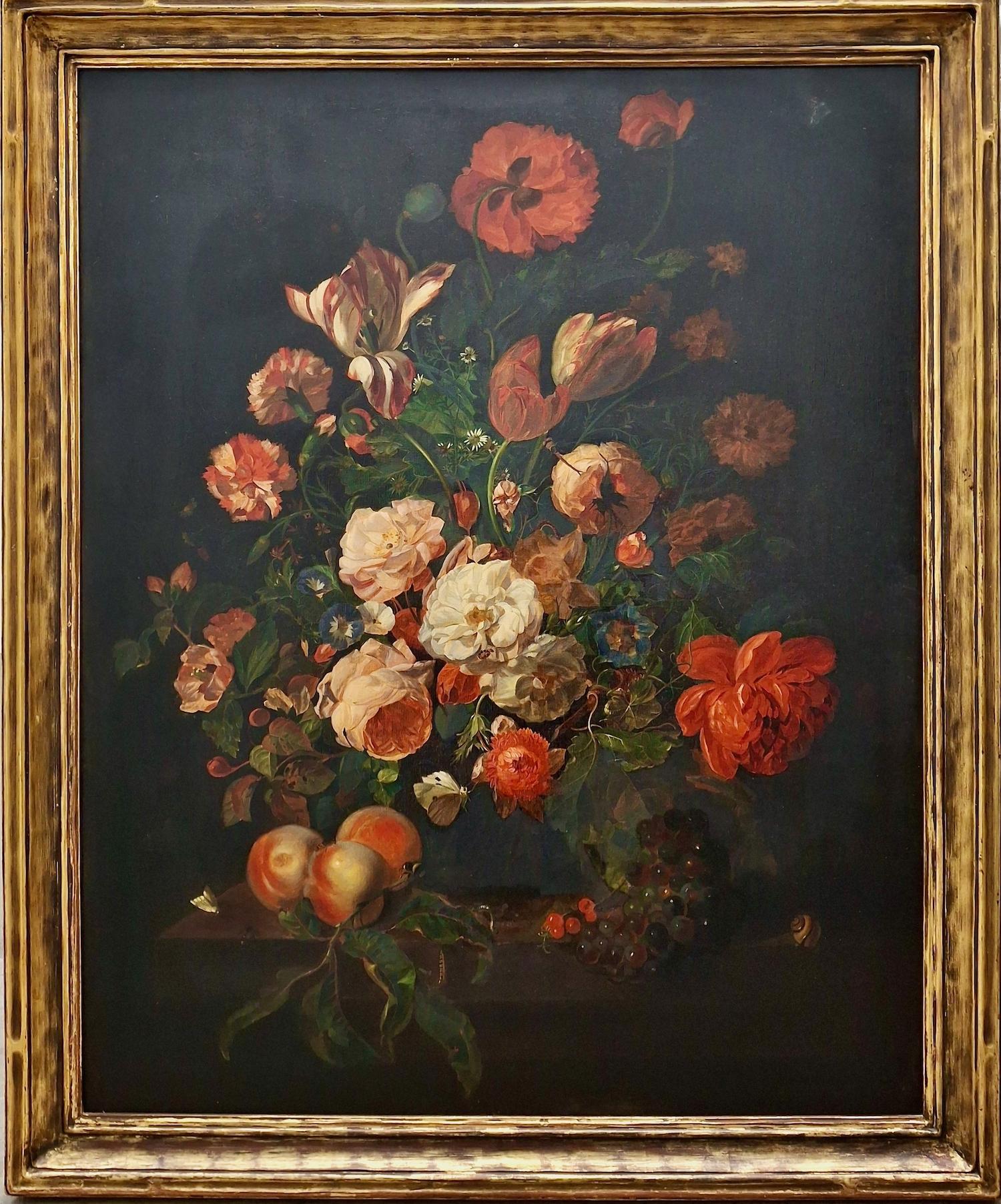
Pieter Casteels IIIStill life of Summer Flowers in a Basket with Fruit.
$34,124.12
£25,000
€29,411.58
CA$47,516.13
A$51,061.08
CHF 27,397.23
MX$601,468.34
NOK 344,489.82
SEK 314,689.23
DKK 219,810.52
About the Item
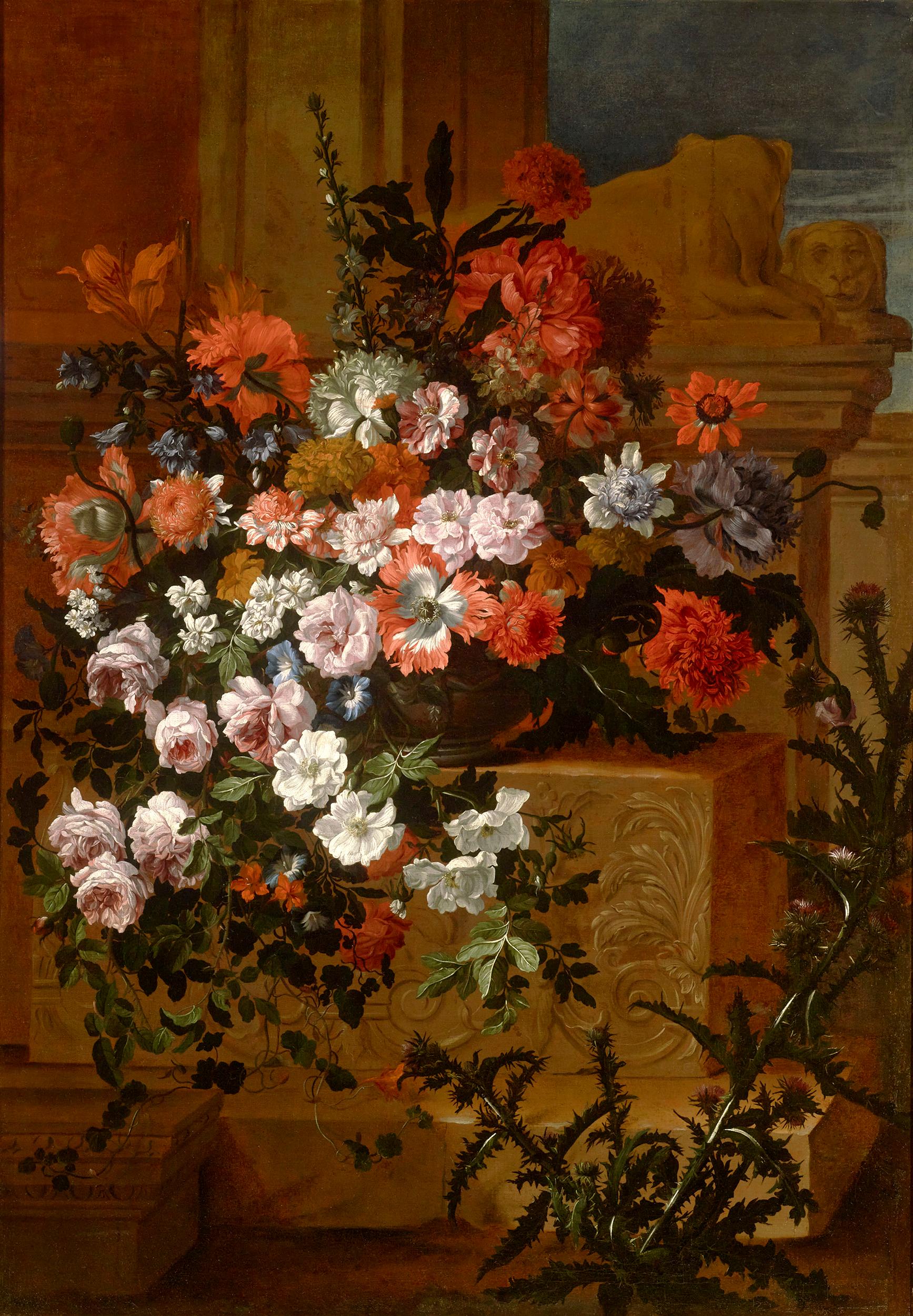
Still life of Summer Flowers in a Basket with Fruit.
Circa 1730
Oil On Canvas
32 ¾ x 48 ¼ inches83.1 x 122.5 cm
Presented in a 17th century Italian carved gilt frame.
Acquired from The collection of the Late Edgar Wigan, Bradstone Brook, Shalford.
ABOUT THE ARTIST:
The son of the Flemish painter Pieter Casteels II (referred to as Casteels the Younger) whom he studied under. While Casteels II was best known for his capriccio harbour scenes and landscapes of his native Antwerp, Casteels III worked primarily in England, where he immigrated in 1708 at the age of 24 and began his career copying Old Master.
Casteels III painted still lives of flowers, and bird and game scenes, and in 1726 produced a volume of twelve plates of bird etchings. Following the success of the publication, he created similar volumes for both flowers and fruit. Pieter Casteels III departed Antwerp with his brother-in-law, the sporting painter Peter Tillemans, for England in 1708, rapidly ascending within London's artistic community.
After a brief return to Antwerp in 1712, the year he became a member in the city's painter’s guild, Casteels settled permanently in England in 1717, where he gained fame for his decorative depictions of flowers and exotic birds. He specialised in paintings of assemblies of birds often set against elaborate, architectural backdrops, much in the manner of Melchior de Hondecoeter.
ABOUT THE SUBJECT:
This fine and highly decorative 18th century Dutch floral piece gathers a colourful group of flowers and fruits in a landscape setting. A study of the flowers find recurring elements such as a variety of flora with intense colours and elements that allow easy recognition of the artist.
The son of the Flemish painter Pieter Casteels II (referred to as Casteels the Younger) whom he studied under. While Casteels II was best known for his capriccio harbour scenes and landscapes of his native Antwerp, Casteels III worked primarily in England, where he immigrated in 1708 at the age of 24 and began his career copying Old Master.
- Creator:Pieter Casteels III (1684 - 1729, Dutch)
- Dimensions:Height: 32.68 in (83 cm)Width: 48.23 in (122.5 cm)
- Medium:
- Movement Style:
- Period:
- Condition:
- Gallery Location:Taunton, GB
- Reference Number:Seller: EFA00131stDibs: LU2028210511982
About the Seller
No Reviews Yet
Vetted Professional Seller
Every seller passes strict standards for authenticity and reliability
Established in 1953
1stDibs seller since 2022
- ShippingRetrieving quote...Shipping from: Taunton, United Kingdom
- Return Policy
More From This Seller
View AllA pair of Military Encampments with Horses
Located in Taunton, GB
A Military Encampment with Horses held by a Groom, and A Military Encampment with a Grey Horse and a Hound
Oil on canvas in carved wood frames
17 ¼ x 21 ¼ in
A Pair (2)
THE ARTI...
Category
17th Century Figurative Paintings
Materials
Oil
A Mediterranean harbour scene in a Capriccio landscape
By Adriaen van der Cabel
Located in Taunton, GB
A Mediterranean harbour scene with figures and ships before a Capriccio landscape.
Oil on Canvas
In a gilded frame
10 ½ x 19 ½ inches
26.6 x 49.5 cm
ABOUT THE ARTIST:
Adriaen van d...
Category
17th Century Landscape Paintings
Materials
Oil
A group portrait of the Southwell family with a Negro Page and Macaw
By Charles Philips
Located in Taunton, GB
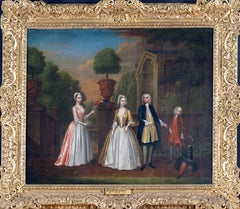
A group portrait of the Southwell family on the terrace with a negro page and Macaw.
Oil on canvas
Signed and dated 1731
Canvas size 25 x 30 ¼ inches 63.5 x 77 cms
Frame exterior 32 x 37 ¼ inches 81 x 94.5 cms
This evocative family portrait offers a glimpse into the life of 18th Century English nobility.
The Southwells are a noble family whose roots go back to the early 17th Century. In 1776 Edward Southwell III was granted the Barony of de Clifford (a title in abeyance at the time), and the line extends to today, with the 28th Baron de Clifford sitting in the House of Lords.
Charles Phillips (1708-1747) was a leading portraitist of his time, having painted many noble and royal portraits. Two of his paintings are part of the Royal Collection Trust.
In this portrait, signed and dated 1731, we see Edward Southwell Sr (1671-1730) and his family on the grounds of their Estate, Kings Weston House near Bristol. On the far left is Mrs. Helena Le Grand (Edward’s sister). Next to her is Mrs. Southwell (Edward’s second wife, the first having died in 1709). On the right is Edward Southwell Jr (1705-1755), Edward’s son by his first marriage and next to him a “Negro Page” (in the euphemistic words of an old label on the painting; more on him below.)
Phillips has arranged the figures in an arc, anchoring the composition. The arc stretches from Mrs. Le Grand’s red dress on the left, through the colourful parrot, onward to the heads of Mr. and Mrs. Southwell, down again to the younger Southwell and finishing on the right with the enslaved boy.
As Edward Sr. died in 1730, this must be a posthumous portrait, making it especially poignant. (Presumably Phillips used another portrait to capture his likeness.)
One can imagine the late Edward’s family looking affectionately at the portrait, remembering the time spent with him on the grounds of Kings Weston House. Southwell stands between wife and son, eyes directed toward one, hand pointed toward the other, symbolically balancing the needs of both.
Devoted husband and father? Perhaps. Slave-owner as well. English noble families of the 18th Century often had financial and practical connections with the slave trade. The Southwells themselves were granted a tract of land by the Crown in 1766, which Edward Southwell III (1738-1777) – the son of the younger Southwell in the portrait – developed with partners into a plantation worked by slave labour.
This portrait shows us that slave ownership was not always a matter for distant colonies. This young boy, likely deprived of his freedom from birth (born to enslaved parents), was made to serve the Southwell family in their home. We see him here sitting half cross-legged, wearing a house servant’s uniform and a faint smile. He gaze is turned upward; at first we think is looking at his Master, then we realise he must be in fact enjoying the sight of the parrot eating from the hand of his Master’s sister. Phillips has placed him on the ground, beneath the rest of the family in pose as in station.
Yet here he is in this portrait just the same, as if he were a member of the family. Was the family fond of him? Was he a playmate of the younger Southwell? Or was he simply there in the Garden that day to serve them their refreshments? The answers to these questions must remain unanswered, known only to the sitters frozen in time by Phillips’ paintbrush. Three centuries later we are fortunate to have this portrait as a snapshot of 18th Century England, both its nobility and its baseness.
Charles Philips, the son of a portraitist, likely acquired his artistic skills from his father. He specialised primarily in painting small portraits and conversation pieces. George Vertue observed that in painting small figure portraits and conversation scenes, Philips gained significant recognition and patronage among fashionable circles, including members of the Royal Family. In 1732, he produced conversation works for the Duchess of Portland and the Duke of Somerset. During the 1730s, his conversation pieces became increasingly complex, featuring more numerous subjects engaged in a greater variety of activities.
Following the precedent set by contemporaries such as Philippe Mercier and William Hogarth, both prominent painters of small-scale conversation pieces, Philips transitioned into the more lucrative field of portrait painting later in the decade. His career peaked in 1737 when he painted full-length portraits of the Prince and Princess of Wales. The Prince of Wales was renowned for his patronage of the arts, particularly towards immigrant artists including Jacopo Amigoni and Philippe Mercier, who were principal influences on Philips.
Two of Philips' paintings in the Royal Collection depict fashionable London clubs not recorded elsewhere. The first, from 1732, shows Frederick...
Category
18th Century Portrait Paintings
Materials
Oil
Sophia, Lady de Clifford and her Children
By Daniel Gardner
Located in Taunton, GB
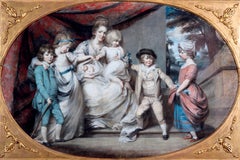
Sophia, Lady de Clifford and her Children
Pastel
Oval
THE ARTIST
Daniel Gardner (1750-1805) was an inventive portrait painter known for blending pastel, gouache, and graphite to ...
Category
18th Century Portrait Paintings
Materials
Pastel
Portrait of James Butler, 2nd Duke of Ormonde (1665-1745), three-quarter length
By Sir Godfrey Kneller
Located in Taunton, GB
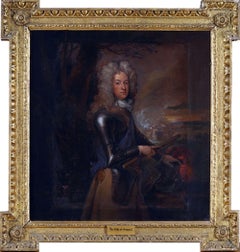
Portrait of James Butler, 2nd Duke of Ormonde (1665-1745), three-quarter length, standing wearing Armour, holding his baton, a skirmish beyond
Oil on canvas
In a carved wood frame
...
Category
17th Century Portrait Paintings
Materials
Oil
Portrait of a Girl holding a Posy
Located in Taunton, GB
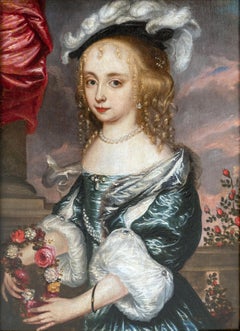
Portrait of a Girl holding a Posy.
Oil on Panel
17 1/2 x 13 inches
44.4 x 33 cm
ABOUT THE ARTIST:
Jacques d'Agar was a French portrait painter born i...
Category
17th Century Romantic Portrait Paintings
Materials
Oil
You May Also Like
Flowers In A Basket - Original Oil, Still Life, French, Franco-Flemish painter
By Jean-Baptiste Monnoyer
Located in Knowle Lane, Cranleigh
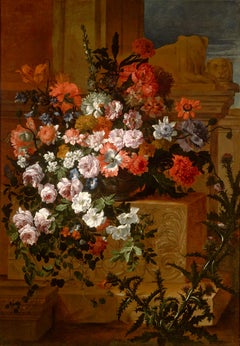
Flowers in A Basket by Jean-Baptiste Monnoyer. A Still Life of flowers in a basket including jasmine, honeysuckle, dahlias, parrot tulips, delphiniums and white carnations.
Category
1690s Baroque Still-life Paintings
Materials
Oil, Canvas
Floral Still Life in Basket - Franco Flemish art Old Master flower oil painting
Located in Hagley, England
This lovely 17th century Old Master floral oil painting is attributed to the circle of noted Franco Flemish artist Jean-Baptiste Monnoyer. Painted circa 1670 it is a still life of a ...
Category
17th Century Old Masters Still-life Paintings
Materials
Oil
Still Life of Flowers and fruit - Dutch Old Master c1700 floral art oil painting
Located in Hagley, England
This superb Dutch Old Master floral still life oil painting is attributed to circle of Simon Pietersz Verelst. Painted circa 1700 the compositio...
Category
Early 1700s Old Masters Still-life Paintings
Materials
Oil
$7,643 Sale Price
20% Off
Still life with flowers and basket. 2021. Canvas, oil, 76x61 cm
Located in Riga, LV
Still life with flowers and a basket. 2021. Canvas, oil, 76x61 cm
Artwork in baroque style and technique. Flowers on black background
Arturs Amatnieks...
Category
2010s Baroque Still-life Paintings
Materials
Canvas, Oil
$2,707 Sale Price
20% Off
Still Life With Flowers By Jean-Baptiste Monnoyer
By Jean-Baptiste Monnoyer
Located in New Orleans, LA
Jean-Baptiste Monnoyer
1636-1699 French
Still Life with Flowers on a Carved Stone Ledge
Oil on canvas
Impeccable detail and luminous color breathe life into this floral still lif...
Category
17th Century Old Masters Still-life Paintings
Materials
Canvas, Oil
Price Upon Request
Attributed to Josef Lauer, Still Life with Roses, Tulips, Apples and Butterflies
By Josef Lauer
Located in San Francisco, CA
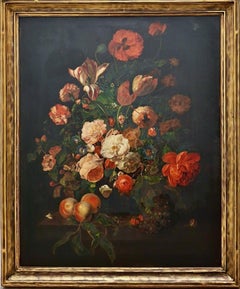
It would be hard to surpass the luscious allure of this 19th-century still life. Although unsigned, the vibrant colors and exquisite detailing reveal the hand of a master. That maste...
Category
19th Century Still-life Paintings
Materials
Canvas, Oil
More Ways To Browse
Italian Still Life Floral Oil Painting
Bird Etching
Dutch Floral
Still Life Flowers Dutch School
Fruit Basket Still Life Painting
Game Still Life Oil Painting
Flower And Bird Painting
Floral Still Life Oil Painting Dutch
Italian Carved Frame Gilt
Bird Oil Painting 18th Century
17th Century Flemish School
Basket Flower Painting
Fruit Basket Painting
Flemish Flower Painting
Melchior Hondecoeter
Pieter Casteels Iii
Antique Roses Painting
Cubist Still Life Art