Items Similar to A Portrait of a Gentleman, thought to be Moses Diego Lopez Pereira
Want more images or videos?
Request additional images or videos from the seller
1 of 5
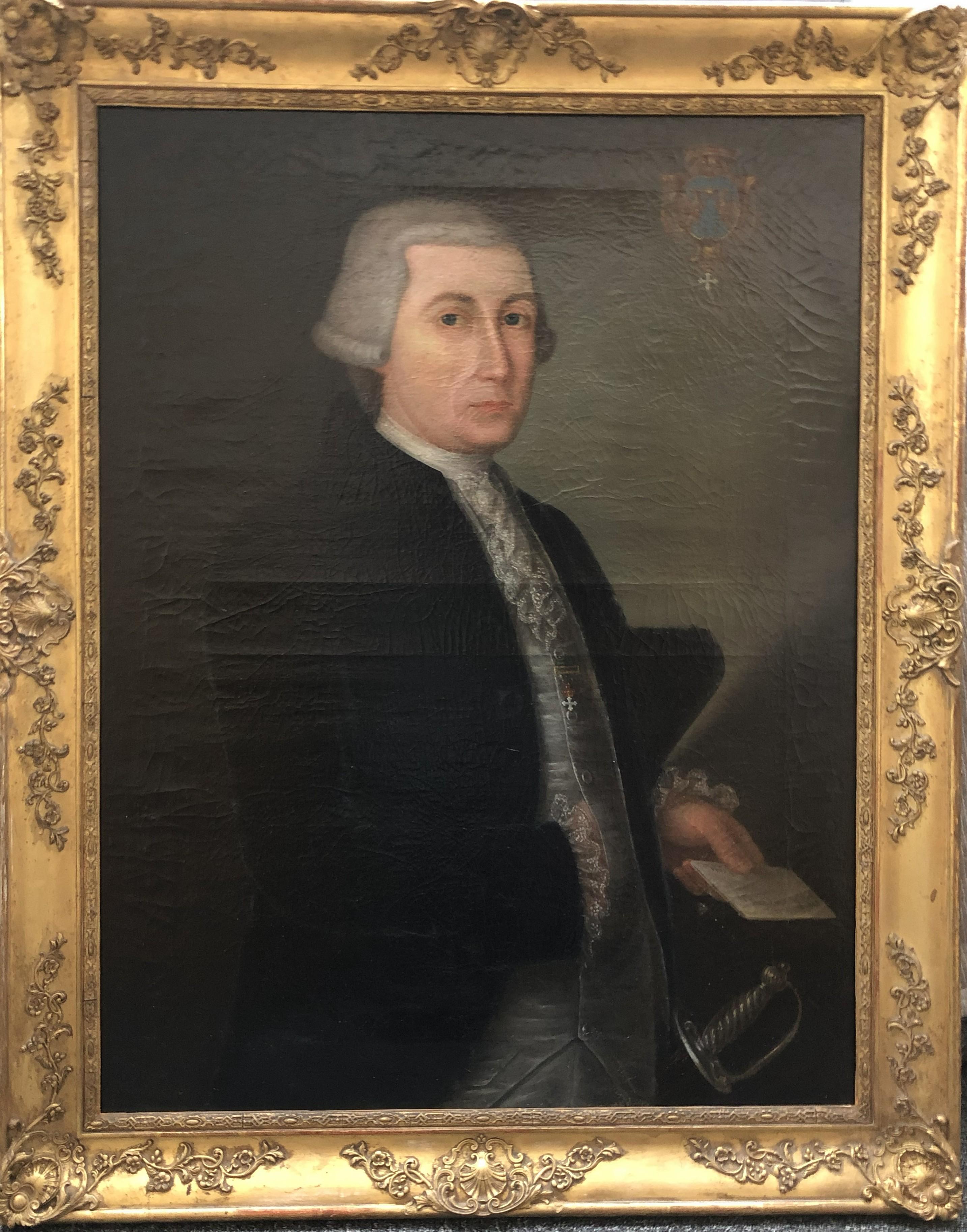
UnknownA Portrait of a Gentleman, thought to be Moses Diego Lopez Pereira18th century
18th century
$19,192.96
£14,000
€16,453.60
CA$26,584.89
A$28,485.28
CHF 15,280.36
MX$337,412.15
NOK 192,753.18
SEK 176,339.34
DKK 122,910.44
About the Item
Austrian School, 18th Century
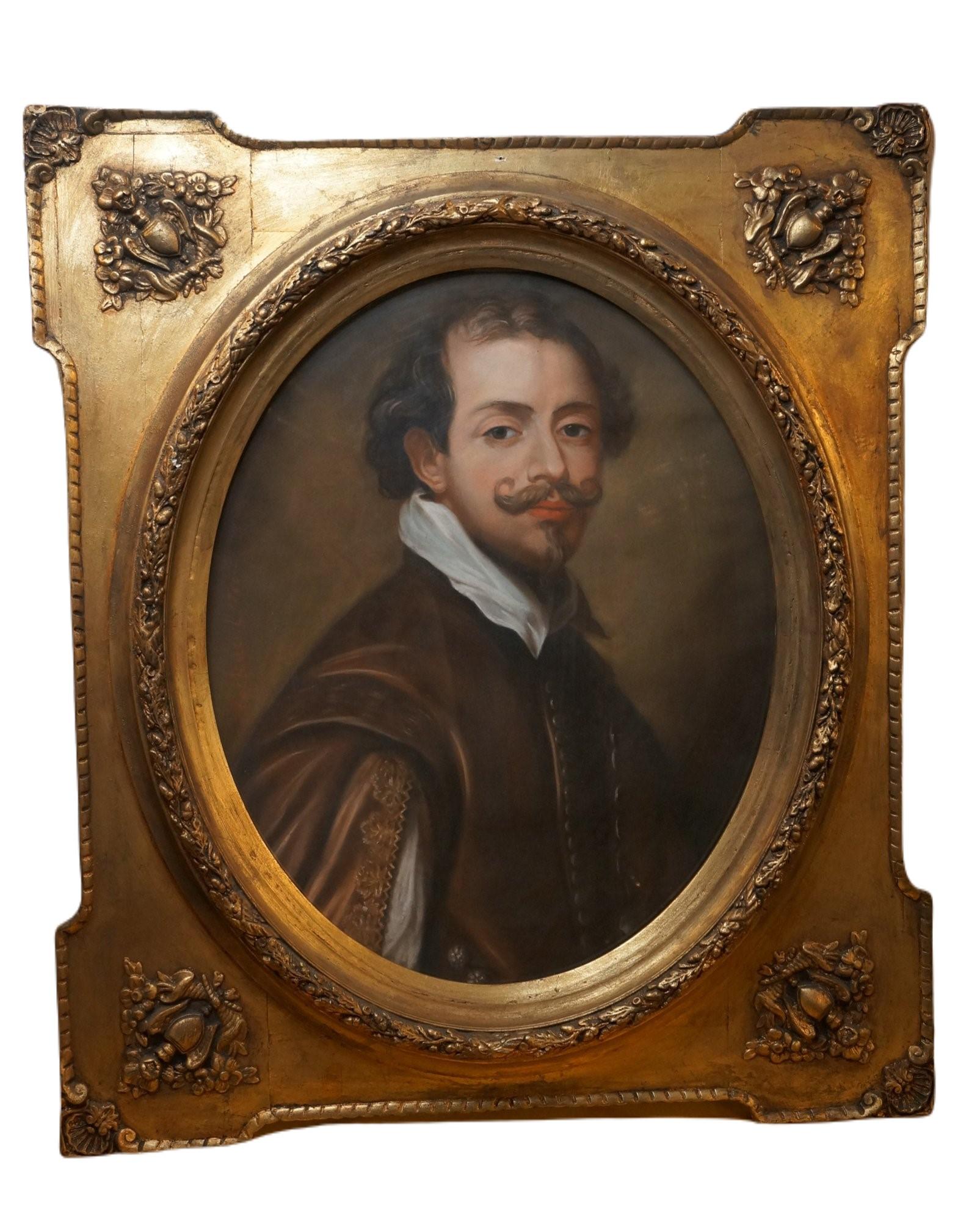
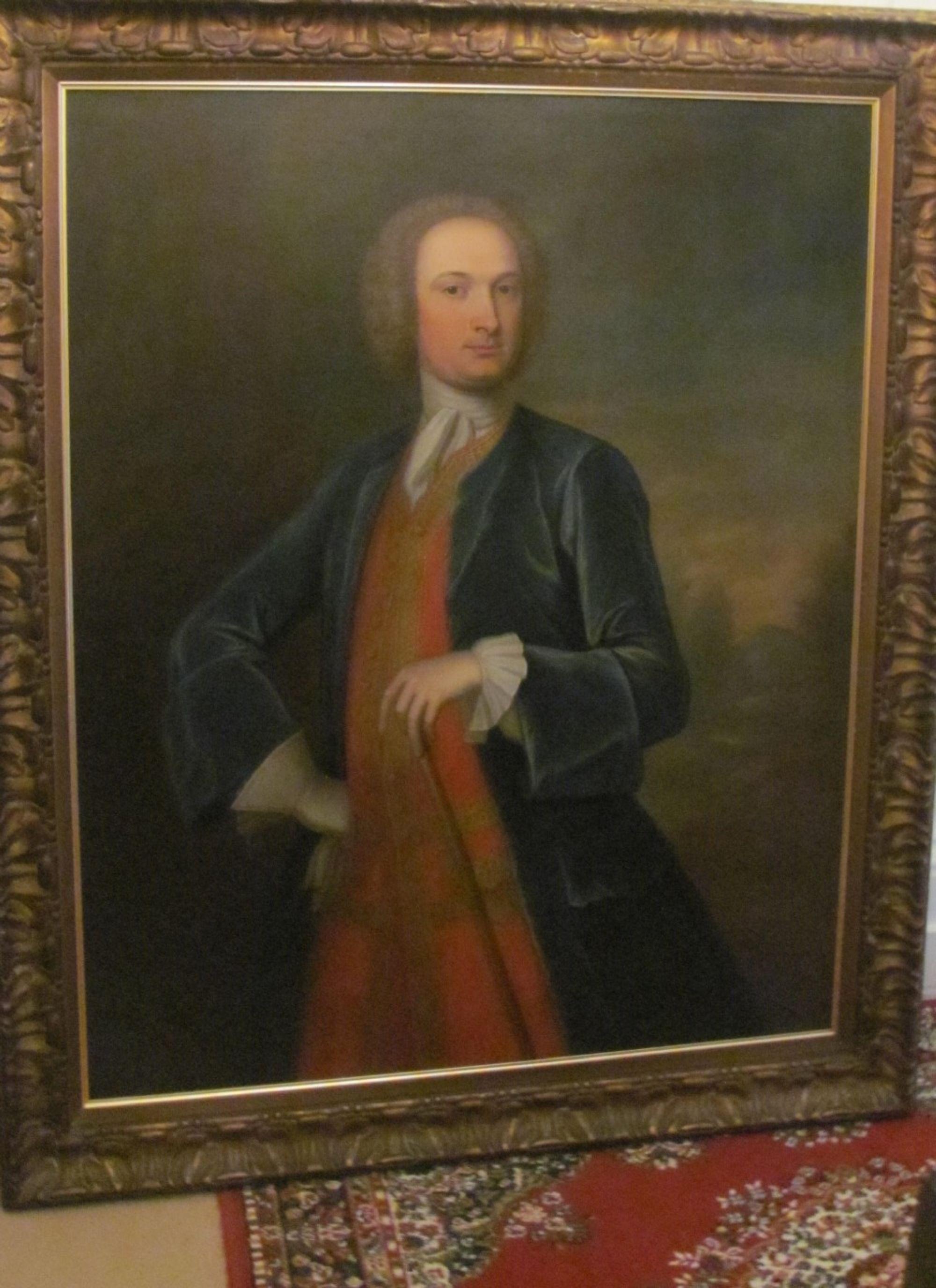
A Portrait of a Gentleman, thought to be Moses Diego Lopez Pereira, 1st Baron d’Aguilar, in an elaborate coat and a powdered wig
Oil on canvas
Provenance:
Ex Collection of Giorgio Forattini, Rome, Italy
Note: The cropped painting bears the following, indistinct but decipherable, inscription:
German: English:
[...JAMIN FREIHERR [...]JAMIN BARON
[G]EBO[REN]: 5te NOV:1699 BORN: 5th NOV. 1699
GEST[ORBEN]: 25 OCT 1759. DIED: 25 OCT 1759.
These dates correspond to the life of Moses Diego Lopez Pereira, 1st Baron d’Aguilar, a key figure among Sephardic Jews in 18th Century Vienna and London. He served as a Court Jew in Vienna, playing crucial roles and aiding the Habsburg Court in various capacities, including financial support for monumental constructions like Schönbrunn Palace. Originally from Portugal, his family, like many Sephardic Jews, left Spain to avoid expulsion due to their refusal to convert to Catholicism. He gained the favour of Empress Maria Theresa, becoming a Privy Councillor and playing a vital role in Jewish matters in Vienna.
Under Diego d’Aquilar’s initiative, a secret Sephardic Jewish community in Vienna received permission to have a synagogue. However, when the Spanish inquisition sought his extradition, he lost his Imperial protection, and the d’Aguilar family, who had returned to Judaism openly, had to flee to London. As a parting gesture, they gifted magnificent silver crown pieces to Viennese Turkish Jews for their Torah scrolls, engraved with the d’Aquilar name. His memory is commemorated annually on Yom Kippur.
The significance of the name “...jamin” is unclear, but it might be related to the Tribe of Benjamin, one of the 12 tribes of Israel, to which d’Aguilar belonged.
Dimensions:
(Panel) 31 in. (H) x 22.75 in. (W)
- Creation Year:18th century
- Dimensions:Height: 31 in (78.74 cm)Width: 22.75 in (57.79 cm)
- Medium:
- Period:
- Condition:Condition report available upon request.
- Gallery Location:London, GB
- Reference Number:1stDibs: LU673314327742
About the Seller
5.0
Vetted Professional Seller
Every seller passes strict standards for authenticity and reliability
Established in 1990
1stDibs seller since 2017
46 sales on 1stDibs
Typical response time: 12 hours
- ShippingRetrieving quote...Shipping from: London, United Kingdom
- Return Policy
More From This Seller
View All18th Century Oil Painting Portrait of Phillip, 6th Viscount Wenman.
By Nathaniel Dance-Holland
Located in London, GB
Sir Nathaniel Dance-Holland (1750-1811) was an English portrait painter and one of the founding members of the Royal Academy in 1768. Justly celebrated in his lifetime he won several...
Category
Late 18th Century Old Masters Portrait Paintings
Materials
Oil
Portrait of Ochius, also called The Passia Ahmed ex Royal Collection of Hanover
By (Attributed to) Sir Godfrey Kneller
Located in London, GB
Attributed to Sir Godfrey Kneller (1646 - 1723)
A Portrait of Ochius, also called The Passia Ahmed
Oil on canvas
In a gilded frame
Painted circa 1689 following the siege of Belgrad...
Category
17th Century Portrait Paintings
Materials
Oil
$71,288 Sale Price
20% Off
Free Shipping
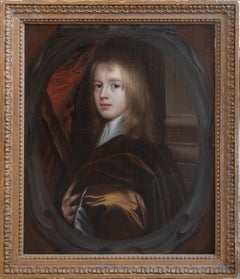
17th Century Oil Painting Portrait of a Young English Boy
By Gerard Soest
Located in London, GB
Gerard SOEST (1600 - 1681)
Portrait of a Young Boy
oil on canvas
35.5 x 30.5 inches inc. frame
Gerard Soest (circa 1600 – 11 February 1681), also known as Gerald Soest, was a portra...
Category
17th Century Old Masters Portrait Paintings
Materials
Oil
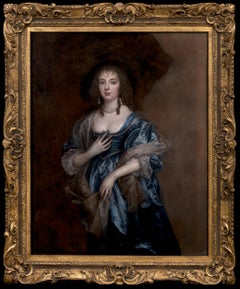
Portrait of Anne, Lady Russell, later Countess of Bedford
By Anthony van Dyck
Located in London, GB
A three-quarter length portrait of Anne, Lady Russell, later Countess of Bedford (1615-1684), in a blue dress. Attributed to Sir Anthony Van Dyck.
Anne C...
Category
17th Century Portrait Paintings
Materials
Oil
$208,380 Sale Price
24% Off
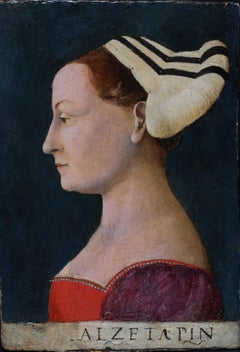
Portrait of an Italian Noblewoman
Located in London, GB
15th century, Italian
Circle of Antonio del Pollaiuolo (1429-1498)
Portrait of an Italian Noblewoman
Oil and tempura on poplar panel
With partial inscription: ALZETAPIN
Provenance:...
Category
15th Century and Earlier Renaissance Portrait Paintings
Materials
Oil, Tempera, Wood Panel
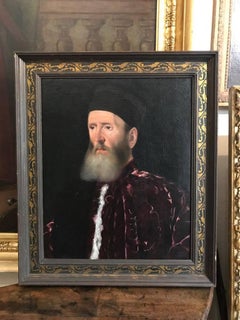
16th Century Italian Renaissance Old Master Portrait of a Procuratore
By Jacopo Bassano
Located in London, GB
Jacopo BASSANO (c. 1510-1592, Italian)
Portrait of a Procuratore
Oil on canvas
30 ¼ x 26 inches (including frame)
Provenance: Lucien Bonaparte’s Collection (as Portrait of Doge Priuli, Tiziano); Rich-mond, Virginia Museum, Portrait of Doge Lorenzo Priuli.
The painting is a portrait of a man half-length, on a black background. It is a three-quarter portrait, according to a custom very common in the genre of portraiture in sixteenth century. The man is wearing a decorated...
Category
16th Century Old Masters Portrait Paintings
Materials
Oil
$241,282 Sale Price
20% Off
Free Shipping
You May Also Like
Portrait of a Venetian Nobleman
Located in Douglas, Isle of Man
Attributed to, Alessandro Longhi 1733-1813, was a prominent Venetian portrait painter, printmaker, and biographer. The son of the famous genre painter Pietro Longhi, he is known for his detailed oil portraits of the Venetian aristocracy and his valuable book on contemporary Venetian painters.
Longhi early life and training
Born: Alessandro Longhi was born on June 12, 1733, in Venice.
He received his initial training from his father, Pietro Longhi.
He later studied under Giuseppe Nogari, a respected portraitist in Venice during the 18th century, and was elected to the Venetian Academy in 1759.
Longhi specialized in portraiture, primarily depicting the nobles and officials of the Republic of Venice. His paintings are a valuable record of the social and political structure of 18th-century Venice.
Rococo aesthetic: Working in the Rococo style, he was adept at capturing the elegance and social status of his subjects. He paid meticulous attention to the elaborate robes, wigs, and emblems of office that signified his subjects' power.
While his official state portraits could be stiff and formal, his portraits of less noble patrons demonstrated a greater sense of realism and psychological insight.
Longhi was also an accomplished printmaker, particularly in etching. His etching technique showed an awareness of Rembrandt's work, and he used this skill to reproduce his and his father's paintings.
In 1762, he published Compendio delle vite de' pittori veneziani istorici più rinomati del presente secolo, a biographical dictionary of contemporary Venetian painters that is still an important resource for art historians. Longhi illustrated the book with etched portraits of the artists.
The portrait of Carlo Goldoni: One of his most celebrated paintings is his portrait of the Venetian playwright and librettist Carlo Goldoni.
For his election to the Venetian Academy, he painted this allegory, which features a personified figure of Painting.
His known portraits include Portrait of a Lady (Uffizi Gallery, Florence), Portrait of a Musician, and various portraits of Venetian nobles and officials.
I have included further albeit identical biographies of Alessandro Longhi.
Alessandro Longhi (born June 12, 1733, Venice—died 1813, Venice) was a painter, etcher, and biographer of Venetian artists, and was the most important Venetian portrait painter of his day.
The son of the painter Pietro Longhi, he was given his first training by his father, who quite soon put him to study under the portrait painter Giuseppe Nogari. In 1759 he was elected a member of the Venetian academy, for which he painted one of his rare allegorical pictures, “Painting and Merit.” In 1762 Longhi issued his book Compendio delle Vite de’ Pittori Veneziani Istorici piu rinomati del presente secolo con sui ritratti dal naturale delineati ed indisi, one of the most important source books for the history of Venetian 18th-century painting. Both portraits and text were printed from plates he etched. Longhi’s facilely rendered portraits are largely generalized likenesses lacking any acuity of character observation. He mainly portrayed the leading Venetian luminaries and dignitaries of his day in a style that drew upon his father’s Rococo manner and 16th-century traditions of Venetian Renaissance portraiture.
The personal details available for the painter Alessandro Longhi are limited, but his biography is intertwined with that of his family and the city of Venice. He was the son of a successful painter, which set his artistic path, and is known for creating sensitive and realistic portraits that captured the social atmosphere of 18th-century Venice.
Alessandro was born in Venice in 1733 to the celebrated genre painter Pietro Longhi. He received his early training from his father before studying under another prominent portraitist, Giuseppe Nogari.
A contrast to his father: While his father was known for painting scenes of everyday Venetian life, Alessandro focused almost exclusively on portraiture. His skill enabled him to capture the intimate psychology and character of his subjects, a quality especially evident in his portraits of less noble patrons.
Election to the academy: In 1759, Alessandro was elected to the Accademia dei Pittori, the Venetian Academy of Painting. His election solidified his reputation as a master of the Rococo style.
Beyond painting, Longhi was an accomplished printmaker, primarily producing etchings that reproduced his own works and those of his father. In 1762, he published the Compendio delle vite de' pittori veneziani, a collection of biographies of contemporary Venetian painters, which is an important historical resource.
He became a prominent portraitist for Venice's upper class, including nobles and state officials. His official state portraits featured grand, full-length depictions of his subjects in their elaborate robes and emblems of office.
Emphasis on realism: In contrast to the stylized nature of official portraits, Alessandro was praised for the "reality" he captured in works featuring common people. For example, his 1760 portrait of an innkeeper was celebrated for its realistic subject matter and "nuova maniera" (new manner).
The art historian Olimpia Theodoli noted that Longhi's etching technique showed he had a firsthand knowledge of Rembrandt's work.
Among his more famous works are a sensitive portrait of playwright Carlo Goldoni and the painting Portrait of a Wine Butler. He also produced religious and allegorical works, including paintings of the "Apostles" for the church of San Pantalon in Venice.
This painting has been carefully conserved and the frame also, the frame looks to be original to the picture but we have no way of confirming this but we believe it to be so. 18th Century Italian portraits...
Category
Mid-18th Century Portrait Paintings
Materials
Canvas, Oil
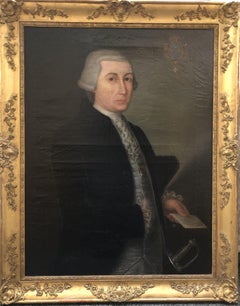
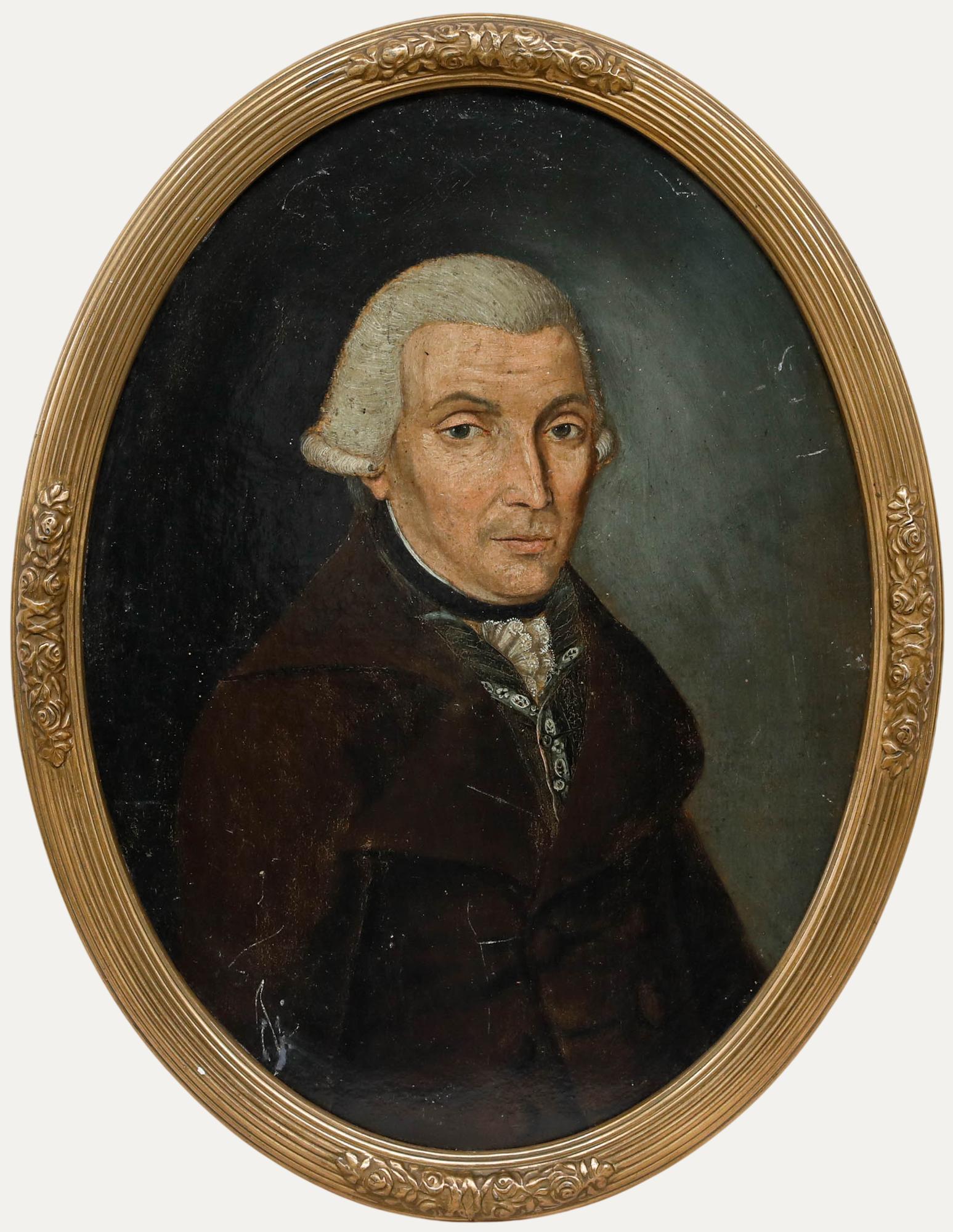
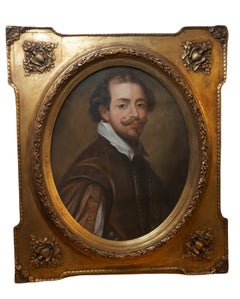
Early 19th Century Oil - Portrait of a Gentleman
Located in Corsham, GB
A formal portrait of a gentleman wearing a brown coat and wig. Well presented in an oval gilt-effect frame with floral ornamentation. Illegibly inscribed in German to the reverse of ...
Category
Early 19th Century Portrait Paintings
Materials
Oil
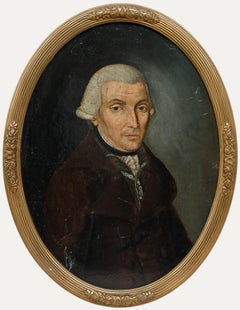
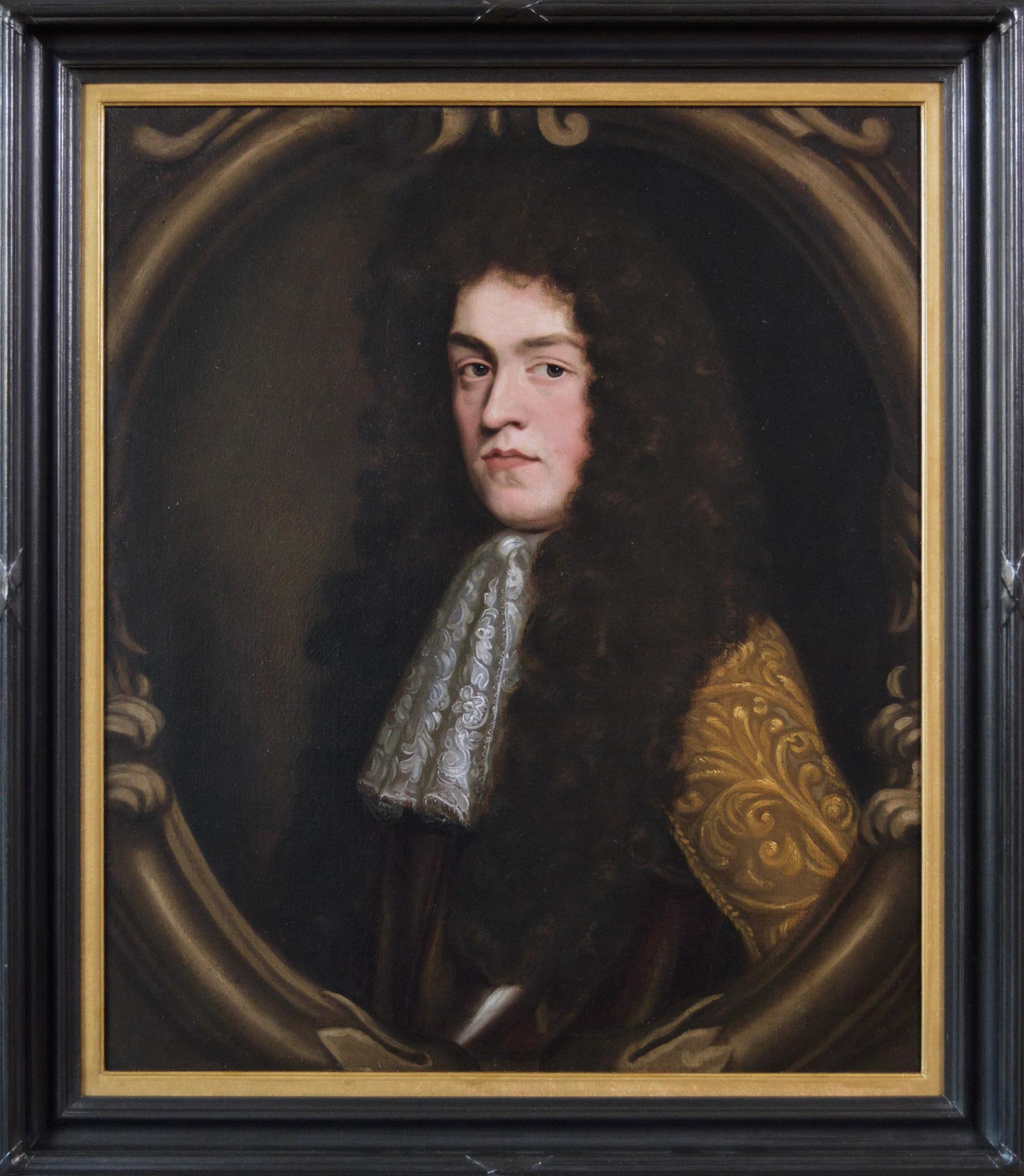
17th Century portrait oil painting of a gentleman
By Willem Wissing
Located in Nr Broadway, Worcestershire
Circle of Willem Wissing
Dutch, (1656-1687)
Portrait of a Gentleman
Oil on canvas
Image size: 29 inches x 24.5 inches
Size including frame: 35 inches x...
Category
17th Century Portrait Paintings
Materials
Canvas, Oil
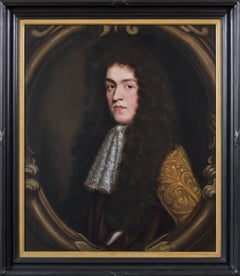
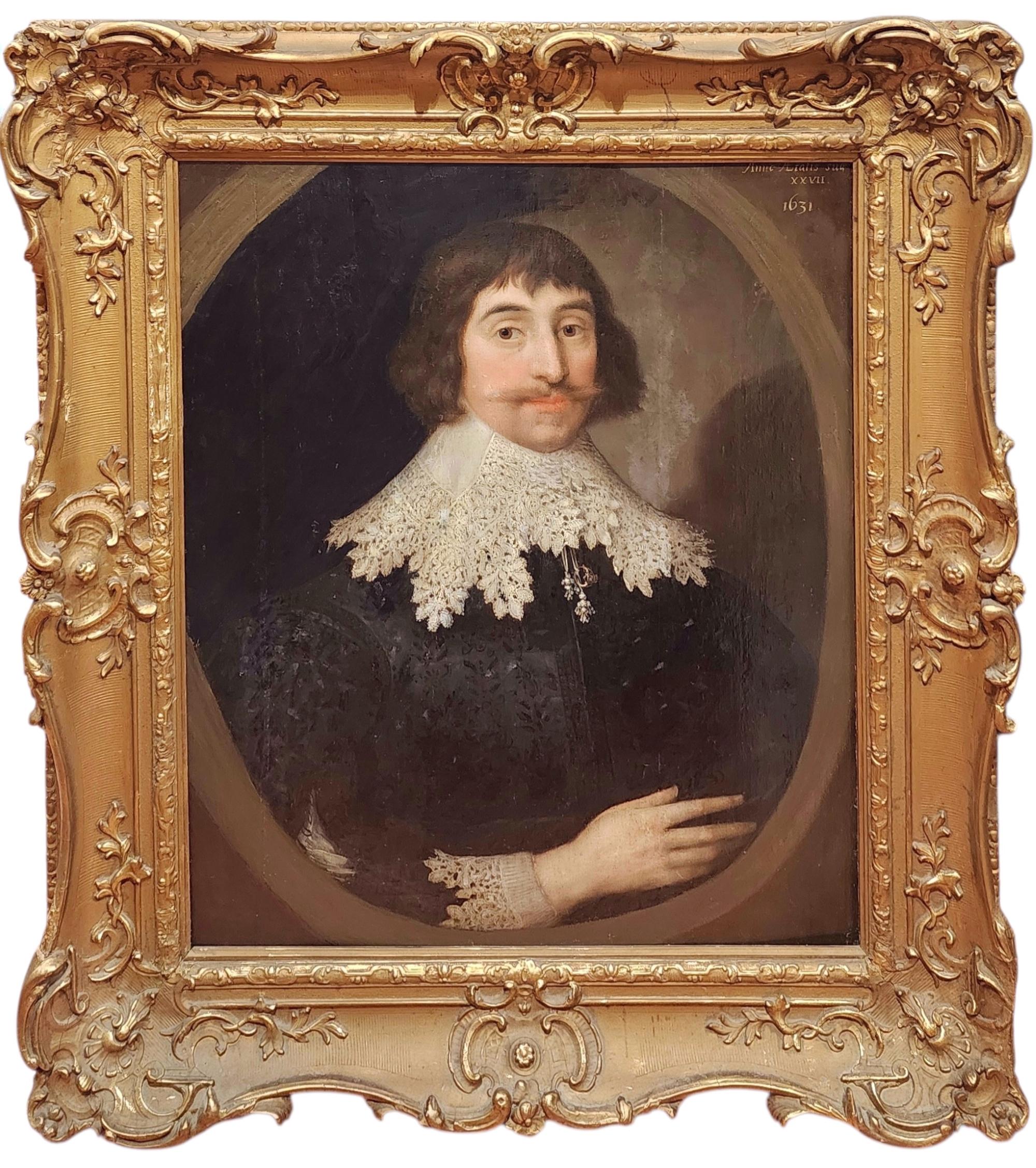
Portrait of a Gentleman, Renaissance Revival, 19th Century
Located in Grand Rapids, MI
In the Manner of Cornelis Janssens van Ceulen I (English, 1592-1661)
" Portrait of a Gentleman ", 19th Century
Oil on Board
27” x 32"
Housed in a 5" 19th-century ornamented fra...
Category
19th Century Renaissance Portrait Paintings
Materials
Oil, Board
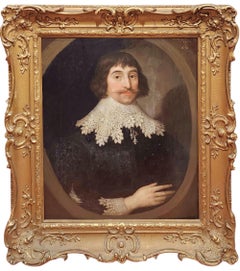
Portrait of a well-to-do gentleman
Located in DEVENTER, NL
Portrait of a well-to-do gentleman in pastel on parchment.
Signed left: Marteau L. 1760.
French School, possibly by Louis Marteau (1715 – 1804)
In a gilded 19th century frame.
Dimen...
Category
18th Century Portrait Paintings
Materials
Pastel, Parchment Paper
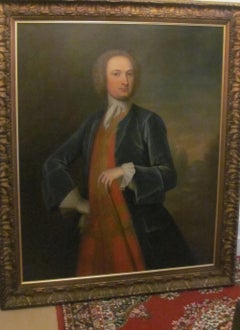
large 18th century portrait gentleman oil on canvas
Located in York, GB
A fine, imposing 18th century portrait of an unknown aristocrat,housed in a gilt frame
The artist is also unidentified but certainly a talented hand, in the circle of one of the fine old masters of the period. Unsigned
The size overall is 148 x 121 cm whilst the painting is 128 x 101 cm
In overall good condition the frame at the bottom has bowed slightly
The painting has been checked whilst being cleaned and has not been affected in any way .
SHIPPING
Free delivery to mainland uk ,worldwide shipping available please email for quote
Delivery usually within 14 working days, insured
please provide telephone/email details for courier.
All taxes/customs etc to be paid for by purchaser.
RETURNS (The Consumer Contracts Regulations) Whilst we are sure that you will be extremely happy with your purchase,
if for any reason you are not, then you are entitled to return the item to us for a refund.
For all purchases made
you are entitled to return the item(s) for a period of up to 14 days
following receipt by you or a representative indicated by you.
Please contact us to confirm that you are returning the item(s)
and the reason for doing so.
Upon receipt of the item(s) we will refund the purchase price via your original payment method...
Category
18th Century Old Masters Portrait Paintings
Materials
Oil
$7,540 Sale Price
44% Off
Free Shipping
More Ways To Browse
Portrait Of A Gentleman
18th Century Portrait Of Gentleman
18th Century Portrait Of A Gentleman
Antique Torah
18th Portrait Gentleman
Used Torah Scroll
Vienna 18th
Powdered Wigs
12 Tribes Of Israel
Oil Paintings Of Nude Woman
Autumn Oil Paintings
Impressionist Seascape Painting
French Impressionist Framed Art
19th Century Paintings Of Children
19th Century Landscape Paintings With River
Contemporary Floral Paintings
De Young
Klimt Gustav