1 of 4
William E. SchumacherStill Life with Flowers1916
1916
About the Item
Authenticity Guarantee
In the unlikely event there’s an issue with an item’s authenticity, contact us within 1 year for a full refund. DetailsMoney-Back Guarantee
If your item is not as described, is damaged in transit, or does not arrive, contact us within 7 days for a full refund. Details24-Hour Cancellation
You have a 24-hour grace period in which to reconsider your purchase, with no questions asked.Vetted Professional Sellers
Our world-class sellers must adhere to strict standards for service and quality, maintaining the integrity of our listings.Price-Match Guarantee
If you find that a seller listed the same item for a lower price elsewhere, we’ll match it.Trusted Global Delivery
Our best-in-class carrier network provides specialized shipping options worldwide, including custom delivery.You May Also Like
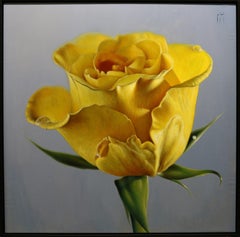
Sunshine Yellow
By Jose Borrell
Located in Atlanta, GA
This painting is in excellent condition and has only been shown in a gallery setting.
While having attended renowned art schools in Spain, including the Fine Arts School of Alcoy ...
Category
2010s Photorealist Still-life Paintings
Materials
Canvas, Oil
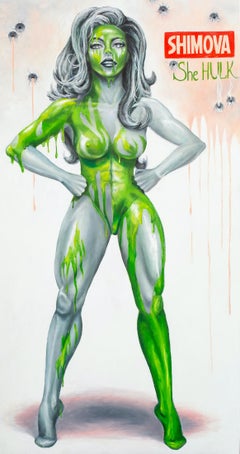
"She Hulk" Oil painting 59" x 31" inch by Alina Shimova
By Alina Shimova
Located in Culver City, CA
"She Hulk" Oil painting 59" x 31" inch by Alina Shimova
2020
Category
21st Century and Contemporary Pop Art Still-life Paintings
Materials
Canvas, Oil
$4,000 Sale Price
20% Off
H 59 in W 31 in D 1 in
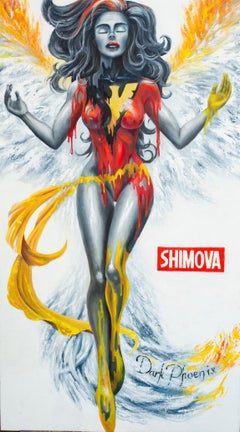
"Dark Phoenix" Oil painting 59" x 31" inch by Alina Shimova
By Alina Shimova
Located in Culver City, CA
"Dark Phoenix" Oil painting 59" x 31" inch by Alina Shimova
2020
Category
21st Century and Contemporary Pop Art Still-life Paintings
Materials
Canvas, Oil
$4,800 Sale Price
20% Off
H 59 in W 31 in D 1 in
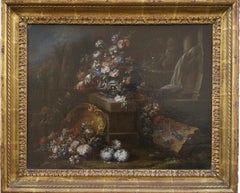
Gaspare Lopez, attrib. Still Life with Fountain, Obelisk and Cascade of Flowers
Located in Firenze, IT
Gaspare Lopez, attrib. Still Life with Fountain, Obelisk and Cascade of Flowers in a Garden, Naples, c. 1720
Painting is not signed.
Oil on canvas, 36 × 45.2 cm
Giltwood frame of later date, 48 × 57.4 cm
Inscription on reverse: “H. C. Veit – 1A Chesham Mews SW1 – 16 June 1957”
This painting, one of a pair of Neapolitan still lifes from the early eighteenth century, displays a refined architectural setting combined with a rich cascade of flowers—features closely associated with the work of Gaspare Lopez, one of the leading Italian flower painters of the period.
At the centre stands a fountain with a putto, its stream rendered in fine, silvery strokes that recall Lopez’s characteristic way of enlivening his compositions with water. To the left rises a slender obelisk, a motif that appears in several of his more elaborate garden scenes and contributes to the noble, decorative tone of the setting.
The cascade of flowers is constructed with the inventive spirit typical of his floral capricci: roses, tulips, peonies, carnations and his distinctive blue bellflowers, painted with a clear, bright touch. The colours are luminous, joyful and decorative, expressing the Neapolitan vitality that marks Lopez’s mature style. Already in his lifetime he was known as “Gaspare dei fiori” for his spectacular and often deliberately exuberant floral arrangements.
The background features an Italianate garden with cypresses, terraces and stone structures. This repertoire closely parallels the still lifes with garden terraces preserved at the Kunsthistorisches Museum in Vienna (inv. GG 1658, 1662, 1664), all attributed to Lopez. Despite its smaller size, the present painting shares the same horizontal layout, bright skies with soft clouds and the interplay of architecture and abundant floral masses, offering strong arguments for the attribution.
Lopez trained under Andrea Belvedere, the foremost Neapolitan flower painter of the late Baroque. From him he inherited a refined botanical vocabulary, brilliant colour and a taste for scenographic compositions, which he later developed in a more decorative and international direction while active between Naples, Rome and Florence.
Condition: old varnish and stable craquelure.
Provenance
A handwritten label on the reverse, dated 16 June 1957 and bearing the London address 1A Chesham Mews, SW1, identifies former ownership by Henri C. “Harry” Veit (1925–2012): American citizen, engineer trained at Princeton, US Navy veteran and grandson of the French Orientalist painter Maurice Bompard...
Category
Early 18th Century Baroque Still-life Paintings
Materials
Oil, Canvas
$4,737
H 14.18 in W 17.8 in
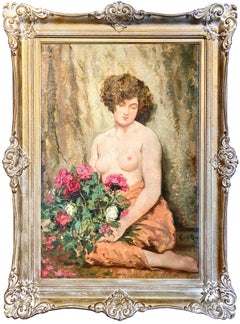
Nude with Roses
by Emile Baes (Brussels 1879 – Paris 1953)
By Emile Baes
Located in Knokke, BE
Emile Baes
Brussels 1879 – Paris 1953
Belgian Painter
'Nude with Roses'
Signature: signed lower middle right 'Emile Baes'
Medium: oil on canvas
Dimensions: image size 111 x 76 cm, ...
Category
Early 20th Century Naturalistic Nude Paintings
Materials
Canvas, Oil
$14,211
H 53.15 in W 39.38 in D 3.94 in
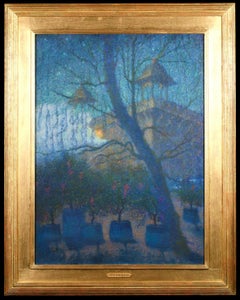
Moorish Palace Gardens - Post Impressionist Landscape Oil by Lucien Levy-Dhurmer
By Lucien Levy-Dhurmer
Located in Marlow, Buckinghamshire
Signed post impressionist oil on canvas landscape by French painter Lucien Levy-Dhurmer. The piece depicts the gardens of a Moorish Palace at evening. Painted in largely blues, there are some flowering trees in the front of the work below a much larger bare tree. Beyond that the palace sits below a starry sky. Mr. Jumeau-Lafond believes the work was likely painted in Morocco but he also stated that Dhurmer often used imagination to construct settings for his ideas.
Signature:
Signed lower left
Dimensions:
Framed: 39"x31"
Unframed: 32"x24"
Provenance:
Private collection - France
The authenticity of this work has been confirmed by Jean-David Jumeau-Lafond
A certificate of authenticity from Mr. Jumeau-Lafond is available upon request
Lucien Lévy-Dhurmer did not follow the conventional route for education in fine arts but was nevertheless a pupil of the painters Raphaël Collin, Vio and Wallet. He was an ornamental painter in an earthenware factory in Golfe-Juan from 1887 to 1895, which influenced his use of pastel. He travelled to Italy in 1895.
Around 1902 he painted the portraits of Rodenbach, Pierre Loti and Marguerite Moreno. Although he had not been instructed by Puvis de Chavannes or Gustave Moreau, he seemed to have much in common with those visionary 'painters of the soul' who had been exhibiting at the Salon de la Rose-Croix for several years: Edmond Aman-Jean, Louis Welden Hawkins, Henri Martin, Charles Maurin and Alphonse Osbert. Following the example of some of these artists, Lévy-Dhurmer admired Italian Renaissance art, evidence of which can be seen in pastels such as Woman with a Medal, Medusa, Circes and Florence. His translation of the Symbolist themes in the scores of Beethoven ( Appassionata), Fauré or Debussy into different hues made him seem like a visionary, but his aesthetic seems to have changed to some extent after 1900, when his landscape painting became more prominent. In fact, only his presentation and style changed. He continued to suggest feelings, interpretations and emotions but without relying on any traditional allegories. He became involved in the Intimist movement, along with Ernest Laurent, Charles Cottet, Henri le Sidaner and René Ménard, whose pastels presaged the Classicism of the 1930s.
He exhibited at the Salon des Artistes Français in Paris from 1882. From 1906 he was associated with the Salon de la Société Nationale des Beaux-Arts. He showed his works in individual exhibitions, notably in 1896 at the Galerie Georges Petit in Paris, which was a very successful exhibition and earned him admiration in artistic and literary circles alike. Several decades later the exhibition Around Lévy-Dhurmer ( Autour de Lévy-Dhurmer) at the Galeries du Grand Palais in Paris in 1973 revealed a tendency in art which had been largely unknown until then and which remained on the margins of the great innovative movements of the 20th century, but which was nonetheless of a quality which could not be ignored. Lévy-Dhurmer obtained a distinction from the Salon des Artistes Français in 1896 and a bronze medal at the 1900 Exposition Universelle in Paris. He became a Chevalier of the Légion d'Honneur in 1902.
Museum and Gallery Holdings
Bayonne (Mus. Basque): Portrait of Pierre Loti (1896, pastel)
Brest (MBA): Circes
Detroit (AI): Vase with Dragonflies (1890, earthenware with iridescent glaze)
Mulhouse: Harvest
New York (Metropolitan Mus. of Art): Flower Pot (c. 1893, earthenware with metallic glaze)
Paris (Mus. d'Orsay): Portrait of Georges Rodenbach (c. 1895, pastel on paper); The Woman with a Medal (1896, pastel on paper on card); The Lost Explorer...
Category
1910s Impressionist Landscape Paintings
Materials
Canvas, Oil
$37,864
Free Shipping
H 39 in W 31 in
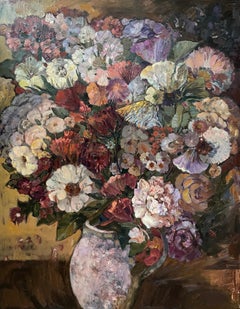
“A lush bouquet in a pink vase” Original floral painting. Large vertical .
Located in Oslo, NO
This artwork showcases a vivid bouquet of flowers in a textured, ceramic vase. The composition bursts with a variety of floral species, each detailed with rich and vibrant hues. Soft...
Category
2010s Impressionist Still-life Paintings
Materials
Canvas, Oil
$2,013
H 35.44 in W 27.56 in D 0.79 in
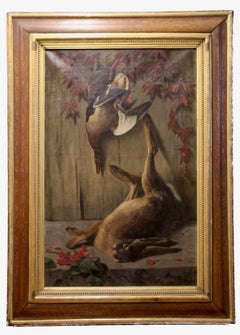
Pair of Hunting, Game Still Lifes by Ferdinand Hoppe, Oil on Canvas, 1885
Located in Berlin, DE
Impressive pair of large 19th-century game still lifes by the German painter Ferdinand Hoppe (1848–1890), each signed and dated “F. Hoppe 85” at lower left. Both works are oil on can...
Category
19th Century Academic Still-life Paintings
Materials
Canvas, Oil
$17,764
Free Shipping
H 48.82 in W 35.44 in
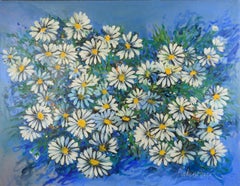
Marguerite Daisy Flowers, Large-Scale Mid Century Still-Life
Located in Soquel, CA
Wonderfully vibrant large scale still life of white and bluish marguerites on a bold blue background by Marilyn Rabinovich (American, b. 1932), circa 1960. Signed lower right corner....
Category
1960s American Impressionist Still-life Paintings
Materials
Canvas, Oil
$3,000
H 36 in W 48 in D 2 in
19th Century still life oil painting of fruit
birds
Located in Nr Broadway, Worcestershire
Ellen Ladell
British, (1853-1912)
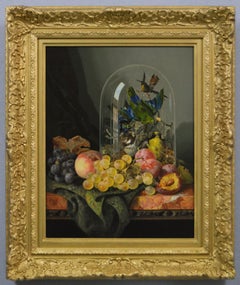
Still Life of Fruit & Exotic Birds
Oil on canvas laid on board, signed
Image size: 17.5 inches x 13.5 inches
Size including frame: 24.75 inches x 20.75 inches
Provenance: Sotheby’s The British Sale, 2003, lot 256
A beautifully painted still life of fruit with a glass dome and taxidermy birds by Ellen Ladell. Grapes, plums and a peach are shown grouped on a floral patterned green cloth at the front of a marble topped table. Behind the fruit is a large glass display dome with an arrangement of exotic taxidermy birds. The reflection in the glass gives the viewer a glimpse of a tall window with a house beyond, adding another dimension to the painting.
Ellen Ladell was born Ellen Maria Levett in Ipswich in 1853 to George and Maria Levett. Her father was a foundry smith and the family lived at 30 Borough Road in Ipswich. She initially worked as a Milliner around 1871 but sought artistic training during her spare time. It is at this point she met and became a pupil of the still life painter Edward Ladell (1821-1886), who at that time was a widower.
Ellen married Edward in Great Yarmouth on 21 October, 1878. The couple initially moved to Torquay where they had their son Kenwyn in 1880, but then decided to settle in Exeter, living at 99 Sidwell Street and setting up a studio at 20 Queen Street. Edward’s influence can been seen in her work as their styles and subject matter share some similarities. However, a number of Ellen’s paintings also included taxidermy under glass...
Category
19th Century Victorian Still-life Paintings
Materials
Canvas, Oil, Board
$9,516
H 24.75 in W 20.75 in D 2.75 in
Still Thinking About These?
All Recently ViewedMore Ways To Browse
Schumacher Painting
The Swimmer
Mood Light
Pink Flowers Art
17th Century Portrait Oil Paintings
Impressionist Painting Mountains
Poppy Art
Family Portrait
19 Century Oil Paintings American
Impressionist Painting Pink
St Marks
Paintings Of London
Vintage Renoir
Cuban Artists
Old Masters Paintings In Gold Frames
Sand Art
Landscape Impressionist Green
American Realism