1910s Art
to
274
1,085
355
395
194
171
Overall Width
to
Overall Height
to
7,602
21,281
162,178
232,939
1,978
2,252
4,935
6,454
5,732
15,022
20,460
25,770
18,494
13,837
5,392
421
320
135
133
49
19
19
12
6
1
1,233
883
31
1,432
691
599
408
391
348
217
151
146
135
134
123
116
102
97
95
77
77
59
58
872
629
486
395
386
102
52
34
23
22
856
373
1,169
957
Period: 1910s
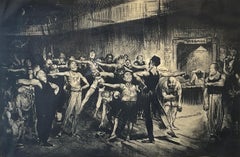
"Business-Men
s Class, Y.M.C.A." George Bellows, Ashcan School Print
Located in New York, NY
George Bellows
Business-Men's Class, Y.M.C.A, 1916
Signed, numbered "No. 41" and titled lower margin
Lithograph on wove paper
11 1/2 x 17 1/8 inches
Edition of 64
Provenance:
Hirschl & Adler Galleries, New York
Private Collection, Ohio
Literature:
Mason, 20.
After his arrival from Columbus, Ohio in 1904, Bellows lived at the West Side YMCA. It was there that he met Eugene Speicher, another aspiring young artist who was to become his lifelong friend. Always interested in the anatomy of the human body, Bellows often satirized the various types who, while leading a sedentary life, feel compelled to devote a portion of their daily routine to physical self-improvement.
Throughout his brief but illustrious career, George Wesley Bellows created striking scenes that documented ordinary American life in all its beauty and banality. Considered an American Realist, the artist eschewed embellishment, finding inspiration in the gritty boroughs of New York City, the rocky coastline of Maine, and, later, in his friends and family. Bellows garnered early recognition for his arresting portrayals of illegal prizefighting, dramatic works executed in dark tonal palettes that underscore the brutality of the violent sport.
Bellows’ elderly Methodist parents hoped their son might pursue the ministry, a calling the extroverted athlete never received. The Columbus native competed on the baseball team at Ohio State University and also served as an illustrator for the college yearbook. In the fall of 1904—just months shy of his expected graduation—Bellows defied his father’s wishes and boarded a train to New York City in hopes of becoming a magazine illustrator like his idols Howard Chandler Christy and Charles Dana Gibson. Before leaving, he reportedly turned down an offer to play professional baseball with the Cincinnati Reds...
Category
Ashcan School 1910s Art
Materials
Paper, Lithograph
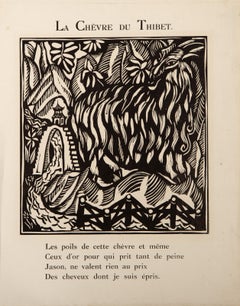
La Chevre Du Thibet, Impressionist Woodblock by Raoul Dufy
By Raoul Dufy
Located in Long Island City, NY
Raoul Dufy, French (1877 - 1953) - La Chevre Du Thibet, Year: circa 1911, Medium: Woodblock, Image Size: 8 x 7.5 inches, Size: 13 x 10 in. (33.02 x 25.4 cm), Description: From the ...
Category
Impressionist 1910s Art
Materials
Woodcut
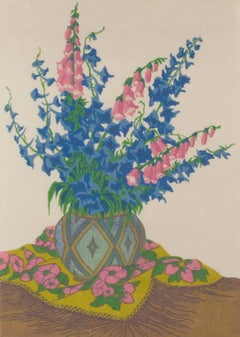
Rittersporn und Fingerhut (Larkspur and Foxglove)
Located in Fairlawn, OH
Rittersporn und Fingerhut
(Larkspur and Foxglove)
Color woodcut, printed on wove paper with mica flecks, 1916
Signed lower right (see photo)
Inscribed lower left (see photo)
Reference: Merx 276
Condition: good-very good
One spot of staining on the far left edge of the composition (see photo)
Color very fresh and vibrant
Full sheet as issued
Image size: 19 x 13 3/8 inches
Carl Thiemann...
Category
Vienna Secession 1910s Art
Materials
Woodcut
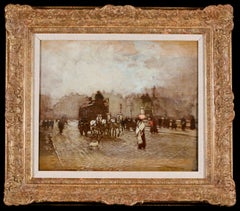
Le Pont Neuf - Impressionist Figures in Landscape Oil by Amedee Marcel-Clement
Located in Marlow, Buckinghamshire
Signed and dated figures in cityscape oil on panel by French impressionist painter Amedee Marcel-Clement. The work depicts a view of the Pont Neuf bridge that runs over the River Sei...
Category
Impressionist 1910s Art
Materials
Oil, Panel
Pablo Picasso, L
Abreuvoir from La Suite Saltimbanques
Located in Chatsworth, CA
This piece is an original drypoint created by Pablo Picasso in 1905 and printed by Ambroise Vollard after steel-facing in 1913. It is from a series entitled La Suite des Saltimbanque...
Category
Surrealist 1910s Art
Materials
Drypoint
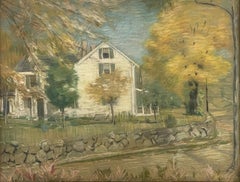
"New England Autumn" Philip Leslie Hale, American Impressionist Landscape House
By Philip Leslie Hale
Located in New York, NY
Philip Leslie Hale
New England Autumn, 1910
Pastel on canvas
25 x 30 inches
Provenance:
Estate of the artist
Sotheby's New York, American Paintings, Drawings and Sculpture, May 24, 1990, Lot 125
R. Anne McCarthy
Rose Art Museum, Waltham, Massachusetts (gift from the above)
Private Collection, Massachusetts
Exhibited:
Philadelphia, The Pennsylvania Academy of the Fine Arts, Tenth Annual Philadelphia Watercolor Exhibition, November 10 - December 15, 1912, no. 13.
Painter, teacher and writer, Philip Leslie Hale is recognized for his decorative paintings of the female figure and for his interior scenes with figures as well as for his progressive approach to painting. However, his career went through several phases that included sporting scenes, figural studies of women including nudes, portraits, and allegorical works reflecting the overwhelming forces of nature.
Of the Boston painters of his time, he seemed the most fully committed to Impressionism, and his technique suggests the influence of French impressionist Edgar Degas. In most of his paintings, the landscape was more important than the figure.
He was a prolific writer in local newspapers and periodicals about the contemporary art scene, discussing the work of his Boston colleagues. He also wrote numerous books on art and art history including a study of Vermeer that was published in 1913. Among his writings are 1892 newspaper columns for Arcadia Magazine titled "Letters from Paris", art criticism for the Boston Herald from 1905 to 1909; and art criticism for the Boston Evening Transcript. He argued for the Boston School of Art as led by Edmund Tarbell whose style was based on Impressionism with elements of Realism, especially figure painting.
Hale was born in Boston in 1865, the son Reverend Edward Hale, a Boston clergyman and a relative of Nathan Hale. He studied with Ellen Day Hale, his sister, and Edmund Tarbell at the Boston Museum School, with J. Alden Weir at the Art Students League in New York City, and then went to Paris for further studies at the Academie Julian and the Ecole des Beaux-Arts. He remained in France for fifteen years, returning to America about 1895. During that time, from 1888, he spent summers at Giverny, France with his good friend, artist, Theodore Butler, and became well acquainted with Claude Monet. Traveling throughout Europe, Hale visited the major museums, and copied the works of Ingres, Vermeer, Watteau and Michelangelo.
Hale married Lilian Westcott Hale...
Category
American Impressionist 1910s Art
Materials
Canvas, Pastel
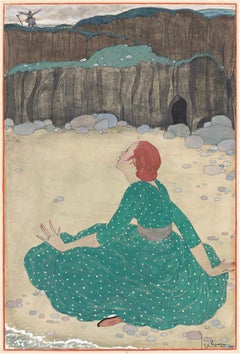
Art Nouveau Woman on Beach in Green Dress Romantic Story "Le Retour"
Located in Miami, FL
In this painting, Art Nouveau French illustrator Georges Lepape depicts a high moment of personal drama. He exquisitely renders a beautiful yet solitary woman sitting on the beach...
Category
Art Nouveau 1910s Art
Materials
Silver
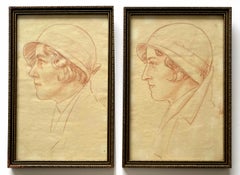
Pair of antique portraits women period clothes framed drawing red hats 19th
Located in Buffalo, NY
A pair of original red conte crayon drawings in their original frames featuring two young women in period clothing.
Category
Art Deco 1910s Art
Materials
Paper, Conté

$551 Sale Price
20% Off
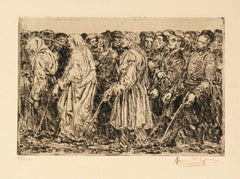
Les Aveugles ( The Blind )
Located in Paonia, CO
Henri DeGroux (1866-1930) was a Belgian Symbolist painter, sculptor and lithographer. He was known for his allegorical, religious and historical subject matter. He became an inspired...
Category
Symbolist 1910s Art
Materials
Lithograph
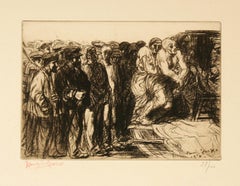
Ambulkance
Located in Paonia, CO
Henri DeGroux (1866-1930) was a Belgian Symbolist painter, sculptor and lithographer. He was known for his allegorical, religious and historical subject matter. He became an inspired...
Category
Symbolist 1910s Art
Materials
Lithograph
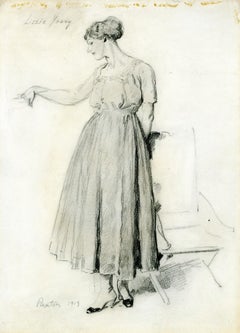
Preliminary Study for the painting Rose and Gold, 1913
Located in Fairlawn, OH
Preliminary Study for the painting Rose and Gold, 1913
Graphite on paper, 1913
Signed in pencil lower left (see photo)
Titlted "Lizzy Young" in pencil upper left (see photo)
Lizzy was a modle that Paxton depicts numerous times.
The painting that this drawing is related to, is illustrated in Lee & Krause, William McGregor Paxton, 1869-1941, Plate 32, text on page 132. The painting was formerly in the collection of Victor Spark and the Honorable Paul Buchanan. It is currently in a Texas Collection.
Provenance: Private Collection, Florida
William McGregor Paxton (June 22, 1869 – 1941) was an American painter and instructor who embraced the Boston School paradigm and was a co-founder of The Guild of Boston Artists. He taught briefly while a student at Cowles Art School, where he met his wife Elizabeth Okie Paxton, and at the Museum of Fine Arts School in Boston. Paxton is known for his portraits, including those of two presidents—Grover Cleveland and Calvin Coolidge—and interior scenes with women, including his wife. His works are in many museums in the United States.
Early life
He was born on June 22, 1869, in Baltimore to James and Rose Doherty Paxton. William's father moved the Paxton family and established a catering business in Newton Corner, Massachusetts, in the mid-1870s.
Education
Paxton attended Cowles Art School on a scholarship he attained at the age of 18. He studied with Dennis Miller Bunker...
Category
American Impressionist 1910s Art
Materials
Graphite
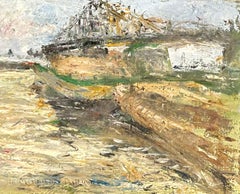
"Near Provincetown" Charles Webster Hawthorne, Cape Cod Impressionist Landscape
Located in New York, NY
Charles Hawthorne
Near Provincetown
Signed and inscribed "TO MY FRIEND RILLINGIK" lower left
Oil on canvas
16 x 20 1/4 inches
Provenance:
Private Collection
Sotheby's New York, September 12, 1994, Lot 145
Spanierman Gallery, New York
Private Collection, Scarsdale, New York
Charles W. Hawthorne (1872-1930) was one of America's most dynamic, penetrating and forthright portrait painters, as well as a creative, inspiring teacher. A painter's painter, Hawthorne ran a summer school in Provincetown - the Cape Cod School of Art - for over thirty years and made it a leading artists' colony of plein-air impressionist-inspired talents. Hawthorne grew up in Richmond, Maine, the son of Joseph Jackson Hawthorne and Cornelia Jane Smith...
Category
Impressionist 1910s Art
Materials
Canvas, Oil
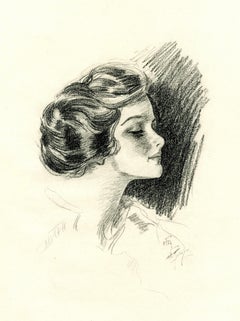
Young Lady in Profile
Located in Fairlawn, OH
Young Lady in Profile (Dorothy Gibson)
Graphite on paper, c. 1915
Signed lower right (see photo).
The sitter for this drawing, along with a huge number of Harrison Fisher’s works, i...
Category
American Impressionist 1910s Art
Materials
Graphite
Early 20th century colorful seaside landscape pastel figures bench trees signed
Located in Milwaukee, WI
"Couple on Bench at the Beach" is an original pastel drawing on paperboard by Francesco Spicuzza. The artist signed the piece in the lower left. This drawing depicts two figures sitting on a bench in front of a body of water. The artist used mostly pastel colors for this piece.
6 7/8" x 9 7/8" art
18 1/2" x 21 3/8" frame
Francesco J. Spicuzza, born in Sicily on July 23, 1883, came to America at the age of 8. He supported himself as a fruit peddler until a newspaperman gave him $4 a week to go to school. He attended classes at the Milwaukee Art Students League, where he studied under Alexander Mueller. There he learned to paint in the then-fashionable "Munich School" technique, with detailed realism in heavy browns and grayed-out hues. Spicuzza completed eight grades in four years, and then in 1911, three businessmen advanced him enough money to allow him to study in New York under artist and teacher John Carlson. It was during this time that Spicuzza changed his style of painting, developing an impressionistic use of color, form and atmospheric renditions. After a period of grinding poverty, one of Spicuzza's pictures won a major New York competition. It was the first of 60 wins, both in the U.S. and Paris. He became a fashionable painter, and many of the leading collections have his work. Spicuzza's typical works were beach scenes, still life, landscapes and portraits done in pastels, oils, ink, charcoal and watercolors. Much of his work traced the history of Milwaukee in the early 1900s. He was probably best known for his scenes of women and children splashing in the waves...
Category
Impressionist 1910s Art
Materials
Paper, Pastel, Board

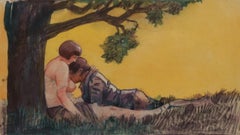
Love Scene Under a Tree / - At the breast of Mother Nature -
By Emil Orlik
Located in Berlin, DE
Emil Orlik (1870 Prague - 1932 Berlin), Love Scene Under a Tree, 1912. Mixed media on paper, 14.5 cm x 25 cm (sheet size), 35.5 cm x 46 cm (frame), signed “ORLIK.” lower right and da...
Category
Modern 1910s Art
Materials
Watercolor
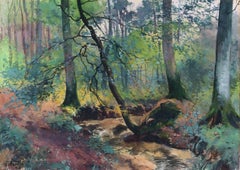
Summer Forest Landscape, 1915 / - The Forest Walk -
Located in Berlin, DE
Stanislas Warnie (1879-1958), Summer Forest Landscape, 1915. Watercolor, 31.5 cm x 45 cm (passepartout), 50.5 cm x 63.5 cm (frame), signed "S. Warnie" at lower left and dated "1915"....
Category
Art Nouveau 1910s Art
Materials
Watercolor
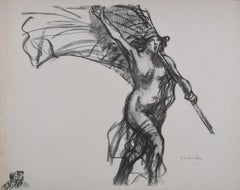
“La Rèpublique nous appelle…” (The Republic calls us…)
Located in Fairlawn, OH
La République Nous Appelle (The Republic Calls Us)
Transfer lithograph with an etching Remarque in the lower left corner, 1915
Signed in pencil lower right (see photo)
Edition: 100 (...
Category
1910s Art
Materials
Lithograph
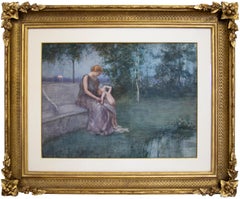
Mother and Child
Located in New York, NY
Watercolor on paper laid on board: An exceptional watercolor in terms of quality and presentation. During this earlier period of Day's career he exhibited extensively and was inspir...
Category
Pre-Raphaelite 1910s Art
Materials
Watercolor, Board, Archival Paper
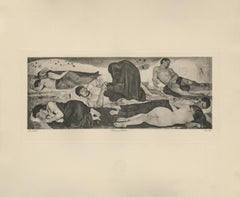
"Night" Copper Plate Heliogravure
Located in Palm Beach, FL
2018 marks the centenary anniversary of Ferdinand Hodler’s death. In that 100 years time, the art world’s esteem of this important artist has proved fickle. It has shifted from extolling his artistic merits during his lifetime to showing something of a feigned disdain- more reflective of the world political order than a true change of heart for Hodler’s work. After years of Hodler being all but a footnote in the annals of art history and generally ignored, finally, the pendulum has righted itself once again. Recent retrospective exhibitions in Europe and the United States have indicated not only a joyful rediscovery of Hodler’s art but a firm conviction that his work and world view hold particular relevance today. DAS WERK FERDINAND HODLERS is not only a collection of printed work reflecting the best of all of his painted work created up to 1914 just before the outbreak of World War I, the portfolio itself is an encapsulation of Hodler’s ethos, Parallelisme.
Hodler developed his philosophy of Parallelisme as a unifying approach to art which strips away detail in search of harmony. By means of abstraction, symmetry and repetition, Hodler sought ways to depict Nature’s essence and her fundamental, universal order. He believed these universal laws governing the natural, observable world extend to the spiritual realm. Symbolist in nature with Romantic undertones, his works are equally portraits of these universal concepts and feelings governing all life as they are a visual portrait in the formal sense. Whether his subject is a solitary tree, a moment in battle, mortal fear, despair, the awe inspired by a vast mountain range, a tender moment or even the collective conviction in a belief, Hodler unveils this guiding principle of Parallelisme.
Several aspects of Hodler’s portfolio reinforce his tenets of Parallelisme. The Table of Contents clearly preferences a harmonious design over detail. The two columns, consisting of twenty lines each, list the images by order of appearance using their German titles. The abbreviated titles are somewhat cryptic in that they obscure the identities of the sitters. Like the image Hodler presents, they are distillations of the sitter without any extraneous details. This shortening was also done in an effort to maintain a harmonious symmetry of the Table of Contents, themselves, and keep titles to a one-line limit. The twenty-fourth title: “Bildnis des Schweizerischen Gesandten C.” was so long, even with abbreviation, that it required two lines; so, for the sake of maintaining symmetry, the fortieth title: “Bauernmadchen” was omitted from the list. This explains why the images are not numbered. Hodler’s reasoning is not purely esoteric. Symmetry and pattern reach beyond mere formal design principles. Finding sameness and imposing it over disorder goes to the root of Hodler’s identity and his art. A Swiss native, Hodler was bi-lingual and spoke German and French. Each printed image, even number forty, have titles in both of Hodler’s languages. Certainly, there was a market for Hodler’s work among francophones and this inclusion may have been a polite gesture to that end; however, this is the only place in the portfolio which includes French. With German titles at the lower left of each image, Hodler’s name at bottom center and corresponding French titles at the lower right of each image, there is a harmony and symmetry woven into all aspects of the portfolio. This holds true for the page design, as it applies to each printed image and as it describes the Swiss artist himself. Seen in this light, Hodler’s portfolio of printed work is the epitome of Hodler’s Parallelisme. DAS WERK FERDINAND HODLERS is also one of the most significant documents to best tell the story of how Hodler, from Switzerland, became caught between political cross-hairs and how the changing tides of nations directly impacted the artist during his lifetime as well as the accessibility of his art for generations to come.
The Munich-based publisher of the portfolio, R. Piper & Co., Verlag, plays a crucial role in this story. Publishing on a wide range of subjects from philosophy and world religion to music, literature and the visual arts; the publisher’s breadth of inquiry within any one genre was equal in scope. Their marketing strategy to publish multiple works on Hodler offers great insight as to what a hot commodity Hodler was at that time. R.Piper & Co.’s Almanach, which they published in 1914 in commemoration of their first ten years in business, clearly illustrates the rapid succession- strategically calculated for achieving the deepest and broadest impact - in which they released three works on Hodler to hit the market by the close of 1914. DAS WERK FERDINAND HODLERS was their premier publication. It preceded C.A. Loosli’s Die Zeichnungen Ferdinand Hodlers, a print portfolio after 50 drawings by Hodler which was released in Autumn of 1914 at the mid-level price-point of 75-150 Marks; and a third less expensive collection of prints after original works by Hodler, which had not been included in either of the first two portfolios, was released at the end of that year entitled Ferdinand Hodler by Dr. Ewald Bender.
The title and timing of DAS WERK FERDINAND HODLERS' debut leaves little doubt as to the connection it has with another avant-garde portfolio of art prints, Das Werk Gustav Klimts, released in 5 installments from 1908 -1914 by Galerie Miethke in Vienna. Hodler, himself, was involved in Klimt’s ground-breaking project. As the owner of Klimt’s 1901 painting, “Judith with the Head of Holifernes” which appears as the ninth collotype print in the second installment of Das Werk Gustav Klimts, Hodler was obliged to grant access of the painting to the art printers in Vienna for them to create the collotype sometime before 1908. Hodler had been previously invited in 1904 to take part in what would be the last exhibition of the Vienna Secession before Klimt and others associated with Galerie Miethke broke away. In an interview that same year, Hodler indicated that he respected and was impressed by Klimt. Hodler’s esteem for Klimt went beyond the art itself; he emulated Klimt’s method aimed at increasing his market reach and appeal to a wider audience by creating a print portfolio of his painted work. By 1914, Hodler and his publisher had the benefit of hindsight to learn from Klimt’s Das Werk publication.
Responding to the sluggish sales of Klimt’s expensive endeavor, Hodler’s publisher devised the same diversified 1-2-3 strategy for selling Hodler’s Das Werk portfolio as they did with regards to all three works on Hodler they published that year. For their premium tier of DAS WERKS FERDINAND HODLERS, R. Piper & Co. issued an exclusive Museum quality edition of 15 examples on which Hodler signed each page. At a cost of 600 Marks, this was generally on par with Klimt’s asking price of 600 Kronen for his Das Werk portfolio. A middle-tiered Preferred edition of 30, costing somewhat less and with Hodler’s signature only on the Title Page, was also available. The General edition, targeting the largest audience with its much more affordable price of 150 Marks, is distinguishable by its smaller size.
Rather than use the subscription format Miethke had chosen for Klimt’s portfolios which proved to have had its challenges, R. Piper & Co. employed a different strategy. In addition to instantly gratifying the buyer with all 40 of the prints comprising DAS WERK FERDINAND HODLERS and the choice among three price points, they advertised in German journals a fourth possibility of ordering single prints from them directly. These printed images are easily discernible from the three complete folio editions. The paper size of the single purchased images is of the larger format like the Museum and Preferred editions, measuring 65 h x 50 w cm; however, the paper itself is the same copper print paper used in the General edition and then mounted on poster board. The publishing house positioned itself to be a direct retailer of Hodler’s art. They astutely recognized the potential for profitability and the importance, therefore, of having proprietary control over his graphic works.
R. Piper & Co. owned the exclusive printing rights to Hodler’s best work found in their three publications dating from 1914. That same year, a competing publication out of Weimar entitled Ferdinand Hodler: Ein Deutungsversuch von Hans Muhlestein appeared. Its author, a young scholar, expressed his frustration with the limited availability of printable work by Hodler. In his Author’s Note on page 19, dated Easter, 1914, Muhlestein confirms that the publisher of Hodler’s three works from that same year owned the exclusive reproductive rights to Hodler’s printed original work. He goes further to explain that even after offering to pay to use certain of those images in his book, the publisher refused. Clearly, a lot of jockeying for position in what was perceived as a hot market was occurring in 1914.
Instead, their timing couldn’t have been more ill-fated, and what began with such high hopes suddenly found a much different market amid a hostile climate. The onset of WWI directly impacted sales. Many, including Ferdinand Hodler, publicly protested the September invasion by Germany of France in which the Reims Cathedral, re-built in the 13th century, was shelled, destroying priceless stained glass and statuary and burning off the iron roof and badly damaging its wooden interior. Thomas Gaehtgens, Director of the Getty Research Institute describes how the bombing of Reims Cathedral triggered blindingly powerful and deeply-felt ultra-nationalistic responses: “The event profoundly shocked French intellectuals, who for the most part had an intense admiration for German literature, music and art. By relying on press accounts and abstracting from the visual propagandistic content, they were unable to interpret the siege of Reims without turning away from German culture in disgust. Similarly, the German intelligentsia and bourgeoisie were also shocked to find themselves described as vandals and barbarians. Ninety-three writers, scientists, university professors, and artists signed a protest, directed against the French insults, that defended the actions of the German army.”
In similar fashion, a flurry of open letters published in German newspapers and journals as well as telegrams and postcards sent directly to Hodler following his outcry in support of Reims reflected the collectively critical reaction to Hodler’s position. Loosli documents that among the list of telegrams Hodler received was one from none other than his publisher in Germany, R.Piper & Co. Allegiances were questioned. The market for Hodler in Germany immediately softened. Matters worsened for the publisher beyond the German backlash to Hodler and his loss of appeal in the home market; with the war in full swing until 1918, there was little chance a German publisher would have much interest coming from outside of Germany and Austria. Following the war and Hodler’s death in 1918, the economy in Germany continued to spiral out and just 5 years later, hyper-inflation had rendered its currency worthless vis-a-vis its value in the pre-war years. Like the economy, Hodler’s reputation was slow to find currency in these difficult times. Even many French art fans had turned sour on Hodler as they considered his long-standing relationship in German and Austrian art circles. Thus, the portfolio’s rarity in Hodler’s lifetime and, consequently, the availability of these printed images from DAS WERK FERDINAND HODLERS since his death has been scarce.
In many ways, Hodler and his portfolios were casualties of war. Thwarted from their intended purpose of reaching a wide audience and show-casing Parallelisme, Hodler’s unique approach to art, this important, undated work has been both elusive and shrouded in mystery. Perhaps DAS WERK FERDINAND HODLERS was left undated as a means of affirming the timelessness of Hodler’s art. Digging back into the past, Hodler’s contemporaries, like R. Piper, C.A. Loosli and Hans Muhlestein, indeed provide the keys to unequivocally clarify what has largely been mired in obscurity. Just after Hodler’s death, the May, 1918 issue of the Burlington Review ran a small column which opined hope for better access to R.Piper & Co.’s DAS WERK FERDINAND HODLERS; 100 years later, it is finally possible. Hodler’s voice rings out through these printed works. Once more, his modern approach to depicting portraits, landscapes and grand scale scenes of Swiss history speak to us of what is universal. Engaging with any one of these images is the chance to connect to Hodler’s vision and his world view- weltanschauung in German, vision du monde in French- however one expresses these concepts through language, its message embedded in his work is the same: “We differ from one another, but we are like each other even more. What unifies us is greater and more powerful than what divides us.” Today, Hodler’s art couldn’t be more timely.
FERDINAND HODLER (SWISS, 1853-1918) explored Parallelisme through figurative poses evocative of music, dance and ritual. His images of sex, night, desertion and death as well as his many landscapes exploring the universal longing for harmony with Nature are unique and important works embodying a Symbolist paradigm. Truly a Modern Master, Hodler’s influence can be felt in the work of Gustav Klimt and Kolomon Moser...
Category
Symbolist 1910s Art
Materials
Paper
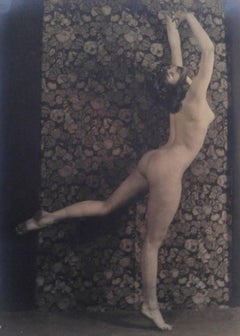
Nude Dancer, from The Female Figure Series by Karl Struss, 1917
By Karl Struss
Located in Denton, TX
Nude Dancer, from The Female Figure series by Karl Struss features a nude woman standing on one leg, with her leg lifted in an arabesque position. Her arms are raised above her head ...
Category
Modern 1910s Art
Materials
Silver Gelatin
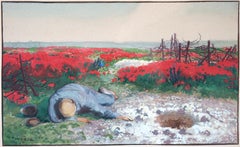
Red blooming war landscape with dead soldier - Bleeding flowers -
Located in Berlin, DE
Johannes Friedrich Heinrich Hänsch (1875-1945), Red blooming war landscape with dead soldier, 1918. Watercolor and gouache on paper, 15 x 24.5 cm (image), 27 x 37 cm (sheet size / frame), monogrammed and dated "19JH18" at lower left.
- Paper slightly darkened
About the artwork
Despite the relatively small format, the watercolor with an internal frame depicts a panoramic view of a flat landscape stretching to the horizon. As far as the eye can see, the poppies bloom in flaming red. The flowers are not rendered individually, however, creating an almost cohesive red surface. The bright red is interspersed with vegetal green. A complementary contrast that creates an intense color effect. In this color contrast, a white area breaks through from the middle ground, widening towards the foreground and surrounding a brown hole. Next to it, in blue, is the actual protagonist of the painting, the first thing that catches the eye: a dead soldier. Next to him is his helmet, revealing the empty interior. The brown, hollow shape corresponds to the hole in the ground. A shell funnel is surrounded by bright ash, which, like the inverted helmet, becomes a sign of death. The soldier's arms point to the funnel, while the empty helmet paraphrases the calotte of the skull and, like the funnel, thematizes the empty darkness of death.
The soldier's body, however, is intact and not - as in Otto Dix's triptych "The War" - a dismembered corpse. Instead, Johannes Hänsch activates the landscape, especially the color, to illustrate a blooming landscape of death that extends from the shell funnel in the foreground to the rising column of smoke on the horizon. If the soldier's body is intact, the tangle of barbed wire emblematically placed over the empty helmet also appears tattered. On the right side of the picture, the barbed wire even seems to stretch its arms to the sky in horror. Against the background of this allegory, the content of the bright red also becomes clear: the landscape is drenched in blood, literally a sea of blood, and the single unknown soldier stands pars pro toto for all those who died on the battlefield. Dying in war is not dying in community, but in solitude. In order to emphasize the isolation in death, Johannes Hänsch has set the blue of the soldier in the axis given by his body in the middle ground of the picture into the red sea.
A master of landscape painting, Hänsch succeeds in creating a natural-looking landscape allegory that illustrates the horror and death of war, without depicting the brutality of war itself. This singular 'war memorial' of the unknown soldier is the opposite of heroization and yet the dignity of the deceased soldier is preserved through the integrity of his body.
About the artist
As the son of the sculptor Adolf Haensch, the young Johannes received his first artistic training in his father's Berlin studio. However, he eventually decided to become a painter, and in 1897 he entered the Berlin Academy of Arts. He initially studied under Paul Vorgang and Eugen Bracht, and was particularly influenced by Bracht's increasingly colourful landscape painting. In 1901 he moved to the class of Friedrich Kallmorgen, with whom he spent several weeks on excursions into nature. In 1905 he became a master pupil of Albert Hertel, who taught him watercolour painting.
From 1903 to 1933 he exhibited annually at the Great Berlin Art Exhibition, the exhibitions of the Berlin Artists' Association and the Munich Glaspalast. In 1905 he was awarded the Carl Blechen...
Category
Realist 1910s Art
Materials
Watercolor
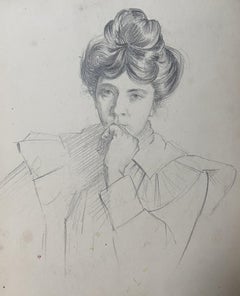
André Eugène Costilhes (1865-1940) A Pensive young woman, portrait drawing
Located in Paris, FR
André Eugène Costilhes (1865-1940)
A Pensive young woman
pencil on paper
29.5 x 22.5 cm (view)
In good condition, except some traces of stains
Framed : 55.5 x 41.5 cm (vintage frame...
Category
Symbolist 1910s Art
Materials
Pencil
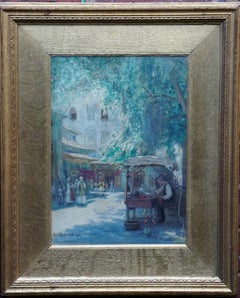
A Market Scene - French Impressionist art 1914 watercolour painting indis signed
Located in Hagley, England
This charming French Impressionist watercolour painting was painted in 1914 and is indistinctly signed. The composition is a market scene with various stalls under trees. The colouring is lovely and it is housed in a superb, gilded oak frame...
Category
Impressionist 1910s Art
Materials
Watercolor
$3,290 Sale Price
20% Off
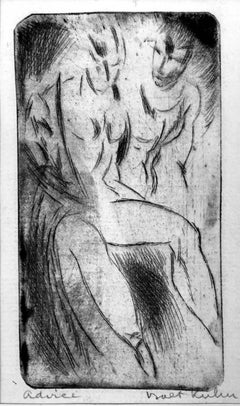
Advice
By Walt Kuhn
Located in New York, NY
Walt Kuhn (1877-1949), Advice, etching and drypoint, 1915, signed in pencil lower right and titled lower left. In generally good condition but obviously a proof impression, with marg...
Category
American Modern 1910s Art
Materials
Drypoint, Etching
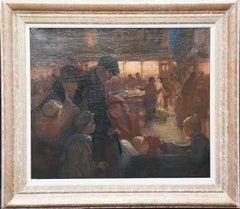
Family Portrait in Market - British 1914 art Post Impressionist oil painting
Located in Hagley, England
This charming early twentieth century Post Impressionist portrait oil painting is by British Jewish female artist Amy Julia Drucker. Of German descent, Drucker was born in England i...
Category
Post-Impressionist 1910s Art
Materials
Oil
Original U. S. Marines, Another Notch Chateau Thierry vintage World War 1 poster
Located in Spokane, WA
Original WWI "Another Notch Chateau Thierry – U.S. Marines" Linen-Backed Poster by Adolph Treidler, 1918. Archival linen-backed, Grade A condition, no flaws, ready to frame.
Adol...
Category
American Realist 1910s Art
Materials
Lithograph
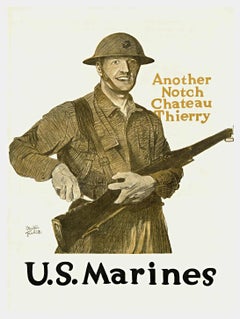
Gustav Klimt "Standing Girl w/Lace Headdress" collotype - Funfundzwanzig folio
By Gustav Klimt
Located in Palm Beach, FL
Title page numbered: 263/450
Category
Vienna Secession 1910s Art
Materials
Paper
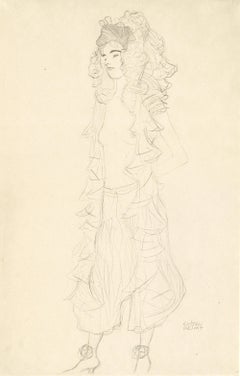
Kostume, Plakate, und Dekorationen, "Shadows
Light"
Located in Palm Beach, FL
Walter Schnackenberg’s style changed several times during his long and successful career. Having studied in Munich, the artist traveled often to Paris where he fell under the spell of the Henri de Toulouse-Lautrec’s colorful and sensuous posters depicting theatrical and decadent subjects. Schnackenberg became a regular contributor of similar compositions to the German magazines Jugend and Simplicissimus before devoting himself to the design of stage scenery and costumes. In the artist’s theatrical work, his mastery of form, ornamentation, and Orientalism became increasingly evident. He excelled at combining fluid Art Nouveau outlines, with spiky Expressionist passages, and the postures and patterns of the mysterious East.
In his later years, Schnackenberg explored the unconscious, using surreal subject matter and paler colors that plainly portrayed dreams and visions, some imbued with political connotations. His drawings, illustrations, folio prints, and posters are highly sought today for their exceedingly imaginative qualities, enchanting subject matter, and arresting use of color.
SCHNACKENBERG: KOSTUME, PLAKATE UND DEKORATIONEN, a cardboard bound art book consisting of 43 prints of work by Walter Schnackenberg, 30 of which are color lithographs that are signed and some are titled and dated in the plate, as well as black and white prints and photographs with accompanying text by Oskar Bie; lithographs printed at Kunstanstalt Oskar Consee in Munich, other images printed by Gesellschaft Pick & Co. in Munich, the text and cover with color images by Schnackenberg front and verso printed by R. Oldenbourg in Munich; published by Musarion Verlag, Munich, 1920.
The majority of Walter Schnackenberg’s artistic output was destroyed by bomb attacks in Munich in 1944. The highly publicized 2013 auction in New York of the recovered pre-war poster collection once belonging to German poster aficionado, Hans Sachs has reintroduced the world to Walter Schnackenberg’s graphic genius and priceless ephemeral art from a lost era. Besides the museum world, designer Karl Lagerfeld is one of the most prodigious collectors of Schnackenberg. Flipping through the pages of Kostume, Plakate und Dekorationen, it becomes quite clear that Schnackenberg’s collection is ground zero at the crossroads of early modern fashion where the cult of celebrity meets up with dance, music, theater and cabaret, film and the graphic medium. Berlin and Munich under Germany’s Weimar Republic in the first quarter of the 20th century produced just the atmosphere to feed this burgeoning industry. Rising inflation sparked a recklessness to live large for the moment and heightened a desire for escapism. An influx of Indian and East Asian dancers and musicians added to the artsy bohemian cultural mix. A new decadence and tolerance resulted. Film boldly featured provocative subject matter. Cabarets became popular venues giving rise to the demi-monde in which people from all social stations mixed more freely in a thriving underground economy and culture where there was a blurring of boundaries and of social codes. Noted art historian and cultural doyen, Oskar Bie astutely observes in his introduction to Schnackenberg’s publication that what unites the images is fantasy and advertisement. Schnackenberg uses the eye as an instrument to brilliantly construct and convey this double message. His personages never directly confront the viewer. Their eyes gaze off in the distance like those of the screenplayer and film star Hedamaria Scholz in Schnackenberg’s “Die Rodelhexe” movie poster. Their eyes follow the path of a dance composition or become a transfixed and ogling male gaze such as the iconic 1911 Odeon Casino poster...
Category
Expressionist 1910s Art
Materials
Lithograph
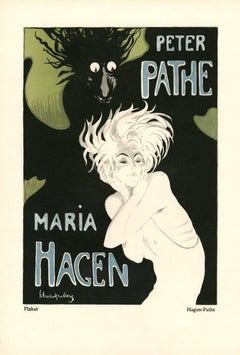
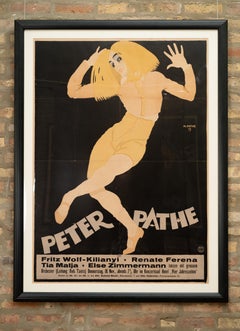
Peter Pathe - Original Lithograph Poster
Located in Palm Beach, FL
PETER PATHE, poster lithograph, Schnackenberg School, 1919, the image features the headline performer, Peter Pathe, in drag wearing a form-fitting button-down jacket, high-waisted shorts buttoning down the front, Mary Jane dance shoes and calf-length white socks; Pathe is depicted in motion with raised jazz hands which frame his bushy-haired heavily made-up face and body curving in dynamic lateral movement with raised front leg turned out; with printed text at the bottom: “PETER PATHE/und/Fritz Wolf-Killanyi * Renate Ferena/Tia Majja * Else Zimmermann tanzenmit grossem/Orchester (Leitung: Rob. Tants) Donnerstag, 18 Nov., amends 71/2 Uhr im Konzertsaal Hotel “Vier Jahreszeiten”/Karten zu Mk. 20. - bis Mk. 3.- bei Alfr. Schmid Nachf., Residenzstr. 7 und Otto Halbreiter, Promendeplatz 16.”; printed text at mid-right: “M. Pathe/19”; marked with the printer’s stamp in the lower right: “Oscar Consee/Kunstanstalt/Munchen/Valley Str./7-9”; the poster is secured by matting and framed with a plexiglass cover, Boston...
Category
Art Nouveau 1910s Art
Materials
Lithograph
"Paysage Cubiste" Watercolor 1915 cm. 23, 5 x 18, 5 Cubism
Located in Torino, IT
Survage,Cubism,1915,france
Leopold Survage ( 1879-1968)
Work signed lower right
Provenance :
Gallerie Zlotowski Paris
Galerie Guillermo de Osma ,Madrid
Private collection In Madrid...
Category
Cubist 1910s Art
Materials
Paper, Watercolor
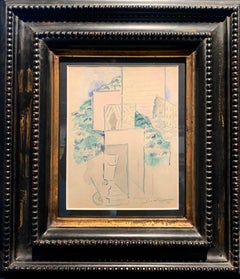
$7,601 Sale Price
20% Off
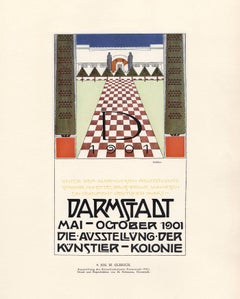
Ottokar Mascha Folio, plate 9: "Darmstadt Poster"by Joseph Maria Olbricht
By Joseph Maria Olbrich
Located in Palm Beach, FL
After JOSEPH MARIA OLBRICHT (1867-1908) DARMSTADT POSTER, 1901, (In Mascha, no. 9) One of the founding members of the Vienna Secession and a highly esteemed architect, Olbricht was c...
Category
Vienna Secession 1910s Art
Materials
Lithograph
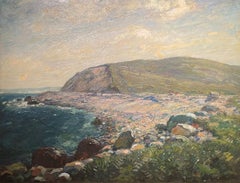
"Stony Cove and Headland, " Henry Ward Ranger, Coastal Landscape, Seascape
Located in New York, NY
Henry Ward Ranger (1858 - 1915)
Stony Cove and Headland, 1910
Oil on canvas
28 x 36 inches
Signed lower right
Provenance:
McDonough Gallery, New York
William Macbeth Galleries, New York
American Art Association, The Completed Pictures Left by the Late Henry Ward Ranger, 1917, Lot 72
A key person in the establishment of the Old Lyme, Connecticut art colony in 1899, Henry Ward Ranger is regarded as the leader of the Tonalist movement in America and was a leading painter in this country in the late 19th and early 20th-centuries.
He was born in Geneseo and raised in Syracuse, New York, and in 1873, enrolled in the College of Fine Arts at Syracuse University, where his father was a professor of photography and drawing. Two years later, he became a re-toucher of paintings in his father's studio and did not earn a college degree.
He also spent much time in New York City, where he was a writer of music criticism and visited galleries, where he had his first exposure to French Barbizon painting...
Category
American Impressionist 1910s Art
Materials
Canvas, Oil
Louis Valtat Mere Et Enfant Monumental Oil Painting
By Louis Valtat
Located in Dallas, TX
Louis Valtat (French, 1869-1952) Fauvist Oil painting of a mother and child.
A very large painting by Louis Valtat titled Mere et Enfant (Mother and C...
Category
Fauvist 1910s Art
Materials
Canvas, Oil
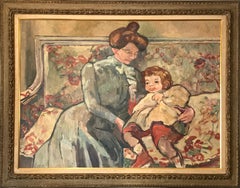
Figure with Guitar II
By Henry Fitch Taylor
Located in Bryn Mawr, PA
Provenance
Noah Goldowsky Gallery, New York;
Collection of Jeptha H. Wade and Emily Vanderbilt Wade, Boston, until 2025
Exhibitions
Cleveland Museum of Art, Art for Collectors, 1971...
Category
American Modern 1910s Art
Materials
Canvas, Oil
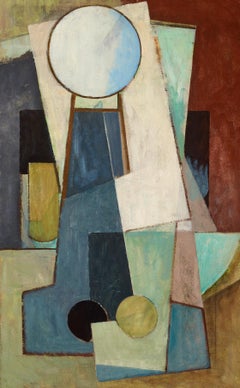
Warwick Castle - British art early 20th century painting river landscape autumn
By Henry Charles Brewer
Located in Hagley, England
A large, fresh and vibrant watercolour view of Warwick Castle which was painted in 1917. The view is captured in detail by Henry Charles Brewer RI who travelled widely and who exhib...
Category
Impressionist 1910s Art
Materials
Watercolor
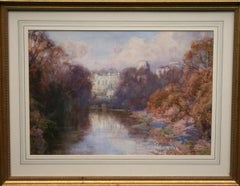
G. A. Rochegrosse (1859-1938) , Study for "Le Cocher" original drawing
Located in Paris, FR
Georges Antoine Rochegrosse (1859-1938)
Study for "Le Cocher"
carbon pencil on thin paper
14.5 x 13 cm
In good condition
Framed : 36.7 x 31 cm
Provenance: Estate of the artist and...
Category
Symbolist 1910s Art
Materials
Carbon Pencil
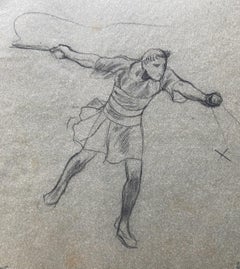
"Portland Harbor, Maine, " Alexander Bower, Snowy River Scene in Winter
Located in New York, NY
Alexander Bower (1875 - 1952)
Portland Harbor, Maine, 1910
Oil on canvas
27 x 33 inches
Signed and dated lower right
An American Impressionist, Alexande Bower was born in New York, studied at The Pennsylvania Academy of Fine Art, and was living with his wife in Cliff Island, Maine by 1914. Despite his urban upbringing, the coast and the sea fascinated Bower. A large portion of his paintings are seascapes, particularly scenes depicting the coast of Cape Elizabeth...
Category
Ashcan School 1910s Art
Materials
Canvas, Oil
$36,000 Sale Price
20% Off
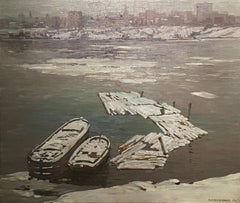
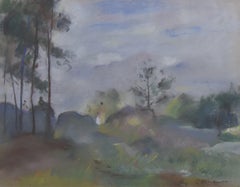
Henry Ottmann (1877-1927) A forest in the mist, pastel signed
Located in Paris, FR
Henry Ottmann (1877-1927)
"Orée du bois par brume", A forest in the mist
signed lower right
pastel on paper
24 x 32 cm
In good condition
In a vintage frame : 43.5 x 53 cm The gilding on the frame is missing in many places
Henry Ottmann particularly excelled in the pastel technique, as can be seen here.
This is due to the fact that this delicate material obviously lends itself very well to the artist's characteristic vaporous style and manner.
We should also note the great modernity of this landscape and its fades, which go almost as far as abstraction.
Henry Ottmann was born on 10 April 1877 in Ancenis.
He made his debut at the Salon La Libre Esthétique in Brussels in 1904 and took part in the Salon des Indépendants in Paris from 1905, the Salon d'Automne, the Salon de la Société Nationale des Beaux-Arts and the Salon des Tuileries.
In 1911 and 1912, Ottmann exhibited at the Artistes de la Société Moderne at the Gallery Paul Durand-Ruel together with Armand Guillaumin, Henri Lebasque and others. In 1912, he exhibited at the gallery Eugène Druet.
In 1920, Ottmann exhibited at the gallery Marcel...
Category
Post-Impressionist 1910s Art
Materials
Pastel
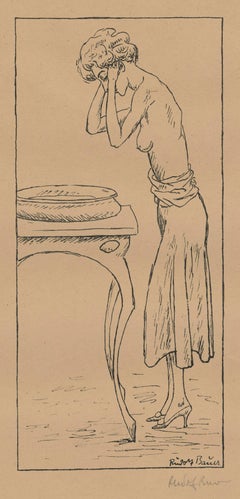
untitled (Young Woman Washing)
By Rudolf Bauer
Located in Fairlawn, OH
untitled (Young Woman Washing)
Lithograph, c. 1910
Signed in pencil lower right; signed in the plate lower right (see photo)
Image size: 11 x 5-1/8"
Sheet size: 18 7/8 x 12 5/8 inches
Condition: Very good
Aging to the tan paper it is printed on
Provenance: Estate of the Artist
Borghi & Company, NYC
Rudolph Bauer
1889-1953
Rudolf Bauer was born in Lindenwald near Bromberg, Silesia, in 1889 but his family moved only a few years later to Berlin. In 1905 Bauer began his studies at the Berlin Academy of Art but left the Academy only a few months later to educate himself. The upshot was paintings, caricatures and comical drawings which were published in 'Berliner Tageblatt', 'Ulk' and 'Le Figaro'.
From 1912 Bauer contributed to the magazine and Gallery 'Der Sturm' founded by Herwarth Walden and pivotal to German Expressionism and the international avant-garde. In 1915 Rudolf Bauer participated for the first time in a group show at Walden's gallery. There he met Hilla von Rebay, with whom he began a relationship of many years that was crucial to Bauer's later work. By 1922 Bauer had shown work at about eight exhibitions mounted by 'Der Sturm'. From 1918 he also taught at the 'Der Sturm' art school, where Georg Muche was the director. After the war ended, Bauer was a founding member of the 'November Group' although he did not collaborate closely with the group. In 1919 Bauer joined forces with the painter and architect Otto Nebel and with Hilla von Rebay to found the artists' association 'Die Krater'. Impressionist at the outset, Bauer's early work reveals Cubist and Expressionist influences. By 1915/16 Bauer had switched to an abstract pictorial idiom, which is markedly influenced by Kandinsky. In the early 1920s Bauer was also preoccupied with Russian Constructivism as well as the Dutch de Stijl group. Bauer's decided preference for non-representational painting culminated in 1929 with the foundation of a private museum, 'Das Geistreich', which he directed as a salon for abstract art.
Political developments in Germany forced Bauer to sell some of his work in America from 1932. His agent in America was Hilla von Rebay, who was by now director of the Guggenheim Collection. In 1936 she organized a touring exhibition of non-representational European art that included sixty Rudolf Bauer oil...
Category
Jugendstil 1910s Art
Materials
Lithograph
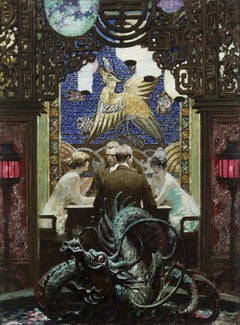
The Den of Iniquity, The Valley of the Giants, Red Book Magazine Illustration
Located in Fort Washington, PA
Story illustration for "The Valley of the Giants," by Peter B. Kyne, published in The Red Book Magazine, June 1918, vol. 31, issue 2, pages 30-39
Kyne's tale was first serialized in...
Category
1910s Art
Materials
Oil, Canvas
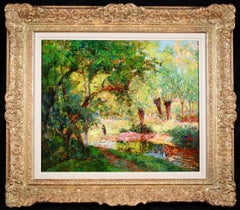
Promenade Estivale - Post Impressionist Landscape Oil by Victor Charreton
Located in Marlow, Buckinghamshire
Signed figure in landscape oil on board circa 1910 by French Post-Impressionist painter Victor Charreton. The piece depicts a lone figure taking a walk beside a stream in a wooded ar...
Category
Post-Impressionist 1910s Art
Materials
Oil, Board
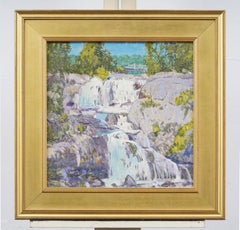
EXHIBITED American Impressionist OLD LYME Connecticut Triple Falls Oil Painting
Located in New York, NY
Carl Lawless (1894-1963)
Circa 1915-1920
Signed lower left
Oil on Canvas
17x17 inches image size
21x21 inches with frame
Good Condition
A beautiful American Impressionist Painting b...
Category
American Impressionist 1910s Art
Materials
Oil
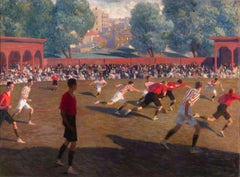
Football by Fedor Ivanovich Zakharov
By Fedor Zakharov (b.1882)
Located in New Orleans, LA
Signed in Cyrillic "F. Zakharov" (lower right) and signed again and inscribed "Fedor Zakharov/Football" (on reverse)
Oil on card laid down on panel
Undoubtedly, football, or socc...
Category
1910s Art
Materials
Oil, Panel, Cardboard
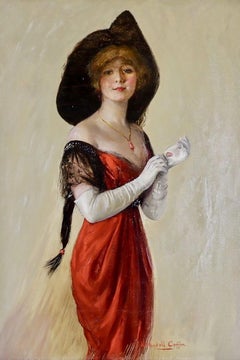
Collier
s Magazine Cover
Located in Fort Washington, PA
Medium: Oil Painting
Signature: Signed Lower Right
Collier's Magazine Cover, February 7 1914
Category
1910s Art
Materials
Oil
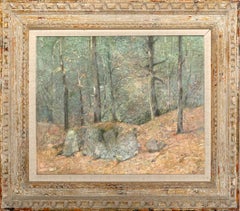
Monochromatic Delicate Impressionist Landscape " A Forest Scene"
By Emil Carlsen
Located in Miami, FL
Danish-American artist Søren Emil Carlsen paints a post-impressionist landscape that blurs the line between representation and abstraction. With its open composition, the artist capt...
Category
Post-Impressionist 1910s Art
Materials
Canvas, Oil
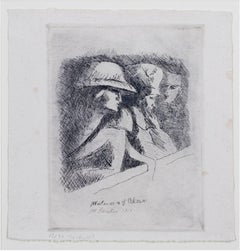
"Matinee a l
Odeon, " Original Etching signed by Maurice Asselin
Located in Milwaukee, WI
"Matinee a l'Odeon" is an original etching by Maurice Asselin. The artist signed and titled the print below the image. This piece is edition 13/30 and depicts three figures watching ...
Category
Post-Impressionist 1910s Art
Materials
Etching
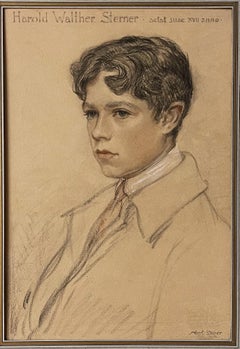
PORTRAIT OF HAROLD STERNER
Located in Portland, ME
Sterner, Albert (American. 1863-1946). PORTRAIT OF HAROLD STERNER. Charcoal and pastel on paper, not dated, but 1912, as the subject is stated to be aged 17. Signed, lower right. 16 1/2 x 11 1/4 inches, framed to 26 1/8 x 20 1/8 inches. In very good condition.
Albert Sterner was born in England, and studied in Paris. He worked as a magazine illustrator, but is best known for his paintings and prints.
Harold Sterner (American, 1895-1976). Architect, painter; New York, N.Y. Born 1895, died 1976...
Category
1910s Art
Materials
Charcoal, Pastel
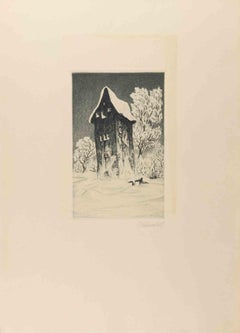
In Schnee - Etching by Fritz Schwimbeck - 1918
Located in Roma, IT
Etching realized by Fritz Schwimbeck in 1918.
Edition of 125 realized in Munich on mulberry paper.
Hand signed in pencil.
Category
Symbolist 1910s Art
Materials
Etching
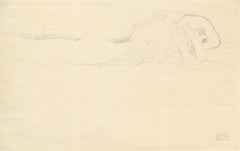
Gustav Klimt "2nd Study for Water Serpents" collotype from Funfundzwanzig folio
By Gustav Klimt
Located in Palm Beach, FL
Title page numbered: 263/450
Category
Vienna Secession 1910s Art
Materials
Paper
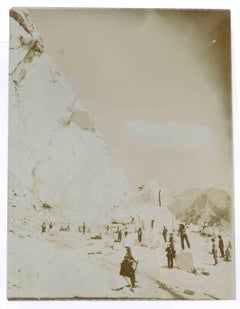
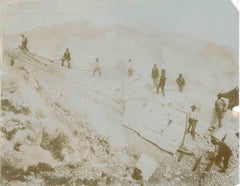
Transportation of Marble Blocks - Vintage Photo - 1910s
Located in Roma, IT
Transportation of Marble Blocks is a Silver Salt print realized in the 1910s.
From Alinari archive.
Good conditions and aged.
Category
Modern 1910s Art
Materials
Photographic Paper
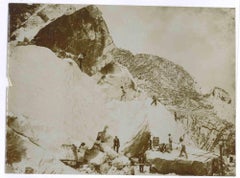
Extraction of Marble Blocks - Vintage Photo - 1910s
Located in Roma, IT
Extraction of Marble Blocks is a Silver Salt print realized in the 1910s.
From Alinari archive.
Good conditions and aged.
Category
Modern 1910s Art
Materials
Photographic Paper
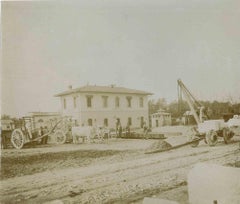
Transportation of Marble Blocks - Vintage Photo - 1910s
Located in Roma, IT
Transportation of Marble Blocks is a Silver Salt print realized in the 1910s.
From Alinari archive.
Good conditions and aged.
Category
Modern 1910s Art
Materials
Photographic Paper

Transportation of Marble Blocks - Vintage Photo - 1910s
Located in Roma, IT
Transportation of Marble Blocks is a Silver Salt print realized in the 1910s.
From Alinari archive.
Good conditions and aged.
Category
Modern 1910s Art
Materials
Photographic Paper
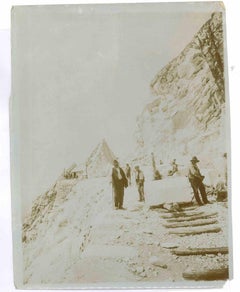
Transportation of Marble Blocks - Vintage Photo - 1910s
Located in Roma, IT
Transportation of Marble Blocks is a Silver Salt print realized in the 1910s.
From Alinari archive.
Good conditions and aged.
Category
Modern 1910s Art
Materials
Photographic Paper
Transportation of Marble Blocks - Vintage Photo - 1910s
Located in Roma, IT
Transportation of Marble Blocks is a Silver Salt print realized in the 1910s.
From Alinari archive.
Good conditions and aged.
Category
Modern 1910s Art
Materials
Photographic Paper

Transportation of Marble Blocks - Vintage Photo - 1910s
Located in Roma, IT
Transportation of Marble Blocks is a Silver Salt print realized in the 1910s.
From Alinari archive.
Good conditions and aged.
Category
Modern 1910s Art
Materials
Photographic Paper
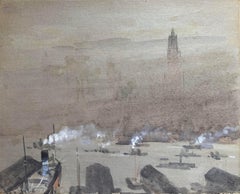
"View of Manhattan and the Woolworth Building" Joseph Pennell, New York Scene
Located in New York, NY
Joseph Pennell
View of Manhattan and the Woolworth Building, East River, circa 1915
Signed lower right
Watercolor with white bodycolor on paper
10 x 12 3/4 inches
Provenance
Arader ...
Category
Ashcan School 1910s Art
Materials
Paper, Watercolor
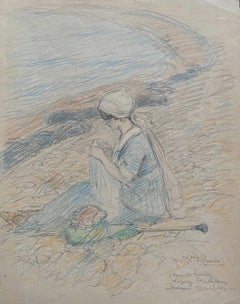
Lubin de Beauvais (1873-1917) L
Anse de Launay 1911, signed color drawing
Located in Paris, FR
Lubin de Beauvais (1873-1917)
L'anse de Launay, a woman at the beach, 1911
signed, dated and titled "Anse de Launay, Loguivy Ploubazlanec, Bretagne,...
Category
Impressionist 1910s Art
Materials
Pencil, Color Pencil
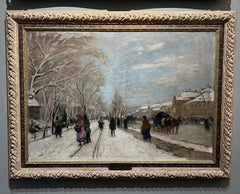
Winter Street Scene
Located in Houston, TX
Antal Berkes (1874-1938)
Antal Berkes (1874–1938) was a Hungarian painter, born in Budapest, Hungary. He lived in Paris for some time and produced cityscapes there as well as simi...
Category
Other Art Style 1910s Art
Materials
Oil
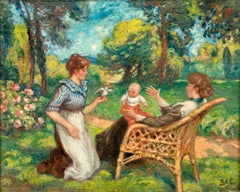
Au Jardin
Located in Mc Lean, VA
Elegant figures in a spring garden with mother and child. Colors are pure and fresh. Has everything that one would want in a D'espagnat . A top 2 % work by this artist .. Signed ...
Category
1910s Art
Materials
Oil
$118,000