1910s Art
to
308
1,086
356
398
194
171
Overall Width
to
Overall Height
to
7,610
21,294
162,198
233,129
1,981
2,257
4,929
6,462
5,741
15,012
20,482
25,759
18,486
13,832
5,390
422
319
135
133
49
19
19
12
6
1
1,237
884
31
1,436
696
600
408
394
349
217
151
146
135
135
123
118
102
97
95
77
77
59
58
875
632
487
398
387
102
52
34
23
22
860
373
1,171
960
Period: 1910s
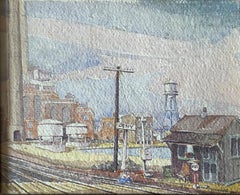
"Train Station, " Max Kuehne, Industrial City Scene, American Impressionism
By Max Kuehne
Located in New York, NY
Max Kuehne (1880 - 1968)
Train Station, circa 1910
Watercolor on paper
8 1/4 x 10 1/4 inches
Signed lower right
Provenance:
Private Collection, Illinois
Max Kuehne was born in Halle, Germany on November 7, 1880. During his adolescence the family immigrated to America and settled in Flushing, New York. As a young man, Max was active in rowing events, bicycle racing, swimming and sailing. After experimenting with various occupations, Kuehne decided to study art, which led him to William Merritt Chase's famous school in New York; he was trained by Chase himself, then by Kenneth Hayes Miller. Chase was at the peak of his career, and his portraits were especially in demand. Kuehne would have profited from Chase's invaluable lessons in technique, as well as his inspirational personality. Miller, only four years older than Kuehne, was another of the many artists to benefit from Chase's teachings. Even though Miller still would have been under the spell of Chase upon Kuehne's arrival, he was already experimenting with an aestheticism that went beyond Chase's realism and virtuosity of the brush. Later Miller developed a style dependent upon volumetric figures that recall Italian Renaissance prototypes.
Kuehne moved from Miller to Robert Henri in 1909. Rockwell Kent, who also studied under Chase, Miller, and Henri, expressed what he felt were their respective contributions: "As Chase had taught us to use our eyes, and Henri to enlist our hearts, Miller called on us to use our heads." (Rockwell Kent, It's Me O Lord: The Autobiography of Rockwell Kent. New York: Dodd, Mead and Co., 1955, p. 83). Henri prompted Kuehne to search out the unvarnished realities of urban living; a notable portion of Henri's stylistic formula was incorporated into his work.
Having received such a thorough foundation in art, Kuehne spent a year in Europe's major art museums to study techniques of the old masters. His son Richard named Ernest Lawson as one of Max Kuehne's European traveling companions. In 1911 Kuehne moved to New York where he maintained a studio and painted everyday scenes around him, using the rather Manet-like, dark palette of Henri.
A trip to Gloucester during the following summer engendered a brighter palette. In the words of Gallatin (1924, p. 60), during that summer Kuehne "executed some of his most successful pictures, paintings full of sunlight . . . revealing the fact that he was becoming a colorist of considerable distinction." Kuehne was away in England the year of the Armory Show (1913), where he worked on powerful, painterly seascapes on the rocky shores of Cornwall. Possibly inspired by Henri - who had discovered Madrid in 1900 then took classes there in 1906, 1908 and 1912 - Kuehne visited Spain in 1914; in all, he would spend three years there, maintaining a studio in Granada. He developed his own impressionism and a greater simplicity while in Spain, under the influence of the brilliant Mediterranean light. George Bellows convinced Kuehne to spend the summer of 1919 in Rockport, Maine (near Camden). The influence of Bellows was more than casual; he would have intensified Kuehne's commitment to paint life "in the raw" around him.
After another brief trip to Spain in 1920, Kuehne went to the other Rockport (Cape Ann, Massachusetts) where he was accepted as a member of the vigorous art colony, spearheaded by Aldro T. Hibbard. Rockport's picturesque ambiance fulfilled the needs of an artist-sailor: as a writer in the Gloucester Daily Times explained, "Max Kuehne came to Rockport to paint, but he stayed to sail." The 1920s was a boom decade for Cape Ann, as it was for the rest of the nation. Kuehne's studio in Rockport was formerly occupied by Jonas Lie.
Kuehne spent the summer of 1923 in Paris, where in July, André Breton started a brawl as the curtain went up on a play by his rival Tristan Tzara; the event signified the demise of the Dada movement. Kuehne could not relate to this avant-garde art but was apparently influenced by more traditional painters — the Fauves, Nabis, and painters such as Bonnard. Gallatin perceived a looser handling and more brilliant color in the pictures Kuehne brought back to the States in the fall. In 1926, Kuehne won the First Honorable Mention at the Carnegie Institute, and he re-exhibited there, for example, in 1937 (Before the Wind). Besides painting, Kuehne did sculpture, decorative screens, and furniture work with carved and gilded molding. In addition, he designed and carved his own frames, and John Taylor Adams encouraged Kuehne to execute etchings. Through his talents in all these media he was able to survive the Depression, and during the 1940s and 1950s these activities almost eclipsed his easel painting. In later years, Kuehne's landscapes and still-lifes show the influence of Cézanne and Bonnard, and his style changed radically.
Max Kuehne died in 1968. He exhibited his work at the National Academy of Design, the Art Institute of Chicago, the Carnegie Institute in Pittsburgh, the Memorial Art Gallery of the University of Rochester, and in various New York City galleries. Kuehne's works are in the following public collections: the Detroit Institute of Arts (Marine Headland), the Whitney Museum (Diamond Hill...
Category
American Impressionist 1910s Art
Materials
Paper, Watercolor
Original
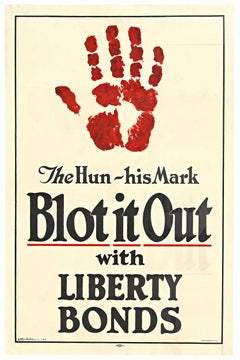
Blot it Out The Hun - his Mark
vintage 1918 WW1 postter
Located in Spokane, WA
Original The Hun ~ his Mark, Blot it Out with Liberty Bonds vintage American World War One poster. Archivail linen backed in mint condition, ready to frame. The images shown are...
Category
American Modern 1910s Art
Materials
Lithograph
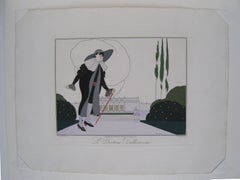
Le Docteur Ballanzone
Located in New York, NY
Pochoir Colored Plate for Journal Des Dames et Des Modes. Engraved by H. Reidel on wove paper. 15 x 19.5". 1914
Pochoir is a process where the plate is first stenciled and then ha...
Category
Art Deco 1910s Art
Materials
Engraving, Color
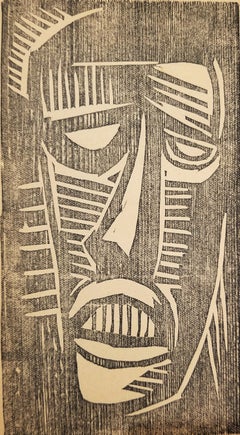
Männlicher Kopf von vorn (Male Head from the Front) /// German Expressionism
Located in Saint Augustine, FL
Artist: Karl Schmidt-Rottluff (German, 1884-1976)
Title: "Männlicher Kopf von vorn (Male Head from the Front)"
Portfolio: Das Spiel Christa vom Schmerz der Schönheit des Weibes (The Play Christa from the Pain of the Beauty of the Woman)
*Issued unsigned
Year: 1918
Medium: Original Woodcut Engraving on wove paper
Limited edition: Unknown
Printer: Fritz Voigt, Berlin, Germany
Publisher: Verlag Die Aktion, Berlin, Germany
Reference: Schapire No. 226, page 46; Jentsch No. 35. Rifkind No. 2563; Lang No. 300; Reed No. 118
Overall size with attached page: 8.5" x 10.63"
Sheet size: 8.5" x 5.38"
Image size: 6.38" x 3.5"
Condition: Toning to sheet (as normal). In very good condition
Very rare
Notes:
Provenance: private collection - Oxnard, CA. Comes from a complete originally bound 48 page folio with 9 original woodcut engravings by Schmidt-Rottluff. Text by Alfred Brust. Presently attached to its accompanying page. The cover and title pages in pictures are not included, only for reference/provenance. There is an example of this work in the permanent collection of the Brücke Museum, Berlin, Germany.
Biography:
Karl Schmidt-Rottluff (born December 1, 1884, Rottluff, near Chemnitz, Germany—died...
Category
Expressionist 1910s Art
Materials
Engraving, Woodcut
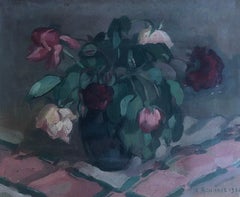
Bouquet of wilted roses
Located in Genève, GE
Work on canvas
Golden wooden frame
39 x 47 x 3 cm
Category
1910s Art
Materials
Oil
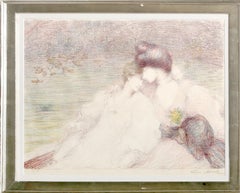
Two Women in Boat, Signed Impressionist Lithograph by Louis Marie Joseph Ridel
Located in Long Island City, NY
Louis Ridel, born February 12, 1866 in Vannes and died November 10, 1937 in Paris, is a painter, sculptor, medalist, French decorator. Louis Ridel studied at the Académie Julian then under the direction of Gustave Moreau at the Ecole des Beaux-Arts in Paris in 1889 (with Matisse, Camoin, Marquet and Rouault). He exhibited at the Salon des Artistes Français between 1893 and 1935, at the Salon des Tuileries between 1927 and 1934, the Universal Exhibition of Ghent in 1913 and the famous Georges Petit Gallery (1909-1910). The works of the artist are present in the museums of Nantes, Strasbourg, Pont-Aven but also Tokyo, Buenos Aires and Rio de Janeiro. This symbolist painter, friend of Aman-Jean, Maxence and Albert Besnard, represented essentially women of the bourgeoisie, ethereal and diaphanous or landscapes of his native region, Brittany. In 1896, he received an honorable mention from the Salon des artistes français, then a third class medal in 1898 and second class in 1900. In 1901, he was out of competition. In 1909, he was named Knight of the Legion of Honor. He receives official orders for the Senate, the Ministry of Public Works or the mayor of the 12th arrondissement of Paris.
Two Women in Boat...
Category
Post-Impressionist 1910s Art
Materials
Lithograph
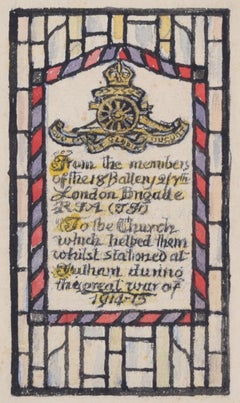
St Etheldreda
s Fulham WW1 commemorative window design by Reginald Hallward
Located in London, GB
To see more, scroll down to "More from this Seller" and below it click on "See all from this Seller."
Reginald Hallward (1858 - 1948)
Stained glass window design for St Etheldreda'...
Category
1910s Art
Materials
Pencil, Gouache
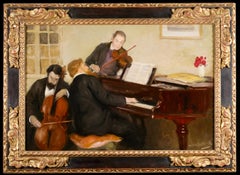
Les Trois Musiciens - Impressionist Figurartive Oil by Henry Caro Delvaille
By Henry Caro-Delvaille
Located in Marlow, Buckinghamshire
Signed figures in interior oil on panel circa 1915 by French impressionist painter Henry Caro Delvaille. The work depicts three musicians - one man seated playing a piano, another st...
Category
Impressionist 1910s Art
Materials
Oil, Panel
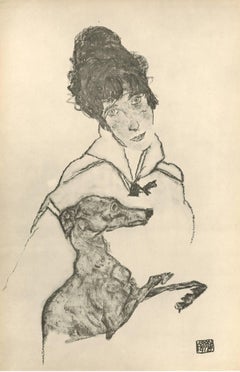
R. Layni, Zeichnungen folio, "Woman with Greyhound" Collotype plate III
Located in Palm Beach, FL
Egon Schiele (1890 – 1918), AUSTRIA
“ART CANNOT BE MODERN, ART IS PRIMORDIALLY ETERNAL.” -SCHIELE
Defiantly iconoclastic in life and art, Egon Schiele is esteemed for his masterful...
Category
Vienna Secession 1910s Art
Materials
Paper
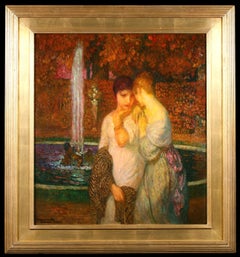
Le Secret - Art Nouveau Figures in Landscape Oil Painting by Michel Simonidy
Located in Marlow, Buckinghamshire
Signed and dated Art Nouveau oil on board figures in landscape by Romanian painter Michel Simonidy. The piece depicts an autumnal scene with two women standing beside a fountain at n...
Category
Art Nouveau 1910s Art
Materials
Oil, Board
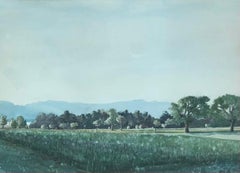
Landscape
Located in Genève, GE
Work on paper
Golden wooden frame with glass pane
58 x 72 x 3.5 cm
Category
Modern 1910s Art
Materials
Watercolor
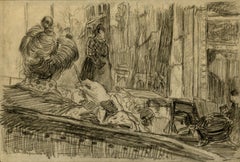
Loge de Theatre (Preliminary study for a painting)
Located in Fairlawn, OH
Loge de Theatre (Preliminary study for a painting)
Graphite on paper
Signed in pencil lower left
Annotated with color notations by the artist (see photo)
A early Parisian theme work ...
Category
Impressionist 1910s Art
Materials
Graphite
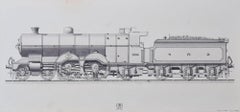
Steam Loco Large Atlantic C1 Great Northern Railway 1910 drawing by Leslie Carr
By Leslie Carr
Located in London, GB
To see more, scroll down to "More from this Seller" and below it click on "See all from this Seller."
Leslie Carr (1891 - 1969)
"Large Atlantic" 1440 Great Northern Railway...
Category
1910s Art
Materials
Ink, Pen
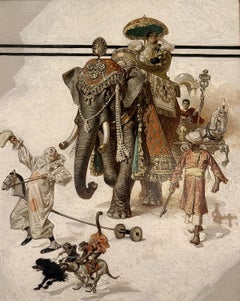
Raj Circus Fantasy, Original cover illustration for The Saturday Evening Post
Located in Fort Washington, PA
Original magazine cover illustration for the June 17, 1916 issue of The Saturday Evening Post.
The image features a celebratory procession including an elephant, monkeys, clowns, a...
Category
1910s Art
Materials
Oil, Canvas
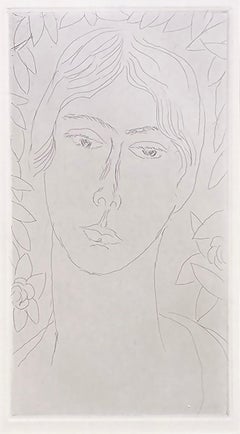
"Mlle Landsberg" (grade planche, pl. 16)
Located in Missouri, MO
"Mlle Landsberg" (grade planche, pl. 16), 1914
Henri Matisse (French, 1869-1954)
Signed and Numbered Lower Right
Edition 12/15
Image size: 7 7/8 x 4 5/16 inches
Sheet size: 17 11/16 x 12 1/2 inches
With frame: 19 1/2 x 14 1/2 inches
Henri Matisse came from a family who were of Flemish origin and lived near the Belgian border. At eight o'clock on the evening of December 31, 1869, he was born in his grandparents' home in the town of Le Cateau in the cheerless far north of France. His father was a self-made seed merchant who was a mixture of determination and tightly coiled tension.
Henri had no clear idea of what he wanted to do with his life. He was a twenty-year-old law clerk convalescing from appendicitis when he first began to paint, using a box of colors given to him by his mother. Little more than a year later, in 1890, he had abandoned law and was studying art in Paris. The classes consisted of drawing from plaster casts and nude models and of copying paintings in the Louvre. He soon rebelled against the school's conservative atmosphere; he replaced the dark tones of his earliest works with brighter colors that reflected his awareness of Impressionism. Matisse was also a violinist; he took an odd pride in the notion that if his painting eye failed, he could support his family by fiddling on the streets of Paris.
Henri found a girlfriend while studying art, and he fathered a daughter, Marguerite, by her in 1894. In 1898 he married another woman, Amelie Parayre. She adopted the beloved Marguerite; they eventually had two sons, Jean, a sculptor and Pierre who became an eminent art dealer. Relations between Matisse and his wife were often strained. He often dallied with other women, and they finally separated in 1939 over a model who had been hired as a companion for Mme. Matisse. She was Madame Lydia, and after Mme. Matisse left, she remained with Matisse until he died.
Matisse spent the summer of 1905 working with Andre Derain in the small Mediterranean seaport of Collioure. They began using bright and dissonant colors. When they and their colleagues exhibited together, they caused a sensation. The critics and the public considered their paintings to be so crude and so roughly crafted that the group became known as Les Fauves (the wild beasts).
By 1907, Matisse moved on from the concerns of Fauvism and turned his attention to studies of the human figure. He had begun to sculpt a few years earlier. In 1910, when he saw an exhibition of Islamic art, he was fascinated with the multiple patterned areas and adapted the decorative universe of the miniatures to his interiors. As a continuation of his interest in the "exotic", Matisse made extended trips to Morocco in 1912 and 1913.
At the end of 1917, Matisse moved to Nice; he would spend part of each year there for the remainder of his life. A meticulous dandy, he wore a light tweed jacket amd a tie when he painted. He never used a palette, but instead squeezed his colors on to plain white kitchen dishes...
Category
Fauvist 1910s Art
Materials
Drypoint, Etching
“Linnet stood gazing over the garden.” Story illustration for Hearst’
By Clarence F. Underwood
Located in Fort Washington, PA
Story illustration for “A Lady in Distress” by George Randolph Chester and Lillian Chester for Hearst’s magazine, published August 1917, page 121.
The full caption reads: “As Linn...
Category
1910s Art
Materials
Oil
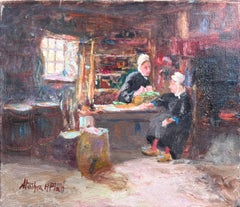
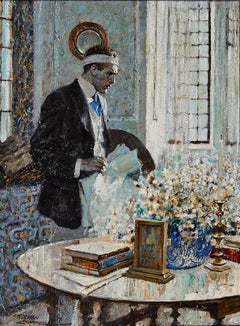
"The Conversation, France" Alethea Hill Platt, American Artist, Interior Scene
Located in New York, NY
Althea Platt
The Conversation, France, circa 1915
Signed lower left
Oil on canvas
8 x 10 inches
Alethea Hill Platt was an American artist and educator. Her paintings of rural lands...
Category
American Impressionist 1910s Art
Materials
Canvas, Oil
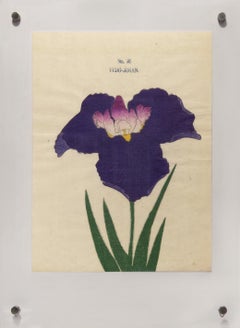
Iris Kaempferi: No.36 YEDO-JIMAN
Located in London, London
Iris Kaempferi: No. 36 YEDO-JIMAN
Tokyo, Yoshinoen-Garden, circa 1910.
Hand-coloured woodblock print on handmade rice paper, numbered and captioned at top, outlined in ink. Framed ...
Category
Naturalistic 1910s Art
Materials
Wood, Watercolor, Rice Paper
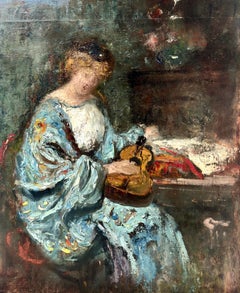
Woman in Blue with Mandolin
By Jacques Martin
Located in Paris, Île-de-France
Jacques MARTIN (Villeurbanne 1844 - Lyon 1919)
Woman in Blue with Mandolin, circa 1915
Oil on canvas
73 × 59 cm
Workshop sale stamp on the reverse.
Unsigned
Provenance
• Workshop...
Category
Modern 1910s Art
Materials
Canvas, Oil
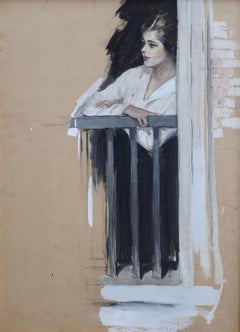
"I
m Sorry to Bother You About Our Bills..." Saturday Evening Post Illustration
Located in Fort Washington, PA
Date: 1918
Medium: Oil on Mounted Canvas
Signature: Signed Lower Left
Dimensions: 24.70" x 18.20"
Illustration from “The Fire Flinger’s” written by William J. Neidig, featured ...
Category
1910s Art
Materials
Canvas, Oil
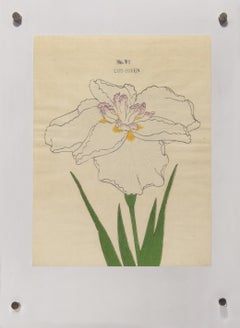
Iris Kaempferi: No. 91 CHO-HIYEN
Located in London, London
Iris Kaempferi: No. 91 CHO-HIYEN
Tokyo, Yoshinoen-Garden, circa 1910.
Hand-coloured woodblock print on handmade rice paper, numbered and captioned at top, outlined in ink. Framed in...
Category
Naturalistic 1910s Art
Materials
Watercolor, Rice Paper
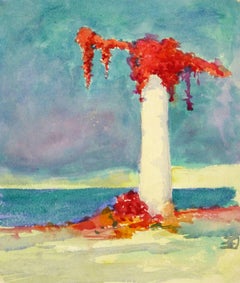
Vintage French Watercolor - Red Vines
Located in Houston, TX
Eye catching watercolor of bright flowering vines covering a towering column along the serene Riviera, circa 1920.
Original one-of-a-kind artwork on paper displayed on a white mat ...
Category
1910s Art
Materials
Paper, Watercolor
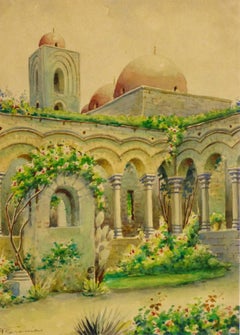
Vintage Italian Landscape - Ornate Courtyard
Located in Houston, TX
Exquisite and highly skilled watercolor of an elaborate Italian courtyard accented with radiant foliage and flowers by Flaromia, circa 1920. Signed lower left.
Original one-of-a-ki...
Category
1910s Art
Materials
Paper, Watercolor
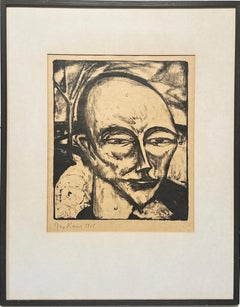
Expressionist Portrait, Lithograph, German"Männerkopf, Mongolischer Kopf", 1918
By Max Kaus
Located in Eltville am Rhein, DE
Max Kaus
Berlin 1891 - 1977
Male Head (Mongolian Head), 1918
Lithograph
Signed in pencil and dated "1918" lower left
Dry stamp "DIE SCHAFFENDEN" on the lower left margin
From an ed...
Category
Expressionist 1910s Art
Materials
Lithograph
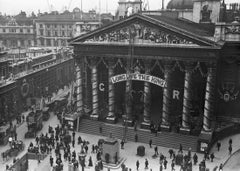
"Long Live The King" by Hulton Archive
Located in London, GB
"Long Live The King" by Hulton Archive
21st June 1911: Workmen putting up decorations at the Royal Exchange to celebrate the Coronation of King George ...
Category
Modern 1910s Art
Materials
Black and White
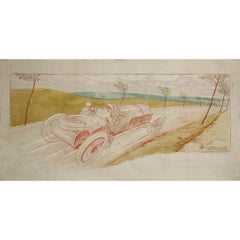
1913 original poster by Ernest Montaut - Grand prix de l
A.C.F. Nazzaro - Fiat
Located in PARIS, FR
This elegant 1913 original poster by Ernest Montaut, celebrating Felice Nazzaro’s victory at the Grand Prix de l’Automobile Club de France in a FIAT, is a remarkable example of the e...
Category
1910s Art
Materials
Paper, Lithograph
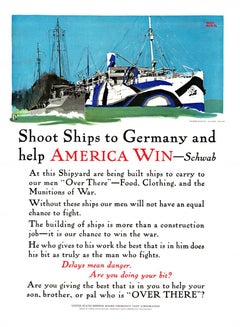
Original "Shoot Ships to Germany and help America Win" vintage poster 1918
Located in Spokane, WA
Original poster: Shoot Ships to Germany. At this Shipyard are being built ships to carry to our men "Over There" -- Food, Clothing, and the Munitions of War.
Without these ships ou...
Category
American Modern 1910s Art
Materials
Lithograph
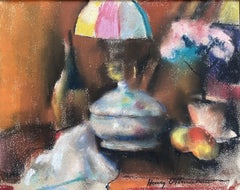
Henry Ottmann (1877-1927) A Still life with a lamp , pastel signed
Located in Paris, FR
Henry Ottmann (1877-1927)
A Still life with a lamp
signed lower right
pastel on paper
30 x 38 cm
Framed 45 x 53 cm
We knew that Henry Ottmann was a great pastelist, and he demons...
Category
Art Deco 1910s Art
Materials
Pastel
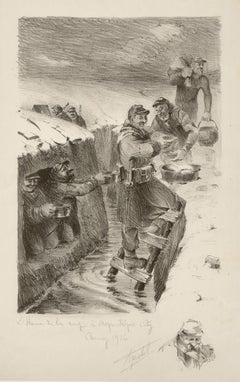
L
heure de la soupe a aquatique city, World War I lithograph by Truchet, 1914
Located in Melbourne, Victoria
Scene from the Western Front.
French lithograph signed and dated in pencil below the image.
Louis Abel-Truchet was a French painter, etcher and lithographer who studied art in Pa...
Category
Other Art Style 1910s Art
Materials
Lithograph
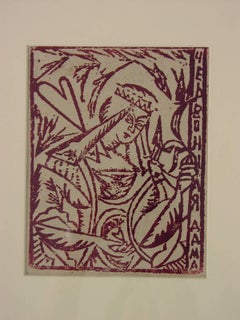
Transrational blog (The Queen of Hearts).
By Olga Rozanova
Located in New York, NY
Rozanova, Olga. Transrational blog (The Queen of Hearts).1915, Moscow
Red Linocut, on thin wove paper, from Zaumnaya gniga [Transrational boog] by A. ...
Category
Suprematist 1910s Art
Materials
Linocut
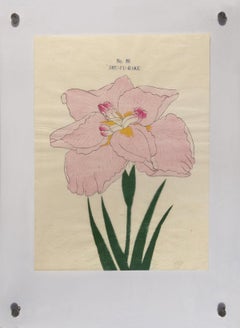
Iris Kaempferi: No. 58 SHU-FU-RAKU
Located in London, London
Iris Kaempferi: No. 58 SHU-FU-RAKU
Tokyo, Yoshinoen-Garden, circa 1910.
Hand-coloured woodblock print on handmade rice paper, numbered and captioned at top, outlined in ink. Framed...
Category
Naturalistic 1910s Art
Materials
Wood, Watercolor, Rice Paper
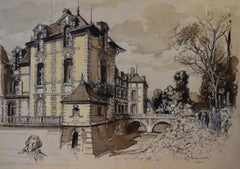
France early 20th century View of the Grosbois castle and head study, watercolor
Located in Paris, FR
French school early 20th century
View of the Grosbois castle and a portrait study.
Black ink, black ink wash and watercolor on paper
Signed lower right (indistinct, see photo)
27 x ...
Category
Academic 1910s Art
Materials
Watercolor, Ink, Carbon Pencil
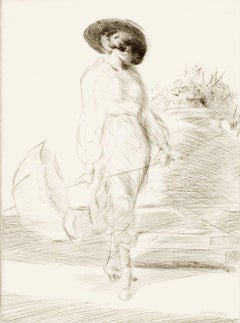
Summer
Located in Plano, TX
Summer. 1914. Drypoint. Appleby 46. 6 7/8 x 4 7/8 (sheet 11 5/8 x 9 3/16). Edition 77. A fine impression printed on cream wove paper on the full sheet with deckle edges. Signed in pe...
Category
Modern 1910s Art
Materials
Drypoint
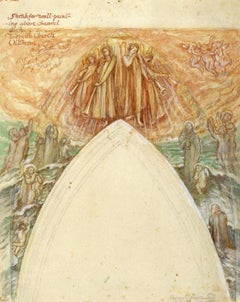
Reginald Hallward: Design: Church Interior Werneth Church Oldham Ecclesiastical
Located in London, GB
To see our other Architectural Drawings, Stained Glass designs and 20th Century British Art, scroll down to "More from this Seller" and below it click on "See all from this Seller."
...
Category
Modern 1910s Art
Materials
Pencil
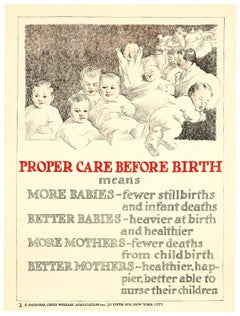
Original "Proper Care Before Birth" means More Babies vintage poster
Located in Spokane, WA
Original “Proper Care Before Birth” vintage poster.
Archival linen backed in excellent condition, ready to frame. Size 20.5” x 27”; circa 1917.
The Original "Proper Care Before Births" vintage poster is a rare find for collectors of World War 1 memorabilia...
Category
American Realist 1910s Art
Materials
Lithograph

$440 Sale Price
20% Off
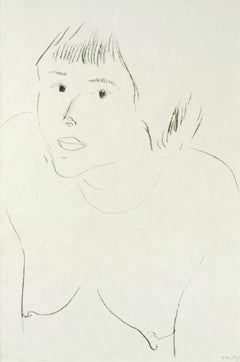
Les yeux noirs (The dark eyes)
Located in Fairlawn, OH
Les yeux noirs (The dark eyes)
Lithograph, 1913
Lacking the artist's signature in pencil as sited in Duthuit. We have found numerous other impressions of this image with the initials...
Category
French School 1910s Art
Materials
Lithograph
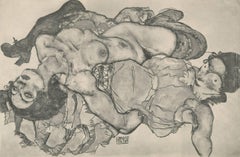
R. Layni, Zeichnungen folio, "Two Girls, Lying Entwined" Collotype plate VIII
Located in Palm Beach, FL
Egon Schiele (1890 – 1918), AUSTRIA
“ART CANNOT BE MODERN, ART IS PRIMORDIALLY ETERNAL.” -SCHIELE
Defiantly iconoclastic in life and art, Egon Schiele is esteemed for his masterful...
Category
Vienna Secession 1910s Art
Materials
Paper
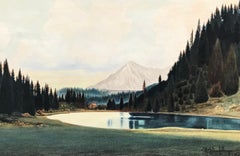
Mountain lake by Schaufelberger - Oil on paper 24x36 cm
Located in Geneva, CH
Work on cardboard
Category
Modern 1910s Art
Materials
Oil
$528 Sale Price
20% Off
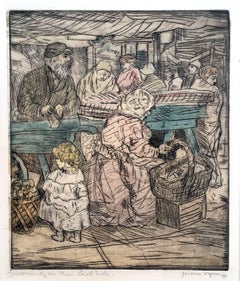
Morning on the East Side
By Jerome Myers
Located in New York, NY
Jerome Myers (1867-1940), Morning on the East Side, c. 1910, colored etching, signed in pencil lower right and annotated “imp.”; numbered and titled (twice) lower left. In very good ...
Category
1910s Art
Materials
Color, Etching
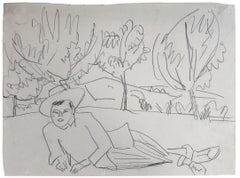
Reclining Young Man Liegender junger Mann - Drawing German Expressionism
Located in London, GB
This pencil drawing by the German artist Ernst Ludwig Kirchner is stamped at the lower left corner, verso with the artist's estate stamp (Lugt 1570b) and inscribed in black ink “B Dr...
Category
Expressionist 1910s Art
Materials
Paper, Pencil
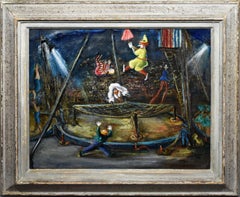
Antique American Ashcan School Modernist Circus Scene Signed PA Oil Painting
Located in Buffalo, NY
Antique American school modernist circus scene by Ann Taube Goodman (Born 1905). Oil on canvas, circa 1925.
Signed. Displayed in a modernist fra...
Category
Modern 1910s Art
Materials
Canvas, Oil
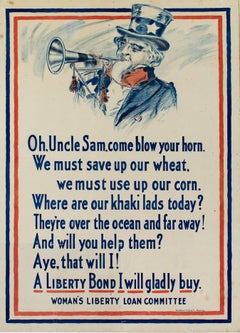
"World War I Poster - Uncle Sam, " Lithograph printed by Meisenheimer Milwaukee
Located in Milwaukee, WI
This World War I poster, featuring Uncle Sam, was printed by Meisenheimer-Milwaukee and was sponsored by the Woman's Liberty Loan Committee. The ar...
Category
Other Art Style 1910s Art
Materials
Lithograph
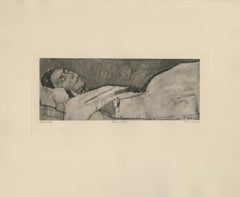
"Dying Woman" Copper Plate Heliogravure
Located in Palm Beach, FL
2018 marks the centenary anniversary of Ferdinand Hodler’s death. In that 100 years time, the art world’s esteem of this important artist has proved fickle. It has shifted from extol...
Category
Symbolist 1910s Art
Materials
Paper
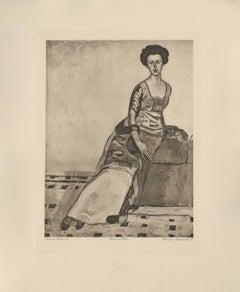
"Portrait of Mrs. Gertrude Miller" Copper Plate Heliogravure
Located in Palm Beach, FL
2018 marks the centenary anniversary of Ferdinand Hodler’s death. In that 100 years time, the art world’s esteem of this important artist has proved fickle. It has shifted from extolling his artistic merits during his lifetime to showing something of a feigned disdain- more reflective of the world political order than a true change of heart for Hodler’s work. After years of Hodler being all but a footnote in the annals of art history and generally ignored, finally, the pendulum has righted itself once again. Recent retrospective exhibitions in Europe and the United States have indicated not only a joyful rediscovery of Hodler’s art but a firm conviction that his work and world view hold particular relevance today. DAS WERK FERDINAND HODLERS is not only a collection of printed work reflecting the best of all of his painted work created up to 1914 just before the outbreak of World War I, the portfolio itself is an encapsulation of Hodler’s ethos, Parallelisme.
Hodler developed his philosophy of Parallelisme as a unifying approach to art which strips away detail in search of harmony. By means of abstraction, symmetry and repetition, Hodler sought ways to depict Nature’s essence and her fundamental, universal order. He believed these universal laws governing the natural, observable world extend to the spiritual realm. Symbolist in nature with Romantic undertones, his works are equally portraits of these universal concepts and feelings governing all life as they are a visual portrait in the formal sense. Whether his subject is a solitary tree, a moment in battle, mortal fear, despair, the awe inspired by a vast mountain range, a tender moment or even the collective conviction in a belief, Hodler unveils this guiding principle of Parallelisme.
Several aspects of Hodler’s portfolio reinforce his tenets of Parallelisme. The Table of Contents clearly preferences a harmonious design over detail. The two columns, consisting of twenty lines each, list the images by order of appearance using their German titles. The abbreviated titles are somewhat cryptic in that they obscure the identities of the sitters. Like the image Hodler presents, they are distillations of the sitter without any extraneous details. This shortening was also done in an effort to maintain a harmonious symmetry of the Table of Contents, themselves, and keep titles to a one-line limit. The twenty-fourth title: “Bildnis des Schweizerischen Gesandten C.” was so long, even with abbreviation, that it required two lines; so, for the sake of maintaining symmetry, the fortieth title: “Bauernmadchen” was omitted from the list. This explains why the images are not numbered. Hodler’s reasoning is not purely esoteric. Symmetry and pattern reach beyond mere formal design principles. Finding sameness and imposing it over disorder goes to the root of Hodler’s identity and his art. A Swiss native, Hodler was bi-lingual and spoke German and French. Each printed image, even number forty, have titles in both of Hodler’s languages. Certainly, there was a market for Hodler’s work among francophones and this inclusion may have been a polite gesture to that end; however, this is the only place in the portfolio which includes French. With German titles at the lower left of each image, Hodler’s name at bottom center and corresponding French titles at the lower right of each image, there is a harmony and symmetry woven into all aspects of the portfolio. This holds true for the page design, as it applies to each printed image and as it describes the Swiss artist himself. Seen in this light, Hodler’s portfolio of printed work is the epitome of Hodler’s Parallelisme. DAS WERK FERDINAND HODLERS is also one of the most significant documents to best tell the story of how Hodler, from Switzerland, became caught between political cross-hairs and how the changing tides of nations directly impacted the artist during his lifetime as well as the accessibility of his art for generations to come.
The Munich-based publisher of the portfolio, R. Piper & Co., Verlag, plays a crucial role in this story. Publishing on a wide range of subjects from philosophy and world religion to music, literature and the visual arts; the publisher’s breadth of inquiry within any one genre was equal in scope. Their marketing strategy to publish multiple works on Hodler offers great insight as to what a hot commodity Hodler was at that time. R.Piper & Co.’s Almanach, which they published in 1914 in commemoration of their first ten years in business, clearly illustrates the rapid succession- strategically calculated for achieving the deepest and broadest impact - in which they released three works on Hodler to hit the market by the close of 1914. DAS WERK FERDINAND HODLERS was their premier publication. It preceded C.A. Loosli’s Die Zeichnungen Ferdinand Hodlers, a print portfolio after 50 drawings by Hodler which was released in Autumn of 1914 at the mid-level price-point of 75-150 Marks; and a third less expensive collection of prints after original works by Hodler, which had not been included in either of the first two portfolios, was released at the end of that year entitled Ferdinand Hodler by Dr. Ewald Bender.
The title and timing of DAS WERK FERDINAND HODLERS' debut leaves little doubt as to the connection it has with another avant-garde portfolio of art prints, Das Werk Gustav Klimts, released in 5 installments from 1908 -1914 by Galerie Miethke in Vienna. Hodler, himself, was involved in Klimt’s ground-breaking project. As the owner of Klimt’s 1901 painting, “Judith with the Head of Holifernes” which appears as the ninth collotype print in the second installment of Das Werk Gustav Klimts, Hodler was obliged to grant access of the painting to the art printers in Vienna for them to create the collotype sometime before 1908. Hodler had been previously invited in 1904 to take part in what would be the last exhibition of the Vienna Secession before Klimt and others associated with Galerie Miethke broke away. In an interview that same year, Hodler indicated that he respected and was impressed by Klimt. Hodler’s esteem for Klimt went beyond the art itself; he emulated Klimt’s method aimed at increasing his market reach and appeal to a wider audience by creating a print portfolio of his painted work. By 1914, Hodler and his publisher had the benefit of hindsight to learn from Klimt’s Das Werk publication.
Responding to the sluggish sales of Klimt’s expensive endeavor, Hodler’s publisher devised the same diversified 1-2-3 strategy for selling Hodler’s Das Werk portfolio as they did with regards to all three works on Hodler they published that year. For their premium tier of DAS WERKS FERDINAND HODLERS, R. Piper & Co. issued an exclusive Museum quality edition of 15 examples on which Hodler signed each page. At a cost of 600 Marks, this was generally on par with Klimt’s asking price of 600 Kronen for his Das Werk portfolio. A middle-tiered Preferred edition of 30, costing somewhat less and with Hodler’s signature only on the Title Page, was also available. The General edition, targeting the largest audience with its much more affordable price of 150 Marks, is distinguishable by its smaller size.
Rather than use the subscription format Miethke had chosen for Klimt’s portfolios which proved to have had its challenges, R. Piper & Co. employed a different strategy. In addition to instantly gratifying the buyer with all 40 of the prints comprising DAS WERK FERDINAND HODLERS and the choice among three price points, they advertised in German journals a fourth possibility of ordering single prints from them directly. These printed images are easily discernible from the three complete folio editions. The paper size of the single purchased images is of the larger format like the Museum and Preferred editions, measuring 65 h x 50 w cm; however, the paper itself is the same copper print paper used in the General edition and then mounted on poster board. The publishing house positioned itself to be a direct retailer of Hodler’s art. They astutely recognized the potential for profitability and the importance, therefore, of having proprietary control over his graphic works.
R. Piper & Co. owned the exclusive printing rights to Hodler’s best work found in their three publications dating from 1914. That same year, a competing publication out of Weimar entitled Ferdinand Hodler: Ein Deutungsversuch von Hans Muhlestein appeared. Its author, a young scholar, expressed his frustration with the limited availability of printable work by Hodler. In his Author’s Note on page 19, dated Easter, 1914, Muhlestein confirms that the publisher of Hodler’s three works from that same year owned the exclusive reproductive rights to Hodler’s printed original work. He goes further to explain that even after offering to pay to use certain of those images in his book, the publisher refused. Clearly, a lot of jockeying for position in what was perceived as a hot market was occurring in 1914.
Instead, their timing couldn’t have been more ill-fated, and what began with such high hopes suddenly found a much different market amid a hostile climate. The onset of WWI directly impacted sales. Many, including Ferdinand Hodler, publicly protested the September invasion by Germany of France in which the Reims Cathedral, re-built in the 13th century, was shelled, destroying priceless stained glass and statuary and burning off the iron roof and badly damaging its wooden interior. Thomas Gaehtgens, Director of the Getty Research Institute describes how the bombing of Reims Cathedral triggered blindingly powerful and deeply-felt ultra-nationalistic responses: “The event profoundly shocked French intellectuals, who for the most part had an intense admiration for German literature, music and art. By relying on press accounts and abstracting from the visual propagandistic content, they were unable to interpret the siege of Reims without turning away from German culture in disgust. Similarly, the German intelligentsia and bourgeoisie were also shocked to find themselves described as vandals and barbarians. Ninety-three writers, scientists, university professors, and artists signed a protest, directed against the French insults, that defended the actions of the German army.”
In similar fashion, a flurry of open letters published in German newspapers and journals as well as telegrams and postcards sent directly to Hodler following his outcry in support of Reims reflected the collectively critical reaction to Hodler’s position. Loosli documents that among the list of telegrams Hodler received was one from none other than his publisher in Germany, R.Piper & Co. Allegiances were questioned. The market for Hodler in Germany immediately softened. Matters worsened for the publisher beyond the German backlash to Hodler and his loss of appeal in the home market; with the war in full swing until 1918, there was little chance a German publisher would have much interest coming from outside of Germany and Austria. Following the war and Hodler’s death in 1918, the economy in Germany continued to spiral out and just 5 years later, hyper-inflation had rendered its currency worthless vis-a-vis its value in the pre-war years. Like the economy, Hodler’s reputation was slow to find currency in these difficult times. Even many French art fans had turned sour on Hodler as they considered his long-standing relationship in German and Austrian art circles. Thus, the portfolio’s rarity in Hodler’s lifetime and, consequently, the availability of these printed images from DAS WERK FERDINAND HODLERS since his death has been scarce.
In many ways, Hodler and his portfolios were casualties of war. Thwarted from their intended purpose of reaching a wide audience and show-casing Parallelisme, Hodler’s unique approach to art, this important, undated work has been both elusive and shrouded in mystery. Perhaps DAS WERK FERDINAND HODLERS was left undated as a means of affirming the timelessness of Hodler’s art. Digging back into the past, Hodler’s contemporaries, like R. Piper, C.A. Loosli and Hans Muhlestein, indeed provide the keys to unequivocally clarify what has largely been mired in obscurity. Just after Hodler’s death, the May, 1918 issue of the Burlington Review ran a small column which opined hope for better access to R.Piper & Co.’s DAS WERK FERDINAND HODLERS; 100 years later, it is finally possible. Hodler’s voice rings out through these printed works. Once more, his modern approach to depicting portraits, landscapes and grand scale scenes of Swiss history speak to us of what is universal. Engaging with any one of these images is the chance to connect to Hodler’s vision and his world view- weltanschauung in German, vision du monde in French- however one expresses these concepts through language, its message embedded in his work is the same: “We differ from one another, but we are like each other even more. What unifies us is greater and more powerful than what divides us.” Today, Hodler’s art couldn’t be more timely.
FERDINAND HODLER (SWISS, 1853-1918) explored Parallelisme through figurative poses evocative of music, dance and ritual. His images of sex, night, desertion and death as well as his many landscapes exploring the universal longing for harmony with Nature are unique and important works embodying a Symbolist paradigm. Truly a Modern Master, Hodler’s influence can be felt in the work of Gustav Klimt and Kolomon Moser...
Category
Symbolist 1910s Art
Materials
Paper
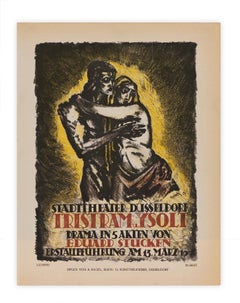
Tristram and Ysoli, Düsseldorf state-theatre, Expressionist stage lithograph
Located in Chicago, IL
Uzarski’s expressionist lithograph advertises a stage production of Tristram and Ysoli (Tristan and Isolde) at the Düsseldorf city-theatre in 1919. This example was published c. 1919...
Category
Expressionist 1910s Art
Materials
Lithograph
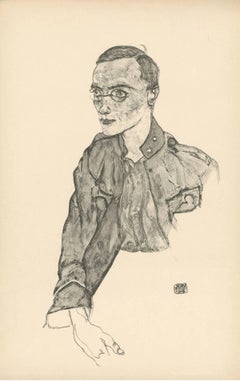
R. Layni, Zeichnungen folio, "One-Year-Volunteer Private" Collotype plate V
Located in Palm Beach, FL
Egon Schiele (1890 – 1918), AUSTRIA
“ART CANNOT BE MODERN, ART IS PRIMORDIALLY ETERNAL.” -SCHIELE
Defiantly iconoclastic in life and art, Egon Schiele is esteemed for his masterful...
Category
Vienna Secession 1910s Art
Materials
Paper
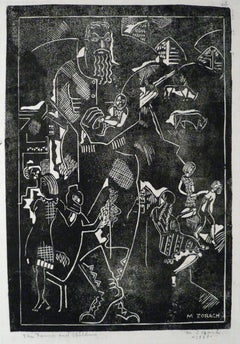
THE FARMER AND CHILDREN (A NEW ENGLAND FAMILY, or THE FATHER).
Located in Portland, ME
Zorach, Marguerite. THE FARMER AND CHILDREN (also titled A NEW ENGLAND FAMILY, or THE FATHER). Linoleum cut, circa 1917. Titled, Signed, and dated 1920 in pencil in the margin and si...
Category
1910s Art
Materials
Linocut
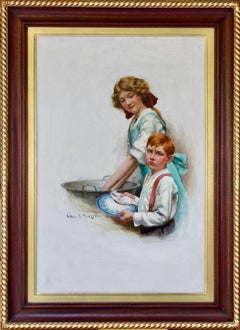
Boy Drying Dishes, The Saturday Evening Post cover
Located in Fort Washington, PA
Signed & Dated Lower Left by Artist
The Saturday Evening Post cover, October 18, 1913
Category
1910s Art
Materials
Oil
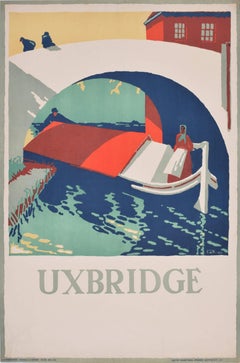
Uxbridge original vintage poster by Edward McKnight Kauffer
Located in London, GB
To see our other original vintage posters, scroll down to "More from this Seller" and below it click on "See all from this Seller" - or send us a message if you cannot find the poster you want.
Edward McKnight Kauffer (1890 - 1954)
Uxbridge (1919)
Original vintage poster
76 x 51 cm
Designed in 1919 and printed by the Dangerfield Printing Co...
Category
1910s Art
Materials
Lithograph
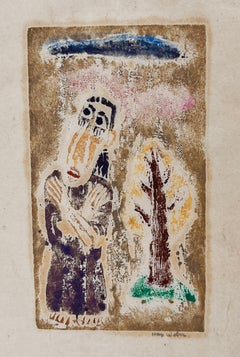
Invocation
By Max Weber
Located in New York, NY
M a x W e b e r – – 1 8 8 1 – 1 9 6 1
Invocation- – 1919-20, Color Woodcut.
Rubenstein 27. Proofs only. Signed in pencil.
Image size 3 3/4 x 2 1/8 inches (124 x 54 mm); sheet size ...
Category
Cubist 1910s Art
Materials
Woodcut
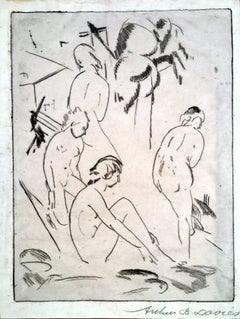
$13,500
Round of Summer (aka Four Figures), First State Proof
Located in New York, NY
Arthur B. Davies (1862-1928), Round of Summer (aka Four Figures), soft ground etching, 1919, signed in pencil lower right. Reference: Czestochowski 91, first state (of 3), trial proo...
Category
American Impressionist 1910s Art
Materials
Etching
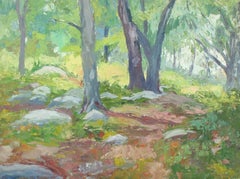
Forrest Interior
By John Rummell
Located in Buffalo, NY
An original antique American oil painting by John Rummell depicting a forest interior.
The stunning composition is highlighted by vibrant colors a thick imposto and lively brush s...
Category
American Impressionist 1910s Art
Materials
Board, Oil
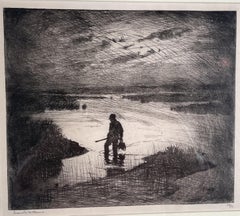
DUSK
By Frank W. Benson
Located in Portland, ME
Benson, Frank. DUSK. P.34. Etching on zinc, 1914. Edition of 50, signed and numbered 47/50 in pencil. 9 1/4 x 10 7/8 inches, plate, framed to 17 x 21 inches.
This atmospheric image, ...
Category
1910s Art
Materials
Etching
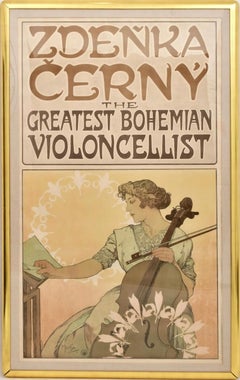
Alphonse Mucha Zdenka Cerny 1913 Lithograph (Rare and Large)
Located in Dallas, TX
Alphonse Mucha (Czech, 1860-1939) Original Lithograph 1913 - Very Large -
"Zdenka Cerny" The Greatest Bohemian Violincellist
Prague, Czechoslovak
Color lithograph
Signed and dated "...
Category
Art Nouveau 1910s Art
Materials
Ink, Archival Paper
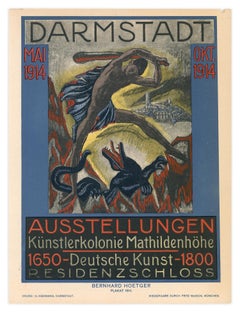
Fourth Darmstadt exhibition, Expressionist dragon poster, Bernhard Hoetger, 1914
By Bernhard Hoetger
Located in Chicago, IL
Bernhard Hoetger’s 1914 Expressionist poster for the Darmstadt Artists' Colony’s (Darmstädter Künstlerkolonie) fourth and final exhibition depicts the legend of Saint George slaying ...
Category
Expressionist 1910s Art
Materials
Offset
Third Liberty Loan, My Daddy Bought Me a Government Bond original World War 1
Located in Spokane, WA
Original WW1 poster: MY DADDY BOUGHT ME A GOVERNMENT BOND OF THE THIRD LIBERTY LOAN. DID YOURS? Archival linen-backed and in very good condition. Print...
Category
American Modern 1910s Art
Materials
Lithograph

"The World Weary" Copper Plate Heliogravure
Located in Palm Beach, FL
2018 marks the centenary anniversary of Ferdinand Hodler’s death. In that 100 years time, the art world’s esteem of this important artist has proved fickle. It has shifted from extolling his artistic merits during his lifetime to showing something of a feigned disdain- more reflective of the world political order than a true change of heart for Hodler’s work. After years of Hodler being all but a footnote in the annals of art history and generally ignored, finally, the pendulum has righted itself once again. Recent retrospective exhibitions in Europe and the United States have indicated not only a joyful rediscovery of Hodler’s art but a firm conviction that his work and world view hold particular relevance today. DAS WERK FERDINAND HODLERS is not only a collection of printed work reflecting the best of all of his painted work created up to 1914 just before the outbreak of World War I, the portfolio itself is an encapsulation of Hodler’s ethos, Parallelisme.
Hodler developed his philosophy of Parallelisme as a unifying approach to art which strips away detail in search of harmony. By means of abstraction, symmetry and repetition, Hodler sought ways to depict Nature’s essence and her fundamental, universal order. He believed these universal laws governing the natural, observable world extend to the spiritual realm. Symbolist in nature with Romantic undertones, his works are equally portraits of these universal concepts and feelings governing all life as they are a visual portrait in the formal sense. Whether his subject is a solitary tree, a moment in battle, mortal fear, despair, the awe inspired by a vast mountain range, a tender moment or even the collective conviction in a belief, Hodler unveils this guiding principle of Parallelisme.
Several aspects of Hodler’s portfolio reinforce his tenets of Parallelisme. The Table of Contents clearly preferences a harmonious design over detail. The two columns, consisting of twenty lines each, list the images by order of appearance using their German titles. The abbreviated titles are somewhat cryptic in that they obscure the identities of the sitters. Like the image Hodler presents, they are distillations of the sitter without any extraneous details. This shortening was also done in an effort to maintain a harmonious symmetry of the Table of Contents, themselves, and keep titles to a one-line limit. The twenty-fourth title: “Bildnis des Schweizerischen Gesandten C.” was so long, even with abbreviation, that it required two lines; so, for the sake of maintaining symmetry, the fortieth title: “Bauernmadchen” was omitted from the list. This explains why the images are not numbered. Hodler’s reasoning is not purely esoteric. Symmetry and pattern reach beyond mere formal design principles. Finding sameness and imposing it over disorder goes to the root of Hodler’s identity and his art. A Swiss native, Hodler was bi-lingual and spoke German and French. Each printed image, even number forty, have titles in both of Hodler’s languages. Certainly, there was a market for Hodler’s work among francophones and this inclusion may have been a polite gesture to that end; however, this is the only place in the portfolio which includes French. With German titles at the lower left of each image, Hodler’s name at bottom center and corresponding French titles at the lower right of each image, there is a harmony and symmetry woven into all aspects of the portfolio. This holds true for the page design, as it applies to each printed image and as it describes the Swiss artist himself. Seen in this light, Hodler’s portfolio of printed work is the epitome of Hodler’s Parallelisme. DAS WERK FERDINAND HODLERS is also one of the most significant documents to best tell the story of how Hodler, from Switzerland, became caught between political cross-hairs and how the changing tides of nations directly impacted the artist during his lifetime as well as the accessibility of his art for generations to come.
The Munich-based publisher of the portfolio, R. Piper & Co., Verlag, plays a crucial role in this story. Publishing on a wide range of subjects from philosophy and world religion to music, literature and the visual arts; the publisher’s breadth of inquiry within any one genre was equal in scope. Their marketing strategy to publish multiple works on Hodler offers great insight as to what a hot commodity Hodler was at that time. R.Piper & Co.’s Almanach, which they published in 1914 in commemoration of their first ten years in business, clearly illustrates the rapid succession- strategically calculated for achieving the deepest and broadest impact - in which they released three works on Hodler to hit the market by the close of 1914. DAS WERK FERDINAND HODLERS was their premier publication. It preceded C.A. Loosli’s Die Zeichnungen Ferdinand Hodlers, a print portfolio after 50 drawings by Hodler which was released in Autumn of 1914 at the mid-level price-point of 75-150 Marks; and a third less expensive collection of prints after original works by Hodler, which had not been included in either of the first two portfolios, was released at the end of that year entitled Ferdinand Hodler by Dr. Ewald Bender.
The title and timing of DAS WERK FERDINAND HODLERS' debut leaves little doubt as to the connection it has with another avant-garde portfolio of art prints, Das Werk Gustav Klimts, released in 5 installments from 1908 -1914 by Galerie Miethke in Vienna. Hodler, himself, was involved in Klimt’s ground-breaking project. As the owner of Klimt’s 1901 painting, “Judith with the Head of Holifernes” which appears as the ninth collotype print in the second installment of Das Werk Gustav Klimts, Hodler was obliged to grant access of the painting to the art printers in Vienna for them to create the collotype sometime before 1908. Hodler had been previously invited in 1904 to take part in what would be the last exhibition of the Vienna Secession before Klimt and others associated with Galerie Miethke broke away. In an interview that same year, Hodler indicated that he respected and was impressed by Klimt. Hodler’s esteem for Klimt went beyond the art itself; he emulated Klimt’s method aimed at increasing his market reach and appeal to a wider audience by creating a print portfolio of his painted work. By 1914, Hodler and his publisher had the benefit of hindsight to learn from Klimt’s Das Werk publication.
Responding to the sluggish sales of Klimt’s expensive endeavor, Hodler’s publisher devised the same diversified 1-2-3 strategy for selling Hodler’s Das Werk portfolio as they did with regards to all three works on Hodler they published that year. For their premium tier of DAS WERKS FERDINAND HODLERS, R. Piper & Co. issued an exclusive Museum quality edition of 15 examples on which Hodler signed each page. At a cost of 600 Marks, this was generally on par with Klimt’s asking price of 600 Kronen for his Das Werk portfolio. A middle-tiered Preferred edition of 30, costing somewhat less and with Hodler’s signature only on the Title Page, was also available. The General edition, targeting the largest audience with its much more affordable price of 150 Marks, is distinguishable by its smaller size.
Rather than use the subscription format Miethke had chosen for Klimt’s portfolios which proved to have had its challenges, R. Piper & Co. employed a different strategy. In addition to instantly gratifying the buyer with all 40 of the prints comprising DAS WERK FERDINAND HODLERS and the choice among three price points, they advertised in German journals a fourth possibility of ordering single prints from them directly. These printed images are easily discernible from the three complete folio editions. The paper size of the single purchased images is of the larger format like the Museum and Preferred editions, measuring 65 h x 50 w cm; however, the paper itself is the same copper print paper used in the General edition and then mounted on poster board. The publishing house positioned itself to be a direct retailer of Hodler’s art. They astutely recognized the potential for profitability and the importance, therefore, of having proprietary control over his graphic works.
R. Piper & Co. owned the exclusive printing rights to Hodler’s best work found in their three publications dating from 1914. That same year, a competing publication out of Weimar entitled Ferdinand Hodler: Ein Deutungsversuch von Hans...
Category
Symbolist 1910s Art
Materials
Paper
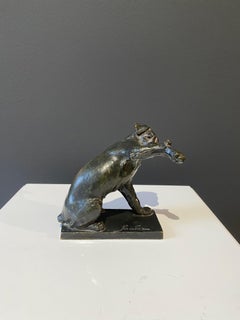
Chien à la sauterelle, Sandoz, Dog, Sculpture, Bronze, Animal, 1910
s
Located in Geneva, CH
Chien à la sauterelle, Sandoz, Dog, Sculpture, Bronze, Animal, 1910's
Chien à la sauterelle
Susse Fondeur
circa 1918-1930
Bronze with brown patina and shade of green
13 x 13 x 9 cm
Signed and seal of the foundry on the base : Sandoz, Susse Fondeur
Catalogue raisonné de l'oeuvre sculpté de Edouard Marcel Sandoz, sculpteur figuriste et animalier 1881-1971, by Félix Marcilhac, Les Editions de l'amateur, 1993...
Category
Modern 1910s Art
Materials
Bronze
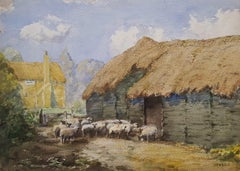
In Cambridgeshire /// British English Sheep Farm Cottage Village Watercolor Art
By John Arthur Dees
Located in Saint Augustine, FL
Artist: John Arthur Dees (English, 1876-1959)
Title: "In Cambridgeshire"
*Signed by Dees lower right
Circa: 1915
Medium: Original Watercolor on paper
Framing: Recently beautifully fr...
Category
English School 1910s Art
Materials
Watercolor
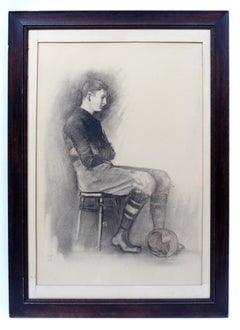
Antique American Drawing Football Player Monogrammed Original Frame early 20th C
Located in Buffalo, NY
An original charcoal drawing of a football player in his uniform circa 1910.
This work is initialed what appears to be "e.w." with the phrase "1/2 hr" written below. We have not be...
Category
American Realist 1910s Art
Materials
Paper, Charcoal