1910s Art
to
280
1,084
355
395
194
171
Overall Width
to
Overall Height
to
7,602
21,277
162,189
233,019
1,979
2,251
4,935
6,453
5,732
15,021
20,462
25,773
18,494
13,838
5,392
421
319
135
133
49
19
19
12
6
1
1,233
882
31
1,432
691
599
408
391
348
217
151
146
135
134
123
116
102
97
95
77
77
59
58
871
628
486
395
386
102
52
34
23
22
855
373
1,168
957
Period: 1910s
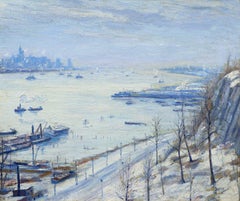
Water View of New York, 1911
By Max Kuehne
Located in New York, NY
In his oil painting, “Water View of New York, 1911,” Max Kuehne paints the Hudson river from a vantage point atop the palisades. The New York skyline ris...
Category
1910s Art
Materials
Canvas, Oil
Gentlemen
s Players
Club Pen
Ink Drawing by Orson B. Lowell (SIGNED LL)
Located in Bristol, CT
Original pen & ink c1920s sketch of a classic gentlemen's private club interior scene, perhaps the Players Club to which this artist himself was a member,...
Category
Other Art Style 1910s Art
Materials
Paper, Ink, Pen

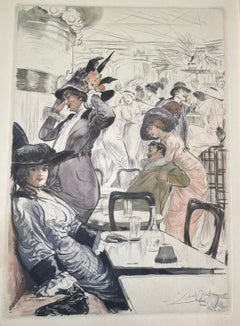
Les Bars
Located in Wilton, CT
A very fine copy of "Les Bars," an album of ten original etchings by the master Lobel-Riche, representing fashionable women in various Parisian social settings. This album, part of a...
Category
Art Nouveau 1910s Art
Materials
Etching
The Small Mechanical Workshop
Located in London, GB
JACQUES VILLON 1875-1963
(Gaston Duchamp) Damville 1875-1963 Paris (French)
Title: The Small Mechanical Workshop Le petit atelier de mécanique, 1914
...
Category
Cubist 1910s Art
Materials
Etching

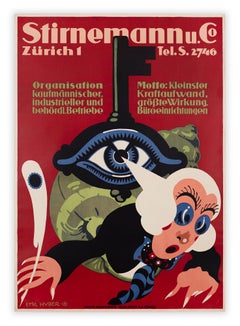
Stirnemann und Co. by Emil Huber, Swiss Surrealist color eyeball poster, 1918
Located in Chicago, IL
Emil Huber’s mesmerizing and surrealist eyeball design for Stirnemann u. Co. Zürich promotes an organization of commercial, industrial and administrative operations in Switzerland.
...
Category
1910s Art
Materials
Lithograph
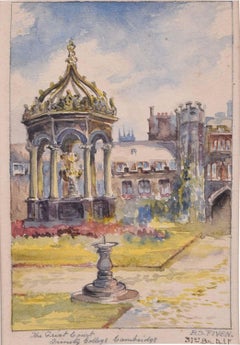
Great Court Trinity College Cambridge Watercolour by B.S. Fiven Fountain c. 1917
Located in London, GB
To see our other views of Oxford and Cambridge , particularly suitable for wedding and graduation presents, scroll down to "More from this Seller" and below it click on "See all from...
Category
Modern 1910s Art
Materials
Watercolor
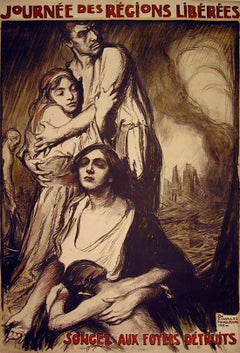
Original Antique French Poster, "Journee", Charles D. Fouqueray, Lithograph
Located in Dallas, TX
"Journee des Regions Liberees!" artist: Charles D. Fouqueray. Size: 45 x 30. Year: 1919. Archival linen backed in great condition; ready to frame.
Original linen backed stone lithograph:
Charles D. Fouqueray
Journee des Regions Liberees!
De La Vasselais Paris Vire (Calvados) Imp. circa 1919 Canvas poster / Vintage Poster on Linnen
Featured is a French poster from award-winning artist Charles Fouqueray, produced for World War I. The image is the majority with title separate and positions across the top in red outlined black text. The text reads "Day of the liberated regions.... think of the destroyed homes". Set against a background of devastated buildings in flames, stands a family group: the father embraces his daughter while the mother hold a younger naked child...
Category
Art Nouveau 1910s Art
Materials
Lithograph
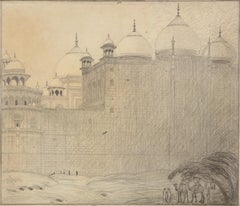
Part of the ring-wall of the Taj Mahal, Agra, India, 1914
Located in Amsterdam, NL
Part of the ring-wall of the Taj Mahal, Agra, India, 1914
Signed with initials and dated bottom right
Black chalk on paper, 45.5 x 53 cm
Literature:
Ernst Braches en J.F. Heijbro...
Category
Art Nouveau 1910s Art
Materials
Paper, Chalk
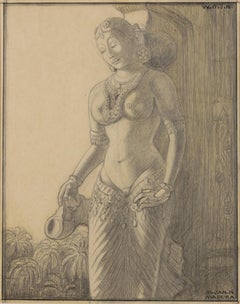
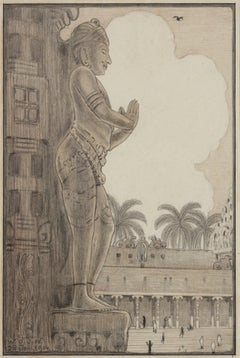
Stone Statue, Madura, India, 1914
Located in Amsterdam, NL
Stone statue in the temple at Madura, India, 1914
Signed with initials and dated, bottom left
Pencil on paper, 25.4 x 16.7 cm
Literature:
Ernst Braches en J.F. Heijbroek, W.O.J. ...
Category
Art Nouveau 1910s Art
Materials
Paper, Pencil
Stone Statue, Madura, India, 1914
Located in Amsterdam, NL
Stone statue in the temple at Madura, India, 1914
Signed with initials top right
Pencil on paper, 21.2 x 16.7 cm
Literature:
Ernst Braches en J.F. Heijbroek, W.O.J. Nieuwenkamp,B...
Category
Art Nouveau 1910s Art
Materials
Paper, Pencil
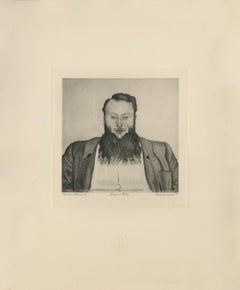
"Portrait of Sculptor James Vibert" Copper Plate Heliogravure
Located in Palm Beach, FL
2018 marks the centenary anniversary of Ferdinand Hodler’s death. In that 100 years time, the art world’s esteem of this important artist has proved fickle. It has shifted from extolling his artistic merits during his lifetime to showing something of a feigned disdain- more reflective of the world political order than a true change of heart for Hodler’s work. After years of Hodler being all but a footnote in the annals of art history and generally ignored, finally, the pendulum has righted itself once again. Recent retrospective exhibitions in Europe and the United States have indicated not only a joyful rediscovery of Hodler’s art but a firm conviction that his work and world view hold particular relevance today. DAS WERK FERDINAND HODLERS is not only a collection of printed work reflecting the best of all of his painted work created up to 1914 just before the outbreak of World War I, the portfolio itself is an encapsulation of Hodler’s ethos, Parallelisme.
Hodler developed his philosophy of Parallelisme as a unifying approach to art which strips away detail in search of harmony. By means of abstraction, symmetry and repetition, Hodler sought ways to depict Nature’s essence and her fundamental, universal order. He believed these universal laws governing the natural, observable world extend to the spiritual realm. Symbolist in nature with Romantic undertones, his works are equally portraits of these universal concepts and feelings governing all life as they are a visual portrait in the formal sense. Whether his subject is a solitary tree, a moment in battle, mortal fear, despair, the awe inspired by a vast mountain range, a tender moment or even the collective conviction in a belief, Hodler unveils this guiding principle of Parallelisme.
Several aspects of Hodler’s portfolio reinforce his tenets of Parallelisme. The Table of Contents clearly preferences a harmonious design over detail. The two columns, consisting of twenty lines each, list the images by order of appearance using their German titles. The abbreviated titles are somewhat cryptic in that they obscure the identities of the sitters. Like the image Hodler presents, they are distillations of the sitter without any extraneous details. This shortening was also done in an effort to maintain a harmonious symmetry of the Table of Contents, themselves, and keep titles to a one-line limit. The twenty-fourth title: “Bildnis des Schweizerischen Gesandten C.” was so long, even with abbreviation, that it required two lines; so, for the sake of maintaining symmetry, the fortieth title: “Bauernmadchen” was omitted from the list. This explains why the images are not numbered. Hodler’s reasoning is not purely esoteric. Symmetry and pattern reach beyond mere formal design principles. Finding sameness and imposing it over disorder goes to the root of Hodler’s identity and his art. A Swiss native, Hodler was bi-lingual and spoke German and French. Each printed image, even number forty, have titles in both of Hodler’s languages. Certainly, there was a market for Hodler’s work among francophones and this inclusion may have been a polite gesture to that end; however, this is the only place in the portfolio which includes French. With German titles at the lower left of each image, Hodler’s name at bottom center and corresponding French titles at the lower right of each image, there is a harmony and symmetry woven into all aspects of the portfolio. This holds true for the page design, as it applies to each printed image and as it describes the Swiss artist himself. Seen in this light, Hodler’s portfolio of printed work is the epitome of Hodler’s Parallelisme. DAS WERK FERDINAND HODLERS is also one of the most significant documents to best tell the story of how Hodler, from Switzerland, became caught between political cross-hairs and how the changing tides of nations directly impacted the artist during his lifetime as well as the accessibility of his art for generations to come.
The Munich-based publisher of the portfolio, R. Piper & Co., Verlag, plays a crucial role in this story. Publishing on a wide range of subjects from philosophy and world religion to music, literature and the visual arts; the publisher’s breadth of inquiry within any one genre was equal in scope. Their marketing strategy to publish multiple works on Hodler offers great insight as to what a hot commodity Hodler was at that time. R.Piper & Co.’s Almanach, which they published in 1914 in commemoration of their first ten years in business, clearly illustrates the rapid succession- strategically calculated for achieving the deepest and broadest impact - in which they released three works on Hodler to hit the market by the close of 1914. DAS WERK FERDINAND HODLERS was their premier publication. It preceded C.A. Loosli’s Die Zeichnungen Ferdinand Hodlers, a print portfolio after 50 drawings by Hodler which was released in Autumn of 1914 at the mid-level price-point of 75-150 Marks; and a third less expensive collection of prints after original works by Hodler, which had not been included in either of the first two portfolios, was released at the end of that year entitled Ferdinand Hodler by Dr. Ewald Bender.
The title and timing of DAS WERK FERDINAND HODLERS' debut leaves little doubt as to the connection it has with another avant-garde portfolio of art prints, Das Werk Gustav Klimts, released in 5 installments from 1908 -1914 by Galerie Miethke in Vienna. Hodler, himself, was involved in Klimt’s ground-breaking project. As the owner of Klimt’s 1901 painting, “Judith with the Head of Holifernes” which appears as the ninth collotype print in the second installment of Das Werk Gustav Klimts, Hodler was obliged to grant access of the painting to the art printers in Vienna for them to create the collotype sometime before 1908. Hodler had been previously invited in 1904 to take part in what would be the last exhibition of the Vienna Secession before Klimt and others associated with Galerie Miethke broke away. In an interview that same year, Hodler indicated that he respected and was impressed by Klimt. Hodler’s esteem for Klimt went beyond the art itself; he emulated Klimt’s method aimed at increasing his market reach and appeal to a wider audience by creating a print portfolio of his painted work. By 1914, Hodler and his publisher had the benefit of hindsight to learn from Klimt’s Das Werk publication.
Responding to the sluggish sales of Klimt’s expensive endeavor, Hodler’s publisher devised the same diversified 1-2-3 strategy for selling Hodler’s Das Werk portfolio as they did with regards to all three works on Hodler they published that year. For their premium tier of DAS WERKS FERDINAND HODLERS, R. Piper & Co. issued an exclusive Museum quality edition of 15 examples on which Hodler signed each page. At a cost of 600 Marks, this was generally on par with Klimt’s asking price of 600 Kronen for his Das Werk portfolio. A middle-tiered Preferred edition of 30, costing somewhat less and with Hodler’s signature only on the Title Page, was also available. The General edition, targeting the largest audience with its much more affordable price of 150 Marks, is distinguishable by its smaller size.
Rather than use the subscription format Miethke had chosen for Klimt’s portfolios which proved to have had its challenges, R. Piper & Co. employed a different strategy. In addition to instantly gratifying the buyer with all 40 of the prints comprising DAS WERK FERDINAND HODLERS and the choice among three price points, they advertised in German journals a fourth possibility of ordering single prints from them directly. These printed images are easily discernible from the three complete folio editions. The paper size of the single purchased images is of the larger format like the Museum and Preferred editions, measuring 65 h x 50 w cm; however, the paper itself is the same copper print paper used in the General edition and then mounted on poster board. The publishing house positioned itself to be a direct retailer of Hodler’s art. They astutely recognized the potential for profitability and the importance, therefore, of having proprietary control over his graphic works.
R. Piper & Co. owned the exclusive printing rights to Hodler’s best work found in their three publications dating from 1914. That same year, a competing publication out of Weimar entitled Ferdinand Hodler: Ein Deutungsversuch von Hans Muhlestein appeared. Its author, a young scholar, expressed his frustration with the limited availability of printable work by Hodler. In his Author’s Note on page 19, dated Easter, 1914, Muhlestein confirms that the publisher of Hodler’s three works from that same year owned the exclusive reproductive rights to Hodler’s printed original work. He goes further to explain that even after offering to pay to use certain of those images in his book, the publisher refused. Clearly, a lot of jockeying for position in what was perceived as a hot market was occurring in 1914.
Instead, their timing couldn’t have been more ill-fated, and what began with such high hopes suddenly found a much different market amid a hostile climate. The onset of WWI directly impacted sales. Many, including Ferdinand Hodler, publicly protested the September invasion by Germany of France in which the Reims Cathedral, re-built in the 13th century, was shelled, destroying priceless stained glass and statuary and burning off the iron roof and badly damaging its wooden interior. Thomas Gaehtgens, Director of the Getty Research Institute describes how the bombing of Reims Cathedral triggered blindingly powerful and deeply-felt ultra-nationalistic responses: “The event profoundly shocked French intellectuals, who for the most part had an intense admiration for German literature, music and art. By relying on press accounts and abstracting from the visual propagandistic content, they were unable to interpret the siege of Reims without turning away from German culture in disgust. Similarly, the German intelligentsia and bourgeoisie were also shocked to find themselves described as vandals and barbarians. Ninety-three writers, scientists, university professors, and artists signed a protest, directed against the French insults, that defended the actions of the German army.”
In similar fashion, a flurry of open letters published in German newspapers and journals as well as telegrams and postcards sent directly to Hodler following his outcry in support of Reims reflected the collectively critical reaction to Hodler’s position. Loosli documents that among the list of telegrams Hodler received was one from none other than his publisher in Germany, R.Piper & Co. Allegiances were questioned. The market for Hodler in Germany immediately softened. Matters worsened for the publisher beyond the German backlash to Hodler and his loss of appeal in the home market; with the war in full swing until 1918, there was little chance a German publisher would have much interest coming from outside of Germany and Austria. Following the war and Hodler’s death in 1918, the economy in Germany continued to spiral out and just 5 years later, hyper-inflation had rendered its currency worthless vis-a-vis its value in the pre-war years. Like the economy, Hodler’s reputation was slow to find currency in these difficult times. Even many French art fans had turned sour on Hodler as they considered his long-standing relationship in German and Austrian art circles. Thus, the portfolio’s rarity in Hodler’s lifetime and, consequently, the availability of these printed images from DAS WERK FERDINAND HODLERS since his death has been scarce.
In many ways, Hodler and his portfolios were casualties of war. Thwarted from their intended purpose of reaching a wide audience and show-casing Parallelisme, Hodler’s unique approach to art, this important, undated work has been both elusive and shrouded in mystery. Perhaps DAS WERK FERDINAND HODLERS was left undated as a means of affirming the timelessness of Hodler’s art. Digging back into the past, Hodler’s contemporaries, like R. Piper, C.A. Loosli and Hans Muhlestein, indeed provide the keys to unequivocally clarify what has largely been mired in obscurity. Just after Hodler’s death, the May, 1918 issue of the Burlington Review ran a small column which opined hope for better access to R.Piper & Co.’s DAS WERK FERDINAND HODLERS; 100 years later, it is finally possible. Hodler’s voice rings out through these printed works. Once more, his modern approach to depicting portraits, landscapes and grand scale scenes of Swiss history speak to us of what is universal. Engaging with any one of these images is the chance to connect to Hodler’s vision and his world view- weltanschauung in German, vision du monde in French- however one expresses these concepts through language, its message embedded in his work is the same: “We differ from one another, but we are like each other even more. What unifies us is greater and more powerful than what divides us.” Today, Hodler’s art couldn’t be more timely.
FERDINAND HODLER (SWISS, 1853-1918) explored Parallelisme through figurative poses evocative of music, dance and ritual. His images of sex, night, desertion and death as well as his many landscapes exploring the universal longing for harmony with Nature are unique and important works embodying a Symbolist paradigm. Truly a Modern Master, Hodler’s influence can be felt in the work of Gustav Klimt and Kolomon Moser...
Category
Symbolist 1910s Art
Materials
Paper
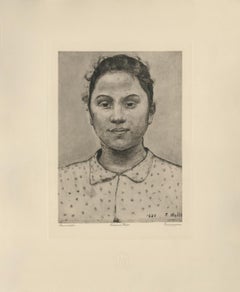
"Portrait of Swiss Political Attachee, Carlin" Copper Plate Heliogravure
Located in Palm Beach, FL
2018 marks the centenary anniversary of Ferdinand Hodler’s death. In that 100 years time, the art world’s esteem of this important artist has proved fickle. It has shifted from extolling his artistic merits during his lifetime to showing something of a feigned disdain- more reflective of the world political order than a true change of heart for Hodler’s work. After years of Hodler being all but a footnote in the annals of art history and generally ignored, finally, the pendulum has righted itself once again. Recent retrospective exhibitions in Europe and the United States have indicated not only a joyful rediscovery of Hodler’s art but a firm conviction that his work and world view hold particular relevance today. DAS WERK FERDINAND HODLERS is not only a collection of printed work reflecting the best of all of his painted work created up to 1914 just before the outbreak of World War I, the portfolio itself is an encapsulation of Hodler’s ethos, Parallelisme.
Hodler developed his philosophy of Parallelisme as a unifying approach to art which strips away detail in search of harmony. By means of abstraction, symmetry and repetition, Hodler sought ways to depict Nature’s essence and her fundamental, universal order. He believed these universal laws governing the natural, observable world extend to the spiritual realm. Symbolist in nature with Romantic undertones, his works are equally portraits of these universal concepts and feelings governing all life as they are a visual portrait in the formal sense. Whether his subject is a solitary tree, a moment in battle, mortal fear, despair, the awe inspired by a vast mountain range, a tender moment or even the collective conviction in a belief, Hodler unveils this guiding principle of Parallelisme.
Several aspects of Hodler’s portfolio reinforce his tenets of Parallelisme. The Table of Contents clearly preferences a harmonious design over detail. The two columns, consisting of twenty lines each, list the images by order of appearance using their German titles. The abbreviated titles are somewhat cryptic in that they obscure the identities of the sitters. Like the image Hodler presents, they are distillations of the sitter without any extraneous details. This shortening was also done in an effort to maintain a harmonious symmetry of the Table of Contents, themselves, and keep titles to a one-line limit. The twenty-fourth title: “Bildnis des Schweizerischen Gesandten C.” was so long, even with abbreviation, that it required two lines; so, for the sake of maintaining symmetry, the fortieth title: “Bauernmadchen” was omitted from the list. This explains why the images are not numbered. Hodler’s reasoning is not purely esoteric. Symmetry and pattern reach beyond mere formal design principles. Finding sameness and imposing it over disorder goes to the root of Hodler’s identity and his art. A Swiss native, Hodler was bi-lingual and spoke German and French. Each printed image, even number forty, have titles in both of Hodler’s languages. Certainly, there was a market for Hodler’s work among francophones and this inclusion may have been a polite gesture to that end; however, this is the only place in the portfolio which includes French. With German titles at the lower left of each image, Hodler’s name at bottom center and corresponding French titles at the lower right of each image, there is a harmony and symmetry woven into all aspects of the portfolio. This holds true for the page design, as it applies to each printed image and as it describes the Swiss artist himself. Seen in this light, Hodler’s portfolio of printed work is the epitome of Hodler’s Parallelisme. DAS WERK FERDINAND HODLERS is also one of the most significant documents to best tell the story of how Hodler, from Switzerland, became caught between political cross-hairs and how the changing tides of nations directly impacted the artist during his lifetime as well as the accessibility of his art for generations to come.
The Munich-based publisher of the portfolio, R. Piper & Co., Verlag, plays a crucial role in this story. Publishing on a wide range of subjects from philosophy and world religion to music, literature and the visual arts; the publisher’s breadth of inquiry within any one genre was equal in scope. Their marketing strategy to publish multiple works on Hodler offers great insight as to what a hot commodity Hodler was at that time. R.Piper & Co.’s Almanach, which they published in 1914 in commemoration of their first ten years in business, clearly illustrates the rapid succession- strategically calculated for achieving the deepest and broadest impact - in which they released three works on Hodler to hit the market by the close of 1914. DAS WERK FERDINAND HODLERS was their premier publication. It preceded C.A. Loosli’s Die Zeichnungen Ferdinand Hodlers, a print portfolio after 50 drawings by Hodler which was released in Autumn of 1914 at the mid-level price-point of 75-150 Marks; and a third less expensive collection of prints after original works by Hodler, which had not been included in either of the first two portfolios, was released at the end of that year entitled Ferdinand Hodler by Dr. Ewald Bender.
The title and timing of DAS WERK FERDINAND HODLERS' debut leaves little doubt as to the connection it has with another avant-garde portfolio of art...
Category
Symbolist 1910s Art
Materials
Paper

"Young Peasant Girl" Copper Plate Heliogravure
Located in Palm Beach, FL
2018 marks the centenary anniversary of Ferdinand Hodler’s death. In that 100 years time, the art world’s esteem of this important artist has proved fickle. It has shifted from extol...
Category
Symbolist 1910s Art
Materials
Paper
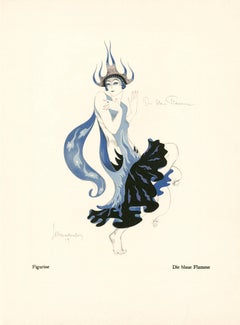
Kostume, Plakate, und Dekorationen, "The Blue Flame"
Located in Palm Beach, FL
Walter Schnackenberg’s style changed several times during his long and successful career. Having studied in Munich, the artist traveled often to Paris where he fell under the spell of the Henri de Toulouse-Lautrec’s colorful and sensuous posters depicting theatrical and decadent subjects. Schnackenberg became a regular contributor of similar compositions to the German magazines Jugend and Simplicissimus before devoting himself to the design of stage scenery and costumes. In the artist’s theatrical work, his mastery of form, ornamentation, and Orientalism became increasingly evident. He excelled at combining fluid Art Nouveau outlines, with spiky Expressionist passages, and the postures and patterns of the mysterious East.
In his later years, Schnackenberg explored the unconscious, using surreal subject matter and paler colors that plainly portrayed dreams and visions, some imbued with political connotations. His drawings, illustrations, folio prints, and posters are highly sought today for their exceedingly imaginative qualities, enchanting subject matter, and arresting use of color.
SCHNACKENBERG: KOSTUME, PLAKATE UND DEKORATIONEN, a cardboard bound art book consisting of 43 prints of work by Walter Schnackenberg, 30 of which are color lithographs that are signed and some are titled and dated in the plate, as well as black and white prints and photographs with accompanying text by Oskar Bie; lithographs printed at Kunstanstalt Oskar Consee in Munich, other images printed by Gesellschaft Pick & Co. in Munich, the text and cover with color images by Schnackenberg front and verso printed by R. Oldenbourg in Munich; published by Musarion Verlag, Munich, 1920.
The majority of Walter Schnackenberg’s artistic output was destroyed by bomb attacks in Munich in 1944. The highly publicized 2013 auction in New York of the recovered pre-war poster collection once belonging to German poster aficionado, Hans Sachs has reintroduced the world to Walter Schnackenberg’s graphic genius and priceless ephemeral art from a lost era. Besides the museum world, designer Karl Lagerfeld is one of the most prodigious collectors of Schnackenberg. Flipping through the pages of Kostume, Plakate und Dekorationen, it becomes quite clear that Schnackenberg’s collection is ground zero at the crossroads of early modern fashion where the cult of celebrity meets up with dance, music, theater and cabaret, film and the graphic medium. Berlin and Munich under Germany’s Weimar Republic in the first quarter of the 20th century produced just the atmosphere to feed this burgeoning industry. Rising inflation sparked a recklessness to live large for the moment and heightened a desire for escapism. An influx of Indian and East Asian dancers and musicians added to the artsy bohemian cultural mix. A new decadence and tolerance resulted. Film boldly featured provocative subject matter. Cabarets became popular venues giving rise to the demi-monde in which people from all social stations mixed more freely in a thriving underground economy and culture where there was a blurring of boundaries and of social codes. Noted art historian and cultural doyen, Oskar Bie astutely observes in his introduction to Schnackenberg’s publication that what unites the images is fantasy and advertisement. Schnackenberg uses the eye as an instrument to brilliantly construct and convey this double message. His personages never directly confront the viewer. Their eyes gaze off in the distance like those of the screenplayer and film star Hedamaria Scholz in Schnackenberg’s “Die Rodelhexe” movie poster. Their eyes follow the path of a dance composition or become a transfixed and ogling male gaze such as the iconic 1911 Odeon Casino poster...
Category
Expressionist 1910s Art
Materials
Lithograph
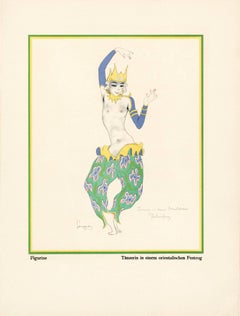
Kostume, Plakate, und Dekorationen, "Dancer in an Oriental Pageant"
Located in Palm Beach, FL
Walter Schnackenberg’s style changed several times during his long and successful career. Having studied in Munich, the artist traveled often to Paris where he fell under the spell o...
Category
Expressionist 1910s Art
Materials
Paper
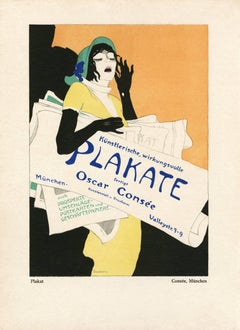
Kostume, Plakate, und Dekorationen, "Consee"
Located in Palm Beach, FL
Walter Schnackenberg’s style changed several times during his long and successful career. Having studied in Munich, the artist traveled often to Paris where he fell under the spell of the Henri de Toulouse-Lautrec’s colorful and sensuous posters depicting theatrical and decadent subjects. Schnackenberg became a regular contributor of similar compositions to the German magazines Jugend and Simplicissimus before devoting himself to the design of stage scenery and costumes. In the artist’s theatrical work, his mastery of form, ornamentation, and Orientalism became increasingly evident. He excelled at combining fluid Art Nouveau outlines, with spiky Expressionist passages, and the postures and patterns of the mysterious East...
Category
Expressionist 1910s Art
Materials
Lithograph
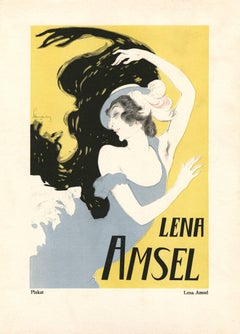
Kostume, Plakate, und Dekorationen, "Lena Amsel"
Located in Palm Beach, FL
Walter Schnackenberg’s style changed several times during his long and successful career. Having studied in Munich, the artist traveled often to Paris where he fell under the spell of the Henri de Toulouse-Lautrec’s colorful and sensuous posters depicting theatrical and decadent subjects. Schnackenberg became a regular contributor of similar compositions to the German magazines Jugend and Simplicissimus before devoting himself to the design of stage scenery and costumes. In the artist’s theatrical work, his mastery of form, ornamentation, and Orientalism became increasingly evident. He excelled at combining fluid Art Nouveau outlines, with spiky Expressionist passages, and the postures and patterns of the mysterious East.
In his later years, Schnackenberg explored the unconscious, using surreal subject matter and paler colors that plainly portrayed dreams and visions, some imbued with political connotations. His drawings, illustrations, folio prints, and posters are highly sought today for their exceedingly imaginative qualities, enchanting subject matter, and arresting use of color.
SCHNACKENBERG: KOSTUME, PLAKATE UND DEKORATIONEN, a cardboard bound art book consisting of 43 prints of work by Walter Schnackenberg, 30 of which are color lithographs that are signed and some are titled and dated in the plate, as well as black and white prints and photographs with accompanying text by Oskar Bie; lithographs printed at Kunstanstalt Oskar Consee in Munich, other images printed by Gesellschaft Pick & Co. in Munich, the text and cover with color images by Schnackenberg front and verso printed by R. Oldenbourg in Munich; published by Musarion Verlag, Munich, 1920.
The majority of Walter Schnackenberg’s artistic output was destroyed by bomb attacks in Munich in 1944. The highly publicized 2013 auction in New York of the recovered pre-war poster collection once belonging to German poster aficionado, Hans Sachs has reintroduced the world to Walter Schnackenberg’s graphic genius and priceless ephemeral art from a lost era. Besides the museum world, designer Karl Lagerfeld is one of the most prodigious collectors of Schnackenberg. Flipping through the pages of Kostume, Plakate und Dekorationen, it becomes quite clear that Schnackenberg’s collection is ground zero at the crossroads of early modern fashion where the cult of celebrity meets up with dance, music, theater and cabaret, film and the graphic medium. Berlin and Munich under Germany’s Weimar Republic in the first quarter of the 20th century produced just the atmosphere to feed this burgeoning industry. Rising inflation sparked a recklessness to live large for the moment and heightened a desire for escapism. An influx of Indian and East Asian dancers and musicians added to the artsy bohemian cultural mix. A new decadence and tolerance resulted. Film boldly featured provocative subject matter. Cabarets became popular venues giving rise to the demi-monde in which people from all social stations mixed more freely in a thriving underground economy and culture where there was a blurring of boundaries and of social codes. Noted art historian and cultural doyen, Oskar Bie astutely observes in his introduction to Schnackenberg’s publication that what unites the images is fantasy and advertisement. Schnackenberg uses the eye as an instrument to brilliantly construct and convey this double message. His personages never directly confront the viewer. Their eyes gaze off in the distance like those of the screenplayer and film star Hedamaria Scholz in Schnackenberg’s “Die Rodelhexe” movie poster. Their eyes follow the path of a dance composition or become a transfixed and ogling male gaze such as the iconic 1911 Odeon Casino poster...
Category
Expressionist 1910s Art
Materials
Lithograph
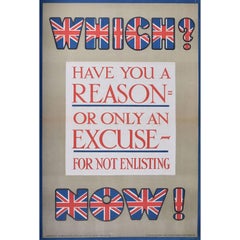
Have you a reason for not enlisting? World War One British Recruitment Poster
Located in London, GB
To see our other original vintage propaganda posters, scroll down to "More from this Seller" and below it click on "See all from this seller" - or send us a message if you cannot find the poster you want.
Parliamentary Recruiting Committee
Which? Have you a Reason for not Enlisting - Or only an Excuse for not Enlisting. Now!
Original lithographic poster c. 1914
75 x 50cm
Published by the Parliamentary Recruiting Committee, London
Printed by the Abbey Press 32
34 Great Peter St Westminster SW
Before conscription was introduced at the beginning of 1916, recruitment into the British Army was all by way of volunteering. Lord Kitchener...
Category
Modern 1910s Art
Materials
Lithograph
"In der Loge" [In the Lodge]
By George Grosz
Located in Astoria, NY
George Grosz (German, 1893-1959), "In der Loge" [In the Lodge], Pen and Ink on Paper, circa 1913, signed in pencil "Grosz" and titled lower lower left, Achim Moeller, Ltd. label to v...
Category
Expressionist 1910s Art
Materials
Paper, Ink, Pen
!["In der Loge" [In the Lodge]](https://a.1stdibscdn.com/a_28452/1748465947797/109976_1_master.jpg?width=240 "George Grosz - \"In der Loge\" [In the Lodge]")
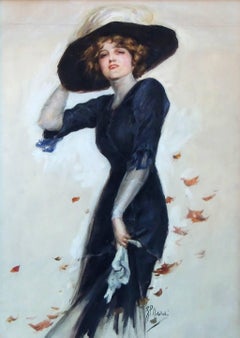
Butterick Fashions Magazine Cover
Located in Fort Washington, PA
Date: 1918
Medium: Oil on Board
Dimensions: 24.00" x 18.00"
Signature: Signed Lower Right
American Art Works Calendar Illustration
Category
1910s Art
Materials
Oil, Board
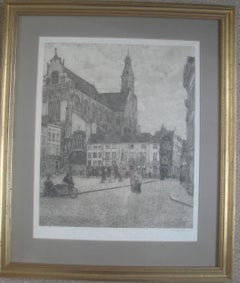
Antwerp, St Pauls Church, G.C. Haverkamp (1872-1926), Original Etching
Located in Frome, Somerset
G.C. Haverkamp ( 1872-1926) View of Antwerp, Veemarkt with Saint Pauls Church , original signed etching circa 1914.
Fine detail etching in good condition .
Antique giltwood frame.
Category
Realist 1910s Art
Materials
Ink
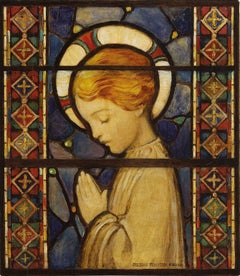
Good Housekeeping cover. Christmas: Child Praying
Located in Miami, FL
Famed female illustrator, Jessie Willcox Smith paints the " Ideal Child" in a spiritual moment for the Christmas cover of Good Housekeeping. The acc...
Category
American Impressionist 1910s Art
Materials
Mixed Media
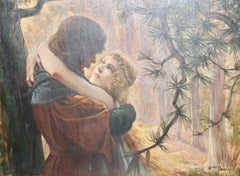
Art Déco Painting, ca. 1910, oil on cardboard. Romantic love scene in the forest
Located in Berlin, DE
Painting, around 1910, oil on cardboard. Romantic love scene in the forest.
Signed, Gaston Bussiere.
With beautiful (original) Art Deco frame.
Frame has minimal damage in places.
Dimensions with frame 67cm x 86cm
This painting is offered here for the first time exclusively on 1stdibs!
From private, German estate.
Gaston Bussière (April 24, 1862 in Cuisery – October 29, 1928 or 1929 in Saulieu) was a French Symbolist painter and illustrator.
Bussière studied at l'Académie des Beaux-Arts in Lyon before entering the école des beaux-arts de Paris where he studied under Alexandre Cabanel and Pierre Puvis de Chavannes. In 1884, he won the Marie Bashkirtseff...
Category
Symbolist 1910s Art
Materials
Oil, Panel, Cardboard

$24,941 Sale Price
25% Off
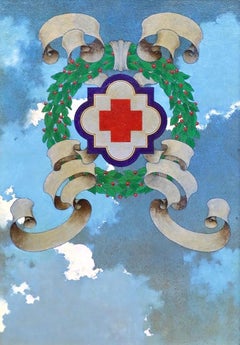
Original Illustration for The Red Cross
Located in Fort Washington, PA
Medium: Oil on Board
Signature: Each Upper Panel, Signed 'Maxfield Parrish/Windsor./Vermont.' (On the Reverse); Each Lower Panel, Signed 'Maxfield Parrish' (Lower Right) Each
1 of a...
Category
1910s Art
Materials
Oil, Board
Who Made it an Issue of Six Shooters, (California Mine; Copper Sky)
Located in Fort Washington, PA
Medium: Oil on Canvas (on Board)
Signature: Signed Lower Left
Literature:
Reese, Lowell Otus, The Little Injun, Collier's Weekly, November 4, 1916, p. 13, illustrated. Schoonover,...
Category
1910s Art
Materials
Canvas, Oil

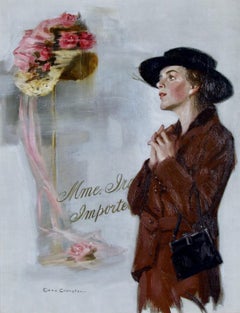
Spring Bonnet - Woman Admiring Hat, Original Cover for The Saturday Evening Post
Located in Fort Washington, PA
Original cover for The Saturday Evening Post, published March 31, 1917. The illustration features a young woman admiring a floral hat in a milliner's window.
A beautiful and delicat...
Category
1910s Art
Materials
Canvas, Oil
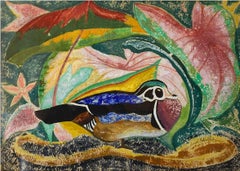
Water Lily and Woodchuck - Barbados
Located in Miami, FL
Powerful visual done at Stella's peak period of creativity in Barbados. Signed lower right. Provenance: Doyle, New York
Elegantly framed.
Category
Futurist 1910s Art
Materials
Gouache, Paper
$68,000 Sale Price
20% Off
Visit to the Bazaar - 1916 British watercolour on silk by Sheringham
Located in London, GB
GEORGE SHERINGHAM
(1884-1937)
Visit to the Bazaar
Signed; inscribed with title on a label on the backboard
Watercolour and gold paint on silk
15 by 38 cm., 6 by 15 in.
(frame size 34 by 56 cm., 13 ½ by 22 in.)
Exhibited:
London, Leicester Galleries, Exhibition of Works by George Sheringham, 1916, no.17.
Sheringham was born in London and studied at the Slade under Henry Tonks and later in Venice, Brussels, Berlin and Paris where he held his first one-man exhibition in 1905. On his return to London he initially supported himself with poster designs and teaching. His first exhibition of fan designs was held at the Ryder Gallery in 1909 followed by another in the following year. With enthusiastic reviews in Studio he had launched his career as a decorative designer, theatrical designer and illustrator. He illustrated books by Max Beerbohm and Cyrus MacMillan. In 1921 he collaborated with his brother Hugh on a book about fishing, The Book of the Fly Rod. He wrote Drawing in Pen and Pencil (1922), with James Laver, Design in the Theatre (1927) and with Rupert Mason and R Boyd Morrison he edited Robes of Thespis, Costume Designs by Modern Artists (1928). As a decorator, Sheringham designed the music room at 40 Devonshire House...
Category
Realist 1910s Art
Materials
Watercolor
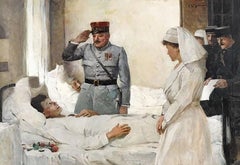
"Yesterday afternoon he was decorated with the Croix de Guerre" World War I
Located in Fort Washington, PA
World War I scene
Story illustration for “Will You Tell Her I’m All Right?” by Catherine Van Dyke for The Ladies Home Journal, published March 1918, illustrated page 11.
The full c...
Category
1910s Art
Materials
Canvas, Oil
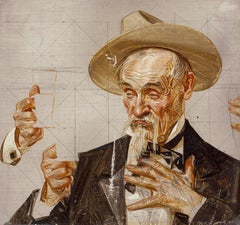
Upset Stomach, The Saturday Evening Post, Preliminary Cover
Located in Fort Washington, PA
Medium: Oil on Canvas
Signature: Unsigned
The finished painting of this illustration was featured on the cover of The Saturday Evening Post, ...
Category
Other Art Style 1910s Art
Materials
Canvas, Oil
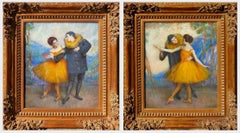
"The Dancers Begin"
"The Dancers Finish"
Located in Lambertville, NJ
One is Signed Lower and the Other is Signed Lower Right
Louis Kronberg (1872 - 1965)
Kronberg, often referred to as "the American Degas,"was born in Boston on December 20, 1872. He displayed artistic talent in his elementary school years and while he was only fifteen years old, his brother, who had become an impresario, made it possible for Louis to copy portraits of stage and concert celebrities backstage. Louis came to know Ignaz Paderewski, Boris Chaliapin...
Category
American Impressionist 1910s Art
Materials
Canvas, Pastel
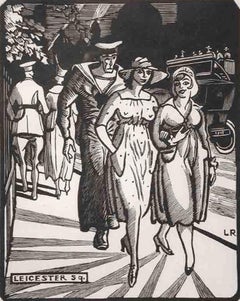
Leicester Square, London by Ludovic-Rodo Pissarro - Wood engraving
Located in London, GB
SOLD UNFRAMED
*UK BUYERS WILL PAY AN ADDITIONAL 20% VAT ON TOP OF THE ABOVE PRICE
Leicester Square, London by Ludovic-Rodo Pissarro (1878-1952)
Wood engraving
14.2 x 11.5 cm (5 ⅝ x...
Category
1910s Art
Materials
Engraving, Woodcut
Oriental Woman, Charcoal Painting by Georges Manzana Pissarro
Located in London, GB
SOLD UNFRAMED
Oriental Woman by Georges Manzana Pissarro (1871-1961)
Charcoal on paper
48 x 32 cm (18 ⅞ x 12 ⅝ inches)
This work is accompanied by a certificate of authenticity fr...
Category
Art Deco 1910s Art
Materials
Charcoal
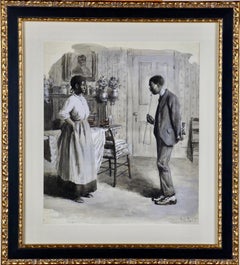
"As Long as You
s Single Dere
s Hope" Scribner
s Magazine, 1915
Located in Fort Washington, PA
Signed "A. B. Frost" Lower Right by Artist
"Jes tak' yo coat off, end dem collars end cuffs, end go out in de yard end cut de grass." Illustration for "As Long as You's Single Dere'...
Category
1910s Art
Materials
Ink
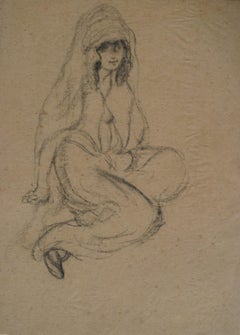
Woman with a White Veil, Mixed Media on Canvas, circa 1915
Located in London, GB
Woman with a White Veil by Georges Manzana Pissarro (1871-1961)
Mixed media with gold and silver on board, laid on canvas
59.5 x 34.5 cm (23 ⅜ x 13 ⅝ inches)
Signed lower right, Manz...
Category
Tribal 1910s Art
Materials
Canvas, Mixed Media, Board

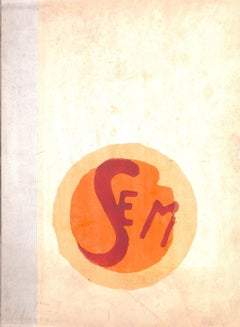
SEM circa 1910s Folio
Located in Bristol, CT
circa 1910s
Plate Sz: 20.5"H x 14.25"W
29 plates
3 double-plates
25 single plates
1 double-sided plate 12.25"H x 17.75"W
Georges Goursat (1863–1934), known as Sem, was a French...
Category
1910s Art
Materials
Lithograph
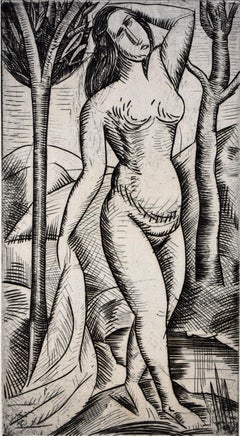
Nude Bather among the Trees Baigneuse nue aux arbres - French Fauvism
By André Derain
Located in London, GB
ANDRÉ DERAIN 1880-1954
Chatou, Paris 1880-1954 Garches (French)
Title: Nude Bather among the Trees Baigneuse nue aux arbres, 1919
Technique: Original Hand Signed and Numbered Etch...
Category
1910s Art
Materials
Etching
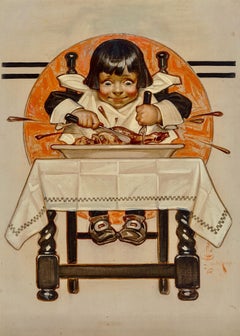
Thanksgiving, The Saturday Evening Post cover, November 12, 1910
Located in Fort Washington, PA
Medium: Oil on Canvas Laid on Panel
Signature: Signed Lower Right
The Saturday Evening Post cover, November 12, 1910
Category
1910s Art
Materials
Canvas, Oil, Panel
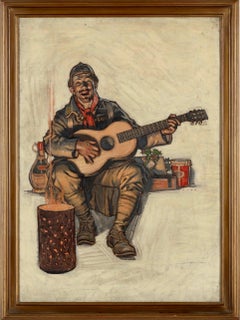
Soldier with Package from Home, Collier
s Magazine Cover
By Herbert Paus
Located in Fort Washington, PA
Signed Center Right by Artist
Collier's Magazine Cover, December 23 1916
Category
1910s Art
Materials
Oil
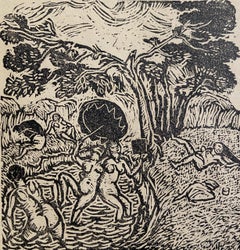
The Bathers, Woodcut on paper, Signed and dated 1912, Italian Artist
Located in London, GB
Woodcut on paper, signed and dated '1912' bottom right
Image size: 5 x 5 1/4 (12.75 x 13.5 cm)
Mounted
Here the artist's bold gouging of the material has created an evocative scene ...
Category
Italian School 1910s Art
Materials
Woodcut
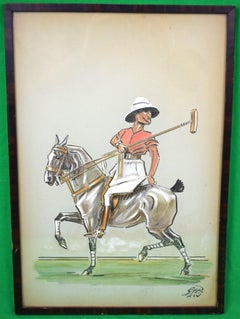
"Polo Player c1914 Gouache
Watercolour by Godfrey Brennan"
Located in Bristol, CT
Art Sz: 15 1/8"H x 10 1/4"W
Frame Sz: 16"H x 11"W
Godfrey Herbert Brennan (1875-1948) was a British artist
w/ Arthur Ackermann & Son Gallery label affixed to verso
*craquelure co...
Category
1910s Art
Materials
Watercolor, Gouache
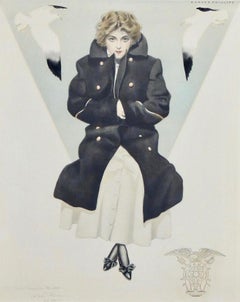
"The Midshipmite" USNA (United States Naval Academy) Woman
Located in Fort Washington, PA
An illustration of a beautiful young woman wearing a naval coat and flanked by two seagulls, commissioned by the United States Naval Academy...
Category
1910s Art
Materials
Watercolor
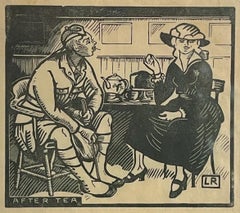
After Tea by Ludovic-Rodo Pissarro - Wood engraving
Located in London, GB
After Tea by Ludovic-Rodo Pissarro (1878-1952)
Wood engraving
12 x 13.2 cm (4 ³/₄ x 5 ¹/₄ inches)
Initialled and titled in the plate
Executed circa 1917
Artist biography
Ludovic-Rod...
Category
Post-Impressionist 1910s Art
Materials
Woodcut
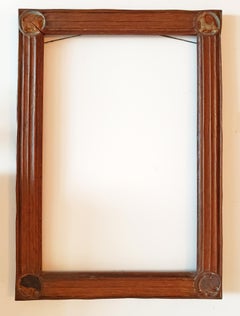
Carved Oak Wood Arts and Crafts Frame with Rabbit, Dog, Bird, Emu Carvings
Located in Miami, FL
One needs to view this work as much as a sculpture as a utilitarian frame.
Handmade Arts & Crafts channeled oak frame with chiseled relief farm animal decoration on each corner, pin and dovetail construction, artist cipher and date carved verso, 45"h x 31.5"w (outside), 37"h x 24"w (inside)
Anna Vaughn Hyatt Huntington...
Category
Art Nouveau 1910s Art
Materials
Wood
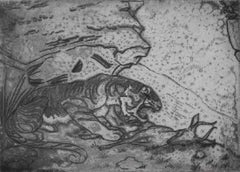
La Proie by Orovida Pissarro, 1917 - Etching Print
Located in London, GB
La Proie by Orovida Pissarro (1893 - 1968)
Etching
12.5 x 17.5 cm (4 ⅞ x 6 ⅞ inches)
Signed and dated 1917
Trial proof no.35
Artist's Biography:
Orovida Camille Pissarro, Lucien and...
Category
1910s Art
Materials
Etching
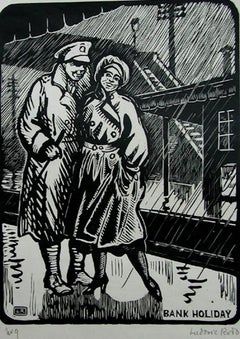
Bank Holiday by Ludovic-Rodo Pissarro - Wood engraving
Located in London, GB
SOLD UNFRAMED
Holiday by Ludovic-Rodo Pissarro (1878-1952)
Wood engraving
15.2 x 11.5 cm (6 x 4 ½ inches)
Initialed and titled in the plate
Signed lower right, Ludovic Rodo and nu...
Category
1910s Art
Materials
Engraving, Woodcut
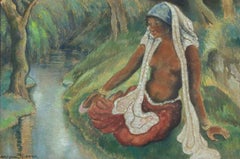
Femme au bord de la rivière by Georges Manzana Pissarro, circa 1910
Located in London, GB
Femme au bord de la rivière by Georges Manzana Pissarro (1871-1961)
Gouache, pastel and silver paint on paper
29.7 x 44.4 cm (11 ³/₄ x 17 ¹/₂ inches)
Signed lower left, manzana. Pis...
Category
Post-Impressionist 1910s Art
Materials
Gouache, Paint, Paper, Pastel
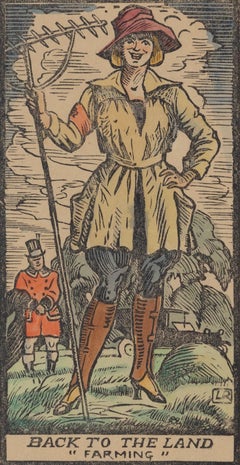
Back to the Land “Farming” by Ludovic-Rodo Pissarro - Colour woodcut
Located in London, GB
Back to the Land “Farming” by Ludovic-Rodo Pissarro (1878-1952)
Colour wood engraving
19.3 x 10.5 cm (7 ⁵/₈ x 4 ¹/₈ inches)
Initialed and titled in the plate and numbered, 4th state ...
Category
1910s Art
Materials
Color, Woodcut
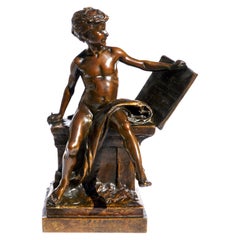
Louis Ernest Barrias Bronze Sculpture
Located in Dallas, TX
French dore bronze depicting a seated figure of a boy with tablet by Louis Ernest Barrias, French(1841-1905) Circa 1912
Modeled as a partially nude youth seated with a tablet and p...
Category
1910s Art
Materials
Bronze
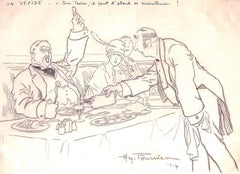
Original Pencil Sketch "Un Decide"
Located in Bristol, CT
Art Sz: 8 1/2"H x 12"W
1917
Category
1910s Art
Materials
Pencil
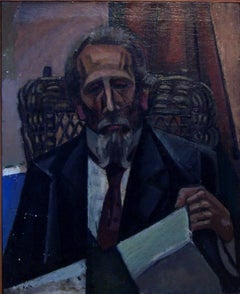
Portrait of the Musician Mazzi
By Alfred Reth
Located in London, GB
ALFRED RETH 1884-1966
Budapest 1884-1966 Paris (Hungarian/French)
Title: Portrait of the Musician Mazzi, 1912
Technique: Original Signed Oil pain...
Category
1910s Art
Materials
Canvas, Oil
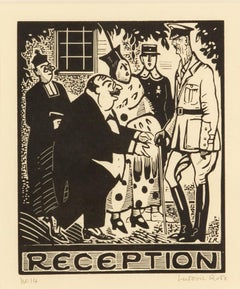
Reception by Ludovic-Rodo Pissarro - Woodcut
Located in London, GB
Reception by Ludovic-Rodo Pissarro (1878-1952)
Wood engraving
14 x 11.5 cm (5 ¹/₂ x 4 ¹/₂ inches)
Initialed and titled in the plate
Signed lower right, L...
Category
1910s Art
Materials
Woodcut
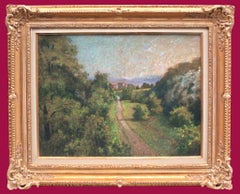
The Path Towards the Village
Located in Saint-Ouen, FR
PRINS Pierre Ernest (1838-1913)
Pastel on card signed low right and dated 1912
Luxury frame gilded with gold leaves with protective glass cover
Card Size ...
Category
Post-Impressionist 1910s Art
Materials
Oil
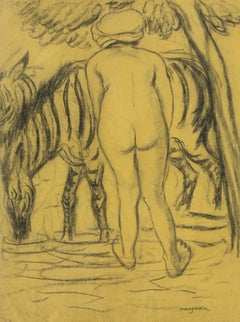
Jeune Femme de Dos au Zèbre by Georges Manzana Pissarro - Nude drawing
Located in London, GB
Jeune Femme de Dos au Zèbre by Georges Manzana Pissarro (1871-1961)
Charcoal on paper
66 x 49 cm (26 x 19 ¼ inches)
Signed lower right, Manzana
Executed circa 1915
This work is acco...
Category
Post-Impressionist 1910s Art
Materials
Paper, Charcoal
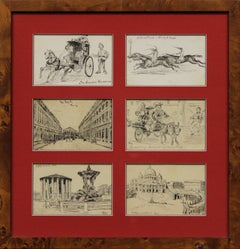
Six Pen
Ink c1910s Postcard Drawings
Located in Bristol, CT
Framed set of 6 pen & ink hand-drawn by R. Weniger postcards from England/ France & Italy addressed to the philanthropist Seymour H. Knox of Buffalo, NY
Art: 12"H x 11 1/2"W
Frame:...
Category
1910s Art
Materials
Paper, Ink, Pen
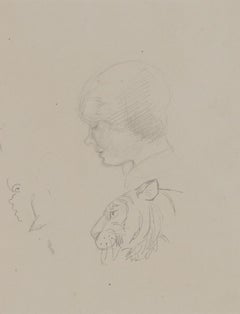
A Study of Human Head and Tiger by Orovida Pissarro - Sketch
Located in London, GB
A Study of Human Head and Tiger by Orovida Pissarro (1893-1968)
Pencil on paper
25.5 x 20 cm (10 x 7⁷/₈ inches)
Executed circa 1917
Artist biography:
Orovida Camille Pissarro, Lucie...
Category
Post-Impressionist 1910s Art
Materials
Paper, Pencil
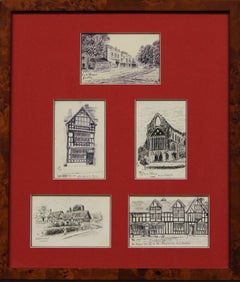
FIve c1910s Pen
Ink Postcard Drawings
Located in Bristol, CT
Classic hand-drawn c1910s framed postcards in pen & ink by R Weniger from England addressed to (the philanthropist) Seymour H Knox of Buffalo, NY
Image Sz: 14 1/2"H x 11 3/4"W
Fram...
Category
1910s Art
Materials
Paper, Pen
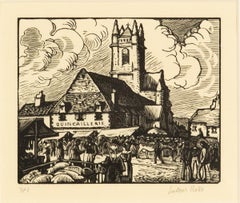
Quincaillerie by Ludovic-Rodo Pissarro - Wood engraving
Located in London, GB
Quincaillerie by Ludovic-Rodo Pissarro (1878 - 1952)
Wood engraving
10.4 x 12.6 cm (4 ¹/₈ x 5 inches)
Initialled in the plate, signed lower right, Ludovi...
Category
Post-Impressionist 1910s Art
Materials
Woodcut
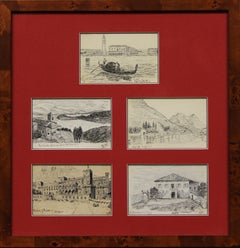
5 Postcard Pen
Ink c1910s Drawings from Italy
Located in Bristol, CT
Framed set of 5 pen & ink hand-drawn by R. Weniger postcards from Italy addressed to the philanthropist Seymour H Knox of Buffalo, NY
Art Sz: 12 1/2"H x 12"W
Frame Sz: 16 3/4"H x 1...
Category
1910s Art
Materials
Paper, Ink, Pen
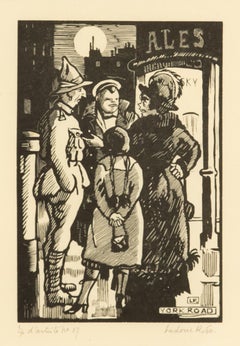
York Road by Ludovic-Rodo Pissarro - Wood engraving
Located in London, GB
York Road by Ludovic-Rodo Pissarro (1878-1952)
Wood engraving
13.2 x 9 cm (5 ¹/₄ x 3 ¹/₂ inches)
Initialed and titled in the plate, signed lower right, Ludovic Rodo and numbered lowe...
Category
Post-Impressionist 1910s Art
Materials
Engraving