1930s Art
to
821
3,412
1,191
904
523
344
Overall Width
to
Overall Height
to
7,567
21,304
159,313
232,436
1,975
2,257
4,946
6,422
5,840
13,335
19,800
25,719
18,319
13,594
5,389
2,465
488
381
228
127
114
102
71
12
12
5
2
2
3,506
2,399
312
3,840
1,721
1,621
1,140
1,101
709
452
439
439
365
356
317
288
287
275
254
227
220
214
195
2,019
1,534
1,364
1,156
867
261
105
91
83
61
1,749
1,141
3,335
2,679
Period: 1930s
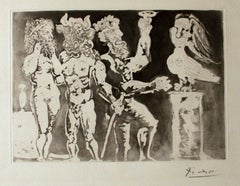
Personnages Masqués et Femme Oiseau - Etching by Pablo Picasso - 1934
Located in Roma, IT
Etching and Aquatint on Montval paper.
Hand Signed. Edition of 260 prints (not numbered and generally not signed).
Plate 24 from "La Suite Vollard".
Catalogue Bloch no. 227; Baer 44...
Category
Cubist 1930s Art
Materials
Paper, Etching, Aquatint
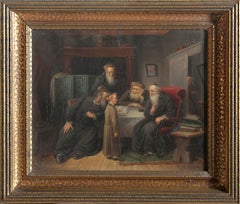
Hebrew School, Judaica Oil Painting by Bernd Werner
By Bernd Werner
Located in Long Island City, NY
Artist: Bernd Werner
Title: Hebrew School
Year: circa 1930
Medium: Oil on Canvas, signed
Size: 10.5 x 12.5 in. (26.67 x 31.75 cm)
Frame Size: 14 x 16 inches
Category
Impressionist 1930s Art
Materials
Canvas, Oil
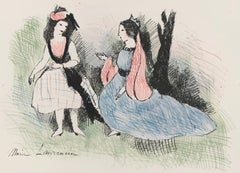
Marie Laurencin, Alice and the Queen, Alice
s Adventures in Wonderland, 1930
Located in Southampton, NY
This exquisite lithograph by Marie Laurencin (1883–1956), titled Alice et la Reine (Alice and the Queen), from the folio Les aventures d'Alice au pays des merveilles (Alice's Adventu...
Category
Modern 1930s Art
Materials
Lithograph
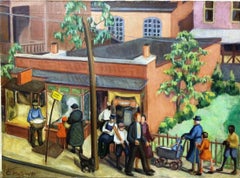
Shopping Day
Located in Los Angeles, CA
>
> Painter George Melville Smith (1879-1979) Painter, illustrator born in Chicago. Smith began formal art studies at the School of the Art Institute of Chicago at the age of seventeen, after first studying as an architect's apprentice. In 1925-26 he studied in Paris under Andre Lhote, then worked as a painter in France, Spain, England and Italy. He exhibited at the Art Institute of Chicago four times during the 1930s, and was included in the Whitney Museum's 1933 exhibit which also featured Grant Wood...
Category
American Modern 1930s Art
Materials
Canvas, Oil
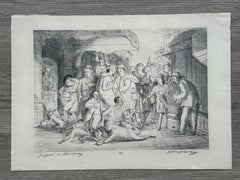
Black Broadway Street Dancers
Located in Wilton Manors, FL
Beautiful WPA era NYC street scene by American artist, Albert Sway (b.1913). Jiggers on Broadway, ca. 1935. Lithograph on paper, image measures 9 x 13 inches. Full sheet measuring 11...
Category
American Realist 1930s Art
Materials
Paper, Ink
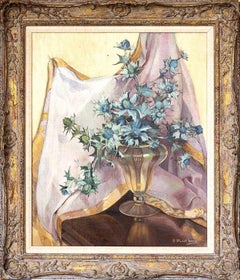
Thistle in a Glass Vase - Large Modern British Still Life Oil Painting
Located in Sevenoaks, GB
A beautiful large 1930's Modern British oil on canvas depicting thistle in a glass vase by Helen Stuart Weir RBA ROI.
Excellent quality early work by this important female artist, w...
Category
Impressionist 1930s Art
Materials
Canvas, Oil
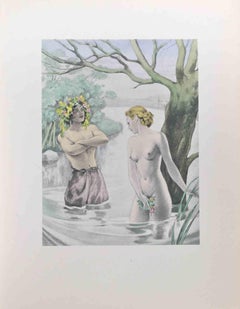
Adam and Eve - Lithograph by Umberto Brunelleschi - 1930s
Located in Roma, IT
Adam and Eve is a color lithograph on ivory paper, created by the Italian artist Umberto Brunelleschi (Montemurlo 1879- Paris 1949).
Illustration for “Tales and Short Stories” by La...
Category
Art Nouveau 1930s Art
Materials
Lithograph
Au Circus
By Dietz Edzard
Located in Sheffield, MA
Dietz Edzard
German, 1893-1963
Au Circus
Oil on canvas
22 by 31 in. W/frame 32 by 41 in.
Signed lower right
Dietz Edzard was born in Bremen in 1893 Germany. He traveled extensive...
Category
Post-Impressionist 1930s Art
Materials
Oil
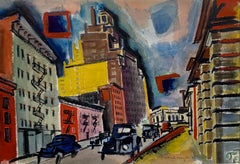
Christopher Street (abstract Greenwich Village cityscape)
Located in Wilton Manors, FL
De Hirsh Margules (1899-1965). Christopher Street, 1939. Watercolor on Arches wove paper. Signed and dated in pencil by artist lower margin. Sheet measures 15.5 x 20 inches. Window in matting measures 15 x 19 inches. Framed measurement: 23 x 30 inched. Bears fragment of original label affixed on verso. Incredibly vibrant and saturated color with no fading or toning of sheet.
Provenance: Babcock Galleries, NYC
Exhibited: The American Federation of Arts Traveling Exhibition.
From the facade of The Waverly at Christopher is depicted One Christopher Street, the 16-story Art Deco residential building erected in 1931. It is not a casual coincidence that the structure appears in this cityscape: 1 Christopher Street is the subject. The original intention of this project was to transform the neighborhood, bring a bit of affluence and make a bid to rival the Upper West Side. Margules, a sensitive aesthete, understood how a massive piece of architecture such as One changes a neighborhood. Sound, scale and focal points are forever altered. A pedestrian's sense of depth and distance becomes pronounced. All of these factors contribute to the intent behind this image. Tall buildings disrupt the human scale, change the skyline and carve up space. In this piece, negative space conforms to the man-made geometries. Clouds become gems fixed in settings.
De Hirsh Margules (1899–1965) was a Romanian-American "abstract realist" painter who crossed paths with many major American artistic and intellectual figures of the first half of the 20th century. Elaine de Kooning said that he was "[w]idely recognized as one of the most gifted and erudite watercolorists in the country". The New York Times critic Howard Devree stated in 1938 that "Margules uses color in a breath-taking manner. A keen observer, he eliminates scrupulously without distortion of his material." Devree later called Margules "one of our most daring experimentalists in the medium"
Margules was also a well-known participant in the bohemian culture of New York City's Greenwich Village, where he was widely known as the "Baron" of Greenwich Village.[1] The New York Times described him as "one of Greenwich Village's best-known personalities" and "one of the best known and most buoyant characters about Greenwich Village.
Early Life
De Hirsh Margules was born in 1899 in the Romanian city of Iași (also known as Iasse, Jassy, or Jasse). When Margules was 10 weeks old, his family immigrated to New York City. Both of his parents were active in the Yiddish theater, His father was Yekutiel "Edward" Margules, a "renowned Jewish actor-impresario and founder of the Yiddish stage." Margules' mother, Rosa, thirty-nine years younger than his father, was an actress in the Yiddish theater and later in vaudeville. Although Margules appeared as a child actor with the Adler Family[11] and Bertha Kalich, his sister, Annette Margules, somewhat dubiously continued in family theater and vaudeville tradition, creating the blackface role of the lightly-clad Tondelayo (a part later played on film Hedy Lamarr) in Earl Carroll's 1924 Broadway exoticist hit, White Cargo. Annette herself faced stereotyping as an exotic flower: writing about her publicist Charles Bouchert stated that "Romania produces a stormy, temperamental type of woman---a type admirably fitted to portray emotion." His brother Samuel became a noted magician who appeared under the name "Rami-Sami." Samuel later became a lawyer, representing magician Horace Goldin, among others. A family portrait including a young De Hirsh, a portrait of Rosa and Annette together, and individual photos of Rosa and Edward can be found on the Museum of the City of New York website.
At around age 9 or 10, Margules took art classes with the Boys Club on East Tenth Street, and his first taste of exhibition was at a student art show presented by the club. By age 11, he had won a city-wide prize (a box camera) at a children's art show presented by the department store Wanamakers.
As a young teenager, Margules was already displaying a characteristic kindness and loyalty. Upon hearing that two friends (one of them was author Alexander King), were in trouble for breaking a school microscope, the nearly broke Margules gave them five dollars to repair the microscope . Margules had to approach a wealthy man that Margules had once saved on the subway from a heart attack. Margules didn't reveal the source of the five dollars to King until twenty-five years later.
In his late teens, Margules studied for a couple of months in Pittsburgh with Edwin Randby, a follower of Western painter Frederic Remington. Thereafter he pursued a two-year course of studies in architecture, design and decoration at the New York Evening School of Art and Design, while working as a clerk during the day at Stern's Department Store. He was encouraged in these artistic pursuits by his neighbor, the painter Benno Greenstein (who later went by the name of Benjamin Benno).
Artistic career
In 1922, Margules began work as a police reporter for the City News Association of New York .Margules then considered himself something of an expert on art, and the painter Myron Lechay is said to have responded to some unsolicited analysis of his work with the remark "Since you seem to know so much about it, why don't you paint yourself?" This led to study with Lechay and a flurry of painting.
Margules' first show was in 1922 at Jane Heap's Little Review Gallery. Thereafter Margules began to participate in shows with a group including Stuart Davis, Jan Matulka, Buckminster Fuller (exhibiting depictions of his "Dymaxion house") in a gallery run by art-lover and restaurateur Romany Marie on the floor above her cafe.
Jane Heap, left, with Mina Loy and Ezra Pound
During the 1920s, Margules traveled outside of the country a number of times. In 1922, with the intent of reaching Bali, he took a job as a "'wiper on a tramp steamer where [he] played nursemaid to the engine." He reached Rotterdam before he turned back. He would return to Rotterdam shortly thereafter.
In 1927, Margules took a lengthy leave of absence from his day job as a police reporter in order to travel to Paris, where he "set up a studio in Montmartre's Place du Tertre, on the top floor of an almost deserted hotel, a shabby establishment, lacking both heat and running water." He studied at the Louvre and traveled to paint landscapes in provincial France and North Africa.
Margules also joined the "Noctambulist" movement and experimented with painting and showing his artwork in low light.Jonathan Cott wrote that:
the painter De Hirsch Margulies sat on the quays of the Seine and painted pictures in the dark. In fact, the first exhibition of these paintings, which could be seen only in a darkened room, took place in [ Walter Lowenfels'] Paris apartment.
Elaine de Kooning remarked that studying the works of the Noctambulists confirmed Margules' "direction toward the use of primary colors for perverse effects of heavy shadow."
It was also in Paris that Margules initially conceived his idea of "Time Painting", where a painting is divided into sectors, each representing a different time of day, with color choices meant to evoke that time of day.
In Paris, his social circle included Lowenfels, photographer Berenice Abbott, publisher Jane Heap, composer George Anthiel, sculptor Thelma Wood, painter André Favory, writer Norman Douglas, writer and editor George Davis, composer and writer Max Ewing, and writer Michael Fraenkel.
Upon his return to New York in 1929, Margules attended an exhibition of John Marin's paintings.
While at the exhibition, he "launched into an eloquent explanation of Marin to two nearby women", and was overheard by an impressed Alfred Stieglitz. The famous photographer and art promoter invited Margules to dine with his wife, the artist Georgia O'Keeffe, and his assistant, painter Emil Zoler. Stieglitz thereafter became a friend and mentor to Margules, becoming for him "what Socrates was to his friends."
Alfred Stieglitz
Stieglitz introduced Margules to John Marin, who quickly became the most important painterly influence upon Margules. Elaine de Kooning later noted that Margules was "indebted to Marin and through Marin to Cézanne for his initial conceptual approach - for his constructions of scenes with no negative elements, for skies that loom with the impact of mountains." Margules himself said that Marin was his "father and ... academy." The admiration was by no means unreciprocated: Marin said that Margules was "an art lover with abounding faith and sincerity, with much intelligence and quick seeing." Stieglitz also introduced Margules to many other artistic and intellectual figures in New York.
With the encouragement of Alfred Stieglitz, Margules in 1936 opened a two-room gallery at 43 West 8th Street called "Another Place." Over the following two years there were fourteen solo exhibitions by Margules and others, and the gallery was well-respected by the press. It was in this gallery that the painter James Lechay, Myron's brother, exhibited his first painting.
In 1936, Margules first saw recognition by major art museums when both the Museum of Modern Art and the Museum of Fine Arts, Boston purchased his works.
In 1942, Margules gave up working as a police reporter, and apparently dedicated himself thereafter solely to an artistic vocation.
"The Baron of Greenwich Village"[edit]
Margules made his mark not only as an artist, but also as an outsized personality known throughout Greenwich Village and beyond.
To local residents, Margules was known as the "Baron", after Baron Maurice de Hirsch, a prominent German Jewish philanthropist. Margules was easily recognizable by the beret he routinely wore over his long hair. Writer Charles Norman said that he "dressed with a flair for sloppiness."
He was said to "know everybody" in Greenwich Village, to the extent that when the novelist and poet Maxwell Bodenheim was murdered, Margules was the first one the police sought to identify the body. Margules' letters show him interacting with art world figures such as Sacha Kolin, John Marin and Alfred Stieglitz, as well as with prominent figures outside the art world such as polymath Buckminster Fuller and writer Henry Miller.
Most of his friends and acquaintances found Margules a generous and voluble man, given to broadly emotionally expressive gestures and acts of kindness and loyalty. In 1929, he exhibited an example of this loyalty and fellow-feeling when he appeared in court to fight what the wrongful commitment of his friend, writer and sculptor Alfred Dreyfuss, who appeared to have been a victim of an illicit attempt to block an inheritance.
The Greenwich Village chronicler Charles Norman described the bone-crushing hugs that Margules would routinely bestow on his friends and acquaintances, and speaks of the "persuasive theatricality" that Margules seemed to have inherited from his actor parents. Norman also wrote about Margules' routine acts of kindness, taking in homeless artists, constantly feeding his friends and providing the salvatory loan where needed. Norman also notes that Margules was blessed with a loud and good voice, and was apt to sing an operatic air without provocation.
The writer and television personality Alexander King said
I think the outstanding characteristics of my friend's personality are affirmation, emphasis, and overemphasis. He chooses to express himself predominantly in superlatives and the gestures which accompany his utterances are sometimes dangerous to life and limb. Of the bystanders, I mean.
King also spoke with affectionate amusement about Margules' pride in his cooking, speaking of how "if he should ever invite you to dinner, he may serve you a hamburger with onions, in his kitchen-living room, with such an air of gastronomic protocol, such mysterious hints and ogliing innuendoes, as if César Ritz and Brillat-Savarin had sneaked out, only a moment before, with his secret recipe in their pockets."
Margules was such a memorable New York personality that comic book writer Alvin Schwartz imagined him at the Sixth Avenue Cafeteria in a risible yet poignant debate with Clark Kent about whether Superman had the ability to stop Hitler.
Margules' entrenchment in the Greenwich Village milieu can be seen in a photograph from Fred McDarrah's "Beat Generation Album" of a January 13, 1961 writers' and poets' meeting to discuss "The Funeral of the Beat Generation", in Robert Cordier [fr]'s railroad flat at 85 Christopher Street. Among the people in the same photograph are Shel Silverstein...
Category
American Modern 1930s Art
Materials
Watercolor, Rag Paper

$6,000 Sale Price
20% Off
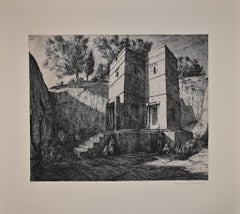
Lalibela - Etching by Lino Bianchi Barriviera - 1939
Located in Roma, IT
Lalibela is an original etching on paper realized by Lino Bianchi Barriviera in 1939-1943.
Hand-signed in pencil. Image Dimensions: 36 x 45 cm.
Nu...
Category
Modern 1930s Art
Materials
Etching
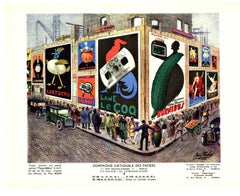
Original Affiches Paul Mohr Compagnie Nationale des Papers 1932 vintage poster
Located in Spokane, WA
Original small format poster Affiches Paul Mohr, 1932. Archival linen backed in excellent condition, ready to frame. The rare Paul Mohr posters are incredibly elusive; many have had only one remaining known copy survive. Printing method: Helio-Typo or Typelo.
Before television, beautiful lithographs adorn the streets and walls of Paris and other European cities. Art for the street, art for the public. Weather and rain would destroy these works of art by renowned artists, only to be replaced.
The artist: Paul Gustave Mohr, a French Avant-garde poster designer from the Art Deco period was born Sept. 4, 1890 in Ham, France and died on April 13, 1959 in Paris. He lived most of his life in Paris, and then settled in the small town of Asnieres, France, just outside of Paris. He attended the Sorbonne University, as well as several art schools. During World War I, he was a pilot in the French Army from 1914-1917. Paul Mohr married Jeanne Levy in 1917 and they had three daughters: Helene, Genevieve, and Jacqueline.
As an artist, he designed advertising posters from 1920 to 1940. His
posters advertised Wonder cycles, Dainty cycles, Lustucru pasta, Banania sugar, Bremsit brakes, Champigneulles beer, L'Union beer, Dubonnet wine, as well as shoes and ham.
This information was provided to me by my mother, Helene Mohr Breitenbucher, who was his eldest daughter. Carol Schuler (granddaughter)
Advertising posters, the affiches of Paul Mohr. This is an original advertising poster for the affiches (posters) created by the master artist Paul Mohr (1890-1959). Archival linen backed in very good condition. No stains, no tears, no paper loss. Grade A condition. Ready to frame. Compagnie Nationale des Papier, Paris.
The crowd on the street looks up in amazement at the art deco-style images that the artist created. Images on the wall feature incredible image that this artist created such as Lustucru, Amer...
Category
Art Deco 1930s Art
Materials
Offset
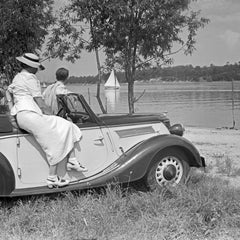
Ford Eifel Tour with a couple – 1935
Located in Cologne, DE
Lakeside scene - Germany, 1935 – Photograph by Heinz Pollmann
This graceful lakeside scene, taken by Heinz Pollmann in 1935, shows a couple seated in a stylish Ford Eifel convertible...
Category
Modern 1930s Art
Materials
Black and White
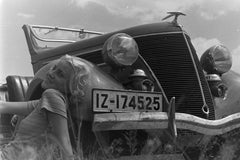
Ford Tour with a young woman - 1937
Located in Cologne, DE
Germany, 1937 – Photograph by Peter Cornelius
In this expressive low-angle portrait by Peter Cornelius, taken in 1937, a young woman sits relaxed in the grass, leaning contentedly ag...
Category
Modern 1930s Art
Materials
Black and White
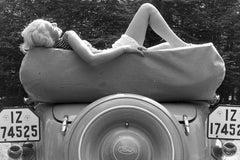
Sunbathing on a Ford - 1938
Located in Cologne, DE
Germany, 1938 – Photograph by Peter Cornelius
In this beautifully composed summer scene, captured by Peter Cornelius in 1938, a young woman reclines atop the folded soft-top of a For...
Category
Modern 1930s Art
Materials
Black and White
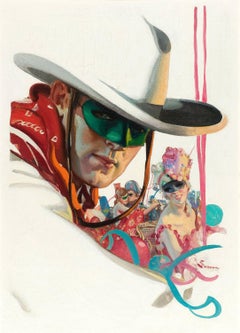
Collier
s Magazine Cover, January 1931
By E.M. Jackson
Located in Fort Washington, PA
Medium: Oil on Canvas
Signature: Signed Lower Right
Collier's Magazine Cover, January 1931
As a child, Jackson shoed early interest in drawing, and took Saturday morning lessons from the only are teacher in town, but went on to graduate as an architect from Georgia Tech...
Category
Other Art Style 1930s Art
Materials
Canvas, Oil
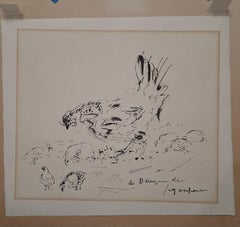
Andre Dunoyer De Segonzac (French, 1884-1974) Pen
Ink "Chickens" C.1930
s
Located in San Francisco, CA
Andre Dunoyer de Segonzac (French, 1884-1974) Pen & Ink "Chickens" c.1930's
Original pen and ink on paper by listed French artist Andre Dunoyer de Segonzac.
A mother hen with her b...
Category
Expressionist 1930s Art
Materials
Ink, Paper
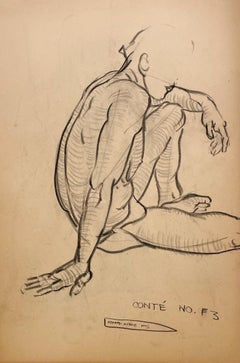
A Fine 1930s, Modern Academic Figure Study Drawing of a Seated Male Nude Model
Located in Chicago, IL
A Fine 1930s, Modern Academic Figure Study Drawing of a Seated Male Nude Model by Notable Chicago Artist, Harold Haydon (Am. 1909-1994). An exceptionally well executed, early 1930s ...
Category
American Modern 1930s Art
Materials
Paper, Charcoal
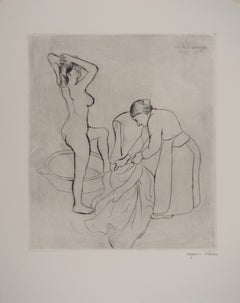
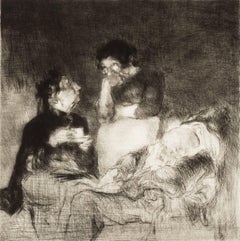
Young Woman and Old Woman - Original Etching Signed (Petrides #E24)
Located in Paris, IDF
Suzanne VALADON (1865-1938)
Young Woman and Old Woman, 1932
Original etching
Signed in pencil
On BFK Rives vellum 47 x 37 cm (c. 18.5 x 14.5 in)
INFORMATION : Printed in 1932, this...
Category
Academic 1930s Art
Materials
Etching
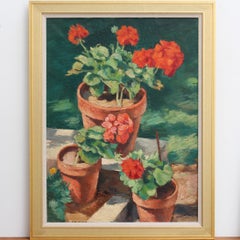
Potted Flowers
Located in London, GB
'Potted Flowers', oil on canvas, by Charles Kvapil (1933). Potted red geraniums symbolise happiness, good health, good wishes, and friendship. They are ...
Category
Expressionist 1930s Art
Materials
Canvas, Oil
$3,685 Sale Price
40% Off
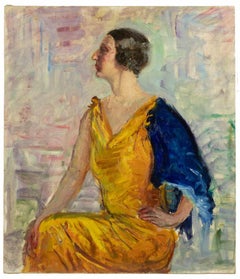
Portrait of Woman - Oil Paint by Antonio Feltrinelli - 1930s
Located in Roma, IT
Portrait of Woman is an original oil on canvas realized in 1930s by Antonio Feltrinelli.
Very good condition. Not signed.
Antonio Feltrinelli (Milan, 1887 – Gargnano, 1942)
He was ...
Category
Modern 1930s Art
Materials
Oil
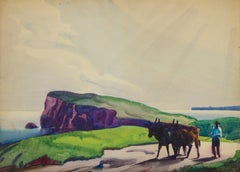
Oxen on Road, Gaspé, Canada, Early 20th Century Cleveland School
By Frank Wilcox
Located in Beachwood, OH
Frank Nelson Wilcox (American, 1887-1964)
Oxen on Road, Gaspé, Canada, 1932
Watercolor on board
Signed and dated lower right
15.25 x 21 inches
Frank Nelson Wilcox (October 3, 1887 – April 17, 1964) was a modernist American artist and a master of watercolor. Wilcox is described as the "Dean of Cleveland School painters," though some sources give this appellation to Henry Keller or Frederick Gottwald. Wilcox was born on October 3, 1887 to Frank Nelson Wilcox, Sr. and Jessie Fremont Snow Wilcox at 61 Linwood Street in Cleveland, Ohio. His father, a prominent lawyer, died at home in 1904 shortly before Wilcox' 17th birthday. His brother, lawyer and publisher Owen N. Wilcox, was president of the Gates Legal Publishing Company or The Gates Press. His sister Ruth Wilcox was a respected librarian.
In 1906 Wilcox enrolled from the Cleveland School of Art under the tutelage of Henry Keller, Louis Rorimer, and Frederick Gottwald. He also attended Keller's Berlin Heights summer school from 1909. After graduating in 1910, Wilcox traveled and studied in Europe, sometimes dropping by Académie Colarossi in the evening to sketch the model or the other students at their easels, where he was influenced by French impressionism. Wilcox was influenced by Keller's innovative watercolor techniques, and from 1910 to 1916 they experimented together with impressionism and post-impressionism. Wilcox soon developed his own signature style in the American Scene or Regionalist tradition of the early 20th century. He joined the Cleveland School of Art faculty in 1913. Among his students were Lawrence Edwin Blazey, Carl Gaertner, Paul Travis, and Charles E. Burchfield. Around this time Wilcox became associated with Cowan Pottery.
In 1916 Wilcox married fellow artist Florence Bard, and they spent most of their honeymoon painting in Berlin Heights with Keller. They had one daughter, Mary. In 1918 he joined the Cleveland Society of Artists, a conservative counter to the Bohemian Kokoon Arts Club, and would later serve as its president. He also began teaching night school at the John Huntington Polytechnic Institute at this time, and taught briefly at Baldwin-Wallace College.
Wilcox wrote and illustrated Ohio Indian Trails in 1933, which was favorably reviewed by the New York Times in 1934. This book was edited and reprinted in 1970 by William A. McGill. McGill also edited and reprinted Wilcox' Canals of the Old Northwest in 1969. Wilcox also wrote, illustrated, and published Weather Wisdom in 1949, a limited edition (50 copies) of twenty-four serigraphs (silk screen prints) accompanied by commentary "based upon familiar weather observations commonly made by people living in the country."
Wilcox displayed over 250 works at Cleveland's annual May Show. He received numerous awards, including the Penton Medal for as The Omnibus, Paris (1920), Fish Tug on Lake Erie (1921), Blacksmith Shop (1922), and The Gravel Pit (1922). Other paintings include The Trailing Fog (1929), Under the Big Top (1930), and Ohio Landscape...
Category
American Modern 1930s Art
Materials
Watercolor
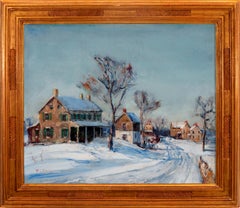
"Road to Argus"
Located in Lambertville, NJ
Jim’s of Lambertville Fine Art Gallery is proud to offer this piece by Walter Emerson Baum (1884 - 1956).
Born in Sellersville, Pennsylvania, Walter Baum was one of the only members...
Category
American Impressionist 1930s Art
Materials
Canvas, Oil
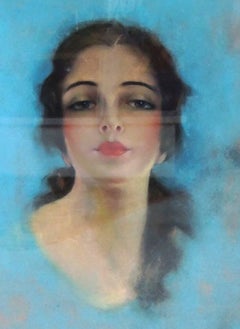
Miss Personality
Calendar Illustration
Located in Fort Washington, PA
Medium: Pastel on Board
Signature: Signed Lower Left
"Miss Personality", American Art Works original art for a calendar.
Category
1930s Art
Materials
Pastel, Board
The Yankee
— America
s Cup, 1934
By Jacques La Grange
Located in Myrtle Beach, SC
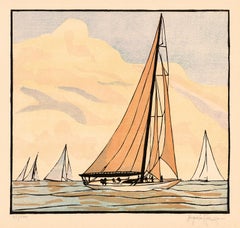
Jacques La Grange, 'The Yankee', color woodcut, edition 500, 1934. Signed and numbered '25/500' in pencil. A fine impression, with fresh colors, on cream wove paper, with margins (1 1/8 to 1 1/4 inches), in excellent condition. A work from La Grange’s celebrated series of woodcuts 'Drama and Color in the America's Cup Races'. Image size 10 x 10 11/16 inches (254 x 271 mm); sheet size 12 1/4 x 13 1/4 inches (311 x 337 mm). Archivally matted to museum standards, unframed.
When the artist created this print in 1934, the 'Yankee' was one of the most promising yachts eligible for the America's Cup but ultimately 'Rainbow' was chosen to defend against England's 'Endeavor' in that year's race. The 'Endeavor' was built for Thomas Sopwith who used his aviation design expertise to ensure the yacht was the most advanced of its day with a steel hull and mast. She was launched in 1934 and won many races in her first season but the Cup challenge was blighted by a strike of Sopwith's professional crew prior to departing for America. Forced to rely mainly on keen amateurs, who lacked the necessary experience, the campaign failed. 'Rainbow' won the series 4–2. This was one of the most contentious of the America's Cup battles and prompted the headline "Britannia rules the waves and America waives the rules."
ABOUT THE ARTIST
Jacques La Grange was born in Clanwilliam (near Cape Town) in South Africa in 1895. He studied at London University and later immigrated to the United States. La Grange established himself as a painter, illustrator, and printmaker specializing in nautical subjects. He and his wife, Helen La Grange, published 'Drama and Color in the America's Cup Races' in 1934 and 'Clipper Ships of America and Great Britain 1833-1869', in 1936. Both were deluxe hardcover limited edition volumes with signed original color woodblock prints. La Grange had solo exhibitions at the Buchanan Gallery in 1929; the Babcock Gallery and the 56th Street Gallery, New York, in 1930; and at the Nicholas Roerich...
Category
American Modern 1930s Art
Materials
Woodcut
$560 Sale Price
20% Off
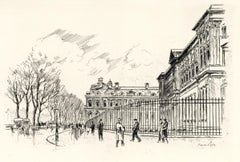
"Les musees" original etching
Located in Henderson, NV
Medium: original etching. This impression on Canson et Montgolfier wove paper was printed in 1937 in an edition of 500 for the "Paris 1937" portfolio. Printed at the atelier of Jean-...
Category
1930s Art
Materials
Etching
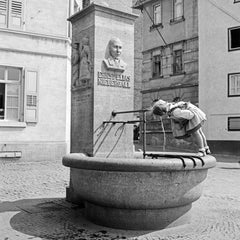
Girl at Ernst Elias Niebergall fountain Darmstadt, Germany 1938 Printed Later
Located in Cologne, DE
One of the photographers at Mauritius Publishing based in Berlin was Karl Heinrich Lämmel. Born on 30 July 1910 in Riesa, Saxony, he has been missing since April 1945. In the thirties, Karl Heinrich Lämmel produced several photographic reports of cities, including Munich and Cologne. Photographs that have yet to be seen and appreciated. Lämmel's pictures show a different view of Germany. His documentation is an unparalleled and intriguing insight into the working and everyday life of the time. Impressive images of cities and their architecture before the destruction of WWII .
The print is new, a Premium-FineArt-Print ( Hahnemühle 308g ), it comes in a secure role without passpartout and frame to reduce shipping cost. This sizes are limited to 25 copies per size.
Description: Impression aus Darmstadt: ein kleines Mädchen trinkt Wasser am Ernst Elias Niebergall Brunnen, Deutschland 1930er Jahre. Impression from Darmstadt: a little girl drinking...
Category
Modern 1930s Art
Materials
Black and White
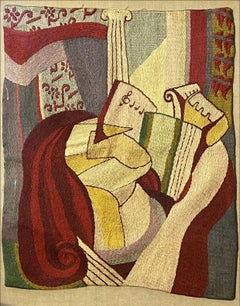
Tennessee WPA Textile - Musical Abstraction (Untitled)
Located in Los Angeles, CA
Musical Abstraction (Untitled), c. 1935 - 1942, handwoven and embroidered textile on linen, 23 1/2 x 19 1/2 inches, label verso reads "Tenn. WPA Project handwoven / Related Art Dep. ...
Category
American Modern 1930s Art
Materials
Textile
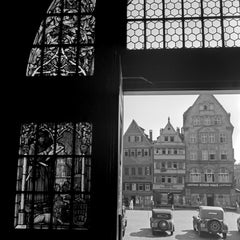
View to shopping passage, Stuttgart Germany 1935, Printed Later
Located in Cologne, DE
One of the photographers at Mauritius Publishing based in Berlin was Karl Heinrich Lämmel. Born on 30 July 1910 in Riesa, Saxony, he has been missing since April 1945. In the thirtie...
Category
Modern 1930s Art
Materials
Black and White
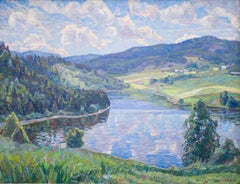
Landscape from Nordingrå, 1935 by Ultramarine Johansson
Located in Stockholm, SE
Carl Johansson, also known as "Ultramarin Johansson," was a Swedish artist born in 1863 and known for his distinctive blue-toned paintings. His work often depicted landscapes, seascapes, and cityscapes, capturing the beauty and essence of Sweden's natural landscapes.
We are proud to offer one of his late works from 1935 for sale. This painting depicts a beautiful landscape from Nordingrå, a small village situated on the High coast of Sweden. The beauty of Nordingrå has captured many artists in the 19th-century, inspiring many famous painters, including Helmer Osslund...
Category
Post-Impressionist 1930s Art
Materials
Canvas, Oil
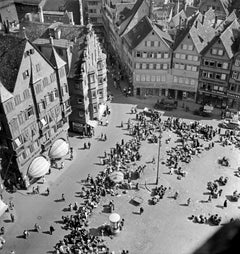
View from belfry of Stuttgart city hall, Stuttgart Germany 1935, Printed Later
Located in Cologne, DE
One of the photographers at Mauritius Publishing based in Berlin was Karl Heinrich Lämmel. Born on 30 July 1910 in Riesa, Saxony, he has been missing since April 1945. In the thirtie...
Category
Modern 1930s Art
Materials
Black and White
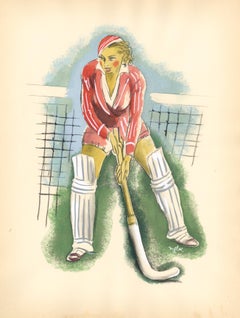
"Le Hockey" pochoir for Les Joies du Sport
Located in Henderson, NV
Medium: pochoir. Printed in Paris in 1932 on Velin du Marais paper at the atelier of Daniel Jacomet for the Les Joies du Sport portfolio and issued in an edition of 750. This was pub...
Category
1930s Art
Materials
Lithograph, Stencil
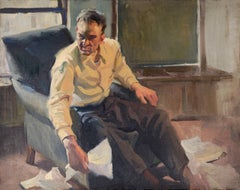
Portrait of a Man in Armchair, Mid Century Short Story Illustration
Located in Soquel, CA
Excellent figurative oil painting of a man seated in an armchair with papers strewn about the interior space by Charles Ross Kinghan (American, 18...
Category
American Impressionist 1930s Art
Materials
Linen, Oil
$2,120 Sale Price
20% Off
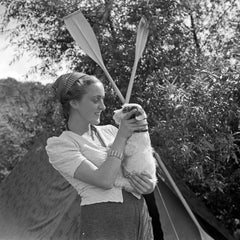
Woman and dog in summer - 1930s
Located in Cologne, DE
Germany, Summer 1936 – Photograph by Heinz Pollmann
In this warm and intimate outdoor portrait by Heinz Pollmann, a young woman stands in front of a canvas tent, cradling her Fox Ter...
Category
Modern 1930s Art
Materials
Black and White
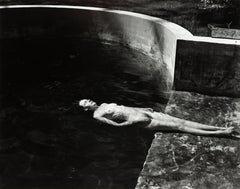
Nude Floating (Charis in Pool)
Located in Pacific Grove, CA
This silver gelatin print made by Edward Weston's son, Cole, in the 1970s or '80s is titled, numbered, stamped and signed by Cole Weston on the back of the mount.
Category
Modern 1930s Art
Materials
Silver Gelatin
$6,000 Sale Price
20% Off
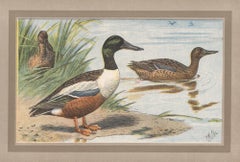
Northern Shoveler, French antique bird duck art illustration print
By P. Mahler
Located in Melbourne, Victoria
'Canard Souchet'
(Northern Shoveler)
French chromolithograph, published in 1931. Printed title lower right of sheet. Plate number top right. From a French series of illustrations o...
Category
Art Deco 1930s Art
Materials
Lithograph
Evening by the Fire
Located in Fort Washington, PA
Magazine illustration for "Home for Lunch," published in Ladies' Home Journal, March 1940. Oil on canvas. 27 x 32 inches. Signed "Sundblom" in lower left image.
Medium: Oil on Canva...
Category
Other Art Style 1930s Art
Materials
Canvas, Oil
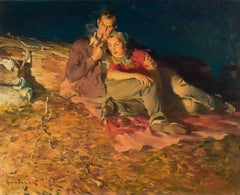
Family scene. Oil sketch on cardboard.
Located in Paris, FR
Family scene. Oil sketch on cardboard.
This work will be recorded in the catalogue raisonné of the work of the artist currently in preparation.
Jules Van Biesbroeck was the son of Jules Evariste van Biesbroeck, a painter of Ghent, but was born in Italy, in Portici, near Naples, while his parents were staying there. (In the 19th century many artists made educational trips to Italy). It was a long visit: the child was two years old by the time the family returned to Ghent.[1]
After a short period of practice with his father, van Biesbroeck was enrolled in the Academy of Fine Arts in Ghent. His first painting, "The Shepherd" (French: Le pâtre), was sold at the Triennale in Ghent. In 1888, when he was only 15 years old, he made his debut at the "Salon des Champs-Elysées" in Paris with his monumental work "The Launch of the Argo" (French: Le lancement...
Category
Post-Impressionist 1930s Art
Materials
Oil

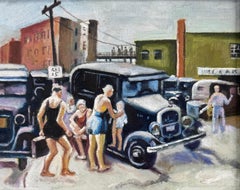
"Study for Long Beach" WPA American Scene Social Realism Modernism Ashcan
Located in New York, NY
"Study for Long Beach" WPA Mid 20th Century American Scene Social Realism Modernism Ashcan
Daniel Ralph Celantano (1902-1980)
"Study for Long Beach"
8 x 10 inches
Oil on artist bo...
Category
American Realist 1930s Art
Materials
Oil, Board
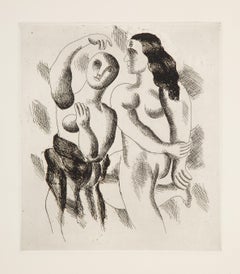
Deux nus Dansant, Modern Drypoint Etching by Fernand Leger
Located in Long Island City, NY
Deux nus Dansant
Fernand Leger, French (1881–1955)
Date: circa 1932
Drypoint Etching
Image Size: 8.5 x 7.5 inches
Size: 14.75 x 11 in. (37.47 x 27.94 cm)
From the collection of the l...
Category
1930s Art
Materials
Drypoint, Etching
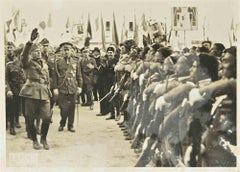
Mussolini Passes in Zapatiè - Vintage Photograph - 1937
Located in Roma, IT
Mussolini Passes in Zapatiè is a black and white vintage photo realized in 1937.
Good condition.
Category
Modern 1930s Art
Materials
Photographic Paper
Study for
Flowers for the President
Located in Fort Washington, PA
Medium: Oil on Canvas
Signature: Unsigned
Sight Size 23.50" x 27.25", Framed 29.50" x 33.00"
The present work is a study for Flowers for the President c...
Category
1930s Art
Materials
Canvas, Oil
The Centenarian
Located in Storrs, CT
The Centenarian. 1930-31. Drypoint. Appleby 144. 10 5/16 x 10 3/8 (sheet 17 3/8 by 12 3/8). Edition 100. A rich impression on cream-colored 'Whatman' laid paper with full margins. Signed and numbered in ink.
Edmund Blampied was a painter, etcher, lithographer and sculptor. Born in 1886 to a family of three boys in St. Martin, Jersey, Blampied became interested in drawing at an early age. After visiting the studio of John Helier Lander in 1899, Blampied decided to make a career as an artist. In 1903 he went to London to attend Lambeth Art School, where he studied etching under Walter Seymour.
In 1905, he joined the Daily Chronicle as an artist. In that year he was awarded a scholarship to Bolt Court Scool of Photo-engraving and Lithography.
In 1912 he left the Chronicle and established his own studio. He earned a living by illustrating novels and short stories.
In 1913, he had his first exhibition at the Leicester Gallery in London. The following year he married Marianne Van Abbé.
During the 1920's, he became a member of the Royal Society of Painter-Etchers and Engravers. During the 1920s Blampied became a member of the Royal Society of Painters-Etchers and Engravers and exhibited in London to critical acclaim. He produced a folio of comic drawings in the 1930s which was published in New York in 1934 and another that was published in London in 1936. The Keeper of Prints and Drawings at the British Museum published a mongraph on his work. His London exhibitions were highly successful.
In 1938, he moved to Bulwarks, St.Aubin in Jersey, but at the onset of the Occupation, had to relocate to Route Orange, St. Brelade. remained there throughout World War II during the German Occupation, despite the fact that his wife was Jewish. During the Occupation he designed bank...
Category
Modern 1930s Art
Materials
Drypoint, Etching
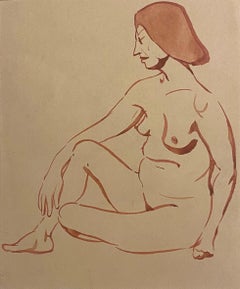
Nude of Woman - Original Watercolor by Jean Delpech - 1930s
By Jean Delpech
Located in Roma, IT
"Nude" is an original drawing in sanguine and watercolor on paper, realized by Jean Delpech (1916-1988).
The state of preservation of the artwork is very good.
Included Passaport....
Category
1930s Art
Materials
Paper, Watercolor
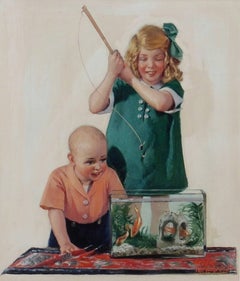
Fisherman’s Luck, Liberty Magazine Cover
Located in Fort Washington, PA
Original cover for Liberty magazine, published March 8, 1930.
Gwendolyn teases little Ulysses for having a bald head after she had taken scissors to it on Valentine’s Day. Lil had frantically taken Ulysses to the barber in an attempt to salvage the remains of his hair, but there wasn’t much left and now his head “felt like a sprouting cactus.” Gwen points to the aquarium on the table and ties a piece of cord to a ruler, attaches a safety pin, and dangles the line above the surface trying to catch a goldfish. “Gwen stood there, stubbornly waiting for the possible turn in her fisherman’s luck!” (Liberty magazine, March 8, 1930, p. 57)
“For the Love o’ Lil: The Picture Story of an American Family”
In 1926, under his long-term contract to produce a cover per week for Liberty magazine, Leslie Thrasher introduced a signature cast of characters that appeared each week, telling a serialized story through his illustrations. Liberty touted its new cover serial as “something no magazine has ever done before…Heretofore, all magazine cover...
Category
1930s Art
Materials
Canvas, Oil
Whorehouse Scene : Prostitutes in Nightie - Original etching
Located in Paris, IDF
Edgar DEGAS (after)
Mimes des Courtisanes de Lucien: one plate
Etching and aquatint
On Rives vellum 25 x 32 cm (c. 10 x 13 inch)
In the early 1920s, Ambroise Vollard (the great art s...
Category
Modern 1930s Art
Materials
Etching, Aquatint
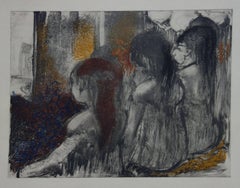
Water on the Rocks - 1930
s Abstracted Landscape
Located in Soquel, CA
Gorgeous painterly landscape oil painting of waves crashing against the rocky shore near a cave by California artist Leslie Bruner Wulff (American, 1890-1968). Signed "Leslie Wulff" ...
Category
Abstract Impressionist 1930s Art
Materials
Canvas, Oil
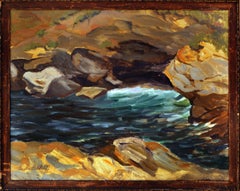
$1,200 Sale Price
20% Off
Relativity, Liberty Magazine Cover
Located in Fort Washington, PA
Original cover for Liberty magazine, published October 17, 1931.
As Lil’s Aunt Ruby, a “social gadabout” and “blithe widow of many years’ standing” arrives at the Jenkins family home for a visit, Sandy tries to hide his irritation once he sees the massive amount of luggage she had in tow. Aunt Ruby shows off an enormous new diamond ring and coyly announces she is to be married that fall and that her new fiance would be arriving shortly. As Lil scrambles up some hors d’oeuvres and cocktails, Sandy hears a car pull up to the house and is shocked to discover that Aunt Ruby’s future husband is none other than Sandy’s boss! (Liberty magazine, October 17, 1931, p. 37)
“For the Love o’ Lil: The Picture Story of an American Family”
In 1926, under his long-term contract to produce a cover per week for Liberty magazine, Leslie Thrasher introduced a signature cast of characters that appeared each week, telling a serialized story through his illustrations. Liberty touted its new cover serial as “something no magazine has ever done before…Heretofore, all magazine cover...
Category
1930s Art
Materials
Canvas, Oil
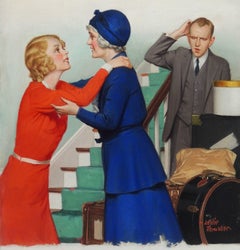
Neighbor to the Sky, Story Illustration for Redbook Magazine, 1936
By Jerome Rozen
Located in Fort Washington, PA
Medium: Oil on Canvas
Signature: Initialed Lower Right
"Margery's voice held him as no other sound ever had." Story illustration for part one of "Neighbor to the Sky" by Gladys Hast...
Category
1930s Art
Materials
Canvas, Oil
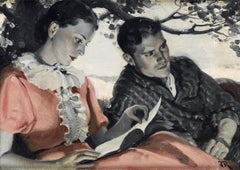
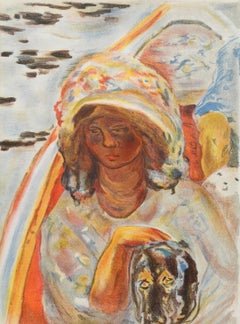
Pierre Bonnard, Young Girl in a Boat, from Verve, Revue Artistique, 1939
Located in Southampton, NY
This exquisite lithograph by Pierre Bonnard (1867–1947), titled Jeune Fille dans une Barque (Young Girl in a Boat), from Verve, Revue Artistique et Litteraire, Vol. II, No. 5–6, orig...
Category
Post-Impressionist 1930s Art
Materials
Lithograph
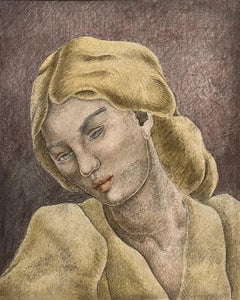
Portrait of Helene Sardeau (The Artist’s Wife)
Located in Los Angeles, CA
(Note: This work is part of our exhibition Connected by Creativity: WPA Era Works from the Collection of Leata and Edward Beatty Rowan)
Fresco, 20 x 16 inches unframed, 22 x 18 inch...
Category
American Modern 1930s Art
Materials
Plaster, Mixed Media
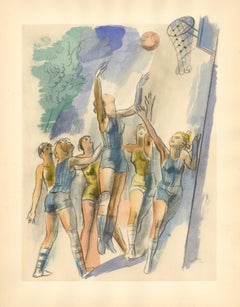
"Le Basket-Ball" pochoir for Les Joies du Sport
Located in Henderson, NV
Medium: pochoir. Printed in Paris in 1932 on Velin du Marais paper at the atelier of Daniel Jacomet for the Les Joies du Sport portfolio and issued in an edition of 750. This was pub...
Category
1930s Art
Materials
Lithograph, Stencil
Place Pigalle
By Lucien Génin
Located in London, GB
'Place Pigalle', oil and gouache on art paper, by Lucien Génin (circa 1930s). Pigalle is well known to tourists who want to experience "Paris by night". It is home to some of Paris' most famous cabarets such as the Moulin Rouge which was immortalised by artist Toulouse-Lautrec. Lautrec's studio was here as was Picasso's, Vincent Van Gogh's and that of Andre Breton. In 1928 Josephine Baker opened her first nightclub next door to Breton's apartment. It is certainly a historical landmark of Paris and well known to so many visitors of this beautiful city. Génin painted Paris and Parisians and this is another one of his charming works among many held by this gallery. Please feel free to peruse them all on this platform. In good overall condition. Newly framed and glazed with anti-reflective glass. Upon request a video may be provided.
About the Artist: After the devastation of the First World War, Lucien Génin (1894 - 1953) left his provincial home in the autumn of 1919 to find his fortune among the lively Parisians in the heart of Montmartre. Génin befriended the painters Frank Will, Gen Paul, Émile Boyer...
Category
1930s Art
Materials
Paper, Oil, Gouache

$1,365 Sale Price
20% Off
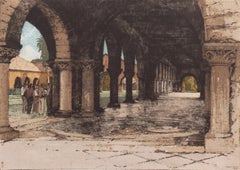
Stanford University, the Quad
, Palo Alto, Vienna Academy, Metropolitan Museum
Located in Santa Cruz, CA
Signed lower center, in pencil, 'Luigi Kasimir' (Austro-Hungarian, 1881-1962), and with title and date, 'Palo Alto, 1931'. at lower right.
Paper dimensions: 12.25 x 16 inches.
N.B. This is an original etching by Luigi Kasimir and is hand-signed by the artist.
The notable etcher and painter, Luigi Kasimir, attended the Vienna Academy of Art where he studied under William Unger, who introduced him to colored etching. Kasimir was influenced by Anders Zorn and Karl von Kalckreuth and he furthered his studies with Sigmund L'Allemand.
A pioneer in the technique of hand-colored etching, Kasimir began exhibiting in 1905 and received immediate critical recognition. Starting with a sketch, usually in pastel, Kasimir would transfer the design, by hand, onto as many as six plates, applying the color by hand to each plate. Luigi Kasimir's work is held in private and public collections throughout the world including in the permanent collections of New York's Metropolitan Museum and Smithsonian Museum, among others.
Reference:
E. Benezit, Dictionnaire des Peintres, Sculpteurs, Dessinateurs, et Graveurs, Jacques Busse...
Category
1930s Art
Materials
Paper, Color, Etching
“Washington Square Park, 1938” NYC Social Realism Female American Artist Oil
By Dorothy Eisner
Located in Yardley, PA
An exceptional, large, early work by American artist Dorothy Eisner (1906-1984).
This painting was recently exhibited at Gracie Mansion in 2019 as part of “She Persists” - a show de...
Category
American Modern 1930s Art
Materials
Canvas, Oil
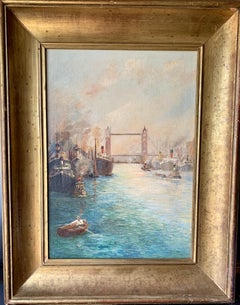
20th century View of Tower Bridge on the Thames in London, with boats, men
Located in Woodbury, CT
Interesting view of the Pool of London, an area known on the Thames near Tower Bridge where freight was loaded and unloaded from the earliest times of the City of London through the ...
Category
English School 1930s Art
Materials
Canvas, Oil
$2,360 Sale Price
20% Off
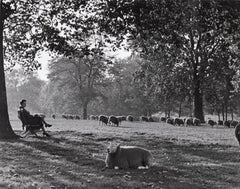
Hyde Park, London, 1934
Located in Middletown, NY
An atmospheric and magical photo by master of the lens, photographic and cinematic, that captures a tranquil corner of Hyde Park. As Suschitzky himself said ...
Category
Modern 1930s Art
Materials
Silver Gelatin
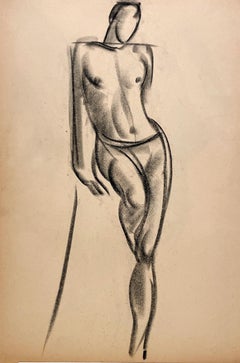
A Fine 1930s, Art Deco Modern Academic Figure Study Drawing, Standing Male Model
Located in Chicago, IL
A Fine 1930s, Art Deco Modern Academic Figure Study Drawing of a Standing Male Nude Model by Notable Chicago Artist, Harold Haydon (Am. 1909-1994). An exceptionally well executed ea...
Category
American Modern 1930s Art
Materials
Charcoal, Paper
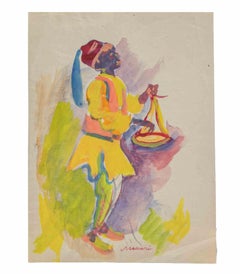
The Arab - Drawing by Mino Maccari - 1930s
By Mino Maccari
Located in Roma, IT
Watercolor on paper realized by Mino Maccari in 1930s.
Hand signed lower right.
Very good condition.
Category
Modern 1930s Art
Materials
Watercolor
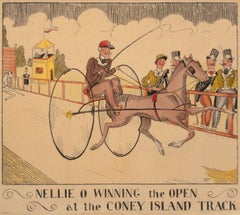
Nellie O Winning the Open at the Coney Island Track
By C.P. Meier
Located in Fort Washington, PA
Date: 1931
Medium: Color Lithograph on Paper
Dimensions: 14.50" x 16.50"
Signature: Signed Lower Right
Category
1930s Art
Materials
Paper, Lithograph
Combat pour Andromède entre Persée et Phinée - From "Les Métamorphoses d
Ovide"
Located in Roma, IT
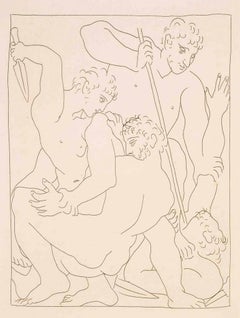
Etching from the portfolio "Les Métamorphoses d'Ovide"publised by Skira in Lausanne, in 1930.
On Arches paper.
Printed by Louis Fort, Paris.
Catalogue Bloch Vol. I n. 108.
Edition of...
Category
Modern 1930s Art
Materials
Etching