Items Similar to 1960
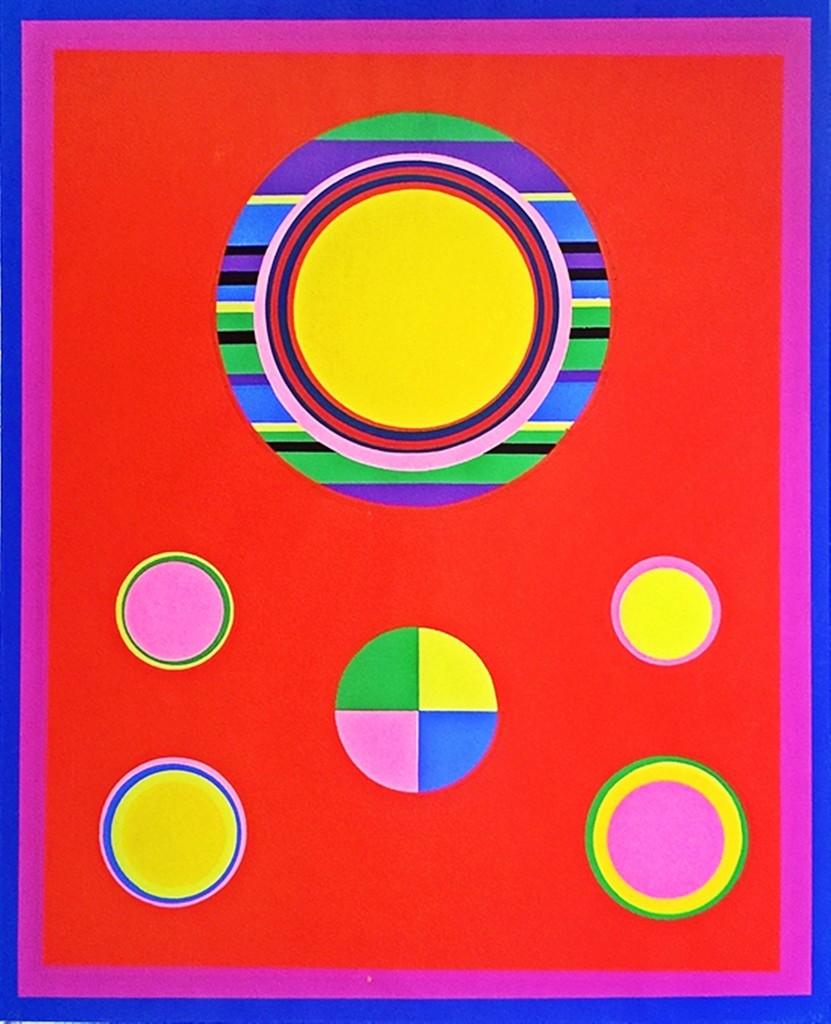
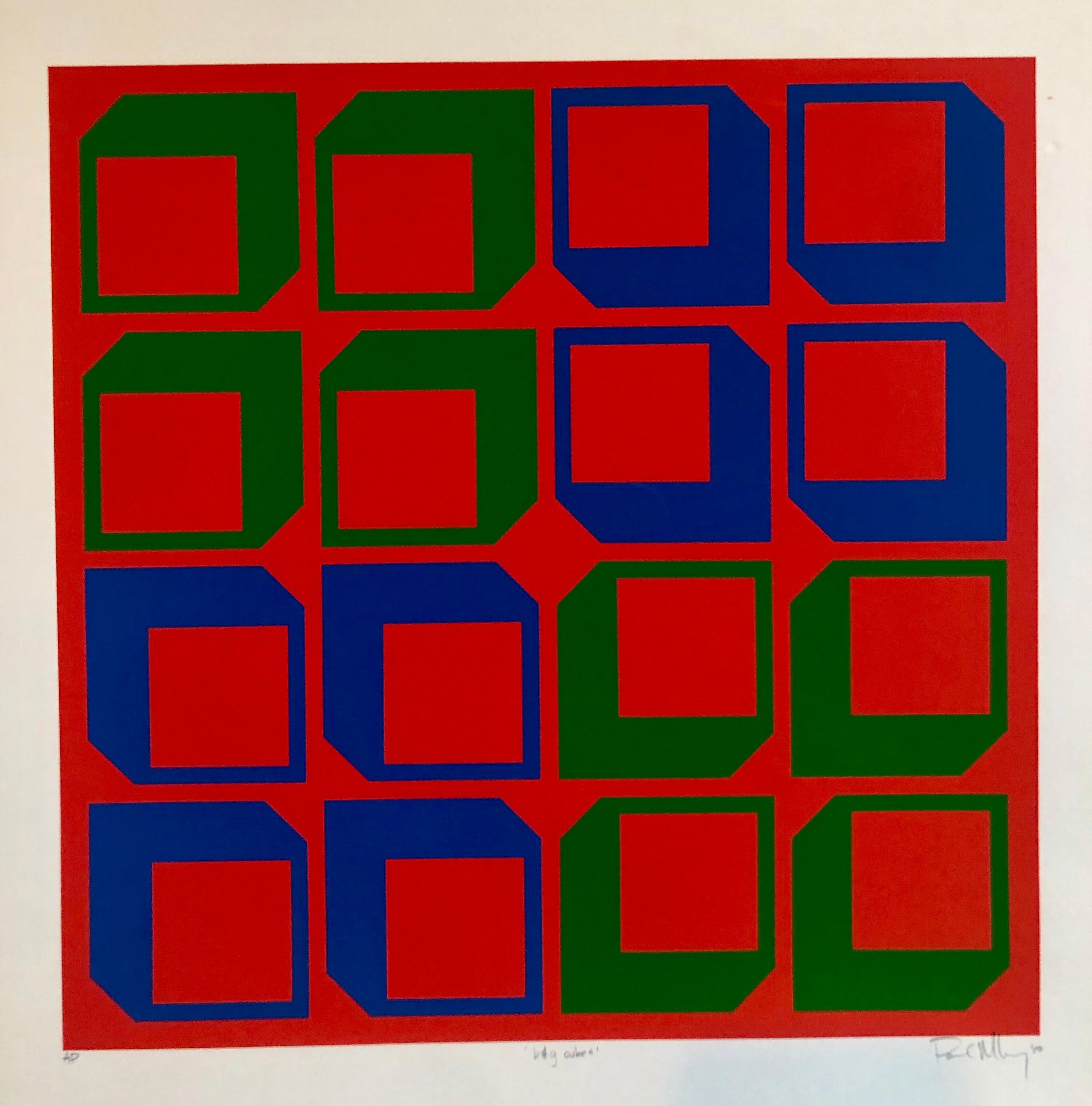
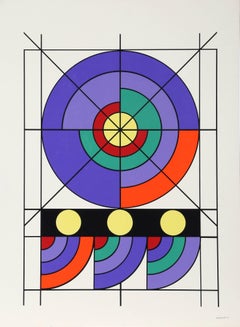
s Baladine Op Art KInetic Screenprint Lithograph Vibrant Mod Neon Colors
Want more images or videos?
Request additional images or videos from the seller
1 of 10
1960
s Baladine Op Art KInetic Screenprint Lithograph Vibrant Mod Neon Colorsc.1960
s
c.1960 s
$450
£342.67
€394.57
CA$637.69
A$685.93
CHF 366.58
MX$8,085.12
NOK 4,621.70
SEK 4,225.11
DKK 2,948.11
About the Item
This is hand signed in pencil. It is not numbered.
This appears to be a silkscreen or serigraph or a multi stone lithograph. It is a great hard edged, geometric, vibrant mid century mod piece done in an almost fluorescent neon color.
This is Op Art, Kinetic in style influenced by Josef Albers, Max Bill and Bauhaus design. Of the era of Pol Bury, Soto, Richard Anuszkiewicz and Victor Vasarely.
Baladine Klossowska ( 1886 — 1969) was a German painter. Originating from an artistic Jewish family with roots in Lithuania, she moved from Breslau, Germany (now Wrocław, Poland) to Paris, France, at the turn of the 20th century, where she was a vivid and active participant in the explosion of artistic experiment then active in the city.
She was mother to controversial modernist painter Balthus as well as the writer Pierre Klossowski and
Born Elisabeth Dorothea Spiro in Breslau, Germany (now Polish Wrocław), to a Jewish family. Her father, Abraham Beer Spiro (Shapiro), was a Lithuanian Jewish cantor, who moved his family from Korelichi in Novogrudok district of Minsk Governorate to Breslau in 1873. In Breslau, he was appointed a Chief cantor of the White Stork Synagogue – one of the two main synagogues of the city. The Spiros were an artistically inclined family. Older brother Eugene Spiro's artistic ambitions.
Spiro married the painter and art historian Erich Klossowski in 1902. The couple left Breslau the same year, and were settled in Paris by 1903. Their sons, Pierre and Balthasar (1908) were born in this new city.
Spiro embraced Paris with a new identity, becoming Baladine Klossowska (out of Balladyna, the heroine of Juliusz Słowacki's romantic drama). Like many women in intellectual and artistic circles in Paris in the first decade of the new century, although preoccupied with tasks of household and home, Kłossowska continued painting, if episodically.
The Klossowskis were forced to leave France in 1914, at the start of World War I, due to their German citizenship. The couple separated permanently in 1917, and Klossowska took her sons to Switzerland. They moved to Berlin in 1921 due to financial pressures. Mother and sons returned to Paris in 1924, where the three for a time lived a materially marginal existence, often dependent upon help from friends and relations, until Pierre and Balthus became established professionally. Balthus, who became rich off of his paintings, later said of these times "'I was poor. The only option was to make a scandal. It worked well. Too well.'"
Klossowska met Bohemian-Austrian poet Rainer Maria Rilke (1875–1926) in 1919. They had previously known of each other in Paris, but had not been more than acquaintances. Rilke, eleven years Klossowska's senior, had during those Paris years socialized with an older generation of artists and intellectuals, while Klossowska and Erich had been young (if well-connected) upcomers.
They moved to Switzerland, finding and directing the renovations for him of the Château de Muzot. Her sons developed close relationships with Rilke, and Balthasar—the future Balthus—published his first book of watercolors about a lost cat, Mitsou, with text by Rilke, during this period.
- Attributed to:Baladine (1886 - 1969)
- Creation Year:c.1960 s
- Dimensions:Height: 20 in (50.8 cm)Width: 16 in (40.64 cm)
- Medium:
- Period:
- Condition:
- Gallery Location:Surfside, FL
- Reference Number:1stDibs: LU38212492712
About the Seller
4.9
Platinum Seller
Premium sellers with a 4.7+ rating and 24-hour response times
Established in 1995
1stDibs seller since 2014
1,863 sales on 1stDibs
Typical response time: <1 hour
- ShippingRetrieving quote...Shipping from: Surfside, FL
- Return Policy
More From This Seller
View All1970
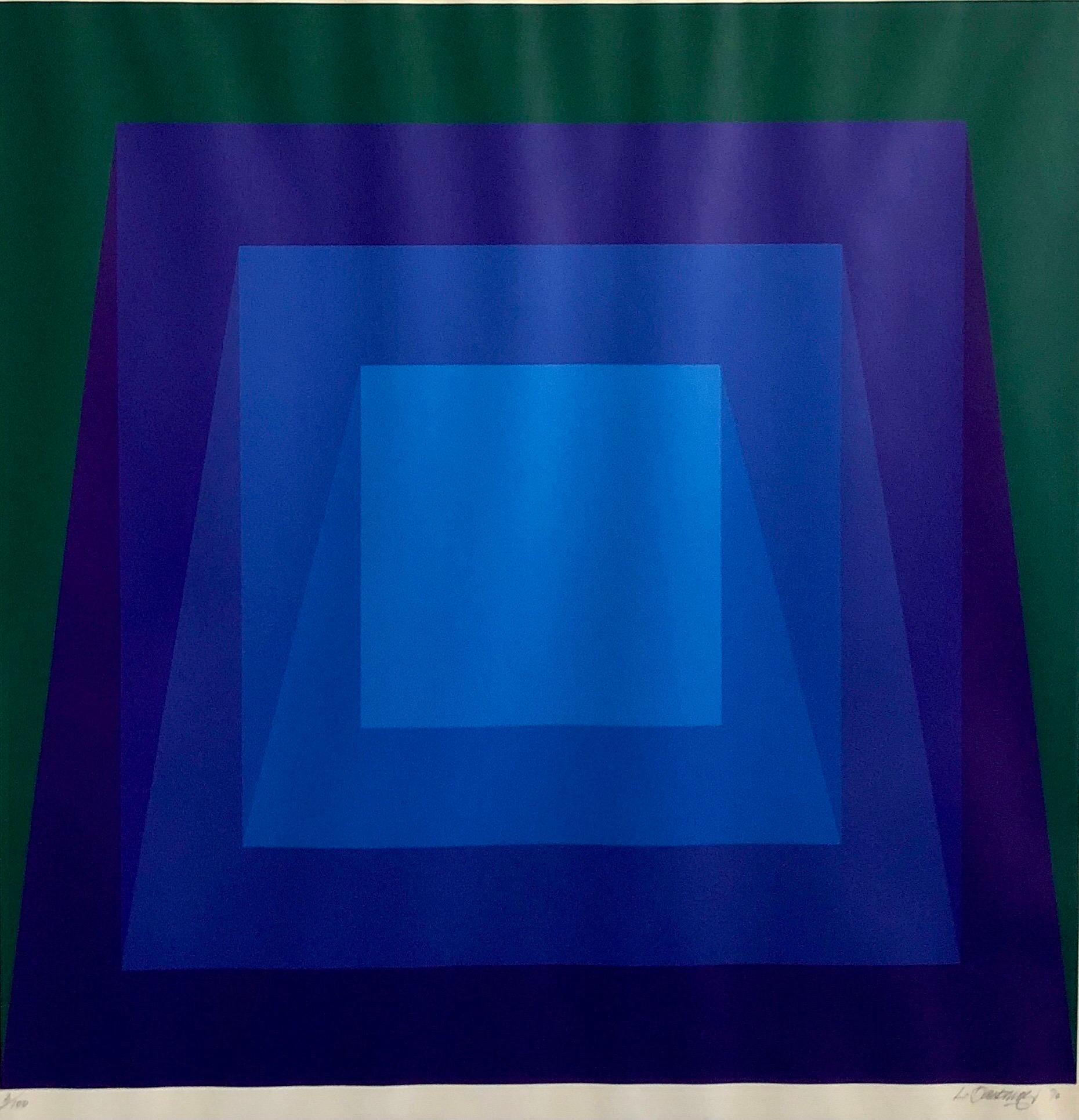
s Op Art Cintique Geometric Abstract Color Gradations Silkscreen Domberger
Located in Surfside, FL
Silkscreen serigraph Op art print.
Luitpold Domberger (1912-2005 ) was a pioneer of artistic screen printing in Germany.
Luitpold (Poldi) Domberger...
Category
1970s Op Art Abstract Prints
Materials
Screen
Abstract Geometric 1970s Kinetic Silkscreen Screen Print Manner Vasarely Op Art
By Paul M. Levy
Located in Surfside, FL
Paul Levy (American, b. 1944) An established designer and illustrator, Paul M. Levy was born in Brooklyn, New York, in 1944. He received his B.S. in Industrial Design from the Univer...
Category
1970s Abstract Geometric Abstract Prints
Materials
Screen
Abstract Geometric 1970s Kinetic Silkscreen Screen Print Manner Vasarely Op Art
By Paul M. Levy
Located in Surfside, FL
Paul Levy (American, b. 1944) An established designer and illustrator, Paul M. Levy was born in Brooklyn, New York, in 1944. He received his B.S. in Industrial Design from the Univer...
Category
1970s Abstract Geometric Abstract Prints
Materials
Screen
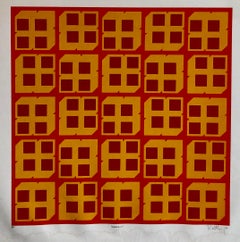
1970
s Large Silkscreen Abstract Geometric Day Glo Serigraph Pop Art Print Neon
By Chryssa Vardea-Mavromichali
Located in Surfside, FL
Silkscreen on Arches paper, Hand signed and Numbered in Pencil. Serigraph in white, back, blue gray (silver).
Chryssa Vardea-Mavromichali (Greek: Χρύσα Βαρδέα-Μαυρομιχάλη; December 31, 1933 – December 23, 2013) was a Greek American artist who worked in a wide variety of media. An American art pioneer in light art and luminist sculpture widely known for her neon, steel, aluminum and acrylic glass installations, she has always used the mononym Chryssa professionally. She worked from the mid-1950s in New York City studios and worked since 1992 in the studio she established in Neos Kosmos, Athens, Greece.
Chryssa was born in Athens into the famous Mavromichalis family from the Mani Peninsula. one of her sisters, who studied medicine, was a friend of the poet and novelist Nikos Kazantzakis.
Chryssa began painting during her teenage years and also studied to be a social worker.In 1953, on the advice of a Greek art critic, her family sent her to Paris to study at the Académie de la Grande Chaumiere where Andre Breton, Edgard Varese, and Max Ernst were among her associates and Alberto Giacometti was a visiting professor.
In 1954, at age twenty-one, Chryssa sailed for the United States, arrived in New York and went to San Francisco, California to study at the California School of Fine Arts. Returning to New York in 1955, she became a United States citizen and established a studio in the city.
Chryssa's first major work was The Cycladic Books preceded American minimalism by seventeen years.
1961, Chryssa's first solo exhibition was mounted at The Guggenheim.
1963, Chryssa's work was shown at the Museum of Modern Art in curator Dorothy Canning Miller's Americans 1963 exhibition. The artists represented in the show also included Richard Anuszkiewicz, Lee Bontecou, Robert Indiana, Richard Lindner, Marisol, Claes Oldenburg, Ad Reinhardt, James Rosenquist and others.
1966, The Gates to Times Square, regarded as "one of the most important American sculptures of all time" and "a thrilling homage to the living American culture of advertising and mass communications." The work is a 10 ft cube installation of two huge letter 'A's through which visitors may walk into "a gleaming block of stainless steel and Plexiglas that seems to quiver in the play of pale blue neon light" which is controlled by programmed timers. First shown in Manhattan's Pace Gallery, it was given to the Albright-Knox Art Gallery in Buffalo, New York in 1972.
1972, The Whitney Museum of American Art mounted a solo exhibition of works by Chryssa.
That's All (early 1970s), the central panel of a triptych related to The Gates of Times Square, was acquired by the Museum of Modern Art between 1975 and 1979.
1973, Chryssa's solo exhibition at the Gallerie Denise René was reviewed for TIME magazine by art critic Robert Hughes before it went on to the Galleries Denise René in Düsseldorf and Paris.
Other works by Chryssa in composite honeycomb aluminum and neon in the 1980s and 1990s include Chinatown, Siren, Urban Traffic, and Flapping Birds.
Chryssa 60/90 retrospective exhibition in Athens in the Mihalarias Art Center. After her long absence from Greece, a major exhibition including large aluminum sculptures - cityscapes, "neon boxes" from the Gates to the Times Square, paintings, drawings etc. was held in Athens.
In 1992, after closing her SoHo studio, which art dealer Leo Castelli had described as "one of the loveliest in the world," Chryssa returned to Greece. She found a derelict cinema which had become a storeroom stacked with abandoned school desks and chairs, behind the old Fix Brewery near the city center in Neos Kosmos, Athens. Using the desks to construct enormous benches, she converted the space into a studio for working on designs and aluminum composite honeycomb sculptures...
Category
1980s Pop Art Abstract Prints
Materials
Screen
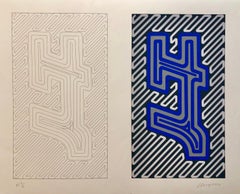
Abstract Geometric 1970s Vintage Silkscreen Screen Print Manner of Vasarely
By Paul M. Levy
Located in Surfside, FL
Paul Levy (American, b. 1944) An established designer and illustrator, Paul M. Levy was born in Brooklyn, New York, in 1944. He received his B.S. in Industrial Design from the University of
Cincinnati, Ohio in 1968, returning later to do independent study there. He also did independent study at Pratt Institute, Brooklyn, New York, in 1969 and received an M.F.A. in Sculpture and Printmaking from Ohio University, Athens. From 1964 through 1971 he worked for design firms in Ohio, New York and California. From 1971 through 1973 he taught at the University of Cincinnati and Ohio University, Athens. He has exhibited in galleries, museums and art groups. In 1971 he was one of a number of artists who created enormous outdoor murals in a Cincinnati project called "Urban
Walls." His graphic designs and illustrations for such firms as Container Corporation of America have appeared in publications such as Fortune, Business Week...
Category
1970s Abstract Geometric Abstract Prints
Materials
Screen
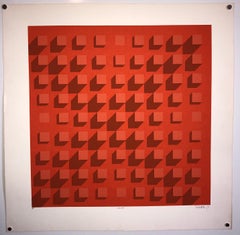
Op Art, Kinetic 1970s Original Vintage Silkscreen Lithograph Print
By David Roth
Located in Surfside, FL
Hand signed and numbered limited edition print.
David Roth studied at the Illinois Institute of Technology's Institute of Design and was twice the recipient of the Moholy-Nagy Scholarship in visual design. It was Roth's initial work as a designer at fine art for commercial use that brought him interesting positions as art director for Lanvin, Charles at the Ritz, and Germain Monteil.
. The strings are tied in bunches and closely hung tram a wooden bar. The size and shape of the string is similar to that at a canvas painting. Each bundle is represented by a vertical row at squares on the graph and the groupings at string are lined up along the wall according to the horizontal rows at the program. The six primary and secondary colors are used in their full intensity along with black, grey, and white.
As a painter Roth works to formulate with color. Some painters regard color as a concomitant of form, hence a subordinate, but Roth's color is the chief medium of his pictorial language. A programmed juxtaposition at primary color allows Roth and the viewer to play upon various combinations. The graphs Roth executes are proportioned according to a strict mathematical formula - the pictures are
Composed according to horizontal and vertical divisions on the graph paper. The optical quality of color, deliberately sought, has its roots in the Bauhaus investigations of illusion, and thus has a direct relationship to the Op art produced in postwar Europe. Roth has arranged his hues so as to persuade the planes to separate from the ground on which they are planted, and float free in space. It is almost as if Roth is giving us a "readout" on his creative process. Although the graphs appear to vary in their use of color the same colors are used throughout, also the same amount of color. Roth's work illustrates the sophistication of the human eye-brain relationship that has developed and invites the viewer to participate in the evolution at visionary ideas.
One Man Shows
1966 The Gallery Upstairs, Buffalo, New York
1967 The Gallery Upstairs, Buffalo, New York
1969 The House of Graphics, New York
1969 Illinois Institute of Technology, Chicago, Illinois
1972 Robert Elkon Gallery, New York
1973 Robert Elkon Gallery, New York
1974 Robert Elkon Gallery, New York
1975 Michael Wyman Gallery, Chicago
1975 Robert Elkon Gallery, New York
1976 G.W. Einstein, New York
1976 Robert Elkon Gallery, New York
1977 Robert Elkon Gallery, New York
1977 G.W. Einstein, New York
1978 Sunne Savage Gallery, Boston, Massachusetts
1978 Robert Elkon Gallery, New York
1979 Nancy Roth Gallery, Katonah, New York
Group Exhibitions
1967 State University of New York, Buffalo
1970 Ronald Feldman Gallery
1970 The Everyman Gallery
1971 Robert Elkon Gallery, New York
1972 The Brooklyn Museum, New York
1972 The Newark Museum, New Jersey
1972 Art...
Category
1970s Op Art Abstract Prints
Materials
Screen
You May Also Like
Rare Op Art Mid Century Modern Geometric Abstraction 1969 silkscreen Signed 6/9
By John Grillo
Located in New York, NY
John Grillo
Untitled Op Art Mid Century Modern, 1969
Color silkscreen on art paper with deckled edges
Signed and dated lower right; numbered 6/9 lower left
Limited Edition of only 9...
Category
1960s Abstract Expressionist Abstract Prints
Materials
Screen
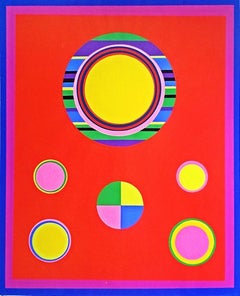
Sven Lukin Modernist Original Screenprint Framed 1969 Bright Modern Mid Century
By Sven Lukin
Located in Buffalo, NY
This incredible work comes with a COA.
The work is currently framed in a new acid free mat and the original 1969 silver metal frame, but new framing is available included in the pric...
Category
1960s Abstract Geometric Abstract Prints
Materials
Silver
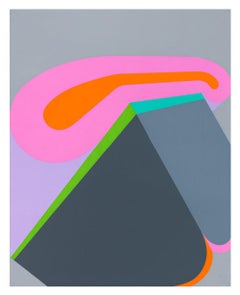
Abstract Composition - Screen Print by Max Bill - 1970s
By Max Bill
Located in Roma, IT
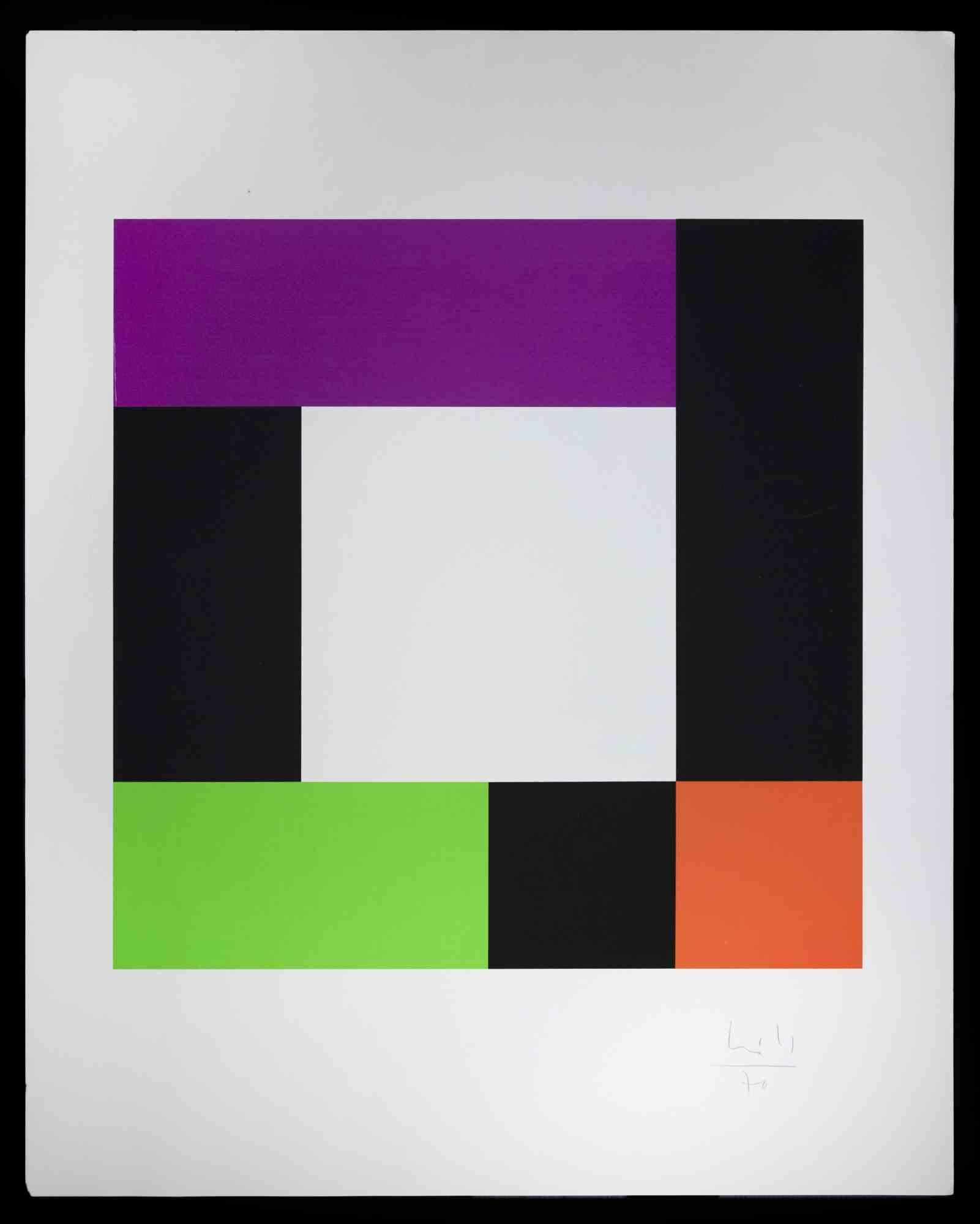
Abstract Composition is an original Screen Print realized by Max Bill in 1970s.
Good conditions.
The artwork is depicted harmonious colors in a well-balanced composition.
Category
1970s Abstract Geometric Abstract Prints
Materials
Screen
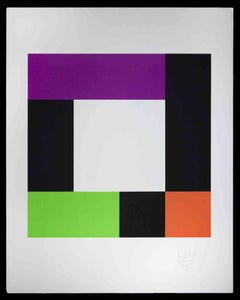
Sven Lukin Modernist Original Screenprint Framed 1969 Bright Modern Mid Century
By Sven Lukin
Located in Buffalo, NY
This incredible work comes with a COA.
The work is currently framed in a new acid free mat and the original 1969 silver metal frame, but new framing is available included in the pric...
Category
1960s Abstract Geometric Abstract Prints
Materials
Silver
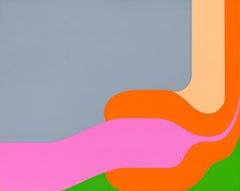
Sin Titulo, Colorful Geometric Abstract Screenprint by Edival Ramosa
By Edival Ramosa
Located in Long Island City, NY
Artist: Edival Ramosa, Brazil (1940 - )
Title: Sin Titulo
Year: 1970
Medium: Screenprint, signed in pencil
Edition: 100
Size: 30 x 22 inches [76.2 x 55.88 cm]
Category
1970s Abstract Geometric Abstract Prints
Materials
Screen
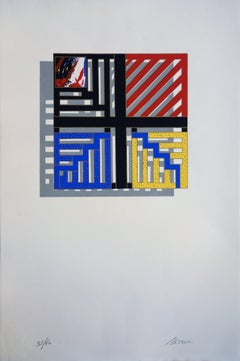
Colored Geometrical Pattern - Original handsigned Screen Print /60ex
By Nivése
Located in Paris, IDF
Oscari NIVESE
Colored Geometrical Pattern
Original screen print
Handsigned in pencil
Numbered / 60 ex
On vellum 38 x 56 cm (c. 15 x 22 inch)
Excellent condition
Category
1990s Abstract Geometric Abstract Prints
Materials
Screen
More Ways To Browse
1960s Op Art
Klossowski Pierre
Antique Prints Scottish Tartan
Blinky Palermo
Calder Sun
Debre Olivier
Deli Sacilotto
Exposition Vallauris
Helen Frankenthaler Signed
Joan Miro Lithograph Signed
Joan Miro Lithograph Volume 1
John Baldessari Signed
John Bolt
Moonlight Lithograph
Nude Descending A Staircase
Pace Gallery Columbus
Red Rider By Marino Marini
Salvador Dali Merchant Of Venice