Want more images or videos?
Request additional images or videos from the seller
1 of 6

Bridget Riley
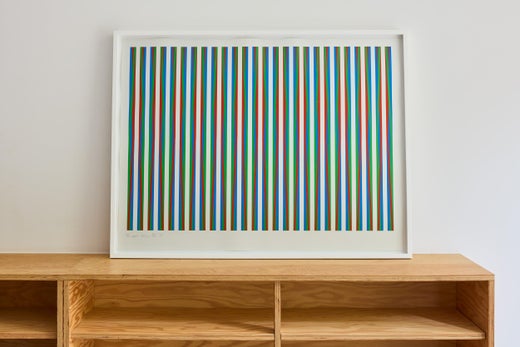
Bridget Riley Hand Signed Offset lithograph print UK, Abstraction British Op Art

2009

$8,000
£6,091.99
€6,956.67
CA$11,240.99
A$12,333.51
CHF 6,496.70
MX$146,720.06
NOK 83,221.92
SEK 75,992.98
DKK 51,973.01

About the Item

Bridget Riley Flashback (Hand Signed), 2009 Offset Lithograph (hand signed by Bridget Riley) 27 × 27 inches Boldly signed in black marker on the front by Bridget Riley Unframed Signed by Bridget Riley in her inimitable hand on the occasion of this 2009-2010 exhibition at the Southampton City Art Gallery of works from the Arts Council of Great Britain collection. Bridget Riley Biography Bridget Riley's (b. 1931) abstract compositions yield a singular sense of visual pleasure for the viewer, a notion derived as much from the artist's formative encounters with Old Master and Impressionist painting as from her early experiences with nature. Since 1961, she has focused exclusively on seemingly simple geometric forms, such as lines, circles, curves, and squares, arrayed across a surface—whether a canvas, a wall, or paper—according to an internal logic. The resulting compositions actively engage the viewer, at times triggering sensations of vibration and movement. This sense of dynamism was explored to great effect in the artist's earliest black-and-white paintings, which established the basis of her enduring formal vocabulary. In 1967, Riley introduced color into her work, thus expanding the perceptual and optical possibilities of her compositions. Riley was born in 1931 in London, where she attended Goldsmiths College from 1949 to 1952 and the Royal College of Art from 1952 to 1955. Riley’s first solo exhibitions were held at Gallery One, London, in 1962 and 1963, followed by two exhibitions at Robert Fraser Gallery, London, in 1966 and 1967. She was also at that time included in numerous group exhibitions such as Towards Art?, Royal College of Art London (1962); The New Generation, Whitechapel Gallery, London (1964); and Painting and Sculpture of a Decade 1954–1964, Tate Gallery, London (1964). In 1965, her work was included in the now-seminal group exhibition The Responsive Eye, organized by William Seitz at The Museum of Modern Art, New York. In 1968, she represented Great Britain at the 34th Venice Biennale (along with Philip King), where she was the first living British painter to win the prestigious International Prize for Painting. Her first retrospective, covering the period from 1961 to 1970, opened at the Kunstverein Hannover in 1971 and subsequently traveled to Kunsthalle Bern; Kunsthalle Düsseldorf; Galleria Civica d’Arte Moderna, Turin; and the Hayward Gallery, London. More recent significant solo presentations include those at Dia Center for the Arts, New York (2000-2001); Museum Haus Esters and Kaiser Wilhelm Museum, Krefeld, Germany (2002); Museum of Contemporary Art, Sydney (2004-2005); Musée d'Art Moderne de la Ville de Paris (2008); Walker Art Gallery, Liverpool (traveled to Birmingham Museums and Art Gallery; Norwich Castle Museum and Art Gallery; Southampton City Art Gallery; 2009-2010); The National Gallery, London (2010-2011); Art Institute of Chicago (2014-2015); The Courtauld Gallery, London (2015); De La Warr Pavilion, Bexhill on Sea, England (traveled to Gemeentemuseum, The Hague; 2015); Graves Gallery, Museum Sheffield, England (2016); Christchurch Art Gallery, New Zealand (2017); and Kawamura Memorial DIC Museum of Art, Sakura, Japan (2018). Bridget Riley: Perceptual Abstraction was on view at the Yale Center for British Art, New Haven, Connecticut, in 2022. The traveling exhibition Bridget Riley Drawings: From the Artist’s Studio, which includes drawings from the late 1940s to the present day, originated at The Art Institute of Chicago and will subsequently be on view at the Hammer Museum, Los Angeles, and the Morgan Library, New York, in 2023 A large-scale wall painting by Riley entitled Messengers was unveiled in 2019 at The National Gallery in London. Also in 2019, a solo presentation of the artist’s work that was organized by the National Galleries of Scotland opened at the Scottish National Gallery, Edinburgh, and traveled to the Hayward Gallery, London (2019-2020). In 1974, Riley was named a CBE (Commander of the Most Excellent Order of the British Empire) and in 1999, appointed the Companion of Honour. In 2003, the artist was awarded the Praemium Imperiale in Tokyo. She received the Kaiser Ring of the City of Goslar, Germany, in 2009 and the Rubens Prize of the City of Siegen, Germany, in 2012. Work by the artist is included in museum and public collections worldwide, including The Albright-Knox Art Gallery, Buffalo, New York; Art Institute of Chicago; Arts Council, U.K.; British Council, U.K.; Dallas Museum of Art; Dia Art Foundation, New York; Israel Museum, Jerusalem; Kunstmuseum Bern; Los Angeles County Museum of Art; The Metropolitan Museum of Art, New York; Moderna Museet, Stockholm; Museum für Gegenwartskunst, Siegen, Germany; The Museum of Contemporary Art, Los Angeles; The Museum of Modern Art, New York; National Museum of Modern Art, Tokyo; Nationalgalerie, Berlin; Stedelijk Museum, Amsterdam; and Tate, London. David Zwirner has worked with Riley since 2014, and the gallery's inaugural exhibition of her work, Bridget Riley: The Stripe Paintings 1961-2014, was held in London that year. In 2015, a career spanning survey was presented at the gallery in New York, and in 2018, the London gallery presented Riley’s recent works from the last four years. Bridget Riley – Studies: 1984-1997 was on view at the gallery’s London location in 2020. Bridget Riley: Past into Present was on view at David Zwirner, London in 2021. Riley lives and works in London, Cornwall, and France. -Courtesy of Zwirner Gallery
  • Creator:
    Bridget Riley (1931, British)
  • Creation Year:
    2009
  • Dimensions:
    Height: 27 in (68.58 cm)Width: 26 in (66.04 cm)
  • Medium:
  • Movement Style:
  • Period:
  • Condition:
    Very good condition other than gentle handling which should frame out.
  • Gallery Location:
    New York, NY
  • Reference Number:
    1stDibs: LU1745217374212

More From This Seller

View All
Chateau Mouton Rothschild Wine Label Signed inscribed Philippine de Rothschild
By Bernard Séjourné
Located in New York, NY
Bernard Séjourné Chateau Mouton Rothschild Wine Label (Hand Signed & Inscribed), 1989 Wine Label Print Signed “To John A. Powers, Chairman, ...
Category

1980s Abstract Abstract Prints

Materials

Lithograph, Offset

Color Field Abstract Chevron Ojai Festival lithograph Deluxe Signed 6/100 Framed
By Kenneth Noland
Located in New York, NY
Kenneth Noland Ojai Festival print (Deluxe signed limited edition), 1986 Lithograph with offset lettering Hand signed and numbered 6/100 by Kenneth Noland on lower front Frame inclu...
Category

1980s Abstract Geometric Abstract Prints

Materials

Lithograph, Offset

Untitled (from Rubber Stamp Portfolio) Lt. Ed Abstract 1970s print with envelope
By Myron Stedman Stout
Located in New York, NY
Myron Stout Untitled (from Rubber Stamp Portfolio), 1976 Rubber Stamp Print on Buckeye Paper 8 × 8 inches Limited Edition of 1000 Stamped with a...
Category

1970s Abstract Abstract Prints

Materials

Lithograph, Offset, Other Medium

Glaspalast Edition print, Munich Germany, SCARCE when Hand Signed by Sean Scully
By Sean Scully
Located in New York, NY
Sean Scully Munich 1996 (Hand Signed), 2001 Offset Lithograph print Hand signed and dated by Sean Scully in 2018 Boldly signed in black marker on the recto. Hand signed by Sean Scull...
Category

Early 2000s Abstract Geometric Abstract Prints

Materials

Ink, Permanent Marker, Lithograph, Offset

Jablonka Galerie exhibition poster, Köln (Hand Signed by Peter Halley)
By Peter Halley
Located in New York, NY
Peter Halley, Jablonka Galerie, Köln (Hand Signed), 1993 Offset lithograph poster (hand signed by Peter Halley) 26 1/2 × 26 1/2 inches Unframed Alpha 137 Gallery is honored to offer ...
Category

1990s Abstract Geometric Abstract Prints

Materials

Offset, Lithograph

Imago Galleries exhibition poster, Palm Desert, CA (Hand Signed by Peter Halley)
By Peter Halley
Located in New York, NY
Peter Halley Peter Halley, Imago Galleries, Palm Desert, CA (Hand Signed), 2006 Offset lithograph poster (hand signed by Peter Halley) 25 1/2 × 18 1/4 inches Provenance; Acquired directly from the artist Unframed Alpha 137 Gallery is honored to offer this offset lithograph, published on the occasion of legendary American artist Peter Halley's 2006 one-man exhibition at Imago Galleries, Palm Desert, California which the artist hand signed in black marker. Scroll images for a photograph of our director Nadine Witkin with the artist. Below is Peter Halley's official biography. What it doesn't mention is that Andy Warhol famously painted his portrait in 1986! Peter Halley is that legendary. According to Halley, he didn't realize until after Warhol's death that the polaroids Warhol took of him with his famous "big shot" camera were made into an original painting. Warhol's painting of Peter Halley was included in the recent Andy Warhol retrospective "Andy Warhol - from A to B and Back Again" at the Whitney. PETER HALLEY BIOGRAPHY Peter Halley, born 1953, New York City, is an American artist who came to prominence as a central figure of the Neo-Conceptualist movement of the 1980s. His paintings redeploy the language of geometric abstraction to explore the organization of social space in the digital era. Since the 1980s, Halley’s lexicon has included three elements: “prisons” and “cells,” connected by “conduits,” which are used in his paintings to explore the technologically determined space and pathways that regulate daily life. Using fluorescent color and Roll-a-Tex, a commercial paint additive that provides readymade texture, Halley embraces materials that are anti-naturalistic and commercially manufactured. In the mid 1990s Halley pioneered the use of wall-sized digital prints in his site-specific installations. He has executed installations at Museo Nivola, Orani, Sardinia (2021); Greene Naftali, New York (2019); Venice Biennale (2019); Lever House, New York (2018); Schirn Kunsthalle, Frankfurt (2016); Disjecta, Portland (2012); the Gallatin School, New York University, (2008, 2017); the Museum of Modern Art, New York (1997); and the Dallas Museum of Art (1995). In 2005, Halley was also commissioned to create a monumental painting for Terminal D at the Dallas/Fort Worth International Airport, Texas. Halley served as professor and director of the MFA painting program at the Yale School of Art from 2002 to 2011. From 1996 to 2005, Halley published INDEX Magazine, which featured interviews with figures working in a variety of creative fields. Halley is also known for his essays on art and culture, written in the 1980s and 1990s, in which he explores themes from French critical theory and the impact of burgeoning digital technology. His Selected Essays, 1981 – 2001, was published by Edgewise Press, New York, in 2013.Halley’s writings have been translated into Spanish, French, and Italian. A catalogue raisonné, PETER HALLEY: Paintings of the 1980s, was published in 2018 by JRP Ringier. Halley’s work can be found in the collections of the Museum of Modern Art, New York; Whitney Museum of American Art, New York; Solomon R. Guggenheim Museum, New York; Broad Art Foundation, Los Angeles; Museum of Contemporary Art, Los Angeles; San Francisco Museum of Modern Art; Boston Museum of Fine Arts; Dallas Museum of Art; Albright-Knox Art Gallery, Buffalo; Tate Modern, London; Stedelijk Museum, Amsterdam; Sammlung Marx, Berlin; Museo Nacional Centro de Arte Reina Sofia, Madrid; Museum of Contemporary Art, Tokyo; Seoul Museum of Art, among others. More about Peter Halley Peter Halley was born in 1953 in New York. He began his formal training at Phillips Academy in Andover, Massachusetts, from which he graduated in 1971. During that time, Halley read Josef Albers’s Interaction of Color (1981), which would influence him throughout his career. From 1973 to 1974 Halley lived in New Orleans, where he absorbed the vibrant cultural influences of the city, began using commercial materials in his art, and first became acquainted with the writings of earthwork artist Robert Smithson. In 1975 the artist graduated from Yale University, New Haven, with a degree in art history. After Yale, Halley returned to New Orleans, where he received an MFA in painting from the University of New Orleans in 1978. He had his first solo exhibition at the Contemporary Art Center, New Orleans, that same year. In 1978 Halley spent a semester teaching art at the University of Louisiana, Lafayette. He has continued to teach throughout his career. In 1980, Halley moved back to New York and had his first solo exhibition in the city at PS122 Gallery. At this time, Halley was drawn to the pop themes and social issues addressed in New Wave music. Inspired by New York’s intense urban environment, Halley set out to use the language of geometric abstraction to describe the actual geometricized space around him. He also began his iconic use of fluorescent Day-Glo paint. In 1984, Halley started to exhibit with the International With Monument gallery, becoming closely associated with the organization and its artists, who exhibited conceptually rigorous work in a market-savvy, coolly presented space that stood in stark contrast to the bohemian, Neo-Expressionist flair of the East Village art scene at the time. In 1986, an exhibition of four artists from International With Monument at the Sonnabend Gallery in New York heralded the group’s growing success. By the late 1980s, Halley was exhibiting with prominent galleries in the United States and Europe. In 1989, an exhibition of his paintings traveled to the Museum Haus Esters, Krefeld, Germany; Maison de la culture et de la communication de Saint-Étienne, France; and Institute of Contemporary Arts, London. From 1991 to 1992, a retrospective toured Europe, with presentations at the CAPC Musée d’art contemporain de Bordeaux, France; Musée d’art contemporain, Lausanne, Switzerland; Museo nacional centro de arte Reina Sofía, Madrid; and Stedelijk Museum, Amsterdam. In 1992, the Des Moines Art Center hosted his first solo exhibition at a U.S. museum. While developing his visual language, Halley became interested in French post-structuralist writers, including Jean Baudrillard, Guy Debord, Michel Foucault, and Paul Virillio, all of whom shared his concern with the character of social spaces in a post-industrial society. In 1981, he published his first essay “Beat, Minimalism, New Wave, and Robert Smithson” in Arts, a New York–based magazine that would publish eight of his essays before the decade’s end. Halley’s writings became the basis for Neo-Geometric Conceptualism (also known as Neo-Geo), the offshoot of Neo-Conceptualism associated with the work of Ashley Bickerton, Halley, and Jeff Koons. In 1988, the artist’s writings were anthologized in Collected Essays, 1981–1987, and again in 1997 in a second anthology, Recent Essays, 1990–1996. In the mid-1990s, Halley began to produce site-specific installations for museums, galleries, and public spaces. These characteristically brought together a range of imagery and mediums, including paintings, wall-size flowcharts, and digitally generated wallpaper prints. Halley has executed permanent installations at the Dallas/Fort Worth International Airport, Texas, and the Gallatin School of Individualized Study at New York University. In 2011, his installation of digital prints Judgment Day...
Category

Early 2000s Abstract Geometric Abstract Prints

Materials

Offset, Lithograph

You May Also Like

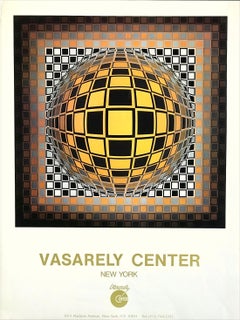
VASARELY CENTER NY 1978 Vintage Op-Art Poster, Geometric Abstract, Gold Black
By Victor Vasarely
Located in Union City, NJ
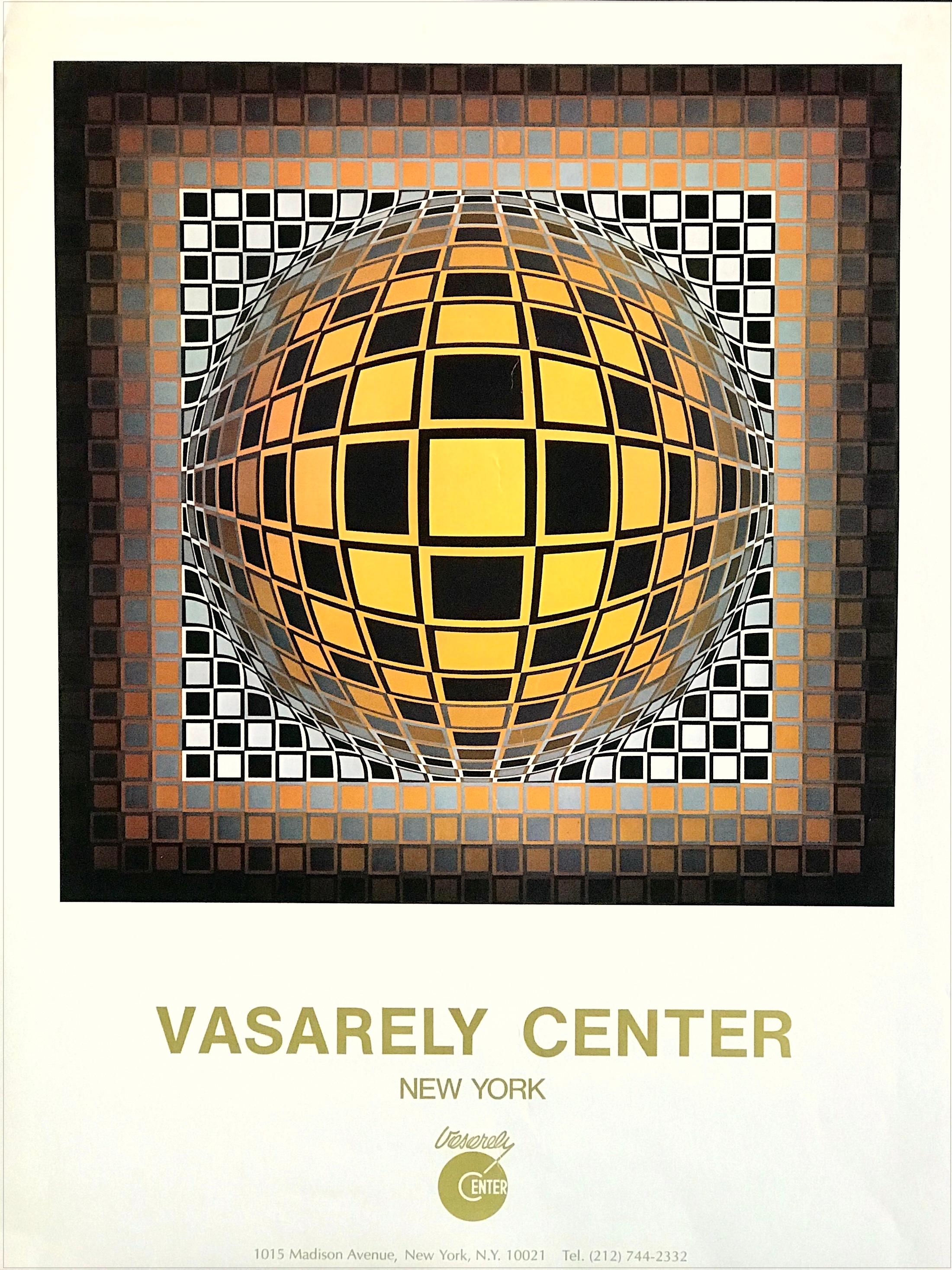
VICTOR VASARELY VASARELY CENTER NY Vintage original vintage Op-art poster published by VCNY (Vasarely Center New York), New York, 1978. Poster size - 32 x 24 inches, unframed, unsi...
Category

1970s Op Art Abstract Prints

Materials

Offset, Lithograph

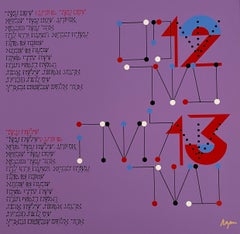
Agam Silkscreen Jerusalem Lithograph Hand Signed Israeli Kinetic Op Art Print
By Yaacov Agam
Located in Surfside, FL
Yaacov Agam, Israeli (b. 1928) Hand signed, not individually numbered but from edition of 180. I can include a copy of the title sheet with the edition size and his signature if you ...
Category

1980s Op Art Abstract Prints

Materials

Lithograph, Screen

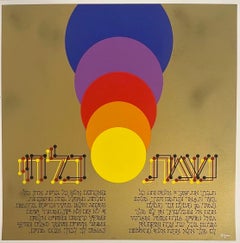
Agam Silkscreen Mod Judaica Lithograph Hand Signed Israeli Kinetic Op Art Print
By Yaacov Agam
Located in Surfside, FL
Yaacov Agam Israeli (b. 1928) Hand signed, not individually numbered but from edition of 180. I can include a copy of the title sheet with the edition size and his signature if you r...
Category

1980s Op Art Abstract Prints

Materials

Lithograph, Screen

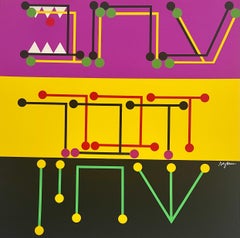
Agam Silkscreen Mod Judaica Lithograph Hand Signed Israeli Kinetic Op Art Print
By Yaacov Agam
Located in Surfside, FL
Yaacov Agam Israeli (b. 1928) Hand signed, not individually numbered but from edition of 180. I can include a copy of the title sheet with the edition size and his signature if you r...
Category

1980s Op Art Abstract Prints

Materials

Lithograph, Screen

Agam Silkscreen Mod Judaica Lithograph Hand Signed Israeli Kinetic Op Art Print
By Yaacov Agam
Located in Surfside, FL
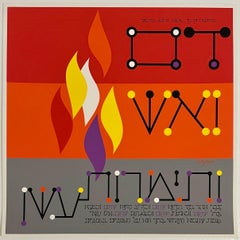
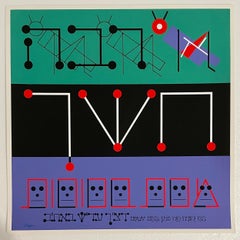
Yaacov Agam Israeli (b. 1928) Hand signed, not individually numbered but from edition of 180. I can include a copy of the title sheet with the edition size and his signature if you request. sheet: 13.5 X 13.5 inches Some of these works have beautiful Hebrew calligraphy and mod imagery, animals, children and such that are not usually found in his work. This is a masterpiece of bold, graphic, mod design. Along with Reuven Rubin and Menashe Kadishman he is among Israel's best known artists internationally. Biographical info: The son of a rabbi, Yaacov Agam can trace his ancestry back six generations to the founder of the Chabad movement in Judaism. in 1946, he entered the Bezalel Academy of Arts and Design in Jerusalem. Studying with Mordecai Ardon, a former student at the Weimar Bauhaus. Yaakov Agam has been associated h with “abstract” artists, “hard edge” artists, and artists such as Josef Albers and Max Bill. Others find in Agam’s work an indebtedness to the masters of the Bauhaus. Agam’s approach to art, being conceptual in nature, has been likened to Marcel Duchamp’s, who expressed the need to put art “at the service of the spirit.” And, because of Agam’s employment of color and motion in his art, he has been compared to Alexander Calder, the artist who put sculpture into motion. (Motion is not an end, but a means for Agam. Calder’s mobiles are structures that are fixed, revolving at the whim of the wind. In a work by Agam, the viewer must intervene.) Agam has also been classified as an “op art” artist because he excels in playing with our visual sensitivities. Agam went to Zurich to study with Johannes Itten at the Kunstgewerbeschule. There, he met Frank Lloyd Wright and Siegfried Giedion, whose ideas on the element of time in art and architecture impressed him. In 1955, Galerie Denise René hosted a major group exhibition in connection with Vasarely's painting experiments with movement. in addition to art by Vasarely, it included works by Yaacov Agam, Pol Bury, Soto and Jean Tinguely, among others. Most Americans were first introduced to Vasarely by the groundbreaking exhibition, "The Responsive Eye," at New York's Museum of Modern Art in 1965. Josef Albers, Richard Anuszkiewicz. The show confirmed Vasarely's international reputation as the father of Op art. Agam has sought to express his ideas in a non-static form of art. In his abstract Kinetic works, which range from paintings and graphics to sculptural installations and building facades. Agam continually seeks to explore new possibilities in form and color and to involve the viewer in all aspects of the artistic process. Thus, for the past 40 years, Yaacov Agam’s pioneering ideas have impacted developments in art, (painting, monoprint, lithograph and agamograph) architecture, theatre, and public sculpture. Reflecting both his Israeli Jewish...
Category

1980s Op Art Abstract Prints

Materials

Lithograph, Screen

Agam Silkscreen Mod Judaica Lithograph Hand Signed Israeli Kinetic Op Art Print
By Yaacov Agam
Located in Surfside, FL
Yaacov Agam Israeli (b. 1928) Hand signed, not individually numbered but from edition of 180. I can include a copy of the title sheet with the edition size and his signature if you request. sheet: 13.5 X 13.5 inches Some of these works have beautiful Hebrew calligraphy and mod imagery, animals, children and such that are not usually found in his work. This is a masterpiece of bold, graphic, mod design. Along with Reuven Rubin and Menashe Kadishman he is among Israel's best known artists internationally. Biographical info: The son of a rabbi, Yaacov Agam can trace his ancestry back six generations to the founder of the Chabad movement in Judaism. in 1946, he entered the Bezalel Academy of Arts and Design in Jerusalem. Studying with Mordecai Ardon, a former student at the Weimar Bauhaus. Yaakov Agam has been associated h with “abstract” artists, “hard edge” artists, and artists such as Josef Albers and Max Bill. Others find in Agam’s work an indebtedness to the masters of the Bauhaus. Agam’s approach to art, being conceptual in nature, has been likened to Marcel Duchamp’s, who expressed the need to put art “at the service of the spirit.” And, because of Agam’s employment of color and motion in his art, he has been compared to Alexander Calder, the artist who put sculpture into motion. (Motion is not an end, but a means for Agam. Calder’s mobiles are structures that are fixed, revolving at the whim of the wind. In a work by Agam, the viewer must intervene.) Agam has also been classified as an “op art” artist because he excels in playing with our visual sensitivities. Agam went to Zurich to study with Johannes Itten at the Kunstgewerbeschule. There, he met Frank Lloyd Wright and Siegfried Giedion, whose ideas on the element of time in art and architecture impressed him. In 1955, Galerie Denise René hosted a major group exhibition in connection with Vasarely's painting experiments with movement. in addition to art by Vasarely, it included works by Yaacov Agam, Pol Bury, Soto and Jean Tinguely, among others. Most Americans were first introduced to Vasarely by the groundbreaking exhibition, "The Responsive Eye," at New York's Museum of Modern Art in 1965. Josef Albers, Richard Anuszkiewicz. The show confirmed Vasarely's international reputation as the father of Op art. Agam has sought to express his ideas in a non-static form of art. In his abstract Kinetic works, which range from paintings and graphics to sculptural installations and building facades. Agam continually seeks to explore new possibilities in form and color and to involve the viewer in all aspects of the artistic process. Thus, for the past 40 years, Yaacov Agam’s pioneering ideas have impacted developments in art, (painting, monoprint, lithograph and agamograph) architecture, theatre, and public sculpture. Reflecting both his Israeli Jewish...
Category

1980s Op Art Abstract Prints

Materials

Lithograph, Screen