Want more images or videos?
Request additional images or videos from the seller
1 of 8
Byron GálvezRojo, Embossed Lithograph by Byron Galvez1989
1989
$1,250List Price
About the Item
- Creator:Byron Gálvez (1941, Mexican)
- Creation Year:1989
- Dimensions:Height: 23.5 in (59.69 cm)Width: 31.5 in (80.01 cm)
- Medium:
- Period:
- Framing:Framing Options Available
- Condition:
- Gallery Location:Long Island City, NY
- Reference Number:1stDibs: LU46613846242

Byron Gálvez
ChatGPT Byron Gálvez (1941–2009) was a celebrated Mexican painter and sculptor known for his abstract and modernist style. Born in Mixquiahuala, Hidalgo, Mexico, Gálvez studied at the Escuela Nacional de Artes Plásticas in Mexico City, where he distinguished himself as an exceptional student. His work reflects a blend of vibrant colors, dynamic forms, and a deep exploration of the human figure and geometric abstraction. Gálvez's artistic career spanned several decades, during which he earned widespread recognition for his contributions to contemporary Mexican art. His work was exhibited in galleries and museums both in Mexico and internationally, and he received numerous awards and honors for his innovative approach to painting and sculpture. In addition to his studio work, Gálvez is also known for his monumental public sculptures, including those displayed in his home state of Hidalgo and other regions of Mexico. His artistic legacy continues to influence modern art, showcasing a unique fusion of Mexican heritage and universal themes.
About the Seller
4.9
Platinum Seller
Premium sellers with a 4.7+ rating and 24-hour response times
Established in 1979
1stDibs seller since 2014
3,221 sales on 1stDibs
Typical response time: 2 hours
Authenticity Guarantee
In the unlikely event there’s an issue with an item’s authenticity, contact us within 1 year for a full refund. DetailsMoney-Back Guarantee
If your item is not as described, is damaged in transit, or does not arrive, contact us within 7 days for a full refund. Details24-Hour Cancellation
You have a 24-hour grace period in which to reconsider your purchase, with no questions asked.Vetted Professional Sellers
Our world-class sellers must adhere to strict standards for service and quality, maintaining the integrity of our listings.Price-Match Guarantee
If you find that a seller listed the same item for a lower price elsewhere, we’ll match it.Trusted Global Delivery
Our best-in-class carrier network provides specialized shipping options worldwide, including custom delivery.You May Also Like
Pietro Consagra Italian Mod Abstract Expressionist Forma, Art Brut Lithograph
By Pietro Consagra
Located in Surfside, FL
Pietro Consagra (Italian, 1920-2005).
Hand signed in pencil and numbered limited edition color lithograph on Magnani paper.
Embossed stamp with limited edition numbers in pencil to lower left, and having artist pencil signature to lower right.
(from a limited edition of 80 with 15 artist's proofs)
Published by Stamperia 2RC, Rome Italy and Marlborough Gallery, Rome, Italy.
Abstract Modernist work in colors, produced in the style of the Forma art movement of Postwar Italy, of which the artist was a prominent member.
Pietro Consagra (1920 – 2005) was an Italian Post war artist working in painting, printmaking and sculpture. In 1947 he was among the founding members of the Forma 1 group of artists, proponents of structured abstraction. (similar to the Art Informel and Art Brut in France and the Brutalist artists)
Consagra was born on 6 October 1920 in Mazara del Vallo, in the province of Trapani in south-western Sicily, to Luigi Consagra and Maria Lentini. From 1931 he enrolled in a trade school for sailors, studying first to become a mechanic, and later to become a captain. In 1938 he moved to Palermo, where he enrolled in the liceo artistico; despite an attack of tuberculosis, he graduated in 1941, and in the same year signed up at the Accademia di Belle Arti, where he studied sculpture under Archimede Campini. After the Invasion of Sicily and the Allied occupation of Palermo in 1943, Consagra found work as a caricaturist for the American Red Cross club of the city; he also joined the Italian Communist Party. Early in 1944, armed with a letter of introduction from an American officer, he travelled to Rome. There he came into contact with the Sicilian artist Concetto Maugeri, and through him with Renato Guttuso, who was also Sicilian and who introduced him to the intellectual life of the city and to other postwar artists such as Leoncillo Leonardi, Mario Mafai and Giulio Turcato. Consagra signed up at the Accademia di Belle Arti di Roma in September 1944 and studied sculpture there under Michele Guerrisi, but left before completing his diploma.
In 1947, with Carla Accardi, Ugo Attardi, Piero Dorazio, Mino Guerrini, Achille Perilli, Antonio Sanfilippo and Giulio Turcato, Consagra started the artist's group Forma 1, which advocated both Marxism and structured abstraction.
Steadily Consagra's work began to find an audience. Working primarily in metal, and later in marble and wood, his thin, roughly carved reliefs, began to be collected by Peggy Guggenheim and other important patrons of the arts. He showed at the Venice Biennale eleven times between 1950 and 1993, and in 1960 won the sculpture prize at the exhibition. During the 1960s he was associated with the Continuità group, an offshoot of Forma I, and in 1967 taught at the School of Arts in Minneapolis. Large commissions allowed him to begin working on a more monumental scale, and works of his were installed in the courtyard of the Foreign Ministry in Rome and in the European Parliament, Strasbourg. His work is found in the collections of The Tate Gallery, London, in Museo Cantonale d'Arte of Lugano and the Museum of Modern Art, Paris, and the National Gallery of Art in Washington, D.C..
Consagra returned to Sicily where he sculpted a number of significant works during the 1980s. With Senator Ludovico Corrao, he helped created an open-air museum in the new town of Gibellina, after the older town had been destroyed in the earthquake of 1968. Consagra designed the gates to the town's entrance, the building named "Meeting" and the gates to the cemetery, where he was later buried.
In 1952 Consagra published La necessità della scultura ("the need for sculpture"), a response to the essay La scultura lingua morta ("sculpture, a dead language"), published in 1945 by Arturo Martini. Other works include L'agguato c'è ("the snare exists", 1960), and La città frontale ("the frontal city", 1969). His autobiography, Vita Mia, was published by Feltrinelli in 1980. In 1989 a substantial retrospective exhibition of work by Consagra was shown at the Galleria Nazionale d'Arte Moderna in Rome; in 1993 a permanent exhibition of his work was installed there. In 1991 his work was shown in the Hermitage Museum in St. Petersburg. In 2002 the Galerie der Stadt Stuttgart opened a permanent exhibition of his work. He was one of ten artists invited by Giovanni Carandente, along with David Smith, Alexander Calder, Arnaldo Pomodoro, Lynn Chadwick, and Beverly Pepper, to fabricate works in Italsider factories in Italy for an outdoor exhibition, "Sculture nella città", held in Spoleto during the summer of 1962. He was included in the The 1962 International Prize for Sculpture the jury included Argan, Romero Brest and James Johnson Sweeney the former director of the Solomon R. Guggenheim Museum in New York. The participants included Louise Nevelson and John Chamberlain for the United States; Lygia Clark for Brazil; Pietro Consagra, Lucio Fontana, Nino Franchina, and Gió Pomodoro for Italy; Pablo Serrano for Spain; and Eduardo Paolozzi, William Turnbull, and Kenneth Armitage for England. Gyula Kosice, Noemí Gerstein...
Category
1960s Abstract Expressionist Abstract Prints
Materials
Lithograph
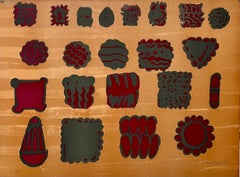
Pietro Consagra Italian Mod Abstract Expressionist Forma, Art Brut Lithograph
By Pietro Consagra
Located in Surfside, FL
Pietro Consagra (Italian, 1920-2005).
Hand signed in pencil and numbered limited edition color lithograph on Magnani paper.
Embossed stamp with limited edition numbers in pencil to lower left, and having artist pencil signature to lower right.
(from a limited edition of 80 with 15 artist's proofs)
Published by Stamperia 2RC, Rome Italy and Marlborough Gallery, Rome, Italy.
Abstract Modernist work in colors, produced in the style of the Forma art movement of Postwar Italy, of which the artist was a prominent member.
Pietro Consagra (1920 – 2005) was an Italian Post war artist working in painting, printmaking and sculpture. In 1947 he was among the founding members of the Forma 1 group of artists, proponents of structured abstraction. (similar to the Art Informel and Art Brut in France and the Brutalist artists)
Consagra was born on 6 October 1920 in Mazara del Vallo, in the province of Trapani in south-western Sicily, to Luigi Consagra and Maria Lentini. From 1931 he enrolled in a trade school for sailors, studying first to become a mechanic, and later to become a captain. In 1938 he moved to Palermo, where he enrolled in the liceo artistico; despite an attack of tuberculosis, he graduated in 1941, and in the same year signed up at the Accademia di Belle Arti, where he studied sculpture under Archimede Campini. After the Invasion of Sicily and the Allied occupation of Palermo in 1943, Consagra found work as a caricaturist for the American Red Cross club of the city; he also joined the Italian Communist Party. Early in 1944, armed with a letter of introduction from an American officer, he travelled to Rome. There he came into contact with the Sicilian artist Concetto Maugeri, and through him with Renato Guttuso, who was also Sicilian and who introduced him to the intellectual life of the city and to other postwar artists such as Leoncillo Leonardi, Mario Mafai and Giulio Turcato. Consagra signed up at the Accademia di Belle Arti di Roma in September 1944 and studied sculpture there under Michele Guerrisi, but left before completing his diploma.
In 1947, with Carla Accardi, Ugo Attardi, Piero Dorazio, Mino Guerrini, Achille Perilli, Antonio Sanfilippo and Giulio Turcato, Consagra started the artist's group Forma 1, which advocated both Marxism and structured abstraction.
Steadily Consagra's work began to find an audience. Working primarily in metal, and later in marble and wood, his thin, roughly carved reliefs, began to be collected by Peggy Guggenheim and other important patrons of the arts. He showed at the Venice Biennale eleven times between 1950 and 1993, and in 1960 won the sculpture prize at the exhibition. During the 1960s he was associated with the Continuità group, an offshoot of Forma I, and in 1967 taught at the School of Arts in Minneapolis. Large commissions allowed him to begin working on a more monumental scale, and works of his were installed in the courtyard of the Foreign Ministry in Rome and in the European Parliament, Strasbourg. His work is found in the collections of The Tate Gallery, London, in Museo Cantonale d'Arte of Lugano and the Museum of Modern Art, Paris, and the National Gallery of Art in Washington, D.C..
Consagra returned to Sicily where he sculpted a number of significant works during the 1980s. With Senator Ludovico Corrao, he helped created an open-air museum in the new town of Gibellina, after the older town had been destroyed in the earthquake of 1968. Consagra designed the gates to the town's entrance, the building named "Meeting" and the gates to the cemetery, where he was later buried.
In 1952 Consagra published La necessità della scultura ("the need for sculpture"), a response to the essay La scultura lingua morta ("sculpture, a dead language"), published in 1945 by Arturo Martini. Other works include L'agguato c'è ("the snare exists", 1960), and La città frontale ("the frontal city", 1969). His autobiography, Vita Mia, was published by Feltrinelli in 1980. In 1989 a substantial retrospective exhibition of work by Consagra was shown at the Galleria Nazionale d'Arte Moderna in Rome; in 1993 a permanent exhibition of his work was installed there. In 1991 his work was shown in the Hermitage Museum in St. Petersburg. In 2002 the Galerie der Stadt Stuttgart opened a permanent exhibition of his work. He was one of ten artists invited by Giovanni Carandente, along with David Smith, Alexander Calder, Arnaldo Pomodoro, Lynn Chadwick, and Beverly Pepper, to fabricate works in Italsider factories in Italy for an outdoor exhibition, "Sculture nella città", held in Spoleto during the summer of 1962. He was included in the The 1962 International Prize for Sculpture the jury included Argan, Romero Brest and James Johnson Sweeney the former director of the Solomon R. Guggenheim Museum in New York. The participants included Louise Nevelson and John Chamberlain for the United States; Lygia Clark for Brazil; Pietro Consagra, Lucio Fontana, Nino Franchina, and Gió Pomodoro for Italy; Pablo Serrano for Spain; and Eduardo Paolozzi, William Turnbull, and Kenneth Armitage for England. Gyula Kosice, Noemí Gerstein...
Category
1960s Abstract Expressionist Abstract Prints
Materials
Lithograph
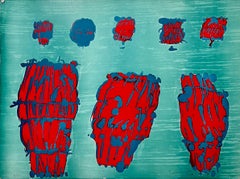
Pietro Consagra Italian Mod Abstract Expressionist Forma Brutalist Lithograph
By Pietro Consagra
Located in Surfside, FL
Pietro Consagra (Italian, 1920-2005).
Hand signed in pencil and numbered limited edition color lithograph on Magnani paper.
Embossed stamp with limited edition numbers in pencil to lower left, and having artist pencil signature to lower right.
(from a limited edition of 80 with 15 artist's proofs)
Published by Stamperia 2RC, Rome Italy and Marlborough Gallery, Rome, Italy.
Abstract Modernist work in colors, produced in the style of the Forma art movement of Postwar Italy, of which the artist was a prominent member.
Pietro Consagra (1920 – 2005) was an Italian Post war artist working in painting, printmaking and sculpture. In 1947 he was among the founding members of the Forma 1 group of artists, proponents of structured abstraction.
Consagra was born on 6 October 1920 in Mazara del Vallo, in the province of Trapani in south-western Sicily, to Luigi Consagra and Maria Lentini. From 1931 he enrolled in a trade school for sailors, studying first to become a mechanic, and later to become a captain. In 1938 he moved to Palermo, where he enrolled in the liceo artistico; despite an attack of tuberculosis, he graduated in 1941, and in the same year signed up at the Accademia di Belle Arti, where he studied sculpture under Archimede Campini. After the Invasion of Sicily and the Allied occupation of Palermo in 1943, Consagra found work as a caricaturist for the American Red Cross club of the city; he also joined the Italian Communist Party. Early in 1944, armed with a letter of introduction from an American officer, he travelled to Rome. There he came into contact with the Sicilian artist Concetto Maugeri, and through him with Renato Guttuso, who was also Sicilian and who introduced him to the intellectual life of the city and to other postwar artists such as Leoncillo Leonardi, Mario Mafai and Giulio Turcato. Consagra signed up at the Accademia di Belle Arti di Roma in September 1944 and studied sculpture there under Michele Guerrisi, but left before completing his diploma.
In 1947, with Carla Accardi, Ugo Attardi, Piero Dorazio, Mino Guerrini, Achille Perilli, Antonio Sanfilippo and Giulio Turcato, Consagra started the artist's group Forma 1, which advocated both Marxism and structured abstraction.
Steadily Consagra's work began to find an audience. Working primarily in metal, and later in marble and wood, his thin, roughly carved reliefs, began to be collected by Peggy Guggenheim and other important patrons of the arts. He showed at the Venice Biennale eleven times between 1950 and 1993, and in 1960 won the sculpture prize at the exhibition. During the 1960s he was associated with the Continuità group, an offshoot of Forma I, and in 1967 taught at the School of Arts in Minneapolis. Large commissions allowed him to begin working on a more monumental scale, and works of his were installed in the courtyard of the Foreign Ministry in Rome and in the European Parliament, Strasbourg. His work is found in the collections of The Tate Gallery, London, in Museo Cantonale d'Arte of Lugano and the Museum of Modern Art, Paris, and the National Gallery of Art in Washington, D.C..
Consagra returned to Sicily where he sculpted a number of significant works during the 1980s. With Senator Ludovico Corrao, he helped created an open-air museum in the new town of Gibellina, after the older town had been destroyed in the earthquake of 1968. Consagra designed the gates to the town's entrance, the building named "Meeting" and the gates to the cemetery, where he was later buried.
In 1952 Consagra published La necessità della scultura ("the need for sculpture"), a response to the essay La scultura lingua morta ("sculpture, a dead language"), published in 1945 by Arturo Martini. Other works include L'agguato c'è ("the snare exists", 1960), and La città frontale ("the frontal city", 1969). His autobiography, Vita Mia, was published by Feltrinelli in 1980. In 1989 a substantial retrospective exhibition of work by Consagra was shown at the Galleria Nazionale d'Arte Moderna in Rome; in 1993 a permanent exhibition of his work was installed there. In 1991 his work was shown in the Hermitage Museum in St. Petersburg. In 2002 the Galerie der Stadt Stuttgart opened a permanent exhibition of his work. He was one of ten artists invited by Giovanni Carandente, along with David Smith, Alexander Calder, Arnaldo Pomodoro, Lynn Chadwick, and Beverly Pepper, to fabricate works in Italsider factories in Italy for an outdoor exhibition, "Sculture nella città", held in Spoleto during the summer of 1962. He was included in the The 1962 International Prize for Sculpture the jury included Argan, Romero Brest and James Johnson Sweeney the former director of the Solomon R. Guggenheim Museum in New York. The participants included Louise Nevelson and John Chamberlain for the United States; Lygia Clark for Brazil; Pietro Consagra, Lucio Fontana, Nino Franchina, and Gió Pomodoro for Italy; Pablo Serrano for Spain; and Eduardo Paolozzi, William Turnbull, and Kenneth Armitage for England. Gyula Kosice, Noemí Gerstein...
Category
1960s Abstract Expressionist Abstract Prints
Materials
Lithograph
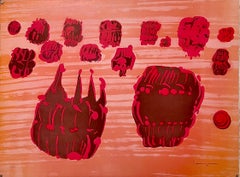
Pietro Consagra Italian Mod Abstract Expressionist Forma Brutalist Lithograph
By Pietro Consagra
Located in Surfside, FL
Pietro Consagra (Italian, 1920-2005).
Hand signed in pencil and numbered limited edition color lithograph on Magnani paper.
Embossed stamp with limited edition numbers in pencil to lower left, and having artist pencil signature to lower right.
(from a limited edition of 80 with 15 artist's proofs)
Published by Stamperia 2RC, Rome Italy and Marlborough Gallery, Rome, Italy.
Abstract Modernist work in colors, produced in the style of the Forma art movement of Postwar Italy, of which the artist was a prominent member.
Pietro Consagra (1920 – 2005) was an Italian Post war artist working in painting, printmaking and sculpture. In 1947 he was among the founding members of the Forma 1 group of artists, proponents of structured abstraction.
Consagra was born on 6 October 1920 in Mazara del Vallo, in the province of Trapani in south-western Sicily, to Luigi Consagra and Maria Lentini. From 1931 he enrolled in a trade school for sailors, studying first to become a mechanic, and later to become a captain. In 1938 he moved to Palermo, where he enrolled in the liceo artistico; despite an attack of tuberculosis, he graduated in 1941, and in the same year signed up at the Accademia di Belle Arti, where he studied sculpture under Archimede Campini. After the Invasion of Sicily and the Allied occupation of Palermo in 1943, Consagra found work as a caricaturist for the American Red Cross club of the city; he also joined the Italian Communist Party. Early in 1944, armed with a letter of introduction from an American officer, he travelled to Rome. There he came into contact with the Sicilian artist Concetto Maugeri, and through him with Renato Guttuso, who was also Sicilian and who introduced him to the intellectual life of the city and to other postwar artists such as Leoncillo Leonardi, Mario Mafai and Giulio Turcato. Consagra signed up at the Accademia di Belle Arti di Roma in September 1944 and studied sculpture there under Michele Guerrisi, but left before completing his diploma.
In 1947, with Carla Accardi, Ugo Attardi, Piero Dorazio, Mino Guerrini, Achille Perilli, Antonio Sanfilippo and Giulio Turcato, Consagra started the artist's group Forma 1, which advocated both Marxism and structured abstraction.
Steadily Consagra's work began to find an audience. Working primarily in metal, and later in marble and wood, his thin, roughly carved reliefs, began to be collected by Peggy Guggenheim and other important patrons of the arts. He showed at the Venice Biennale eleven times between 1950 and 1993, and in 1960 won the sculpture prize at the exhibition. During the 1960s he was associated with the Continuità group, an offshoot of Forma I, and in 1967 taught at the School of Arts in Minneapolis. Large commissions allowed him to begin working on a more monumental scale, and works of his were installed in the courtyard of the Foreign Ministry in Rome and in the European Parliament, Strasbourg. His work is found in the collections of The Tate Gallery, London, in Museo Cantonale d'Arte of Lugano and the Museum of Modern Art, Paris, and the National Gallery of Art in Washington, D.C..
Consagra returned to Sicily where he sculpted a number of significant works during the 1980s. With Senator Ludovico Corrao, he helped created an open-air museum in the new town of Gibellina, after the older town had been destroyed in the earthquake of 1968. Consagra designed the gates to the town's entrance, the building named "Meeting" and the gates to the cemetery, where he was later buried.
In 1952 Consagra published La necessità della scultura ("the need for sculpture"), a response to the essay La scultura lingua morta ("sculpture, a dead language"), published in 1945 by Arturo Martini. Other works include L'agguato c'è ("the snare exists", 1960), and La città frontale ("the frontal city", 1969). His autobiography, Vita Mia, was published by Feltrinelli in 1980. In 1989 a substantial retrospective exhibition of work by Consagra was shown at the Galleria Nazionale d'Arte Moderna in Rome; in 1993 a permanent exhibition of his work was installed there. In 1991 his work was shown in the Hermitage Museum in St. Petersburg. In 2002 the Galerie der Stadt Stuttgart opened a permanent exhibition of his work. He was one of ten artists invited by Giovanni Carandente, along with David Smith, Alexander Calder, Arnaldo Pomodoro, Lynn Chadwick, and Beverly Pepper, to fabricate works in Italsider factories in Italy for an outdoor exhibition, "Sculture nella città", held in Spoleto during the summer of 1962. He was included in the The 1962 International Prize for Sculpture the jury included Argan, Romero Brest and James Johnson Sweeney the former director of the Solomon R. Guggenheim Museum in New York. The participants included Louise Nevelson and John Chamberlain for the United States; Lygia Clark for Brazil; Pietro Consagra, Lucio Fontana, Nino Franchina, and Gió Pomodoro for Italy; Pablo Serrano for Spain; and Eduardo Paolozzi, William Turnbull, and Kenneth Armitage for England. Gyula Kosice, Noemí Gerstein...
Category
1960s Abstract Expressionist Abstract Prints
Materials
Lithograph
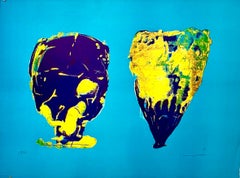
Pietro Consagra Italian Mod Abstract Expressionist Forma Art Informel Lithograph
By Pietro Consagra
Located in Surfside, FL
Pietro Consagra (Italian, 1920-2005).
Hand signed in pencil and numbered limited edition color lithograph on Magnani paper.
Embossed stamp with limited edition numbers in pencil to lower left, and having artist pencil signature to lower right.
(from a limited edition of 80 with 15 artist's proofs)
Published by Stamperia 2RC, Rome Italy and Marlborough Gallery, Rome, Italy.
Abstract Modernist work in colors, produced in the style of the Forma art movement of Postwar Italy, of which the artist was a prominent member.
Pietro Consagra (1920 – 2005) was an Italian Post war artist working in painting, printmaking and sculpture. In 1947 he was among the founding members of the Forma 1 group of artists, proponents of structured abstraction. (similar to the Art Informel and Art Brut in France and the Brutalist artists)
Consagra was born on 6 October 1920 in Mazara del Vallo, in the province of Trapani in south-western Sicily, to Luigi Consagra and Maria Lentini. From 1931 he enrolled in a trade school for sailors, studying first to become a mechanic, and later to become a captain. In 1938 he moved to Palermo, where he enrolled in the liceo artistico; despite an attack of tuberculosis, he graduated in 1941, and in the same year signed up at the Accademia di Belle Arti, where he studied sculpture under Archimede Campini. After the Invasion of Sicily and the Allied occupation of Palermo in 1943, Consagra found work as a caricaturist for the American Red Cross club of the city; he also joined the Italian Communist Party. Early in 1944, armed with a letter of introduction from an American officer, he travelled to Rome. There he came into contact with the Sicilian artist Concetto Maugeri, and through him with Renato Guttuso, who was also Sicilian and who introduced him to the intellectual life of the city and to other postwar artists such as Leoncillo Leonardi, Mario Mafai and Giulio Turcato. Consagra signed up at the Accademia di Belle Arti di Roma in September 1944 and studied sculpture there under Michele Guerrisi, but left before completing his diploma.
In 1947, with Carla Accardi, Ugo Attardi, Piero Dorazio, Mino Guerrini, Achille Perilli, Antonio Sanfilippo and Giulio Turcato, Consagra started the artist's group Forma 1, which advocated both Marxism and structured abstraction.
Steadily Consagra's work began to find an audience. Working primarily in metal, and later in marble and wood, his thin, roughly carved reliefs, began to be collected by Peggy Guggenheim and other important patrons of the arts. He showed at the Venice Biennale eleven times between 1950 and 1993, and in 1960 won the sculpture prize at the exhibition. During the 1960s he was associated with the Continuità group, an offshoot of Forma I, and in 1967 taught at the School of Arts in Minneapolis. Large commissions allowed him to begin working on a more monumental scale, and works of his were installed in the courtyard of the Foreign Ministry in Rome and in the European Parliament, Strasbourg. His work is found in the collections of The Tate Gallery, London, in Museo Cantonale d'Arte of Lugano and the Museum of Modern Art, Paris, and the National Gallery of Art in Washington, D.C..
Consagra returned to Sicily where he sculpted a number of significant works during the 1980s. With Senator Ludovico Corrao, he helped created an open-air museum in the new town of Gibellina, after the older town had been destroyed in the earthquake of 1968. Consagra designed the gates to the town's entrance, the building named "Meeting" and the gates to the cemetery, where he was later buried.
In 1952 Consagra published La necessità della scultura ("the need for sculpture"), a response to the essay La scultura lingua morta ("sculpture, a dead language"), published in 1945 by Arturo Martini. Other works include L'agguato c'è ("the snare exists", 1960), and La città frontale ("the frontal city", 1969). His autobiography, Vita Mia, was published by Feltrinelli in 1980. In 1989 a substantial retrospective exhibition of work by Consagra was shown at the Galleria Nazionale d'Arte Moderna in Rome; in 1993 a permanent exhibition of his work was installed there. In 1991 his work was shown in the Hermitage Museum in St. Petersburg. In 2002 the Galerie der Stadt Stuttgart opened a permanent exhibition of his work. He was one of ten artists invited by Giovanni Carandente, along with David Smith, Alexander Calder, Arnaldo Pomodoro, Lynn Chadwick, and Beverly Pepper, to fabricate works in Italsider factories in Italy for an outdoor exhibition, "Sculture nella città", held in Spoleto during the summer of 1962. He was included in the The 1962 International Prize for Sculpture the jury included Argan, Romero Brest and James Johnson Sweeney the former director of the Solomon R. Guggenheim Museum in New York. The participants included Louise Nevelson and John Chamberlain for the United States; Lygia Clark for Brazil; Pietro Consagra, Lucio Fontana, Nino Franchina, and Gió Pomodoro for Italy; Pablo Serrano for Spain; and Eduardo Paolozzi, William Turnbull, and Kenneth Armitage for England. Gyula Kosice, Noemí Gerstein...
Category
1960s Abstract Expressionist Abstract Prints
Materials
Lithograph
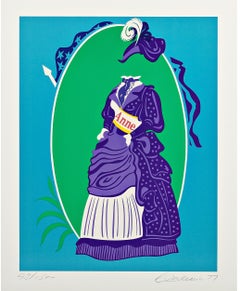
Anne, inspired by Gertrude Stein
s opera about Susan B. Anthony Signed/N print
By Robert Indiana
Located in New York, NY
Robert Indiana
Anne inspired by Susan B. Anthony, 1977
Color Lithograph on Arches Paper
Hand Signed, dated and numbered 93 from the limited edition of 150 (93/150) front in graphite pencil
17 4/5 × 14 inches
Unframed
Robert Indiana, celebrated for his iconic “LOVE” design, entered the realm of the theater in 1966 when he served as a set and costume designer for The Mother of Us All, an adaptation of Gertrude Stein and Virgil Thomson’s 1947 opera about activist Susan B. Anthony during the Women’s Suffrage Movement. Billed as “An American Pop Opera,” the play was first performed at the Guthrie Theatre...
Category
1970s Pop Art Figurative Prints
Materials
Lithograph
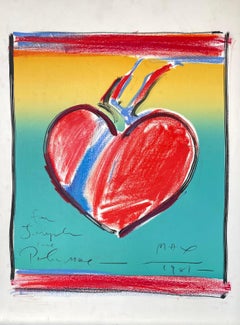
HEART II Signed Lithograph with Hand Coloring, Pop Art, Unique Pastel Drawing
By Peter Max
Located in Union City, NJ
HEART II - is a unique lithograph by the pop culture icon - Peter Max featuring with hand colored pastel drawing accents. The image HEART II was printed in 1981 as a limited edition...
Category
1980s Pop Art Mixed Media
Materials
Mixed Media, Lithograph
$3,680 Sale Price
20% Off
H 30 in W 22 in
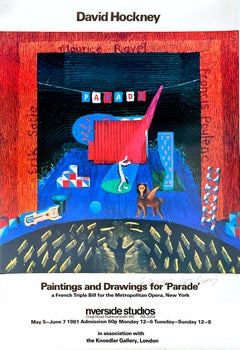
Paintings and Drawings for Parade offset lithograph Hand Signed by David Hockney
By David Hockney
Located in New York, NY
David Hockney
Paintings and Drawings for Parade - Metropolitan Museum (Hand Signed by David Hockney), 1981
Offset Lithograph. Hand signed by David Hockney...
Category
1980s Pop Art Abstract Prints
Materials
Lithograph, Offset
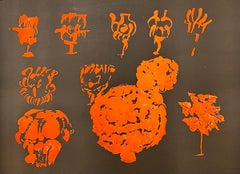
Red Lava Abstract Collagraph
By Winifred Heron
Located in Soquel, CA
Bold collagraph print by Aptos artist Winifred Heron (Italian-American, 1922-2015). The black ink has an iridescent quality. Signed in the lower right corner by the artist and number...
Category
1980s Abstract Expressionist Abstract Prints
Materials
Paper, Lithograph
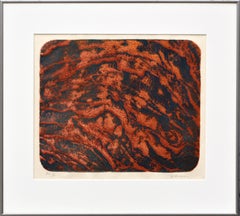
"Grusgrav", Mid Century Modern Danish Color-Field Abstract in Yellow, 36/80
Located in Soquel, CA
"Grusgrav", a wonderfully minimal yet expressive mid century modern abstract limited edition hand signed lithograph by Frede Christoffersen (Danish, 1919-1987). This 1962 color-field abstract features a subdued palette of earthy golden rod yellows and sage, the geometric areas of color divided into fractured shapes with organic and expressive texture. Grusgrav, the title of the piece, is Danish for gravel pit.
Titled "Grusgrav", signed with the artist's initials "FC" and dated "62" lower right. Numbered "36/80" lower left.
Signed "Frede Christoffersen" on verso.
Official Org. U.M. Grafik warranty certificate stamp on verso.
Displayed in a vintage painted wood frame.
Image size: 11.5"H x 17"W.
Another lithograph print of "Grusgrav" from the same edition, number 44/80, is included in the collection of the Fuglsang Art Museum (Fuglsang Kunstmuseum) on the island of Lolland in Denmark.
Born in Borup, Denmark, outside out Copenhagen. Christoffersen spent a short period at the Copenhagen Arts and Crafts School before travelling to the Far East in 1940-41. The result was his 20 "Smaa sorte Tegninger" published in 1941. From 1942 to 1943, he studied at the Royal Danish Academy of Fine Arts, both at the graphic arts school and at the school of painting, under Aksel Jørgensen...
Category
1960s Color-Field Abstract Prints
Materials
Paper, Lithograph
$1,500
H 18.5 in W 23.5 in D 0.5 in
More From This Seller
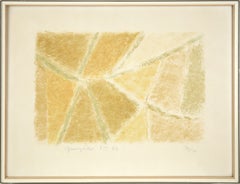
View AllLive from Lincoln Center, Abstract Expressionist Lithograph by Frankenthaler
By Helen Frankenthaler
Located in Long Island City, NY
Artist: Helen Frankenthaler (after), American (1928 - 2011)
Title: Live from Lincoln Center, 20th Year (Eve)
Year: 1995
Medium: Lithograph Poster, signed in the plate
Size: 48 in. x ...
Category
1990s Abstract Expressionist Abstract Prints
Materials
Lithograph
$1,440 Sale Price
20% Off
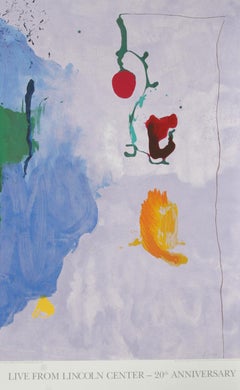
Light Explosion I, Abstract Minimalist Lithograph by Antonio Peticov
By Antonio Peticov
Located in Long Island City, NY
Artist: Antonio Peticov (Brazilian, b. 1946)
Title: Light Explosion I
Year: circa 1981
Medium: Lithograph, signed and numbered in pencil
Edition: 30
Image Size: 28 x 28 inches
...
Category
1980s Abstract Abstract Prints
Materials
Lithograph
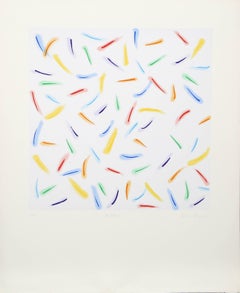
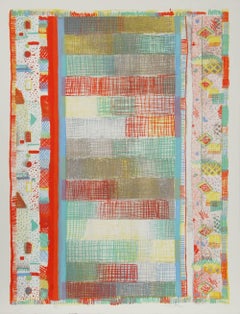
Colorful Abstract Expressionist Lithograph by Robert Natkin
By Robert Natkin
Located in Long Island City, NY
Artist: Robert Natkin, American (1930 - 2010)
Title: Untitled - V
Year: circa 1977
Medium: Lithograph, Signed in Pencil
Size: 31 in. x 24 in. (78.74 cm x 60.96 cm)
Category
1970s Abstract Expressionist Abstract Prints
Materials
Lithograph
$960 Sale Price
20% Off
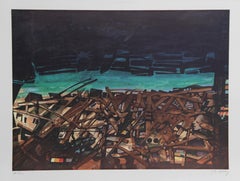
Guatemala, Signed Surrealist Landscape Lithograph by John Hultberg
By John Hultberg
Located in Long Island City, NY
Artist: John Hultberg
Title: Guatemala
Year: circa 1978
Medium: Lithograph, signed and numbered in pencil
Edition: 200, AP 30
Image Size: 19 x 26 inches
Paper Size: 22 in. x 30 in....
Category
1970s Surrealist Abstract Prints
Materials
Lithograph
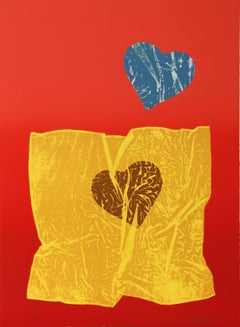
Love, Colorful Pop Art Lithograph by Antonio Recalcati
By Antonio Recalcati
Located in Long Island City, NY
Artist: Antonio Recalcati
Title: Love
Year: 1979
Medium: Lithograph, signed and numbered in pencil
Edition: 300
Paper Size: 30 x 22 inches
Category
1970s Pop Art Abstract Prints
Materials
Lithograph
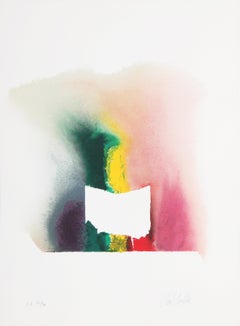
Le Couleur Est Un Chemin 4, Abstract Lithograph by Paul Jenkins
By Paul Jenkins
Located in Long Island City, NY
A lithograph from the portfolio "Le Couleur est un Chemin" or "The Color is a Path", a collection by Paul Jenkins that also includes several poems. This abstract piece is signed and ...
Category
1980s Abstract Prints
Materials
Lithograph
Still Thinking About These?
All Recently ViewedRead More
Romare Bearden’s Humanity Infuses His Bright, Bold Art
Through collage, painting and printmaking, the artist foregrounded Black life in America in revolutionary new ways.
Chryssa’s 1962 Neon Sculpture Was Way ahead of the Art-World Curve
By working with lettering, neon and Pop imagery, Chryssa pioneered several postmodern themes at a time when most male artists detested commercial mediums.