1 of 8
Felix DolahGelsomina2019
2019
$409.19List Price
About the Item
- Creator:Felix Dolah (1988, German)
- Creation Year:2019
- Dimensions:Height: 16.54 in (42 cm)Width: 11.7 in (29.7 cm)
- Medium:
- Movement Style:
- Period:
- Condition:
- Gallery Location:London, GB
- Reference Number:1stDibs: LU174229645312
Felix Dolah (b.1988) is a self-taught artist who lives and works in Mainz, central Germany. Felix Dolah's drawings are monochrome: mixed on paper, water and charcoal giving birth to a series of portraits of individuals, alone or grouped, whose gender is sometimes difficult to define. Those long limbs loosed like spider-threads, form the originality of these people with deformed features and expressionless faces. The characters seem to emerge from a world in pain where social cohesion reigns supreme. Rehabilitating the importance of the social entity, Felix Dolah raises the communication as unique means of survival. At the heart of his work, there is a humanity that is disintegrating, in a desperate quest for identity. The landscape is nonexistent: only the human counts. The ghostly shadows that populate the universe of Felix Dolah look timeless: they are the part of ourselves that rambles in an in-between, the part which was transformed, camouflaged, destroyed. It is probably for this reason that Felix Dolah leaves fingerprints on some of his drawings, giving the work an organic, carnal dimension. In this way he recomposes an identity which diluted with water, tends to fade. Who are these disembodied bodies? The last upheavals of a world frozen in its inhumanity.
Authenticity Guarantee
In the unlikely event there’s an issue with an item’s authenticity, contact us within 1 year for a full refund. DetailsMoney-Back Guarantee
If your item is not as described, is damaged in transit, or does not arrive, contact us within 7 days for a full refund. Details24-Hour Cancellation
You have a 24-hour grace period in which to reconsider your purchase, with no questions asked.Vetted Professional Sellers
Our world-class sellers must adhere to strict standards for service and quality, maintaining the integrity of our listings.Price-Match Guarantee
If you find that a seller listed the same item for a lower price elsewhere, we’ll match it.Trusted Global Delivery
Our best-in-class carrier network provides specialized shipping options worldwide, including custom delivery.You May Also Like
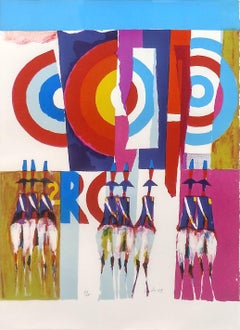
CARABINIERI A OSTIA
By Nicola Simbari
Located in Aventura, FL
Serigraph on paper. Hand signed and numbered by the artist. Artwork size 27.5 x 19.5 inches. Frame size approx 32 x 24 inches. Artwork is in excellent condition. Edition of 125. C...
Category
1990s Expressionist Abstract Prints
Materials
Paper, Screen
Nick
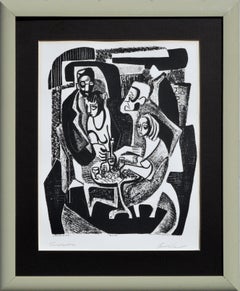
s Coffee House in the Village - Rare Edition 1970s Modern Figurative Print
By Lenore SImon
Located in Soquel, CA
This bold screen print depicts a scene from the 1950s, set in a jazz coffee house in Greenwich Village called Nick's, which Simon patronized while in high school. The original stone ...
Category
Late 20th Century Expressionist Figurative Prints
Materials
Archival Paper, Screen
$920 Sale Price
20% Off
H 22 in W 18 in D 0.75 in
Ghosts of Philadelphia 2
By Tom Bennett
Located in Brooklyn, NY
Monotype
Dramatic imagery from Tom Bennett’s series of black and white monotypes, blending surrealistic mindscapes with stark realism
About Tom Bennett:
With quick brushstrokes, Tom...
Category
2010s Expressionist Figurative Prints
Materials
Monotype, Archival Ink
Untitled
Located in Barcelona, BARCELONA
Includes a Certificate of Authenticity
Category
1990s Expressionist Abstract Prints
Materials
Lithograph
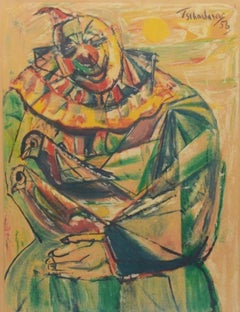
Mid Century Modern Clown print, hand signed 144/250 Russian born American artist
By Nahum Tschacbasov
Located in New York, NY
Nahum Tschacbasov
Mid Century Modern Clown, 1956
Lithograph
Signed, dated and numbered 144/250 in graphite on the front
34 x 27.5 inches
Unframed, affixed to matting
Published by American Color Slide Co, Ltd., New York
Terrific uncommon vintage signed, numbered and dated mid Century modern lithograph from this interesting and distinctive -and undervalued Russian American artist. Highly collectible clown...
Category
Mid-20th Century Expressionist Abstract Prints
Materials
Lithograph
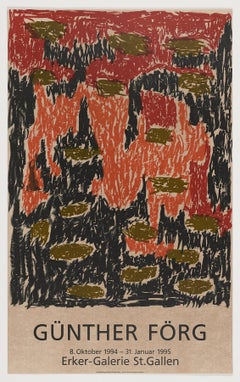
Günther Förg German Artist 1995 Original Poster lithograph
By Günther Förg
Located in Miami, FL
Günther Förg (Germany, 1952-2013)
'Erker-Gallery', 1995
Original poster from exhibition of 1995
lithograph on paper
36.5 x 22.6 in. (92.7 x 57.4 cm.)
Unframed
Ref: FOR100-201
Günthe...
Category
1990s Expressionist Abstract Prints
Materials
Lithograph
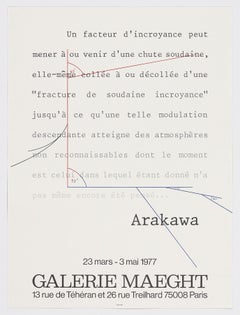
Shusaku Arakawa Japanese Artist 1977 original vintage poster lithograph print
By Shusaku Arakawa
Located in Miami, FL
Shusaku Arakawa (Japan, 1936-2010)
'Galerie Maeght', 1977
Original poster from exhibition of 1977
lithograph on paper
23.7 x 17.8 in. (60 x 45 cm.)
Unframed
Ref: ARA100-201
Shusaku ...
Category
1970s Expressionist Abstract Prints
Materials
Lithograph
$300
H 23.63 in W 17.72 in
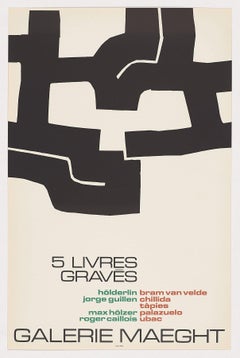
Eduardo Chillida Spanish Artist Original Unused Lithograph Poster
By Eduardo Chillida
Located in Miami, FL
Eduardo Chillida (Spain, 1924-2002)
'5 Livres Gravés', 1974
Original poster from show
lithograph on paper
25.2 x 17 in. (64 x 43 cm.)
Unframed
Ref: CHI100-202
Eduardo Chillida
He be...
Category
1970s Expressionist Abstract Prints
Materials
Lithograph
$350
H 25.19 in W 16.92 in
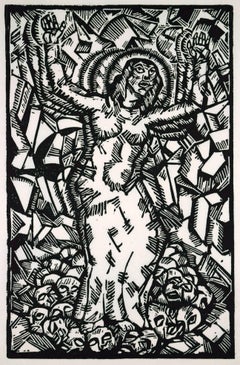
The Mother / - Violated Motherhood -
By Georg Tappert
Located in Berlin, DE
Georg Tappert (1880 Berlin - 1957 Berlin), The Mother, 1918 (1964). Estate print from 1964. Linocut on Japan, 31.5 cm x 20 cm (image), 44.5 cm x 28 cm (sheet size), marked lower left...
Category
1910s Expressionist Figurative Prints
Materials
Paper
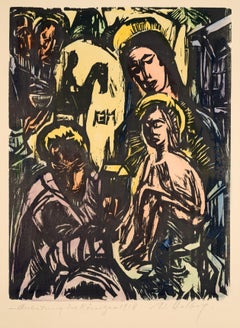
Adoration of the Magi / - The Rider of the Sun -
Located in Berlin, DE
Walter Helbig (1878 Falkenstein - 1968 Ascona), Adoration of the Magi, 1918. Hand-colored linocut, 30 cm x 22.5 cm (depiction), 50 cm x 35 cm (sheet size), signed “W.[alter] Helbig” in pencil lower right, inscribed “Adoration of the Magi” lower left and dated “1918”. Below this a handwritten dedication “with heartfelt Christmas greetings”.
- Paper somewhat darkened and with slight creases, thumbtack holes in the corners
- The Rider of the Sun -
The 'apocalypse' of World War I brought about a return to sacred art. Walter Helbig belonged to the circle of the 'Brücke' and the 'Blauer Reiter'. With his reinterpretation of religious themes in an expressionist formal language, Helbig shaped an avant-garde neo-sacred art. This is symbolically expressed in the silhouette of the rider against the sun-like yellow background. It refers to the awakening initiated by the Blue Riding, which is now linked back to the sacred.
The rider and horse "look" at Mary and the Christ Child, who occupy the entire field. Opposite them are the three kings, the eldest of whom kneels before Christ and offers him a gold-filled casket. The expressionist lines give rise to a tower that rises into the "sun", so that the gift has become a Gothic church, expressing the hope that the fallen world will be resurrected in the name of Christ. This dimension of meaning is emphasized by the magical effect of the color scheme.
About the artist
In 1895, Walter Helbig began studying at the Dresden Academy of Art, where he became friends with the future Brücke artist Otto Müller, with whom he lived in Dresden from 1903 to 1905. While studying in Italy from 1897 to 1899, he met Arnold Böcklin and Adolf von Hildebrand. After completing his studies, he first worked for Otto Gussmann, painting churches. From 1905 to 1909 he worked as a freelance painter in Hamburg. In 1909, through the mediation of Otto Müller, Helbig made the acquaintance of artists from the 'Brücke'. In 1910 he exhibited at the founding exhibition of the Berlin 'Neue Sezession'. In the same year, he moved to Switzerland, where, together with Hans Arp and Oscar Lüthy, he founded the 'Moderne Bund' in Weggis, to which Cuno Amiet and Giovanni Giacometti also belonged. At the second exhibition of the 'Moderne Bund' in Zurich in 1911, Henri Matisse and Robert Delaunay were represented alongside artists from the 'Blauer Reiter'. In 1913, Helbig traveled to Paris with Arp and Lüthy. After the dissolution of the 'Moderne Bund', Helbig was represented at the first Dada exhibition in Zurich in 1914. In 1919, he joined the Berlin 'Novembergruppe'. After the devastation of World War I, Helbig turned increasingly to religious themes in his work. In 1924, like many other artists of his time, he moved to Ascona for financial reasons, where he became a naturalized citizen in 1938. There he founded the artists' association "The Great Bear", to which Marianne von Werefkin...
Category
1910s Expressionist Figurative Prints
Materials
Paper
$776
H 19.69 in W 13.78 in D 0.4 in
Still Thinking About These?
All Recently ViewedMore Ways To Browse
Bavarian Paintings
Bronze Heart Sculpture
Bronze Portrait Head
Calder Ink
Chanel Sculpture
Charles Mcgee
Christmas Posters
El Salvador Art
Fish Painting French
Francis Bacon Painting
Gothic Oil Painting
Jewish Torah
Korean Contemporary Sculpture
Large India Paintings
Latin America Sculpture
Lying Down Sculpture
Mille Nuits
Moroccan Woman