Want more images or videos?
Request additional images or videos from the seller
1 of 9
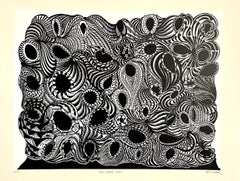
Igael TumarkinIsraeli Josef Zaritsky Abstract Modernist Lithograph Print "Composition"c.1959
c.1959
$750List Price
About the Item
- Creator:Igael Tumarkin (1933, German, Israeli)
- Creation Year:c.1959
- Dimensions:Height: 20 in (50.8 cm)Width: 27 in (68.58 cm)Depth: 2 in (5.08 cm)
- Medium:
- Movement Style:
- Period:
- Condition:minor wear, please see photos.
- Gallery Location:Surfside, FL
- Reference Number:1stDibs: LU3824573541
About the Seller
4.9
Platinum Seller
Premium sellers with a 4.7+ rating and 24-hour response times
Established in 1995
1stDibs seller since 2014
1,858 sales on 1stDibs
Authenticity Guarantee
In the unlikely event there’s an issue with an item’s authenticity, contact us within 1 year for a full refund. DetailsMoney-Back Guarantee
If your item is not as described, is damaged in transit, or does not arrive, contact us within 7 days for a full refund. Details24-Hour Cancellation
You have a 24-hour grace period in which to reconsider your purchase, with no questions asked.Vetted Professional Sellers
Our world-class sellers must adhere to strict standards for service and quality, maintaining the integrity of our listings.Price-Match Guarantee
If you find that a seller listed the same item for a lower price elsewhere, we’ll match it.Trusted Global Delivery
Our best-in-class carrier network provides specialized shipping options worldwide, including custom delivery.You May Also Like
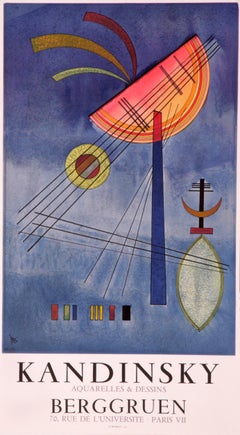
Berggruen abstract lithographic poster by Wassily Kandinsky, 1972
By Wassily Kandinsky
Located in New York, NY
This colorful modern lithographic poster by Wassily Kandinsky was printed in 1972 at the Atelier Mourlot in Paris to promote an exhibition of his watercolors and drawings at the Gale...
Category
1970s Modern Abstract Prints
Materials
Lithograph
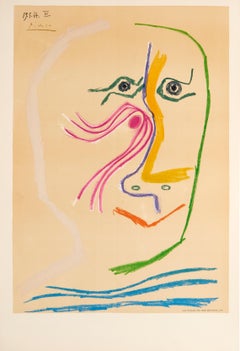
Hommage a Rene Char after Pablo Picasso
By Pablo Picasso
Located in New York, NY
This colorful lithograph after Pablo Picasso was printed by the Atelier Mourlot in Paris in 1964 and is unsigned*. This image is taken from a drawing in pencil and colored chalk enti...
Category
1960s Modern Abstract Prints
Materials
Lithograph
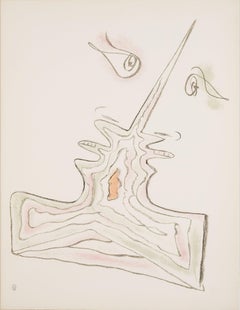
Les Amoureux- From the Album "Jean Cocteau Lithographies" by Jean Cocteau
By Jean Cocteau
Located in New York, NY
The modern lithograph "Les Amoureux" by Jean Cocteau was printed at the Atelier Mourlot in 1957. Cocteau was a master at representing the languid forms of his subjects in sketches. H...
Category
1950s Modern Abstract Prints
Materials
Lithograph
$952 Sale Price
20% Off
H 25.5 in W 19.75 in
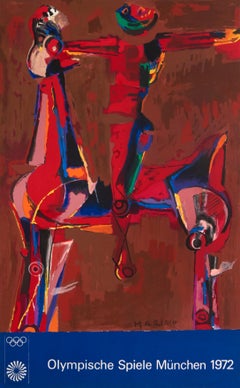
Olympische Spiele Munchen by Marino Marini -poster for 1972 olympics in Munich
By Marino Marini
Located in New York, NY
Classic Poster Paper - Good Condition A
Original lithographic poster created by Marino Marini for the 1972 Olympic Games in Munich, Germany. It is both ...
Category
1970s Modern Abstract Prints
Materials
Lithograph
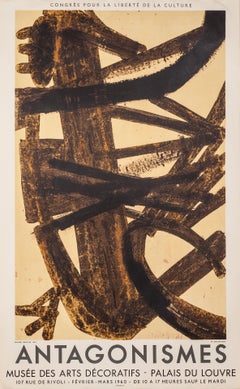
Antagonismes by Pierre Soulages (1960) - lithographic poster
By Pierre Soulages
Located in New York, NY
Made for an exhibition of artist Pierre Soulages works at the Musee Des Arts Decoratifs (museum of decorative arts and design) at the Palais du Louvre in Paris, 1960. The original im...
Category
Mid-20th Century Modern Abstract Prints
Materials
Lithograph
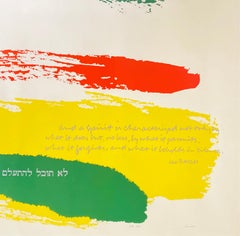
Leo Baeck "and a Spirit is Characterized"
By Corita Kent
Located in Missouri, MO
Leo Baeck and a Spirit is Characterized
Sister Mary Corita Kent (American, 1918-1986)
Signed Lower Right in Pencil
Edition of 250 Lower center
21.5 x 21.5 inches
24 x 24 inches frame...
Category
20th Century American Modern Abstract Prints
Materials
Color, Lithograph
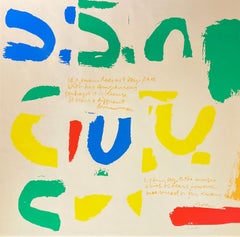
Thoreau "If a Man Does Not Keep Peace"
By Corita Kent
Located in Missouri, MO
Thoreau "If a Man Does Not Keep Peace"
Sister Mary Corita Kent (American, 1918-1986)
Signed in Pencil Lower Right
22.5 x 22.5 inches
23.25 x 23.25 inches with frame
Sister Mary Cori...
Category
20th Century American Modern Abstract Prints
Materials
Color, Lithograph
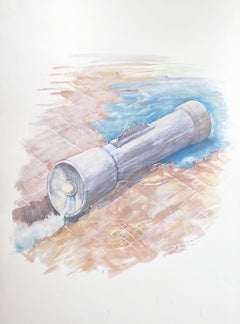
Colossal Flashlight in Place of Hoover Dam
By Claes Oldenburg
Located in Missouri, MO
Colossal Flashlight in Place of Hoover Dam, 1982
By Claes Oldenburg (Swedish, American, 1929-2022)
Signed Lower Right
Dated Middle Right
Unframed: 23" x 22"
Framed: 36.5" x 27.5"
Whimsical sculpture of pop culture objects, many of them large and out-of-doors, is the signature work of Swedish-born Claes Oldenburg who became one of America's leading Pop Artists. He was born in Stockholm, Sweden. His father was a diplomat, and during Claes' childhood moved his family from Stockholm to a variety of locations including Chicago where the father was general consul of Sweden and where Oldenburg spent most of his childhood. He attended the Latin School of Chicago, and then Yale University where he studied literature and art history, graduating in 1950, the same year Claes became an American citizen.
Returning to Chicago, he enrolled at the Art Institute of Chicago from 1952 to 1954 and also worked as a reporter at the City News Bureau. He opened his own studio, and in 1953, some of his satirical drawings were included in his first group show at the Club St. Elmo, Chicago. He also painted at the Oxbow School of Painting in Michigan.
In 1956, he moved to New York where he drew and painted while working as a clerk in the art libraries of Cooper-Union Museum for the Arts of Decoration. Selling his first artworks during this time, he earned 25 dollars for five pieces.
Oldenburg became friends with numerous artists including Jim Dine, Red Grooms and Allan Kaprow, who with his "Happenings" was especially influential on Oldenburg's interest in environmental art. Another growing interest was soft sculpture, and in 1957, he created a piece later titled Sausage, a free-hanging woman's stocking stuffed with newspaper.
In 1959, he had his first one-man show, held at the Judson Gallery at Washington Square. He exhibited wood and newspaper sculpture and painted papier-mache objects. Some viewers of the exhibit commented how refreshing Oldenburg's pieces were in contrast to the Abstract Expressionism, a style which much dominated the art world. During this time, he was influenced by the whimsical work of French artist, Bernard Buffet, and he experimented with materials and images of the junk-filled streets of New York.
In 1960, Oldenburg created his first Pop-Art Environments and Happenings in a mock store full of plaster objects. He also did Performances with a cast of colleagues including artists Lucas Samaras, Tom Wesselman, Carolee Schneemann, Oyvind Fahlstrom and Richard Artschwager, dealer Annina Nosei, critic Barbara Rose, and screenwriter Rudy Wurlitzer.
His first wife (1960-1970) Pat Muschinski, who sewed many of his early soft sculptures, was a constant performer in his Happenings. This brash, often humorous, approach to art was at great odds with the prevailing sensibility that, by its nature, art dealt with "profound" expressions or ideas.
In December 1961, he rented a store on Manhattan's Lower East Side to house "The Store," a month-long installation he had first presented at the Martha Jackson Gallery in New York. This installation was stocked with sculptures roughly in the form of consumer goods.
Oldenburg moved to Los Angeles in 1963 "because it was the most opposite thing to New York I could think of". That same year, he conceived AUT OBO DYS, performed in the parking lot of the American Institute of Aeronautics and Astronautics in December 1963.
In 1965 he turned his attention to drawings and projects for imaginary outdoor monuments. Initially these monuments took the form of small collages such as a crayon image of a fat, fuzzy teddy bear looming over the grassy fields of New York's Central Park (1965) and Lipsticks in Piccadilly Circus, London (1966). Oldenburg realized his first outdoor public monument in 1967; Placid Civic Monument took the form of a Conceptual performance/action behind the Metropolitan Museum of Art, New York, with a crew of gravediggers digging a 6-by-3-foot rectangular hole in the ground.
Many of Oldenburg's large-scale sculptures of mundane objects elicited public ridicule before being embraced as whimsical, insightful, and fun additions to public outdoor art. From the early 1970s Oldenburg concentrated almost exclusively on public commissions.
Between 1969 and 1977 Oldenburg had been in a relationship with Hannah Wilke, feminist artist, but in 1977 he married Coosje van Bruggen, a Dutch-American writer and art historian who became collaborator with him on his artwork. He had met her in 1970, when she curated an exhibition for him at the Stedelijk Museum in Amsterdam. Their first collaboration came when Oldenburg was commissioned to rework Trowel I, a 1971 sculpture of an oversize garden tool, for the grounds of the Kröller-Müller Museum in Otterlo, the Netherlands.
Oldenburg has officially signed all the work he has done since 1981 with both his own name and van Bruggen's. In 1988, the two created the iconic Spoonbridge and Cherry sculpture for the Walker Art Center in Minneapolis, Minnesota that remains a staple of the Minneapolis Sculpture Garden as well as a classic image of the city. Typewriter Eraser...
Category
20th Century American Modern Abstract Prints
Materials
Paper, Lithograph
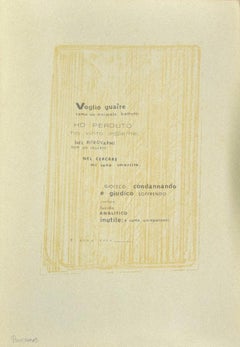
Poetry - Photo-lithograph on Cardboard - Early 20th Century
By Emile Hugon
Located in Roma, IT
Poetry is an original photo-lithograph on ivory-colored cardboard realized by Anonymous Artist of the XX Century.
The Text on the artwork:
"I want to Heal like a beaten animal; I ...
Category
Early 20th Century Modern Abstract Prints
Materials
Lithograph, Photogravure
$356
H 13 in W 9.06 in D 0.04 in
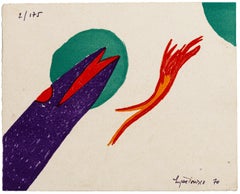
Composition - Lithograph by Eugène Ionesco - 1970
Located in Roma, IT
Composition is an lithography artwork realized by Eugène Ionesco ( 1909-1994).
In very good condition.
Sheet dimension: 22.5 x 28 cm.
The artwork rep...
Category
1970s Modern Abstract Prints
Materials
Lithograph
$832
H 8.86 in W 11.03 in D 0.04 in
More From This Seller
View AllIsraeli Tumarkin Abstract Modernist Graffiti Art Lithograph Print "Broken Hour"
Located in Surfside, FL
This was from a portfolio which included works by Yosl Bergner, Menashe Kadishman, Yosef Zaritsky, Aharon Kahana, Moshe Tamir and Michael Gross.
Yigal Tumarkin (also Igael Tumarkin...
Category
1950s Modern Abstract Prints
Materials
Lithograph
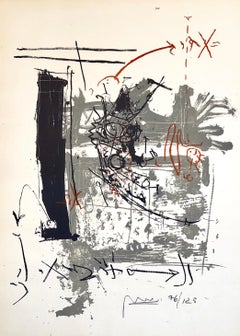
Israeli Josef Zaritsky Abstract Modernist Lithograph Print "Composition"
Located in Surfside, FL
Abstract Composition, 1959 Lithograph
This was from a portfolio which included works by Yosl Bergner, Menashe Kadishman, Yosef Zaritsky, Aharon Kahana, Moshe Tamir and Michael Gross.
Joseph (Yossef) Zaritsky (Hebrew: יוסף זריצקי; September 1, 1891 – November 30, 1985) was one of Israel's greatest artists and one of the early promoters of modern art in the Land of Israel both during the period of the Yishuv (Palestine, the body of Jewish residents in the Land of Israel before the establishment of the State of Israel) and after the establishment of the State. In 1948 Zaritsky was one of the founders of the "Ofakim Hadashim" group. In his works he created a uniquely Israeli style of abstract art, which he sought to promote by means of the group. For this work he was awarded the Israel Prize for painting in 1959.
Joseph Zaritsky...
Category
1950s Modern Abstract Prints
Materials
Lithograph
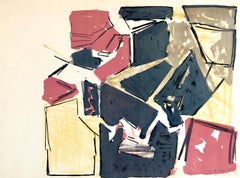
Conceptual Art Hand Signed Mel Bochner Lithograph Print Abstract Geometric Ed 30
By Mel Bochner
Located in Surfside, FL
Mel Bochner (American, 1940-2025)
Color lithograph (color line photo-engraving on off-white wove paper)
Hand signed and numbered in graphite pencil
This is a PP (Printers Proof) outs...
Category
1990s Conceptual Abstract Prints
Materials
Lithograph
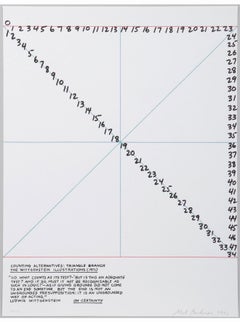
1981 American Post Minimalist Abstract Art Lithograph Neon Series Keith Sonnier
By Keith Sonnier
Located in Surfside, FL
Keith Sonnier, American (1941-2020)
lithograph
From Neon series
circa 1980-1981
Bears the Waterstreet Press watermarks and Arches paper blind stamp to lower right corner. Pub. Edizioni Lucio Amelio
Hand signed with initials in pencil
Dimensions: 30 x 21 3/4 inches
Post minimalist Abstract by Keith Sonnier
Keith Sonnier (1941 – 2020) was a post minimalist sculptor, performance artist, video and light artist. Sonnier was one of the first artists to use light in sculpture in the 1960s. With his use of neon in combination with ephemeral materials he achieved international recognition. Sonnier was part of the Process Art movement.
James Keith Sonnier was born July 31, 1941, in Mamou, Louisiana. His family was Cajun and Roman Catholic. His father was a hardware store owner, Joseph Sonnier, and his mother was a florist and singer, Mae Ledoux. He graduated in 1963 from Southwestern Louisiana Institute (now known as the University of Louisiana at Lafayette). In 1966, he graduated with his MFA degree from Rutgers University, where he studied under Allan Kaprow, Robert Watts, and Robert Morris. After graduation from Rutgers, he moved to New York City with Jackie Winsor and some of his former classmates.
Sonnier died in Southampton, NY on July 18, 2020.
Sonnier began experimenting with neon in 1968. Neon lights became a signature material used in his sculptural works. The common materials Sonnier employed included neon and fluorescent lights; reflective materials; aluminum and copper; and glass and wires. Of the generation of James Turrell and Dan Flavin, He was also associated with the Light and Space movement, a loosely affiliated art movement related to op art, minimalism and geometric abstraction originating in Southern California in the 1960s and influenced by John McLaughlin. It is characterized by a focus on perceptual phenomena, such as light, volume and scale, and the use of materials such as glass, neon, fluorescent lights, resin and cast acrylic, often forming installations conditioned by the work's surroundings. Artists included Ron Cooper...
Category
1980s Post-Minimalist Abstract Prints
Materials
Paper, Lithograph
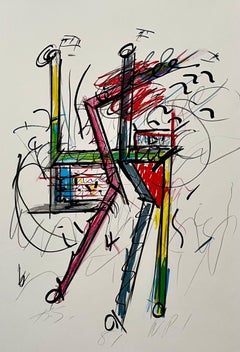
1981 American Post Minimalist Abstract Art Lithograph Neon Series Keith Sonnier
By Keith Sonnier
Located in Surfside, FL
Keith Sonnier, American (1941-2020)
lithograph
From Neon series
circa 1980-1981
Bears the Waterstreet Press watermarks and Arches paper blind stamp to lower right corner. Pub. Edizioni Lucio Amelio
Hand signed with initials in pencil
Dimensions: 30 x 21 3/4 inches
Post minimalist Abstract by Keith Sonnier
Keith Sonnier (1941 – 2020) was a post minimalist sculptor, performance artist, video and light artist. Sonnier was one of the first artists to use light in sculpture in the 1960s. With his use of neon in combination with ephemeral materials he achieved international recognition. Sonnier was part of the Process Art movement.
James Keith Sonnier was born July 31, 1941, in Mamou, Louisiana. His family was Cajun and Roman Catholic. His father was a hardware store owner, Joseph Sonnier, and his mother was a florist and singer, Mae Ledoux. He graduated in 1963 from Southwestern Louisiana Institute (now known as the University of Louisiana at Lafayette). In 1966, he graduated with his MFA degree from Rutgers University, where he studied under Allan Kaprow, Robert Watts, and Robert Morris. After graduation from Rutgers, he moved to New York City with Jackie Winsor and some of his former classmates.
Sonnier died in Southampton, NY on July 18, 2020.
Sonnier began experimenting with neon in 1968. Neon lights became a signature material used in his sculptural works. The common materials Sonnier employed included neon and fluorescent lights; reflective materials; aluminum and copper; and glass and wires. Of the generation of James Turrell and Dan Flavin, He was also associated with the Light and Space movement, a loosely affiliated art movement related to op art, minimalism and geometric abstraction originating in Southern California in the 1960s and influenced by John McLaughlin. It is characterized by a focus on perceptual phenomena, such as light, volume and scale, and the use of materials such as glass, neon, fluorescent lights, resin and cast acrylic, often forming installations conditioned by the work's surroundings. Artists included Ron Cooper...
Category
1980s Post-Minimalist Abstract Prints
Materials
Paper, Lithograph
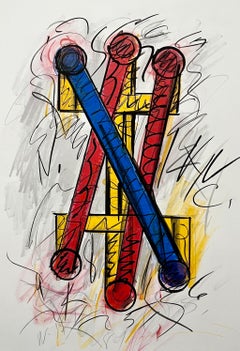
Large 1960s French Art Brut Lithograph Bold Black
White Op Art Philippe Dereux
Located in Surfside, FL
Printed by Pierre Chave, Vence, published by Bianchi Frères in Nice, France
ink on watermarked chiffon de Mandeure paper, hand signed in pencil lower right, "PH Dureux," numbered 4/5...
Category
1960s Outsider Art Abstract Prints
Materials
Archival Paper, Lithograph