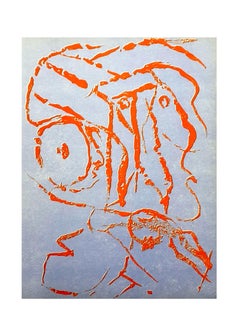
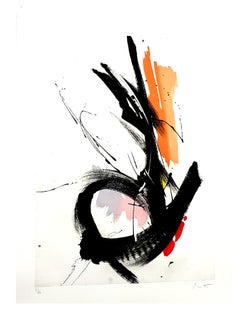
Items Similar to Israeli Tumarkin Abstract Modernist Graffiti Art Lithograph Print "Broken Hour"
Want more images or videos?
Request additional images or videos from the seller
1 of 9
Igael TumarkinIsraeli Tumarkin Abstract Modernist Graffiti Art Lithograph Print "Broken Hour"c.1959
c.1959
$750
£569.18
€655.81
CA$1,059.63
A$1,135.38
CHF 609.05
MX$13,448.70
NOK 7,682.83
SEK 7,028.60
DKK 4,899.01
About the Item
This was from a portfolio which included works by Yosl Bergner, Menashe Kadishman, Yosef Zaritsky, Aharon Kahana, Moshe Tamir and Michael Gross.
Yigal Tumarkin (also Igael Tumarkin) (born 1933) is an Israeli painter and sculptor.
Biography
Peter Martin Gregor Heinrich Hellberg (later Yigal Tumarkin) was born in Dresden, Germany. His father, Martin Hellberg, was a German theater actor and director. His mother, Berta Gurevitch and his stepfather, Herzl Tumarkin, immigrated to Mandate Palestine when he was two. Tumarkin served in the Israeli Navy. After completing his military service, he studied sculpture in Ein Hod, a village of artists near Mount Carmel. Johanaan Peter worked there with Hans Jean Arp and Dada artist Marcel Janco pioneering Modernist studio Jewelry in Israel. Tumarkin did some Jewelry as awards for the state of Israel (along with Yaacov Agam, Jacques Lipchitz, Salvador Dali, Samuel Bak, Dani Karavan and others.) This is not from that edition but much more rare studio produced limited edition sculptural pieces. Among Tumarkin's best known works are the Holocaust memorial in Rabin Square, Tel Aviv and his sculptures commemorating fallen soldiers in the Negev.
Tumarkin is also a theoretician and stage designer. In the 1950s, Tumarkin worked in East Berlin, Amsterdam, and Paris. Upon his return to Israel in 1961, he became a driving force behind the break from the charismatic monopoly of lyric abstraction there. Tumarkin created assemblages of found objects, generally with violent Expressionist undertones and decidedly unlyrical color. Hebrew. His determination to "be different" influenced his younger Israeli colleagues. The furor generated around Tumarkin's works, such as the old pair of trousers stuck to one of his pictures, intensified the mystique surrounding him.Tumarkin has worked extensively in the medium of printmaking, producing over three hundred prints. He was encouraged by the print studios founded during those years in the USA, where prominent artists such as Jasper Johns and Robert Rauschenberg began to engage in printmaking. Tumarkin prints of the sixties were at crossroads between Abstract Expressionism and Pop Art, and between Pop Art and abstract movements that followed. In addition, he was influenced by the Surrealism and Dada movements whose impact was expressed in the combination of free brushstrokes and drip paintings together with the use of such materials as newspaper cuttings, photographs and junk. Tumarkin has participated in various international exhibitions, and won many awards. His works are displayed in private collections and in museums both in Israel and abroad. His work is in many museums and galleries and was included in the show Israel - Entre Reve et Realite at the Musée Juif de Belgique, Brussels, Belgium along with Yosl Bergner, Abel Pann, Reuven Rubin, Igael Tumarkin, Ephraim Moshe Lilien, Yaacov Agam, Jacob Pins and Menashe Kadishman amongst others.
Education
1954 – Studied with Rudi Lehmann, Ein-Hod
1955 Studied with Bertolt Brecht, Berliner Ensemble, Berlin
1955-57 Assistant to the designer Karl von Appen
Awards and recognition
1963 First Prize for Battle of Hulaykat Monument
1968 The Sandberg Prize for Israeli Art, Israel Museum, Jerusalem, Israel
1968 First Prize for Memorial to Sailors, Haifa
1971 First Prize for Memorial for "Holocaust and Resurrection", Tel Aviv
1978 First Prize in the Biennale for Drawing, Reike
1984 Award from the President of the Italian Republic
1985 Dizengoff Prize for Sculpture
1990 Guest of the Japan Foundation
1992 August Rodin Prize, The International Sculpture Competition of the Open Museum, Hakone, Japan, for his sculpture of the sign at the entrance to Auschwitz concentration camp Arbeit Macht Frei.
1997 Award of Excellence, the President of the Federal Republic of Germany
1998 Sussman Prize, Vienna
2004 Israel Prize for sculpture
- Creator:Igael Tumarkin (1933, German, Israeli)
- Creation Year:c.1959
- Dimensions:Height: 26.5 in (67.31 cm)Width: 18.75 in (47.63 cm)Depth: 2 in (5.08 cm)
- Medium:
- Movement Style:
- Period:
- Condition:minor wear, please see photos.
- Gallery Location:Surfside, FL
- Reference Number:1stDibs: LU38214372962
About the Seller
4.9
Platinum Seller
Premium sellers with a 4.7+ rating and 24-hour response times
Established in 1995
1stDibs seller since 2014
1,863 sales on 1stDibs
Typical response time: <1 hour
- ShippingRetrieving quote...Shipping from: Surfside, FL
- Return Policy
More From This Seller
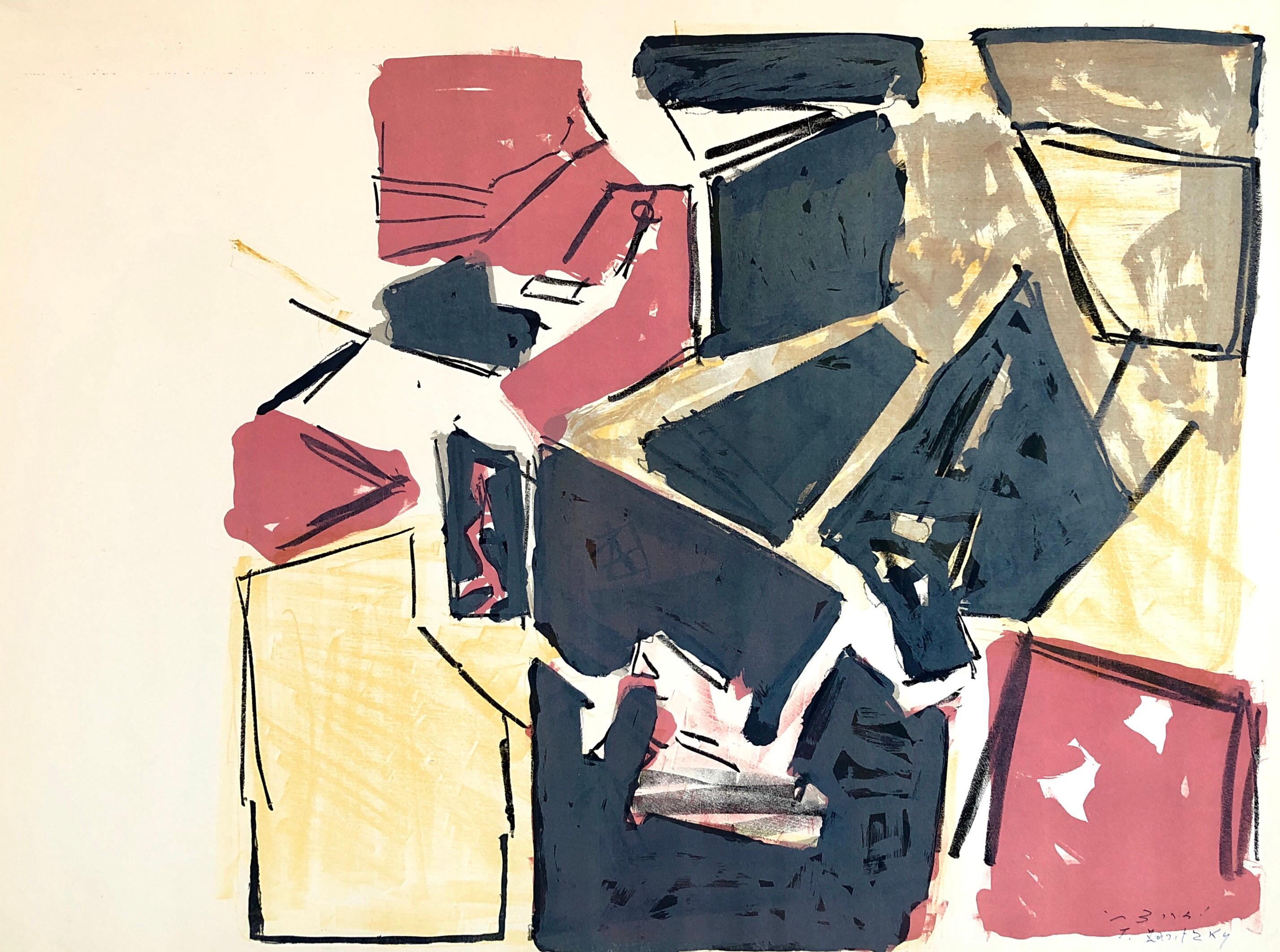
View AllIsraeli Josef Zaritsky Abstract Modernist Lithograph Print "Composition"
Located in Surfside, FL
Abstract Composition, 1959 Lithograph
This was from a portfolio which included works by Yosl Bergner, Menashe Kadishman, Yosef Zaritsky, Aharon Kahana, Moshe Tamir and Michael Gross.
Joseph (Yossef) Zaritsky (Hebrew: יוסף זריצקי; September 1, 1891 – November 30, 1985) was one of Israel's greatest artists and one of the early promoters of modern art in the Land of Israel both during the period of the Yishuv (Palestine, the body of Jewish residents in the Land of Israel before the establishment of the State of Israel) and after the establishment of the State. In 1948 Zaritsky was one of the founders of the "Ofakim Hadashim" group. In his works he created a uniquely Israeli style of abstract art, which he sought to promote by means of the group. For this work he was awarded the Israel Prize for painting in 1959.
Joseph Zaritsky...
Category
1950s Modern Abstract Prints
Materials
Lithograph
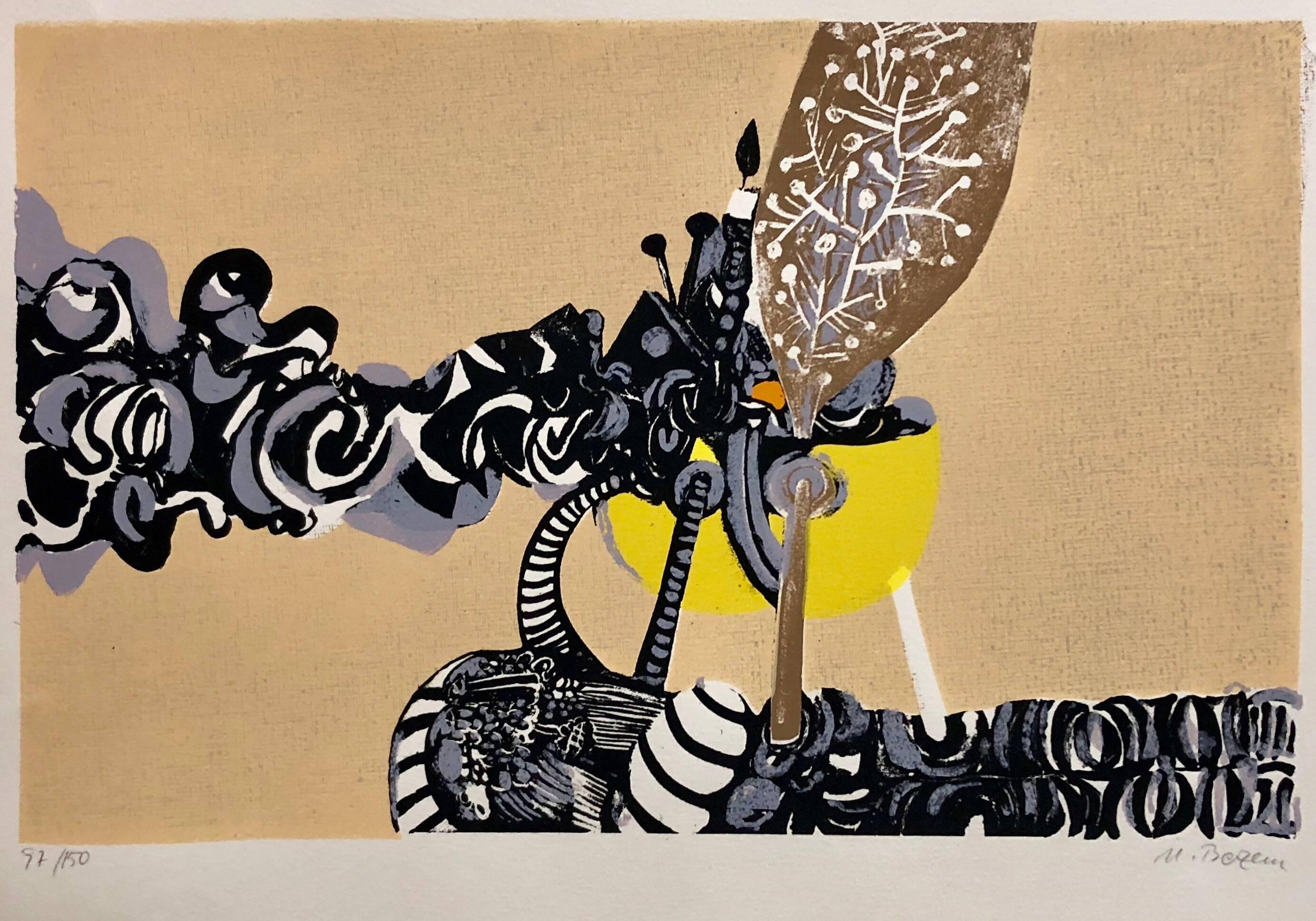
Rare Israeli Surrealist Judaica Abstract Lithograph Naftali Bezem
By Naftali Bezem
Located in Surfside, FL
Fine lithograph on deckle edged French Arches paper. Pencil signed and numbered from edition of 150.
A Surrealist Judaica scene of a bearded man (Rabbi) in a boat with Shabbat candlesticks. with blindstamp from Editions Empreinte in Paris, France. (They published, Jean Michel Folon, Sempe, Raoul Ubac, Raymond Savignac, Cesar, Bengt Lindstrom , Paul Aizpiri and many other modern masters.
Naftali Bezem (Hebrew: נפתלי בזם; born November 27, 1924) is an Israeli painter, muralist, and sculptor.
Bezem was born in Essen, Germany, in 1924. His early adolescence was spent under Nazi oppression, in constant fear for the safety of his parents, who perished in the Holocaust in the Polish Auschwitz concentration camp. Naftali emigrated to Mandate Palestine in 1939, at the age of fourteen with a Youth Aliyah group.
From 1943 to 1946, he studied art at the Bezalel Academy of Art and Design in Jerusalem with Israeli painter Mordecai Ardon. He then spent three years studying in Paris.His most famous public works include a wall relief at Yad Vashem in Jerusalem and the ceiling mural in the main reception room at the President's Residence, Jerusalem.In 1957, Bezem was a co-recipient of the Dizengoff Prize for Painting.
Group Exhibitions
Orit Art Gallery, Tel Aviv
Artists: Yosef Zaritsky, Marcel Janco, Lea Nikel, Robert Baser, Bezem, Michael Druks,
Israeli Painting (Watercolors and Gouache)
Artists:
Pinchas Abramovich, Bezem, Naftali Nachum Gutman, Haim Gliksberg, Mordechai Levanon, Avigdor Stematsky, Avshalom Okashi, Yehiel Krize...
Category
20th Century Modern Figurative Prints
Materials
Lithograph
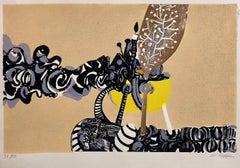
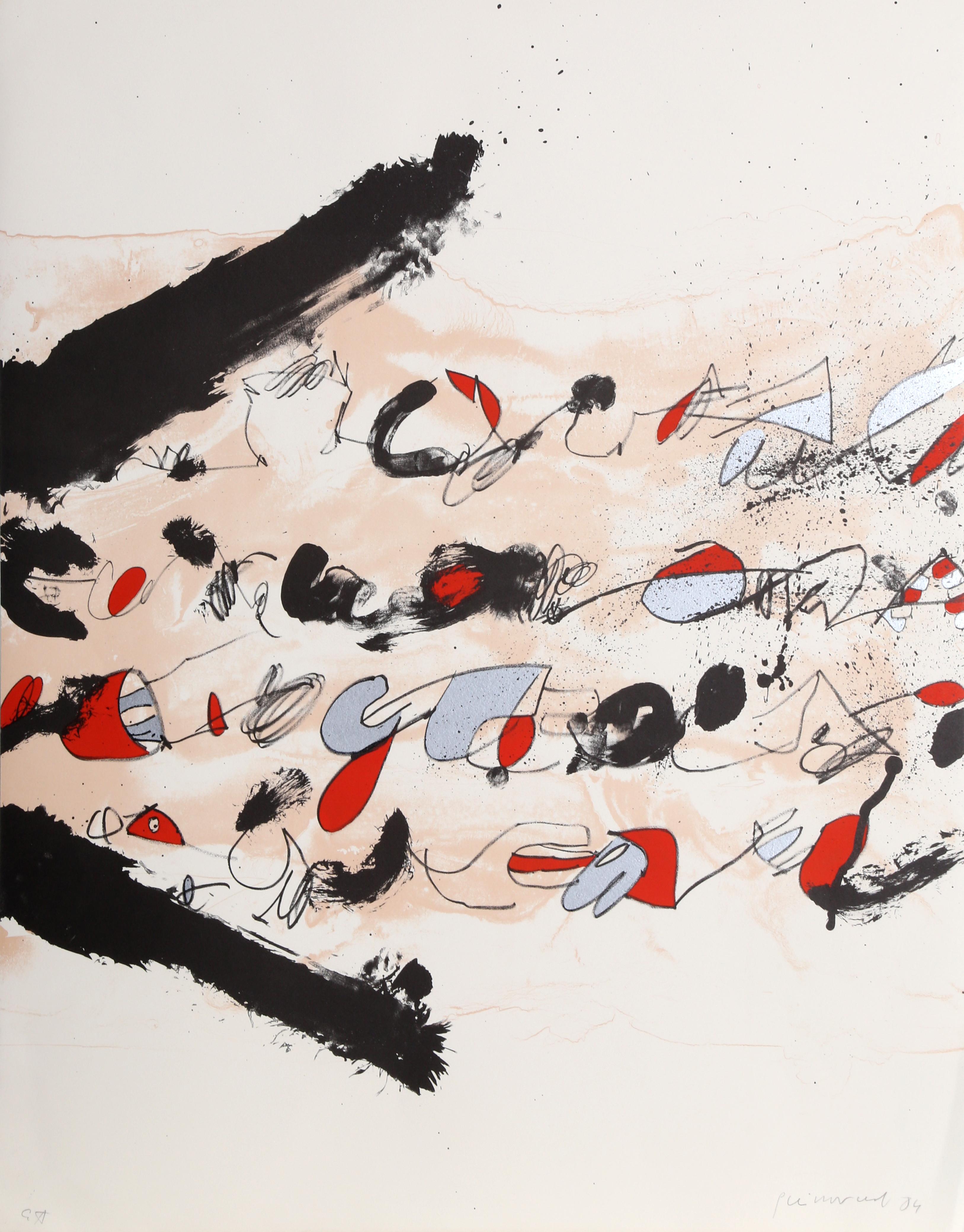
Abstract Latin American Art Spanish Catalan Lithograph Josep Guinovart New York
By Josep Guinovart Bertrán
Located in Surfside, FL
Guinovart, Josep (Spanish/Catalan, 1927-2007), Untitled Abstract, 1984, lithograph on paper, hand signed, dated and marked E.A. (artist's proof) in pencil at bottom, full sheet 26.75 x 22 inches, unframed.
Josep Guinovart (1927 –2007) was a Spanish Catalan painter most famous for his informalist or abstract expressionist work.
In 1941, he began to work as a decorator. Three years later, he started his studies at the Escuela de Artes y Oficios de la Llotja (Art School of La Llotja) where he stayed until 1946.
He first exhibited his work in 1948 in Galerías Syla in Barcelona. In 1951, he produced his first engravings entitled 'Homage to Federico García Lorca'. Two years later, he was awarded a grant from the French Institute to study in Paris for nine months. Here he discovered the cubist works of Henri Matisse and Pablo Picasso and travelled to Belgium, Holland and Germany.
On his return to Barcelona and after a period working as an illustrator and set designer, around 1957 he began moving towards abstract art. His work is highly unconventional and usually on a large scale, using a wide range of materials, three-dimensional objects and organic substances such as eggshell, earth and straw.
In 1962, he illustrated a book of poetry entitled Posies by Joan Salvat-Papasseit for the Ariel Editorial. He won many accolades for his work throughout the 1970s and 80s, including Spain's National Award for Plastic Arts in 1982. In 1994, a museum foundation dedicated to his art was inaugurated in Agramunt, his mother's birthplace to which he always felt a special attachment.
In 2006 he designed the winery Mas Blanch i Jové in La Pobla de Cérvoles (Lleida) and created The Artists' Vineyard, a project intended to mix sculptures and other art works from different artists in the middle of a vineyard. The Artists' Vineyard was inaugurated after his death in 2010 with the unveiling of his sculpture The Countryside Organ: a music instrument, 6 meters height, for the wind to sing the vines. This winery also displays the 10.5 meters work In Vino Veritas...
Category
1980s Abstract Abstract Prints
Materials
Lithograph
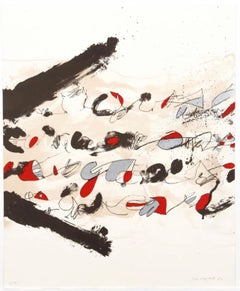
Judy Rifka Abstract Expressionist Contemporary Lithograph Hebrew 10 Commandment
By Judy Rifka
Located in Surfside, FL
Judy Rifka (American, b. 1945)
44/84 Lithograph on paper titled "Thou Shalt Not Bear False Witness against Thy Neighbor"; Depicting an abstract composition in blue, green, red and black tones with Hebrew script. Judaica interest. (I have seen this print described as a screenprint and as a lithograph)
Hand signed in pencil and dated alongside an embossed pictorial blindstamp of a closed hand with one raised index finger. Solo Press.
From The Ten Commandments Kenny Scharf; Joseph Nechvatal; Gretchen Bender; April Gornik; Robert Kushner; Nancy Spero; Vito Acconci; Jane Dickson; Judy Rifka; Richard Bosman and Lisa Liebmann.
Judy Rifka (born 1945) is an American woman artist active since the 1970s as a painter and video artist. She works heavily in New York City's Tribeca and Lower East Side and has associated with movements coming out of the area in the 1970s and 1980s such as Colab and the East Village, Manhattan art scene. A video artist, book artist and abstract painter, Rifka is a multi-faceted artist who has worked in a variety of media in addition to her painting and printmaking. She was born in 1945 in New York City and studied art at Hunter College, the New York Studio School and the Skowhegan School of Painting and Sculpture in Maine.
Rifka took part in the 1980 Times Square Show, (Organized by Collaborative Projects, Inc. in 1980 at what was once a massage parlor, with now-famous participants such as Jenny Holzer, Nan Goldin, Keith Haring, Kenny Scharf, Jean-Michel Basquiat, and Kiki Smith, the roster of the exhibition reads like a who’s who of the art world), two Whitney Museum Biennials (1975, 1983), Documenta 7, Just Another Asshole (1981), curated by Carlo McCormick and received the cover of Art in America in 1984 for her series, "Architecture," which employed the three-dimensional stretchers that she adopted in exhibitions dating to 1982; in a 1985 review in the New York Times, Vivien Raynor noted Rifka's shift to large paintings of the female nude, which also employed the three-dimensional stretchers. In a 1985 episode of Miami Vice, Bianca Jagger played a character attacked in front of Rifka's three-dimensional nude still-life, "Bacchanaal", which was on display at the Museum of Art Fort Lauderdale. Rene Ricard wrote about Rifka in his influential December 1987 Art Forum article about the iconic identity of artists from Van Gogh to Jean-Michel Basquiat and Keith Haring, The Radiant Child.The untitled acrylic painting on plywood, in the collection of the Honolulu Museum of Art, demonstrates the artist's use of plywood as a substrate for painting. Artist and writer Mark Bloch called her work "imaginative surfaces that support experimental laboratories for interferences in sensuous pigment." According to artist and curator Greg de la Haba, Judy Rifka's irregular polygons on plywood "are among the most important paintings of the decade".
In 2013, Rifka's daily posts on Facebook garnered a large social media audience for her imaginative "selfies," erudite friendly comments, and widely attended solo and group exhibitions, Judy Rifka's pop art figuration is noted for its nervous line and frenetic pace. In the January 1998 issue of Art in America, Vincent Carducci echoed Masheck, “Rifka reworks the neo-classical and the pop, setting all sources in quotation for today’s art-world cognoscenti.” Rifka, along with artists like David Wojnarowicz, helped to take Pop sensibility into a milieu that incorporated politics and high art into Postmodernism; Robert Pincus-Witten stated in his 1988 essay, Corinthian Crackerjacks & Passing Go that "Rifka’s commitment to process and discovery, doctrine with Abstract Expressionist practice, is of paramount concern though there is nothing dogmatic or pious about Rifka’s use of method. Playful rapidity and delight in discovery is everywhere evident in her painting." In 2016, a large retrospective of Rifka's art was shown at the Jean-Paul Najar Foundation in Dubai. In 2017, Gregory de la Haba presented a Rifka retrospective at the Amstel Gallery in The Yard, a section of Manhattan described as "a labyrinth of small cubicles, conference rooms and small office spaces that are rented out to young entrepreneurs, professionals and hipsters". In 2019 her video Bubble Dancers New Space Ritual was selected for the International Istanbul Bienali.
Alexandra Goldman Talks To Judy Rifka About Ionic Ironic: Mythos from the '80s at CORE:Club and the Inexistence of "Feminist Art" Whitehot Magazine of Contemporary Art. She was included in "50 Contemporary Women Artists", a book comprising a refined selection of current and impactful artists. The foreword is by Elizabeth Sackler of the Brooklyn Museum’s Sackler Center for Feminist Art. Additional names in the book include sculptor and carver Barbara Segal...
Category
1980s Pop Art Abstract Prints
Materials
Lithograph, Screen
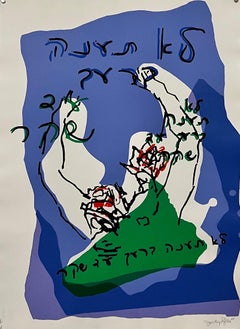
Israeli Surrealist Judaica Abstract Lithograph Naftali Bezem
By Naftali Bezem
Located in Surfside, FL
Naftali Bezem (Hebrew: נפתלי בזם; born November 27, 1924) is an Israeli painter, muralist, and sculptor.
Bezem was born in Essen, Germany, in 1924. His early adolescence was spent...
Category
20th Century Modern Prints and Multiples
Materials
Lithograph

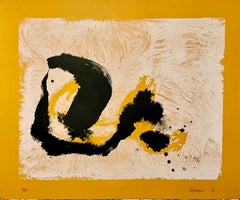
Lyrical Abstract Expressionist Lithograph Cleve Gray Lithograph Silkscreen Print
By Cleve Gray
Located in Surfside, FL
Cleve Gray, American (1918-2004)
Composition, (1976)
serigraph or lithograph
Hand signed lower right, and editioned 9/50
Dimensions: 19.25 X 23.75 inches sheet.
unframed
Cleve Gray (1918 – 2004) was an American Abstract expressionist painter, who was also associated with Color Field painting and Lyrical Abstraction.
Gray was born Cleve Ginsberg, the family changed their name to Gray in 1936. Gray attended the Ethical Culture School in New York City (1924–1932). From the age of 11 until the age of 14 he had his first formal art training with Antonia Nell, who had been a student of George Bellows. From 15 to 18 he attended the Phillips Academy, in Andover, Massachusetts; where he studied painting with Bartlett Hayes and won the Samuel F. B. Morse Prize for most promising art student. In 1940 he graduated from Princeton University summa cum laude, with a degree in Art and Archeology. He was a member of Phi Beta Kappa. At Princeton he studied painting with James C. Davis and Far Eastern Art with George Rowley, under whose supervision he wrote his thesis on Yuan dynasty landscape painting. Best known for his calligraphic abstractions which melded elements of Abstract Expressionism, Color Field painting, and traditional Chinese scroll painting. After graduation in 1941 Gray moved to Tucson, Arizona. In Arizona he exhibited his modernist landscape paintings and still lifes at the Alfred Messer Studio Gallery in Tucson. In 1942 he returned to New York and joined the United States Army. During World War II, he served in the signal intelligence service in Britain, France and Germany, where he rose to the rank of sergeant. After the liberation of Paris he was the first American GI to greet Pablo Picasso and Gertrude Stein. He began informal art training with the French artists André Lhote and Jacques Villon, continuing his art studies in Paris after the war. Gray returned to the United States in 1946. In 1949 he moved to the house his parents had owned on a 94-acre property in Warren, Connecticut, and lived there for the rest of his life. In the 1960s he formed a close friendship with Barnett Newman. It was during this time that he experienced an artistic metamorphosis, dissolving his earlier cubist compositions in a sea of distilled color. This dramatic body of work marked the beginning of an artistic meditation that would last for over 40 years. The rigors of French modernism, the ethos of Abstract Expressionism and the meditative restraint of Chinese and Japanese scroll painting commingle with astounding affect. The atmospheric, subdued tones of his 1960s paintings gradually gave way to bright, monochromatic fields of color, hazily washed onto the canvas in stain like swathes. Much of his work from the last three decades of his career feature striking graphic brushwork that conjures the influence of Japanese and Chinese calligraphy. He married the noted author Francine du Plessix on April 23, 1957. They worked in separate studios in two outbuildings with a driveway in between. Gray was a veteran of scores of exhibitions throughout his career, as listed below, from the early days Tucson, through to postwar Paris and New York, and most recently in 2002 at the Berry-Hill Gallery in New York City. His paintings are held in the collections of numerous prominent museums and institutions. In 2009 the art critic Karen Wilkin curated a posthumous retrospective of his work at the Boca Raton Museum of Art, Florida, and other posthumous exhibitions have been held.
Museum collections
Addison Gallery of American Art, Phillips Academy, Andover, MA
Albright-Knox Art Gallery, Buffalo, New York
Boca Raton Museum of Art, Boca Raton, Florida
The Brooklyn Museum, New York City
Columbia University Art Gallery, New York City
Columbus Museum of Art, Ohio
The Corcoran Gallery of Art, Washington, D.C.
Grey Art Gallery and Study Center, New York University, New York City
Solomon R. Guggenheim Museum, New York City
Honolulu Museum of Art, Honolulu, Hawaii
The Jewish Museum, New York City
The Metropolitan Museum of Art, New York City
Museum of Art, Rhode Island School of Design, Providence
Museum of Fine Arts, Boston
Museum of Fine Arts, Houston
Museum of Modern Art, New York City
The Neuberger Museum, State University of New York at Purchase
New Britain Museum of American Art, Connecticut
The Newark Museum, New Jersey
Norton Gallery of Art, West Palm Beach, Florida
Oklahoma City Art Center, Oklahoma
The Phillips Collection, Washington, D.C.[14]
The Art Museum, Princeton University, New Jersey[6]
Rose Art Museum, Brandeis University, Waltham, Massachusetts
Sheldon Museum of Art, University of Nebraska, Lincoln
Smithsonian American Art Museum, Washington, D.C.
The Wadsworth Atheneum, Hartford, Connecticut
Whitney Museum of American Art, New York City
Yale University, New Haven, Connecticut
Williams College Museum of Art, Williamstown, Massachusetts
Yale University Art Gallery, New Haven, Connecticut
He was included in the show 1977, Group Exhibition, Betty Parsons Gallery. Mino Argento...
Category
1970s Abstract Expressionist Abstract Prints
Materials
Lithograph
You May Also Like
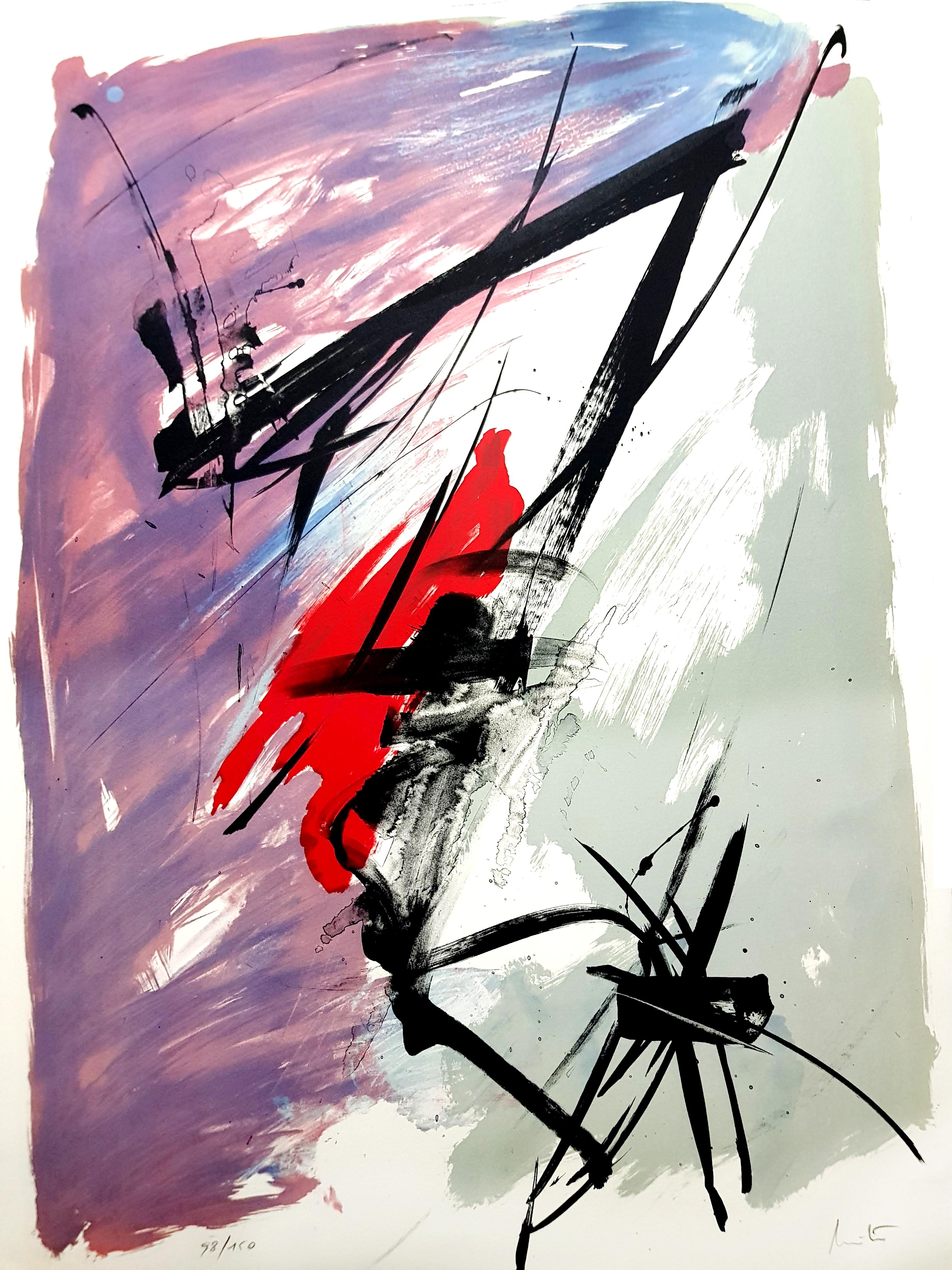
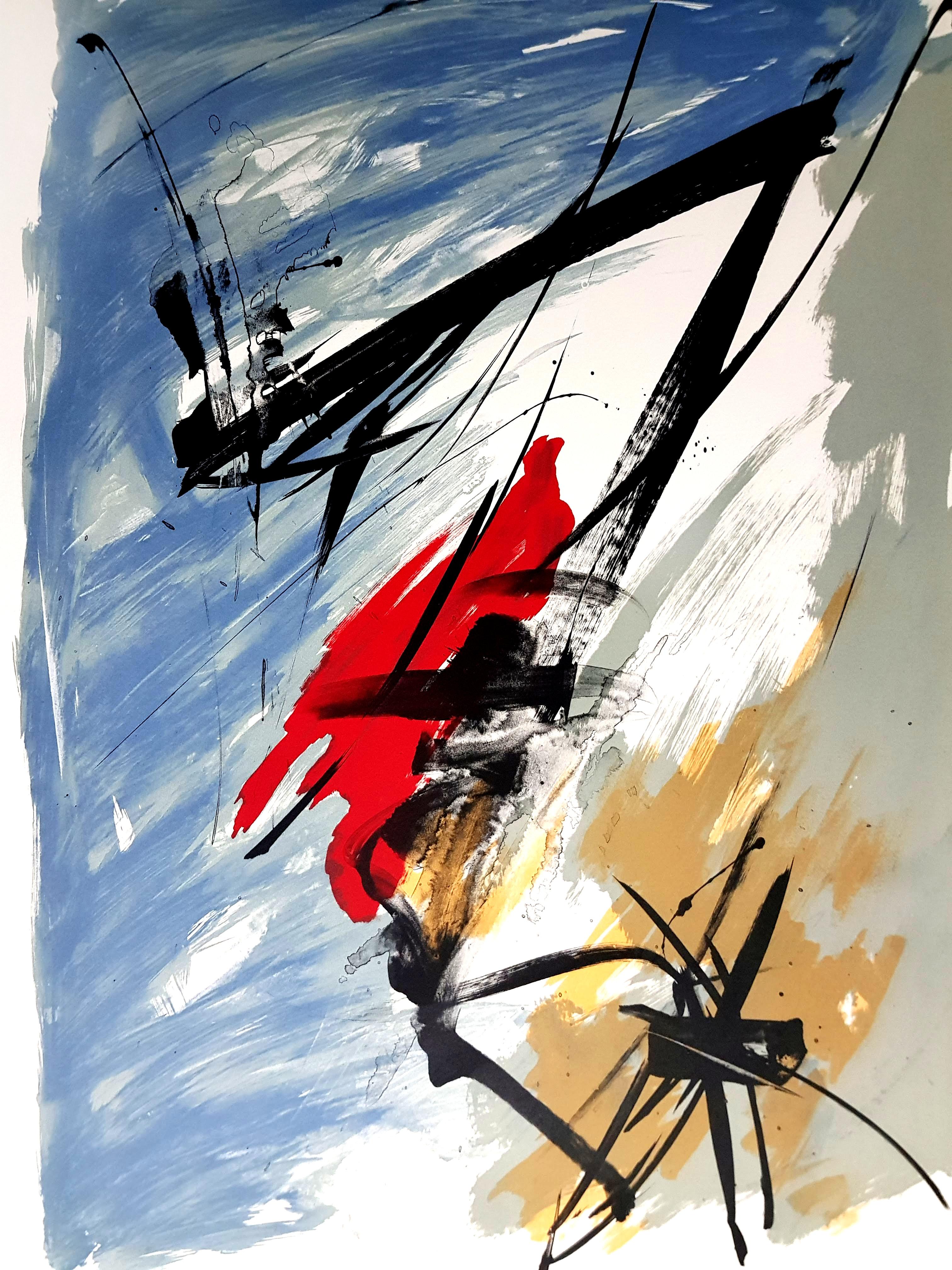
Jean Miotte - Abstract Composition - Original Signed Lithograph
By Jean Miotte
Located in Collonge Bellerive, Geneve, CH
Jean Miotte - Rare Original Signed Lithograph
Title: Abstract Composition
Dimensions: 76 x 56 cm
Edition: 98/150
Signed and Numbered in pencil
Jean Miotte, 1926 - 2016
Miotte came ...
Category
1970s Abstract Expressionist Abstract Prints
Materials
Aquatint
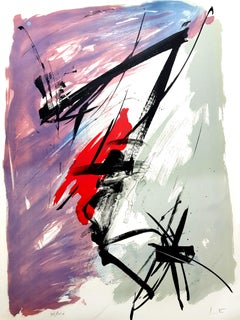
New York, Abstract Expressionist Lithograph by Josep Guinovart
By Josep Guinovart Bertrán
Located in Long Island City, NY
Artist: Jose Guinovart, Spanish (1927 - 2007)
Title: New York
Year: 1984
Medium: Lithograph, signed and numbered in pencil
Edition: 99, EA
Paper Size: 27 x 22 in. (68.58 x 55.88 cm)
Category
1970s Abstract Expressionist Abstract Prints
Materials
Lithograph
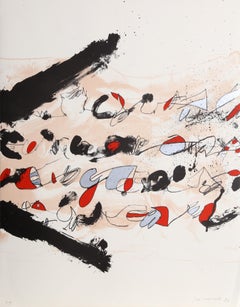
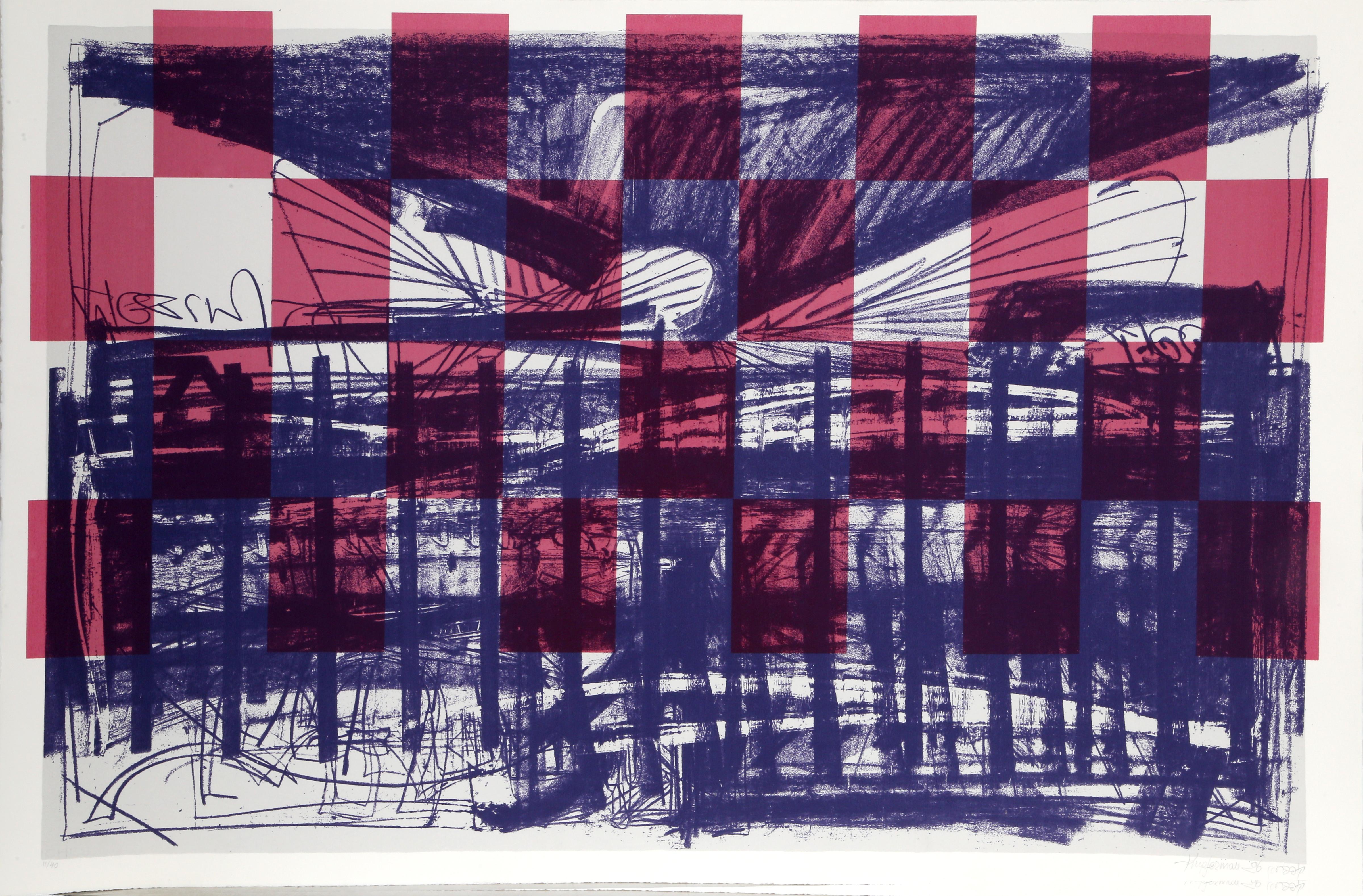
Untitled II, Abstract Screenprint by Moshe Kupferman
By Moshe Kupferman
Located in Long Island City, NY
Artist: Moshe Kupferman, Israeli (1926 - 2003)
Title: Untitled II
Year: 1997
Medium: Screenprint, signed and numbered in pencil
Edition: 40
Image Size: 30 x 45 inches
Size: 32 x 47....
Category
1990s Abstract Abstract Prints
Materials
Screen
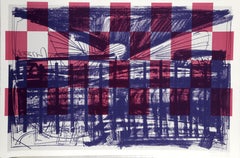
Jean Miotte - Abstract Composition - Original Aquatint Engraving
By Jean Miotte
Located in Collonge Bellerive, Geneve, CH
Jean Miotte - Rare Original Aquatint Engraving
Title: Abstract Composition
Dimensions: 76 x 56 cm
Jean Miotte, 1926 - 2016
Miotte came of artistic age in the decade after World War...
Category
1970s Abstract Expressionist Abstract Prints
Materials
Aquatint
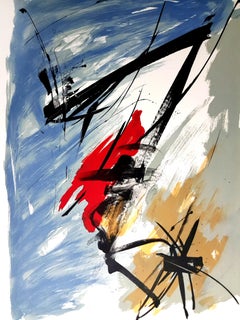
Jean Miotte - Abstract Composition - Original Signed Lithograph
By Jean Miotte
Located in Collonge Bellerive, Geneve, CH
Jean Miotte - Rare Original Signed Lithograph
Title: Abstract Composition
Dimensions: 76 x 56 cm
Edition: 64/99
Signed and Numbered in pencil
Category
1990s Abstract Expressionist Abstract Prints
Materials
Aquatint
Pierre Alechinsky - Composition - Original Lithograph
Located in Collonge Bellerive, Geneve, CH
Pierre Alechinsky - Composition - Original Lithograph
From the literary review "XXe Siècle"
1960
Dimensions: 32 x 24 cm
Publisher: G. di San Lazzaro.
Unsigned and unumbered as issued
Category
1960s Abstract Abstract Prints
Materials
Lithograph