Want more images or videos?
Request additional images or videos from the seller
1 of 3

Isamu Noguchi
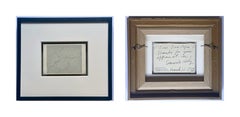
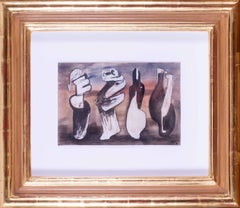
RARE Art Card: The Cry, 1957 (Hand Signed and inscribed by Isamu Noguchi) Framed

1987

$5,800
£4,434.60
€5,076.14
CA$8,178.70
A$8,903.43
CHF 4,752.87
MX$107,484.85
NOK 59,761.47
SEK 55,544.36
DKK 37,911.41

About the Item

This is an extraordinarily rare hand signed card of a modern master -- we likely won't see the likes of this again. Framed and ready to hang. Makes a great gift. Isamu Noguchi Offset lithograph postcard Hand signed and inscribed "Regards Dan Pope Isamu Noguchi" Provenance: Acquired from the private collection of Dan Pope, a former CBS News cameraman who famously amassed a world class collection of visual artists' autographs during the 1980s and 1990s Extremely rare collectors' item. Makes a great gift. Elegantly float-framed in a white wood frame under UV plexiglass. Measurements: Framed 10.5 inches (vertical) by 9 inches (horizontal) by 2 inches Signed postcard: 5.75 inches by 4.25 inches The work depicted in this card is Noguchi's "The Cry", 1 1959 Balsa Wood work that is in the permanent collection of the Guggenheim Museum. (It was later editioned in bronze) ISAMU NOGUCHI BIOGRAPHY Isamu Noguchi (1904–1988) was one of the twentieth century’s most important and critically acclaimed sculptors. Through a lifetime of artistic experimentation, he created sculptures, gardens, furniture and lighting designs, ceramics, architecture, landscapes, and set designs. His work, at once subtle and bold, traditional and modern, set a new standard for the reintegration of the arts. Noguchi, an internationalist, traveled extensively throughout his life. (In his later years he maintained studios both in Japan and New York.) He discovered the impact of large-scale public works in Mexico, earthy ceramics and tranquil gardens in Japan, subtle ink-brush techniques in China, and the purity of marble in Italy. He incorporated all of these impressions into his work, which utilized a wide range of materials, including stainless steel, marble, cast iron, balsa wood, bronze, sheet aluminum, basalt, granite, and water. When Noguchi’s mother Léonie Gilmour met his father, she was a young writer and editor living in New York City. Gilmour was a white American of mostly Irish descent born in Brooklyn. His father Yonejiro Noguchi, an itinerant Japanese poet, was Asian. Noguchi was born in Los Angeles, but moved to Japan with his mother at the age of two and lived there until the age of thirteen. In the summer of 1918, Noguchi returned alone to the United States to attend high school in Rolling Prairie and then La Porte, Indiana, adding yet another layer to an increasingly complex identity. (He proudly identified as a “Hoosier” for the rest of his life.) After high school he moved to Connecticut to work briefly for the sculptor Gutzon Borglum, and then to New York City to attend Columbia University. While enrolled there as a premedical student, he also began taking evening sculpture classes on New York’s Lower East Side with the sculptor Onorio Ruotolo at the Leonardo da Vinci School of Art. He soon left the university to become an academic sculptor, supporting himself by making his first portrait busts. In 1926, Noguchi saw an exhibition in New York of the work of Constantin Brancusi that profoundly changed his artistic direction. With a John Simon Guggenheim Fellowship, Noguchi went to Paris, and in 1927 worked in Brancusi’s studio. Inspired by the older artist’s forms and philosophy, Noguchi turned to modernism and abstraction, infusing his highly finished pieces with a lyrical and emotional expressiveness, and with an aura of mystery. Returning to New York City as well as traveling extensively in Asia, Mexico, and Europe in the late 1920s through the 1930s, Noguchi survived on portrait sculpture and design commissions, proposed landscape works and playgrounds, and intersected and engaged in collaborations with a wide range of luminaries. Noguchi’s work was not well-known in the United States until 1940, when he completed a large-scale sculpture symbolizing the freedom of the press, which was commissioned in 1938 for the Associated Press Building in Rockefeller Center, New York City. This was the first of what would eventually become numerous celebrated public works worldwide, ranging from playgrounds to plazas, gardens to fountains, all reflecting his belief in the social significance of sculpture. The Japanese attack on Pearl Harbor and the backlash against Japanese Americans in the United States had a dramatic personal effect on Noguchi, motivating him to become a political activist. In 1942, he cofounded Nisei Writers and Artists Mobilization for Democracy, a group dedicated to raising awareness of the patriotism of Japanese Americans; and voluntarily entered the Colorado River Relocation Center (Poston) concentration camp in Arizona where he remained for six months. Following his release, Noguchi set up a studio at 33 MacDougal Alley in Greenwich Village, New York City, where he returned to stone sculpture as well as prolific explorations of new materials and methods. His ideas and feelings are reflected in his works of that period, particularly the delicate slab sculptures included in the 1946 exhibition Fourteen Americans at The Museum of Modern Art, New York. Noguchi did not belong to any particular movement, but collaborated with artists working in a range of disciplines and schools. He created stage sets as early as 1935 for Martha Graham, beginning a lifelong collaboration; as well as for Merce Cunningham, Erick Hawkins, and George Balanchine and composer John Cage. In the 1960s, Noguchi began working with stone carver Masatoshi Izumi on the island of Shikoku, Japan; a collaboration that would also continue for the rest of his life. From 1961 to 1966, he worked on a playground design with the architect Louis Kahn. Whenever given the opportunity to venture into the mass-production of his designs, Noguchi seized it. In 1937, he designed a Bakelite intercom for the Zenith Radio Corporation, and in 1947, his glass-topped table was produced by Herman Miller. This design and others—such as his designs for Akari light sculptures which were initially developed in 1951 using traditional Japanese materials—are still being produced today. In 1985, Noguchi opened The Isamu Noguchi Garden Museum (now known as The Noguchi Museum), in Long Island City, New York. The Museum, established and designed by the artist, marked the culmination of his commitment to public spaces. Located in a 1920s industrial building across the street from where the artist had established a studio in 1960, it has a serene outdoor sculpture garden, and many galleries that display Noguchi’s work, along with photographs, drawings, and models from his career. He also indicated that his studio in Mure, Japan, be preserved to inspire artists and scholars; a wish that was fulfilled with the opening of the Isamu Noguchi Garden Museum Japan in 1999. Noguchi’s first retrospective in the United States was in 1968, at the Whitney Museum of American Art in New York City. In 1986, he represented the United States at the Venice Biennale. Noguchi received the Edward MacDowell Medal for Outstanding Lifetime Contribution to the Arts in 1982; the Kyoto Prize in Arts in 1986; the National Medal of Arts in 1987; and the Order of the Sacred Treasure from the Japanese government in 1988. He died in New York City in 1988.
  • Creator:
    Isamu Noguchi (1904 - 1988, Japanese, American)
  • Creation Year:
    1987
  • Dimensions:
    Height: 5.75 in (14.61 cm)Width: 4.25 in (10.8 cm)
  • Medium:
  • Movement Style:
  • Period:
  • Condition:
    Ships framed.
  • Gallery Location:
    New York, NY
  • Reference Number:
    1stDibs: LU1745217331882

More From This Seller

View All
Kind of Blue (Hand signed and dated card depicting his sculpture)
By Richard Deacon
Located in New York, NY
Richard Deacon Kind of Blue (Hand Signed and Dated card), 2005 Offset lithograph postcard Boldly signed and dated 9-01-05 by the artist above the image of the sculpture 5 4/5 × 4 1/4 inches Unframed Offset lithograph postcard depicting Richard Deacon's 1995 ceramic sculpture "Kind of Blue", in the collection of the Arts Council of Great Britain. This work is hand signed and dated on the front of the image. Very good vintage condition; minor handling and discoloration around far corners (edges) to the card which will easily frame out. Richard Deacon’s voluptuous abstract forms have placed him at the forefront of British sculpture since the 1980s and, hugely influential, his works are visible in major public commissions around the world. His voracious appetite for material has seen him move between laminated wood, stainless steel, corrugated iron, polycarbonate, marble, clay, vinyl, foam and leather. As he explains: “Changing materials from one work to the next is a way of beginning again each time (and thus of finishing what had gone before)”. Deacon describes himself as a ‘fabricator’, emphasising the construction behind the finished object – although many of the works are indeed cast, modelled or carved by hand – and accordingly the logic of the fabrication is often exposed: sinuous curved forms might be bound by glue oozing between layers of wood or have screws and rivets protruding from sheets of steel, wearing their hearts on their sleeves. Such transparency highlights the reactive nature of the process: it is part of a two-way conversation between artist and material that transforms the workaday into something metaphorical. The idea of ‘fabrication’ also denotes making something up, of fiction rather than truth, and this knack for wordplay surfaces in Deacon’s titles, which might establish juxtapositions or wreak new meaning from familiar sayings or clichés – see Let’s not be Stupid (1991), No Stone Unturned (1999), Water Under the Bridge (2008) or Shiver My Timbers (2016). Richard Deacon Biography Richard Deacon was born in Bangor, Wales, UK in 1949 and lives and works in London, UK. He has a BA from St Martin’s School of Art, London, UK (1972) and an MA in Environmental Media from the Royal College of Art, London, UK (1977). Solo exhibitions include Kula Gallery and the Museum of Fine Arts, Split, Croatia (2021); Middelheim Museum, Antwerp, Belgium (2017); San Diego Museum of Art, San Diego, CA, USA (2017); Prague City Gallery, Prague, Czech Republic (2017); Museum Folkwang, Essen, Germany (2016), Kunstmuseum Winterthur, Switzerland (2015); Tate Britain, London, UK (2014); Sprengel Museum, Hannover, Germany (2011); Musée de la Ville de Strasbourg, France (2010); Portland Art Museum, Oregon, USA (2008); PS1 Contemporary Art Center, New York, USA (2001); MACCSI, Caracas, Venezuela (1996); Whitechapel Art Gallery, London, UK (1989) and Museum of Contemporary Art, Los Angeles, USA (1988). He represented Wales at the Venice Biennale, Italy (2007) and has participated in the Venice Architecture Biennale, Italy (2012), Glasgow International, UK (2006) and documenta 9, Kassel, Germany (1992). He won the Turner Prize in 1987 and the Robert Jakobsen...
Category

Early 2000s Contemporary Abstract Prints

Materials

Postcard, Lithograph, Offset

The ORIGINAL limited edition 1965 Los Angeles County Museum of Art LACMA poster
By Alexander Calder
Located in New York, NY
Alexander Calder The original Los Angeles County Museum of Art poster, 1965 Limited Edition vintage Offset Lithograph 32 × 24 3/4 inches 81.3 × 62.9 cm Edition of 300 This is the OR...
Category

1960s Modern Abstract Prints

Materials

Lithograph, Offset

Untitled Stockholm print, from the Castelli Sonnabend Collection signed/numbered
By Jim Dine
Located in New York, NY
Jim Dine Untitled from the Castelli Sonnabend Collection, 1973 Screenprint on rag paper in original portfolio sleeve Hand signed and numbered 158/300 by Jim Dine on the front. Printe...
Category

1970s Pop Art Abstract Prints

Materials

Rag Paper, Screen, Pencil

Kimber Smith, Abstract Expressionist Geometric Abstraction signed/n lithograph
By Kimber Smith
Located in New York, NY
KIMBER SMITH Untitled Abstract Expressionist Geometric Abstraction, 1967 Lithograph on Rives paper 25 × 19 3/5 inches Signed in silver...
Category

1960s Abstract Geometric Abstract Prints

Materials

Lithograph

Robert Rauschenberg, rare 1970s Signed/N Earth Day William Burroughs lithograph
By Robert Rauschenberg
Located in New York, NY
ROBERT RAUSCHENBERG Dream of William Burroughs, 1972 Offset lithograph 34 1/2 × 24 inches Edition 103/150 Signed, dated and numbered in black marker on the front Unframed Wonderful e...
Category

1970s Pop Art Abstract Prints

Materials

Lithograph, Offset

James Siena at PACE poster Hand signed by James Siena complex linear abstraction
By James Siena
Located in New York, NY
James Siena at PACE Gallery, 2019 Offset lithograph exhibition invitation (Hand signed by James Siena) 19 1/2 × 14 1/2 inches Unframed This exquisite fold...
Category

2010s Abstract Geometric Abstract Prints

Materials

Offset, Graphite, Pencil, Lithograph

You May Also Like

Werkbund – Original Swiss Exhibition Poster
Located in Zurich, CH
Original Swiss Exhibition poster by Hermann Eidenbenz (lithograph, printed by Art. Institut Grafica in Basel) advertising a show of the Basel section ...
Category

1930s Modern Abstract Prints

Materials

Paper

Modern Pair of Oriental Numbered and Signed Etching
Located in Roma, IT
1970s Pair of black and white important numbered and signed etching. Japan 1973. Every item of our Gallery, upon request, is accompanied by a certificate of authenticity issued by S...
Category

1970s Modern More Prints

Materials

Paper, Lithograph

1980s Signed Mario Schifano Artwork on Paper
By Mario Schifano
Located in Roma, IT
Materic silkscreen print “Ondate di gelo” (Frost Waves) by Mario Schifano. Signature and numbering in pencil on front side. Dry stamp of the artist on front. Edition F.C. (Not for...
Category

1980s Modern Abstract Prints

Materials

Paper

Colossal Flashlight in Place of Hoover Dam
By Claes Oldenburg
Located in Missouri, MO
Colossal Flashlight in Place of Hoover Dam, 1982 By Claes Oldenburg (Swedish, American, 1929-2022) Signed Lower Right Dated Middle Right Unframed: 23" x 22" Framed: 36.5" x 27.5" Whimsical sculpture of pop culture objects, many of them large and out-of-doors, is the signature work of Swedish-born Claes Oldenburg who became one of America's leading Pop Artists. He was born in Stockholm, Sweden. His father was a diplomat, and during Claes' childhood moved his family from Stockholm to a variety of locations including Chicago where the father was general consul of Sweden and where Oldenburg spent most of his childhood. He attended the Latin School of Chicago, and then Yale University where he studied literature and art history, graduating in 1950, the same year Claes became an American citizen. Returning to Chicago, he enrolled at the Art Institute of Chicago from 1952 to 1954 and also worked as a reporter at the City News Bureau. He opened his own studio, and in 1953, some of his satirical drawings were included in his first group show at the Club St. Elmo, Chicago. He also painted at the Oxbow School of Painting in Michigan. In 1956, he moved to New York where he drew and painted while working as a clerk in the art libraries of Cooper-Union Museum for the Arts of Decoration. Selling his first artworks during this time, he earned 25 dollars for five pieces. Oldenburg became friends with numerous artists including Jim Dine, Red Grooms and Allan Kaprow, who with his "Happenings" was especially influential on Oldenburg's interest in environmental art. Another growing interest was soft sculpture, and in 1957, he created a piece later titled Sausage, a free-hanging woman's stocking stuffed with newspaper. In 1959, he had his first one-man show, held at the Judson Gallery at Washington Square. He exhibited wood and newspaper sculpture and painted papier-mache objects. Some viewers of the exhibit commented how refreshing Oldenburg's pieces were in contrast to the Abstract Expressionism, a style which much dominated the art world. During this time, he was influenced by the whimsical work of French artist, Bernard Buffet, and he experimented with materials and images of the junk-filled streets of New York. In 1960, Oldenburg created his first Pop-Art Environments and Happenings in a mock store full of plaster objects. He also did Performances with a cast of colleagues including artists Lucas Samaras, Tom Wesselman, Carolee Schneemann, Oyvind Fahlstrom and Richard Artschwager, dealer Annina Nosei, critic Barbara Rose, and screenwriter Rudy Wurlitzer. His first wife (1960-1970) Pat Muschinski, who sewed many of his early soft sculptures, was a constant performer in his Happenings. This brash, often humorous, approach to art was at great odds with the prevailing sensibility that, by its nature, art dealt with "profound" expressions or ideas. In December 1961, he rented a store on Manhattan's Lower East Side to house "The Store," a month-long installation he had first presented at the Martha Jackson Gallery in New York. This installation was stocked with sculptures roughly in the form of consumer goods. Oldenburg moved to Los Angeles in 1963 "because it was the most opposite thing to New York I could think of". That same year, he conceived AUT OBO DYS, performed in the parking lot of the American Institute of Aeronautics and Astronautics in December 1963. In 1965 he turned his attention to drawings and projects for imaginary outdoor monuments. Initially these monuments took the form of small collages such as a crayon image of a fat, fuzzy teddy bear looming over the grassy fields of New York's Central Park (1965) and Lipsticks in Piccadilly Circus, London (1966). Oldenburg realized his first outdoor public monument in 1967; Placid Civic Monument took the form of a Conceptual performance/action behind the Metropolitan Museum of Art, New York, with a crew of gravediggers digging a 6-by-3-foot rectangular hole in the ground. Many of Oldenburg's large-scale sculptures of mundane objects elicited public ridicule before being embraced as whimsical, insightful, and fun additions to public outdoor art. From the early 1970s Oldenburg concentrated almost exclusively on public commissions. Between 1969 and 1977 Oldenburg had been in a relationship with Hannah Wilke, feminist artist, but in 1977 he married Coosje van Bruggen, a Dutch-American writer and art historian who became collaborator with him on his artwork. He had met her in 1970, when she curated an exhibition for him at the Stedelijk Museum in Amsterdam. Their first collaboration came when Oldenburg was commissioned to rework Trowel I, a 1971 sculpture of an oversize garden tool, for the grounds of the Kröller-Müller Museum in Otterlo, the Netherlands. Oldenburg has officially signed all the work he has done since 1981 with both his own name and van Bruggen's. In 1988, the two created the iconic Spoonbridge and Cherry sculpture for the Walker Art Center in Minneapolis, Minnesota that remains a staple of the Minneapolis Sculpture Garden as well as a classic image of the city. Typewriter Eraser...
Category

20th Century American Modern Abstract Prints

Materials

Paper, Lithograph

Plate 6, from Derriere Le Miroir #173
By Alexander Calder
Located in Washington, DC
Artist: Alexander Calder Title: Plate 6 Portfolio: Derriere le Miroir #173 Medium: Lithograph Date: 1968 Edition: Unnumbered Frame Size: 21 1/4" x 17 1/4" Sheet Size: 15" x 11" Image...
Category

1960s Modern Abstract Prints

Materials

Lithograph

Canto Pisan
By Zao Wou-Ki
Located in New York, NY
A superb, richly-inked impression of this very scarce, early proof color aquatint on Arches. Artist's proof, aside from the edition of 180. Signed, dated and inscribed "H II fer pass...
Category

1970s Modern Abstract Prints

Materials

Color, Aquatint