Jasper Johns
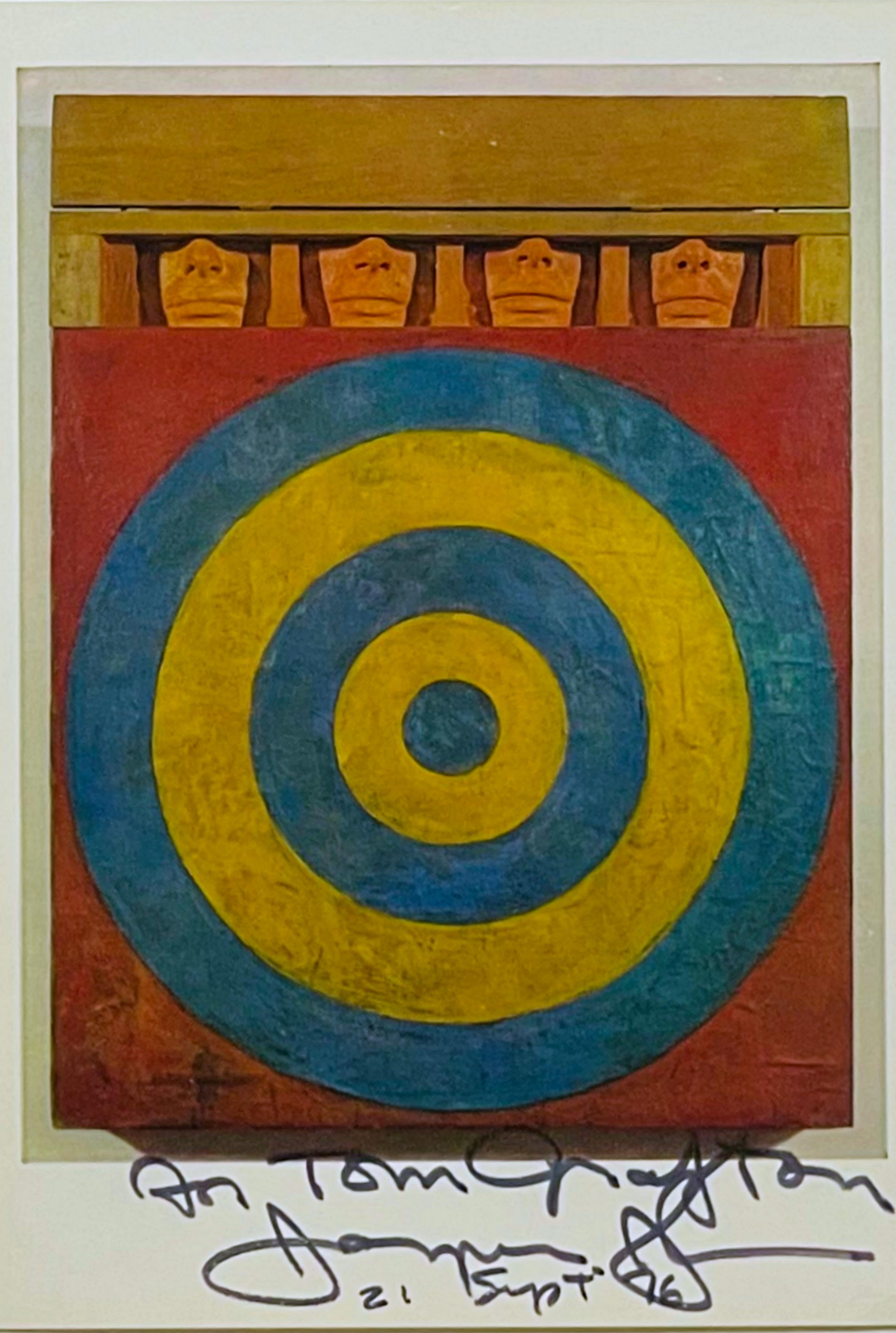
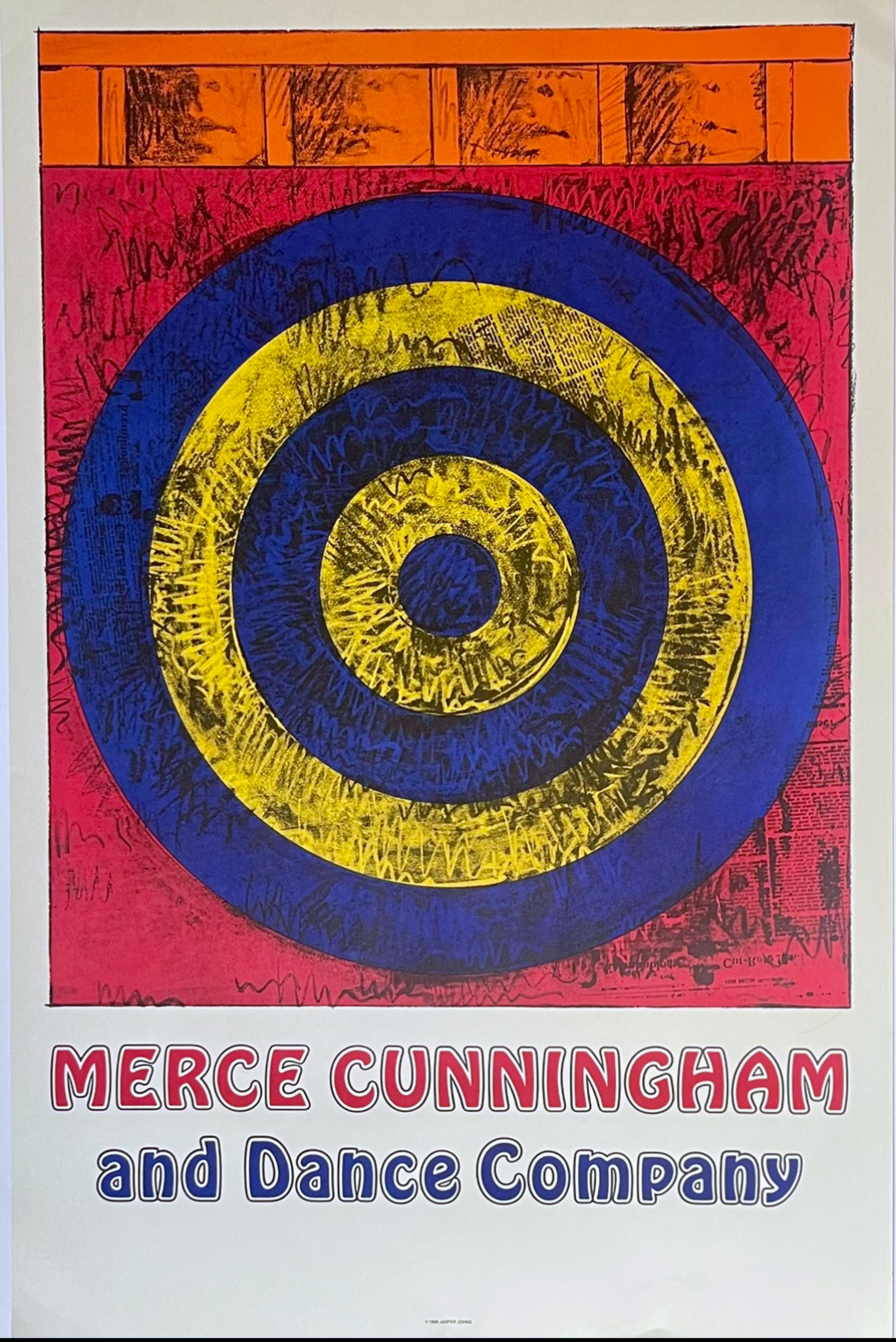
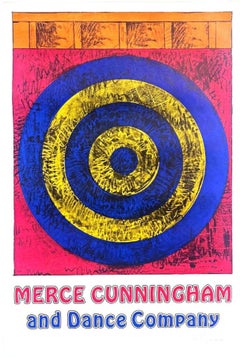
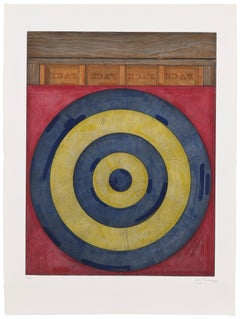
Target with Four Faces (ULAE 55), 1968
Silkscreen in colors on Rives BFK wove paper
Signed and dated in red ink and numbered 53/100 (total edition includes ten artist's proofs).
Frame included:
This work is floated and framed in a museum quality black wood frame with UV plexiglass.
Other examples of this iconic work are in the permanent collection of the Museum of Modern Art, the Whitney Museum and major public and private institutional collections.
Measurements:
Frame:
46.5 x 35 x 2 inches
Print:
41 x 29 inches
About Jasper Johns:
When Jasper Johns had his first one-person exhibition at the Leo Castelli Gallery — in 1958, at the age of twenty-seven — its impact was widespread and immediate. His work signaled a new direction for contemporary art, one that would lead away from Abstract Expressionism and forward to Pop, Minimalism, Conceptual art, and beyond. The Museum of Modern Art acquired four works directly from the show: paintings of targets, flags, and numerals (subjects Johns called “things the mind already knows”).
In the six decades since, Johns has continued to explore new symbols and images, building an extensive personal lexicon that is sometimes enigmatic but always unmistakably his own. A single painted motif might reappear decades later in a sculpture, a drawing, a print, or even in another painting. “My experience of life is that it’s very fragmented; certain kinds of things happen, and in another place a different kind of thing occurs,” he has explained. “I would like my work to have some vivid indication of those differences.”
Jasper Johns (b. 1930) grew up in South Carolina and moved to New York in 1953, where he met Robert Rauschenberg, John Cage, and Merce Cunningham. The artistic ideas of these four friends and sometime collaborators helped establish a new American avant-garde, redefining the role of artistic intent through the use of found imagery and chance. Johns’s work in particular has had a profound impact on American culture. He has been the subject of one-person exhibitions at museums around the world, including career surveys at the Museum of Modern Art, the Metropolitan Museum of Art, and the Whitney Museum of Art in New York, the National Gallery of Art in Washington, DC, the Centre Pompidou in Paris, the Royal Academy in London, the San Francisco Museum of Modern Art, and the Philadelphia Museum of Art.
- Courtesy of Matthew Marks Gallery
Jasper Johns Biography:
Jasper Johns was born in 1930 in Augusta, Georgia, and raised in South Carolina. He began drawing as a young child, and from the age of five knew he wanted to be an artist. For three semesters he attended the University of South Carolina at Columbia, where his art teachers urged him to move to New York, which he did in late 1948. There he saw numerous exhibitions and attended the Parsons School of Design for a semester. After serving two years in the army during the Korean War, stationed in South Carolina and Sendai, Japan, he returned to New York in 1953. He soon became friends with the artist Robert Rauschenberg (born 1925), also a Southerner, and with the composer John Cage and the choreographer Merce Cunningham.
Together with Rauschenberg and several Abstract Expressionist painters of the previous generation, Jackson Pollock, Willem de Kooning, and Barnett Newman, Johns is one of the most significant and influential American painters of the twentieth century. He also ranks with Dürer, Rembrandt, Goya, Munch, and Picasso as one of the greatest printmakers of any era. In addition, he makes many drawings—unique works on paper, usually based on a painting he has previously painted—and he has created an unusual body of sculptural objects.
Johns’ early mature work, of the mid- to late 1950s, invented a new style that helped to engender a number of subsequent art movements, among them Pop, Minimal, and Conceptual Art. The new style has usually been understood to be coolly antithetical to the expressionistic gestural abstraction of the previous generation. This is partly because, while Johns’ painting extended the allover compositional techniques of Abstract Expressionism, his use of these techniques stresses conscious control rather than spontaneity.
Johns’ early style is perfectly exemplified by the lush reticence of the large monochrome White Flag of 1955 (
1998.329
). This painting was preceded by a red, white, and blue version, Flag (1954–55; Museum of Modern Art, New York), and followed by numerous drawings and prints of flags in various mediums, including the elegant oil on paper Flag (1957; (
1999.425
)). In 1958, Johns painted Three Flags (Whitney Museum of American Art, New York), in which three canvases are superimposed on one another in what appears to be reverse perspective, projecting toward the viewer.
The American flag subject is typical of Johns’ use of quotidian imagery in the mid- to late 1950s. As he explained, the imagery derives from “things the mind already knows,” utterly familiar icons such as flags, targets, stenciled numbers, ale cans, and, slightly later, maps of the U.S.
It has been suggested that the American flag in Johns’ work is an autobiographical reference, because a military hero after whom he was named, Sergeant William Jasper, raised the flag in a brave action during the Revolutionary War. Because a flag is a flat object, it may signify flatness or the relative lack of depth in much modernist painting. The flag may of course function as an emblem of the United States and may in turn connote American art, Senator Joseph McCarthy, or the Vietnam War, depending on the date of Johns’ use of the image, the date of the viewer’s experience of it, or the nationality of the viewer. Or the flag may connote none of these things. In Johns’ later work, for example The Seasons, a set of intaglio prints made in 1987 (
1999.407a–d
), it seems inescapably to refer to his own art. In other words, the meaning of the flag in Johns’ art suggests the extent to which the “meaning” of this subject matter may be fluid and open to continual reinterpretation.
As Johns became well known—and perhaps as he realized his audience could be relied upon to study his new work—his subjects with a demonstrable prior existence expanded. In addition to popular icons, Johns chose images that he identified in interviews as things he had seen—for example, a pattern of flagstones he glimpsed on a wall while driving. Still later, the “things the mind already knows” became details from famous works of art, such as the Isenheim Altarpiece by Matthias Grünewald (1475/80–1528), which Johns began to trace onto his work in 1981. Throughout his career, Johns has included in most of his art certain marks and shapes that clearly display their derivation from factual, unimagined things in the world, including handprints and footprints, casts of parts of the body, or stamps made from objects found in his studio, such as the rim of a tin can.
-Courtesy Metropolitan Museum of Art