Blue Rider Abstract Prints
to
1
2
1
Overall Width
to
Overall Height
to
9,143
3,356
2,371
1,162
1,082
302
257
144
112
104
74
17
14
3
4
3
1
3
1
3
1
1
1
2
1
4
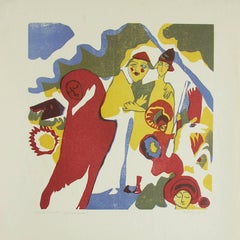
Style: Blue Rider
Allerheiligen- All Saints Day.
Located in New York, NY
KANDINSKY, Wassily. Allerheiligen- All Saints Day. Original three-color woodcut (red, yellow ochre, blue – with olive green). 1911. Signed with the monogram...
Category
1910s Blue Rider Abstract Prints
Materials
Woodcut
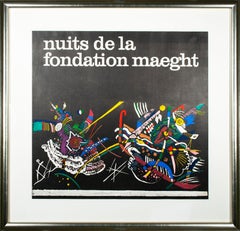
Nuits de la Fondation Maeght
lithograph event poster
Located in Milwaukee, WI
This poster, published in 1971 for the Fondation Maeght, proudly boasts a lithographic rendering of Wassily Kandinsky's 1922 mural plans for the Juryfreie exhibition in Germany. It w...
Category
1970s Blue Rider Abstract Prints
Materials
Lithograph
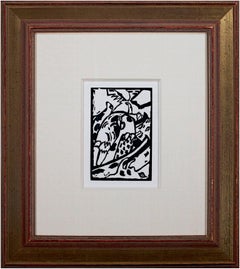
Improvisation 7
original first ed. woodcut from
Klänge
by Wassily Kandinsky
Located in Milwaukee, WI
The present woodcut print comes from 'Klänge (Sounds),' a book of original graphics and poetry by Wassily Kandinsky. This first edition was released in an edition of 300, each book signed and numbered by the artist. The title of the album and this particular print, 'Improvisation,' demonstrated Kandinsky's interest in music and how abstract musical forms could be translated into images on a two-dimensional surface. This particular composition is difficult to read, but through the abstraction, one can make out various figures and a landscape beyond.
7.5 x 5 inches, image
22 x 19.5 inches, frame
Woodcut in black ink on laid paper (watermark Van Gelder Zonen)
Signed with encircled 'K' in the block, lower right
Framed to conservation standards using 100 percent acid free archival materials including silk-lined matting with 1/4 inch bevel, museum glass, and a gold-gilded moulding
Ref. Roethel 124
The Museum of Modern Art described 'Klänge (Sounds)' as follows:
Vasily Kandinsky's self-described "musical album," Klänge (Sounds), consists of thirty-eight prose-poems he wrote between 1909 and 1911 and fifty-six woodcuts he began in 1907. In the woodcuts Kandinsky veiled his subject matter, creating increasingly indecipherable images (though the horse and rider, his symbol for overcoming objective representation, runs through as a leitmotif). This process proved crucial for the development of abstraction in his art. Kandinsky said his choice of media sprang from an "inner necessity" for expression: the woodcuts were not merely illustrative, nor were the poems purely verbal descriptions. Kandinsky sought a synthesis of the arts, in which meaning was created through the interaction of, and space between, text and image, sound and meaning, mark and blank space. The experimental typography shows his interest in the physical aspects of the book.
Klänge is one of three major publications by Kandinsky that appeared shortly before World War I, alongside Über die Geistige in der Kunst (Concerning the Spiritual in Art) and the Blaue Reiter almanac...
Category
1910s Blue Rider Abstract Prints
Materials
Woodcut
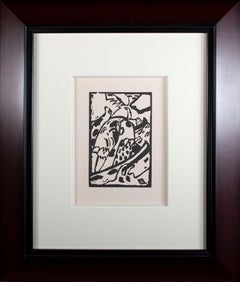
Improvisation 7
second ed. woodcut from
Klänge
by Wassily Kandinsky
Located in Milwaukee, WI
'Improvisation 7' second ed. woodcut from 'Klänge' is a woodcut print created by Wassily Kandinsky. The present woodcut print comes from the second edition of 'Klänge (Sounds),' a book of original graphics and poetry by Wassily Kandinsky. The title of the album and of this print, 'Improvisation,' demonstrated Kandinsky's interest in music and how abstract musical forms could be translated into images on a two-dimensional surface. This particular composition is difficult to read, but through the abstraction, one can make out various figures and a landscape beyond. Originally carved and printed in 1911, this second edition print was done ca. 1938. It is a woodcut in black ink on woven paper. Signed with encircled 'K' in the block, lower right (from the book, signed in ink, ed. 117/300)
Image Size: 7 1/2" x 5 inches
Frame Size: 22 1/4" x 18 3/4"
Ref. Roethel 124
Artist Bio:
The Museum of Modern Art described 'Klänge (Sounds)' as follows:
Vasily Kandinsky's self-described "musical album," Klänge (Sounds), consists of thirty-eight prose-poems he wrote between 1909 and 1911 and fifty-six woodcuts he began in 1907. In the woodcuts Kandinsky veiled his subject matter, creating increasingly indecipherable images (though the horse and rider, his symbol for overcoming objective representation, runs through as a leitmotif). This process proved crucial for the development of abstraction in his art. Kandinsky said his choice of media sprang from an "inner necessity" for expression: the woodcuts were not merely illustrative, nor were the poems purely verbal descriptions. Kandinsky sought a synthesis of the arts, in which meaning was created through the interaction of, and space between, text and image, sound and meaning, mark and blank space. The experimental typography shows his interest in the physical aspects of the book.
Klänge is one of three major publications by Kandinsky that appeared shortly before World War I, alongside Über die Geistige in der Kunst (Concerning the Spiritual in Art) and the Blaue Reiter almanac...
Category
1910s Blue Rider Abstract Prints
Materials
Woodcut, Laid Paper
Related Items
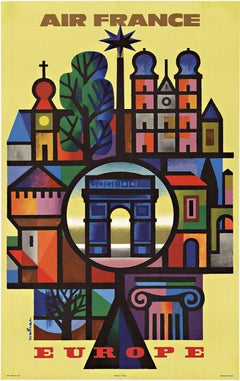
Air France Europe original vintage travel poster
Located in Spokane, WA
Original AIR FRANCE EUROPE, Editions Perceval, artist: Jacques Nathan Garamond. Professional acid-free archival linen backed vintage travel post...
Category
1960s Blue Rider Abstract Prints
Materials
Lithograph

$1,299
H 39.5 in W 24.5 in
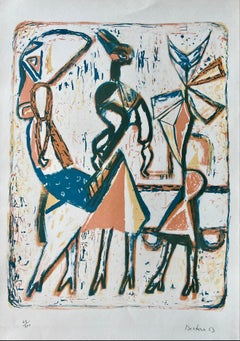
Trois femmes
Located in Belgrade, MT
Walter Becker was born in 1893 in Essen, Ruhr, Germany. Considered an important graphic artist of the "lost generation", Becker is well known for his depictions of figures and portraits in a style that combined elements of German Expressionism, Dada, and French modernism. He worked in a variety of print media, including color lincut, lithography, woodcut and etching. After a short military service, Becker studied under the German Sculptor Karl Albiker at the Dresden Academy of Fine Arts. He moved to southern France where he lived and worked from 1924-1935, and was in contact with George Braque, Thomas...
Category
Mid-20th Century Blue Rider Abstract Prints
Materials
Lithograph
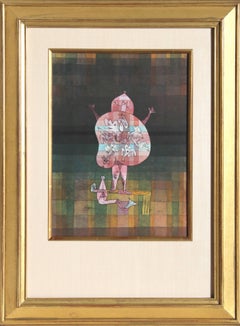
Bauchredner und Rufer im Moor, Cubist Pochoir Print on Rice Paper by Paul Klee
By Paul Klee
Located in Long Island City, NY
Artist: Paul Klee, After, Swiss (1879 - 1940)
Title: Bauchredner und Rufer im Moor (Ventiloque criant dans le marais)
Year: 1964 after 1920 Drawing
Medium: Pochoir on Rice Paper, Sig...
Category
1960s Blue Rider Abstract Prints
Materials
Rice Paper, Stencil
$2,280 Sale Price
20% Off
H 26 in W 19 in
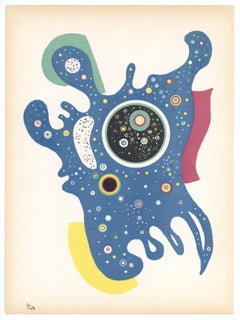
"Stars" original lithograph
Located in Henderson, NV
Medium: original lithograph. Printed in 1938 and published in Paris by Teriade for the art revue Verve (volume 1, number 2). Kandinsky was invited to contribute an original compositi...
Category
1930s Blue Rider Abstract Prints
Materials
Lithograph
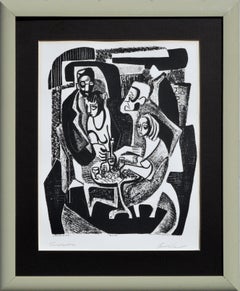
Nick
s Coffee House in the Village - Rare Edition 1970s Modern Figurative Print
By Lenore SImon
Located in Soquel, CA
This bold screen print depicts a scene from the 1950s, set in a jazz coffee house in Greenwich Village called Nick's, which Simon patronized while in high school. The original stone ...
Category
Late 20th Century Blue Rider Abstract Prints
Materials
Archival Paper, Screen
$920 Sale Price
20% Off
H 22 in W 18 in D 0.75 in
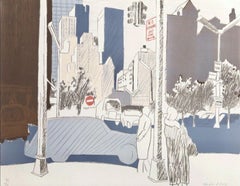
New York City Street Scene (L.18), Fairfield Porter
Located in Fairfield, CT
Artist: Fairfield Porter (1907-1975)
Title: Street Scene (L.18)
Year: 1969
Medium: Lithograph on Arches paper
Edition: 69/100, plus proofs
Size: 22.25 x 30 inches
Condition: Excellen...
Category
1960s Blue Rider Abstract Prints
Materials
Lithograph
$2,396 Sale Price
20% Off
H 22.25 in W 30 in
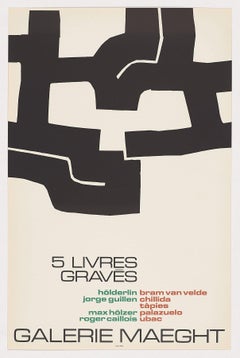
Eduardo Chillida Spanish Artist Original Unused Lithograph Poster
Located in Miami, FL
Eduardo Chillida (Spain, 1924-2002)
'5 Livres Gravés', 1974
Original poster from show
lithograph on paper
25.2 x 17 in. (64 x 43 cm.)
Unframed
Ref: CHI100-202
Eduardo Chillida
He be...
Category
1970s Blue Rider Abstract Prints
Materials
Lithograph
$350
H 25.19 in W 16.92 in
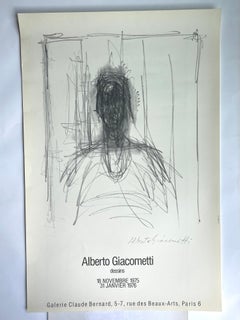
Alberto Giacometti, rare vintage original poster
Located in Saint Ouen, FR
Rare vintage original poster published by the famous Paris Gallery Claude Bernard pour an historic exhibition of Jean Dubuffet in the sixties (1964) a...
Category
1960s Blue Rider Abstract Prints
Materials
Paper
$416
H 25.6 in W 16.93 in D 0.4 in
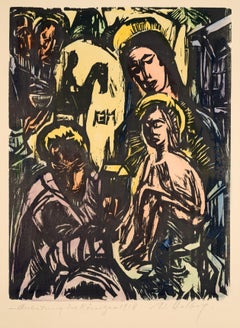
Adoration of the Magi / - The Rider of the Sun -
Located in Berlin, DE
Walter Helbig (1878 Falkenstein - 1968 Ascona), Adoration of the Magi, 1918. Hand-colored linocut, 30 cm x 22.5 cm (depiction), 50 cm x 35 cm (sheet size), signed “W.[alter] Helbig” in pencil lower right, inscribed “Adoration of the Magi” lower left and dated “1918”. Below this a handwritten dedication “with heartfelt Christmas greetings”.
- Paper somewhat darkened and with slight creases, thumbtack holes in the corners
- The Rider of the Sun -
The 'apocalypse' of World War I brought about a return to sacred art. Walter Helbig belonged to the circle of the 'Brücke' and the 'Blauer Reiter'. With his reinterpretation of religious themes in an expressionist formal language, Helbig shaped an avant-garde neo-sacred art. This is symbolically expressed in the silhouette of the rider against the sun-like yellow background. It refers to the awakening initiated by the Blue Riding, which is now linked back to the sacred.
The rider and horse "look" at Mary and the Christ Child, who occupy the entire field. Opposite them are the three kings, the eldest of whom kneels before Christ and offers him a gold-filled casket. The expressionist lines give rise to a tower that rises into the "sun", so that the gift has become a Gothic church, expressing the hope that the fallen world will be resurrected in the name of Christ. This dimension of meaning is emphasized by the magical effect of the color scheme.
About the artist
In 1895, Walter Helbig began studying at the Dresden Academy of Art, where he became friends with the future Brücke artist Otto Müller, with whom he lived in Dresden from 1903 to 1905. While studying in Italy from 1897 to 1899, he met Arnold Böcklin and Adolf von Hildebrand. After completing his studies, he first worked for Otto Gussmann, painting churches. From 1905 to 1909 he worked as a freelance painter in Hamburg. In 1909, through the mediation of Otto Müller, Helbig made the acquaintance of artists from the 'Brücke'. In 1910 he exhibited at the founding exhibition of the Berlin 'Neue Sezession'. In the same year, he moved to Switzerland, where, together with Hans Arp and Oscar Lüthy, he founded the 'Moderne Bund' in Weggis, to which Cuno Amiet and Giovanni Giacometti also belonged. At the second exhibition of the 'Moderne Bund' in Zurich in 1911, Henri Matisse and Robert Delaunay were represented alongside artists from the 'Blauer Reiter'. In 1913, Helbig traveled to Paris with Arp and Lüthy. After the dissolution of the 'Moderne Bund', Helbig was represented at the first Dada exhibition in Zurich in 1914. In 1919, he joined the Berlin 'Novembergruppe'. After the devastation of World War I, Helbig turned increasingly to religious themes in his work. In 1924, like many other artists of his time, he moved to Ascona for financial reasons, where he became a naturalized citizen in 1938. There he founded the artists' association "The Great Bear", to which Marianne von Werefkin...
Category
1910s Blue Rider Abstract Prints
Materials
Paper
$773
H 19.69 in W 13.78 in D 0.4 in
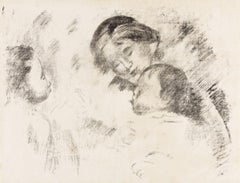
Une Mère et Deux Enfants
Located in New York, NY
A very good, dark and evenly-printed impression of this scarce lithograph on cream laid paper. From the edition of approximately 50.
Category
1910s Blue Rider Abstract Prints
Materials
Laid Paper, Lithograph
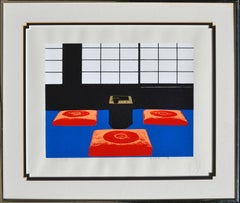
Japanese Living Room - Modern Geometric Screen Print
By Yuichiro Kato
Located in Soquel, CA
A minimal geometric silkscreen of a traditional Japanese living room with cushions and a portable hand warmer by Yuiichiro Kato (Japanese, b- 1926). Displayed in a metal frame. Image...
Category
1970s Blue Rider Abstract Prints
Materials
Printer s Ink, Laid Paper, Screen
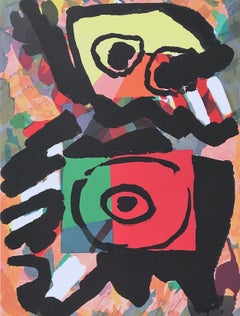
MULTI PERSONAGE Signed Lithograph, Abstract Collage Portrait, CoBrA Artist
By Karel Appel
Located in Union City, NJ
MULTI PERSONAGE is an original limited edition lithograph by the Dutch artist Karel Appel, printed using hand lithography techniques on archival Arches paper, 100% acid free. MULTI PERSONAGE is a lively abstract color collage portrait expressed in vibrant shades of red, blue, pink, green, purple, yellow with hints of multi color pastel tones and white creating an abstracted body and face. Bold black paint strokes define the face with its zany black eyes, head, body and limbs; collage effect torn paper bits fill in the body form. MULTI PERSONAGE is a very unique, fantastically playful and wild composition by Karel Appel, one of the founders of the avant-garde art movement CoBrA active during the late 1940's thru early 1950's. His paintings are known for incorporating applications of vibrant, violent colors often possessing a primal, childlike quality.
Print size - 30 x 20 inches, unframed, excellent condition, hand signed in pencil by Karel Appel
Edition size - 175, plus proofs
Year published - 1980
Printer - JK Fine Art Editions Co., NY
Karel Appel was one of the founders of the avant-garde art movement CoBrA, active during the late 1940's thru early 1950's. His paintings are known for incorporating applications of vibrant, violent colors often possessing a primal, childlike quality.
Karel Appel, (born April 25, 1921, Amsterdam, Netherlands—died May 3, 2006, Zürich, Switzerland), Dutch painter of turbulent, colorful, and semi-abstract compositions, who was a co-founder (1948) of the CoBRA group of northern European Expressionists. He was also a noted sculptor and graphic artist.
Appel attended the Royal Academy of Fine Arts, Amsterdam (1940–43), and helped found the “Reflex” group, which became known as CoBRA (for Copenhagen, Brussels, and Amsterdam), in 1948. He moved to Paris in 1950 and by the 1960s had settled in New York City; he later lived in Italy and Switzerland. Partly in reaction against what they perceived as the sterile academicism of the de Stijl movement, the CoBRA artists...
Category
1980s Blue Rider Abstract Prints
Materials
Lithograph
Previously Available Items
Felson,
Located in New York, NY
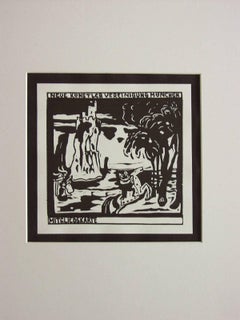
Black and White Woodcut. Published in 1909 in an edition of 100 to be used as a card member for the group of artists "Neu Kunstler-Vereingun Munchen". The impression is complete in ...
Category
1910s Blue Rider Abstract Prints
Materials
Woodcut
Blue Rider abstract prints for sale on 1stDibs.
Find a wide variety of authentic Blue Rider abstract prints available for sale on 1stDibs. Works in this style were very popular during the 20th Century, but contemporary artists have continued to produce works inspired by this movement. Many Pop art paintings were created by popular artists on 1stDibs, including Wassily Kandinsky, and (after) Wassily Kandinsky. Frequently made by artists working with Woodcut Print, and Laid Paper and other materials, all of these pieces for sale are unique and have attracted attention over the years. Not every interior allows for large Blue Rider abstract prints, so small editions measuring 6.05 inches across are also available. Prices for abstract prints made by famous or emerging artists can differ depending on medium, time period and other attributes. On 1stDibs, the price for these items starts at $1,900 and tops out at $25,600, while the average work sells for $4,250.