Want more images or videos?
Request additional images or videos from the seller
1 of 6

Alphonse Mucha
Alphonse Mucha s Le Pater: "Lead Us Not Into Temptation" Japon lithograph, 1899

1899

On Hold
$12,000
On Hold
£9,108.62
On Hold
€10,445.30
On Hold
CA$16,937.93
On Hold
A$18,181.28
On Hold
CHF 9,680.60
On Hold
MX$215,336.92
On Hold
NOK 122,336.36
On Hold
SEK 111,727.22
On Hold
DKK 78,031.11

About the Item

Lithographic sepia plate of Lead Us Not Into Temptation but Deliver Us From Evil from Alphonse Mucha’s masterpiece of mysticism, Le Pater. This example comes from the extremely scarce edition of 110 strikes “published on Imperial Japon paper, a papyrus-like marbled surface upon which the ink would rest to ensure a strike of superior clarity.” These prints were the first to be struck before the larger edition of 400 on Marais paper. Printed by F. Champenois, published by Henri Piazza in Paris, 1899. “Le Pater is the perfect convergence of three important movements at the close of the 19th century: Art Nouveau, Mysticism, and Religion. Art Nouveau, through its respect and honor of Nature, promotes the idea of a spirit of energy coursing through all things–a tenet of Mysticism–that finds foundation in the traditions of Mucha's personal relationship with the imagery of Religion. Le Pater gave Mucha a venue to communicate his beliefs specifically through his unique approach to Art and the coded language he had been learning through his devotion to Masonic teachings. He combined the aesthetics of Medieval manuscripts with Moorish arabesques, Byzantine mandalas, and Classical Renaissance melodrama to create a body of work that guided viewers across the gap between the ancient and the modern. The published plates for Le Pater were struck by Champenois on December 20, 1899 in an edition of 510 copies with the express agreement that they never be reprinted. As much of Mucha's work had been commercialized by Champenois due to numerous printings across multiple mediums, by this point he felt he had earned the right to insist on this deeply personal work existing only in the original release he had envisioned. The title page, prayer plates, and illuminated manuscript pages were printed using stone lithography, a laborious and resource-intensive process. The Studio magazine mentioned seven stones as being excessive for creating a lithographic poster (Toulouse-Lautrec would commonly use as few as four); Mucha used as many as twelve stones to create the variations in shading and gilding in Le Pater. Adding another level of luxury and dimension, the cover and title page incorporate a letterpress technique, and the allegorical scenes were printed using a highly sophisticated and detailed engraving process which appears to have photomechanical origins.” All quotes from Thomas Negovan’s Le Pater: Alphonse Mucha's Symbolist Masterpiece and the Lineage of Mysticism (2019) This piece arrives accompanied by a dossier containing extensive academic information about the artist and this artwork. Notable museum collections include: Virginia Museum of Fine Arts (Marais paper edition) Notable museum collections featuring works by Alphonse Mucha include: Musée d'Orsay, Paris; Louvre Museum Graphic Art Database, Paris; Metropolitan Museum of Art, New York City; Museum of Modern Art, New York City; Los Angeles County Museum of Art; Mucha Museum, Prague, Czech Republic; and more.
  • Creator:
    Alphonse Mucha (1860 - 1930, Czech)
  • Creation Year:
    1899
  • Dimensions:
    Height: 15.88 in (40.34 cm)Width: 11.94 in (30.33 cm)Depth: 0.2 in (5.08 mm)
  • Medium:
  • Movement Style:
  • Period:
  • Framing:
    Framing Options Available
  • Condition:
    Exceptional condition commensurate with age. Minor burning in corners and very small discoloration mark in upper left margin. Paper is fully intact and free of tears, chips, or mold. Image is pristine and will frame beautifully.
  • Gallery Location:
    Chicago, IL
  • Reference Number:
    Seller: LP-J11stDibs: LU149327971792

More From This Seller

View All
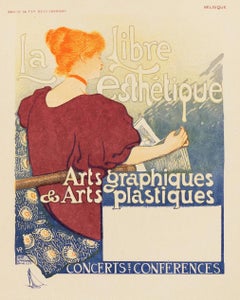
La Libre Esthetique by Théo van Rysselberghe, Art Nouveau Japon lithograph, 1897
By Theo van Rysselberghe
Located in Chicago, IL
Lithograph of Théo van Rysselberghe's La Libre Esthetique, published by Imprimerie Chaix, the printing house known for publishing the works of Belle Epoque master Jules Chéret. While...
Category

1890s Art Nouveau Prints and Multiples

Materials

Lithograph

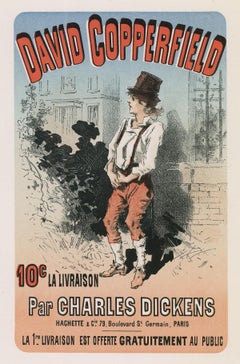
David Copperfield Par Charles Dickens by Jules Chéret, Japon lithograph, 1886
By Jules Chéret
Located in Chicago, IL
Extremely rare early work by “The Father of the Poster,” Jules Chéret: Lithograph announcing Charles Dickens’s David Copperfield, printed on Imperial...
Category

1890s Art Nouveau Prints and Multiples

Materials

Lithograph

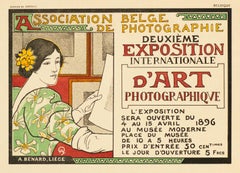
Second International Photographic Art Exhibition by Auguste Donnay, 1897
By Auguste Donnay
Located in Chicago, IL
A young woman wearing a floral dress examines photographic works in a gallery display. Auguste Donnay created this poster for the Second International Photographic Art Exhibition, he...
Category

1890s Art Nouveau Prints and Multiples

Materials

Lithograph

Musée Grévin, Pantomimes Lumineuses by Jules Cheret, Commedia lithograph, 1896
By Jules Chéret
Located in Chicago, IL
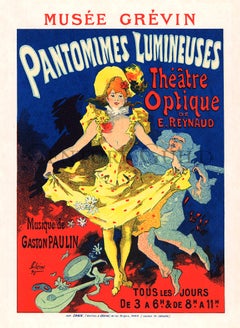
Jules Chéret’s poster advertising the Théâtre Optique (Optical Theatre) immortalized a momentous convergence of technology, culture, history, and art with the 1892 debut of Emile Reynaud’s praxinoscope at the Musée Grévin in Paris. Reynaud presented his Pantomimes Lumineuses, the world’s first animated films, using his innovative system which projected light through moving pictures to offer illuminated pantomimes. Among the three short films Reynaud screened through his praxinoscope was Pauvre Pierrot (Poor Pierrot), a story of Pierrot courting Columbine based on the timeless archetypal love triangle featured in many Commedia dell’arte pantomimes. As a member of the Cercle Funambulesque (roughly “Friends of the Tightrope-walkers”), a French society which championed the contemporary creation of Commedia dell-arte-inspired pantomimes, Jules Chéret was often inspired by Pierrot and produced a large number of works depicting him, often with his beloved Columbine. Cheret’s involvement with the Cercle, combined with the immense popularity of these archetypes in the late 19th century, meant that they appeared frequently in his works. This work comes from the extremely scarce edition of 25 strikes on Imperial Japon paper, a mulberry bark-based stock inspired by the smooth-surfaced papers used in Japanese printmaking. This world-class example of lithography captures superior resolution and color-richness to that of its large-format counterpart. The use of marbled Imperial Japon paper allows inks to rest upon its surface rather than being absorbed by a more porous paper stock. An extremely scarce fraction of the edition of 25 are estimated to have survived to date. Stone lithograph of Jules Chéret’s Musée Grévin...
Category

1890s Art Nouveau Prints and Multiples

Materials

Lithograph

Vin Mariani, Popular French Tonic Wine by Jules Chéret, Japon lithograph, 1896
By Jules Chéret
Located in Chicago, IL
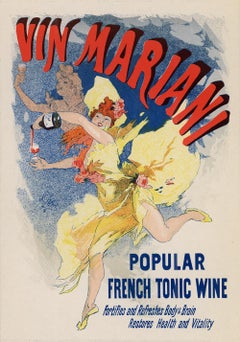
Vin Mariani was the world's first commercial cocaine-based product, pre-dating the notorious cocaine-based soda Coca Cola by over two decades. The stimulat...
Category

1890s Art Nouveau Prints and Multiples

Materials

Lithograph

Prang s Easter by Louis Rhead, Art Nouveau Japon lithograph, edition of 25, 1897
By Louis Rhead
Located in Chicago, IL
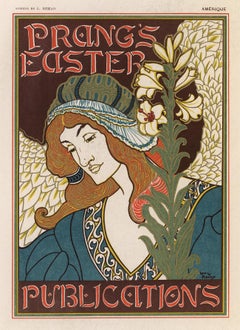
“America was quick to reveal strong Art Nouveau voices; it was Louis Comfort Tiffany who encouraged Bing to open his salon, and artists Will Bradley and Ethel Reed exhibited a Japonist simplicity that presented a strong, refined take on the Art Nouveau ideal. Louis Rhead was born in England but emigrated to the United States in 1883 at the age of 24, and quickly found himself celebrated both in the United States and in France, exhibiting his designs in the prestigious Salon des Cent in Paris in 1897.” -Quoted from Flowering Lines: Rare Art Nouveau Graphics 1883-1911 by Thomas Negovan (2017) Lithograph of Louis Rhead’s Prang’s Easter Publications, published in 1897 by Imprimerie Chaix, the printing house known for publishing the works of Belle Epoque master Jules Chéret. This example was printed with a plate of shimmering gold ink. While this poster was printed in multiple sizes and formats, this 1897 edition of 25 strikes on Japon paper is the most desirable and extremely scarce edition. Japon paper allows inks to rest upon its surface rather than being absorbed by a more permeable paper stock. The rare, small format poster lithographs created at this time were printed using rich, dense, lead inks. This world-class example of lithography captures superior resolution and color-richness to that of its large-format counterpart. This artwork is presented in archival rag mat and arrives accompanied by a certificate of authenticity. Notable museum collections containing this work include: Metropolitan Museum of Art, New York City (medium-format version on paper) (1984.1202.146) Notable museum collections featuring works by John Louis...
Category

1890s Art Nouveau Prints and Multiples

Materials

Lithograph

You May Also Like

Manon - Original lithograph (1897/98)
By René Francois Xavier Prinet
Located in Paris, IDF
Rene Xavier PRINET (1861 - 1946) Manon Original litograph Printed signature in the plate 1897/98 On vellum 40 x 31 cm (c. 16 x 12") INFORMATION : Published by 'Estampe Moderne, Par...
Category

1890s Art Nouveau Figurative Prints

Materials

Lithograph

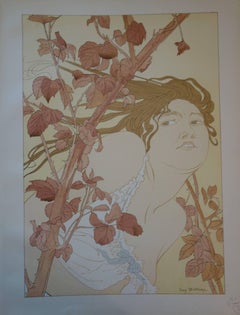
In the Brambles - Original lithograph - 1897
By Henry Detouche
Located in Paris, IDF
Henry DETOUCHE In the Brambles Original lithograph Printed signature in the plate 1897/98 Printed on paper Vélin Size 40 x 31 cm (c. 16 x 12") INFORMATION : Published by 'Estampe...
Category

1890s Art Nouveau Figurative Prints

Materials

Lithograph

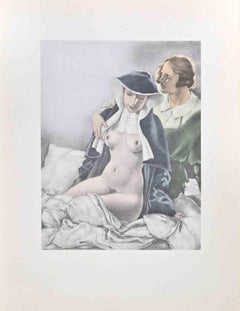
La Monaca - Lithograph by Umberto Brunelleschi - 1930s
By Umberto Brunelleschi
Located in Roma, IT
La Monaca is a color lithograph on ivory paper, created by the Italian artist Umberto Brunelleschi (Montemurlo 1879- Paris 1949). Illustration for “Tales and Short Stories” by La Fo...
Category

1930s Art Nouveau Figurative Prints

Materials

Lithograph

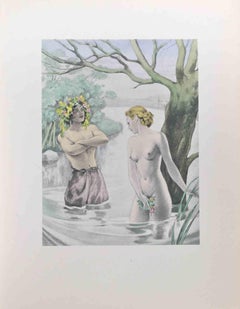
Adam and Eve - Lithograph by Umberto Brunelleschi - 1930s
By Umberto Brunelleschi
Located in Roma, IT
Adam and Eve is a color lithograph on ivory paper, created by the Italian artist Umberto Brunelleschi (Montemurlo 1879- Paris 1949). Illustration for “Tales and Short Stories” by La...
Category

1930s Art Nouveau Figurative Prints

Materials

Lithograph

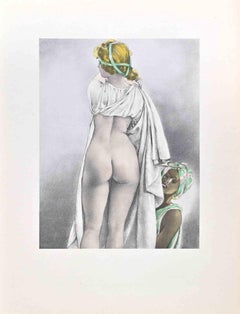
Pretty Woman - Lithograph by Umberto Brunelleschi - 1930s
By Umberto Brunelleschi
Located in Roma, IT
Pretty woman  is a color lithograph on ivory paper, created by the Italian artist Umberto Brunelleschi (Montemurlo 1879- Paris 1949). Illustration for “Tales and Short Stories” by L...
Category

1930s Art Nouveau Figurative Prints

Materials

Lithograph

La Monaca - Lithograph by Umberto Brunelleschi - 1930s
By Umberto Brunelleschi
Located in Roma, IT
La Monaca is a color lithograph on ivory paper, created by the Italian artist Umberto Brunelleschi (Montemurlo 1879- Paris 1949). Illustration for “Tales and Short Stories” by La Fo...
Category

1930s Art Nouveau Figurative Prints

Materials

Lithograph