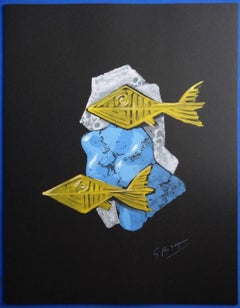
Items Similar to Stars - Cubism French Bird Stars
Want more images or videos?
Request additional images or videos from the seller
1 of 9
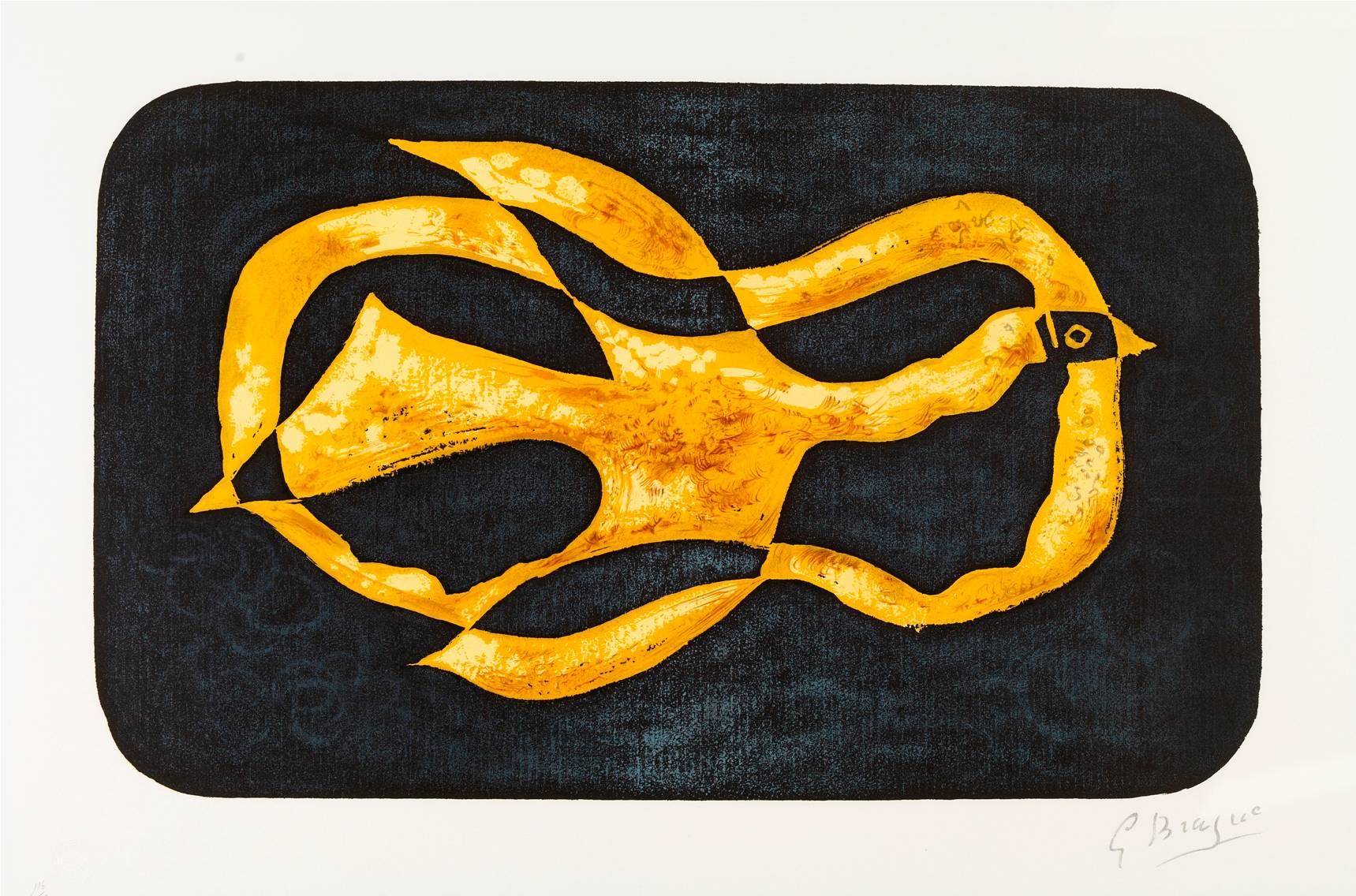
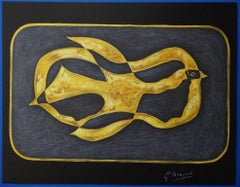
(after) Georges BraqueStars - Cubism French Bird Stars1959
1959
$3,300
£2,504.38
€2,885.58
CA$4,662.37
A$4,995.66
CHF 2,679.82
MX$59,174.28
NOK 33,804.45
SEK 30,925.84
DKK 21,555.65
About the Item
This lithograph in colours is hand signed in pencil by the artist ‘G. Braque’, at the lower right margin.
It is also hand numbered in pencil 122 from the edition of 300, at the lower left margin.
It was published by Maeght Éditeur, Paris.
The paper bears the Maeght Éditeur blindstamp at the bottom left corner.
Note: This work is from a series of graphics by Braque which are based on his paintings, watercolours or gouaches and published by Gallery Maeght. A catalogue published by Maeght reads as follows "These graphics were pulled on fine paper, in limited editions, from 100 to 300 copies, all numbered. In most cases the artist himself chose the pieces and the printing process which to him seemed most appropriate. He assisted in the execution of the graphics, observed and directed the work of the lithographer, did the work himself where necessary, corrected the proofs and gave his final approval by signing each example".
Literature: Vallier, D. (1984) Braque: The Complete Graphics Catalogue Raisonné. New York: Art Books Intl. Ltd.
Reference: Maeght 1029, illustrated on page 294.
Condition: Good condition. Pale staining in the sheet corners from previous mounting. The numbering slightly rubbed.
- Creator:(after) Georges Braque (1882 - 1963, French)
- Creation Year:1959
- Dimensions:Height: 19.1 in (48.5 cm)Width: 25.4 in (64.5 cm)
- More Editions Sizes:Edition of 300Price: $3,300
- Medium:
- Movement Style:
- Period:
- Condition:
- Gallery Location:London, GB
- Reference Number:1stDibs: LU18017510982
(after) Georges Braque
Braque began his artistic career painting in a Fauvist style, strongly influenced by friends Raoul Dufy and Henri Matisse. In 1907, however, after befriending Pablo Picasso, Braque began focusing on Cubist compositions and a more muted color palette. He and Picasso would work closely until 1914 when Picasso began focusing on symbolism and portraiture, while Braque sought to explore “pure composition” void of meaning and symbolism. A 1922 exhibition at the Salon d’Automne in Paris launched Braque further into fame. He won several important prizes over the next few decades, including First Prize at the Carnegie International and the main prize for painting at the Venice Biennale. In 1961, Braque became the first living artist to ever have his work displayed at The Louvre. Throughout the 1930s and 40s, Braque created many works featuring Greek and Roman mythological imagery such as this print, though his hope was to use the images simply as visual objects stripped of their histories, lore, and symbolism.
About the Seller
4.8
Vetted Professional Seller
Every seller passes strict standards for authenticity and reliability
Established in 1981
1stDibs seller since 2013
176 sales on 1stDibs
Typical response time: 8 hours
- ShippingRetrieving quote...Shipping from: London, United Kingdom
- Return Policy
More From This Seller
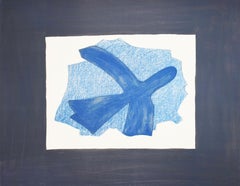
View AllThe Flight - French Cubism Bird
By Georges Braque
Located in London, GB
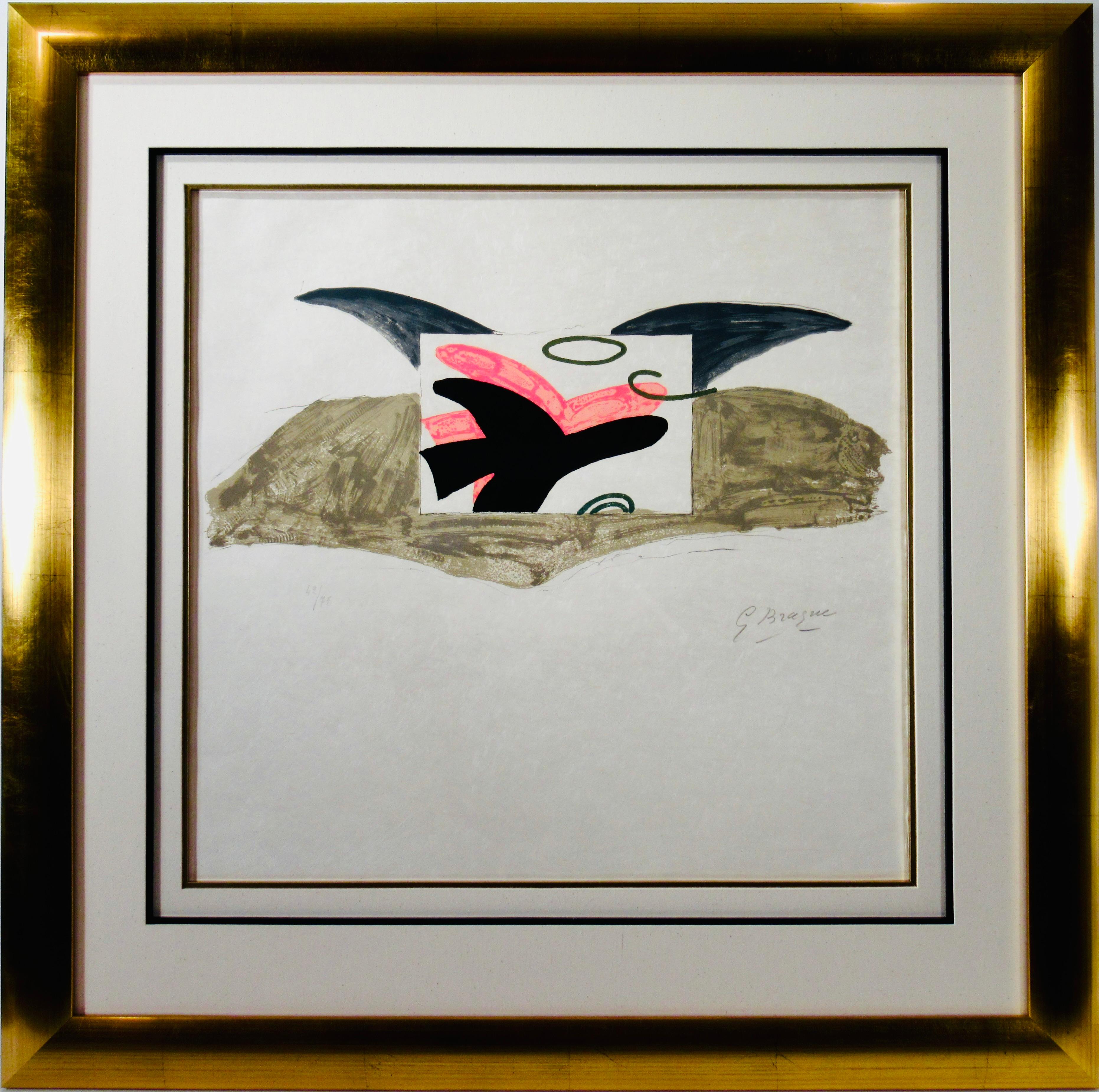
This original lithograph in colours is hand signed in pencil by the artist "G. Braque" at the lower right margin.
It is also hand numbered in pencil from the edition of 75, at the lo...
Category
1960s Cubist Animal Prints
Materials
Lithograph
Fish and Sky - American Pop Art
By Roy Lichtenstein
Located in London, GB
This work is hand signed in pencil "R. Lichtenstein" at the lower right margin on the mount board. It is also signed, verso.
It is also hand numbered in pencil from the edition of 20...
Category
1960s Pop Art Animal Prints
Materials
Lithograph, Screen
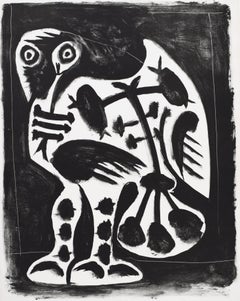
The Great Owl - Owl Wisdom French Spanish
By Pablo Picasso
Located in London, GB
This original lithograph is hand signed in pencil by the artist "Picasso" at the lower right margin.
It is one of five artist’s proofs aside from the standard edition of 50.
It was p...
Category
1940s Post-War Animal Prints
Materials
Lithograph
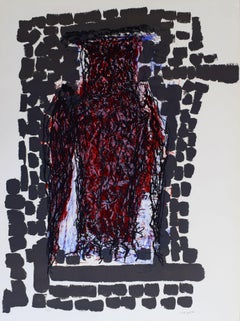
Owl VIII Hibou VIII - Owl Bird Wisdom Canadian
By Jean-Paul Riopelle
Located in London, GB
This original lithograph is hand signed in pencil by the artist "Riopelle" at the lower right corner.
It is also hand numbered in pencil from the edition of 75, at the lower left cor...
Category
1970s Animal Prints
Materials
Lithograph
Owl X Hibou X
By Jean-Paul Riopelle
Located in London, GB
This original lithograph is hand signed in pencil by the artist "Riopelle" at the lower right corner.
It is also hand numbered in pencil from the edition of 75, at the lower left cor...
Category
1970s Animal Prints
Materials
Lithograph
Flying Dove (with Rainbow) La Colombe Volante (à l
arc-en-ciel)
By (after) Pablo Picasso
Located in London, GB
Additional Information: This lithograph is hand signed in pencil by the artist "Picasso" at the lower right image.
It is also hand numbered in pencil from the edition of 200, at the ...
Category
1950s Post-War Animal Prints
Materials
Lithograph
You May Also Like
Lettera Amorosa
By George Braque
Located in San Francisco, CA
This artwork titled "Lettera Amorosa" 1963, is an original color lithograph on Japan nacre paper by renown French artist Georges Braque, 1882-1963. It is hand signed and numbered 42/...
Category
Mid-20th Century Cubist Abstract Prints
Materials
Lithograph
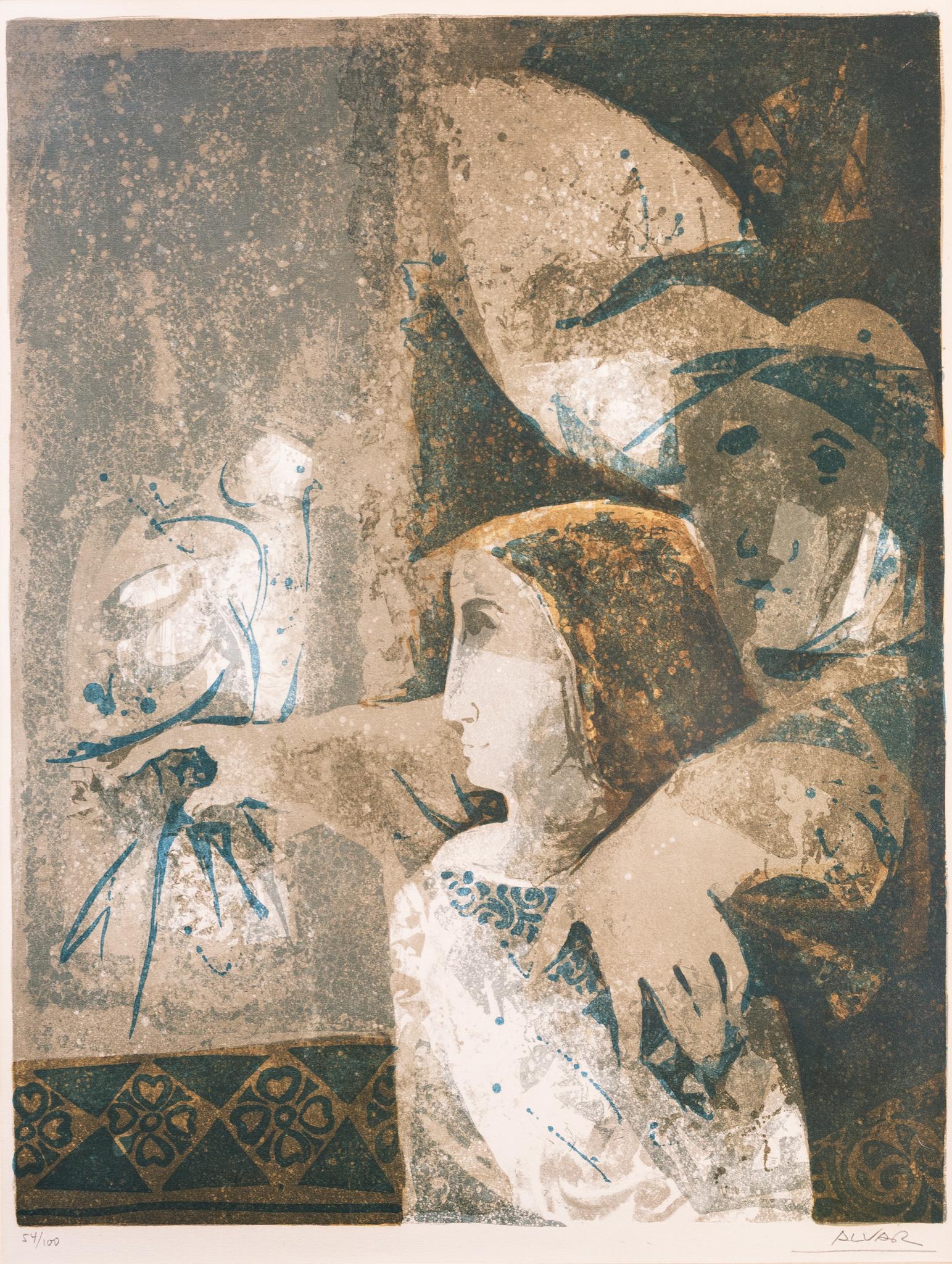
"Gray with Dove" 54/100 Cubist Mother Child Bird Blue Earth Tones Peaceful
By Alvar Sunol Munoz-Ramos
Located in Austin, TX
Page size: 27 x 20 in.
Frame size: 32 x 25 in.
Signed in pencil, bottom right: "ALVAR"
Numbered in pencil, bottom left "54/100"
A dreamy, abstract litograph in misty blues, grays, w...
Category
Mid-20th Century Cubist Abstract Prints
Materials
Archival Paper, Lithograph
Leda and the Swann - lithograph - 399 copies
By (after) Georges Braque
Located in Paris, IDF
Georges BRAQUE
Leda and the Swann
Stone lithograph (Art-Litho workshop, Paris)
Printed signature in the pate
Limited to 399 copies unumbered
On Arches vellum 18 x 23" (45 x 58 cm)
E...
Category
Late 20th Century Cubist Animal Prints
Materials
Lithograph
Jean Cocteau - Europe
s Agriculture - Original Lithograph
By Jean Cocteau
Located in Collonge Bellerive, Geneve, CH
Original Lithograph by Jean Cocteau
Title: Europe's Agriculture
Signed in the stone/printed signature
Dimensions: 33 x 46 cm
Luxury impression from the portfolio published by Sciaky....
Category
1960s Cubist Animal Prints
Materials
Lithograph

After Georges Braque - Antiborée - Lithograph
Located in Collonge Bellerive, Geneve, CH
Lithograph after Georges Braque.
Signed in the plate
Edition of 150
Dimensions: 76 x 117 cm
Bibliography:
« Les Métamorphoses de Braque» of Heger de Loewenfeld and Raphaël de Cuttoli , Editions FAC, Paris, 1989.
In 1961 Georges Braque decided with his laidary friend Heger de Loewenfeld to pick up certain of his works to in order to create artworks, this beautiful litograph is one of them.
Héméra in the Mythology:
In Greek mythology Hemera was the personification of day and one of the Greek primordial deities. She is the goddess of the daytime and, according to Hesiod, the daughter of Erebus and Nyx (the goddess of night). Hemera is remarked upon in Cicero's De Natura Deorum, where it is logically determined that Dies (Hemera) must be a god, if Uranus is a god. The poet Bacchylides states that Nyx and Chronos are the parents, but Hyginus in his preface to the Fabulae mentions Chaos as the mother/father and Nyx as her sister.
She was the female counterpart of her brother and consort, Aether (Light), but neither of them figured actively in myth or cult. Hyginus lists their children as Uranus, Gaia, and Thalassa (the primordial sea goddess), while Hesiod only lists Thalassa as their child.
The father of Cubism
Three Cubist that distinguishes art historian periods were initiated and developed by Georges Braque: The Cubist Cézanne (1907-1909), Executive (1909-1912) and synthetic (1912-1922).
Post-Impressionist and fawn, Braque no longer adheres to the contingency of a decorative way or the other. Cézanne’s paintings exhibited at the Grand Palais during the retrospective of 1907 are a revelation: Cézanne sought and invented a pictorial language. In his footsteps, Braque went to the South with the reasons of the Master. He returned with Estaque landscapes and surprising Ciotat it keeps Cezanne geometric model and retains the “passages” continuity from one surface to another to create the sensation of “turning around” of the object represented. But he wants to go after the consequences of the vision of Cezanne. In his paintings Houses in L’Estaque (1908) it simplifies the volumes of houses, neglects detail by removing doors and windows: the plastic rhythm that builds the table. Large Nude , a masterpiece of the period, can be considered the first work of Cézanne cubism .
Systematizing and deepening Braque discoveries open the door analytical cubism. In 1909, his painting became more cerebral than sensual. The pattern is recreated in the two-dimensionality of the canvas, leaving aside any illusionistic perspective. In Still Life with Violin, objects are analyzed facets according to their characteristic elements, each facet referring to a particular view of the object. There are so many facets of points selected view: Table reflects the knowledge of the object and the ubiquity of the eye. Moreover, Braque is looking for the essence of the objects in the world rather than their contingency, which explains the absence of light source and use of muted colors (gray, ocher), contingent aspects of the object . But formal logic has stepped facets, erased any anecdote to the object and ultimately led to his painting a hermetic more marked on the edge of abstraction (see the series of Castle Roche-Guyon ).
Braque, anxious to keep the concrete and refusing at all costs that the logic of Cubism takes the paintings to abstract, reintroduced signs of reality in his paintings in 1912 marks the beginning of Synthetic Cubism. Historians speak of “signs of real” rather than reality because what interests Braque, this is not to put reality into a table, but to create a painting which, by its language, refers to the real. To do this, he invented two major techniques XX th century inclusions and contributions. The inclusions consist of painting objects that have no real depth, materials (wallpaper in Nature morte aux playing cards faux wood is a pictorial inclusion) or letters (calligraphic inclusion in Portuguese ), made first brush and a few months later stencil. Contributions are defined in contrast with the collage on canvas of foreign materials: glued or sand paper, sawdust, etc.. Regarding the collages, Braque used for the first time in September 1912 a piece of adhesive paper imitating faux wood Compote...
Category
1950s Cubist Animal Prints
Materials
Lithograph
Secret thoughts - lithograph - 399 copies
By (after) Georges Braque
Located in Paris, IDF
MEDIUM : Lithograph
PRINTER : Atelier Art-Litho
EDITOR : Armand ISRAEL, Paris
SIGNATURE : Printed
LIMITED : 399 copies unumbered
PAPER : Arches vellum
SIZE : 18 x 23"
CONDITION : Ex...
Category
Late 20th Century Cubist Animal Prints
Materials
Lithograph