Want more images or videos?
Request additional images or videos from the seller
1 of 7
Alex ColvilleBorder Collie1973
1973
$6,400List Price
About the Item
- Creator:Alex Colville (1920 - 2013, Canadian)
- Creation Year:1973
- Dimensions:Height: 4.75 in (12.07 cm)Width: 4.75 in (12.07 cm)
- Medium:
- Movement Style:
- Period:
- Framing:Framing Options Available
- Condition:Very good condition.
- Gallery Location:Toronto, CA
- Reference Number:Seller: 11-221stDibs: LU215211326552
About the Seller
4.8
Vetted Professional Seller
Every seller passes strict standards for authenticity and reliability
Established in 2009
1stDibs seller since 2015
197 sales on 1stDibs
Typical response time: 2 hours
Authenticity Guarantee
In the unlikely event there’s an issue with an item’s authenticity, contact us within 1 year for a full refund. DetailsMoney-Back Guarantee
If your item is not as described, is damaged in transit, or does not arrive, contact us within 7 days for a full refund. Details24-Hour Cancellation
You have a 24-hour grace period in which to reconsider your purchase, with no questions asked.Vetted Professional Sellers
Our world-class sellers must adhere to strict standards for service and quality, maintaining the integrity of our listings.Price-Match Guarantee
If you find that a seller listed the same item for a lower price elsewhere, we’ll match it.Trusted Global Delivery
Our best-in-class carrier network provides specialized shipping options worldwide, including custom delivery.You May Also Like
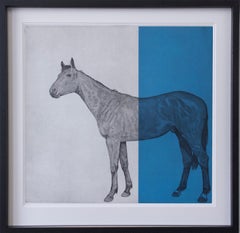
Guy Allen, Horse Study Blue, Bright Art, Etching Print, Contemporary Equine Art
By Guy Allen
Located in Deddington, GB
Guy Allen
Horse Study Blue
Limited Edition Etching with Screen Print Overlay
Edition of 45
Image Size: H 53.5cm x W 56.5cm
Sheet Size: H 80cm x W 77cm x D 0.1cm
Sold Unframed
Please ...
Category
21st Century and Contemporary Realist Animal Prints
Materials
Paper, Etching, Screen
$844
H 31.5 in W 30.32 in D 0.04 in
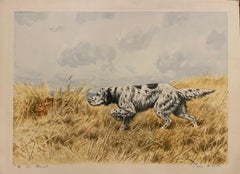
Hunting Dog speaking to a bunny "Be Quiet", lithograph signed by aris
Located in Chesterfield, MI
Hunting dog speaking to the rabbit: "Be Quiet".
Humor in art is rare! Titled and pencil signed by the artist Paul Wood.
Published in France by Paris Etching Society.
"Made in Fra...
Category
20th Century Realist Animal Prints
Materials
Lithograph
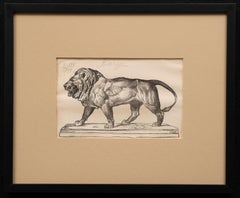
Antoine Louis-Barye "Walking Lion" Antique Engraving by Firmin Gillot ca. 1870
By Antoine-Louis Barye
Located in SANTA FE, NM
"Walking Lion"
Antoine Louis-Barye (France, 1775-1895)
Antique Engraving by Firmin Gillot
Circa. 1870
11 1/3 x 7 3/4 (21 3/8 x 17 1/2 frame) inches
This is "Walking Lion," along with "Walking Tiger...
Category
1870s Realist Animal Prints
Materials
Black and White
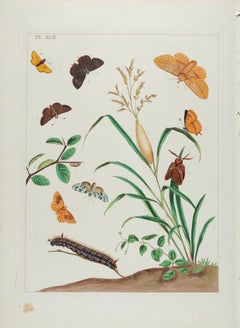
Moths in Their Natural Landscape: Antique Hand-colored Engraving by Moses Harris
By Moses Harris
Located in Alamo, CA
This is a hand-colored engraving depicting the natural history of Pinkunderwing Moths, Cream Spotted Tyger Moths in their natural botanical environment, which is plate 4 from Moses H...
Category
Mid-19th Century Realist Landscape Prints
Materials
Engraving
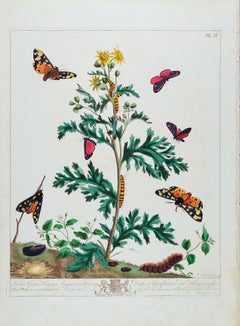
Tortoise-shell Butterfly, Hawk Moth: Antique Hand-colored Engraving by M. Harris
By Moses Harris
Located in Alamo, CA
This is a hand-colored antique engraving depicting the natural history of the Tortoise-shell Butterfly and Privet Hawk Moth, which is plate 2 from Moses Harris' publication "The Aure...
Category
Mid-19th Century Realist Landscape Prints
Materials
Engraving
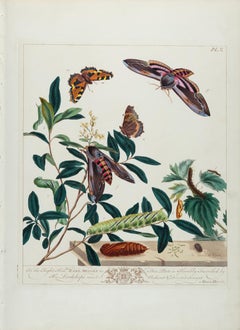
Moths and a Lady Bug in a Landscape: A Hand-colored Engraving by Moses Harris
By Moses Harris
Located in Alamo, CA
This is a hand-colored engraving depicting the natural history of moths and a lady bug, which is plate 22 from Moses Harris' publication "The Aurelian: or Natural History of English Insects; Namely Moths & Butterflies", first published in London in 1766 and this from an 1840 edition. The engraving depicts the natural history developmental stages of the Burnished Brass Moth, the Dark Gothic...
Category
Mid-19th Century Realist Landscape Prints
Materials
Engraving
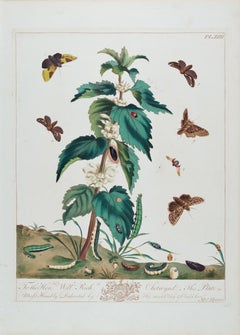
$875
H 14.5 in W 10.38 in
Admirable Butterflies, Magpie Moths: A Hand-colored Engraving by Moses Harris
By Moses Harris
Located in Alamo, CA
This is a hand-colored antique engraving depicting the natural history of the Admirable Butterfly and the Small Magpie Moth, which is plate 6 from Moses Harris' publication "The Aure...
Category
Mid-19th Century Realist Landscape Prints
Materials
Engraving
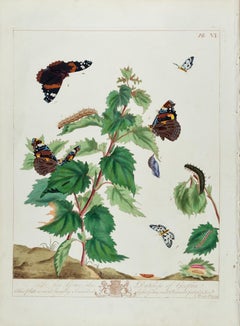
Butterflies
Moths in Nature: An Antique Hand-colored Engraving by Moses Harris
By Moses Harris
Located in Alamo, CA
This is a hand-colored antique engraving depicting the natural history of the the Brown Hairstreak Butterfly, the Larke Skipper Butterfly, the Small Skipper Butterfly, the Scarce Mar...
Category
Mid-19th Century Realist Landscape Prints
Materials
Engraving
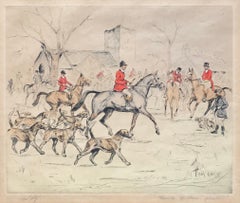
Hounds Gentlemen Please by Tom Carr - Engraving 26x31 cm
Located in Geneva, CH
Work on paper
Ed: 63/75
Category
Mid-20th Century Realist Animal Prints
Materials
Engraving
$360 Sale Price
28% Off
H 10.24 in W 12.21 in D 0.08 in
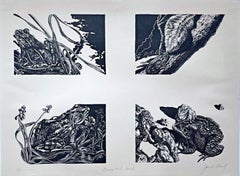
Frogs and Toad, Signed lithograph (AP), from Conspiracy: The Artist as Witness
By Jack Beal
Located in New York, NY
Jack Beal
Frogs and Toad, 1971
Hand signed in pencil by Jack Beal, annotated AP
One-color lithograph proofed by hand and pulled by machine from a zinc plate on Arches buff paper with deckled edges at the Shorewood Bank Street Atelier
Stamped, hand numbered AP, aside from the regular edition of 150 Stamped on reverse: COPYRIGHT © 1971 BY JACK BEAL, bears blind stamp
18 × 24 inches
Unframed
18 x 24 inches
Stamped on reverse: COPYRIGHT © 1971 BY JACK BEAL, bears distinctive blind stamp of publisher (shown) Publisher: David Godine, Center for Constitutional Rights, Washington, D.C.
Jack Beal's "Frogs and Toads" is a classic example of protest art from the early 1970s - the most influential era until today. This historic graphic was created for the legendary portfolio "CONSPIRACY: the Artist as Witness", to raise money for the legal defense of the Chicago 8 - a group of anti-Vietnam War activists indicted by President Nixon's Attorney General John Mitchell for conspiring to riot during the 1968 Democratic National Convention. (1968 was also the year Bobby Kennedy was killed and American casualties in Vietnam exceeded 30,000.) The eight demonstrators included Abbie Hoffman, Jerry Rubin, David Dellinger, Tom Hayden, Rennie Davis, John Froines, Lee Weiner, and Bobby Seale. (The eighth activist, Bobby Seale, was severed from the case and sentenced to four years for contempt after being handcuffed, shackled to a chair and gagged.) Although Abbie Hoffman would later joke that these radicals couldn't even agree on lunch, the jury convicted them of conspiracy, with one juror proclaiming the demonstrators "should have been shot down by the police." All of the convictions were ultimately overturned by the 7th Circuit Court of Appeals.
This lithograph has fine provenance: it comes directly from the original Portfolio: "Conspiracy The Artist as Witness" which also featured works by Alexander Calder, Nancy Spero and Leon Golub, Romare Bearden Sol Lewitt, Robert Morris, Claes Oldenburg, Larry Poons, Peter Saul, Raphael Soyer and Frank Stella - as well as this one by Jack Beal. It was originally housed in an elegant cloth case, accompanied by a colophon page. This is the first time since 1971 that this important work has been removed from the original portfolio case for sale. It is becoming increasingly scarce because so many from this edition are in the permanent collections of major museums and institutions worldwide.
Jack Beal wrote a special message about this work on the Portfolio's colophon page. It says, "In 1956, shortly after Sondra and I moved to New York, two friends were arrested and jailed for protesting air-raid drills. From them and their friends came our education. This work is dedicated to them and their families. "In Memory of Patricia McClure Daw and AL Uhrie" - This print was made for their children.
Jack Beal Biography:
Early in his career Walter Henry “Jack” Beal Jr. painted abstract expressionist canvases, because he believed it was “the only valid way to paint.” By the early 1960s he totally altered his approach and fully repudiated abstraction. Turning to representation, he painted narrative and figurative subjects, often enhanced by bright colors and dramatic perspectives.
Beal was born in Richmond, Virginia, and from 1950 to 1953 he attended the Norfolk Division of William and Mary College Polytechnic Institute, (now Old Dominion University) where he studied biology and anatomy. Shifting gears, he sought art training at the School of the Art Institute of Chicago where he focused on drawing, and met his wife, artist Sondra Freckelton. His art history instructor encouraged her students to paint in the manner of established artists, and to that end he frequented the Institute’s galleries. For Beal this was significant: “Until I saw pictures of real quality I had tended to think of painting as just so much self-indulgent smearing around, but when I saw masterpieces by Cézanne and Matisse, and other painters of similar stature, I was bowled over; suddenly I realized the force of art.”
After spending three years (1953–1956) at the Art Institute, Beal concluded his studies there without getting a terminal degree, thinking it was only useful if he wanted to teach, which, at the time, he did not. He also took courses at the University of Chicago in 1955 and 1956. During this period he married Freckelton, a fellow student and sculptor who began her career working in wood and plastic. Together they moved to New York’s SoHo District before its transformation from a wasteland of sweatshops and small factories into an arts district. They were active with the Artist Tenants Association which was instrumental in getting zoning laws changed so that artists could live and work in the well-lit lofts.
Embracing what came to be called “New Realism,” Beal initially painted an occasional landscape as well as earthy-toned still lifes which consisted of jumbled collections filled with personal objects. His signature style started with a series of female nudes—all modeled by Freckelton—based on Greek mythology. These were large canvases with flat paint surfaces, dramatic foreshortening, and unusual perspectives. He further enlivened them with vivid colors, stark lighting, and dynamic patterns derived from textiles and overstuffed furniture. He stopped painting nudes after two episodes. The first came as he was loading a canvas of his naked wife onto a truck in lower Manhattan; several laborers walked by and started to fondle and kiss the painting. On the one hand he felt his wife had been violated, while on the other he was pleased that his realism was so convincing. The second occurred after a solo exhibition in Chicago at which the reception had been sponsored by Playboy magazine. A few days later he was approached by a publicist and asked if Playboy bunnies could be photographed in front of his paintings. He refused.
Some portrait commissions came Beal’s way, but he preferred only portraying friends. More significant were four large murals on the History of Labor in America, the 20th Century: Technology (1975), which he undertook for the headquarters of the United States Department of Labor in Washington. Following a historical timeline, the themes were: colonization, settlement, nineteenth century industry, and twentieth century technology. The unveiling ceremony was attended by government officials and Joan Mondale, an arts advocate and wife of the vice-president. The reviewer for the Washington Post wrote enthusiastically: “They’re heartfelt and they’re big (each is 12 feet square). Their many costumed actors (the Indian, the trapper, the scientist, the hardhat, the capitalist in striped pants, the union maid, etc.) strike dramatic poses in dramatic settings (a seaside wood at dawn, an outdoor blacksmith’s forge, a 19th-century mill, a 20th-century lab). The lighting is theatrical. Beal’s compositions, with their swooping curves and bunched diagonals, are as complicated as his interwoven plots.” To accomplish the murals Beal assembled a team of assistants and models, much in the manner of Renaissance masters, which included artist friends and Freckelton. who by then was painting brightly colorful still lifes.
A second mural commission ensued from New York City’s Metropolitan Transit Authority for two twenty-foot long installations for the Times Square Interborough Rapid Transit Company subway station. Beal’s designs for The Return of Spring (installed in 2001, three days after the terrorist attacks in New York, Washington, DC and Philadelphia) and The Onset of Winter (installed in 2005), Beal captured the appearance of his models in an oil painting made to the scale of the intended mosaic. A collaboration with Miotto Mosaics, the canvases were shipped to the Travisanutto Workshop, in Spilimbergo, Italy, where craftsmen fabricated the design to glass mosaics. The Return of Spring depicted construction workers and other New Yorkers in front of a subway kiosk and an outdoor produce market and in The Onset of Winter, a crowd watches a film crew recording a woman entering the subway as snow falls against the city’s skyline. Harkening back to some of his early nudes based on Greek myth, Persephone, goddess of fertility and wife of Hades, appears in both. The symbolism is pertinent, since she spent six months each year below ground.
Although he disparaged teaching early on, Beal and Freckelton offered four summertime workshops on their farm in Oneonta, New York. He was an instructor at the New York Academy of Art, a graduate art school he helped to establish in 1982. Returning to Virginia, he taught at Hollins College...
Category
1970s Realist Animal Prints
Materials
Lithograph
More From This Seller
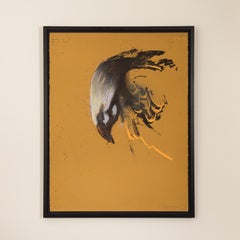
View AllEagle
By Tony Scherman
Located in Toronto, Ontario
Tony Scherman (1950 - 2023) is one of the most collected and cherished Canadian artists. He is renowned internationally for his work, typically executed in encaustic, a mix of wax an...
Category
2010s Contemporary Animal Prints
Materials
Screen
$6,500
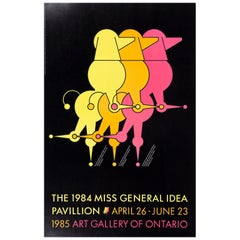
The 1984 Miss General Idea Pavillion
By General Idea
Located in Toronto, Ontario
General Idea was founded in 1967 in Toronto by AA Bronson (b. 1946), Felix Partz (1945-1994), and Jorge Zontal (1944-1994). Over the course of 25 years, they made a significant contr...
Category
1980s Conceptual Animal Prints
Materials
Lithograph, Screen
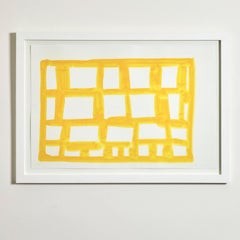
Untitled
By Stanley Whitney
Located in Toronto, Ontario
Stanley Whitney (b.1946) is a contemporary African-American abstract painter known for his signature composition of loose grids of saturated color. Whitney holds an MFA from Yale Uni...
Category
2010s Abstract Animal Prints
Materials
Etching
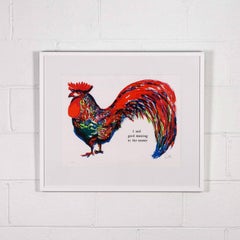
Rooster
By Charles Pachter
Located in Toronto, Ontario
Charles Pachter is one of the most collected and cherished Canadian artists.
His iconic, uplifting and patriotic images have independently earned their place in the nation's museum...
Category
1960s Pop Art Animal Prints
Materials
Lithograph
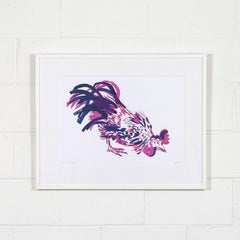
Charles Pachter "Good Night to the Rooster"
By Charles Pachter
Located in Toronto, Ontario
Charles Pachter is one of the most collected and cherished Canadian artists.
His iconic, uplifting and patriotic images have independently earned their place in museums across the ...
Category
1960s Abstract Animal Prints
Materials
Giclée
Scribble Cat
By William Kentridge
Located in Toronto, Ontario
William Kentridge (b. 1955) is an internationally acclaimed South African artist renowned for his dynamic prints, drawings, large-scale installations, and animated films. Kentridge balances universal experiences with the complexity of South African political history and society.
Born in Johannesburg to two prominent lawyers active in anti-apartheid efforts, Kentridge’s proximity to the dissolution of apartheid gave him a unique social sensitivity. His upbringing would shape the socio-political lens that informed his work as an artist.
Kentridge is somewhat of a polymath. Having pursued formal education across politics, fine art, miming, and theater, it comes as no surprise that his work cannot be contained to the bounds of a single medium. Charcoal and ink are often his first tools for creation. The density, darkness and texture of the medium is instantly recognizable throughout his oeuvre..
Click here to learn more about Kentridge’s artist process from inside his Johannesburg studio.
"Scribble Cat" is a paradigm of Kentridge's work and is instantly recognizable for its strong aesthetic and composition of layered pages.
Kentridge's interest in cats stems back to his childhood when the prominent South African artist Cecil Skotnes...
Category
2010s Contemporary Animal Prints
Materials
Aquatint